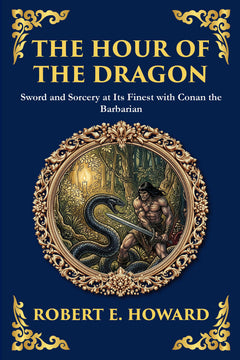
Steel clashes against sorcery in this gripping and blood-stained tale of ancient ruins, savage gods, and brutal ambition.
The complete Red Nails appears in modern English through Library of Alexandria Press, available online with audiobook narration included for members.
Have you ever wondered why civilizations destroy themselves from within? Red Nails is a visceral descent into a decaying world where power is everything, and the line between savagery and civilization is razor thin. In one of the most celebrated Conan tales ever written, Robert E. Howard brings us face-to-face with the ruins of an ancient city gripped by internal strife and haunted by the remnants of dark magic.
When the fearsome swordswoman Valeria flees into the jungles of the south, she encounters Conan of Cimmeria. Their uneasy alliance soon leads them to the lost city of Xuchotl—a labyrinthine fortress teeming with death, mystery, and madness. Inside, two rival factions—the Tecuhltli and the Xotalanc—wage a senseless blood feud, feeding the walls of the city with their dead.
As Conan and Valeria are drawn into the city’s savage politics, they must confront not only human enemies but ancient horrors, sorcerous traps, and their own brutal instincts. Beneath the towering stone walls, secrets slither in the dark, and every corridor echoes with the madness of a once-great people who destroyed themselves out of hatred and pride.
| Formats | eBook (EPUB + PDF) · Audiobook · Paperback · Hardcover · Large Print |
| Language | English |
| Trim size (print) | 6 × 9 in |
| Binding | Paperback — perfect-bound · Hardcover — casewrap |
| Large Print edition | Same text in a larger, easy-read type — a larger font, not a larger trim |
| Print pricing | Every physical book at our true cost — at-cost, no profit (members) |
| Library | 873 restored titles, always growing |
| Length | 32,571 words · ~2 hr 10 min reading |
| Reading level | Grade 5 · an easy, flowing read (this modern-English edition) |
| Edition | Modern English translation · 2026 |
Member reviews for this edition are collected as readers finish it — be the first. Across the library: 12,000+ books shipped, every plan covered by a 365-day print guarantee.
A faithful, unabridged modern-English edition by The Library of Alexandria — carefully rendered for today's reader and verified paragraph-by-paragraph against the public-domain source. Available as eBook, audiobook, paperback, hardcover, and large print.
Included free with your membership
Cancel anytime, one click · 30-day money-back guarantee
Edition last updated July 2026
Red Nails — complete and unabridged: all 8 sections included with membership, plus the full audiobook.
In clear modern English — the complete text is included with membership.
There are stories that arrive at the very end of a writer’s life and feel, in retrospect, like a summation—everything a creator had been reaching toward finally distilled into a single, concentrated draught. Red Nails is one of those stories. Written by Robert E. Howard in 1935 and published in installments shortly after his death in 1936, it stands as the last tale of Conan the Cimmerian that Howard ever set down. It is, in many ways, the most extreme and most fully realized expression of the genre Howard himself had invented. Reading it today, a contemporary audience encounters not merely an adventure story but the closing statement of a literary pioneer who burned through his imaginative fuel at a furious, almost reckless pace, and who left behind a body of work whose influence has only deepened with the passing decades.
This edition presents that final Conan adventure in a modern translation, adapted for the contemporary reader. That phrase deserves a moment of explanation, because it speaks to the spirit in which this book has been prepared. Howard wrote in the dense, ornate, sometimes archaic prose of the American pulp magazines of the 1930s, a style saturated with the conventions of its era. His sentences could be magnificent, but they could also be tangled with period idioms, obscure vocabulary, and rhythms that now read as quaint or distancing. The aim here has been to preserve the thunder of Howard’s voice—the muscular momentum, the vivid sensory assault, the brooding atmosphere—while smoothing the passages that might otherwise trip a modern reader and pull them out of the spell. Nothing essential has been lost. The blood still runs hot, the shadows still crawl, and the menace still presses close. What you hold is a doorway into one of the strangest and most haunting corners of fantasy fiction, made accessible without being diminished.
To understand why Red Nails matters, it helps to understand the man who wrote it and the world he conjured into being. Robert Ervin Howard was born in 1906 in Peaster, Texas, and spent most of his short life in the small town of Cross Plains, in the dusty heart of the state. He was a voracious reader and a relentless writer, a young man of enormous physical and imaginative energy who poured his ambitions onto the page at a rate that exhausts the mere contemplation of it. By the time he died at the age of thirty, he had produced an astonishing volume of fiction across genres—boxing stories, Westerns, horror, historical adventure, and the heroic fantasy that would become his lasting legacy.
It was in the pages of Weird Tales, the legendary pulp magazine that also published H. P. Lovecraft and Clark Ashton Smith, that Howard found his most enduring home. Howard and Lovecraft, in fact, became correspondents and friends, two outsized imaginations writing letters back and forth across the country, debating philosophy, history, and the nature of civilization itself. That last subject—civilization and its discontents—runs like a vein of iron through everything Howard wrote, and it pulses with particular force through the Conan stories.
Conan first appeared in 1932 and quickly became Howard’s signature creation, the figure with whom his name would be forever joined. The character is a barbarian from the imagined northern land of Cimmeria, a wandering adventurer who lives through the so-called Hyborian Age, a fictional epoch that Howard placed in the deep, prehistoric past—after the fall of Atlantis and before the dawn of recorded history. Across roughly twenty stories, Conan appears as a thief, a mercenary, a pirate, a warlord, and eventually a king, his life presented out of chronological order in fragments that together form a sprawling, unsystematic mythology. He is one of the most influential characters in the history of popular fiction, the prototype of countless imitators, and the founding figure of an entire subgenre.
That subgenre is sword and sorcery, the very phrase invoked in this book’s subtitle. The term was coined years after Howard’s death, but the thing it describes was largely his invention. Sword and sorcery is heroic fantasy of a particular flavor—more intimate and more visceral than the grand epic fantasy that would later flow from the pen of writers like J. R. R. Tolkien. Where epic fantasy concerns itself with the fate of nations and the clash of cosmic good against cosmic evil, sword and sorcery zooms in tight on the individual: a single adventurer, a personal quest, a confined and dangerous setting, an atmosphere thick with peril and dark magic. The stakes are immediate and physical. The morality is ambiguous. The hero is not a chosen savior but a survivor, motivated by gold, by lust, by curiosity, or simply by the will to live another day. Howard understood instinctively that there was a primal appeal in this kind of story, something that bypassed the intellect and spoke directly to older, deeper layers of the human imagination.
Red Nails is the purest possible distillation of that vision. Stripped of any pretense to the epic, it is a story of survival in a sealed and rotting world, a tale of two outsiders thrown into a closed society consumed by ancient hatred. It is dark, claustrophobic, and relentlessly intense, and it represents Howard pushing his own creation to its furthest extreme. Many readers and critics regard it as the finest of all the Conan stories, and a strong case can be made that it is also the most modern in its sensibility—its bleakness, its psychological complexity, and its refusal of easy heroics anticipate the darker fantasy of generations to come.
It is worth pausing here to acknowledge the circumstances of the story’s composition. Howard wrote Red Nails during a difficult period. His beloved mother was gravely ill, and the burden of her care weighed heavily on him. In June of 1936, in despair over her impending death, Howard took his own life at the age of thirty. Red Nails was published in Weird Tales across the latter half of that same year, appearing in three parts beginning in July, the first installment reaching readers just weeks after the author’s death. There is something almost unbearably poignant in the timing. The last Conan story, the last great burst of that ferocious creative energy, arrived in print as a kind of posthumous farewell. Readers who knew Howard’s work would have opened the magazine knowing that no more tales of the Cimmerian would ever come from his hand. The story’s atmosphere of doom and decay, its sense of a world running down toward its inevitable end, takes on an additional resonance when read in this light—though it should be said that Howard’s gift for dark grandeur needed no biographical excuse. He wrote shadows because shadows were always present in his vision of existence.
What makes the story so compelling, and so durable, is the particular intensity Howard brought to it. He had a painter’s eye for color and a sculptor’s sense of physical form. His action scenes move with a propulsive rhythm that few writers have ever matched; his settings are rendered with a feverish vividness that lingers long after the page is turned. He understood, too, the power of the uncanny—the way a single strange detail, glimpsed at the edge of vision, can make the hair rise on the back of the neck. Red Nails deploys all of these gifts at the height of their power. The reader is drawn into a world that feels both utterly alien and disturbingly real, a place governed by its own poisonous logic, where the ordinary rules of human conduct have curdled into something monstrous.
Without revealing the turns of the plot—for the pleasures of discovery should be left intact—it is fair to set the stage and to prepare the reader for the kind of experience that awaits. The story opens, as so many of Howard’s tales do, with movement: a journey through wild and dangerous country, the sense of vast spaces and lurking threats. Conan does not travel alone in this adventure. He is accompanied by Valeria, one of Howard’s most striking creations—a woman warrior and pirate, fierce and self-possessed, the equal of the Cimmerian in courage and very nearly his match in skill with a blade.
Valeria deserves particular notice, because she complicates the lazy assumptions that sometimes attach to old pulp fiction. She is no damsel, no decorative prize to be rescued. She is a fighter who has carved out a place for herself in a brutal world through sheer competence and will, and she navigates the story’s horrors with the same hard-eyed pragmatism that defines Conan himself. Howard’s attitudes were, in many ways, products of his time and place, and modern readers will encounter elements throughout his work that reflect the prejudices of the 1930s. But in Valeria he created a character whose strength and autonomy feel genuinely forward-looking, a woman who refuses to be subordinated and who earns her place at the center of the action on her own terms. Her partnership with Conan—wary, charged, mutually respectful—gives the story a dynamic and human core around which the surrounding nightmare revolves.
For nightmare is the right word. The heart of Red Nails is a setting unlike anything else in the Conan canon, and indeed unlike much else in all of fantasy fiction. It is a place sealed off from the world, a society that has turned inward upon itself and rotted in the darkness. The inhabitants of this place are locked in a generations-long blood feud, a war without end and without mercy, conducted in conditions of decadent confinement. Howard renders this world in colors so saturated they seem to glow—deep crimsons, sickly greens, the gleam of jewels and the gleam of blades. There is a heady, hallucinatory quality to the descriptions, a sense of beauty gone septic, of luxury laid over corruption. The atmosphere owes something to the decadent tradition in literature, the fascination with civilizations in their final, perfumed decline, but Howard makes it entirely his own through the sheer kinetic force of his prose.
This is the thematic engine of the story, and it is one that runs through all of Howard’s best work: the conviction that civilization is a thin and fragile membrane stretched over an abyss of savagery. For Howard, the barbarian was not simply a figure of brute strength but a kind of moral touchstone—clear-eyed, vital, governed by a code, however rough. The civilized, by contrast, were always at risk of softening into corruption, of letting their refinements curdle into cruelty and their comforts breed weakness. The sealed world of Red Nails is the ultimate expression of this idea, a society that has reached the terminal stage of civilized decay, consumed from within by hatreds it can no longer even properly remember the origins of. Into this poisoned hothouse come Conan and Valeria—outsiders, barbarians in the truest sense, bringing with them the harsh clarity of the wilderness. The collision between these two modes of being generates much of the story’s power and meaning.
Readers steeped in modern fantasy and horror will find much here that feels strangely familiar, and that is because so much of what came afterward drew, directly or indirectly, from this well. The claustrophobic dungeon-crawl, the decadent and inbred aristocracy, the ancient feud whose causes have been forgotten, the lone adventurers picking their way through a deadly labyrinth—these are now staples of the genre, but in 1935 they were being assembled with a freshness and ferocity that had rarely been seen. The sense of a closed system, a self-contained little universe with its own rules and its own slow death, anticipates a great deal of later fiction. There are notes here, too, that point forward to the grim, morally complex fantasy that would come to dominate the form many decades later. Howard’s refusal to flinch, his willingness to follow his dark logic to its conclusions, makes Red Nails feel less like a relic and more like a precursor.
It would be a disservice, however, to dwell only on the story’s darkness, for Howard was also a master of pure, exhilarating adventure. The pace never flags. Danger follows danger; revelation tumbles after revelation. There are monsters in this tale—Howard had a genius for the description of strange and terrible creatures—and there are battles rendered with a clarity and excitement that put the reader directly into the thick of the fray. There is treasure, and treachery, and the constant electric tension of not knowing who can be trusted. The story moves like a fever dream, propulsive and immersive, and the reader who surrenders to its rhythm will find the pages turning almost of their own accord.
Cancel anytime, one click · 30-day money-back guarantee
Founding annual rate available now — your price locks for life when you join.
Not ready? Get this free chapter by email — read it anytime.
✓ Sent — check your inbox for Red Nails.
Steel clashes against sorcery in this gripping and blood-stained tale of ancient ruins, savage gods, and brutal ambition. In Red Nails, Conan the Cimmerian ventures into the mysterious and crumbling city of Xuchotl, where two warring factions tear each other apart in an endless feud soaked in blood and vengeance. Alongside the fierce and capable warrior Valeria, Conan must fight his way through treachery, sorcery, and betrayal to survive.
Red Nails was written by Robert E. Howard. This edition presents the complete work in clear modern English, faithfully rendered from the public-domain original by Library of Alexandria Press.
The opening chapter is free to read on this page. Members read and listen to the complete work — and the entire library — free, and can order any physical book at our true print cost.
8 chapters (~32,571 words) — about 2 hr 10 min of reading in this modern-English edition.
No. This is the complete, unabridged Red Nails, carefully rendered into clear modern English and verified paragraph-by-paragraph against the public-domain source — nothing is cut or summarised.
Red Nails is available as eBook, paperback, hardcover and large print. eBook and audiobook are included with membership; printed editions ship at our true print cost.
Red Nails follows Valeria of the Red Brotherhood, a fierce pirate and swordswoman, as she flees into the mysterious jungles of Darfar after killing a man who wronged her. She encounters Conan the Cimmerian, who has been tracking her, and the two form an uneasy alliance when they discover Xuchotl, a massive, enclosed city hidden in the wilderness. Xuchotl is inhabited by the last remnants of two warring factions—Tecuhltli and Xotalanc—locked in a generations-long blood feud within the city's walls. The inhabitants have devolved into a state of perpetual warfare, marking their kills with red nails driven into a pillar.
Valeria and Conan are drawn into the conflict when they are welcomed by Tecuhltli and learn of the city's dark history, including the sorcerer Tascela, an ancient woman who uses dark magic to maintain her youth and power. As the violence escalates, Conan and Valeria must navigate treachery, sorcery, and savage combat. The story climaxes in brutal confrontations that reveal the depths of Xuchotl's corruption and madness. Ultimately, Conan and Valeria escape the doomed city, leaving behind a civilization that has consumed itself through hatred and isolation.
Civilization's Decay and Self-Destruction: The city of Xuchotl represents a civilization that has turned inward and consumed itself. Cut off from the outside world, the inhabitants have channeled all their energy into mutual destruction, their culture reduced to nothing but an endless cycle of revenge and murder. The red nails that mark each kill symbolize how they measure their entire existence by death.
Barbarism Versus Civilization: Howard presents a paradox where the "civilized" inhabitants of Xuchotl are far more savage and depraved than Conan the barbarian. While Xuchotl possesses ancient knowledge and sorcery, its people have lost all humanity, whereas Conan retains a code of honor and loyalty. The story suggests that civilization without purpose or renewal becomes more monstrous than barbarism.
The Corruption of Power and Sorcery: Tascela embodies how the pursuit of power and immortality corrupts absolutely. Her sorcery allows her to live for centuries, but she has become a parasitic creature who feeds on others. Magic in Xuchotl is not enlightenment but a tool of domination and decay, representing humanity's darkest impulses given supernatural form.
Gender and Independence: Valeria stands as one of Howard's most fully realized female characters, equal to Conan in every way. She refuses to be possessed or protected, insisting on her autonomy even when facing death. Her relationship with Conan is one of mutual respect between warriors, challenging contemporary gender conventions.
Red Nails, published in 1936, stands as one of Robert E. Howard's finest and final Conan stories, showcasing his mature style and darkest vision. The novella is remarkable for its claustrophobic setting—almost the entire story unfolds within the sealed city of Xuchotl, creating an atmosphere of inescapable doom. Howard's prose is visceral and immediate, filled with violent action but also psychological horror as the true nature of Xuchotl's madness unfolds. The story functions as a powerful allegory about isolationism and the dangers of civilizations that turn inward, consuming themselves in petty conflicts while their greater culture dies.
The work has influenced countless sword-and-sorcery tales and remains notable for Valeria, one of the genre's earliest truly equal female warriors. Howard's exploration of a dying civilization trapped in its own hatred resonates beyond pulp adventure, touching on themes of cultural stagnation and the thin veneer separating civilization from savagery. The story's pessimistic view—that advanced civilizations may be more prone to self-destruction than barbaric societies—reflects Howard's own philosophical concerns and gives the tale enduring relevance. Red Nails represents sword-and-sorcery at its most psychologically complex and thematically rich.
“Civilized men are more discourteous than savages because they know they can be impolite without having their skulls split, as a general thing.”
“Let me live deep while I live; let me know the rich juices of red meat and stinging wine on my palate, the hot embrace of white arms, the mad exultation of battle when the blue blades flame and crimson, and I am content.”
“It was the hate of the man who has dwelt too long in one place, within the same walls, until the very stones oppressed him.”
“These people are all mad. Why did they shut themselves in here? If they opened those doors and went out into the world, they wouldn't have to kill each other.”
“The people of Xuchotl had forgotten the use of the outer doors. They had become prisoners of their own walls.”
Robert E. Howard (1906–1936) wrote Red Nails in July 1935, and it was published posthumously in Weird Tales magazine in three parts from July to October 1936, just months after Howard's tragic suicide. It was the last Conan story Howard completed, representing the culmination of his sword-and-sorcery vision. Howard wrote during the Great Depression in rural Texas, and his work often reflected anxieties about civilization's fragility and the appeal of simpler, more direct ways of life. The story's claustrophobic setting and theme of self-destructive isolationism may reflect the political tensions of the 1930s, as nations turned inward and old hatreds threatened to consume Europe.
The Conan stories were set in Howard's fictional Hyborian Age, a prehistoric period between the sinking of Atlantis and the beginning of recorded history. Red Nails draws on Howard's interest in lost civilizations and Mesoamerican cultures, with Xuchotl suggesting Aztec or Mayan influences. The story has become one of the most celebrated Conan tales, praised for its strong female protagonist, tight plotting, and dark psychological depth.