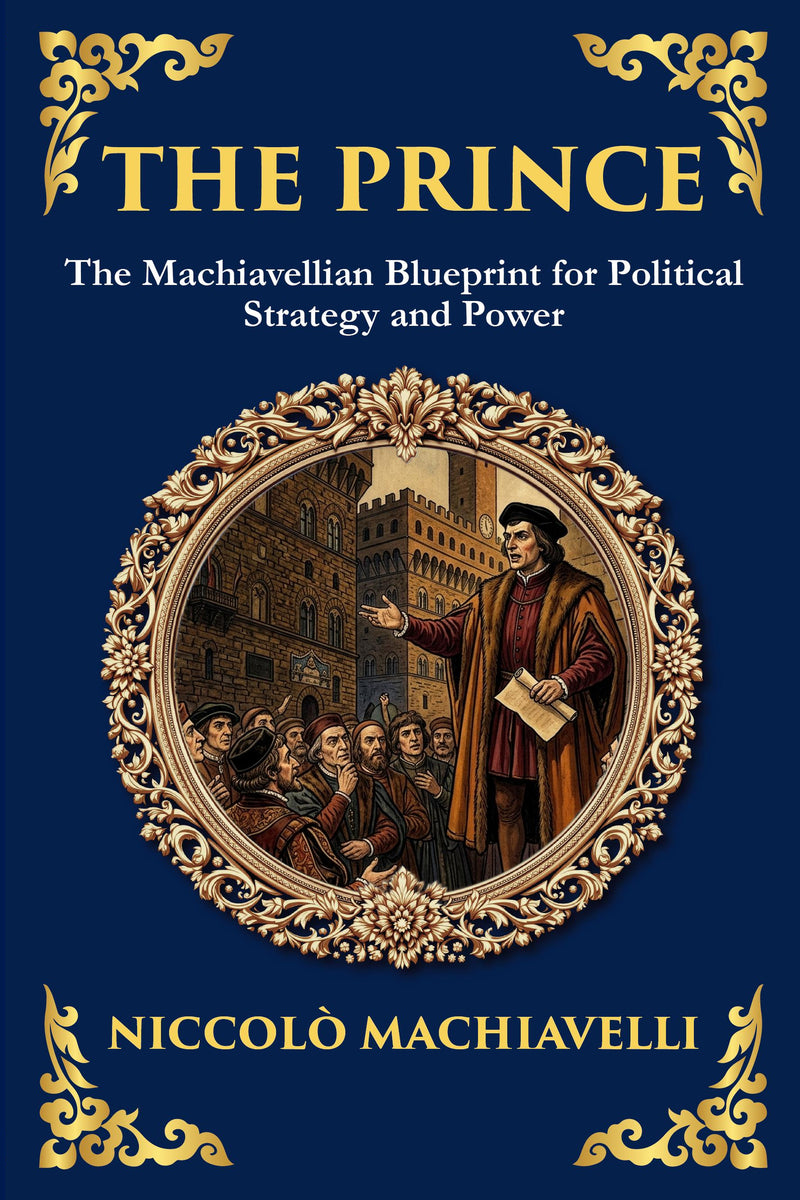
The Prince
Written over 500 years ago, The Prince remains one of the most influential—and controversial— treatises on power ever penned.
or free app
10,000+ hrs library
30-day guarantee
The complete The Prince appears in modern English through Library of Alexandria Press, available online with audiobook narration included for members.
Have you ever wondered why the most powerful leaders don’t always play by the rules? The Prince: The Machiavellian Blueprint for Political Strategy and Power is Niccolò Machiavelli’s bold and unapologetic exploration of how power is acquired, wielded, and maintained—by any means necessary. Far from the idealistic musings of philosophers, this book confronts the reader with a raw, unvarnished perspective on leadership.
Written during the turmoil of Renaissance Italy, Machiavelli’s advice was designed not for saints, but for princes—those willing to do what must be done to rule. From the importance of reputation to the utility of deception, The Prince strips politics down to its primal instincts. In doing so, it has inspired, angered, and fascinated readers for centuries.
What you’ll discover in this modern edition
- The Brutal Truth About Leadership – Why good intentions are often not enough to survive in the world of power.
- When to Be Loved… and When to Be Feared – Navigate the delicate balance between popularity and authority.
- How to Control Fortune – Learn Machiavelli’s insights on adaptability, timing, and strategic opportunity.
- The Power of Image and Perception – Understand why appearances often matter more than reality in politics.
- Why Morality and Politics Rarely Mix – Examine how rulers justify actions the public would condemn.
| Formats | eBook (EPUB + PDF) · Audiobook · Paperback · Hardcover · Large Print |
| Language | English |
| Trim size (print) | 6 × 9 in |
| Binding | Paperback — perfect-bound · Hardcover — casewrap |
| Large Print edition | Same text in a larger, easy-read type — a larger font, not a larger trim |
| Print pricing | Every physical book at our true cost — at-cost, no profit (members) |
| Library | 873 restored titles, always growing |
| Length | 42,050 words · ~2 hr 48 min reading |
| Reading level | Grade 10 · a comfortable read (this modern-English edition) |
| Edition | Modern English translation · 2026 |
Member reviews for this edition are collected as readers finish it — be the first. Across the library: 12,000+ books shipped, every plan covered by a 365-day print guarantee.
About this edition
A faithful, unabridged modern-English edition by The Library of Alexandria — carefully rendered for today's reader and verified paragraph-by-paragraph against the public-domain source. Available as eBook, audiobook, paperback, hardcover, and large print.
- Complete & unabridgedVerified paragraph by paragraph against the source — never a scan, never abridged.
- Modern English, faithfulReadable today, with the author’s meaning kept intact. Readable — not simplified.
- Every format, one membershipRead in your browser or the free app, or listen to the full audiobook.
Included free with your membership
Cancel anytime, one click · 30-day money-back guarantee
Edition last updated July 2026
What’s inside
The Prince — complete and unabridged: all 28 sections included with membership, plus the full audiobook.
Begin reading The Prince
In clear modern English — the complete text is included with membership.
Introduction
In the autumn of 1513, a disgraced civil servant sat in a modest farmhouse outside Florence, his career in ruins, his name tarnished by accusation, his body still bearing the memory of torture. By day he wandered the woods, supervised laborers, gambled in a roadside tavern, and traded coarse jokes with butchers and millers. But each evening, as he later confessed in one of the most famous letters in European history, he shed his muddy work clothes, dressed himself in robes fit for a royal court, and entered his study to commune with the great minds of antiquity. There, nourished by the company of ancient statesmen and generals, he forgot his troubles, ceased to fear poverty, and lost all dread of death. Out of those long evenings emerged a slim, ferocious little book that would forever change how human beings think about power.
The author was Niccolò Machiavelli, and the book was The Prince. Few works in the history of writing have provoked such a strange and lasting combination of fascination, condemnation, admiration, and fear. Within decades of its circulation, the name “Machiavelli” had been transformed into an adjective, “Machiavellian,” that would come to signify cunning, ruthlessness, and the cold-blooded pursuit of advantage. The Catholic Church placed his writings on the Index of Forbidden Books. English dramatists turned “Old Nick” into a nickname for the devil himself. Generations of moralists denounced him as the man who taught princes how to lie, betray, and murder their way to dominion. And yet, across five centuries, the book has refused to die. Statesmen have studied it in secret. Revolutionaries have carried it into battle. Business executives have raided it for strategy. Political scientists have placed it at the very foundation of their discipline. There is something in these pages that simply will not let us go.
To understand why, you must first set aside the caricature. The Machiavelli of popular imagination, the grinning schemer whispering poison into the ear of a tyrant, bears little resemblance to the man who actually wrote this book. The real Machiavelli was a patriot, a republican, a passionate lover of his city, and a public servant who had given the best years of his life to the diplomatic service of Florence. For fourteen years he had served as secretary to the Second Chancery, a position that placed him at the nerve center of Florentine foreign policy. He had ridden across Europe on diplomatic missions, observing kings, popes, and warlords at close range. He had watched the brilliant and terrifying Cesare Borgia rise and fall. He had negotiated with the French monarchy and the German emperor. He had organized a citizen militia for Florence, convinced that a republic defended by its own citizens was stronger than one that hired mercenaries. He had, in short, spent his adult life learning how power actually worked, not in the comfortable abstractions of the philosophers, but in the brutal, contingent, often blood-soaked reality of Italian politics.
Then, in 1512, everything collapsed. The Medici family, expelled from Florence eighteen years earlier, returned to power with the backing of Spanish troops. The republic Machiavelli had served was dissolved. He was dismissed from his post, banned from the territory of the Florentine government, and soon afterward arrested on suspicion of conspiring against the new regime. He was tortured on the rack, an agonizing ordeal he endured with surprising stubbornness, and only released in a general amnesty when a Medici cardinal was elected Pope. Stripped of his livelihood and exiled to the countryside, he found himself at the age of forty-four with his life’s work behind him and no clear future ahead.
It was in this condition of forced idleness and desperate hope that he wrote The Prince. The book was not, originally, intended as a timeless treatise for all humanity. It was, at least in part, a job application. Machiavelli dedicated it to a member of the very Medici family that had ruined him, hoping that a demonstration of his hard-won political wisdom might win him back into public service. The strategy failed; the Medici never gave him the appointment he craved. But the failure of the immediate purpose produced something far greater than any administrative post could have been. Denied the chance to act on the world’s stage, Machiavelli instead distilled everything he had learned about that stage into a book of dazzling concentration and unsettling honesty.
What makes The Prince so dangerous, and so enduring, is not that it recommends evil. It is that it refuses to look away from the world as it is. For centuries before Machiavelli, writers who advised rulers had produced a genre known as the “mirror for princes.” These were earnest, edifying works that explained how a good ruler ought to behave: with justice, mercy, piety, generosity, and honesty. They painted portraits of the ideal monarch as a model of Christian virtue, and they assumed that to be a good ruler was, fundamentally, to be a good man. The trouble, Machiavelli observed, was that this comforting picture had almost nothing to do with how rulers actually survived and prospered. The world was full of princes who had been generous and just and pious, and who had lost their states and their lives precisely because of it. And it was full of princes who had lied, betrayed, and killed, and who had died peacefully in their beds, founders of dynasties, celebrated by history.
Machiavelli’s revolutionary move was to declare, with a kind of cold clarity that still shocks, that he would write about what people actually do rather than what they ought to do. He famously wrote that many had imagined republics and principalities that no one had ever seen or known to exist, but that the gap between how one lives and how one ought to live is so wide that the man who abandons what is done for what ought to be done learns his own ruin rather than his preservation. This is the hinge on which the entire book turns. It is a deliberate break with the moral idealism of the past, and it opens the door to a way of thinking that we now recognize as distinctly modern: the analysis of politics as a practical art, governed by its own logic, rather than as a branch of ethics.
From this starting point flow all the famous and infamous arguments of the book. Is it better for a ruler to be loved or feared? Machiavelli’s answer, that it is best to be both but, if one must choose, far safer to be feared, has echoed down the centuries. He examines the uses of cruelty and concludes, with chilling precision, that cruelty can be “well used” or “badly used,” that injuries should be inflicted all at once so that they are felt less, while benefits should be distributed gradually so that they are savored more. He discusses whether a prince should keep his word, and reaches the conclusion that a wise ruler cannot and should not keep faith when doing so would harm his interests and when the reasons that led him to promise no longer exist. He insists that a prince must learn how not to be good, and to use this knowledge or not according to necessity. He compares the prince to both the lion and the fox, arguing that the ruler must combine the strength of the one with the cunning of the other, for the lion cannot defend himself against traps and the fox cannot defend himself against wolves.
These passages have a way of lodging themselves in the memory like splinters. They are quoted, paraphrased, and invoked in boardrooms and war rooms and campaign offices to this day. But to read them merely as a how-to manual for the aspiring tyrant is to miss almost everything that makes the book profound. What Machiavelli is really doing is conducting an unflinching investigation into the relationship between power and morality, between intention and outcome, between the world we wish we lived in and the world we actually inhabit. He is forcing his reader to confront an uncomfortable truth: that the qualities we praise as virtues in private life, when transferred to the exercise of public power, can produce catastrophe, while the qualities we condemn as vices can sometimes preserve the peace, security, and freedom of an entire people.
Consider his analysis of generosity. The instinct of the moralist is to praise the generous ruler and condemn the miserly one. But Machiavelli points out that a prince who wishes to maintain a reputation for generosity must spend lavishly, which eventually forces him to tax his subjects heavily, which makes him hated; whereas the prince who is willing to be called stingy can keep his treasury full, defend his state without burdening his people, and thereby practice a deeper and more genuine generosity toward the many. The lesson is not that meanness is good. The lesson is that the public consequences of an action may be the exact opposite of its private reputation, and that the responsible ruler must judge by consequences rather than by appearances. This is a far more sophisticated and morally serious argument than the cartoon version of Machiavelli would suggest.
It is also worth pausing on the concept that runs like a golden thread through the entire work: the famous interplay between virtù and fortuna. These Italian words do not translate neatly into English, and much of the book’s depth lies in the tension between them. Fortuna, fortune, is the realm of chance, accident, and circumstance, the unpredictable tide of events that no human being can fully control. Virtù is not “virtue” in the moral sense at all; it is something closer to skill, energy, boldness, foresight, and the capacity to bend events to one’s will. Machiavelli’s great question is how much of human affairs is governed by fortune and how much by our own ability. He offers a memorable image: fortune is like a violent river that, when it floods, destroys everything in its path, but in calm times can be channeled and controlled by dikes and embankments built in advance. The man of virtù is the one who prepares for the flood, who reads the signs, who adapts to changing times, who seizes opportunity when it appears. In one of the book’s most arresting passages, he even compares fortune to a woman who favors the bold, an image that reveals as much about the assumptions of his age as it does about his philosophy of action.
The volume you are holding is described as a modern translation adapted for the contemporary reader, and that description deserves a word of explanation, because it shapes how you should approach what follows. Machiavelli wrote in the Italian of the early sixteenth century, in a prose style that is famously compressed, allusive, and dense with references to events and figures that were household names in his own day but are obscure to us now. The original text assumes that its reader already knows who Cesare Borgia was, what happened at the siege of this or that Italian city, why the relationship between the Pope and the King of France mattered so much. It is written, in other words, for an insider, a fellow practitioner of the dark art of Renaissance statecraft.
A faithful but unmodernized translation can therefore be heavy going for a reader encountering the book for the first time. The names pile up; the historical allusions fly past; the syntax twists and coils in ways that mirror the Italian but resist easy comprehension in English. There is great value in such scholarly editions, and any reader who falls in love with Machiavelli will eventually want to seek them out, along with the rich body of footnotes and commentary that surrounds them. But there is also great value in an edition that clears away some of the underbrush so that the reader can see the architecture of the argument, that renders Machiavelli’s thought in language a modern person can absorb without a scholarly apparatus at hand, and that allows the sheer force of his ideas to come through with the immediacy and shock that his first readers must have felt.
Cancel anytime, one click · 30-day money-back guarantee
Founding annual rate available now — your price locks for life when you join.
Not ready? Get this free chapter by email — read it anytime.
✓ Sent — check your inbox for The Prince.
Questions about The Prince
What is The Prince about?
Written over 500 years ago, The Prince remains one of the most influential—and controversial— treatises on power ever penned. With fearless clarity, Machiavelli dissects politics as it truly operates, not as it ought to. Through sharp insights and ruthless logic, he lays bare the timeless principles of manipulation, statecraft, and control.
Who wrote The Prince?
The Prince was written by Niccolò Machiavelli. This edition presents the complete work in clear modern English, faithfully rendered from the public-domain original by Library of Alexandria Press.
Is The Prince free to read?
The opening chapter is free to read on this page. Members read and listen to the complete work — and the entire library — free, and can order any physical book at our true print cost.
How long is The Prince?
28 chapters (~42,050 words) — about 2 hr 48 min of reading in this modern-English edition.
Is this an abridged version of The Prince?
No. This is the complete, unabridged The Prince, carefully rendered into clear modern English and verified paragraph-by-paragraph against the public-domain source — nothing is cut or summarised.
What formats does The Prince come in?
The Prince is available as eBook, paperback, hardcover and large print. eBook and audiobook are included with membership; printed editions ship at our true print cost.
Shipping & returns
Billing & membership
More from the library


Explore History
- The Advancement of Learning · Francis Bacon
- Democracy in America — Volume 2 · Alexis de Tocqueville
- Second Treatise of Government · John Locke
- Society in America, Volume 1 (of 2) · Harriet Martineau
- The Everlasting Man · G. K. Chesterton
- The Book of Tea · Kakuzo Okakura
- The Japanese Spirit · Yoshisaburo Okakura
- Give Me Liberty or Give Me Death · Patrick Henry
- Ion · Plato
- John F. Kennedy’s Inaugural Address · John F. Kennedy
- The Declaration of Independence of the United States of America · Thomas Jefferson
- On Heroes, Hero-Worship, and the Heroic in History · Thomas Carlyle
- The Communist Manifesto
- The Souls of Black Folk · W. E. B. Du Bois
- Letters on the Equality of the Sexes, and the Condition of Woman · Sarah Grimké
- The Romance of Biography (Vol. 1 of 2) · Mrs. Jameson
- The Erotic Motive in Literature · Albert Mordell
The Prince
The Prince
The Machiavellian Blueprint for Political Strategy and Power
Niccolò Machiavelli
Contents
- Introduction
- Chapter 1
- Chapter 2
- Chapter 3
- Chapter 4
- Chapter 5
- Chapter 6
- Chapter 7
- Chapter 8
- Chapter 9
- Chapter 10
- Chapter 11
- Chapter 12
- Chapter 13
- Chapter 14
- Chapter 15
- Chapter 16
- Chapter 17
- Chapter 18
- Chapter 19
- Chapter 20
- Chapter 21
- Chapter 22
- Chapter 23
- Chapter 24
- Chapter 25
- Chapter 26
- Chapter 27
Introduction
In the autumn of 1513, a disgraced civil servant sat in a modest farmhouse outside Florence, his career in ruins, his name tarnished by accusation, his body still bearing the memory of torture. By day he wandered the woods, supervised laborers, gambled in a roadside tavern, and traded coarse jokes with butchers and millers. But each evening, as he later confessed in one of the most famous letters in European history, he shed his muddy work clothes, dressed himself in robes fit for a royal court, and entered his study to commune with the great minds of antiquity. There, nourished by the company of ancient statesmen and generals, he forgot his troubles, ceased to fear poverty, and lost all dread of death. Out of those long evenings emerged a slim, ferocious little book that would forever change how human beings think about power.
The author was Niccolò Machiavelli, and the book was The Prince. Few works in the history of writing have provoked such a strange and lasting combination of fascination, condemnation, admiration, and fear. Within decades of its circulation, the name “Machiavelli” had been transformed into an adjective, “Machiavellian,” that would come to signify cunning, ruthlessness, and the cold-blooded pursuit of advantage. The Catholic Church placed his writings on the Index of Forbidden Books. English dramatists turned “Old Nick” into a nickname for the devil himself. Generations of moralists denounced him as the man who taught princes how to lie, betray, and murder their way to dominion. And yet, across five centuries, the book has refused to die. Statesmen have studied it in secret. Revolutionaries have carried it into battle. Business executives have raided it for strategy. Political scientists have placed it at the very foundation of their discipline. There is something in these pages that simply will not let us go.
To understand why, you must first set aside the caricature. The Machiavelli of popular imagination, the grinning schemer whispering poison into the ear of a tyrant, bears little resemblance to the man who actually wrote this book. The real Machiavelli was a patriot, a republican, a passionate lover of his city, and a public servant who had given the best years of his life to the diplomatic service of Florence. For fourteen years he had served as secretary to the Second Chancery, a position that placed him at the nerve center of Florentine foreign policy. He had ridden across Europe on diplomatic missions, observing kings, popes, and warlords at close range. He had watched the brilliant and terrifying Cesare Borgia rise and fall. He had negotiated with the French monarchy and the German emperor. He had organized a citizen militia for Florence, convinced that a republic defended by its own citizens was stronger than one that hired mercenaries. He had, in short, spent his adult life learning how power actually worked, not in the comfortable abstractions of the philosophers, but in the brutal, contingent, often blood-soaked reality of Italian politics.
Then, in 1512, everything collapsed. The Medici family, expelled from Florence eighteen years earlier, returned to power with the backing of Spanish troops. The republic Machiavelli had served was dissolved. He was dismissed from his post, banned from the territory of the Florentine government, and soon afterward arrested on suspicion of conspiring against the new regime. He was tortured on the rack, an agonizing ordeal he endured with surprising stubbornness, and only released in a general amnesty when a Medici cardinal was elected Pope. Stripped of his livelihood and exiled to the countryside, he found himself at the age of forty-four with his life’s work behind him and no clear future ahead.
It was in this condition of forced idleness and desperate hope that he wrote The Prince. The book was not, originally, intended as a timeless treatise for all humanity. It was, at least in part, a job application. Machiavelli dedicated it to a member of the very Medici family that had ruined him, hoping that a demonstration of his hard-won political wisdom might win him back into public service. The strategy failed; the Medici never gave him the appointment he craved. But the failure of the immediate purpose produced something far greater than any administrative post could have been. Denied the chance to act on the world’s stage, Machiavelli instead distilled everything he had learned about that stage into a book of dazzling concentration and unsettling honesty.
What makes The Prince so dangerous, and so enduring, is not that it recommends evil. It is that it refuses to look away from the world as it is. For centuries before Machiavelli, writers who advised rulers had produced a genre known as the “mirror for princes.” These were earnest, edifying works that explained how a good ruler ought to behave: with justice, mercy, piety, generosity, and honesty. They painted portraits of the ideal monarch as a model of Christian virtue, and they assumed that to be a good ruler was, fundamentally, to be a good man. The trouble, Machiavelli observed, was that this comforting picture had almost nothing to do with how rulers actually survived and prospered. The world was full of princes who had been generous and just and pious, and who had lost their states and their lives precisely because of it. And it was full of princes who had lied, betrayed, and killed, and who had died peacefully in their beds, founders of dynasties, celebrated by history.
Machiavelli’s revolutionary move was to declare, with a kind of cold clarity that still shocks, that he would write about what people actually do rather than what they ought to do. He famously wrote that many had imagined republics and principalities that no one had ever seen or known to exist, but that the gap between how one lives and how one ought to live is so wide that the man who abandons what is done for what ought to be done learns his own ruin rather than his preservation. This is the hinge on which the entire book turns. It is a deliberate break with the moral idealism of the past, and it opens the door to a way of thinking that we now recognize as distinctly modern: the analysis of politics as a practical art, governed by its own logic, rather than as a branch of ethics.
From this starting point flow all the famous and infamous arguments of the book. Is it better for a ruler to be loved or feared? Machiavelli’s answer, that it is best to be both but, if one must choose, far safer to be feared, has echoed down the centuries. He examines the uses of cruelty and concludes, with chilling precision, that cruelty can be “well used” or “badly used,” that injuries should be inflicted all at once so that they are felt less, while benefits should be distributed gradually so that they are savored more. He discusses whether a prince should keep his word, and reaches the conclusion that a wise ruler cannot and should not keep faith when doing so would harm his interests and when the reasons that led him to promise no longer exist. He insists that a prince must learn how not to be good, and to use this knowledge or not according to necessity. He compares the prince to both the lion and the fox, arguing that the ruler must combine the strength of the one with the cunning of the other, for the lion cannot defend himself against traps and the fox cannot defend himself against wolves.
These passages have a way of lodging themselves in the memory like splinters. They are quoted, paraphrased, and invoked in boardrooms and war rooms and campaign offices to this day. But to read them merely as a how-to manual for the aspiring tyrant is to miss almost everything that makes the book profound. What Machiavelli is really doing is conducting an unflinching investigation into the relationship between power and morality, between intention and outcome, between the world we wish we lived in and the world we actually inhabit. He is forcing his reader to confront an uncomfortable truth: that the qualities we praise as virtues in private life, when transferred to the exercise of public power, can produce catastrophe, while the qualities we condemn as vices can sometimes preserve the peace, security, and freedom of an entire people.
Consider his analysis of generosity. The instinct of the moralist is to praise the generous ruler and condemn the miserly one. But Machiavelli points out that a prince who wishes to maintain a reputation for generosity must spend lavishly, which eventually forces him to tax his subjects heavily, which makes him hated; whereas the prince who is willing to be called stingy can keep his treasury full, defend his state without burdening his people, and thereby practice a deeper and more genuine generosity toward the many. The lesson is not that meanness is good. The lesson is that the public consequences of an action may be the exact opposite of its private reputation, and that the responsible ruler must judge by consequences rather than by appearances. This is a far more sophisticated and morally serious argument than the cartoon version of Machiavelli would suggest.
It is also worth pausing on the concept that runs like a golden thread through the entire work: the famous interplay between virtù and fortuna. These Italian words do not translate neatly into English, and much of the book’s depth lies in the tension between them. Fortuna, fortune, is the realm of chance, accident, and circumstance, the unpredictable tide of events that no human being can fully control. Virtù is not “virtue” in the moral sense at all; it is something closer to skill, energy, boldness, foresight, and the capacity to bend events to one’s will. Machiavelli’s great question is how much of human affairs is governed by fortune and how much by our own ability. He offers a memorable image: fortune is like a violent river that, when it floods, destroys everything in its path, but in calm times can be channeled and controlled by dikes and embankments built in advance. The man of virtù is the one who prepares for the flood, who reads the signs, who adapts to changing times, who seizes opportunity when it appears. In one of the book’s most arresting passages, he even compares fortune to a woman who favors the bold, an image that reveals as much about the assumptions of his age as it does about his philosophy of action.
The volume you are holding is described as a modern translation adapted for the contemporary reader, and that description deserves a word of explanation, because it shapes how you should approach what follows. Machiavelli wrote in the Italian of the early sixteenth century, in a prose style that is famously compressed, allusive, and dense with references to events and figures that were household names in his own day but are obscure to us now. The original text assumes that its reader already knows who Cesare Borgia was, what happened at the siege of this or that Italian city, why the relationship between the Pope and the King of France mattered so much. It is written, in other words, for an insider, a fellow practitioner of the dark art of Renaissance statecraft.
A faithful but unmodernized translation can therefore be heavy going for a reader encountering the book for the first time. The names pile up; the historical allusions fly past; the syntax twists and coils in ways that mirror the Italian but resist easy comprehension in English. There is great value in such scholarly editions, and any reader who falls in love with Machiavelli will eventually want to seek them out, along with the rich body of footnotes and commentary that surrounds them. But there is also great value in an edition that clears away some of the underbrush so that the reader can see the architecture of the argument, that renders Machiavelli’s thought in language a modern person can absorb without a scholarly apparatus at hand, and that allows the sheer force of his ideas to come through with the immediacy and shock that his first readers must have felt.
I will skip the discussion of republics since I have already written about them in detail elsewhere, and I will focus only on principalities. I will follow the order mentioned above to discuss how these states should be governed and maintained.
I will start by saying that it is much easier to keep a hereditary state—where the people are long accustomed to the ruling family—than a new one. An average prince can maintain his power simply by not breaking the traditions of his ancestors and by handling new situations wisely, unless he is overthrown by an overwhelming and extraordinary force. Even then, if the usurper faces any serious trouble, the original prince will likely regain his throne.
For example, in Italy, the Duke of Ferrara could not have survived the attacks by the Venetians in 1484 or by Pope Julius in 1510 if he hadn’t been established in his lands for so long. A hereditary prince has less reason and less need to offend his people, so he is more likely to be loved. Unless he is exceptionally cruel or flawed, his subjects will naturally be well-disposed toward him. Because his family has ruled for so long, the memories and reasons that usually trigger a revolution have faded; once one change happens, it usually paves the way for another.
End of the free sample
Keep reading, free
Members read and listen to the complete book — and the entire library. Cancel anytime, one click · 30-day money-back guarantee.