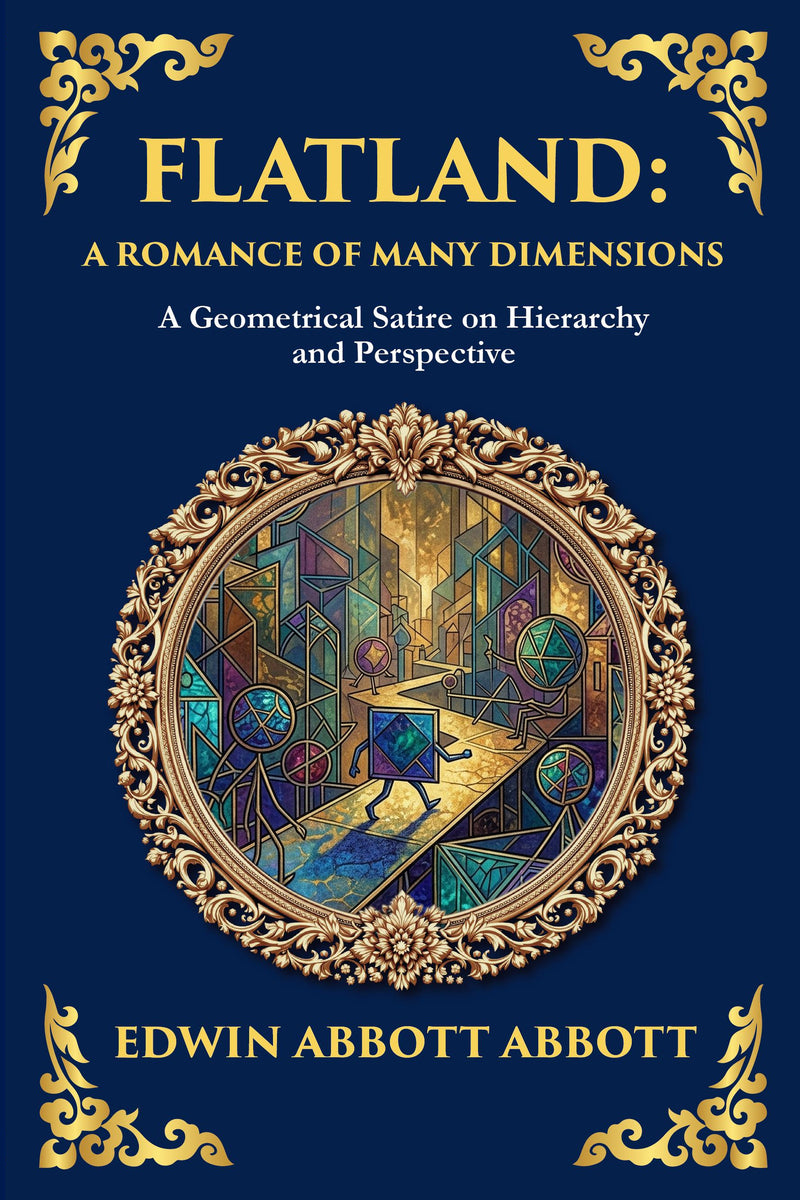
Flatland: A Romance of Many Dimensions
In a world where social class is measured by the number of sides you possess, Flatland offers a mind-bending journey through space, thought, and oppression.
or free app
10,000+ hrs library
30-day guarantee
The complete Flatland: A Romance of Many appears in modern English through Library of Alexandria Press, available online with audiobook narration included for members.
Have you ever wondered why we resist what we cannot comprehend? In Flatland: A Romance of Many Dimensions, Edwin Abbott Abbott weaves a dazzling parable of geometric fantasy and biting social commentary. Set in a world confined to two dimensions, the story follows a self-satisfied Square whose orderly understanding of existence is overturned when he encounters a being from the third dimension—a Sphere.
This encounter not only blows apart his grasp of geometry but forces him to reconsider the very foundations of his society. In Flatland, a being's number of sides determines their social class: Triangles are soldiers, Squares are professionals, and Circles—perfect and revered—are the priests of power. The book exposes the absurdity of such rigid structures, echoing the class and gender hierarchies of Victorian England.
But beyond its critique of social norms, Flatland is a visionary meditation on intellectual humility. Abbott challenges readers to imagine realities beyond their own—to entertain the possibility that what we see is only a shadow of what is.
What you’ll discover in this modern edition
- A Groundbreaking Exploration of Dimensions Travel through 1D, 2D, and 3D spaces and open your mind to mathematical and philosophical wonder.
| Formats | eBook (EPUB + PDF) · Audiobook · Paperback · Hardcover · Large Print |
| Language | English |
| Trim size (print) | 6 × 9 in |
| Binding | Paperback — perfect-bound · Hardcover — casewrap |
| Large Print edition | Same text in a larger, easy-read type — a larger font, not a larger trim |
| Print pricing | Every physical book at our true cost — at-cost, no profit (members) |
| Library | 873 restored titles, always growing |
| Length | 33,695 words · ~2 hr 15 min reading |
| Reading level | Grade 11 · a confident, adult read (this modern-English edition) |
| Edition | Modern English translation · 2026 |
Member reviews for this edition are collected as readers finish it — be the first. Across the library: 12,000+ books shipped, every plan covered by a 365-day print guarantee.
About this edition
A faithful, unabridged modern-English edition by The Library of Alexandria — carefully rendered for today's reader and verified paragraph-by-paragraph against the public-domain source. Available as eBook, audiobook, paperback, hardcover, and large print.
- Complete & unabridgedVerified paragraph by paragraph against the source — never a scan, never abridged.
- Modern English, faithfulReadable today, with the author’s meaning kept intact. Readable — not simplified.
- Every format, one membershipRead in your browser or the free app, or listen to the full audiobook.
Included free with your membership
Cancel anytime, one click · 30-day money-back guarantee
Edition last updated July 2026
What’s inside
Flatland: A Romance of Many Dimensions — complete and unabridged: all 25 sections included with membership, plus the full audiobook.
Begin reading Flatland: A Romance of Many Dimensions
In clear modern English — the complete text is included with membership.
Introduction
There are books that entertain, books that instruct, and books that quietly rearrange the furniture of your mind so that you can never again walk through the same rooms in quite the same way. Flatland belongs firmly to that third category. First published in 1884, it remains one of the most ingenious thought experiments ever committed to print—a slim volume that disguises itself as a whimsical fantasy about geometric shapes and, in doing so, smuggles in some of the most profound questions a human being can ask. What are the limits of what we can perceive? How do we know that the world we experience is the whole of reality? And what happens to those who claim to have glimpsed something beyond the borders of accepted truth?
The author, Edwin Abbott Abbott, was no ordinary novelist. He was a clergyman, a Shakespearean scholar, and above all a headmaster—the principal of the City of London School, where he spent decades shaping young minds and championing reforms in education. He was a man fluent in classical languages, deeply engaged with theology, and passionately committed to the idea that learning should liberate rather than confine. When he sat down to write this curious little book, he was not attempting to launch a career as a writer of speculative fiction. He was doing something more subtle and more daring: he was using the language of mathematics—a language he loved—to make an argument about humility, perception, and the dangers of assuming that the boundaries of our own experience mark the boundaries of all that is possible.
It is worth pausing on that ambition, because it is easy to mistake Flatland for a mere mathematical curiosity, a clever toy for people who enjoy puzzles about geometry. It is that, certainly, and gloriously so. But it is also a satire of the rigid social hierarchies of Victorian England, a meditation on the nature of knowledge, a parable about the persecution of visionaries, and—perhaps most enduringly—an invitation to imagine dimensions beyond the three we inhabit. Few books have managed to be so many things at once while remaining so compact, so readable, and so genuinely delightful. This is a work that has been treasured by mathematicians and physicists, by science fiction writers and philosophers, by theologians and schoolchildren, each finding in its pages something different and something true.
This particular edition is a modern translation, adapted for the contemporary reader. That phrase deserves a word of explanation, because Abbott’s original prose, charming as it is, was written in a register that suited the educated Victorian audience of the late nineteenth century. The sentences could be long and elaborate, the vocabulary occasionally archaic, the rhythms more formal than anything we are accustomed to today. The purpose of an adaptation like this one is not to dilute the wit or to flatten the elegance of the original, but to clear away the incidental obstacles of dated language so that the essential brilliance of the ideas can reach you with the same freshness and immediacy that Abbott’s first readers must have felt. The geometry is unchanged. The satire is intact. The strange and beautiful logic of the story remains exactly as it was conceived. What has been adjusted is the surface, the better to reveal the depths.
To enter the book is to be asked to perform an act of imagination unlike any other. You are invited to picture a world that exists entirely on a flat surface—a vast sheet of paper, if you like, across which figures move and live and die without any conception of “above” or “below.” Imagine drawing a triangle, a square, a circle on a tabletop, and then imagine that these shapes are not drawings at all but living, thinking beings, sliding across the surface, never rising and never sinking, because for them there is no such thing as rising or sinking. This is Flatland.
The genius of the conceit lies in how completely Abbott commits to it. He does not simply describe this two-dimensional realm; he works out, with patient and playful rigor, exactly what life would be like within it. How would the inhabitants recognize one another if everything they see is reduced to a single line, viewed edge-on? How would they navigate, build houses, conduct their affairs, distinguish friend from foe? How would they understand rain, or weather, or direction? Abbott answers all of these questions and many more, and the pleasure of the early chapters comes precisely from watching him solve each problem with the satisfying inevitability of a good proof. You find yourself nodding along, thinking “yes, of course, that is exactly how it would have to work”—and in that moment of agreement, you have already begun to inhabit a perspective radically different from your own.
But the world of Flatland is not merely a geometric exercise. It is a society, and a rigidly stratified one. The shapes are arranged into a hierarchy determined by the number of their sides and the regularity of their form. At the bottom are the simplest figures; at the top, those of such complexity that they approach the perfection of the circle. Your shape is your destiny. Your shape determines your status, your prospects, your treatment by others, and the very respect with which you are addressed. The narrator, who guides us through this world, accepts these arrangements as natural and proper, and one of the quiet marvels of the book is the way Abbott uses this acceptance to hold up a mirror to his own society—and, if we are honest, to ours.
Here the satire bites. Victorian England was a world obsessed with class, with rank, with the careful calibration of who stood above whom. It was a world in which the circumstances of one’s birth could fix the entire trajectory of one’s life, in which the appearance of respectability mattered enormously, and in which whole categories of people were denied opportunity and dignity on the basis of accidents over which they had no control. By translating these social anxieties into the cold, clear language of geometry, Abbott exposes their absurdity without ever needing to preach. When status is reduced to a matter of angles and sides, we see, perhaps for the first time, just how arbitrary and cruel such systems can be. And because the narrator defends these arrangements so earnestly, we are made to feel the discomfort of recognizing our own complacencies in his.
It would be a disservice to say too much about the particulars of how this hierarchy operates, or about the more pointed and provocative elements of Abbott’s social commentary, because part of the experience of reading the book is encountering these things for yourself and feeling the slow dawning of recognition. Suffice it to say that some passages will strike the modern reader as startling, even uncomfortable, and it is important to read them as Abbott intended: as satire, as an exaggeration meant to reveal injustice rather than to endorse it. The author was, in his own life, a reformer and a champion of broadening opportunity. The rigidities he describes in Flatland are not his values but his targets. Reading him with that understanding, you will find that the sharpest of his barbs are aimed not at the powerless but at the comfortable certainties of those who believe their advantages to be the natural order of things.
What makes all of this so effective is the voice of the narrator himself. He is earnest, a little pompous, thoroughly conventional in his views, and utterly convinced of the rightness of his world. He addresses us with the polite formality of a Victorian gentleman explaining the customs of his country to a foreign visitor. And it is precisely because he is so reasonable, so measured, so sure of himself, that the eventual unsettling of his certainties carries such force. We come to know him, to understand the shape of his thoughts as well as the shape of his body, and so when the foundations of his understanding begin to tremble, we feel the tremor too.
If the first part of the book is a study of a flat world, the second is something altogether more vertiginous—a leap into the realm of pure wonder. Without revealing the turns the narrative takes, it can be said that the heart of Flatland concerns the question of dimensions: what they are, how a being confined to one number of them might come to grasp the existence of more, and what it costs to carry such knowledge back to a world that cannot or will not understand it.
This is where Abbott’s deceptively simple premise reveals its full power. By starting us in a two-dimensional world, he prepares us to think about our own three-dimensional one in an entirely new way. For if the inhabitants of a flat world cannot conceive of “up,” cannot even imagine what it would mean to rise above their plane, then might we not be similarly limited? Might there be a direction, a dimension, a whole order of reality that we cannot perceive simply because we lack the faculties to do so—just as a creature on a flat surface lacks the faculty to perceive height? The argument unfolds with a beautiful logical symmetry. We laugh at the limitations of the flat beings, and then, with a jolt, we realize that the joke may be on us. The structure of the book is itself an argument, building rung by rung up a ladder of dimensions, and inviting us to wonder how many rungs there might be above the highest one we can see.
This idea—the analogy of dimensions—was not entirely new in Abbott’s time. Mathematicians had begun to explore the formal properties of spaces with four or more dimensions, and there was considerable intellectual excitement about what such spaces might mean. But Abbott did something that no equation could do: he made the concept felt. He gave it drama, emotion, and consequence. He turned an abstract mathematical notion into a story about discovery, conviction, isolation, and the terrible loneliness of seeing what others cannot see. And in doing so, he created a work that would go on to influence generations of thinkers in fields he could scarcely have imagined.
When Einstein’s theories of relativity transformed our understanding of space and time in the early twentieth century—introducing time as a kind of fourth dimension woven into the fabric of the universe—readers returned to Flatland and found in it an uncanny preparation for these strange new ideas. The book had taught them how to think about dimensions beyond their immediate experience, how to use analogy to reach toward the inconceivable. Later still, as physicists developed theories proposing that the universe might contain many more dimensions than the familiar four, curled up too small for us to detect, Abbott’s parable seemed more prescient than ever. He had given us a vocabulary, a way of imagining, that the science of his own day could not yet justify but that the science of the future would come to require.
Yet to read Flatland purely as a precursor to modern physics is to undersell its richness. The dimensional analogy is also, profoundly, a spiritual and philosophical one. Abbott was a man of deep religious feeling, and the book carries an undertone of mystical longing—a sense that the visible world might be only the surface of a far greater reality, that there might be planes of existence beyond our perception, and that the testimony of those who claim to have glimpsed them deserves at least our humble consideration. The experience of the narrator, as he confronts the possibility of dimensions beyond his own, has been read by many as an allegory of religious revelation: the encounter with a truth so far beyond ordinary experience that it cannot be communicated in ordinary terms, and that brands the one who receives it as either a prophet or a madman in the eyes of his fellows.
This is the deepest and most moving layer of the book. For the central drama of Flatland is not really about geometry at all. It is about what happens to anyone who comes to know something that the rest of the world is not prepared to accept—who tries to share a vision that exceeds the categories available to their listeners, and who is met not with gratitude but with suspicion, ridicule, or worse. It is a story about the cost of enlightenment, the gap between the one who sees and the many who cannot, and the courage required to hold fast to a truth that no one around you will believe. Anyone who has ever felt themselves to be ahead of their time, or who has tried to explain a hard-won insight to an unreceptive audience, will recognize the ache at the center of this little book. It is, in the end, a parable about the loneliness of vision, and it is told with a tenderness that catches you off guard amid all the playful geometry.
Cancel anytime, one click · 30-day money-back guarantee
Founding annual rate available now — your price locks for life when you join.
Not ready? Get this free chapter by email — read it anytime.
✓ Sent — check your inbox for Flatland: A Romance of Many Dimensions.
Questions about Flatland: A Romance of Many Dimensions
What is Flatland: A Romance of Many about?
In a world where social class is measured by the number of sides you possess, Flatland offers a mind-bending journey through space, thought, and oppression. Written by Edwin Abbott Abbott in 1884, this classic novella follows a humble Square who lives in a two-dimensional world— until a mysterious visitor from the third dimension shatters everything he thought he knew. Part science fiction, part social critique, and part mathematical thought experiment, Flatland is a brilliantly imaginative satire that challenges t
Who wrote Flatland: A Romance of Many?
Flatland: A Romance of Many was written by Edwin Abbott Abbott. This edition presents the complete work in clear modern English, faithfully rendered from the public-domain original by Library of Alexandria Press.
Is Flatland: A Romance of Many free to read?
The opening chapter is free to read on this page. Members read and listen to the complete work — and the entire library — free, and can order any physical book at our true print cost.
How long is Flatland: A Romance of Many?
25 chapters (~33,695 words) — about 2 hr 15 min of reading in this modern-English edition.
Is this an abridged version of Flatland: A Romance of Many?
No. This is the complete, unabridged Flatland: A Romance of Many, carefully rendered into clear modern English and verified paragraph-by-paragraph against the public-domain source — nothing is cut or summarised.
What formats does Flatland: A Romance of Many come in?
Flatland: A Romance of Many is available as eBook, paperback, hardcover and large print. eBook and audiobook are included with membership; printed editions ship at our true print cost.
Shipping & returns
Billing & membership
More from the library


Explore Science Fiction
- The Island of Doctor Moreau · H. G. Wells
- A Midsummer Night’s Dream · William Shakespeare
- The Invisible Man: A Grotesque Romance · H. G. Wells
- The War of the Worlds · H. G. Wells
- The Strange Case of Dr. Jekyll and Mr. Hyde · Robert Louis Stevenson
- Limanora: the island of progress · Godfrey Sweven
- The Book of Dragons · E. Nesbit
- She · H. Rider Haggard
- Dorothy and the Wizard in Oz · L. Frank Baum
- The Princess and the Goblin · George MacDonald
- Gawayne and the Green Knight: A Fairy Tale · Charlton M. Lewis
- Lucian’s True History · Lucian of Samosata
- The Willows · Algernon Blackwood
- The Call of Cthulhu · H. P. Lovecraft
- The Life-Eater · Harold Ward
- The Marvelous Land of Oz · L. Frank Baum
- Mars is My Destination · Frank Belknap Long
- The Black Kiss
- The Beasts in the Void · Paul W. Fairman
- John Jones’s Dollar · Harry Stephen Keeler
- Subversive · Mack Reynolds
- The Mississippi Saucer · Frank Belknap Long
- Man of Distinction · Michael Shaara
- Spawn of the Comet · H. Thompson Rich
- The Golden Judge · Nathaniel Gordon
- Final Weapon · Everett B. Cole
- The Big Fix · George O. Smith
- Last Enemy · H. Beam Piper
- Time and Time Again · H. Beam Piper
- Sabotage in Space · Carey Rockwell
Flatland: A Romance of Many Dimensions
Flatland: A Romance of Many Dimensions
A Geometrical Satire on Hierarchy and Perspective
Edwin Abbott Abbott
Contents
- Introduction
- Part 1
- Chapter 1
- Chapter 2
- Chapter 3
- Chapter 4
- Chapter 5
- Chapter 6
- Chapter 7
- Chapter 8
- Chapter 9
- Chapter 10
- Chapter 11
- Chapter 12
- Part 2
- Chapter 13
- Chapter 14
- Chapter 15
- Chapter 16
- Chapter 17
- Chapter 18
- Chapter 19
- Chapter 20
- Chapter 21
- Chapter 22
Introduction
There are books that entertain, books that instruct, and books that quietly rearrange the furniture of your mind so that you can never again walk through the same rooms in quite the same way. Flatland belongs firmly to that third category. First published in 1884, it remains one of the most ingenious thought experiments ever committed to print—a slim volume that disguises itself as a whimsical fantasy about geometric shapes and, in doing so, smuggles in some of the most profound questions a human being can ask. What are the limits of what we can perceive? How do we know that the world we experience is the whole of reality? And what happens to those who claim to have glimpsed something beyond the borders of accepted truth?
The author, Edwin Abbott Abbott, was no ordinary novelist. He was a clergyman, a Shakespearean scholar, and above all a headmaster—the principal of the City of London School, where he spent decades shaping young minds and championing reforms in education. He was a man fluent in classical languages, deeply engaged with theology, and passionately committed to the idea that learning should liberate rather than confine. When he sat down to write this curious little book, he was not attempting to launch a career as a writer of speculative fiction. He was doing something more subtle and more daring: he was using the language of mathematics—a language he loved—to make an argument about humility, perception, and the dangers of assuming that the boundaries of our own experience mark the boundaries of all that is possible.
It is worth pausing on that ambition, because it is easy to mistake Flatland for a mere mathematical curiosity, a clever toy for people who enjoy puzzles about geometry. It is that, certainly, and gloriously so. But it is also a satire of the rigid social hierarchies of Victorian England, a meditation on the nature of knowledge, a parable about the persecution of visionaries, and—perhaps most enduringly—an invitation to imagine dimensions beyond the three we inhabit. Few books have managed to be so many things at once while remaining so compact, so readable, and so genuinely delightful. This is a work that has been treasured by mathematicians and physicists, by science fiction writers and philosophers, by theologians and schoolchildren, each finding in its pages something different and something true.
This particular edition is a modern translation, adapted for the contemporary reader. That phrase deserves a word of explanation, because Abbott’s original prose, charming as it is, was written in a register that suited the educated Victorian audience of the late nineteenth century. The sentences could be long and elaborate, the vocabulary occasionally archaic, the rhythms more formal than anything we are accustomed to today. The purpose of an adaptation like this one is not to dilute the wit or to flatten the elegance of the original, but to clear away the incidental obstacles of dated language so that the essential brilliance of the ideas can reach you with the same freshness and immediacy that Abbott’s first readers must have felt. The geometry is unchanged. The satire is intact. The strange and beautiful logic of the story remains exactly as it was conceived. What has been adjusted is the surface, the better to reveal the depths.
To enter the book is to be asked to perform an act of imagination unlike any other. You are invited to picture a world that exists entirely on a flat surface—a vast sheet of paper, if you like, across which figures move and live and die without any conception of “above” or “below.” Imagine drawing a triangle, a square, a circle on a tabletop, and then imagine that these shapes are not drawings at all but living, thinking beings, sliding across the surface, never rising and never sinking, because for them there is no such thing as rising or sinking. This is Flatland.
The genius of the conceit lies in how completely Abbott commits to it. He does not simply describe this two-dimensional realm; he works out, with patient and playful rigor, exactly what life would be like within it. How would the inhabitants recognize one another if everything they see is reduced to a single line, viewed edge-on? How would they navigate, build houses, conduct their affairs, distinguish friend from foe? How would they understand rain, or weather, or direction? Abbott answers all of these questions and many more, and the pleasure of the early chapters comes precisely from watching him solve each problem with the satisfying inevitability of a good proof. You find yourself nodding along, thinking “yes, of course, that is exactly how it would have to work”—and in that moment of agreement, you have already begun to inhabit a perspective radically different from your own.
But the world of Flatland is not merely a geometric exercise. It is a society, and a rigidly stratified one. The shapes are arranged into a hierarchy determined by the number of their sides and the regularity of their form. At the bottom are the simplest figures; at the top, those of such complexity that they approach the perfection of the circle. Your shape is your destiny. Your shape determines your status, your prospects, your treatment by others, and the very respect with which you are addressed. The narrator, who guides us through this world, accepts these arrangements as natural and proper, and one of the quiet marvels of the book is the way Abbott uses this acceptance to hold up a mirror to his own society—and, if we are honest, to ours.
Here the satire bites. Victorian England was a world obsessed with class, with rank, with the careful calibration of who stood above whom. It was a world in which the circumstances of one’s birth could fix the entire trajectory of one’s life, in which the appearance of respectability mattered enormously, and in which whole categories of people were denied opportunity and dignity on the basis of accidents over which they had no control. By translating these social anxieties into the cold, clear language of geometry, Abbott exposes their absurdity without ever needing to preach. When status is reduced to a matter of angles and sides, we see, perhaps for the first time, just how arbitrary and cruel such systems can be. And because the narrator defends these arrangements so earnestly, we are made to feel the discomfort of recognizing our own complacencies in his.
It would be a disservice to say too much about the particulars of how this hierarchy operates, or about the more pointed and provocative elements of Abbott’s social commentary, because part of the experience of reading the book is encountering these things for yourself and feeling the slow dawning of recognition. Suffice it to say that some passages will strike the modern reader as startling, even uncomfortable, and it is important to read them as Abbott intended: as satire, as an exaggeration meant to reveal injustice rather than to endorse it. The author was, in his own life, a reformer and a champion of broadening opportunity. The rigidities he describes in Flatland are not his values but his targets. Reading him with that understanding, you will find that the sharpest of his barbs are aimed not at the powerless but at the comfortable certainties of those who believe their advantages to be the natural order of things.
What makes all of this so effective is the voice of the narrator himself. He is earnest, a little pompous, thoroughly conventional in his views, and utterly convinced of the rightness of his world. He addresses us with the polite formality of a Victorian gentleman explaining the customs of his country to a foreign visitor. And it is precisely because he is so reasonable, so measured, so sure of himself, that the eventual unsettling of his certainties carries such force. We come to know him, to understand the shape of his thoughts as well as the shape of his body, and so when the foundations of his understanding begin to tremble, we feel the tremor too.
If the first part of the book is a study of a flat world, the second is something altogether more vertiginous—a leap into the realm of pure wonder. Without revealing the turns the narrative takes, it can be said that the heart of Flatland concerns the question of dimensions: what they are, how a being confined to one number of them might come to grasp the existence of more, and what it costs to carry such knowledge back to a world that cannot or will not understand it.
This is where Abbott’s deceptively simple premise reveals its full power. By starting us in a two-dimensional world, he prepares us to think about our own three-dimensional one in an entirely new way. For if the inhabitants of a flat world cannot conceive of “up,” cannot even imagine what it would mean to rise above their plane, then might we not be similarly limited? Might there be a direction, a dimension, a whole order of reality that we cannot perceive simply because we lack the faculties to do so—just as a creature on a flat surface lacks the faculty to perceive height? The argument unfolds with a beautiful logical symmetry. We laugh at the limitations of the flat beings, and then, with a jolt, we realize that the joke may be on us. The structure of the book is itself an argument, building rung by rung up a ladder of dimensions, and inviting us to wonder how many rungs there might be above the highest one we can see.
This idea—the analogy of dimensions—was not entirely new in Abbott’s time. Mathematicians had begun to explore the formal properties of spaces with four or more dimensions, and there was considerable intellectual excitement about what such spaces might mean. But Abbott did something that no equation could do: he made the concept felt. He gave it drama, emotion, and consequence. He turned an abstract mathematical notion into a story about discovery, conviction, isolation, and the terrible loneliness of seeing what others cannot see. And in doing so, he created a work that would go on to influence generations of thinkers in fields he could scarcely have imagined.
When Einstein’s theories of relativity transformed our understanding of space and time in the early twentieth century—introducing time as a kind of fourth dimension woven into the fabric of the universe—readers returned to Flatland and found in it an uncanny preparation for these strange new ideas. The book had taught them how to think about dimensions beyond their immediate experience, how to use analogy to reach toward the inconceivable. Later still, as physicists developed theories proposing that the universe might contain many more dimensions than the familiar four, curled up too small for us to detect, Abbott’s parable seemed more prescient than ever. He had given us a vocabulary, a way of imagining, that the science of his own day could not yet justify but that the science of the future would come to require.
Yet to read Flatland purely as a precursor to modern physics is to undersell its richness. The dimensional analogy is also, profoundly, a spiritual and philosophical one. Abbott was a man of deep religious feeling, and the book carries an undertone of mystical longing—a sense that the visible world might be only the surface of a far greater reality, that there might be planes of existence beyond our perception, and that the testimony of those who claim to have glimpsed them deserves at least our humble consideration. The experience of the narrator, as he confronts the possibility of dimensions beyond his own, has been read by many as an allegory of religious revelation: the encounter with a truth so far beyond ordinary experience that it cannot be communicated in ordinary terms, and that brands the one who receives it as either a prophet or a madman in the eyes of his fellows.
This is the deepest and most moving layer of the book. For the central drama of Flatland is not really about geometry at all. It is about what happens to anyone who comes to know something that the rest of the world is not prepared to accept—who tries to share a vision that exceeds the categories available to their listeners, and who is met not with gratitude but with suspicion, ridicule, or worse. It is a story about the cost of enlightenment, the gap between the one who sees and the many who cannot, and the courage required to hold fast to a truth that no one around you will believe. Anyone who has ever felt themselves to be ahead of their time, or who has tried to explain a hard-won insight to an unreceptive audience, will recognize the ache at the center of this little book. It is, in the end, a parable about the loneliness of vision, and it is told with a tenderness that catches you off guard amid all the playful geometry.
I call our world Flatland—not because that is its official name, but to make it easier for you, my lucky readers, to understand, since you have the privilege of living in Space.
Imagine a giant sheet of paper. On this surface, straight Lines, Triangles, Squares, Pentagons, Hexagons, and other shapes move around freely instead of staying in one spot. They cannot move up or down; they are stuck on the surface, much like shadows, except they have glowing edges. If you imagine that, you will have a good idea of my country and my people. Sadly, a few years ago, I would have called this “my universe,” but my mind has since been opened to a broader perspective.
In such a place, you will immediately realize that “solid” objects, as you know them, cannot exist. You might assume that we could at least tell the difference between Triangles, Squares, and other shapes by looking at them as they move. Actually, we cannot see them that way, and we cannot tell one shape from another. Nothing was visible to us—nor could it be—except for straight Lines. I will quickly explain why this is necessary.
Place a penny in the middle of a table in your world of Space. Lean over it and look straight down. It looks like a circle.
Now, move back to the edge of the table and slowly lower your eyes, bringing your perspective closer to that of a Flatlander. You will notice the penny starts to look more like an oval. Finally, when your eyes are exactly level with the edge of the table—meaning you are effectively a Flatlander—the penny will no longer look like an oval at all. As far as you can see, it will look like a straight line.
End of the free sample
Keep reading, free
Members read and listen to the complete book — and the entire library. Cancel anytime, one click · 30-day money-back guarantee.