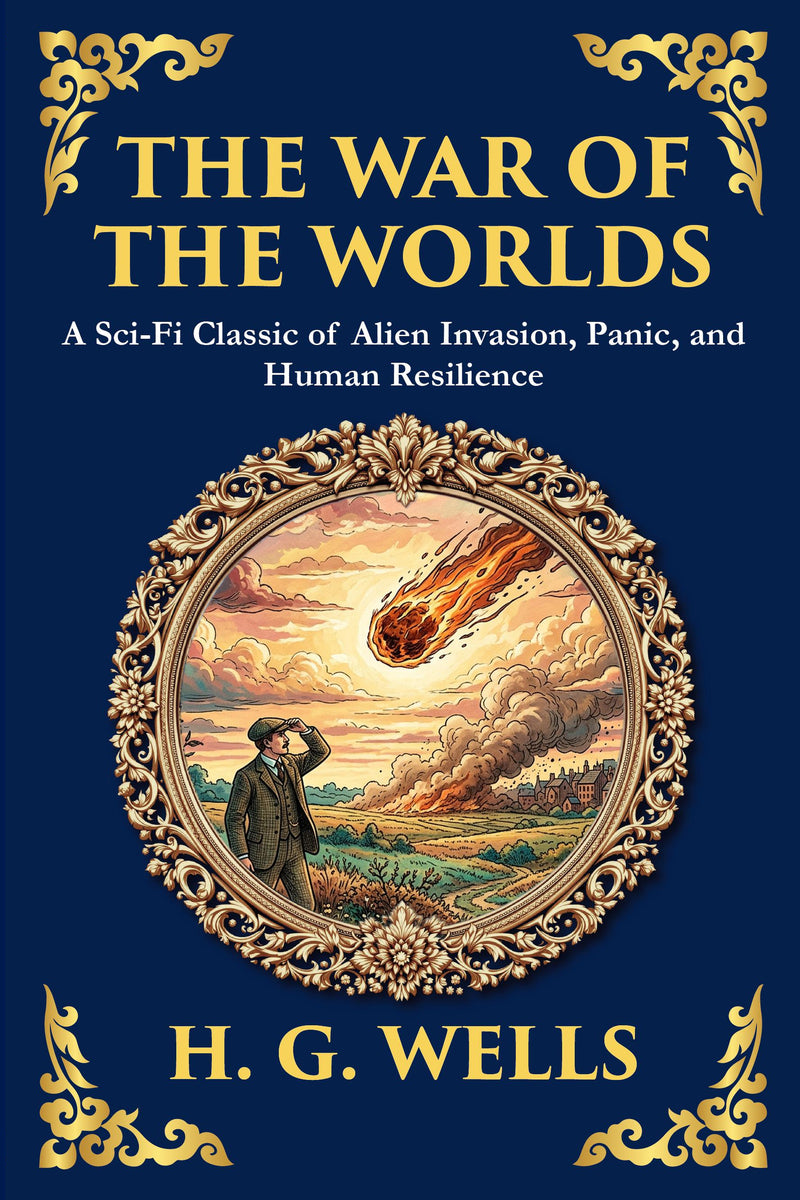
The War of the Worlds
From the moment the cylinders crash to Earth, humanity is no longer alone—and no longer safe. The War of the Worlds is H. G. Wells’ groundbreaking tale of an alien invasion that strikes fear into the heart of Victorian England and continues to thrill readers to this day.
or free app
10,000+ hrs library
30-day guarantee
The complete The War of the Worlds appears in modern English through Library of Alexandria Press, available online with audiobook narration included for members.
Have you ever wondered why the greatest threats come not from monsters—but from our unpreparedness? The War of the Worlds is a visionary classic that not only defined the alien invasion genre but also reshaped science fiction for generations. First published in 1898, this electrifying novel by H. G. Wells imagines the Earth under siege by a technologically superior Martian race—and humanity’s desperate struggle for survival.
Told through the eyes of a nameless narrator, the story unfolds with chilling immediacy as alien cylinders land across England. From the quiet countryside to the heart of London, fear spreads faster than the Martian heat rays. With every page, readers feel the collapse of society, the unraveling of order, and the haunting question: What does it mean to be human when the world turns to chaos?
This modern edition presents Wells’ prophetic storytelling with clarity and intensity, making his warnings and insights more relevant than ever.
What you’ll discover in this modern edition
- A Groundbreaking Tale of First Contact – Witness the terrifying moment when humans realize they are not alone.
- An Exploration of Civilization Under Threat – See how societies crumble and individuals rise (or fall) in crisis.
- Unforgettable Imagery and Suspense – Experience iconic scenes: towering tripods, black smoke, and the desolate streets of London.
- A Timeless Reflection on Imperialism and Humanity – Engage with Wells’ subtle critiques of colonization and human arrogance.
- A Sci-Fi Story That Feels Shockingly Modern – With themes of survival, adaptation, and resistance that echo into today.
| Formats | eBook (EPUB + PDF) · Audiobook · Paperback · Hardcover · Large Print |
| Language | English |
| Trim size (print) | 6 × 9 in |
| Binding | Paperback — perfect-bound · Hardcover — casewrap |
| Large Print edition | Same text in a larger, easy-read type — a larger font, not a larger trim |
| Print pricing | Every physical book at our true cost — at-cost, no profit (members) |
| Library | 873 restored titles, always growing |
| Length | 59,922 words · ~4 hr 0 min reading |
| Reading level | Grade 8 · an easy, flowing read (this modern-English edition) |
| Edition | Modern English translation · 2026 |
Member reviews for this edition are collected as readers finish it — be the first. Across the library: 12,000+ books shipped, every plan covered by a 365-day print guarantee.
About this edition
A faithful, unabridged modern-English edition by The Library of Alexandria — carefully rendered for today's reader and verified paragraph-by-paragraph against the public-domain source. Available as eBook, audiobook, paperback, hardcover, and large print.
- Complete & unabridgedVerified paragraph by paragraph against the source — never a scan, never abridged.
- Modern English, faithfulReadable today, with the author’s meaning kept intact. Readable — not simplified.
- Every format, one membershipRead in your browser or the free app, or listen to the full audiobook.
Included free with your membership
Cancel anytime, one click · 30-day money-back guarantee
Edition last updated July 2026
What’s inside
The War of the Worlds — complete and unabridged: all 20 sections included with membership, plus the full audiobook.
Begin reading The War of the Worlds
In clear modern English — the complete text is included with membership.
Introduction
When The War of the Worlds first appeared in serialized form in 1897, it arrived in a world brimming with confidence. The British Empire spanned the globe, technology was advancing at a dizzying pace, and the human race—particularly its Western, industrialized branch—had grown comfortable in the belief that it stood at the summit of creation. Into this self-assured age, H. G. Wells dropped a single, terrifying idea: what if humanity were not the apex of intelligence in the universe? What if, somewhere out in the cold darkness of space, there existed beings who regarded us the way we regard the insects we crush beneath our boots—or worse, the way we regard livestock to be harvested?
That question, posed with chilling calm in the opening pages, would echo across more than a century of fiction, film, radio, and the collective human imagination. The novel you are about to read is not merely the grandfather of the alien invasion genre; it is the genre’s blueprint, its founding scripture, the work against which every subsequent tale of extraterrestrial menace has been measured. Yet to reduce it to a historical curiosity—a quaint Victorian thrill-ride to be admired from a safe distance—would be a grave mistake. Beneath its surface of tripod war-machines and heat-rays lies something far more enduring and unsettling: a meditation on power, on vulnerability, and on the fragile illusions we tell ourselves about our place in the order of things.
This particular edition presents the story in a modern translation, carefully adapted for the contemporary reader. The intention behind such an adaptation is not to diminish or “dumb down” the original genius of Wells’s prose, but to clear away the linguistic underbrush that can, for some modern readers, obscure the breathtaking momentum of the narrative. Victorian sentence structures, antiquated turns of phrase, and references that have faded from common knowledge can create distance between a reader and a story that deserves to feel immediate, urgent, and alive. The aim here is to let the terror breathe—to allow the relentless pace, the mounting dread, and the philosophical weight of Wells’s vision to reach you as freshly and forcefully as they reached the panic-stricken Londoners who first devoured these pages. What remains is the essential Wells: the cool, observational narrator; the methodical escalation of catastrophe; the unforgettable images that have lodged themselves permanently in our cultural memory.
To understand why this slim novel has cast such a long shadow, one must understand the extraordinary man who wrote it. Herbert George Wells was born in 1866 in Bromley, Kent, into circumstances that gave him an intimate, lifelong awareness of how precarious human fortunes could be. His father was a struggling shopkeeper and part-time professional cricketer; his mother was a domestic servant. As a boy, young Bertie suffered a broken leg that confined him to bed for an extended period—an accident that proved, in a strange way, to be the making of him. With nothing else to do, he read voraciously, devouring everything within reach and discovering the boundless worlds that books could open. That early immersion in reading planted seeds that would later blossom into one of the most influential literary careers of the modern age.
Wells’s path to authorship was anything but straightforward. He worked as a draper’s apprentice, a job he loathed and which left him with a deep, abiding sympathy for ordinary working people trapped in lives of drudgery. He clawed his way into education through scholarships, eventually studying biology under Thomas Henry Huxley—the famous champion of Darwin known as “Darwin’s Bulldog”—at the Normal School of Science in London. This scientific training would prove absolutely central to everything Wells later wrote. Unlike the fantasists who preceded him, Wells approached the impossible with the rigor of a trained scientist. When he imagined invaders from Mars, he did not conjure them from pure fancy; he reasoned them into existence, asking what kind of biology, what kind of technology, what kind of evolutionary pressures might produce such creatures, and what the cold logic of natural selection might mean for a species that found itself outmatched.
This is the secret ingredient that elevates the work above mere sensationalism. Wells understood Darwin not as an abstract theory but as a brutal, indifferent engine that had shaped every living thing—including humanity. The Darwinian principle that life is a ceaseless struggle for survival, that the strong displace the weak, that adaptation is everything and sentiment counts for nothing, runs through the entire narrative like a current of ice water. The terrible question the novel forces upon us is this: if these laws governed our own ascent to dominance, by what right do we expect to be exempt from them? If we have driven other species to extinction without a moment’s moral hesitation, on what grounds can we protest when a superior intelligence treats us with the same indifference?
It is worth pausing to appreciate just how radical and prophetic Wells’s imagination truly was. Writing at the very dawn of the twentieth century, before the airplane, before tanks rolled across battlefields, before the horrors of chemical warfare and the atomic bomb, Wells conjured images of mechanized destruction so vivid and so prescient that they would later seem like premonitions. The poison gas, the armored fighting vehicles, the aerial dominance, the obliteration of entire populations by weapons against which conventional armies are helpless—all of these would become grim realities in the world wars that followed within Wells’s own lifetime. He was not merely inventing entertainment; he was, whether consciously or not, sketching the contours of the coming century’s nightmares. Few writers in history have demonstrated such an uncanny ability to peer beyond the horizon of their own time.
But Wells was no mere doomsayer. He was, throughout his long and prolific career, a passionate believer in human potential and an advocate for social progress, education, and a more rational organization of society. He wrote scores of books across an astonishing range of subjects—science fiction, of course, but also realist novels, sweeping histories, political tracts, and works of social commentary. He coined or popularized concepts that have become commonplace in our thinking about the future. His scientific romances of the 1890s—including The Time Machine, The Island of Doctor Moreau, and The Invisible Man—established him as a literary pioneer, but it was the tale of the Martian invasion that perhaps best captured the dual nature of his genius: his gift for spine-tingling spectacle married to his unflinching willingness to interrogate humanity’s deepest assumptions about itself.
There is a moral dimension to all of this that rewards close attention as you read. Wells was a fierce critic of imperialism, and it is no accident that a story about technologically superior beings arriving to conquer and exploit a “lesser” people appeared at the height of British colonial expansion. In the famous opening passages, Wells explicitly invites his readers—comfortable citizens of an empire that had subjugated peoples across the globe—to consider how their own conquests might appear from the other side. He references the fate of the Tasmanians, an indigenous people effectively annihilated by European colonizers, and asks whether the Martians’ treatment of humanity is really any different from how “civilized” Europeans had behaved toward those they deemed inferior. This is a stunning act of moral provocation, all the more powerful for being delivered without sermonizing. The mirror Wells holds up is not flattering, and the discomfort it produces is entirely deliberate. As you follow the narrator’s flight from the advancing terror, you may find yourself reflecting that the true horror of the story lies not only in the alien menace but in the recognition that humanity has played the role of the merciless invader many times over in its own history.
What makes this novel work so brilliantly, even now, more than a hundred and twenty years after its first publication, is the masterful craft with which Wells builds and sustains a mood of escalating terror. There is a great deal that modern thriller writers and horror filmmakers could still learn from his technique, and reading the book with an eye to its construction reveals just how deliberate and sophisticated its effects truly are.
Consider, first, the narrator. Wells made a crucial choice in telling this story through the eyes of an ordinary, unnamed man—a writer of philosophical essays living in the quiet suburbs—rather than a soldier, a scientist-hero, or a man of action. This decision is fundamental to the book’s power. Our guide through the catastrophe is not equipped to save the world; he can barely save himself. He observes, he flees, he hides, he despairs, he occasionally acts with courage and more often with simple, desperate instinct. He is, in other words, exactly like us. We experience the invasion not from the lofty vantage of command headquarters but from ground level, in the dust and confusion and panic of an ordinary person watching his familiar world dissolve into chaos. This intimacy of perspective is what makes the dread so visceral. We are not watching the apocalypse on a screen; we are running through the fields with our hearts pounding.
The narrator’s tone, too, is a marvel of calculated effect. He recounts the most horrifying events with a kind of detached, almost scientific precision, as though he were a naturalist recording observations in a field journal. This restraint is far more frightening than hysteria would be. When the narrator describes the methodical advance of the invaders, the systematic destruction of towns and cities, the casual extermination of human beings, his very calmness underscores the helplessness of the situation. There is no rousing music, no defiant speeches, no comforting reassurance that the heroes will prevail. There is only the cold, clear-eyed documentation of a disaster unfolding with terrible inevitability. This is journalism from the end of the world, and its dispassionate quality makes the underlying horror all the more potent.
Wells also understood, with an instinct that predated the entire vocabulary of cinematic suspense, the power of the slow reveal. The story does not open with the world already in flames. It opens with quiet—with astronomical observations, with a falling star, with curious onlookers gathering around a strange cylinder in a sandpit. The threat emerges gradually, almost imperceptibly at first, so that we share the characters’ initial inability to comprehend the scale of what is happening. There is a maddening, all-too-human tendency in the early scenes for people to assume that things will return to normal, that the authorities have matters in hand, that this disruption is temporary and manageable. We watch ordinary life continue—trains running, newspapers printing, people going about their business—even as catastrophe gathers at the edges of perception. This gap between the magnitude of the danger and the public’s failure to grasp it generates an almost unbearable tension. We, the readers, can see what is coming, and we want to scream a warning to the oblivious characters who continue to underestimate the threat.
The pacing throughout is relentless once the action begins in earnest. Wells alternates between scenes of frantic motion and scenes of claustrophobic stillness, between vast panoramas of destruction and tight, suffocating moments of hiding and waiting. There is a long central section in which the narrator finds himself trapped in confined quarters, forced into proximity with another survivor whose psychological deterioration provides some of the book’s most harrowing and humane moments. Here Wells turns his attention from external spectacle to the internal collapse of the human spirit under unbearable pressure, exploring how different people respond to the destruction of everything they have known. Some break entirely. Some retreat into denial or grandiose fantasy. Some cling to faith, others to rage, others to a kind of numb, animal will to survive. These passages reveal Wells’s deep interest in human psychology and his refusal to offer simple comfort. He knew that the true test of catastrophe is not merely physical survival but the preservation of one’s sanity and humanity amid horror.
Cancel anytime, one click · 30-day money-back guarantee
Founding annual rate available now — your price locks for life when you join.
Not ready? Get this free chapter by email — read it anytime.
✓ Sent — check your inbox for The War of the Worlds.
Questions about The War of the Worlds
What is The War of the Worlds about?
From the moment the cylinders crash to Earth, humanity is no longer alone—and no longer safe. The War of the Worlds is H. G. Wells’ groundbreaking tale of an alien invasion that strikes fear into the heart of Victorian England and continues to thrill readers to this day. As Martian tripods rise from the countryside, leaving destruction in their wake, the world witnesses the fragility of civilization and the resilience of the human spirit.
Who wrote The War of the Worlds?
The War of the Worlds was written by H. G. Wells. This edition presents the complete work in clear modern English, faithfully rendered from the public-domain original by Library of Alexandria Press.
Is The War of the Worlds free to read?
The opening chapter is free to read on this page. Members read and listen to the complete work — and the entire library — free, and can order any physical book at our true print cost.
How long is The War of the Worlds?
20 chapters (~59,922 words) — about 4 hr 0 min of reading in this modern-English edition.
Is this an abridged version of The War of the Worlds?
No. This is the complete, unabridged The War of the Worlds, carefully rendered into clear modern English and verified paragraph-by-paragraph against the public-domain source — nothing is cut or summarised.
What formats does The War of the Worlds come in?
The War of the Worlds is available as eBook, paperback, hardcover and large print. eBook and audiobook are included with membership; printed editions ship at our true print cost.
Shipping & returns
Billing & membership
More from the library


Explore Military & Strategy
- The Belle of Bowling Green · Amelia E. Barr
- Give Me Liberty or Give Me Death · Patrick Henry
- The Thirty-Nine Steps · John Buchan
- Julius Caesar · William Shakespeare
- Rilla of Ingleside · L. M. Montgomery
- Troilus and Criseyde · Geoffrey Chaucer
- The Adventures of Heine · Edgar Wallace
- The Declaration of Independence of the United States of America · Thomas Jefferson
- Armageddon—2419 A.D. · Philip Francis Nowlan
- The Variable Man · Philip K. Dick
- Arms and the Man · Bernard Shaw
- South Africa and the Transvaal War, Vol. 2 (of 8) · Louis Creswicke
- The Red Badge of Courage: An Episode of the American Civil War · Stephen Crane
- Second Variety · Philip K. Dick
- Lysistrata · Aristophanes
- The Iliad · Homer
- A Matter of Proportion · Anne Walker
- This Side of Paradise · F. Scott Fitzgerald
The War of the Worlds
The War of the Worlds
A Sci-Fi Classic of Alien Invasion, Panic, and Human Resilience
H. G. Wells
Contents
- Introduction
- Book 1
- Chapter 1
- Chapter 2
- Chapter 3
- Chapter 4
- Chapter 5
- Chapter 6
- Chapter 7
- Chapter 8
- Chapter 9
- Chapter 10
- Chapter 11
- Chapter 12
- Chapter 13
- Chapter 14
- Chapter 15
- Chapter 16
- Chapter 17
- Book 2
Introduction
When The War of the Worlds first appeared in serialized form in 1897, it arrived in a world brimming with confidence. The British Empire spanned the globe, technology was advancing at a dizzying pace, and the human race—particularly its Western, industrialized branch—had grown comfortable in the belief that it stood at the summit of creation. Into this self-assured age, H. G. Wells dropped a single, terrifying idea: what if humanity were not the apex of intelligence in the universe? What if, somewhere out in the cold darkness of space, there existed beings who regarded us the way we regard the insects we crush beneath our boots—or worse, the way we regard livestock to be harvested?
That question, posed with chilling calm in the opening pages, would echo across more than a century of fiction, film, radio, and the collective human imagination. The novel you are about to read is not merely the grandfather of the alien invasion genre; it is the genre’s blueprint, its founding scripture, the work against which every subsequent tale of extraterrestrial menace has been measured. Yet to reduce it to a historical curiosity—a quaint Victorian thrill-ride to be admired from a safe distance—would be a grave mistake. Beneath its surface of tripod war-machines and heat-rays lies something far more enduring and unsettling: a meditation on power, on vulnerability, and on the fragile illusions we tell ourselves about our place in the order of things.
This particular edition presents the story in a modern translation, carefully adapted for the contemporary reader. The intention behind such an adaptation is not to diminish or “dumb down” the original genius of Wells’s prose, but to clear away the linguistic underbrush that can, for some modern readers, obscure the breathtaking momentum of the narrative. Victorian sentence structures, antiquated turns of phrase, and references that have faded from common knowledge can create distance between a reader and a story that deserves to feel immediate, urgent, and alive. The aim here is to let the terror breathe—to allow the relentless pace, the mounting dread, and the philosophical weight of Wells’s vision to reach you as freshly and forcefully as they reached the panic-stricken Londoners who first devoured these pages. What remains is the essential Wells: the cool, observational narrator; the methodical escalation of catastrophe; the unforgettable images that have lodged themselves permanently in our cultural memory.
To understand why this slim novel has cast such a long shadow, one must understand the extraordinary man who wrote it. Herbert George Wells was born in 1866 in Bromley, Kent, into circumstances that gave him an intimate, lifelong awareness of how precarious human fortunes could be. His father was a struggling shopkeeper and part-time professional cricketer; his mother was a domestic servant. As a boy, young Bertie suffered a broken leg that confined him to bed for an extended period—an accident that proved, in a strange way, to be the making of him. With nothing else to do, he read voraciously, devouring everything within reach and discovering the boundless worlds that books could open. That early immersion in reading planted seeds that would later blossom into one of the most influential literary careers of the modern age.
Wells’s path to authorship was anything but straightforward. He worked as a draper’s apprentice, a job he loathed and which left him with a deep, abiding sympathy for ordinary working people trapped in lives of drudgery. He clawed his way into education through scholarships, eventually studying biology under Thomas Henry Huxley—the famous champion of Darwin known as “Darwin’s Bulldog”—at the Normal School of Science in London. This scientific training would prove absolutely central to everything Wells later wrote. Unlike the fantasists who preceded him, Wells approached the impossible with the rigor of a trained scientist. When he imagined invaders from Mars, he did not conjure them from pure fancy; he reasoned them into existence, asking what kind of biology, what kind of technology, what kind of evolutionary pressures might produce such creatures, and what the cold logic of natural selection might mean for a species that found itself outmatched.
This is the secret ingredient that elevates the work above mere sensationalism. Wells understood Darwin not as an abstract theory but as a brutal, indifferent engine that had shaped every living thing—including humanity. The Darwinian principle that life is a ceaseless struggle for survival, that the strong displace the weak, that adaptation is everything and sentiment counts for nothing, runs through the entire narrative like a current of ice water. The terrible question the novel forces upon us is this: if these laws governed our own ascent to dominance, by what right do we expect to be exempt from them? If we have driven other species to extinction without a moment’s moral hesitation, on what grounds can we protest when a superior intelligence treats us with the same indifference?
It is worth pausing to appreciate just how radical and prophetic Wells’s imagination truly was. Writing at the very dawn of the twentieth century, before the airplane, before tanks rolled across battlefields, before the horrors of chemical warfare and the atomic bomb, Wells conjured images of mechanized destruction so vivid and so prescient that they would later seem like premonitions. The poison gas, the armored fighting vehicles, the aerial dominance, the obliteration of entire populations by weapons against which conventional armies are helpless—all of these would become grim realities in the world wars that followed within Wells’s own lifetime. He was not merely inventing entertainment; he was, whether consciously or not, sketching the contours of the coming century’s nightmares. Few writers in history have demonstrated such an uncanny ability to peer beyond the horizon of their own time.
But Wells was no mere doomsayer. He was, throughout his long and prolific career, a passionate believer in human potential and an advocate for social progress, education, and a more rational organization of society. He wrote scores of books across an astonishing range of subjects—science fiction, of course, but also realist novels, sweeping histories, political tracts, and works of social commentary. He coined or popularized concepts that have become commonplace in our thinking about the future. His scientific romances of the 1890s—including The Time Machine, The Island of Doctor Moreau, and The Invisible Man—established him as a literary pioneer, but it was the tale of the Martian invasion that perhaps best captured the dual nature of his genius: his gift for spine-tingling spectacle married to his unflinching willingness to interrogate humanity’s deepest assumptions about itself.
There is a moral dimension to all of this that rewards close attention as you read. Wells was a fierce critic of imperialism, and it is no accident that a story about technologically superior beings arriving to conquer and exploit a “lesser” people appeared at the height of British colonial expansion. In the famous opening passages, Wells explicitly invites his readers—comfortable citizens of an empire that had subjugated peoples across the globe—to consider how their own conquests might appear from the other side. He references the fate of the Tasmanians, an indigenous people effectively annihilated by European colonizers, and asks whether the Martians’ treatment of humanity is really any different from how “civilized” Europeans had behaved toward those they deemed inferior. This is a stunning act of moral provocation, all the more powerful for being delivered without sermonizing. The mirror Wells holds up is not flattering, and the discomfort it produces is entirely deliberate. As you follow the narrator’s flight from the advancing terror, you may find yourself reflecting that the true horror of the story lies not only in the alien menace but in the recognition that humanity has played the role of the merciless invader many times over in its own history.
What makes this novel work so brilliantly, even now, more than a hundred and twenty years after its first publication, is the masterful craft with which Wells builds and sustains a mood of escalating terror. There is a great deal that modern thriller writers and horror filmmakers could still learn from his technique, and reading the book with an eye to its construction reveals just how deliberate and sophisticated its effects truly are.
Consider, first, the narrator. Wells made a crucial choice in telling this story through the eyes of an ordinary, unnamed man—a writer of philosophical essays living in the quiet suburbs—rather than a soldier, a scientist-hero, or a man of action. This decision is fundamental to the book’s power. Our guide through the catastrophe is not equipped to save the world; he can barely save himself. He observes, he flees, he hides, he despairs, he occasionally acts with courage and more often with simple, desperate instinct. He is, in other words, exactly like us. We experience the invasion not from the lofty vantage of command headquarters but from ground level, in the dust and confusion and panic of an ordinary person watching his familiar world dissolve into chaos. This intimacy of perspective is what makes the dread so visceral. We are not watching the apocalypse on a screen; we are running through the fields with our hearts pounding.
The narrator’s tone, too, is a marvel of calculated effect. He recounts the most horrifying events with a kind of detached, almost scientific precision, as though he were a naturalist recording observations in a field journal. This restraint is far more frightening than hysteria would be. When the narrator describes the methodical advance of the invaders, the systematic destruction of towns and cities, the casual extermination of human beings, his very calmness underscores the helplessness of the situation. There is no rousing music, no defiant speeches, no comforting reassurance that the heroes will prevail. There is only the cold, clear-eyed documentation of a disaster unfolding with terrible inevitability. This is journalism from the end of the world, and its dispassionate quality makes the underlying horror all the more potent.
Wells also understood, with an instinct that predated the entire vocabulary of cinematic suspense, the power of the slow reveal. The story does not open with the world already in flames. It opens with quiet—with astronomical observations, with a falling star, with curious onlookers gathering around a strange cylinder in a sandpit. The threat emerges gradually, almost imperceptibly at first, so that we share the characters’ initial inability to comprehend the scale of what is happening. There is a maddening, all-too-human tendency in the early scenes for people to assume that things will return to normal, that the authorities have matters in hand, that this disruption is temporary and manageable. We watch ordinary life continue—trains running, newspapers printing, people going about their business—even as catastrophe gathers at the edges of perception. This gap between the magnitude of the danger and the public’s failure to grasp it generates an almost unbearable tension. We, the readers, can see what is coming, and we want to scream a warning to the oblivious characters who continue to underestimate the threat.
The pacing throughout is relentless once the action begins in earnest. Wells alternates between scenes of frantic motion and scenes of claustrophobic stillness, between vast panoramas of destruction and tight, suffocating moments of hiding and waiting. There is a long central section in which the narrator finds himself trapped in confined quarters, forced into proximity with another survivor whose psychological deterioration provides some of the book’s most harrowing and humane moments. Here Wells turns his attention from external spectacle to the internal collapse of the human spirit under unbearable pressure, exploring how different people respond to the destruction of everything they have known. Some break entirely. Some retreat into denial or grandiose fantasy. Some cling to faith, others to rage, others to a kind of numb, animal will to survive. These passages reveal Wells’s deep interest in human psychology and his refusal to offer simple comfort. He knew that the true test of catastrophe is not merely physical survival but the preservation of one’s sanity and humanity amid horror.
In the final years of the nineteenth century, no one would have believed that our world was being watched closely by intelligences greater than our own, yet just as mortal. While humans went about their daily business, they were being studied—perhaps as intently as a scientist with a microscope examines the tiny creatures swarming in a drop of water. With total confidence, people traveled the globe attending to their small affairs, certain that they were the masters of the physical world. It is likely that the microbes under a microscope feel the same way. No one considered the older worlds of space as a source of danger; if they thought of them at all, they dismissed the idea of alien life as impossible or unlikely. It is strange to look back at the mindset of those days. At most, people imagined there might be other humans on Mars—likely inferior beings who would welcome missionaries from Earth. Yet across the void of space, minds that make ours look like those of dying animals—vast, cold, and unsympathetic intellects—watched this earth with envy and slowly, surely, plotted against us. Then, early in the twentieth century, came the great awakening.
I hardly need remind the reader that Mars revolves around the sun at an average distance of 140 million miles, receiving barely half the light and heat that Earth does. If the nebular hypothesis is correct, Mars must be older than our world; life there likely began long before Earth stopped being a molten mass. Because Mars is only about one-seventh the volume of Earth, it probably cooled faster, reaching a temperature that allowed life to start sooner. It has air, water, and everything necessary to support living beings.
End of the free sample
Keep reading, free
Members read and listen to the complete book — and the entire library. Cancel anytime, one click · 30-day money-back guarantee.