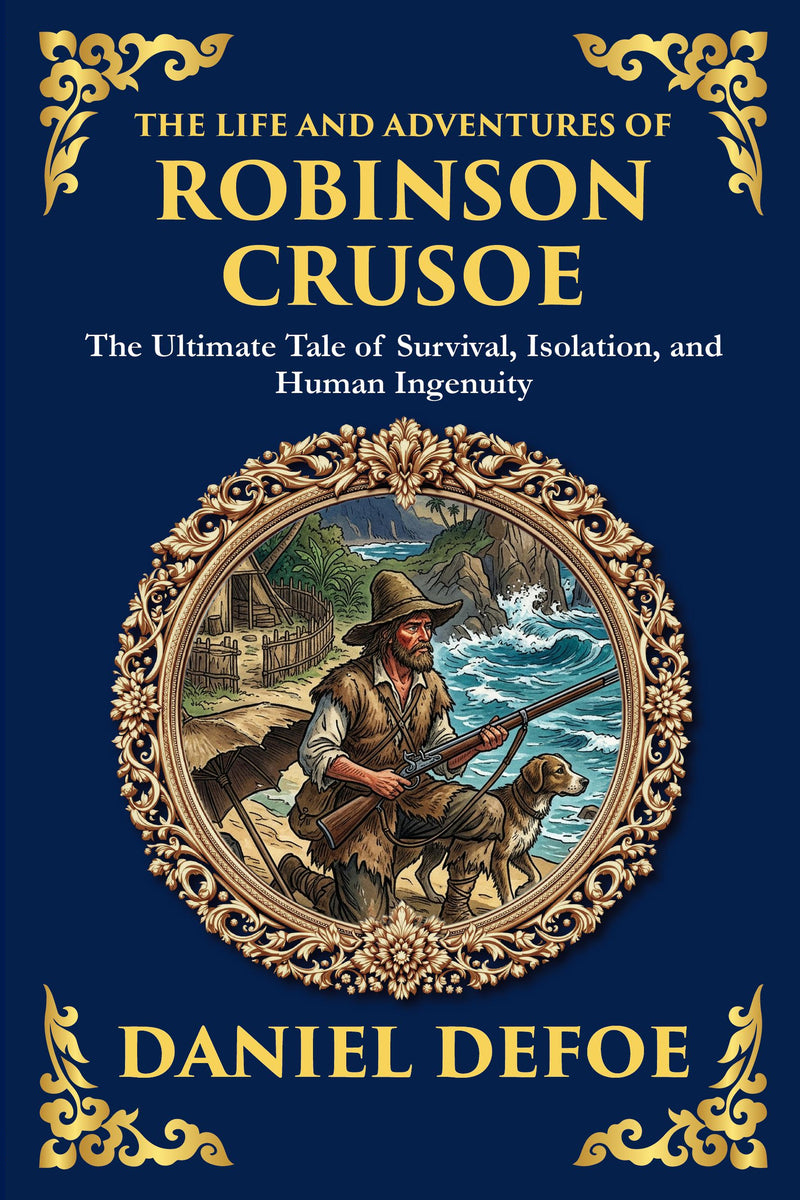
The Life and Adventures of Robinson Crusoe
Shipwrecked. Alone. Doomed—or destined? In The Life and Adventures of Robinson Crusoe, Daniel Defoe tells the gripping tale of one man’s incredible journey from shipwreck survivor to master of his own island.
or free app
10,000+ hrs library
30-day guarantee
The complete The Life and Adventures of Robinson appears in modern English through Library of Alexandria Press, available online with audiobook narration included for members.
Have you ever wondered why isolation reveals our truest selves? The Life and Adventures of Robinson Crusoe stands as one of the earliest and most influential novels in the English language. Part gripping survival story, part philosophical exploration, Daniel Defoe’s masterpiece takes us deep into the soul of a man forced to redefine life, faith, and humanity itself.
When Crusoe is shipwrecked on a deserted island, he is stripped of everything—home, comfort, society. Armed with nothing but his will and scattered remnants from the wreckage, he must forge a new life from nature’s unforgiving elements. But survival is only the beginning.
As the years stretch on, Crusoe builds shelter, grows food, defends himself against danger, and slowly reclaims control over a life once thought lost. His encounters with cannibals, mutineers, and his faithful companion Friday deepen the novel’s enduring exploration of civilization, morality, religion, and redemption. More than just an adventure story, Robinson Crusoe is a timeless meditation on solitude, perseverance, and the power of human ingenuity.
What you’ll discover in this modern edition
- The Ultimate Survival Adventure – Follow Crusoe’s transformation from victim of fate to ruler of his island.
- A Groundbreaking Classic – One of the very first novels of modern literature, inspiring generations of explorers and storytellers.
- An Unforgettable Castaway Journey – From shipwreck to salvation, witness every challenge and triumph in vivid detail.
- Spiritual and Philosophical Insights – Reflect on themes of providence, faith, and human destiny amidst hardship.
- A Story of Human Mastery Over Nature – See how one man’s ingenuity shapes an untamed world into a new kind of home.
| Formats | eBook (EPUB + PDF) · Audiobook · Paperback · Hardcover · Large Print |
| Language | English |
| Trim size (print) | 6 × 9 in |
| Binding | Paperback — perfect-bound · Hardcover — casewrap |
| Large Print edition | Same text in a larger, easy-read type — a larger font, not a larger trim |
| Print pricing | Every physical book at our true cost — at-cost, no profit (members) |
| Library | 873 restored titles, always growing |
| Length | 105,152 words · ~7 hr 1 min reading |
| Reading level | Grade 6 · an easy, flowing read (this modern-English edition) |
| Edition | Modern English translation · 2026 |
Member reviews for this edition are collected as readers finish it — be the first. Across the library: 12,000+ books shipped, every plan covered by a 365-day print guarantee.
About this edition
A faithful, unabridged modern-English edition by The Library of Alexandria — carefully rendered for today's reader and verified paragraph-by-paragraph against the public-domain source. Available as eBook, audiobook, paperback, hardcover, and large print.
- Complete & unabridgedVerified paragraph by paragraph against the source — never a scan, never abridged.
- Modern English, faithfulReadable today, with the author’s meaning kept intact. Readable — not simplified.
- Every format, one membershipRead in your browser or the free app, or listen to the full audiobook.
Included free with your membership
Cancel anytime, one click · 30-day money-back guarantee
Edition last updated July 2026
What’s inside
The Life and Adventures of Robinson Crusoe — complete and unabridged: all 21 sections included with membership, plus the full audiobook.
Begin reading The Life and Adventures of Robinson Crusoe
In clear modern English — the complete text is included with membership.
Introduction
When a book survives for more than three hundred years, passing through the hands of countless generations, translated into nearly every language on earth, and reborn endlessly in adaptations, retellings, and homages, it has earned a special kind of immortality. Robinson Crusoe is precisely that sort of book. First published in 1719, it arrived at a moment when the very idea of the modern novel was still taking shape, and in many ways it helped to shape it. To open these pages is to step into one of the foundational stories of Western literature, a tale so deeply woven into our collective imagination that even those who have never read a single word of it carry some image of its hero—a lone figure on a deserted shore, surveying an empty horizon, learning to make a life out of nothing.
This particular edition has been prepared as a modern translation, carefully adapted for the contemporary reader. That phrase deserves a moment of explanation, because it speaks directly to the experience you are about to have. Daniel Defoe wrote in the early eighteenth century, and the English of his time, while powerful and vivid, can present obstacles to a modern audience. His original sentences often ran to extraordinary lengths, stacked with clauses and asides, punctuated according to conventions that no longer match our habits of reading. Spelling, vocabulary, and turns of phrase that were perfectly natural to a reader in 1719 can today create distance, friction, and fatigue. The aim of this adaptation is to remove those obstacles without diminishing the spirit, intelligence, and emotional weight of the story. What remains is the essence of Defoe’s masterpiece, rendered in language that flows naturally for the reader of today, so that the adventure can unfold with all its original urgency and none of its archaic difficulty.
It is worth saying clearly: a faithful modern adaptation is not a simplification. The goal is not to dumb the book down but to open it up—to let the drama, the tension, the loneliness, and the triumph reach you directly, unmediated by the linguistic distance of three centuries. The story Defoe told is timeless. The way he told it was, inevitably, of its era. This edition seeks to honor the former while gently updating the latter, giving you the best of both: the enduring genius of the original and the accessibility of contemporary prose.
One of the most fascinating aspects of this book is that it did not spring entirely from Defoe’s imagination. The seed of the story lay in real events, in the documented experiences of sailors who found themselves cast away in distant and inhospitable places. The most famous of these was a Scottish sailor named Alexander Selkirk, who, after a quarrel with his captain, was put ashore on an uninhabited island in the Pacific in 1704. He survived there alone for more than four years before being rescued, and his ordeal became a sensation when he returned to Britain. Accounts of his solitude, his ingenuity, and his struggle to keep his sanity circulated widely, and they almost certainly influenced Defoe as he conceived his tale.
Yet Defoe did far more than transcribe a survival story. He took the bare facts of castaway life and transformed them into something richer and more universal: a meditation on what it means to be human, to be alone, to lose everything and slowly, painstakingly, build it back. The genius of the book is not merely in its depiction of survival, though that depiction is remarkable in its detail. It is in the way the author uses the situation of a solitary man on an island to explore questions that touch every reader’s life. What do we truly need to survive? What do we need to be content? How does a person endure isolation without losing themselves? What is the relationship between work and dignity, between fear and faith, between self-reliance and the deep human longing for companionship?
Defoe wrote at a time of enormous expansion and uncertainty. England was becoming a global maritime power, its ships venturing to every corner of the known world, its merchants and adventurers seeking fortune across vast oceans. The age was full of stories of shipwreck, piracy, exotic lands, and unimaginable dangers. Defoe himself was a man of his time in the fullest sense—a merchant, a journalist, a pamphleteer, a sometime spy, a man who knew bankruptcy and imprisonment and the precariousness of fortune. He understood risk and ruin from the inside, and that hard-won knowledge infuses every page of this book. When his hero loses everything and must start over with only his wits and whatever he can salvage, Defoe wrote with the authority of someone who knew what it meant to be brought low and to claw one’s way back.
This blend of real-world grounding and imaginative power is part of what made the book so revolutionary. Readers in 1719 had never encountered anything quite like it. Defoe presented the story not as an obvious fiction but as a true memoir, written by the man who had lived it. The realism was so convincing, the detail so precise, that many early readers believed it to be a genuine account. This was no accident. Defoe was pioneering a new way of telling stories—one that prized the texture of ordinary, plausible experience over the heightened fantasy of older forms of narrative. He gave us the inventory of a salvaged ship, the labor of building a shelter, the slow trial and error of growing food and taming animals. He showed us a man thinking through his problems step by methodical step. In doing so, he helped invent the modern novel itself, and the influence of his approach can be traced through three centuries of literature that followed.
To read this book, then, is to encounter not only a thrilling adventure but a turning point in the history of storytelling. You are reading a work that taught later writers how to make fiction feel real, how to make an ordinary man into a hero, and how to find drama in the simple, relentless struggle to stay alive and to make meaning out of circumstance.
There is something deeply satisfying about the practical genius the book celebrates. Much of its enduring appeal lies in watching its protagonist confront problem after problem and slowly, ingeniously solve them. How do you build a home with no tools? How do you preserve food, make clothing, keep track of time, defend yourself against the unknown? The book is, among many other things, a tribute to human resourcefulness—to the capacity of a single determined mind to bend a hostile environment to its will. There is a reason that countless readers across the centuries have come away from this story feeling strangely empowered, as if they too could survive anything, build anything, endure anything. The hero’s victories are small and hard-won, and that is exactly why they feel so real and so inspiring.
But the book is not only about ingenuity. It is also, profoundly, about the inner life. Stripped of society, of conversation, of every distraction and convenience, the protagonist is thrown back entirely upon himself. The story becomes an extended exploration of solitude—of what happens to the human spirit when it is deprived of company for years on end. There are passages of despair and passages of unexpected peace, moments of crushing loneliness and moments of profound gratitude. The hero wrestles with fear, with regret, with the great existential questions that arise when a person has nothing but time and silence in which to think. In this sense, the island becomes a kind of mirror, reflecting back the deepest concerns of any thoughtful human being. We may never be cast away on a tropical shore, but we all know something of loneliness, of self-doubt, of the search for purpose and meaning. The book speaks to all of these, and that is one reason it has never lost its hold on readers.
Approaching a classic of this age requires a certain spirit, and a few words of guidance may enrich your experience. The first and most important thing to understand is that the pace of this story is different from that of a modern thriller. Defoe was not writing for an audience accustomed to rapid cuts and constant action. He was writing for readers who savored detail, who took pleasure in the careful accumulation of fact and observation. There are stretches of this book that move slowly and deliberately, that linger over the minutiae of daily survival—the planting of a crop, the construction of a tool, the patient taming of a beast. Some modern readers, conditioned to expect breathless momentum, may at first find this measured rhythm unfamiliar. I encourage you to surrender to it rather than resist it.
There is a particular and unexpected pleasure to be found in this slower pace. As you settle into the story, you will discover that the very accumulation of detail is what makes the island feel so vividly real, and what makes the hero’s gradual mastery of his situation so deeply satisfying. You begin to feel the passage of time as he feels it. You begin to understand the value of every small object, every hard-won skill. The slowness is not a flaw; it is essential to the book’s effect. It is what allows you to truly inhabit the experience of solitude and survival, rather than merely watching it from a distance. In our age of constant stimulation and instant gratification, there is something almost meditative, even healing, about giving yourself over to this patient, attentive way of reading.
The second thing to keep in mind is that this is a book written in and about a particular historical moment, with all the attitudes and assumptions that moment carried. The early eighteenth century was an age of empire, exploration, and the brutal commerce in human beings that accompanied European expansion. Defoe’s hero is a man of his time, and so is his creator. The book contains views about religion, about other peoples and cultures, about commerce and colonization, that reflect the world in which it was written. Some of these views will inevitably strike the modern reader as troubling or wrong, and rightly so. The relationships and hierarchies the book depicts, the assumptions it makes about who holds authority and why, belong to a worldview that we have, in many crucial respects, moved beyond.
I raise this not to discourage you, but to prepare you, and to suggest a productive way of holding these elements as you read. A great classic does not ask us to agree with everything it says. It asks us to understand the world that produced it, to see how people in another age thought and felt and justified their actions, and to reflect on how far we have come and how much remains to be examined. Reading a book like this with open eyes—neither excusing its blind spots nor allowing them to obscure its genuine greatness—is part of what it means to be a thoughtful reader of historical literature. The story’s treatment of these themes can spark valuable reflection about freedom, power, equality, and the long, difficult progress of human conscience. Approached this way, even the most dated elements of the book become occasions for thought rather than mere obstacles.
The third thing worth knowing is that this book operates on several levels at once, and the more of them you can perceive, the richer your reading will be. On its surface, it is a rip-roaring adventure—a tale of shipwreck and survival, of danger and discovery, of one man against the elements. Read it for that alone and you will be richly rewarded. But beneath the adventure runs a deep current of spiritual and moral reflection. The hero’s journey is not only physical but inward; over the course of his ordeal he undergoes a profound transformation, reconsidering his past, his choices, his beliefs, and his place in the universe. The book can be read as a parable of fall and redemption, of pride humbled and faith discovered. It can also be read as an economic fable, a meditation on labor, property, and the making of value. And it can be read as a psychological study of how a mind copes with extremity, isolation, and the relentless demands of survival. You need not catch every layer to enjoy the book, but knowing they are there may deepen your appreciation as you go.
Cancel anytime, one click · 30-day money-back guarantee
Founding annual rate available now — your price locks for life when you join.
Not ready? Get this free chapter by email — read it anytime.
✓ Sent — check your inbox for The Life and Adventures of Robinson Crusoe.
Questions about The Life and Adventures of Robinson Crusoe
Who wrote The Life and Adventures of Robinson?
The Life and Adventures of Robinson was written by Daniel Defoe. This edition presents the complete work in clear modern English, faithfully rendered from the public-domain original by Library of Alexandria Press.
Is The Life and Adventures of Robinson free to read?
The opening chapter is free to read on this page. Members read and listen to the complete work — and the entire library — free, and can order any physical book at our true print cost.
How long is The Life and Adventures of Robinson?
21 chapters (~105,152 words) — about 7 hr 1 min of reading in this modern-English edition.
Is this an abridged version of The Life and Adventures of Robinson?
No. This is the complete, unabridged The Life and Adventures of Robinson, carefully rendered into clear modern English and verified paragraph-by-paragraph against the public-domain source — nothing is cut or summarised.
What formats does The Life and Adventures of Robinson come in?
The Life and Adventures of Robinson is available as eBook, paperback, hardcover and large print. eBook and audiobook are included with membership; printed editions ship at our true print cost.
Shipping & returns
Billing & membership
More from the library


Explore Adventure
- Tarzan of the Apes · Edgar Rice Burroughs
- The Wonderful Wizard of Oz · L. Frank Baum
- Peter Pan · J. M. Barrie
- Moby Dick; Or, The Whale · Herman Melville
- The Riddle of the Sands · Erskine Childers
- The Loss of the Swansea: A Story of the Florida Coast · W. L. Alden
- Sky Island · L. Frank Baum
- Vikram and the Vampire: Classic Hindu Tales of Adventure, Magic, and Romance · Unknown
- Tales of Unrest · Joseph Conrad
- The Tomb of Ts’in · Edgar Wallace
- Skinny McCord · Percy Keese Fitzhugh
- The Men of the Moss-Hags · S. R. Crockett
- The Hunniwell Boys and the Platinum Mystery · L. P. Wyman
- Allan Quatermain · H. Rider Haggard
- She · H. Rider Haggard
- Medical Life in the Navy · Gordon Stables
- The Thirty-Nine Steps · John Buchan
- The Story of Doctor Dolittle · Hugh Lofting
- The Princess and the Goblin · George MacDonald
- The Man Who Would Be King · Rudyard Kipling
- Lucian’s True History · Lucian of Samosata
- The Secret Adversary · Agatha Christie
- Lord Jim · Joseph Conrad
- The Marvelous Land of Oz · L. Frank Baum
- The Virginian: A Horseman of the Plains · Owen Wister
- Mars is My Destination · Frank Belknap Long
- Anabasis · Xenophon
- The Mississippi Saucer · Frank Belknap Long
- Sabotage in Space · Carey Rockwell
- Brood of the Dark Moon · Charles Willard Diffin
The Life and Adventures of Robinson Crusoe
The Life and Adventures of Robinson Crusoe
The Ultimate Tale of Survival, Isolation, and Human Ingenuity
Daniel Defoe
Contents
- Introduction
- Chapter 1
- Chapter 2
- Chapter 3
- Chapter 4
- Chapter 5
- Chapter 6
- Chapter 7
- Chapter 8
- Chapter 9
- Chapter 10
- Chapter 11
- Chapter 12
- Chapter 13
- Chapter 14
- Chapter 15
- Chapter 16
- Chapter 17
- Chapter 18
- Chapter 19
- Chapter 20
Introduction
When a book survives for more than three hundred years, passing through the hands of countless generations, translated into nearly every language on earth, and reborn endlessly in adaptations, retellings, and homages, it has earned a special kind of immortality. Robinson Crusoe is precisely that sort of book. First published in 1719, it arrived at a moment when the very idea of the modern novel was still taking shape, and in many ways it helped to shape it. To open these pages is to step into one of the foundational stories of Western literature, a tale so deeply woven into our collective imagination that even those who have never read a single word of it carry some image of its hero—a lone figure on a deserted shore, surveying an empty horizon, learning to make a life out of nothing.
This particular edition has been prepared as a modern translation, carefully adapted for the contemporary reader. That phrase deserves a moment of explanation, because it speaks directly to the experience you are about to have. Daniel Defoe wrote in the early eighteenth century, and the English of his time, while powerful and vivid, can present obstacles to a modern audience. His original sentences often ran to extraordinary lengths, stacked with clauses and asides, punctuated according to conventions that no longer match our habits of reading. Spelling, vocabulary, and turns of phrase that were perfectly natural to a reader in 1719 can today create distance, friction, and fatigue. The aim of this adaptation is to remove those obstacles without diminishing the spirit, intelligence, and emotional weight of the story. What remains is the essence of Defoe’s masterpiece, rendered in language that flows naturally for the reader of today, so that the adventure can unfold with all its original urgency and none of its archaic difficulty.
It is worth saying clearly: a faithful modern adaptation is not a simplification. The goal is not to dumb the book down but to open it up—to let the drama, the tension, the loneliness, and the triumph reach you directly, unmediated by the linguistic distance of three centuries. The story Defoe told is timeless. The way he told it was, inevitably, of its era. This edition seeks to honor the former while gently updating the latter, giving you the best of both: the enduring genius of the original and the accessibility of contemporary prose.
One of the most fascinating aspects of this book is that it did not spring entirely from Defoe’s imagination. The seed of the story lay in real events, in the documented experiences of sailors who found themselves cast away in distant and inhospitable places. The most famous of these was a Scottish sailor named Alexander Selkirk, who, after a quarrel with his captain, was put ashore on an uninhabited island in the Pacific in 1704. He survived there alone for more than four years before being rescued, and his ordeal became a sensation when he returned to Britain. Accounts of his solitude, his ingenuity, and his struggle to keep his sanity circulated widely, and they almost certainly influenced Defoe as he conceived his tale.
Yet Defoe did far more than transcribe a survival story. He took the bare facts of castaway life and transformed them into something richer and more universal: a meditation on what it means to be human, to be alone, to lose everything and slowly, painstakingly, build it back. The genius of the book is not merely in its depiction of survival, though that depiction is remarkable in its detail. It is in the way the author uses the situation of a solitary man on an island to explore questions that touch every reader’s life. What do we truly need to survive? What do we need to be content? How does a person endure isolation without losing themselves? What is the relationship between work and dignity, between fear and faith, between self-reliance and the deep human longing for companionship?
Defoe wrote at a time of enormous expansion and uncertainty. England was becoming a global maritime power, its ships venturing to every corner of the known world, its merchants and adventurers seeking fortune across vast oceans. The age was full of stories of shipwreck, piracy, exotic lands, and unimaginable dangers. Defoe himself was a man of his time in the fullest sense—a merchant, a journalist, a pamphleteer, a sometime spy, a man who knew bankruptcy and imprisonment and the precariousness of fortune. He understood risk and ruin from the inside, and that hard-won knowledge infuses every page of this book. When his hero loses everything and must start over with only his wits and whatever he can salvage, Defoe wrote with the authority of someone who knew what it meant to be brought low and to claw one’s way back.
This blend of real-world grounding and imaginative power is part of what made the book so revolutionary. Readers in 1719 had never encountered anything quite like it. Defoe presented the story not as an obvious fiction but as a true memoir, written by the man who had lived it. The realism was so convincing, the detail so precise, that many early readers believed it to be a genuine account. This was no accident. Defoe was pioneering a new way of telling stories—one that prized the texture of ordinary, plausible experience over the heightened fantasy of older forms of narrative. He gave us the inventory of a salvaged ship, the labor of building a shelter, the slow trial and error of growing food and taming animals. He showed us a man thinking through his problems step by methodical step. In doing so, he helped invent the modern novel itself, and the influence of his approach can be traced through three centuries of literature that followed.
To read this book, then, is to encounter not only a thrilling adventure but a turning point in the history of storytelling. You are reading a work that taught later writers how to make fiction feel real, how to make an ordinary man into a hero, and how to find drama in the simple, relentless struggle to stay alive and to make meaning out of circumstance.
There is something deeply satisfying about the practical genius the book celebrates. Much of its enduring appeal lies in watching its protagonist confront problem after problem and slowly, ingeniously solve them. How do you build a home with no tools? How do you preserve food, make clothing, keep track of time, defend yourself against the unknown? The book is, among many other things, a tribute to human resourcefulness—to the capacity of a single determined mind to bend a hostile environment to its will. There is a reason that countless readers across the centuries have come away from this story feeling strangely empowered, as if they too could survive anything, build anything, endure anything. The hero’s victories are small and hard-won, and that is exactly why they feel so real and so inspiring.
But the book is not only about ingenuity. It is also, profoundly, about the inner life. Stripped of society, of conversation, of every distraction and convenience, the protagonist is thrown back entirely upon himself. The story becomes an extended exploration of solitude—of what happens to the human spirit when it is deprived of company for years on end. There are passages of despair and passages of unexpected peace, moments of crushing loneliness and moments of profound gratitude. The hero wrestles with fear, with regret, with the great existential questions that arise when a person has nothing but time and silence in which to think. In this sense, the island becomes a kind of mirror, reflecting back the deepest concerns of any thoughtful human being. We may never be cast away on a tropical shore, but we all know something of loneliness, of self-doubt, of the search for purpose and meaning. The book speaks to all of these, and that is one reason it has never lost its hold on readers.
Approaching a classic of this age requires a certain spirit, and a few words of guidance may enrich your experience. The first and most important thing to understand is that the pace of this story is different from that of a modern thriller. Defoe was not writing for an audience accustomed to rapid cuts and constant action. He was writing for readers who savored detail, who took pleasure in the careful accumulation of fact and observation. There are stretches of this book that move slowly and deliberately, that linger over the minutiae of daily survival—the planting of a crop, the construction of a tool, the patient taming of a beast. Some modern readers, conditioned to expect breathless momentum, may at first find this measured rhythm unfamiliar. I encourage you to surrender to it rather than resist it.
There is a particular and unexpected pleasure to be found in this slower pace. As you settle into the story, you will discover that the very accumulation of detail is what makes the island feel so vividly real, and what makes the hero’s gradual mastery of his situation so deeply satisfying. You begin to feel the passage of time as he feels it. You begin to understand the value of every small object, every hard-won skill. The slowness is not a flaw; it is essential to the book’s effect. It is what allows you to truly inhabit the experience of solitude and survival, rather than merely watching it from a distance. In our age of constant stimulation and instant gratification, there is something almost meditative, even healing, about giving yourself over to this patient, attentive way of reading.
The second thing to keep in mind is that this is a book written in and about a particular historical moment, with all the attitudes and assumptions that moment carried. The early eighteenth century was an age of empire, exploration, and the brutal commerce in human beings that accompanied European expansion. Defoe’s hero is a man of his time, and so is his creator. The book contains views about religion, about other peoples and cultures, about commerce and colonization, that reflect the world in which it was written. Some of these views will inevitably strike the modern reader as troubling or wrong, and rightly so. The relationships and hierarchies the book depicts, the assumptions it makes about who holds authority and why, belong to a worldview that we have, in many crucial respects, moved beyond.
I raise this not to discourage you, but to prepare you, and to suggest a productive way of holding these elements as you read. A great classic does not ask us to agree with everything it says. It asks us to understand the world that produced it, to see how people in another age thought and felt and justified their actions, and to reflect on how far we have come and how much remains to be examined. Reading a book like this with open eyes—neither excusing its blind spots nor allowing them to obscure its genuine greatness—is part of what it means to be a thoughtful reader of historical literature. The story’s treatment of these themes can spark valuable reflection about freedom, power, equality, and the long, difficult progress of human conscience. Approached this way, even the most dated elements of the book become occasions for thought rather than mere obstacles.
The third thing worth knowing is that this book operates on several levels at once, and the more of them you can perceive, the richer your reading will be. On its surface, it is a rip-roaring adventure—a tale of shipwreck and survival, of danger and discovery, of one man against the elements. Read it for that alone and you will be richly rewarded. But beneath the adventure runs a deep current of spiritual and moral reflection. The hero’s journey is not only physical but inward; over the course of his ordeal he undergoes a profound transformation, reconsidering his past, his choices, his beliefs, and his place in the universe. The book can be read as a parable of fall and redemption, of pride humbled and faith discovered. It can also be read as an economic fable, a meditation on labor, property, and the making of value. And it can be read as a psychological study of how a mind copes with extremity, isolation, and the relentless demands of survival. You need not catch every layer to enjoy the book, but knowing they are there may deepen your appreciation as you go.
I was born in 1632 in the city of York. I came from a good family, though we weren’t originally from England; my father was a foreigner from Bremen who first settled in Hull. He built up a decent fortune through trade, and after leaving that business, he moved to York. It was there that he married my mother, whose family name was Robinson—a very respectable family in that region. Because of them, I was originally called Robinson Kreutznaer. However, as is common with how names change in England, we now call ourselves and write our name as Crusoe, and that is what my friends always called me.
I had two older brothers. One was a lieutenant colonel in an English infantry regiment in Flanders, previously commanded by the famous Colonel Lockhart; he was killed in a battle against the Spaniards near Dunkirk. I never found out what happened to my second brother, just as my parents never found out what happened to me.
As the third son and someone with no professional training, my mind was filled with restless thoughts from a very young age. My father, who was quite old, had given me a decent education—about what you’d expect from home tutoring and a local free school—and he wanted me to study law. But I wanted nothing more than to go to sea. This urge was so strong that I ignored my father’s wishes and direct orders, as well as all the pleas and persuasion of my mother and friends. It felt as though there was something inevitable in my nature, driving me straight toward the miserable life that awaited me.
My father, a wise and serious man, gave me excellent advice against what he suspected I was planning. One morning, he called me into his room, where he was stuck in bed with gout, and spoke to me very earnestly about the matter. He asked me what reasons I had for leaving my father’s house and my home country—other than a simple desire to wander—especially since I was well-connected and had the chance to build a successful life of comfort and pleasure through hard work and diligence. He explained that only two types of people went abroad seeking adventure: those who were desperate and had nothing to lose, or those who were already powerful and sought even greater fame through extraordinary achievements. He told me that both of those paths were far beyond my reach or beneath my dignity. He believed I occupied the middle ground—the upper end of the working class—which he had found through long experience to be the best position in the world. He argued it was the most suitable for human happiness because it avoided the hardships, labor, and suffering of the poor, while avoiding the pride, luxury, ambition, and envy of the rich. He told me I could judge the happiness of this middle state by one fact: it is the life that everyone else envies. He noted that kings often regret the burdens of being born to greatness and wish they had been placed right in the middle, between the poor and the powerful. He added that the wise man confirms this as the standard for happiness when he prays for neither poverty nor riches.
End of the free sample
Keep reading, free
Members read and listen to the complete book — and the entire library. Cancel anytime, one click · 30-day money-back guarantee.