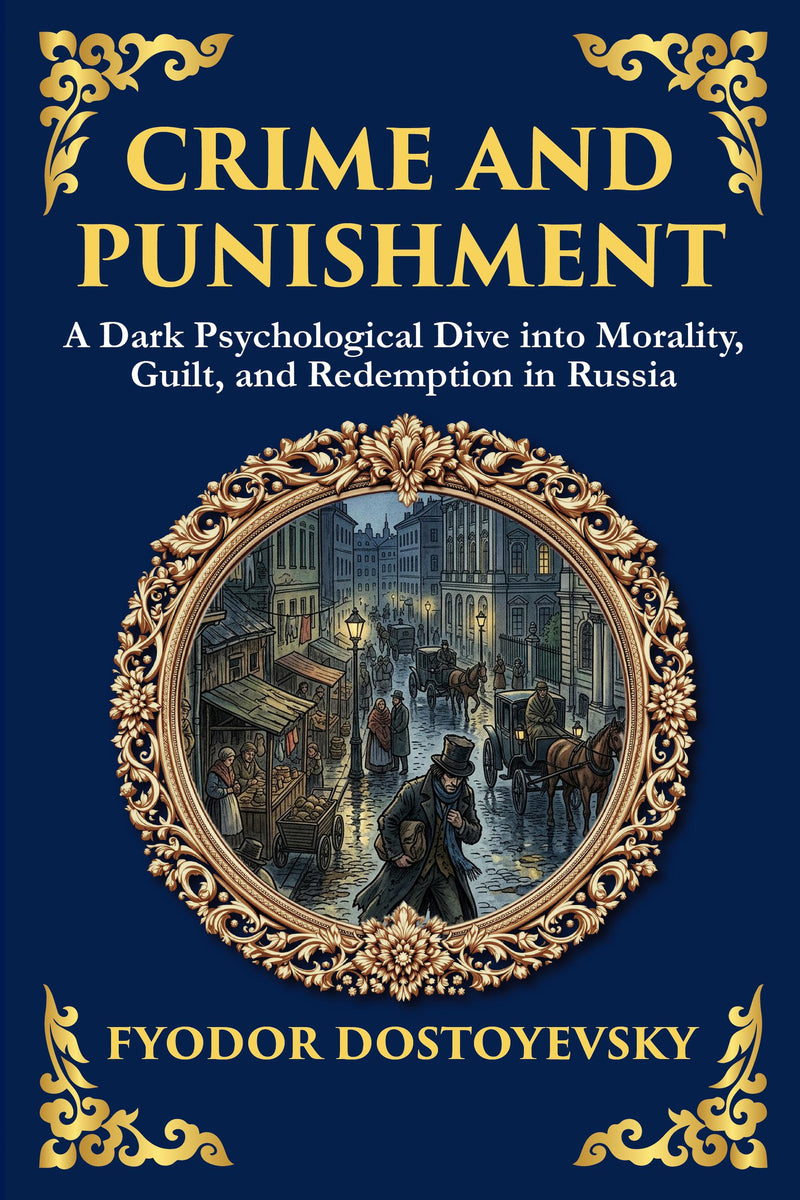
Crime and Punishment
In the depths of St. Petersburg, a penniless student named Raskolnikov commits a calculated murder—convinced he can justify the act as a means to a greater good.
or free app
10,000+ hrs library
30-day guarantee
The complete Crime and Punishment appears in modern English through Library of Alexandria Press, available online with audiobook narration included for members.
Have you ever wondered why true punishment comes not from others—but from within? In Crime and Punishment, Fyodor Dostoyevsky probes the darkest corners of the human mind to reveal the anguish of guilt, the temptations of rationalized evil, and the arduous path toward moral redemption. Set in 19th-century Russia, this landmark novel follows Rodion Raskolnikov, a brilliant yet impoverished former student who convinces himself that certain individuals—those of “extraordinary” intellect—are above the law.
Acting on this belief, he murders a corrupt pawnbroker. But instead of liberation, he finds himself caught in a web of dread, suspicion, and spiritual collapse.
What you’ll discover in this modern edition
- A Deep Psychological Portrait – Step inside the mind of a man tormented by guilt, alienation, and his search for meaning.
- A Tense Crime Thriller with Profound Themes – Experience the suspense of a murder mystery intertwined with philosophical introspection.
- An Unflinching Exploration of Morality – Question the boundaries of right and wrong, justice and forgiveness.
- A Cast of Complex Characters – From the compassionate Sonia to the relentless Porfiry, each figure reflects aspects of hope, judgment, and humanity.
- A Cornerstone of World Literature – Recognized globally for its intensity, depth, and revolutionary insight into the psyche. This accessible edition brings Dostoyevsky’s vision into vivid clarity for today’s reader.
| Formats | eBook (EPUB + PDF) · Audiobook · Paperback · Hardcover · Large Print |
| Language | English |
| Trim size (print) | 6 × 9 in |
| Binding | Paperback — perfect-bound · Hardcover — casewrap |
| Large Print edition | Same text in a larger, easy-read type — a larger font, not a larger trim |
| Print pricing | Every physical book at our true cost — at-cost, no profit (members) |
| Library | 873 restored titles, always growing |
| Length | 190,586 words · ~12 hr 42 min reading |
| Reading level | Grade 4 · an easy, flowing read (this modern-English edition) |
| Edition | Modern English translation · 2026 |
Member reviews for this edition are collected as readers finish it — be the first. Across the library: 12,000+ books shipped, every plan covered by a 365-day print guarantee.
About this edition
A faithful, unabridged modern-English edition by The Library of Alexandria — carefully rendered for today's reader and verified paragraph-by-paragraph against the public-domain source. Available as eBook, audiobook, paperback, hardcover, and large print.
- Complete & unabridgedVerified paragraph by paragraph against the source — never a scan, never abridged.
- Modern English, faithfulReadable today, with the author’s meaning kept intact. Readable — not simplified.
- Every format, one membershipRead in your browser or the free app, or listen to the full audiobook.
Included free with your membership
Cancel anytime, one click · 30-day money-back guarantee
Edition last updated July 2026
What’s inside
Crime and Punishment — complete and unabridged: all 16 sections included with membership, plus the full audiobook.
Begin reading Crime and Punishment
In clear modern English — the complete text is included with membership.
Introduction
There are books we read, and there are books that read us. Some stories entertain us for an evening and then fade gently from memory, leaving behind only a pleasant impression and perhaps a single image we half-remember years later. Others lodge themselves in the mind like a splinter, refusing to be ignored, returning to us at odd hours—on a late-night walk, in a moment of moral doubt, in the silence that follows a decision we are not sure we should have made. The novel you are about to begin belongs firmly to the second category. It is not a book you finish so much as a book that finishes with you, in its own time, on its own terms. And it has been doing this to readers for more than a century and a half.
When this novel first appeared in serialized form in 1866, it caused an immediate sensation in Russia. Readers devoured each installment, gripped by a tension that felt almost unbearable. But what they were responding to was not merely a thrilling plot—though there is a kind of suspense here that rivals any modern thriller. What they sensed, and what generations of readers have sensed since, was that they were in the presence of something unprecedented: a writer who had managed to climb inside the human mind and report back from its most hidden and frightening chambers. Here was a story that did not simply describe a crime and its consequences. It performed the far more difficult feat of making us live inside a tormented consciousness, of forcing us to think the thoughts of a man who has convinced himself that the ordinary rules of morality do not apply to him—and then to suffer, alongside him, the slow and terrible discovery of how wrong he was.
This is a story about a young man in a great, suffocating city. He is poor, brilliant, proud, and dangerously isolated. He has been living too much inside his own head, brooding in a cramped room that the narrative will famously compare to a coffin, spinning out a theory that flatters his intelligence and excuses his desperation. And from this theory, this dangerous abstraction nursed in solitude, a single act will emerge that will set the entire vast machinery of the novel in motion. But to say more about what happens would be to rob you of one of the great experiences in all of literature. What matters for now is that you understand the nature of the journey you are about to take: it is a descent, and then, perhaps, an ascent. It is a study of the human soul under the most extreme pressure imaginable. And it asks questions that have lost none of their urgency: What does it mean to be good? Can the end ever justify the means? Is there such a thing as a crime that leaves no mark on the one who commits it? And when a person has fallen as far as a person can fall, is there any road back?
A New Translation for a New Generation of Readers
It is worth pausing, before you begin, to say a word about the form in which you are encountering this masterpiece—because it matters a great deal. This edition presents the novel in a modern translation, adapted for the contemporary reader, and that phrase deserves some honest explanation, since it goes to the heart of why this book can feel so alive on the page when other classics can feel like they are speaking to us from behind a thick pane of glass.
The original text was written in nineteenth-century Russian, a language as different from contemporary English as it is possible for two languages to be. Every translation, therefore, is an act of interpretation, a series of thousands of small decisions about how to carry meaning across the chasm that separates one language, one century, and one culture from another. Earlier English translations, many of them produced more than a hundred years ago, were extraordinary achievements in their day. But they often clothed the text in a formal, Victorian register that the original never possessed. They rendered the urgent, fevered, sometimes fragmented voice of the author into stately and elaborate sentences that can feel ornate and distant to a reader today. The result, for many modern readers, has been a paradox: a book celebrated as one of the most gripping and psychologically immediate ever written, encountered through prose that keeps the reader at arm’s length.
This edition takes a different approach. The aim here has been to honor the meaning, the emotional intensity, and the philosophical depth of the original while rendering it in language that breathes naturally for a reader living now. This does not mean the text has been simplified or stripped of its complexity—far from it. The ideas remain as challenging as they ever were, the moral questions as thorny, the psychological insight as piercing. What has changed is the friction between you and the page. Where an older translation might have presented a tangled thicket of subordinate clauses, this version seeks clarity without sacrificing rhythm. Where antiquated idioms might have stopped a contemporary reader cold, this version finds equivalents that carry the same charge. The goal throughout has been to give you the experience that the very first readers had: the sense of being grabbed by the collar and pulled into a world from which you cannot easily escape.
Some readers, encountering the phrase “adapted for the contemporary reader,” may feel a flicker of suspicion. Has something essential been lost? Has the great work been diminished to make it easier? It is a fair question, and it deserves a direct answer. The intention of this edition is not to dumb the book down but to clear the path to it. Think of it as the difference between viewing a magnificent painting through a layer of accumulated grime and viewing it after a careful cleaning. The painting is the same; the genius is the same; but suddenly the colors are vivid again, and you can see what the artist actually intended you to see. The hope is that this translation performs a similar service—removing the varnish of time so that the original brilliance can shine through with the immediacy and force it was always meant to have.
There is something fitting in this, too, given the nature of the book itself. This is a novel obsessed with the gap between abstraction and reality, between the cold theories we build in our heads and the warm, messy, suffering humanity that those theories so often ignore. A translation that buried the human voice of the characters under layers of stiff formality would, in a sense, be committing the very error the novel warns against. By contrast, a translation that lets you hear the characters as living, breathing, anguished people—people who could be sitting across from you in a crowded room—stays true to the deepest purpose of the work. You will find, as you read, that the dialogue crackles, that the inner monologues feel like thoughts you might actually have, that the great confrontations between characters carry the electric tension of real human conflict. This is by design, and it is in service of the original, not a betrayal of it.
To read this novel without some sense of the man who wrote it is to miss part of what makes it so extraordinary. The author did not invent the darkness he describes from a comfortable distance. He had lived in it. He knew, from his own bitter experience, what it meant to stand on the edge of an abyss and stare down into it.
Fyodor Dostoyevsky was born in Moscow in 1821, the son of a doctor whose harshness left lasting scars. His early life was marked by loss—his mother died when he was still young, and his father’s death soon after was sudden and, by some accounts, violent. He trained as a military engineer, a profession entirely at odds with his temperament, before abandoning it to devote himself to literature. His first novel brought him sudden acclaim, and for a brief moment it seemed that an easy and brilliant career lay ahead of him.
Then came the event that would change everything. As a young man, Dostoyevsky became involved with a circle of intellectuals who met to discuss forbidden political and social ideas in an autocratic state that brooked no dissent. In 1849, he was arrested. He was imprisoned, interrogated, and sentenced to death. And then came the moment that no reader of his work can ever forget: he was taken, along with his fellow prisoners, to a public square to be executed. He stood there in the freezing cold, facing a firing squad, believing he had only minutes left to live. He watched as the first group of men was tied to the stakes. He waited his turn. And then, at the very last possible instant, a messenger arrived with a reprieve. The execution had been a piece of cruel theater, a calculated psychological torture ordered to teach the prisoners a lesson. The death sentence was commuted to years of hard labor in a Siberian prison camp.
It is impossible to overstate what this experience did to him. To stand at the threshold of death, to feel the seconds running out, to surrender every hope—and then to be flung back into life—this is an ordeal that reorganizes a person’s entire understanding of existence. Dostoyevsky emerged from it transformed. The years he subsequently spent among hardened criminals in Siberia, sharing their squalor, their suffering, and their occasional flashes of unexpected grace, gave him an education that no university could have provided. He came to know human beings at their most degraded and their most redeemable, often within the same person. He saw murderers who were also capable of tenderness, thieves who carried a buried decency, brutal men in whom some spark of conscience refused to die. And he came to believe, with the unshakable conviction of someone who had been remade by suffering, that no human soul is ever entirely beyond hope.
All of this pours into the novel you are about to read. When the author writes of a man crushed by guilt, of the way a single deed can poison every subsequent moment of a person’s life, of the strange and terrible workings of conscience, he is not theorizing. He is drawing on the deepest experiences of his own existence. He knew what it was to be a prisoner, to be watched, to feel the weight of one’s own conscience as a physical presence. He knew the particular psychology of the condemned man, the way fear and defiance and longing and despair can coexist in a single mind. This is why the inner life of his characters feels so devastatingly authentic. He is not imagining what such states of mind might be like; he is remembering.
His later years were no easier. He struggled with epilepsy, with crushing debts, with a gambling addiction that repeatedly ruined him, and with the deaths of people he loved. He wrote many of his greatest works under conditions of frantic financial pressure, sometimes dictating to a stenographer at breakneck speed to meet a deadline that, if missed, would have spelled financial catastrophe. There is a roughness, an urgency, a sense of a man writing for his life, that comes directly from these circumstances—and far from being a flaw, it is part of what gives his work its overwhelming power. These are not the polished, leisurely productions of a comfortable author. They are dispatches from the front lines of human suffering, written by someone who had been there and come back to tell the tale.
When he died in 1881, he was mourned as one of the great voices of his nation, and his stature has only grown in the century and a half since. He has been claimed by philosophers, theologians, psychologists, and novelists as a founding influence. The discipline of psychology itself owes him a profound debt; he anticipated, in his fiction, insights about the human unconscious that the formal science would not articulate for decades. Writers across the world have looked to him as a model of what fiction can do—how deep it can go, how much truth it can bear. To read him is to encounter not just a storyteller but a thinker of the first rank, one who used the form of the novel to wrestle with the largest questions a human being can ask.
Cancel anytime, one click · 30-day money-back guarantee
Founding annual rate available now — your price locks for life when you join.
Not ready? Get this free chapter by email — read it anytime.
✓ Sent — check your inbox for Crime and Punishment.
Questions about Crime and Punishment
What is Crime and Punishment about?
In the depths of St. Petersburg, a penniless student named Raskolnikov commits a calculated murder—convinced he can justify the act as a means to a greater good. But what begins as a philosophical experiment unravels into a harrowing psychological battle between guilt and redemption.
Who wrote Crime and Punishment?
Crime and Punishment was written by Fyodor Dostoyevsky. This edition presents the complete work in clear modern English, faithfully rendered from the public-domain original by Library of Alexandria Press.
Is Crime and Punishment free to read?
The opening chapter is free to read on this page. Members read and listen to the complete work — and the entire library — free, and can order any physical book at our true print cost.
How long is Crime and Punishment?
16 chapters (~190,586 words) — about 12 hr 42 min of reading in this modern-English edition.
Is this an abridged version of Crime and Punishment?
No. This is the complete, unabridged Crime and Punishment, carefully rendered into clear modern English and verified paragraph-by-paragraph against the public-domain source — nothing is cut or summarised.
What formats does Crime and Punishment come in?
Crime and Punishment is available as eBook, paperback and hardcover. eBook and audiobook are included with membership; printed editions ship at our true print cost.
Shipping & returns
Billing & membership
More from the library


Explore Mystery & Crime
- Resurrection · Leo Tolstoy
- The Strange Case of Dr. Jekyll and Mr. Hyde · Robert Louis Stevenson
- The Riddle of the Sands · Erskine Childers
- The Wisdom of Father Brown · G. K. Chesterton
- The Cask of Amontillado · Edgar Allan Poe
- The Tomb of Ts’in · Edgar Wallace
- Ghost Stories of an Antiquary · M. R. James
- The Hunniwell Boys and the Platinum Mystery · L. P. Wyman
- The Seven Dials Mystery · Agatha Christie
- The Thirty-Nine Steps · John Buchan
- The Hand in the Dark · Arthur J. Rees
- Lady Audley’s Secret · M. E. Braddon
- The Mystery of the Blue Train · Agatha Christie
- The Secret Adversary · Agatha Christie
- The Call of Cthulhu · H. P. Lovecraft
- The Adventures of Heine · Edgar Wallace
- The Valley of Fear · Arthur Conan Doyle
- The Innocence of Father Brown · G. K. Chesterton
- McTeague: A Story of San Francisco · Frank Norris
- Tess of the d’Urbervilles: A Pure Woman · Thomas Hardy
- The Big Fix · George O. Smith
- The Ambulance Made Two Trips · Murray Leinster
- Time Crime · H. Beam Piper
- The Misplaced Battleship · Harry Harrison
- Supermind · Randall Garrett and Laurence M....
- Lone Star Planet · H. Beam Piper and John J. McGuire
- Dracula · Bram Stoker
- The Murder on the Links · Agatha Christie
- The Hound of the Baskervilles · Arthur Conan Doyle
- The King in Yellow · Robert W. Chambers
Crime and Punishment
Crime and Punishment
A Dark Psychological Dive into Morality, Guilt, and Redemption in Russia
Fyodor Dostoyevsky
Contents
- Introduction
- Part 1
- Chapter 1
- Chapter 2
- Chapter 3
- Chapter 4
- Chapter 5
- Chapter 6
- Chapter 7
- Part 2
- Part 3
- Part 4
- Part 5
- Part 6
- Chapter 8
- Epilogue
Introduction
There are books we read, and there are books that read us. Some stories entertain us for an evening and then fade gently from memory, leaving behind only a pleasant impression and perhaps a single image we half-remember years later. Others lodge themselves in the mind like a splinter, refusing to be ignored, returning to us at odd hours—on a late-night walk, in a moment of moral doubt, in the silence that follows a decision we are not sure we should have made. The novel you are about to begin belongs firmly to the second category. It is not a book you finish so much as a book that finishes with you, in its own time, on its own terms. And it has been doing this to readers for more than a century and a half.
When this novel first appeared in serialized form in 1866, it caused an immediate sensation in Russia. Readers devoured each installment, gripped by a tension that felt almost unbearable. But what they were responding to was not merely a thrilling plot—though there is a kind of suspense here that rivals any modern thriller. What they sensed, and what generations of readers have sensed since, was that they were in the presence of something unprecedented: a writer who had managed to climb inside the human mind and report back from its most hidden and frightening chambers. Here was a story that did not simply describe a crime and its consequences. It performed the far more difficult feat of making us live inside a tormented consciousness, of forcing us to think the thoughts of a man who has convinced himself that the ordinary rules of morality do not apply to him—and then to suffer, alongside him, the slow and terrible discovery of how wrong he was.
This is a story about a young man in a great, suffocating city. He is poor, brilliant, proud, and dangerously isolated. He has been living too much inside his own head, brooding in a cramped room that the narrative will famously compare to a coffin, spinning out a theory that flatters his intelligence and excuses his desperation. And from this theory, this dangerous abstraction nursed in solitude, a single act will emerge that will set the entire vast machinery of the novel in motion. But to say more about what happens would be to rob you of one of the great experiences in all of literature. What matters for now is that you understand the nature of the journey you are about to take: it is a descent, and then, perhaps, an ascent. It is a study of the human soul under the most extreme pressure imaginable. And it asks questions that have lost none of their urgency: What does it mean to be good? Can the end ever justify the means? Is there such a thing as a crime that leaves no mark on the one who commits it? And when a person has fallen as far as a person can fall, is there any road back?
A New Translation for a New Generation of Readers
It is worth pausing, before you begin, to say a word about the form in which you are encountering this masterpiece—because it matters a great deal. This edition presents the novel in a modern translation, adapted for the contemporary reader, and that phrase deserves some honest explanation, since it goes to the heart of why this book can feel so alive on the page when other classics can feel like they are speaking to us from behind a thick pane of glass.
The original text was written in nineteenth-century Russian, a language as different from contemporary English as it is possible for two languages to be. Every translation, therefore, is an act of interpretation, a series of thousands of small decisions about how to carry meaning across the chasm that separates one language, one century, and one culture from another. Earlier English translations, many of them produced more than a hundred years ago, were extraordinary achievements in their day. But they often clothed the text in a formal, Victorian register that the original never possessed. They rendered the urgent, fevered, sometimes fragmented voice of the author into stately and elaborate sentences that can feel ornate and distant to a reader today. The result, for many modern readers, has been a paradox: a book celebrated as one of the most gripping and psychologically immediate ever written, encountered through prose that keeps the reader at arm’s length.
This edition takes a different approach. The aim here has been to honor the meaning, the emotional intensity, and the philosophical depth of the original while rendering it in language that breathes naturally for a reader living now. This does not mean the text has been simplified or stripped of its complexity—far from it. The ideas remain as challenging as they ever were, the moral questions as thorny, the psychological insight as piercing. What has changed is the friction between you and the page. Where an older translation might have presented a tangled thicket of subordinate clauses, this version seeks clarity without sacrificing rhythm. Where antiquated idioms might have stopped a contemporary reader cold, this version finds equivalents that carry the same charge. The goal throughout has been to give you the experience that the very first readers had: the sense of being grabbed by the collar and pulled into a world from which you cannot easily escape.
Some readers, encountering the phrase “adapted for the contemporary reader,” may feel a flicker of suspicion. Has something essential been lost? Has the great work been diminished to make it easier? It is a fair question, and it deserves a direct answer. The intention of this edition is not to dumb the book down but to clear the path to it. Think of it as the difference between viewing a magnificent painting through a layer of accumulated grime and viewing it after a careful cleaning. The painting is the same; the genius is the same; but suddenly the colors are vivid again, and you can see what the artist actually intended you to see. The hope is that this translation performs a similar service—removing the varnish of time so that the original brilliance can shine through with the immediacy and force it was always meant to have.
There is something fitting in this, too, given the nature of the book itself. This is a novel obsessed with the gap between abstraction and reality, between the cold theories we build in our heads and the warm, messy, suffering humanity that those theories so often ignore. A translation that buried the human voice of the characters under layers of stiff formality would, in a sense, be committing the very error the novel warns against. By contrast, a translation that lets you hear the characters as living, breathing, anguished people—people who could be sitting across from you in a crowded room—stays true to the deepest purpose of the work. You will find, as you read, that the dialogue crackles, that the inner monologues feel like thoughts you might actually have, that the great confrontations between characters carry the electric tension of real human conflict. This is by design, and it is in service of the original, not a betrayal of it.
To read this novel without some sense of the man who wrote it is to miss part of what makes it so extraordinary. The author did not invent the darkness he describes from a comfortable distance. He had lived in it. He knew, from his own bitter experience, what it meant to stand on the edge of an abyss and stare down into it.
Fyodor Dostoyevsky was born in Moscow in 1821, the son of a doctor whose harshness left lasting scars. His early life was marked by loss—his mother died when he was still young, and his father’s death soon after was sudden and, by some accounts, violent. He trained as a military engineer, a profession entirely at odds with his temperament, before abandoning it to devote himself to literature. His first novel brought him sudden acclaim, and for a brief moment it seemed that an easy and brilliant career lay ahead of him.
Then came the event that would change everything. As a young man, Dostoyevsky became involved with a circle of intellectuals who met to discuss forbidden political and social ideas in an autocratic state that brooked no dissent. In 1849, he was arrested. He was imprisoned, interrogated, and sentenced to death. And then came the moment that no reader of his work can ever forget: he was taken, along with his fellow prisoners, to a public square to be executed. He stood there in the freezing cold, facing a firing squad, believing he had only minutes left to live. He watched as the first group of men was tied to the stakes. He waited his turn. And then, at the very last possible instant, a messenger arrived with a reprieve. The execution had been a piece of cruel theater, a calculated psychological torture ordered to teach the prisoners a lesson. The death sentence was commuted to years of hard labor in a Siberian prison camp.
It is impossible to overstate what this experience did to him. To stand at the threshold of death, to feel the seconds running out, to surrender every hope—and then to be flung back into life—this is an ordeal that reorganizes a person’s entire understanding of existence. Dostoyevsky emerged from it transformed. The years he subsequently spent among hardened criminals in Siberia, sharing their squalor, their suffering, and their occasional flashes of unexpected grace, gave him an education that no university could have provided. He came to know human beings at their most degraded and their most redeemable, often within the same person. He saw murderers who were also capable of tenderness, thieves who carried a buried decency, brutal men in whom some spark of conscience refused to die. And he came to believe, with the unshakable conviction of someone who had been remade by suffering, that no human soul is ever entirely beyond hope.
All of this pours into the novel you are about to read. When the author writes of a man crushed by guilt, of the way a single deed can poison every subsequent moment of a person’s life, of the strange and terrible workings of conscience, he is not theorizing. He is drawing on the deepest experiences of his own existence. He knew what it was to be a prisoner, to be watched, to feel the weight of one’s own conscience as a physical presence. He knew the particular psychology of the condemned man, the way fear and defiance and longing and despair can coexist in a single mind. This is why the inner life of his characters feels so devastatingly authentic. He is not imagining what such states of mind might be like; he is remembering.
His later years were no easier. He struggled with epilepsy, with crushing debts, with a gambling addiction that repeatedly ruined him, and with the deaths of people he loved. He wrote many of his greatest works under conditions of frantic financial pressure, sometimes dictating to a stenographer at breakneck speed to meet a deadline that, if missed, would have spelled financial catastrophe. There is a roughness, an urgency, a sense of a man writing for his life, that comes directly from these circumstances—and far from being a flaw, it is part of what gives his work its overwhelming power. These are not the polished, leisurely productions of a comfortable author. They are dispatches from the front lines of human suffering, written by someone who had been there and come back to tell the tale.
When he died in 1881, he was mourned as one of the great voices of his nation, and his stature has only grown in the century and a half since. He has been claimed by philosophers, theologians, psychologists, and novelists as a founding influence. The discipline of psychology itself owes him a profound debt; he anticipated, in his fiction, insights about the human unconscious that the formal science would not articulate for decades. Writers across the world have looked to him as a model of what fiction can do—how deep it can go, how much truth it can bear. To read him is to encounter not just a storyteller but a thinker of the first rank, one who used the form of the novel to wrestle with the largest questions a human being can ask.
On an exceptionally hot evening in early July, a young man left the attic where he lived in S. Place and walked slowly, as if hesitating, toward K. bridge.
He had managed to avoid his landlady on the stairs. His attic was at the top of a tall, five-story building and felt more like a closet than a room. The landlady, who provided his room, meals, and cleaning, lived on the floor below. Every time he left, he had to pass her kitchen, and the door was always open. Whenever he did, he felt a sick, nervous dread that made him scowl and feel ashamed. He owed her a great deal of money and was terrified of running into her.
This wasn’t because he was a coward; in fact, it was the opposite. For some time, he had been extremely stressed and irritable, almost to the point of depression. He had become so wrapped up in himself and isolated from others that he dreaded meeting anyone, not just his landlady. He was crushed by poverty, though lately, the stress of his financial situation had stopped bothering him. He had stopped caring about practical matters and had lost the will to deal with them. He wasn’t actually afraid of anything his landlady could do to him. But the idea of being stopped on the stairs—forced to listen to her pointless gossip, her nagging demands for payment, her threats and complaints, and then having to scramble for excuses and lie to her—was too much. He would rather sneak down the stairs like a cat and slip out unseen.
However, as he stepped out into the street this evening, he became acutely aware of his fears.
“I’m planning to try something like that, yet I’m frightened by these little things,” he thought with a strange smile. “Hm... yes, everything is in a person’s hands, but they let it all slip away out of cowardice; that’s a fact. I wonder what people are most afraid of. Taking a new step, saying a new word—that’s what they fear most... But I’m talking too much. I do nothing because I chatter. Or maybe I chatter because I do nothing. I’ve spent the last month chatting to myself, lying in my den for days on end thinking... about Jack the Giant-killer. Why am I even going there? Am I actually capable of this? Is this serious? No, it’s not serious at all. It’s just a fantasy to keep me entertained; a toy! Yes, maybe it’s just a toy.”
End of the free sample
Keep reading, free
Members read and listen to the complete book — and the entire library. Cancel anytime, one click · 30-day money-back guarantee.