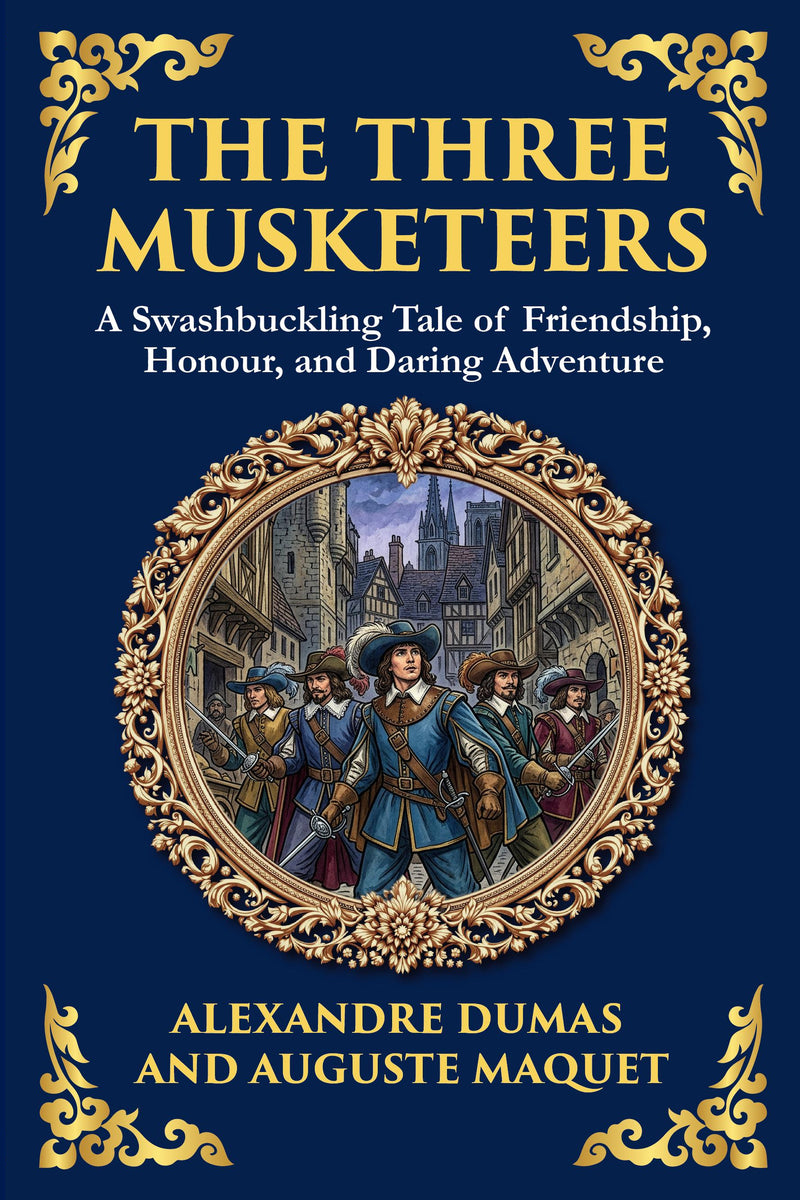
The Three Musketeers
Alexandre Dumas In a world of intrigue, duels, and royal secrets, a young man named d’Artagnan leaves his home to join the King’s Musketeers.
or free app
10,000+ hrs library
30-day guarantee
The complete The Three Musketeers appears in modern English through Library of Alexandria Press, available online with audiobook narration included for members.
Have you ever wondered why true friendship can change the course of history? In The Three Musketeers, Alexandre Dumas weaves an unforgettable tale of bravery, loyalty, and daring exploits. This swashbuckling adventure follows d’Artagnan, a spirited young man determined to prove his worth and earn a place among the King’s elite guards, the Musketeers.
Along his journey, he encounters the legendary trio—Athos, Porthos, and Aramis—and their lives intertwine in a battle against treachery and deceit. As the four friends pledge themselves to the iconic motto, “All for one, and one for all!”, they must face dangerous duels, royal conspiracies, and heart-pounding missions to protect the honor of the Queen and the stability of the French crown. Their greatest adversaries?
The manipulative Cardinal Richelieu and the deadly Milady de Winter, whose charm is as dangerous as her schemes. This modern, accessible edition captures the excitement and timeless themes of Dumas’ masterpiece, making it perfect for new readers and longtime fans alike.
What you’ll discover in this modern edition
- The Birth of a Hero: Follow d’Artagnan’s transformation from a naive young swordsman to a courageous hero.
- Unbreakable Brotherhood: Experience the loyalty and camaraderie of Athos, Porthos, and Aramis as they fight side by side.
- Epic Battles and Daring Duels: Sword fights, secret missions, and relentless action set against the grandeur of 17th-century France.
- Villains Who Define Treachery: Encounter Cardinal Richelieu’s cunning politics and Milady de Winter’s ruthless vengeance.
- Themes That Transcend Time: Honour, friendship, sacrifice, and the timeless struggle between good and evil. Dive into a thrilling journey of heroism and betrayal.
| Formats | eBook (EPUB + PDF) · Audiobook · Paperback · Hardcover · Large Print |
| Language | English |
| Trim size (print) | 6 × 9 in |
| Binding | Paperback — perfect-bound · Hardcover — casewrap |
| Large Print edition | Same text in a larger, easy-read type — a larger font, not a larger trim |
| Print pricing | Every physical book at our true cost — at-cost, no profit (members) |
| Library | 873 restored titles, always growing |
| Length | 203,671 words · ~13 hr 35 min reading |
| Reading level | Grade 6 · an easy, flowing read (this modern-English edition) |
| Edition | Modern English translation · 2026 |
Member reviews for this edition are collected as readers finish it — be the first. Across the library: 12,000+ books shipped, every plan covered by a 365-day print guarantee.
About this edition
A faithful, unabridged modern-English edition by The Library of Alexandria — carefully rendered for today's reader and verified paragraph-by-paragraph against the public-domain source. Available as eBook, audiobook, paperback, hardcover, and large print.
- Complete & unabridgedVerified paragraph by paragraph against the source — never a scan, never abridged.
- Modern English, faithfulReadable today, with the author’s meaning kept intact. Readable — not simplified.
- Every format, one membershipRead in your browser or the free app, or listen to the full audiobook.
Included free with your membership
Cancel anytime, one click · 30-day money-back guarantee
Edition last updated July 2026
What’s inside
The Three Musketeers — complete and unabridged: all 60 sections included with membership, plus the full audiobook.
Begin reading The Three Musketeers
In clear modern English — the complete text is included with membership.
Introduction
There are stories that announce themselves quietly and others that arrive with the clatter of hooves on cobblestone, the flash of steel beneath a Parisian sky, and the thunderous cry of men who have decided that loyalty is worth dying for. This is unmistakably the latter. Few novels in the history of world literature have so completely captured the imagination of generation after generation as this tale of swordsmen, schemers, queens, cardinals, and a young man from the provinces who arrives in the capital with little more than ambition, a borrowed horse, and a heart that refuses to be intimidated by anything or anyone.
To open these pages is to step into one of the most beloved adventures ever committed to paper, a work so thoroughly woven into the fabric of popular culture that even those who have never read a single word of it can recite its rallying cry. The phrase “all for one, and one for all” has long since transcended its origins to become a kind of universal shorthand for solidarity, friendship, and shared purpose. Yet the phrase, however famous, is only the smallest taste of what awaits within. The full experience of this story—its breathless pacing, its wit, its romance, its danger, and above all its profound understanding of human loyalty—can only be found by reading it whole, allowing yourself to be carried along by a narrative engine that has lost none of its power in the long span of years since it first appeared.
A Tale Born of Two Minds and a Restless Age
It is worth understanding, before you begin, the remarkable circumstances under which this masterpiece came into being, for the story behind the story is itself a kind of adventure. The novel first reached the public in serialized form, appearing in installments in a French newspaper during the early 1840s. This was the great age of the feuilleton, the serial novel, when entire nations would wait breathlessly for the next chapter of an unfolding tale, much as audiences today await the next episode of a beloved television series. Writers of the era learned to construct their narratives with cliffhangers and reversals, with each installment designed to leave readers desperate for more. This method of composition left an indelible mark on the work you now hold: it moves with extraordinary momentum, never lingering too long, always pressing forward toward the next confrontation, the next intrigue, the next breathless escape.
The principal author, Alexandre Dumas, was already a celebrated figure when he turned his prodigious energies to this project. A man of enormous appetite for life, work, food, travel, and storytelling, Dumas possessed a gift for narrative that few writers have ever matched. He understood, perhaps more instinctively than anyone of his time, that the purpose of fiction was first and foremost to delight, to thrill, to sweep the reader off their feet and carry them somewhere they had never been. He was the grandson of a French nobleman and an enslaved woman of African descent from the Caribbean, and his own grandfather had risen to become a celebrated general in the revolutionary armies of France—a man of legendary physical prowess and courage. Something of that ancestral boldness seems to pulse through every page Dumas wrote, an irrepressible love of action and honor that found its perfect expression in the world of seventeenth-century swordsmen.
But Dumas did not work alone. The name of Auguste Maquet appears alongside his own on the title page of this edition, and rightly so, for Maquet was the indispensable collaborator who helped bring this and many of Dumas’s greatest works to life. Maquet was a meticulous researcher and a skilled constructor of plots, a man with a deep knowledge of history and an instinct for dramatic structure. The two formed a creative partnership that would produce some of the most enduring popular fiction ever written. Maquet would often supply detailed historical frameworks, character outlines, and draft scenes, while Dumas brought his incomparable flair for dialogue, his sparkling wit, his sense of pacing, and that ineffable energy that makes his prose crackle with life. The precise division of labor between them has been the subject of much scholarly debate over the years, but what matters for the reader is the result: a seamless fusion of two talents that produced something neither could likely have achieved alone. To honor that collaboration, this edition properly credits both men, recognizing the historical truth that great works are sometimes the product of more than one mind.
The novel draws upon genuine historical sources, most notably a set of purported memoirs published in the previous century, which claimed to recount the adventures of a real soldier who served in the elite guard of the French king. Dumas and Maquet took these materials and transformed them, embellishing, inventing, reshaping, and breathing dramatic fire into the historical record. The result is not history in any strict sense, but something arguably more powerful: a vision of a vanished age, brought to such vivid life that it has shaped the way countless readers imagine that period more profoundly than any textbook ever could. The world of the novel—a France of dueling cavaliers, scheming politicians, secret romances, and shadowy conspiracies—is a romantic reimagining, a heightened and idealized version of the seventeenth century filtered through the sensibilities of the nineteenth. And it is all the more enchanting for it.
The era in which the story is set was one of genuine turbulence and intrigue. The French monarchy was navigating a complex web of religious tension, aristocratic ambition, and shifting alliances with the powers of Europe. A brilliant and ruthless churchman wielded enormous political authority, often eclipsing the king himself, and the relationships among the royal court, the church, and the nobility were fraught with suspicion and rivalry. Into this charged atmosphere Dumas places his characters, allowing them to brush up against great historical figures and momentous events, so that the personal dramas of his heroes become entangled with the fate of nations. This interweaving of the intimate and the epic is one of the great pleasures of the book: a quarrel over a point of honor can blossom into a matter of international consequence, and a stolen token of affection can threaten to topple the stability of a kingdom.
Why has this particular tale survived where so many others, equally popular in their day, have faded into obscurity? The answer lies in a combination of elements that Dumas and Maquet balanced with almost miraculous skill, elements that continue to speak to readers across the centuries and across every barrier of language and culture.
First and foremost, there is the matter of friendship. At its beating heart, this is a story about the bonds between people who choose one another, who pledge themselves to a common cause and stand together against impossible odds. The central relationships in the novel are drawn with such warmth, such humor, and such depth that they feel less like literary inventions than like friendships we ourselves might wish to have. Each of the principal companions is a fully realized individual with his own quirks, vices, virtues, secrets, and sorrows. There is the worldly and melancholy one, haunted by a past he refuses to discuss; the vain and theatrical one, given to grand gestures and amorous adventures; the pious and ambitious one, forever torn between worldly success and spiritual aspiration; and the youthful newcomer whose courage, cleverness, and occasional rashness drive much of the action. To watch these men come together, to bicker and tease and ultimately to risk everything for one another, is to witness one of the most satisfying portraits of male friendship in all of literature. Their loyalty is not sentimental or easy; it is tested again and again by danger, temptation, and the cruel machinations of their enemies. And it is precisely because the friendship is so hard-won that it moves us so deeply.
Then there is the sheer momentum of the storytelling. From the very first pages, when our young hero sets out from his rural home toward the capital, the narrative grips and does not let go. Dumas was a master of pacing, of knowing exactly when to accelerate into a frenzy of action and when to pause for a moment of wit or intimacy. The book is studded with set pieces of breathtaking excitement: duels conducted with deadly seriousness and surprising flashes of humor, midnight rides across the countryside with the fate of an entire realm hanging in the balance, daring infiltrations of fortified strongholds, narrow escapes from assassins and traps, and confrontations of nerve and cunning that pit our heroes against adversaries of formidable intelligence. Yet for all its action, the novel never feels mechanical or hollow. Each episode advances the larger story, deepens our understanding of the characters, and raises the stakes still further.
The villains deserve special mention, for a story is only as good as the dangers its heroes must overcome, and the antagonists here are among the most memorable ever devised. There is a powerful and cunning statesman whose intelligence and ruthlessness make him a worthy opponent, a man whose schemes operate on a scale that dwarfs the petty concerns of ordinary men. And there is one particular figure—an agent of extraordinary beauty, charm, and lethal resourcefulness—who has rightly become one of the most iconic antagonists in literary history. This character’s combination of allure and menace, intelligence and cruelty, creates a current of genuine peril that runs beneath the surface of the entire narrative. The reader quickly learns that these are not enemies to be taken lightly, and the sense that our heroes are perpetually one step away from disaster lends the story an electric tension that never flags.
Beneath the surface of all this adventure runs a thoughtful meditation on the nature of honor, duty, and morality. The world Dumas depicts is one in which a man’s word is his bond, in which insults must be answered, in which loyalty to one’s friends and one’s sovereign can demand the ultimate sacrifice. Yet the novel is far from a simple celebration of these values; it interrogates them, complicates them, and shows us the human costs they exact. The characters are forced again and again to weigh competing loyalties, to choose between their personal desires and their obligations, to decide what they are willing to do—and what they are not willing to do—in service of a cause. There is moral ambiguity here, and tragedy as well as triumph. Some of the most powerful passages in the book deal with the painful recognition that even noble intentions can lead to terrible consequences, and that the line between justice and vengeance can be perilously thin. This depth of moral seriousness, lurking beneath the swashbuckling surface, is part of what elevates the novel above mere entertainment and into the realm of genuine literature.
And we must not forget the humor, for this is, among everything else, a tremendously funny book. Dumas had a wicked sense of comedy, and his characters are forever engaging in banter, playing pranks, falling into absurd predicaments, and commenting wryly upon their own misfortunes. The dialogue sparkles with wit, and even in the midst of the gravest danger there is room for laughter. This lightness of touch is essential to the book’s enduring appeal; it prevents the story from ever becoming ponderous or grim, and it makes the company of these characters such a joy that we are reluctant to part from them when the final page is turned. The interplay between the friends—their teasing, their competitiveness, their genuine affection masked by gruff insults—creates a texture of warmth and humanity that draws the reader ever deeper into their world.
Reading This Edition: A Bridge Across the Centuries
Cancel anytime, one click · 30-day money-back guarantee
Founding annual rate available now — your price locks for life when you join.
Not ready? Get this free chapter by email — read it anytime.
✓ Sent — check your inbox for The Three Musketeers.
Questions about The Three Musketeers
What is The Three Musketeers about?
Alexandre Dumas In a world of intrigue, duels, and royal secrets, a young man named d’Artagnan leaves his home to join the King’s Musketeers. Along the way, he forges an unbreakable bond with three brave and loyal musketeers—Athos, Porthos, and Aramis. Together, they navigate a dangerous game of political conspiracies, forbidden love, and deadly enemies, including the cunning Cardinal Richelieu and the mysterious femme fatale, Milady de Winter.
Who wrote The Three Musketeers?
The Three Musketeers was written by Alexandre Dumas and Auguste Maquet. This edition presents the complete work in clear modern English, faithfully rendered from the public-domain original by Library of Alexandria Press.
Is The Three Musketeers free to read?
The opening chapter is free to read on this page. Members read and listen to the complete work — and the entire library — free, and can order any physical book at our true print cost.
How long is The Three Musketeers?
60 chapters (~203,671 words) — about 13 hr 35 min of reading in this modern-English edition.
Is this an abridged version of The Three Musketeers?
No. This is the complete, unabridged The Three Musketeers, carefully rendered into clear modern English and verified paragraph-by-paragraph against the public-domain source — nothing is cut or summarised.
What formats does The Three Musketeers come in?
The Three Musketeers is available as eBook, paperback and hardcover. eBook and audiobook are included with membership; printed editions ship at our true print cost.
Shipping & returns
Billing & membership
More from the library


Explore Adventure
- Tarzan of the Apes · Edgar Rice Burroughs
- The Wonderful Wizard of Oz · L. Frank Baum
- Peter Pan · J. M. Barrie
- Moby Dick; Or, The Whale · Herman Melville
- The Riddle of the Sands · Erskine Childers
- The Loss of the Swansea: A Story of the Florida Coast · W. L. Alden
- Sky Island · L. Frank Baum
- Vikram and the Vampire: Classic Hindu Tales of Adventure, Magic, and Romance · Unknown
- Tales of Unrest · Joseph Conrad
- The Tomb of Ts’in · Edgar Wallace
- Skinny McCord · Percy Keese Fitzhugh
- The Men of the Moss-Hags · S. R. Crockett
- The Hunniwell Boys and the Platinum Mystery · L. P. Wyman
- Allan Quatermain · H. Rider Haggard
- She · H. Rider Haggard
- Medical Life in the Navy · Gordon Stables
- The Thirty-Nine Steps · John Buchan
- The Story of Doctor Dolittle · Hugh Lofting
- The Princess and the Goblin · George MacDonald
- The Man Who Would Be King · Rudyard Kipling
- Lucian’s True History · Lucian of Samosata
- The Secret Adversary · Agatha Christie
- Lord Jim · Joseph Conrad
- The Marvelous Land of Oz · L. Frank Baum
- The Virginian: A Horseman of the Plains · Owen Wister
- Mars is My Destination · Frank Belknap Long
- Anabasis · Xenophon
- The Mississippi Saucer · Frank Belknap Long
- Sabotage in Space · Carey Rockwell
- Brood of the Dark Moon · Charles Willard Diffin
The Three Musketeers
The Three Musketeers
A Swashbuckling Tale of Friendship, Honor, and Daring Adventure
Alexandre Dumas and Auguste Maquet
Contents
- Introduction
- Author’s Preface
- Chapter 1
- Chapter 2
- Chapter 3
- Chapter 4
- Chapter 5
- Chapter 6
- Chapter 7
- Chapter 8
- Chapter 9
- Chapter 10
- Chapter 11
- Chapter 12
- Chapter 13
- Chapter 14
- Chapter 15
- Chapter 16
- Chapter 17
- Chapter 18
- Chapter 19
- Chapter 20
- Chapter 21
- Chapter 22
- Chapter 23
- Chapter 24
- Chapter 25
- Chapter 26
- Chapter 27
- Chapter 28
- Chapter 29
- Chapter 30
- Chapter 31
- Chapter 32
- Chapter 33
- Chapter 34
- Chapter 35
- Chapter 36
- Chapter 37
- Chapter 38
- … and 20 more chapters
Introduction
There are stories that announce themselves quietly and others that arrive with the clatter of hooves on cobblestone, the flash of steel beneath a Parisian sky, and the thunderous cry of men who have decided that loyalty is worth dying for. This is unmistakably the latter. Few novels in the history of world literature have so completely captured the imagination of generation after generation as this tale of swordsmen, schemers, queens, cardinals, and a young man from the provinces who arrives in the capital with little more than ambition, a borrowed horse, and a heart that refuses to be intimidated by anything or anyone.
To open these pages is to step into one of the most beloved adventures ever committed to paper, a work so thoroughly woven into the fabric of popular culture that even those who have never read a single word of it can recite its rallying cry. The phrase “all for one, and one for all” has long since transcended its origins to become a kind of universal shorthand for solidarity, friendship, and shared purpose. Yet the phrase, however famous, is only the smallest taste of what awaits within. The full experience of this story—its breathless pacing, its wit, its romance, its danger, and above all its profound understanding of human loyalty—can only be found by reading it whole, allowing yourself to be carried along by a narrative engine that has lost none of its power in the long span of years since it first appeared.
A Tale Born of Two Minds and a Restless Age
It is worth understanding, before you begin, the remarkable circumstances under which this masterpiece came into being, for the story behind the story is itself a kind of adventure. The novel first reached the public in serialized form, appearing in installments in a French newspaper during the early 1840s. This was the great age of the feuilleton, the serial novel, when entire nations would wait breathlessly for the next chapter of an unfolding tale, much as audiences today await the next episode of a beloved television series. Writers of the era learned to construct their narratives with cliffhangers and reversals, with each installment designed to leave readers desperate for more. This method of composition left an indelible mark on the work you now hold: it moves with extraordinary momentum, never lingering too long, always pressing forward toward the next confrontation, the next intrigue, the next breathless escape.
The principal author, Alexandre Dumas, was already a celebrated figure when he turned his prodigious energies to this project. A man of enormous appetite for life, work, food, travel, and storytelling, Dumas possessed a gift for narrative that few writers have ever matched. He understood, perhaps more instinctively than anyone of his time, that the purpose of fiction was first and foremost to delight, to thrill, to sweep the reader off their feet and carry them somewhere they had never been. He was the grandson of a French nobleman and an enslaved woman of African descent from the Caribbean, and his own grandfather had risen to become a celebrated general in the revolutionary armies of France—a man of legendary physical prowess and courage. Something of that ancestral boldness seems to pulse through every page Dumas wrote, an irrepressible love of action and honor that found its perfect expression in the world of seventeenth-century swordsmen.
But Dumas did not work alone. The name of Auguste Maquet appears alongside his own on the title page of this edition, and rightly so, for Maquet was the indispensable collaborator who helped bring this and many of Dumas’s greatest works to life. Maquet was a meticulous researcher and a skilled constructor of plots, a man with a deep knowledge of history and an instinct for dramatic structure. The two formed a creative partnership that would produce some of the most enduring popular fiction ever written. Maquet would often supply detailed historical frameworks, character outlines, and draft scenes, while Dumas brought his incomparable flair for dialogue, his sparkling wit, his sense of pacing, and that ineffable energy that makes his prose crackle with life. The precise division of labor between them has been the subject of much scholarly debate over the years, but what matters for the reader is the result: a seamless fusion of two talents that produced something neither could likely have achieved alone. To honor that collaboration, this edition properly credits both men, recognizing the historical truth that great works are sometimes the product of more than one mind.
The novel draws upon genuine historical sources, most notably a set of purported memoirs published in the previous century, which claimed to recount the adventures of a real soldier who served in the elite guard of the French king. Dumas and Maquet took these materials and transformed them, embellishing, inventing, reshaping, and breathing dramatic fire into the historical record. The result is not history in any strict sense, but something arguably more powerful: a vision of a vanished age, brought to such vivid life that it has shaped the way countless readers imagine that period more profoundly than any textbook ever could. The world of the novel—a France of dueling cavaliers, scheming politicians, secret romances, and shadowy conspiracies—is a romantic reimagining, a heightened and idealized version of the seventeenth century filtered through the sensibilities of the nineteenth. And it is all the more enchanting for it.
The era in which the story is set was one of genuine turbulence and intrigue. The French monarchy was navigating a complex web of religious tension, aristocratic ambition, and shifting alliances with the powers of Europe. A brilliant and ruthless churchman wielded enormous political authority, often eclipsing the king himself, and the relationships among the royal court, the church, and the nobility were fraught with suspicion and rivalry. Into this charged atmosphere Dumas places his characters, allowing them to brush up against great historical figures and momentous events, so that the personal dramas of his heroes become entangled with the fate of nations. This interweaving of the intimate and the epic is one of the great pleasures of the book: a quarrel over a point of honor can blossom into a matter of international consequence, and a stolen token of affection can threaten to topple the stability of a kingdom.
Why has this particular tale survived where so many others, equally popular in their day, have faded into obscurity? The answer lies in a combination of elements that Dumas and Maquet balanced with almost miraculous skill, elements that continue to speak to readers across the centuries and across every barrier of language and culture.
First and foremost, there is the matter of friendship. At its beating heart, this is a story about the bonds between people who choose one another, who pledge themselves to a common cause and stand together against impossible odds. The central relationships in the novel are drawn with such warmth, such humor, and such depth that they feel less like literary inventions than like friendships we ourselves might wish to have. Each of the principal companions is a fully realized individual with his own quirks, vices, virtues, secrets, and sorrows. There is the worldly and melancholy one, haunted by a past he refuses to discuss; the vain and theatrical one, given to grand gestures and amorous adventures; the pious and ambitious one, forever torn between worldly success and spiritual aspiration; and the youthful newcomer whose courage, cleverness, and occasional rashness drive much of the action. To watch these men come together, to bicker and tease and ultimately to risk everything for one another, is to witness one of the most satisfying portraits of male friendship in all of literature. Their loyalty is not sentimental or easy; it is tested again and again by danger, temptation, and the cruel machinations of their enemies. And it is precisely because the friendship is so hard-won that it moves us so deeply.
Then there is the sheer momentum of the storytelling. From the very first pages, when our young hero sets out from his rural home toward the capital, the narrative grips and does not let go. Dumas was a master of pacing, of knowing exactly when to accelerate into a frenzy of action and when to pause for a moment of wit or intimacy. The book is studded with set pieces of breathtaking excitement: duels conducted with deadly seriousness and surprising flashes of humor, midnight rides across the countryside with the fate of an entire realm hanging in the balance, daring infiltrations of fortified strongholds, narrow escapes from assassins and traps, and confrontations of nerve and cunning that pit our heroes against adversaries of formidable intelligence. Yet for all its action, the novel never feels mechanical or hollow. Each episode advances the larger story, deepens our understanding of the characters, and raises the stakes still further.
The villains deserve special mention, for a story is only as good as the dangers its heroes must overcome, and the antagonists here are among the most memorable ever devised. There is a powerful and cunning statesman whose intelligence and ruthlessness make him a worthy opponent, a man whose schemes operate on a scale that dwarfs the petty concerns of ordinary men. And there is one particular figure—an agent of extraordinary beauty, charm, and lethal resourcefulness—who has rightly become one of the most iconic antagonists in literary history. This character’s combination of allure and menace, intelligence and cruelty, creates a current of genuine peril that runs beneath the surface of the entire narrative. The reader quickly learns that these are not enemies to be taken lightly, and the sense that our heroes are perpetually one step away from disaster lends the story an electric tension that never flags.
Beneath the surface of all this adventure runs a thoughtful meditation on the nature of honor, duty, and morality. The world Dumas depicts is one in which a man’s word is his bond, in which insults must be answered, in which loyalty to one’s friends and one’s sovereign can demand the ultimate sacrifice. Yet the novel is far from a simple celebration of these values; it interrogates them, complicates them, and shows us the human costs they exact. The characters are forced again and again to weigh competing loyalties, to choose between their personal desires and their obligations, to decide what they are willing to do—and what they are not willing to do—in service of a cause. There is moral ambiguity here, and tragedy as well as triumph. Some of the most powerful passages in the book deal with the painful recognition that even noble intentions can lead to terrible consequences, and that the line between justice and vengeance can be perilously thin. This depth of moral seriousness, lurking beneath the swashbuckling surface, is part of what elevates the novel above mere entertainment and into the realm of genuine literature.
And we must not forget the humor, for this is, among everything else, a tremendously funny book. Dumas had a wicked sense of comedy, and his characters are forever engaging in banter, playing pranks, falling into absurd predicaments, and commenting wryly upon their own misfortunes. The dialogue sparkles with wit, and even in the midst of the gravest danger there is room for laughter. This lightness of touch is essential to the book’s enduring appeal; it prevents the story from ever becoming ponderous or grim, and it makes the company of these characters such a joy that we are reluctant to part from them when the final page is turned. The interplay between the friends—their teasing, their competitiveness, their genuine affection masked by gruff insults—creates a texture of warmth and humanity that draws the reader ever deeper into their world.
Reading This Edition: A Bridge Across the Centuries
On the first Monday of April 1625, the market town of Meung—the birthplace of the author of Romance of the Rose—looked as if it were in the middle of a revolution, as though the Huguenots had just staged a second La Rochelle. Seeing women fleeing toward the High Street and leaving their children crying in open doorways, many citizens rushed to put on their armor. Bolstering their shaky courage with muskets or spears, they headed toward the Jolly Miller inn, where a loud, curious crowd was growing larger by the minute.
Panics were common in those days; hardly a few days passed without some city recording such an event in its archives. Nobles fought each other, the king fought the cardinal, and Spain fought the king. On top of these public or secret wars, there were robbers, beggars, Huguenots, wolves, and thugs who fought everyone. The citizens were always quick to take up arms against thieves, wolves, or thugs—and often against nobles or Huguenots, and sometimes even the king—but never against the cardinal or Spain. Because of this habit, when the citizens heard the commotion on that first Monday of April 1625, and saw neither the red-and-yellow banner nor the livery of the Duc de Richelieu, they rushed toward the Jolly Miller. Once they arrived, the cause of the uproar was obvious to everyone.
A young man—we can sketch his portrait quickly. Imagine an eighteen-year-old Don Quixote; a Don Quixote without the breastplate, chainmail, or thigh guards. Instead, he wore a woolen doublet in a blue that had faded into an indescribable shade between wine dregs and a heavenly azure. He had a long, brown face with high cheekbones, a sign of intelligence, and heavily developed jaw muscles—an unmistakable trait of a Gascon, even without his hat. And our young man did wear a hat, adorned with a sort of feather. His eyes were open and intelligent, and his nose was hooked but finely shaped. Too large for a boy but too small for a man, an experienced eye might have mistaken him for a farmer’s son on a journey, if not for the long sword hanging from a leather strap. The sword banged against his calves as he walked and against the rough side of his horse when he rode.
End of the free sample
Keep reading, free
Members read and listen to the complete book — and the entire library. Cancel anytime, one click · 30-day money-back guarantee.