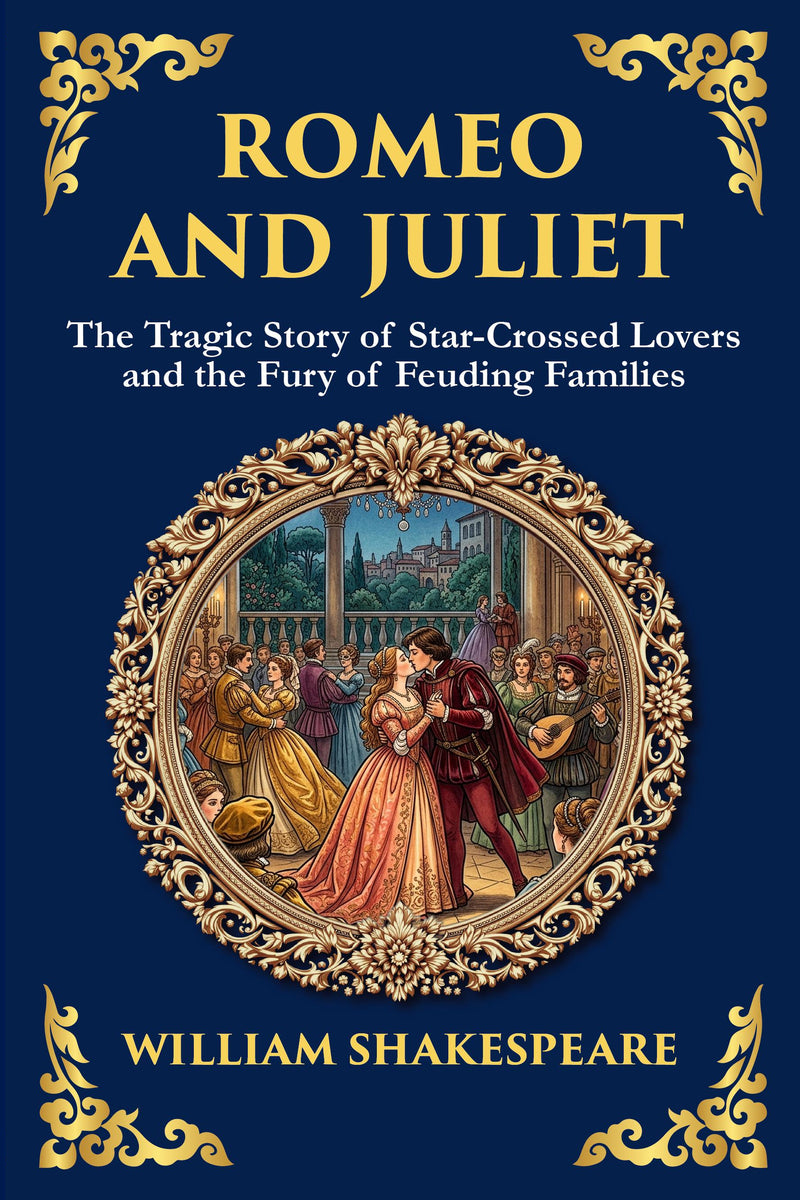
Romeo and Juliet
In the ancient city of Verona, love blossoms where it should never bloom. Romeo Montague and Juliet Capulet, heirs to feuding families, fall desperately in love at first sight.
or free app
10,000+ hrs library
30-day guarantee
The complete Romeo and Juliet appears in modern English through Library of Alexandria Press, available online with audiobook narration included for members.
Have you ever wondered why love sometimes isn’t enough to overcome the forces that divide us? In Romeo and Juliet, William Shakespeare crafts the ultimate story of forbidden love, searing passion, and tragic fate. Set in a world where family honor overshadows reason, and vengeance hides behind every corner, two young lovers defy their birthright in a desperate bid to rewrite destiny.
Their story is more than a love affair—it is a reflection of timeless themes that continue to echo through every generation: The Passion of First Love – Experience the intensity and tenderness of a romance born in secrecy and urgency. The Destructive Power of Hate – Witness how ancient grudges and senseless pride lead to irreversible tragedy. The Cost of Impulsiveness – See how rash decisions and youthful fervor lead to heartbreaking consequences.
A Warning and a Hope – Understand how tragedy can be the catalyst for peace and reconciliation. This modern edition of Romeo and Juliet presents Shakespeare’s immortal words in an accessible and elegantly formatted style for today’s readers. Whether you're discovering it for the first time or returning to a beloved classic, this is the definitive version to read, reflect upon, and remember.
Step into the world of Verona, where love and fate dance hand in hand—and discover why Romeo and Juliet remains one of the most powerful and enduring tales of all time.
What you’ll discover in this modern edition
- The sweeping romance of Romeo and Juliet
- The heartache of love crushed by feuding families
- The poetic brilliance of Shakespeare’s most famous tragedy
- The eternal question: Can love endure in a world of hate? A masterpiece of passion, sorrow, and timeless language—Romeo and Juliet continues to captivate hearts and haunt imaginations across centuries.
| Formats | eBook (EPUB + PDF) · Audiobook · Paperback · Hardcover · Large Print |
| Language | English |
| Trim size (print) | 6 × 9 in |
| Binding | Paperback — perfect-bound · Hardcover — casewrap |
| Large Print edition | Same text in a larger, easy-read type — a larger font, not a larger trim |
| Print pricing | Every physical book at our true cost — at-cost, no profit (members) |
| Library | 873 restored titles, always growing |
| Length | 22,150 words · ~1 hr 29 min reading |
| Reading level | Grade 7 · an easy, flowing read (this modern-English edition) |
| Edition | Modern English translation · 2026 |
Member reviews for this edition are collected as readers finish it — be the first. Across the library: 12,000+ books shipped, every plan covered by a 365-day print guarantee.
About this edition
A faithful, unabridged modern-English edition by The Library of Alexandria — carefully rendered for today's reader and verified paragraph-by-paragraph against the public-domain source. Available as eBook, audiobook, paperback, hardcover, and large print.
- Complete & unabridgedVerified paragraph by paragraph against the source — never a scan, never abridged.
- Modern English, faithfulReadable today, with the author’s meaning kept intact. Readable — not simplified.
- Every format, one membershipRead in your browser or the free app, or listen to the full audiobook.
Included free with your membership
Cancel anytime, one click · 30-day money-back guarantee
Edition last updated July 2026
What’s inside
Romeo and Juliet — complete and unabridged: all 26 sections included with membership, plus the full audiobook.
Begin reading Romeo and Juliet
In clear modern English — the complete text is included with membership.
Introduction
There are stories so deeply woven into the fabric of human culture that we feel we know them before we have ever read a single line. We absorb them through fragments overheard, through borrowed phrases, through the gestures of lovers in films and the headlines of newspapers reporting heartbreak. Romeo and Juliet is such a story. Its very title has become shorthand for a kind of love—passionate, headlong, defiant, and shadowed by danger. We speak of “star-crossed lovers” and of a “Romeo” without always pausing to recall that these phrases came from a single play, written more than four centuries ago by a glover’s son from a market town in the English Midlands. Yet to approach this work as though we already understand it is to risk missing the astonishing thing it actually is: not a sentimental fable about young romance, but a furious, tender, intelligent, and devastating exploration of how love and hatred share the same blood, how the young inherit the wars of the old, and how the smallest accidents of timing can spell the difference between a wedding and a grave.
This edition presents that extraordinary work in a modern translation, adapted for the contemporary reader. Before we go any further, it is worth being honest about what that means and why it matters. Shakespeare wrote in the English of the late sixteenth century, an English that was vibrant, inventive, and at the cutting edge of its own moment—but which, to the modern ear, can feel like a thicket of unfamiliar words, inverted phrasings, and references to a world that has largely vanished. For some readers, this language is a delight to be savored; for others, it becomes a barrier so high that the human drama on the other side of it is lost entirely. The purpose of a modern adaptation is not to replace the original or to claim superiority over it, but to open a door. It is to ensure that the heartbeat of the story—the urgency of two young people falling in love against impossible odds, the menace of armed men in a sunlit square, the agony of a parent and child at war, the unbearable arithmetic of a message delivered too late—reaches you directly, without the static of comprehension getting in the way. What you hold is an invitation to experience the emotional truth of this play fully, and perhaps, having done so, to return one day to Shakespeare’s original lines with the confidence of someone who already knows the territory of the heart it maps.
One of the first surprises for many readers is the discovery that Shakespeare did not invent this tale. The bones of it were already old when he set them down. Stories of young lovers thwarted by feuding families and undone by tragic misunderstanding had circulated through Italian and European literature for generations before he wrote. There were earlier Italian versions in which lovers very much like these met, married in secret, and came to ruin through a fatal sequence of mischance. By the time the story reached England, it had been retold in verse by an English poet, and it was almost certainly this version that Shakespeare took up, reshaped, compressed, and transformed.
What he did with that inherited material is the real act of genius. The earlier tellings tended to treat the lovers as cautionary figures—warnings against the dangers of disobedience, of acting on passion rather than prudence, of the recklessness of youth. They moralized. They held the young couple at arm’s length and clucked their tongues. Shakespeare did something almost the opposite. He drew close. He gave the lovers an inner life so vivid and a voice so true that we cease to judge them and begin instead to inhabit them. He compressed the timeline dramatically: where the older versions allowed the romance to unfold over months, Shakespeare squeezes the entire arc into a matter of days. This compression is one of the play’s secret engines. Everything happens at breakneck speed, and that speed is not a flaw but the very point. Young love does not feel gradual to those experiencing it; it feels like falling, like being swept off your feet by a current too strong to resist. By collapsing time, Shakespeare makes us feel the vertigo of it, the breathless sense that the world is moving faster than anyone can control.
He also populated the story with characters who feel astonishingly alive even now. There is a nurse whose earthy humor and rambling affection make her one of the most beloved comic-yet-heartbreaking figures in all of theater. There is a hot-tempered young man whose love of a quarrel sets a fire that cannot be put out. There is a quicksilver friend whose wit dazzles and whose imagination spins out into one of the most famous flights of fancy ever written. There is a well-meaning friar whose schemes are born of kindness but whose plans go terribly, tragically awry. And at the center, of course, there are the two young people whose names have outlived empires.
It is worth pausing on just how young they are. This is not the story of seasoned adults navigating a mature relationship. Juliet, in particular, is presented as being on the threshold of womanhood, barely more than a child by our standards, and Romeo is not much older. This matters enormously to how we should read what unfolds. The intensity of their feeling, the absoluteness of their commitment, the impatience and the impulsiveness—these are not failures of character but the authentic texture of first love experienced by the very young. Shakespeare understood, with uncanny precision, the way that adolescent emotion burns hotter and brighter precisely because it has no past to temper it and cannot imagine a future without the beloved. To read this play as the story of two foolish children making bad decisions is to misread it entirely. To read it as the story of two human beings discovering, with shocking suddenness, what it means to love and to be loved in return—and to have that discovery crushed by forces far larger than themselves—is to read it as Shakespeare intended.
The famous opening tells us, almost before the story begins, how it will end. We are told plainly that these lovers are doomed, that their deaths will at last bury their parents’ strife. This is one of the boldest choices in the play. Why give away the ending? Because the tragedy is not in the surprise; it is in the inevitability. Knowing where it all leads transforms every tender moment into something almost unbearably poignant. When the lovers meet and the world seems to open before them, we already know the shadow that hangs over it. We watch them reach for happiness with our hearts in our throats, because we have been told what waits at the end of the road. This is a kind of dramatic irony so powerful that it has shaped the way tragedy has been written ever since. We are not asked to wonder whether it will end in sorrow, but to grieve at the cruel mechanics of how—the misfortunes, the hasty decisions, the messages gone astray, the single beat of time that, had it fallen differently, might have changed everything.
This sense of fate and chance pressing down on human lives runs through the entire work. The lovers themselves speak of stars and dreams and dark premonitions. They feel, even in their happiest moments, the nearness of disaster. Whether you read the ending as the work of an indifferent fate, or as the natural consequence of human hatred and haste, or as some terrible collaboration between the two, is a question the play leaves open. It is one of the things that makes it endlessly rewarding to return to. There is no comfortable lesson to be extracted, no tidy moral that resolves the ache. There is only the spectacle of two young people who found something rare and pure in a world that could not let them keep it.
Why a Modern Translation, and How to Read It
Let us return for a moment to the question of language, because it sits at the heart of what this edition is and why it exists. Shakespeare is, without serious dispute, one of the supreme masters of the English language. His vocabulary was vast, his ear for rhythm unmatched, his capacity to coin new words and phrases so prolific that we still use hundreds of his inventions in everyday speech without realizing their origin. To read him in the original is to encounter language at the absolute peak of its expressive power. So why translate him at all?
The answer is simple and unsentimental. Language changes. The English of four hundred years ago is not the English we speak today. Words have shifted their meanings, sometimes subtly and sometimes completely. Grammatical structures that were natural then sound strange or even backward to us now. References to mythology, to contemporary customs, to objects and ideas that filled the everyday world of an audience in Shakespeare’s time, are opaque to most modern readers. The result is that a great many people, encountering the original text cold, find themselves spending so much energy decoding the surface that they never reach the depths beneath. They labor through a footnote-laden page, looking up a word here, untangling a sentence there, and by the time they have figured out what a line literally means, the emotional momentum has drained away. The play, which should move like a river in flood, becomes a slow march through unfamiliar terrain.
A modern translation removes that obstacle. It renders the meaning of every line in language that you can understand immediately, so that nothing stands between you and the unfolding drama. The wit lands as wit. The threat lands as threat. The tenderness lands as tenderness. You can follow the verbal sparring, the sudden turns of feeling, the layered ironies, in real time, the way the very first audiences did—because for them, remember, this was simply the way people talked. They did not experience Shakespeare as difficult or archaic. They experienced him as thrilling, immediate, and alive. A modern adaptation aims to restore that original immediacy, to let you feel the play the way its first audiences felt it: as a story happening now, to people you care about, with stakes that could not be higher.
It is important to be clear about what is gained and what is necessarily set aside in such a translation. What is gained is accessibility, momentum, and clarity—the ability to lose yourself in the story without friction. What is set aside, to some degree, is the particular music of Shakespeare’s original verse, the dense wordplay that depends on the specific double meanings of specific words, the rhythm of the poetry as he composed it. This is an honest trade-off, and no one who loves Shakespeare would pretend otherwise. The original is the original; nothing can replace it, and nothing here is meant to. But the trade-off is well worth making for the reader who might otherwise never make it through, or who has tried before and been defeated. Think of it this way: a translation of a great poem from one language to another can never capture every nuance of the original, yet we are immeasurably enriched by being able to read the masterpieces of other tongues at all. The same logic applies here. This version is a bridge. Once you have crossed it and stand on the far side, knowing the story intimately, understanding its characters and its movements and its meanings, you may find that the original text, when you turn to it, suddenly opens up. You will recognize the moments. You will know what is happening and why. And the famous lines you have heard quoted all your life will land with their full weight, because you will at last understand the context that gives them their power.
So how should you read this edition to get the most from it? First, give yourself permission to be swept along. This is a fast-moving story, and it rewards immersion. Do not feel you must pause and analyze every moment; let the drama carry you. The events unfold over just a few days, and reading the play in a similar spirit of breathless momentum is one of the best ways to feel its peculiar intensity. Notice how quickly everything happens, how decisions are made in the heat of feeling, how little time anyone has to reflect or reconsider. That speed is meant to make you anxious, to make your pulse quicken, to fill you with a sense of helpless urgency. Lean into it.
Cancel anytime, one click · 30-day money-back guarantee
Founding annual rate available now — your price locks for life when you join.
Not ready? Get this free chapter by email — read it anytime.
✓ Sent — check your inbox for Romeo and Juliet.
Questions about Romeo and Juliet
What is Romeo and Juliet about?
In the ancient city of Verona, love blossoms where it should never bloom. Romeo Montague and Juliet Capulet, heirs to feuding families, fall desperately in love at first sight. But their union, forged in secrecy and sealed with passion, is doomed from the start.
Who wrote Romeo and Juliet?
Romeo and Juliet was written by William Shakespeare. This edition presents the complete work in clear modern English, faithfully rendered from the public-domain original by Library of Alexandria Press.
Is Romeo and Juliet free to read?
The opening chapter is free to read on this page. Members read and listen to the complete work — and the entire library — free, and can order any physical book at our true print cost.
How long is Romeo and Juliet?
26 chapters (~22,150 words) — about 1 hr 29 min of reading in this modern-English edition.
Is this an abridged version of Romeo and Juliet?
No. This is the complete, unabridged Romeo and Juliet, carefully rendered into clear modern English and verified paragraph-by-paragraph against the public-domain source — nothing is cut or summarised.
What formats does Romeo and Juliet come in?
Romeo and Juliet is available as eBook, paperback, hardcover and large print. eBook and audiobook are included with membership; printed editions ship at our true print cost.
Shipping & returns
Billing & membership
More from the library


Explore Poetry & Drama
- As You Like It · William Shakespeare
- The Raven · Edgar Allan Poe
- The Merchant of Venice · William Shakespeare
- A Midsummer Night’s Dream · William Shakespeare
- The Imaginary Invalid · Molière
- A Woman of No Importance · Oscar Wilde
- Gitanjali · Rabindranath Tagore
- Sonnets from the Portuguese · Elizabeth Barrett Browning
- The New Life (La Vita Nuova) · Dante Alighieri
- The Rime of the Ancient Mariner · Samuel Taylor Coleridge
- Lady Windermere’s Fan · Oscar Wilde
- The Home Book of Verse — Volume 4 · Burton Egbert Stevenson
- Ghosts · Henrik Ibsen
- Mrs. Warren’s Profession · Bernard Shaw
- An Enemy of the People · Henrik Ibsen
- Gawayne and the Green Knight: A Fairy Tale · Charlton M. Lewis
- The Nibelungenlied · G. H. Needler
- Julius Caesar · William Shakespeare
- The Aeneid of Virgil · Virgil
- Troilus and Criseyde · Geoffrey Chaucer
- The Post Office · Rabindranath Tagore
- Lamia · John Keats
- The Ballad of the White Horse · G. K. Chesterton
- A Shropshire Lad · A. E. Housman
- The Birth of the War-God: A Poem by Kalidasa · Kálidása
- Riders to the Sea · J. M. Synge
- The Prophet · Kahlil Gibran
- Twelfth Night; Or, What You Will · William Shakespeare
- Othello, the Moor of Venice · William Shakespeare
- Salomé: A Tragedy in One Act · Oscar Wilde
Romeo and Juliet
Romeo and Juliet
The Tragic Story of Star-Crossed Lovers and the Fury of Feuding Families
William Shakespeare
Contents
- Introduction
- Cast of Characters
- Act 1, Scene 1
- Act 1, Scene 2
- Act 1, Scene 3
- Act 1, Scene 4
- Act 1, Scene 5
- Act 2, Scene 1
- Act 2, Scene 2
- Act 2, Scene 3
- Act 2, Scene 4
- Act 2, Scene 5
- Act 2, Scene 6
- Act 3, Scene 1
- Act 3, Scene 2
- Act 3, Scene 3
- Act 3, Scene 4
- Act 3, Scene 5
- Act 4, Scene 1
- Act 4, Scene 2
- Act 4, Scene 3
- Act 4, Scene 4
- Act 4, Scene 5
- Act 5, Scene 1
- Act 5, Scene 2
- Act 5, Scene 3
Introduction
There are stories so deeply woven into the fabric of human culture that we feel we know them before we have ever read a single line. We absorb them through fragments overheard, through borrowed phrases, through the gestures of lovers in films and the headlines of newspapers reporting heartbreak. Romeo and Juliet is such a story. Its very title has become shorthand for a kind of love—passionate, headlong, defiant, and shadowed by danger. We speak of “star-crossed lovers” and of a “Romeo” without always pausing to recall that these phrases came from a single play, written more than four centuries ago by a glover’s son from a market town in the English Midlands. Yet to approach this work as though we already understand it is to risk missing the astonishing thing it actually is: not a sentimental fable about young romance, but a furious, tender, intelligent, and devastating exploration of how love and hatred share the same blood, how the young inherit the wars of the old, and how the smallest accidents of timing can spell the difference between a wedding and a grave.
This edition presents that extraordinary work in a modern translation, adapted for the contemporary reader. Before we go any further, it is worth being honest about what that means and why it matters. Shakespeare wrote in the English of the late sixteenth century, an English that was vibrant, inventive, and at the cutting edge of its own moment—but which, to the modern ear, can feel like a thicket of unfamiliar words, inverted phrasings, and references to a world that has largely vanished. For some readers, this language is a delight to be savored; for others, it becomes a barrier so high that the human drama on the other side of it is lost entirely. The purpose of a modern adaptation is not to replace the original or to claim superiority over it, but to open a door. It is to ensure that the heartbeat of the story—the urgency of two young people falling in love against impossible odds, the menace of armed men in a sunlit square, the agony of a parent and child at war, the unbearable arithmetic of a message delivered too late—reaches you directly, without the static of comprehension getting in the way. What you hold is an invitation to experience the emotional truth of this play fully, and perhaps, having done so, to return one day to Shakespeare’s original lines with the confidence of someone who already knows the territory of the heart it maps.
One of the first surprises for many readers is the discovery that Shakespeare did not invent this tale. The bones of it were already old when he set them down. Stories of young lovers thwarted by feuding families and undone by tragic misunderstanding had circulated through Italian and European literature for generations before he wrote. There were earlier Italian versions in which lovers very much like these met, married in secret, and came to ruin through a fatal sequence of mischance. By the time the story reached England, it had been retold in verse by an English poet, and it was almost certainly this version that Shakespeare took up, reshaped, compressed, and transformed.
What he did with that inherited material is the real act of genius. The earlier tellings tended to treat the lovers as cautionary figures—warnings against the dangers of disobedience, of acting on passion rather than prudence, of the recklessness of youth. They moralized. They held the young couple at arm’s length and clucked their tongues. Shakespeare did something almost the opposite. He drew close. He gave the lovers an inner life so vivid and a voice so true that we cease to judge them and begin instead to inhabit them. He compressed the timeline dramatically: where the older versions allowed the romance to unfold over months, Shakespeare squeezes the entire arc into a matter of days. This compression is one of the play’s secret engines. Everything happens at breakneck speed, and that speed is not a flaw but the very point. Young love does not feel gradual to those experiencing it; it feels like falling, like being swept off your feet by a current too strong to resist. By collapsing time, Shakespeare makes us feel the vertigo of it, the breathless sense that the world is moving faster than anyone can control.
He also populated the story with characters who feel astonishingly alive even now. There is a nurse whose earthy humor and rambling affection make her one of the most beloved comic-yet-heartbreaking figures in all of theater. There is a hot-tempered young man whose love of a quarrel sets a fire that cannot be put out. There is a quicksilver friend whose wit dazzles and whose imagination spins out into one of the most famous flights of fancy ever written. There is a well-meaning friar whose schemes are born of kindness but whose plans go terribly, tragically awry. And at the center, of course, there are the two young people whose names have outlived empires.
It is worth pausing on just how young they are. This is not the story of seasoned adults navigating a mature relationship. Juliet, in particular, is presented as being on the threshold of womanhood, barely more than a child by our standards, and Romeo is not much older. This matters enormously to how we should read what unfolds. The intensity of their feeling, the absoluteness of their commitment, the impatience and the impulsiveness—these are not failures of character but the authentic texture of first love experienced by the very young. Shakespeare understood, with uncanny precision, the way that adolescent emotion burns hotter and brighter precisely because it has no past to temper it and cannot imagine a future without the beloved. To read this play as the story of two foolish children making bad decisions is to misread it entirely. To read it as the story of two human beings discovering, with shocking suddenness, what it means to love and to be loved in return—and to have that discovery crushed by forces far larger than themselves—is to read it as Shakespeare intended.
The famous opening tells us, almost before the story begins, how it will end. We are told plainly that these lovers are doomed, that their deaths will at last bury their parents’ strife. This is one of the boldest choices in the play. Why give away the ending? Because the tragedy is not in the surprise; it is in the inevitability. Knowing where it all leads transforms every tender moment into something almost unbearably poignant. When the lovers meet and the world seems to open before them, we already know the shadow that hangs over it. We watch them reach for happiness with our hearts in our throats, because we have been told what waits at the end of the road. This is a kind of dramatic irony so powerful that it has shaped the way tragedy has been written ever since. We are not asked to wonder whether it will end in sorrow, but to grieve at the cruel mechanics of how—the misfortunes, the hasty decisions, the messages gone astray, the single beat of time that, had it fallen differently, might have changed everything.
This sense of fate and chance pressing down on human lives runs through the entire work. The lovers themselves speak of stars and dreams and dark premonitions. They feel, even in their happiest moments, the nearness of disaster. Whether you read the ending as the work of an indifferent fate, or as the natural consequence of human hatred and haste, or as some terrible collaboration between the two, is a question the play leaves open. It is one of the things that makes it endlessly rewarding to return to. There is no comfortable lesson to be extracted, no tidy moral that resolves the ache. There is only the spectacle of two young people who found something rare and pure in a world that could not let them keep it.
Why a Modern Translation, and How to Read It
Let us return for a moment to the question of language, because it sits at the heart of what this edition is and why it exists. Shakespeare is, without serious dispute, one of the supreme masters of the English language. His vocabulary was vast, his ear for rhythm unmatched, his capacity to coin new words and phrases so prolific that we still use hundreds of his inventions in everyday speech without realizing their origin. To read him in the original is to encounter language at the absolute peak of its expressive power. So why translate him at all?
The answer is simple and unsentimental. Language changes. The English of four hundred years ago is not the English we speak today. Words have shifted their meanings, sometimes subtly and sometimes completely. Grammatical structures that were natural then sound strange or even backward to us now. References to mythology, to contemporary customs, to objects and ideas that filled the everyday world of an audience in Shakespeare’s time, are opaque to most modern readers. The result is that a great many people, encountering the original text cold, find themselves spending so much energy decoding the surface that they never reach the depths beneath. They labor through a footnote-laden page, looking up a word here, untangling a sentence there, and by the time they have figured out what a line literally means, the emotional momentum has drained away. The play, which should move like a river in flood, becomes a slow march through unfamiliar terrain.
A modern translation removes that obstacle. It renders the meaning of every line in language that you can understand immediately, so that nothing stands between you and the unfolding drama. The wit lands as wit. The threat lands as threat. The tenderness lands as tenderness. You can follow the verbal sparring, the sudden turns of feeling, the layered ironies, in real time, the way the very first audiences did—because for them, remember, this was simply the way people talked. They did not experience Shakespeare as difficult or archaic. They experienced him as thrilling, immediate, and alive. A modern adaptation aims to restore that original immediacy, to let you feel the play the way its first audiences felt it: as a story happening now, to people you care about, with stakes that could not be higher.
It is important to be clear about what is gained and what is necessarily set aside in such a translation. What is gained is accessibility, momentum, and clarity—the ability to lose yourself in the story without friction. What is set aside, to some degree, is the particular music of Shakespeare’s original verse, the dense wordplay that depends on the specific double meanings of specific words, the rhythm of the poetry as he composed it. This is an honest trade-off, and no one who loves Shakespeare would pretend otherwise. The original is the original; nothing can replace it, and nothing here is meant to. But the trade-off is well worth making for the reader who might otherwise never make it through, or who has tried before and been defeated. Think of it this way: a translation of a great poem from one language to another can never capture every nuance of the original, yet we are immeasurably enriched by being able to read the masterpieces of other tongues at all. The same logic applies here. This version is a bridge. Once you have crossed it and stand on the far side, knowing the story intimately, understanding its characters and its movements and its meanings, you may find that the original text, when you turn to it, suddenly opens up. You will recognize the moments. You will know what is happening and why. And the famous lines you have heard quoted all your life will land with their full weight, because you will at last understand the context that gives them their power.
So how should you read this edition to get the most from it? First, give yourself permission to be swept along. This is a fast-moving story, and it rewards immersion. Do not feel you must pause and analyze every moment; let the drama carry you. The events unfold over just a few days, and reading the play in a similar spirit of breathless momentum is one of the best ways to feel its peculiar intensity. Notice how quickly everything happens, how decisions are made in the heat of feeling, how little time anyone has to reflect or reconsider. That speed is meant to make you anxious, to make your pulse quicken, to fill you with a sense of helpless urgency. Lean into it.
[Enter Sampson and Gregory, armed with swords and shields.]
Gregory, I swear, we aren’t going to take this kind of abuse.
No, because then we’d be doing the dirty work.
I mean, if we get angry, we’ll draw our swords.
Yeah, and while you’re alive, try to keep your neck out of a noose.
But you aren’t provoked to strike very often.
Any dog from the house of Montague can provoke me.
To be “moved” is to stir; but to be brave is to stand your ground. So, if you’re “moved,” you’re actually just running away.
A dog from that house will move me to stand my ground.
I’ll push aside any man or woman from the Montagues.
That just shows you’re a weak coward, because the weakest people are the ones pushed against the wall.
True, and that’s why women, being the weaker sex, are always pushed against the wall. So, I’ll push the Montague men out of the way and pin their women against the wall.
The fight is between our masters and us, their servants.
It’s all the same; I’ll be a tyrant. Once I’ve fought the men, I’ll be “civil” with the women—I’ll cut off their heads.
Yeah, their heads—or their virginity. Take it however you want.
The ones who feel it will certainly “take it” in a certain sense.
They’ll feel me as long as I can stand; and everyone knows I’m a handsome piece of meat.
It’s a good thing you’re not a fish; if you were, you’d be a goner. Get your weapon out; here come some Montagues.
My sword is out. Start a fight, and I’ve got your back.
What? You’re going to turn around and run?
Let’s make sure the law is on our side; let them start it.
I’ll scowl at them as I walk by, and they can take that however they want.
End of the free sample
Keep reading, free
Members read and listen to the complete book — and the entire library. Cancel anytime, one click · 30-day money-back guarantee.