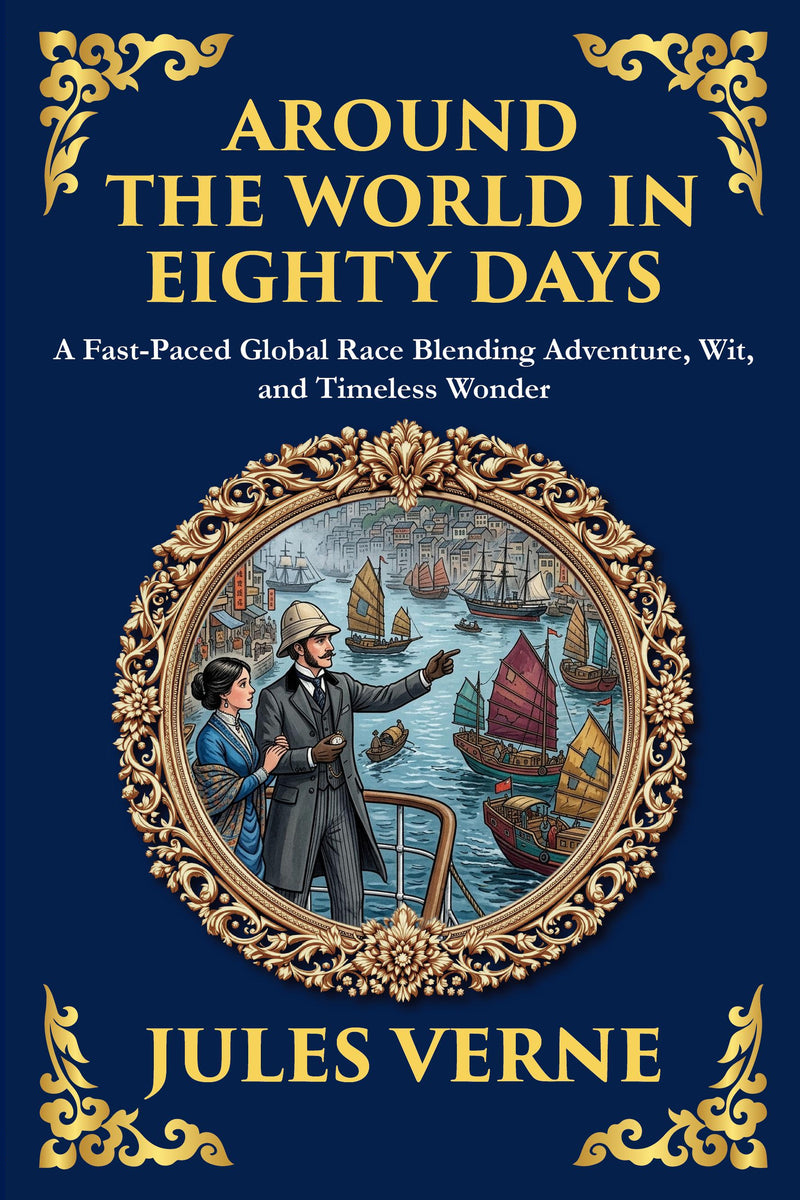
Around the World in Eighty Days
When the reserved and mysterious English gentleman Phileas Fogg wagers that he can circumnavigate the globe in just eighty days, society laughs—and the clock starts ticking.
or free app
10,000+ hrs library
30-day guarantee
The complete Around the World in Eighty Days appears in modern English through Library of Alexandria Press, available online with audiobook narration included for members.
Have you ever wondered why we chase the impossible—and how far we’d go to win? Jules Verne’s Around the World in Eighty Days is the exhilarating story of a man who risks his fortune—and his reputation—for the sake of a seemingly impossible bet. Part travelogue, part mystery, part comedy of manners, and pure adventure at heart, this beloved classic transports readers on a race across the globe.
The story begins in London, where the methodical Phileas Fogg announces to the members of the Reform Club that he can circle the earth in just eighty days. His wager: £20,000. Accompanied by his newly hired and often bewildered French valet, Passepartout, Fogg embarks on a breathless journey through exotic ports, perilous routes, and chaotic encounters —from India’s bustling streets and American railways to steamships and elephants.
But there’s a twist: hot on his trail is Detective Fix, convinced Fogg is a bank robber escaping justice. As time slips away, the world becomes a maze of delays, dangers, and unexpected friendships. Can logic and planning overcome the chaos of real life?
With wit, heart, and relentless pace, Verne captures the spirit of exploration and the essence of what it means to believe in one’s mission—even when everyone else doubts you.
What you’ll discover in this modern edition
- A High-Stakes Journey Around the World – Experience a whirlwind tour of the 19th- century globe, from Europe to Asia to the American Wild West.
- An Unforgettable Hero in Phileas Fogg – A man whose calm reason meets wild chaos in unexpected ways.
- Adventure, Humor, and Heart – A story filled with twists, narrow escapes, and a hint of romance.
- A Satirical Glance at Colonialism and Globalization – Verne’s wit shines in his portrayals of different cultures and bureaucracies.
- A Celebration of Precision vs. Spontaneity – Fogg’s logic clashes with the unpredictable world, often hilariously and heroically.
| Formats | eBook (EPUB + PDF) · Audiobook · Paperback · Hardcover · Large Print |
| Language | English |
| Trim size (print) | 6 × 9 in |
| Binding | Paperback — perfect-bound · Hardcover — casewrap |
| Large Print edition | Same text in a larger, easy-read type — a larger font, not a larger trim |
| Print pricing | Every physical book at our true cost — at-cost, no profit (members) |
| Library | 873 restored titles, always growing |
| Length | 59,142 words · ~3 hr 57 min reading |
| Reading level | Grade 8 · an easy, flowing read (this modern-English edition) |
| Edition | Modern English translation · 2026 |
Member reviews for this edition are collected as readers finish it — be the first. Across the library: 12,000+ books shipped, every plan covered by a 365-day print guarantee.
About this edition
A faithful, unabridged modern-English edition by The Library of Alexandria — carefully rendered for today's reader and verified paragraph-by-paragraph against the public-domain source. Available as eBook, audiobook, paperback, hardcover, and large print.
- Complete & unabridgedVerified paragraph by paragraph against the source — never a scan, never abridged.
- Modern English, faithfulReadable today, with the author’s meaning kept intact. Readable — not simplified.
- Every format, one membershipRead in your browser or the free app, or listen to the full audiobook.
Included free with your membership
Cancel anytime, one click · 30-day money-back guarantee
Edition last updated July 2026
What’s inside
Around the World in Eighty Days — complete and unabridged: all 38 sections included with membership, plus the full audiobook.
Begin reading Around the World in Eighty Days
In clear modern English — the complete text is included with membership.
Introduction
Imagine a man so precise that he dismisses a servant for bringing his shaving water two degrees too cool. A man who eats at the same time every day, walks the same number of steps from his chair to his front door, and lives by a routine so exact that the neighbors could set their clocks by his comings and goings. Now imagine that this same man—this monument to predictability, this human metronome—stakes his entire fortune on the maddest of propositions: that he can circle the entire globe in just eighty days. This is the delicious paradox at the heart of one of the most beloved adventure stories ever written, and it is the engine that drives every page that follows.
When Jules Verne sat down to write this novel in the early 1870s, the world was changing at a velocity that must have seemed dizzying, even frightening, to those who lived through it. The Suez Canal had opened in 1869, slicing a watery shortcut between continents that had been separated by deserts for all of human history. The transcontinental railroad in America had been completed that same year, allowing a traveler to cross a vast continent in days rather than the months it had once demanded of pioneers and wagon trains. India had been knitted together by rail lines, and steamships churned across oceans on regular, advertised schedules. For the first time in the long story of our species, the planet had become measurable—not just in the abstract sense of cartographers and astronomers, but in the practical, ticket-buying, timetable-consulting sense of an ordinary person with money and nerve.
This is the world that Verne captures with such loving, almost giddy precision. The book you are about to read is, in one sense, a celebration of human ingenuity and the shrinking of distances. It is a love letter to the steamships, locomotives, and telegraph wires that made the impossible suddenly, thrillingly possible. But to read it merely as a hymn to technology would be to miss its warmth, its humor, and its profound understanding of the human heart. For all its talk of schedules and connections and miles per hour, this is a story about people—their stubbornness, their loyalty, their capacity for surprise, and their hidden depths beneath surfaces that seem, at first glance, entirely transparent.
The protagonist, an Englishman of mysterious means and mathematical habits, is the kind of character who could so easily have been a mere joke—a stiff figure of fun, a windup toy of British reserve. Yet as the journey unfolds, something remarkable happens. We begin to see that beneath the cold exterior, beneath the unflappable calm and the maddening composure, there beats a heart capable of generosity, courage, and even tenderness. Verne understood something essential about human nature: that the most interesting people are often those whose true selves are revealed not in comfort but in crisis, not when everything goes according to plan but precisely when the plan collapses into chaos. And in this story, the plan collapses again and again, in ways that will keep you turning pages long past the hour you intended to set the book down.
Then there is the servant—a Frenchman whose name suggests an honest, well-meaning fellow, and who provides much of the novel’s warmth and comedy. He had taken his position precisely because he longed for a quiet, settled life after years of adventure and instability. The cosmic joke, of course, is that he has attached himself to the one master in all of London who is about to drag him headlong into the most exhausting, perilous, globe-spanning escapade imaginable. Through his eyes, we experience the wonder, the terror, and the absurdity of the journey. He is our surrogate, our companion, the one who gasps when we would gasp and worries when we would worry. His devotion to his master, which deepens with every passing mile and every shared danger, forms one of the quiet emotional spines of the book—a friendship that grows precisely because it is tested.
I will not say more about the other figures who join this remarkable expedition, nor about the obstacles that rise to meet our travelers at every turn. Part of the singular joy of this novel lies in not knowing what comes next, in being carried along by the same breathless momentum that drives the characters forward. But I will say this: Verne was a master of the cliffhanger long before that word entered our vocabulary. He understood, perhaps better than any writer of his age, how to end a chapter at exactly the moment of maximum suspense, leaving the reader no choice but to press onward. Reading this book is a little like riding one of the very trains it describes—you climb aboard, the whistle blows, and suddenly you are hurtling forward with no easy way to stop.
To fully appreciate what you hold in your hands, it helps to understand the extraordinary mind that created it. Jules Verne, born in the French port city of Nantes in 1828, grew up surrounded by ships, by the comings and goings of sailors with their tales of distant ports, by the salt smell of adventure carried on the Atlantic wind. The sea and the wider world called to him from his earliest years. There is a famous, possibly embellished, story that as a boy he attempted to run away to sea aboard a ship bound for the Indies, only to be caught and returned to his family, after which he supposedly promised to travel henceforth only in his imagination. Whether or not the tale is literally true, it captures something essential about the man he would become: a writer who explored the entire planet, and even beyond it, from the comfort of his study, transporting millions of readers along with him.
Verne’s father intended him for the law, and the young man dutifully went off to Paris to pursue that respectable profession. But the city’s theaters, salons, and literary cafés proved far more seductive than legal briefs. He began writing plays and short stories, fell in with the artistic crowd, and gradually came to understand that words, not contracts, were his true calling. It was a slow and often discouraging apprenticeship. Success did not come quickly, and there were lean years of struggle and self-doubt before he found the formula that would make him one of the most widely read authors in human history.
That formula crystallized when Verne began collaborating with the visionary publisher Pierre-Jules Hetzel, who recognized in the young writer a rare gift: the ability to wrap rigorous scientific and geographical detail in stories of pulse-pounding adventure. Together they conceived of what Verne called his “Extraordinary Voyages,” a vast series of novels that would, in Hetzel’s grand phrase, depict “the entire earth, the entire world” while educating as much as they entertained. The series would eventually encompass dozens of titles and take readers beneath the oceans, into the bowels of the earth, up into the skies in balloons, and even—astonishingly, for a writer working in the 1860s—to the moon. Verne possessed an almost prophetic imagination, anticipating submarines, space travel, and other marvels decades before they became reality. But what made his books endure was never the gadgetry alone. It was the human stories he hung upon the scaffolding of science, the characters whose journeys we cared about even as we marveled at the wonders they encountered.
This particular novel occupies a special place within Verne’s vast body of work, and indeed within the history of popular literature. Unlike many of his other tales, it contains no fantastical inventions, no impossible machines, no speculative leaps into a future that had not yet arrived. Every steamship, every railway, every mode of conveyance described within these pages actually existed and operated according to the very timetables Verne consulted. In that sense, the book is almost a work of journalism dressed in the clothing of fiction—a demonstration that the marvelous was no longer confined to the realm of imagination, but had become a feature of the ordinary, ticketed, scheduled world. The adventure here is not in defying the laws of nature but in pushing the existing machinery of civilization to its absolute limits, in seeing just how fast a determined human being could fling himself around the planet using only the resources available to any sufficiently wealthy and resolute traveler.
There is a wonderful piece of literary history attached to this novel’s first appearance. When it was originally published as a serial in a French newspaper in 1872, it caused a genuine sensation—not merely among readers but among the businesses whose vessels and railways featured in the story. Some accounts hold that steamship and railway companies actually lobbied to have their services mentioned in the narrative, hoping to capitalize on the public excitement. The tension built with each installment was so acute that readers reportedly waited at the newspaper offices for the next chapter, desperate to learn whether the seemingly impossible feat would be accomplished. The serial format, with its enforced cliffhangers and weekly suspense, was perfectly suited to a story whose entire premise was a race against the relentless ticking of the clock. Readers became, in effect, participants in the wager themselves, betting on outcomes, debating the odds, living and breathing every delay and every desperate improvisation.
The novel’s influence rippled outward far beyond its initial publication. It inspired real-life imitators who set out to beat the fictional record, the most famous being the American journalist Nellie Bly, who in 1889 circumnavigated the globe in seventy-two days, carrying with her the spirit of Verne’s restless protagonist. The story has been adapted countless times for stage and screen, reimagined for new generations, and translated into virtually every written language on earth. Its title has become a kind of cultural shorthand, instantly evoking the romance of travel, the thrill of the race, the marvel of a world made small enough to be encircled. Few works of fiction have so thoroughly entered the collective imagination of humanity, and fewer still have done so while retaining their power to delight on each fresh encounter.
A Note on This Edition and How to Read It
The book you are about to read has been prepared as a modern translation, carefully adapted for the contemporary reader. This deserves a few words of explanation, because the question of how to present a classic work to a new audience is a delicate and important one, and you have every right to know what choices have been made on your behalf.
Verne wrote, of course, in French, and the version most English-speaking readers have encountered over the past century and a half was shaped by early translations of wildly varying quality. Some of those nineteenth-century renderings were hasty, careless, or even deliberately abridged, trimming descriptions and altering details to suit the perceived tastes of their original audiences. Others rendered Verne’s brisk, energetic prose into a stilted, formal English that made the author seem far more ponderous than he actually was in his native tongue. The accumulated effect was that generations of readers encountered a somewhat diminished version of Verne—slower, stiffer, and less alive than the writer his French contemporaries knew and loved.
This edition seeks to restore the qualities that made Verne so irresistible: the propulsive pace, the dry wit, the sense of breathless forward motion. Care has been taken to render the prose in language that flows naturally for the modern ear, free of the archaic constructions and convoluted phrasings that can place an unnecessary barrier between the reader and the story. At the same time, every effort has been made to preserve the spirit, the substance, and the abundant charm of the original. The goal throughout has been faithfulness—not to any single word or phrase in isolation, but to the experience Verne intended his readers to have: that intoxicating blend of education and excitement, of wonder and wit, of armchair travel that nonetheless makes the pulse quicken.
Cancel anytime, one click · 30-day money-back guarantee
Founding annual rate available now — your price locks for life when you join.
Not ready? Get this free chapter by email — read it anytime.
✓ Sent — check your inbox for Around the World in Eighty Days.
Questions about Around the World in Eighty Days
What is Around the World in Eighty Days about?
When the reserved and mysterious English gentleman Phileas Fogg wagers that he can circumnavigate the globe in just eighty days, society laughs—and the clock starts ticking. With only a valet, a travel bag, and unshakeable precision, Fogg embarks on a whirlwind journey across continents, battling storms, delays, wild adventures, and a relentless detective who believes he’s a criminal in disguise. Around the World in Eighty Days is a masterful tale of ingenuity, perseverance, and the thrill of the unknown, written b
Who wrote Around the World in Eighty Days?
Around the World in Eighty Days was written by Jules Verne. This edition presents the complete work in clear modern English, faithfully rendered from the public-domain original by Library of Alexandria Press.
Is Around the World in Eighty Days free to read?
The opening chapter is free to read on this page. Members read and listen to the complete work — and the entire library — free, and can order any physical book at our true print cost.
How long is Around the World in Eighty Days?
38 chapters (~59,142 words) — about 3 hr 57 min of reading in this modern-English edition.
Is this an abridged version of Around the World in Eighty Days?
No. This is the complete, unabridged Around the World in Eighty Days, carefully rendered into clear modern English and verified paragraph-by-paragraph against the public-domain source — nothing is cut or summarised.
What formats does Around the World in Eighty Days come in?
Around the World in Eighty Days is available as eBook, paperback, hardcover and large print. eBook and audiobook are included with membership; printed editions ship at our true print cost.
Shipping & returns
Billing & membership
More from the library


Explore Adventure
- Tarzan of the Apes · Edgar Rice Burroughs
- The Wonderful Wizard of Oz · L. Frank Baum
- Peter Pan · J. M. Barrie
- Moby Dick; Or, The Whale · Herman Melville
- The Riddle of the Sands · Erskine Childers
- The Loss of the Swansea: A Story of the Florida Coast · W. L. Alden
- Sky Island · L. Frank Baum
- Vikram and the Vampire: Classic Hindu Tales of Adventure, Magic, and Romance · Unknown
- Tales of Unrest · Joseph Conrad
- The Tomb of Ts’in · Edgar Wallace
- Skinny McCord · Percy Keese Fitzhugh
- The Men of the Moss-Hags · S. R. Crockett
- The Hunniwell Boys and the Platinum Mystery · L. P. Wyman
- Allan Quatermain · H. Rider Haggard
- She · H. Rider Haggard
- Medical Life in the Navy · Gordon Stables
- The Thirty-Nine Steps · John Buchan
- The Story of Doctor Dolittle · Hugh Lofting
- The Princess and the Goblin · George MacDonald
- The Man Who Would Be King · Rudyard Kipling
- Lucian’s True History · Lucian of Samosata
- The Secret Adversary · Agatha Christie
- Lord Jim · Joseph Conrad
- The Marvelous Land of Oz · L. Frank Baum
- The Virginian: A Horseman of the Plains · Owen Wister
- Mars is My Destination · Frank Belknap Long
- Anabasis · Xenophon
- The Mississippi Saucer · Frank Belknap Long
- Sabotage in Space · Carey Rockwell
- Brood of the Dark Moon · Charles Willard Diffin
Around the World in Eighty Days
Around the World in Eighty Days
A Fast-Paced Global Race Blending Adventure, Wit, and Timeless Wonder
Jules Verne
Contents
- Introduction
- Chapter 1
- Chapter 2
- Chapter 3
- Chapter 4
- Chapter 5
- Chapter 6
- Chapter 7
- Chapter 8
- Chapter 9
- Chapter 10
- Chapter 11
- Chapter 12
- Chapter 13
- Chapter 14
- Chapter 15
- Chapter 16
- Chapter 17
- Chapter 18
- Chapter 19
- Chapter 20
- Chapter 21
- Chapter 22
- Chapter 23
- Chapter 24
- Chapter 25
- Chapter 26
- Chapter 27
- Chapter 28
- Chapter 29
- Chapter 30
- Chapter 31
- Chapter 32
- Chapter 33
- Chapter 34
- Chapter 35
- Chapter 36
- Chapter 37
Introduction
Imagine a man so precise that he dismisses a servant for bringing his shaving water two degrees too cool. A man who eats at the same time every day, walks the same number of steps from his chair to his front door, and lives by a routine so exact that the neighbors could set their clocks by his comings and goings. Now imagine that this same man—this monument to predictability, this human metronome—stakes his entire fortune on the maddest of propositions: that he can circle the entire globe in just eighty days. This is the delicious paradox at the heart of one of the most beloved adventure stories ever written, and it is the engine that drives every page that follows.
When Jules Verne sat down to write this novel in the early 1870s, the world was changing at a velocity that must have seemed dizzying, even frightening, to those who lived through it. The Suez Canal had opened in 1869, slicing a watery shortcut between continents that had been separated by deserts for all of human history. The transcontinental railroad in America had been completed that same year, allowing a traveler to cross a vast continent in days rather than the months it had once demanded of pioneers and wagon trains. India had been knitted together by rail lines, and steamships churned across oceans on regular, advertised schedules. For the first time in the long story of our species, the planet had become measurable—not just in the abstract sense of cartographers and astronomers, but in the practical, ticket-buying, timetable-consulting sense of an ordinary person with money and nerve.
This is the world that Verne captures with such loving, almost giddy precision. The book you are about to read is, in one sense, a celebration of human ingenuity and the shrinking of distances. It is a love letter to the steamships, locomotives, and telegraph wires that made the impossible suddenly, thrillingly possible. But to read it merely as a hymn to technology would be to miss its warmth, its humor, and its profound understanding of the human heart. For all its talk of schedules and connections and miles per hour, this is a story about people—their stubbornness, their loyalty, their capacity for surprise, and their hidden depths beneath surfaces that seem, at first glance, entirely transparent.
The protagonist, an Englishman of mysterious means and mathematical habits, is the kind of character who could so easily have been a mere joke—a stiff figure of fun, a windup toy of British reserve. Yet as the journey unfolds, something remarkable happens. We begin to see that beneath the cold exterior, beneath the unflappable calm and the maddening composure, there beats a heart capable of generosity, courage, and even tenderness. Verne understood something essential about human nature: that the most interesting people are often those whose true selves are revealed not in comfort but in crisis, not when everything goes according to plan but precisely when the plan collapses into chaos. And in this story, the plan collapses again and again, in ways that will keep you turning pages long past the hour you intended to set the book down.
Then there is the servant—a Frenchman whose name suggests an honest, well-meaning fellow, and who provides much of the novel’s warmth and comedy. He had taken his position precisely because he longed for a quiet, settled life after years of adventure and instability. The cosmic joke, of course, is that he has attached himself to the one master in all of London who is about to drag him headlong into the most exhausting, perilous, globe-spanning escapade imaginable. Through his eyes, we experience the wonder, the terror, and the absurdity of the journey. He is our surrogate, our companion, the one who gasps when we would gasp and worries when we would worry. His devotion to his master, which deepens with every passing mile and every shared danger, forms one of the quiet emotional spines of the book—a friendship that grows precisely because it is tested.
I will not say more about the other figures who join this remarkable expedition, nor about the obstacles that rise to meet our travelers at every turn. Part of the singular joy of this novel lies in not knowing what comes next, in being carried along by the same breathless momentum that drives the characters forward. But I will say this: Verne was a master of the cliffhanger long before that word entered our vocabulary. He understood, perhaps better than any writer of his age, how to end a chapter at exactly the moment of maximum suspense, leaving the reader no choice but to press onward. Reading this book is a little like riding one of the very trains it describes—you climb aboard, the whistle blows, and suddenly you are hurtling forward with no easy way to stop.
To fully appreciate what you hold in your hands, it helps to understand the extraordinary mind that created it. Jules Verne, born in the French port city of Nantes in 1828, grew up surrounded by ships, by the comings and goings of sailors with their tales of distant ports, by the salt smell of adventure carried on the Atlantic wind. The sea and the wider world called to him from his earliest years. There is a famous, possibly embellished, story that as a boy he attempted to run away to sea aboard a ship bound for the Indies, only to be caught and returned to his family, after which he supposedly promised to travel henceforth only in his imagination. Whether or not the tale is literally true, it captures something essential about the man he would become: a writer who explored the entire planet, and even beyond it, from the comfort of his study, transporting millions of readers along with him.
Verne’s father intended him for the law, and the young man dutifully went off to Paris to pursue that respectable profession. But the city’s theaters, salons, and literary cafés proved far more seductive than legal briefs. He began writing plays and short stories, fell in with the artistic crowd, and gradually came to understand that words, not contracts, were his true calling. It was a slow and often discouraging apprenticeship. Success did not come quickly, and there were lean years of struggle and self-doubt before he found the formula that would make him one of the most widely read authors in human history.
That formula crystallized when Verne began collaborating with the visionary publisher Pierre-Jules Hetzel, who recognized in the young writer a rare gift: the ability to wrap rigorous scientific and geographical detail in stories of pulse-pounding adventure. Together they conceived of what Verne called his “Extraordinary Voyages,” a vast series of novels that would, in Hetzel’s grand phrase, depict “the entire earth, the entire world” while educating as much as they entertained. The series would eventually encompass dozens of titles and take readers beneath the oceans, into the bowels of the earth, up into the skies in balloons, and even—astonishingly, for a writer working in the 1860s—to the moon. Verne possessed an almost prophetic imagination, anticipating submarines, space travel, and other marvels decades before they became reality. But what made his books endure was never the gadgetry alone. It was the human stories he hung upon the scaffolding of science, the characters whose journeys we cared about even as we marveled at the wonders they encountered.
This particular novel occupies a special place within Verne’s vast body of work, and indeed within the history of popular literature. Unlike many of his other tales, it contains no fantastical inventions, no impossible machines, no speculative leaps into a future that had not yet arrived. Every steamship, every railway, every mode of conveyance described within these pages actually existed and operated according to the very timetables Verne consulted. In that sense, the book is almost a work of journalism dressed in the clothing of fiction—a demonstration that the marvelous was no longer confined to the realm of imagination, but had become a feature of the ordinary, ticketed, scheduled world. The adventure here is not in defying the laws of nature but in pushing the existing machinery of civilization to its absolute limits, in seeing just how fast a determined human being could fling himself around the planet using only the resources available to any sufficiently wealthy and resolute traveler.
There is a wonderful piece of literary history attached to this novel’s first appearance. When it was originally published as a serial in a French newspaper in 1872, it caused a genuine sensation—not merely among readers but among the businesses whose vessels and railways featured in the story. Some accounts hold that steamship and railway companies actually lobbied to have their services mentioned in the narrative, hoping to capitalize on the public excitement. The tension built with each installment was so acute that readers reportedly waited at the newspaper offices for the next chapter, desperate to learn whether the seemingly impossible feat would be accomplished. The serial format, with its enforced cliffhangers and weekly suspense, was perfectly suited to a story whose entire premise was a race against the relentless ticking of the clock. Readers became, in effect, participants in the wager themselves, betting on outcomes, debating the odds, living and breathing every delay and every desperate improvisation.
The novel’s influence rippled outward far beyond its initial publication. It inspired real-life imitators who set out to beat the fictional record, the most famous being the American journalist Nellie Bly, who in 1889 circumnavigated the globe in seventy-two days, carrying with her the spirit of Verne’s restless protagonist. The story has been adapted countless times for stage and screen, reimagined for new generations, and translated into virtually every written language on earth. Its title has become a kind of cultural shorthand, instantly evoking the romance of travel, the thrill of the race, the marvel of a world made small enough to be encircled. Few works of fiction have so thoroughly entered the collective imagination of humanity, and fewer still have done so while retaining their power to delight on each fresh encounter.
A Note on This Edition and How to Read It
The book you are about to read has been prepared as a modern translation, carefully adapted for the contemporary reader. This deserves a few words of explanation, because the question of how to present a classic work to a new audience is a delicate and important one, and you have every right to know what choices have been made on your behalf.
Verne wrote, of course, in French, and the version most English-speaking readers have encountered over the past century and a half was shaped by early translations of wildly varying quality. Some of those nineteenth-century renderings were hasty, careless, or even deliberately abridged, trimming descriptions and altering details to suit the perceived tastes of their original audiences. Others rendered Verne’s brisk, energetic prose into a stilted, formal English that made the author seem far more ponderous than he actually was in his native tongue. The accumulated effect was that generations of readers encountered a somewhat diminished version of Verne—slower, stiffer, and less alive than the writer his French contemporaries knew and loved.
This edition seeks to restore the qualities that made Verne so irresistible: the propulsive pace, the dry wit, the sense of breathless forward motion. Care has been taken to render the prose in language that flows naturally for the modern ear, free of the archaic constructions and convoluted phrasings that can place an unnecessary barrier between the reader and the story. At the same time, every effort has been made to preserve the spirit, the substance, and the abundant charm of the original. The goal throughout has been faithfulness—not to any single word or phrase in isolation, but to the experience Verne intended his readers to have: that intoxicating blend of education and excitement, of wonder and wit, of armchair travel that nonetheless makes the pulse quicken.
In 1872, Mr. Phileas Fogg lived at No. 7 Saville Row, Burlington Gardens—the same house where Sheridan died in 1814. He was a prominent member of the Reform Club, even though he always seemed to avoid the spotlight. He was a mysterious man; little was known about him, other than the fact that he was a sophisticated man of the world. People said he looked like Byron—or at least that he had a Byronic look—but he was a bearded, calm version of Byron who looked as if he could live for a thousand years without aging.
While he was certainly English, it was unclear if Phileas Fogg was actually a Londoner. He was never seen at the Stock Exchange, the Bank, or in the financial offices of the City. He didn’t own any ships that docked in London, he held no public office, and he had never studied law at any of the Inns of Court. His voice had never been heard in the Court of Chancery, the Exchequer, the Queen’s Bench, or the Ecclesiastical Courts. He wasn’t a manufacturer, a merchant, or a gentleman farmer. He was unknown to the scientific and academic communities, and he never participated in the high-level discussions of the Royal Institution, the London Institution, the Artisan’s Association, or the Institution of Arts and Sciences. In fact, he didn’t belong to any of the countless societies that filled the capital, from the Harmonic Society to the Entomologists, who were mostly dedicated to getting rid of pests.
Phileas Fogg belonged to the Reform Club, and that was it.
The way he got into this exclusive club was simple enough.
He was recommended by the Barings, with whom he had an open line of credit. His checks were always paid immediately from his current account, which was always full.
End of the free sample
Keep reading, free
Members read and listen to the complete book — and the entire library. Cancel anytime, one click · 30-day money-back guarantee.