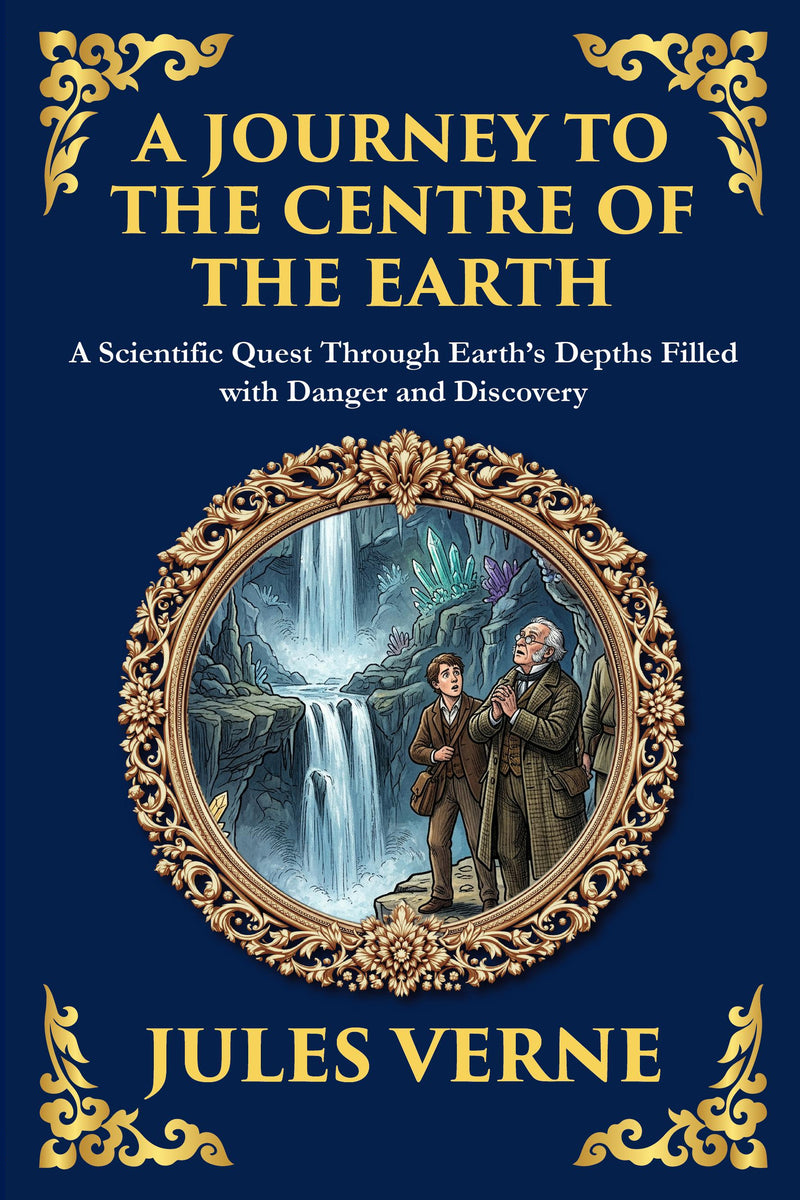
A Journey to the Centre of the Earth
When eccentric scientist Professor Lidenbrock discovers a cryptic manuscript hinting at a hidden passage to the Earth's core, he sets off on a daring expedition with his skeptical nephew and a fearless guide.
or free app
10,000+ hrs library
30-day guarantee
The complete A Journey to the Centre of the Earth appears in modern English through Library of Alexandria Press, available online with audiobook narration included for members.
Have you ever wondered why the greatest discoveries lie beneath the surface—both of the Earth and of ourselves? A Journey to the Centre of the Earth is Jules Verne’s unforgettable tale of scientific ambition, underground marvels, and the spirit of exploration. Blending riveting adventure with astonishing imagination, this novel takes readers far below the crust of the Earth, into a realm where ancient mysteries and geological wonders await.
Led by the brilliant but headstrong Professor Lidenbrock, the journey begins with a decoded message that reveals an entrance to Earth’s interior through the crater of a volcano. Joined by his cautious nephew Axel and their unflinching guide Hans, the team descends into a landscape beyond comprehension—facing labyrinthine tunnels, prehistoric beasts, natural hazards, and a breathtaking underground sea.
What you’ll discover in this modern edition
- A Scientific Expedition Like No Other – A thrilling exploration of geology, paleontology, and the wonders of Earth’s hidden layers
- The Power of Perseverance – How intellect, bravery, and trust guide the characters through overwhelming challenges
- A Vivid Underground World – From fossil forests to crystal cathedrals, Verne’s imagination builds a rich, immersive setting
- A Reflection on the Human Spirit – The journey becomes a metaphor for confronting fear, uncertainty, and the unknown
- A Landmark of Early Science Fiction – One of the first and finest examples of speculative literature, paving the way for generations of adventurers and dreamers
| Formats | eBook (EPUB + PDF) · Audiobook · Paperback · Hardcover · Large Print |
| Language | English |
| Trim size (print) | 6 × 9 in |
| Binding | Paperback — perfect-bound · Hardcover — casewrap |
| Large Print edition | Same text in a larger, easy-read type — a larger font, not a larger trim |
| Print pricing | Every physical book at our true cost — at-cost, no profit (members) |
| Library | 873 restored titles, always growing |
| Length | 77,573 words · ~5 hr 10 min reading |
| Reading level | Grade 8 · an easy, flowing read (this modern-English edition) |
| Edition | Modern English translation · 2026 |
Member reviews for this edition are collected as readers finish it — be the first. Across the library: 12,000+ books shipped, every plan covered by a 365-day print guarantee.
About this edition
A faithful, unabridged modern-English edition by The Library of Alexandria — carefully rendered for today's reader and verified paragraph-by-paragraph against the public-domain source. Available as eBook, audiobook, paperback, hardcover, and large print.
- Complete & unabridgedVerified paragraph by paragraph against the source — never a scan, never abridged.
- Modern English, faithfulReadable today, with the author’s meaning kept intact. Readable — not simplified.
- Every format, one membershipRead in your browser or the free app, or listen to the full audiobook.
Included free with your membership
Cancel anytime, one click · 30-day money-back guarantee
Edition last updated July 2026
What’s inside
A Journey to the Centre of the Earth — complete and unabridged: all 45 sections included with membership, plus the full audiobook.
Begin reading A Journey to the Centre of the Earth
In clear modern English — the complete text is included with membership.
Introduction
There are books that simply tell a story, and there are books that open a door. When Jules Verne published this remarkable tale in 1864, he was doing something far more audacious than spinning an adventure yarn. He was inviting his readers to step through a door in the floor of the world itself—to descend, page by page, into a realm that no human eye had ever beheld, guided only by the twin lanterns of imagination and science. More than a century and a half later, that door still swings open just as easily, and the descent remains every bit as exhilarating. To read this novel today is to discover that the wonder Verne planted in his readers’ minds has not aged a single day.
The premise is deceptively simple. A driven, irascible German professor named Otto Lidenbrock stumbles upon a cryptic message hidden within an ancient manuscript—a coded note left behind by a long-dead alchemist claiming to have found a passage into the planet’s interior. From that single spark of discovery, Verne builds one of the most thrilling and intellectually charged expeditions in all of literature. But before you take that first step downward, it helps to understand a little about the man who imagined this journey, the strange and electric era that produced it, and why this particular adventure has refused to be forgotten while so many others have faded into the dust of literary history.
Jules Verne was born in 1828 in the bustling French port city of Nantes, a place where the great rivers met the sea and where the masts of merchant ships crowded the horizon. It is impossible to overstate how much this childhood by the water shaped him. The young Verne grew up watching vessels depart for distant shores, listening to sailors’ tales of foreign lands, and—according to one famous if possibly embellished family story—even attempting to stow away aboard a ship bound for the Indies as a boy, before his father retrieved him and extracted a promise that he would only travel “in his imagination.” Whether or not the tale is strictly true, it captures something essential about the writer Verne would become: a man who turned the longing to explore into one of the most extraordinary literary careers the world has ever known.
His father, a successful lawyer, intended Jules to follow him into the legal profession, and the dutiful son did indeed study law in Paris. But the city in the 1840s and 1850s was alive with theatre, literature, and the heady ferment of new ideas, and Verne found himself drawn irresistibly toward the world of writing. He penned plays and short stories, mingled with literary figures of the day, and—crucially—developed a deep and abiding fascination with science. This was an age when discoveries seemed to tumble forth one after another: geology was rewriting the history of the Earth, paleontology was resurrecting monsters from the rock, chemistry and physics were peeling back the secrets of matter and energy, and the very age of the planet was a subject of furious, exhilarating debate. Verne, restlessly curious, read everything he could and filled notebook after notebook with facts, figures, and the raw material of wonder.
His breakthrough came when he met the publisher Pierre-Jules Hetzel, a partnership that would prove one of the most fruitful in publishing history. Together they conceived of a grand project: a series of novels that Hetzel would eventually call the Voyages Extraordinaires, the “Extraordinary Journeys.” The aim was nothing less than to dramatize the whole of human knowledge—to take readers, especially young ones, to every corner of the known and imagined world, and to make the learning of geography, science, and natural history feel like the greatest adventure imaginable. Over the course of his long career, Verne would produce more than sixty novels in this series, carrying his readers around the world in eighty days, twenty thousand leagues beneath the sea, and to the surface of the Moon.
This novel was among the earliest of those journeys, and in many ways it set the template for everything that followed. Here, fully formed, are the hallmarks that would make Verne the most translated French author in the world and one of the founding figures of modern science fiction: the meticulous attention to scientific detail, the breathless sense of forward momentum, the contrast between cool reason and reckless passion, and above all the unshakeable conviction that the universe is a vast, marvelous puzzle just waiting to be solved by the determined and the brave. Verne did not invent the adventure novel, but he transformed it. He fused the thrill of exploration with the rigor of science and created something genuinely new—a literature of plausibility, in which the fantastic becomes believable precisely because it is grounded so carefully in fact.
It is worth pausing here to appreciate just how influential this approach would become. The astronauts who first orbited the Moon, the engineers who built submarines, the explorers who pressed into the deepest and most hostile regions of the planet—again and again, the pioneers of the twentieth century have credited Verne with first lighting the fire of their ambition. He wrote of the possible before it was possible, and in doing so he helped make it so. To open one of his books is to stand at the very headwaters of a tradition that runs straight through to the science fiction and exploration narratives we cherish today. This particular descent into the Earth is one of the purest distillations of that genius.
To fully savour the adventure that awaits, it helps to imagine yourself into the moment of its creation. The 1860s were a time of intellectual upheaval almost impossible to exaggerate. Just five years before this book appeared, Charles Darwin had published his world-shaking ideas about the origin and transformation of living things, sending shockwaves through every domain of thought. Geologists were arguing fiercely over the age of the planet and the forces that had shaped it—whether mountains and valleys were the product of sudden, violent catastrophes or of slow, patient change across spans of time too vast for the mind to comfortably grasp. Fossil hunters were unearthing the bones of colossal creatures that had once walked the Earth, and reconstructing, with mingled awe and bafflement, the lost worlds in which they had lived. The deep past was being excavated, and with it came a dizzying new sense of how strange and ancient and full of secrets the planet beneath our feet truly was.
Into this churning sea of speculation, Verne cast his net. The interior of the Earth was, at the time, almost entirely unknown—a genuine blank space on the map of human knowledge, and therefore the perfect canvas for an imagination as disciplined and daring as his. Was the core of the planet molten and impassably hot, as many scientists insisted? Or might there be vast hollow spaces, hidden seas, even pockets of survivable air far below the surface? Verne did not have to invent the controversy; he simply seized upon a genuine scientific debate of his day and pursued it to its most thrilling conclusion. This is the secret of his enduring power. He never asked his readers to abandon their reason at the door. Instead, he took the open questions of his time—the things that the smartest people alive genuinely did not yet know—and built his marvels in the gaps between competing theories, where anything still seemed possible.
This is why the science woven through the narrative feels so vivid and convincing, even when modern knowledge has overtaken some of its particulars. Verne worked hard to get the details right, consulting the leading authorities of his era on geology, mineralogy, physics, and the natural history of the deep past. When his characters examine a rock formation, identify a mineral, measure a temperature, or interpret the evidence around them, they are doing so with the genuine vocabulary and methods of nineteenth-century science. The result is a kind of authenticity that grips the reader: you are not merely watching an adventure unfold, you are participating in a process of discovery, learning to read the clues in the stone alongside the characters themselves. Verne turns observation into suspense. Every measurement matters; every reading of the instruments could mean the difference between triumph and catastrophe.
And yet—and this is the crucial point—you do not need to know a single thing about geology to be utterly swept away. The wonder of this book is that it carries its learning so lightly, folding fact and marvel together so seamlessly that the reader absorbs knowledge almost without noticing, the way one might pick up the geography of a foreign country simply by traveling through it with open eyes. Verne was, above all, a teacher who understood the deepest secret of teaching: that the surest way to make someone learn is to make them want to. He does not lecture. He lures. He dangles a mystery, and then he lets curiosity do the rest.
It is also worth noting how the book reflects a particular spirit of its age—an age of confidence, of faith in human ingenuity, of the conviction that there was no frontier so forbidding that courage and intellect together could not eventually conquer it. This was the century of the great explorations, when expeditions set out to the poles, into the heart of unmapped continents, and to the floors of the oceans. Verne shared and celebrated this spirit even as he gently probed its limits. His adventurers are driven by an almost reckless thirst for knowledge, a hunger to go where no one has gone and to see what no one has seen. There is something deeply human and deeply moving in this impulse, and Verne renders it with such conviction that the reader cannot help but be infected by it. By the time the expedition stands at the threshold of the unknown, you will find yourself leaning forward, eager to descend right alongside them.
What is it, then, that has kept readers returning to this book for over a hundred and fifty years, across every language and culture on Earth? Part of the answer lies in the sheer, irresistible appeal of the central idea. There is something primal in the notion of descending into the Earth, of penetrating the solid ground we walk upon every day and discovering that it is not solid at all, but riddled with mystery. We live our entire lives upon the thinnest crust of an immense and largely unexplored sphere, and Verne taps directly into a fascination that is older than civilization itself: the question of what lies beneath. Caves and caverns have always stirred the human imagination—they are the dwellings of myth, the gateways to the underworld in story after story across every people and every era. Verne takes this ancient resonance and electrifies it with the bright current of modern science. The result is a tale that satisfies on two levels at once: it speaks to the most archaic part of us, the part that has always wondered what is hidden in the dark below, and it satisfies the modern mind that wants to understand, to measure, to know.
But the deeper secret of the book’s longevity lies in its characters and in the wonderful tension between them. Verne understood that an adventure is only as compelling as the people who undertake it, and here he gives us a trio of travelers whose interplay is a constant delight. There is the professor himself—a man of towering intellect and even more towering impatience, whose obsessive determination drives the entire enterprise forward like a force of nature. He is brilliant and maddening, courageous and selfish, sometimes admirable and sometimes almost comically difficult, and the friction he generates supplies much of the book’s energy and humour. Set against him is the narrator, a younger and far more cautious soul, whose reluctance, fear, and frequent good sense make him the perfect companion for the reader. Through his eyes we experience the journey, sharing his terror and his amazement, his doubts and his moments of unexpected courage. We are not asked to be heroes ourselves; we are asked only to follow this very relatable, very human guide as he is pulled, often against his better judgment, into the greatest adventure imaginable. And then there is a third member of the party, a steadfast and quietly capable figure whose calm competence and unflappable loyalty provide the ballast that keeps the whole expedition from flying apart—a character whose strength lies not in words but in deeds, and who often proves to be the difference between life and death.
Cancel anytime, one click · 30-day money-back guarantee
Founding annual rate available now — your price locks for life when you join.
Not ready? Get this free chapter by email — read it anytime.
✓ Sent — check your inbox for A Journey to the Centre of the Earth.
Questions about A Journey to the Centre of the Earth
What is A Journey to the Centre of the Earth about?
When eccentric scientist Professor Lidenbrock discovers a cryptic manuscript hinting at a hidden passage to the Earth's core, he sets off on a daring expedition with his skeptical nephew and a fearless guide. Their journey begins in a dormant volcano in Iceland and spirals into a subterranean world of breathtaking wonder and unimaginable peril. From prehistoric creatures and luminous caverns to subterranean oceans and volcanic eruptions, A Journey to the Centre of the Earth is a thrilling adventure into the unknown
Who wrote A Journey to the Centre of the Earth?
A Journey to the Centre of the Earth was written by Jules Verne. This edition presents the complete work in clear modern English, faithfully rendered from the public-domain original by Library of Alexandria Press.
Is A Journey to the Centre of the Earth free to read?
The opening chapter is free to read on this page. Members read and listen to the complete work — and the entire library — free, and can order any physical book at our true print cost.
How long is A Journey to the Centre of the Earth?
45 chapters (~77,573 words) — about 5 hr 10 min of reading in this modern-English edition.
Is this an abridged version of A Journey to the Centre of the Earth?
No. This is the complete, unabridged A Journey to the Centre of the Earth, carefully rendered into clear modern English and verified paragraph-by-paragraph against the public-domain source — nothing is cut or summarised.
What formats does A Journey to the Centre of the Earth come in?
A Journey to the Centre of the Earth is available as eBook, paperback, hardcover and large print. eBook and audiobook are included with membership; printed editions ship at our true print cost.
Shipping & returns
Billing & membership
More from the library


Explore Adventure
- Tarzan of the Apes · Edgar Rice Burroughs
- The Wonderful Wizard of Oz · L. Frank Baum
- Peter Pan · J. M. Barrie
- Moby Dick; Or, The Whale · Herman Melville
- The Riddle of the Sands · Erskine Childers
- The Loss of the Swansea: A Story of the Florida Coast · W. L. Alden
- Sky Island · L. Frank Baum
- Vikram and the Vampire: Classic Hindu Tales of Adventure, Magic, and Romance · Unknown
- Tales of Unrest · Joseph Conrad
- The Tomb of Ts’in · Edgar Wallace
- Skinny McCord · Percy Keese Fitzhugh
- The Men of the Moss-Hags · S. R. Crockett
- The Hunniwell Boys and the Platinum Mystery · L. P. Wyman
- Allan Quatermain · H. Rider Haggard
- She · H. Rider Haggard
- Medical Life in the Navy · Gordon Stables
- The Thirty-Nine Steps · John Buchan
- The Story of Doctor Dolittle · Hugh Lofting
- The Princess and the Goblin · George MacDonald
- The Man Who Would Be King · Rudyard Kipling
- Lucian’s True History · Lucian of Samosata
- The Secret Adversary · Agatha Christie
- Lord Jim · Joseph Conrad
- The Marvelous Land of Oz · L. Frank Baum
- The Virginian: A Horseman of the Plains · Owen Wister
- Mars is My Destination · Frank Belknap Long
- Anabasis · Xenophon
- The Mississippi Saucer · Frank Belknap Long
- Sabotage in Space · Carey Rockwell
- Brood of the Dark Moon · Charles Willard Diffin
A Journey to the Centre of the Earth
A Journey to the Centre of the Earth
A Scientific Quest Through Earth’s Depths Filled with Danger and Discovery
Jules Verne
Contents
- Introduction
- Chapter 1
- Chapter 2
- Chapter 3
- Chapter 4
- Chapter 5
- Chapter 6
- Chapter 7
- Chapter 8
- Chapter 9
- Chapter 10
- Chapter 11
- Chapter 12
- Chapter 13
- Chapter 14
- Chapter 15
- Chapter 16
- Chapter 17
- Chapter 18
- Chapter 19
- Chapter 20
- Chapter 21
- Chapter 22
- Chapter 23
- Chapter 24
- Chapter 25
- Chapter 26
- Chapter 27
- Chapter 28
- Chapter 29
- Chapter 30
- Chapter 31
- Chapter 32
- Chapter 33
- Chapter 34
- Chapter 35
- Chapter 36
- Chapter 37
- Chapter 38
- Chapter 39
- … and 5 more chapters
Introduction
There are books that simply tell a story, and there are books that open a door. When Jules Verne published this remarkable tale in 1864, he was doing something far more audacious than spinning an adventure yarn. He was inviting his readers to step through a door in the floor of the world itself—to descend, page by page, into a realm that no human eye had ever beheld, guided only by the twin lanterns of imagination and science. More than a century and a half later, that door still swings open just as easily, and the descent remains every bit as exhilarating. To read this novel today is to discover that the wonder Verne planted in his readers’ minds has not aged a single day.
The premise is deceptively simple. A driven, irascible German professor named Otto Lidenbrock stumbles upon a cryptic message hidden within an ancient manuscript—a coded note left behind by a long-dead alchemist claiming to have found a passage into the planet’s interior. From that single spark of discovery, Verne builds one of the most thrilling and intellectually charged expeditions in all of literature. But before you take that first step downward, it helps to understand a little about the man who imagined this journey, the strange and electric era that produced it, and why this particular adventure has refused to be forgotten while so many others have faded into the dust of literary history.
Jules Verne was born in 1828 in the bustling French port city of Nantes, a place where the great rivers met the sea and where the masts of merchant ships crowded the horizon. It is impossible to overstate how much this childhood by the water shaped him. The young Verne grew up watching vessels depart for distant shores, listening to sailors’ tales of foreign lands, and—according to one famous if possibly embellished family story—even attempting to stow away aboard a ship bound for the Indies as a boy, before his father retrieved him and extracted a promise that he would only travel “in his imagination.” Whether or not the tale is strictly true, it captures something essential about the writer Verne would become: a man who turned the longing to explore into one of the most extraordinary literary careers the world has ever known.
His father, a successful lawyer, intended Jules to follow him into the legal profession, and the dutiful son did indeed study law in Paris. But the city in the 1840s and 1850s was alive with theatre, literature, and the heady ferment of new ideas, and Verne found himself drawn irresistibly toward the world of writing. He penned plays and short stories, mingled with literary figures of the day, and—crucially—developed a deep and abiding fascination with science. This was an age when discoveries seemed to tumble forth one after another: geology was rewriting the history of the Earth, paleontology was resurrecting monsters from the rock, chemistry and physics were peeling back the secrets of matter and energy, and the very age of the planet was a subject of furious, exhilarating debate. Verne, restlessly curious, read everything he could and filled notebook after notebook with facts, figures, and the raw material of wonder.
His breakthrough came when he met the publisher Pierre-Jules Hetzel, a partnership that would prove one of the most fruitful in publishing history. Together they conceived of a grand project: a series of novels that Hetzel would eventually call the Voyages Extraordinaires, the “Extraordinary Journeys.” The aim was nothing less than to dramatize the whole of human knowledge—to take readers, especially young ones, to every corner of the known and imagined world, and to make the learning of geography, science, and natural history feel like the greatest adventure imaginable. Over the course of his long career, Verne would produce more than sixty novels in this series, carrying his readers around the world in eighty days, twenty thousand leagues beneath the sea, and to the surface of the Moon.
This novel was among the earliest of those journeys, and in many ways it set the template for everything that followed. Here, fully formed, are the hallmarks that would make Verne the most translated French author in the world and one of the founding figures of modern science fiction: the meticulous attention to scientific detail, the breathless sense of forward momentum, the contrast between cool reason and reckless passion, and above all the unshakeable conviction that the universe is a vast, marvelous puzzle just waiting to be solved by the determined and the brave. Verne did not invent the adventure novel, but he transformed it. He fused the thrill of exploration with the rigor of science and created something genuinely new—a literature of plausibility, in which the fantastic becomes believable precisely because it is grounded so carefully in fact.
It is worth pausing here to appreciate just how influential this approach would become. The astronauts who first orbited the Moon, the engineers who built submarines, the explorers who pressed into the deepest and most hostile regions of the planet—again and again, the pioneers of the twentieth century have credited Verne with first lighting the fire of their ambition. He wrote of the possible before it was possible, and in doing so he helped make it so. To open one of his books is to stand at the very headwaters of a tradition that runs straight through to the science fiction and exploration narratives we cherish today. This particular descent into the Earth is one of the purest distillations of that genius.
To fully savour the adventure that awaits, it helps to imagine yourself into the moment of its creation. The 1860s were a time of intellectual upheaval almost impossible to exaggerate. Just five years before this book appeared, Charles Darwin had published his world-shaking ideas about the origin and transformation of living things, sending shockwaves through every domain of thought. Geologists were arguing fiercely over the age of the planet and the forces that had shaped it—whether mountains and valleys were the product of sudden, violent catastrophes or of slow, patient change across spans of time too vast for the mind to comfortably grasp. Fossil hunters were unearthing the bones of colossal creatures that had once walked the Earth, and reconstructing, with mingled awe and bafflement, the lost worlds in which they had lived. The deep past was being excavated, and with it came a dizzying new sense of how strange and ancient and full of secrets the planet beneath our feet truly was.
Into this churning sea of speculation, Verne cast his net. The interior of the Earth was, at the time, almost entirely unknown—a genuine blank space on the map of human knowledge, and therefore the perfect canvas for an imagination as disciplined and daring as his. Was the core of the planet molten and impassably hot, as many scientists insisted? Or might there be vast hollow spaces, hidden seas, even pockets of survivable air far below the surface? Verne did not have to invent the controversy; he simply seized upon a genuine scientific debate of his day and pursued it to its most thrilling conclusion. This is the secret of his enduring power. He never asked his readers to abandon their reason at the door. Instead, he took the open questions of his time—the things that the smartest people alive genuinely did not yet know—and built his marvels in the gaps between competing theories, where anything still seemed possible.
This is why the science woven through the narrative feels so vivid and convincing, even when modern knowledge has overtaken some of its particulars. Verne worked hard to get the details right, consulting the leading authorities of his era on geology, mineralogy, physics, and the natural history of the deep past. When his characters examine a rock formation, identify a mineral, measure a temperature, or interpret the evidence around them, they are doing so with the genuine vocabulary and methods of nineteenth-century science. The result is a kind of authenticity that grips the reader: you are not merely watching an adventure unfold, you are participating in a process of discovery, learning to read the clues in the stone alongside the characters themselves. Verne turns observation into suspense. Every measurement matters; every reading of the instruments could mean the difference between triumph and catastrophe.
And yet—and this is the crucial point—you do not need to know a single thing about geology to be utterly swept away. The wonder of this book is that it carries its learning so lightly, folding fact and marvel together so seamlessly that the reader absorbs knowledge almost without noticing, the way one might pick up the geography of a foreign country simply by traveling through it with open eyes. Verne was, above all, a teacher who understood the deepest secret of teaching: that the surest way to make someone learn is to make them want to. He does not lecture. He lures. He dangles a mystery, and then he lets curiosity do the rest.
It is also worth noting how the book reflects a particular spirit of its age—an age of confidence, of faith in human ingenuity, of the conviction that there was no frontier so forbidding that courage and intellect together could not eventually conquer it. This was the century of the great explorations, when expeditions set out to the poles, into the heart of unmapped continents, and to the floors of the oceans. Verne shared and celebrated this spirit even as he gently probed its limits. His adventurers are driven by an almost reckless thirst for knowledge, a hunger to go where no one has gone and to see what no one has seen. There is something deeply human and deeply moving in this impulse, and Verne renders it with such conviction that the reader cannot help but be infected by it. By the time the expedition stands at the threshold of the unknown, you will find yourself leaning forward, eager to descend right alongside them.
What is it, then, that has kept readers returning to this book for over a hundred and fifty years, across every language and culture on Earth? Part of the answer lies in the sheer, irresistible appeal of the central idea. There is something primal in the notion of descending into the Earth, of penetrating the solid ground we walk upon every day and discovering that it is not solid at all, but riddled with mystery. We live our entire lives upon the thinnest crust of an immense and largely unexplored sphere, and Verne taps directly into a fascination that is older than civilization itself: the question of what lies beneath. Caves and caverns have always stirred the human imagination—they are the dwellings of myth, the gateways to the underworld in story after story across every people and every era. Verne takes this ancient resonance and electrifies it with the bright current of modern science. The result is a tale that satisfies on two levels at once: it speaks to the most archaic part of us, the part that has always wondered what is hidden in the dark below, and it satisfies the modern mind that wants to understand, to measure, to know.
But the deeper secret of the book’s longevity lies in its characters and in the wonderful tension between them. Verne understood that an adventure is only as compelling as the people who undertake it, and here he gives us a trio of travelers whose interplay is a constant delight. There is the professor himself—a man of towering intellect and even more towering impatience, whose obsessive determination drives the entire enterprise forward like a force of nature. He is brilliant and maddening, courageous and selfish, sometimes admirable and sometimes almost comically difficult, and the friction he generates supplies much of the book’s energy and humour. Set against him is the narrator, a younger and far more cautious soul, whose reluctance, fear, and frequent good sense make him the perfect companion for the reader. Through his eyes we experience the journey, sharing his terror and his amazement, his doubts and his moments of unexpected courage. We are not asked to be heroes ourselves; we are asked only to follow this very relatable, very human guide as he is pulled, often against his better judgment, into the greatest adventure imaginable. And then there is a third member of the party, a steadfast and quietly capable figure whose calm competence and unflappable loyalty provide the ballast that keeps the whole expedition from flying apart—a character whose strength lies not in words but in deeds, and who often proves to be the difference between life and death.
Looking back at everything that has happened since that eventful day, I can hardly believe my adventures were real. They were so incredible that even now I feel stunned when I think about them.
My uncle was German, and he had married my mother’s sister, who was English. Because he was very fond of his nephew—who had no father—he invited me to live with him in Germany to study. He lived in a large town and was a professor of philosophy, chemistry, geology, mineralogy, and many other “ologies.”
One day, after spending several hours in the lab while my uncle was out, I suddenly realized I needed to “renovate my tissues”—meaning I was hungry. I was just about to wake up our old French cook when my uncle, Professor Von Hardwigg, suddenly opened the front door and rushed upstairs.
Now, my uncle Professor Hardwigg isn’t a bad man by any means, but he is short-tempered and eccentric. Dealing with him means obeying him. As soon as his heavy footsteps echoed through our home, he shouted for me to come to him.
I rushed to obey, but before I could reach his room—jumping three steps at a time—he was already stamping his right foot on the landing.
“Harry!” he shouted frantically. “Are you coming?”
To be honest, at that moment I was far more interested in what we were having for dinner than in any scientific problem. To me, soup was more interesting than soda, an omelet was more tempting than arithmetic, and an artichoke was ten times more valuable than any amount of asbestos.
But my uncle wasn’t a man to be kept waiting. So, putting all minor concerns aside, I went to him.
He was a very learned man. Most people in that category collect information like peddlers collect goods, storing it up just to share it for the benefit of society. My excellent uncle, Professor Hardwigg, was not like that. He studied, burned the midnight oil, pored over heavy volumes, and digested massive books just to keep the knowledge for himself.
End of the free sample
Keep reading, free
Members read and listen to the complete book — and the entire library. Cancel anytime, one click · 30-day money-back guarantee.