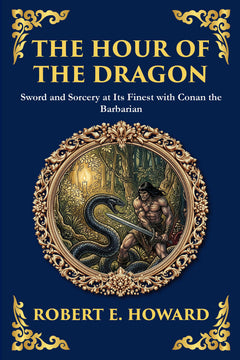
Deep within a jungle kingdom shrouded in superstition lies a hoard of priceless gems—the legendary Jewels of Gwahlur. But the path to such treasure is steeped in danger.
The complete Jewels of Gwahlur appears in modern English through Library of Alexandria Press, available online with audiobook narration included for members.
Have you ever wondered why tales of treasure and superstition capture the imagination across every age? In Jewels of Gwahlur, Robert E. Howard delivers one of Conan’s most gripping adventures, set in a lush, perilous jungle where greed and fear intermingle. Known for his raw strength and unyielding will, Conan faces a challenge unlike any other—where treasure is guarded not only by warriors and priests, but by fear itself.
As Conan pursues the fabled Jewels, he must navigate a treacherous web of deception spun by those who would see him fail. Dark temples whisper with the voices of gods, rivals lurk in the shadows, and ancient superstitions cast their spell over the land. Yet only through cunning, courage, and sheer ferocity can Conan hope to emerge alive—and perhaps claim the glittering prize that so many desire.
| Formats | eBook (EPUB + PDF) · Audiobook · Paperback · Hardcover · Large Print |
| Language | English |
| Trim size (print) | 6 × 9 in |
| Binding | Paperback — perfect-bound · Hardcover — casewrap |
| Large Print edition | Same text in a larger, easy-read type — a larger font, not a larger trim |
| Print pricing | Every physical book at our true cost — at-cost, no profit (members) |
| Library | 873 restored titles, always growing |
| Length | 20,209 words · ~1 hr 21 min reading |
| Reading level | Grade 7 · an easy, flowing read (this modern-English edition) |
| Edition | Modern English translation · 2026 |
Member reviews for this edition are collected as readers finish it — be the first. Across the library: 12,000+ books shipped, every plan covered by a 365-day print guarantee.
A faithful, unabridged modern-English edition by The Library of Alexandria — carefully rendered for today's reader and verified paragraph-by-paragraph against the public-domain source. Available as eBook, audiobook, paperback, hardcover, and large print.
Included free with your membership
Cancel anytime, one click · 30-day money-back guarantee
Edition last updated July 2026
Jewels of Gwahlur — complete and unabridged: all 5 sections included with membership, plus the full audiobook.
In clear modern English — the complete text is included with membership.
There are stories that announce themselves with trumpets and stories that slip into the reader’s imagination like a thief through a moonlit window. The tale you are about to read belongs gloriously to both kinds. It arrives with the clang of steel and the roar of jungle beasts, yet it also creeps along corridors of crumbling stone, whispering of secrets that ought to have stayed buried. For nearly a century, readers have followed a wandering barbarian into the green heart of a forgotten land in search of gemstones that gleam with more than mere wealth. What they have found there is something far richer: a story that distills, into a few breathless chapters, everything that made its author one of the most influential and imitated writers of adventure fiction the world has ever produced.
This particular edition presents that classic in a modern translation, carefully adapted for the contemporary reader. Before you turn to the first page, it is worth pausing to consider what makes this story endure, where it came from, and how to read it so that you might savor every shadow, every glint of jeweled light, every footfall echoing in halls where no living thing should walk. The pages ahead will reward your attention enormously, and a little context will only sharpen the pleasure.
The Man Who Built Worlds at the Edge of Civilization
To understand the texture and the urgency of this story, it helps to understand the remarkable, restless mind that produced it. Robert E. Howard was born in Texas in 1906 and lived almost his entire short life in the small, dusty town of Cross Plains, on the rough and weathered edge of the American frontier. This matters more than it might seem. Howard grew up surrounded by men who remembered the open range, who told tales of gunfighters and oil booms and the violence that came with both. He absorbed a worldview in which civilization was a thin, fragile veneer painted over something older, wilder, and far more honest. That conviction—that beneath the manners and the marble of every great city lurks the same raw appetite that drives a hungry animal through the dark—beats at the center of nearly everything he wrote.
Howard was an astonishingly prolific writer, the kind of natural storyteller who seemed to channel narrative directly onto the page. He worked in a frenzy, often reading his sentences aloud as he hammered them out, pacing and shouting and living each fight and flight as he committed it to paper. He wrote boxing stories, historical adventures, horror tales, Westerns, and weird fiction, selling much of it to the legendary pulp magazines of the 1920s and 1930s—those cheap, garish periodicals printed on rough paper that nonetheless served as the proving ground for some of the twentieth century’s most enduring popular literature. It was in the pages of one such magazine, Weird Tales, that Howard introduced the character whose exploits you are about to read, and in doing so he effectively invented an entire genre.
That genre is now known as “sword and sorcery,” and the barbarian wanderer at its heart became one of the most recognizable figures in all of fiction. He is a mercenary, a thief, a soldier, a pirate, and eventually a king—but in this story we find him in one of his most characteristic roles, that of the lone adventurer drawn by the promise of treasure into a place where treasure is the least of the dangers. Howard wrote dozens of these tales over a few short, white-hot years, and they range across a sprawling invented prehistory he called the Hyborian Age, a vanished epoch he placed between the sinking of fabled Atlantis and the dawn of recorded human history. It was a brilliant device. By setting his stories in a world that never was, but that resembled the real ancient world closely enough to feel plausible, Howard freed himself to roam wherever his imagination led—across deserts and frozen wastes, into decadent cities and pirate-haunted seas and, as here, into steaming jungles where ruined civilizations rot beneath the vines.
Tragically, Howard’s own life ended far too soon. He died in 1936, at the age of only thirty, leaving behind a body of work that has only grown in stature with each passing decade. He did not live to see the staggering scope of his influence. Generations of writers, filmmakers, game designers, and artists have drawn from the well he dug. The fantasy fiction that fills shelves and screens today—the muscular heroes, the brooding atmosphere of decayed grandeur, the sense that magic is something terrible rather than wondrous—owes an enormous and often unacknowledged debt to this Texan who wrote about a barbarian by lamplight while the world outside his window was still half-wild. To read his work now is to return to a source, to drink from the spring before it became a river.
What makes Howard remarkable, and what keeps his stories alive when so many of his contemporaries have faded into footnotes, is the sheer kinetic energy of his prose and the conviction of his vision. He did not write timidly. His sentences move. They lunge and parry and strike. When his hero runs, you feel the burn in your own lungs; when he fights, you flinch from the blade. And underneath all that action runs a current of genuine philosophical weight—a melancholy awareness of how empires fall, how splendor turns to dust, how the proud monuments of vanished peoples become merely the lairs of beasts and the haunts of ghosts. This story, in particular, is saturated with that mood. It is an adventure, yes, full of peril and cunning and narrow escapes, but it is also a meditation on illusion, on the way that fear and superstition can build prisons more inescapable than any of iron.
The decision to present Howard’s work in a modern translation, adapted for the contemporary reader, deserves a word of explanation as well, because thoughtful readers may wonder what such an adaptation involves and why it might be desirable. Howard wrote for an audience nearly a hundred years ago, in the idiom of his time and the conventions of the pulp marketplace. His original prose, magnificent as it is, sometimes employs vocabulary, sentence rhythms, and stylistic flourishes that can feel ornate or archaic to readers today. This edition aims to preserve the headlong momentum, the vivid imagery, and the essential spirit of the original while smoothing the path for the modern eye and ear. The goal is not to replace Howard but to welcome new readers into his world—to ensure that the barriers of changing language do not stand between you and the pure pleasure of the tale. Purists will always have the original texts, and rightly treasure them. But for many readers, an accessible rendering is precisely the doorway through which a lifelong love of these stories begins.
A Jungle, a Treasure, and the Architecture of Dread
Without spoiling a single one of the surprises that await you, it is worth setting the stage so that you can step into this story with your senses already sharpened to its particular flavor. The tale unfolds in a remote and isolated kingdom, deep within a jungle so dense and forbidding that it has kept its secrets for centuries. Somewhere in this green labyrinth lies a city—or what remains of one—built by hands long vanished, and within that city sleeps a hoard of legendary gemstones whose fame has spread far enough to lure a certain adventurer across hostile country in search of them.
But this is no simple smash-and-grab. Howard understood that the most thrilling treasure hunts are the ones complicated by belief, by ritual, by the strange logic of a society that has organized itself around fear and reverence. The people who dwell near this place have woven the treasure into a tapestry of legend and worship. There are oracles to consult and priesthoods to deceive. There are rival schemers with their own designs on the prize, men who are perhaps more dangerous than any monster precisely because their motives are so coldly human. And there is the question, which hangs over the entire narrative like mist over the jungle canopy, of what is real and what is illusion—of whether the supernatural terrors that guard the gems are genuine manifestations of something beyond human understanding, or elaborate frauds maintained to keep the credulous in line, or some unsettling combination of both.
This tension is the engine that drives the story forward and gives it a sophistication that elevates it well above mere swashbuckling. Our protagonist is a man supremely confident in the evidence of his own senses, a creature of muscle and instinct who trusts a sword far more than a prayer. He has no patience for the superstitions that paralyze others, and his skepticism is one of his greatest weapons. Yet the world he has entered does not always play by the rules he understands. The narrative repeatedly asks the reader, alongside its hero, to question what can be trusted—the testimony of an oracle, the behavior of a frightened guide, the shape glimpsed at the end of a darkened corridor. Howard plays this game with masterful control, building suspense not through gore or spectacle alone but through the far more subtle and durable mechanism of uncertainty. You will find yourself, more than once, holding your breath and straining to see into the dark right along with the man at the center of it all.
The setting itself becomes almost a character in its own right, and this is one of the great pleasures of the reading experience. Howard’s depiction of the ancient ruined city is a triumph of atmosphere. He understood, as the best writers of the weird and the gothic have always understood, that a building can be terrifying. The grandeur of a place built for purposes now forgotten, its corridors echoing with the absence of the multitudes who once thronged them, its dust undisturbed for ages, its silence pregnant with the possibility of sound—all of this Howard renders with extraordinary skill. As you move through these halls in the company of the protagonist, you will feel the oppressive weight of accumulated centuries, the prickling sense of being watched, the constant awareness that any chamber might conceal either fabulous wealth or sudden death. The jewels of the title shimmer at the heart of this darkness like a lure, and the longer the search continues, the more clearly we understand that the real subject of the story is not the gems at all, but everything a man will risk, endure, and become in the pursuit of them.
It is worth saying something, too, about the protagonist himself, because much of the story’s pleasure derives from his particular character. He is not a knight in shining armor, nor a clever gentleman thief, nor a tortured antihero of the modern fashionable kind. He is something more elemental: a man whose values are simple, direct, and surprisingly consistent. He will steal without compunction, fight without hesitation, and leave without sentiment when leaving is the wise course. Yet he possesses a rough code of his own, a kind of barbaric integrity that emerges at unexpected moments and that often surprises those who underestimate him as a mere brute. Part of the genius of Howard’s characterization is that the hero’s apparent simplicity conceals a sharp practical intelligence and an instinctive understanding of human nature. He reads people quickly and accurately. He sees through pretenses that fool more sophisticated men. And when he is moved to action—whether by greed, by anger, by lust for life, or by some flicker of unexpected compassion—he acts with a wholeness and decisiveness that civilized men, hemmed in by hesitation and self-doubt, can only envy.
This is, in the end, a large part of why these stories have endured and why they continue to find new readers in every generation. The barbarian hero embodies a fantasy of freedom—freedom from the compromises, the anxieties, the soul-deadening constraints of organized society. He answers to no king, no god, no law but his own will and his own survival. There is something deeply satisfying in watching such a figure move through a world of scheming priests and treacherous courtiers and superstitious crowds, cutting through their elaborate webs with the clean edge of his blade and the clear sight of his unclouded eyes. Howard did not invent this fantasy, but he gave it perhaps its most enduring and influential expression, and you will feel its appeal afresh in the story before you.
Cancel anytime, one click · 30-day money-back guarantee
Founding annual rate available now — your price locks for life when you join.
Not ready? Get this free chapter by email — read it anytime.
✓ Sent — check your inbox for Jewels of Gwahlur.
Deep within a jungle kingdom shrouded in superstition lies a hoard of priceless gems—the legendary Jewels of Gwahlur. But the path to such treasure is steeped in danger. Conan the Cimmerian, driven by ambition and sharpened by instinct, ventures into a realm of scheming priests, rival treasure hunters, and ghostly prophecies.
Jewels of Gwahlur was written by Robert E. Howard. This edition presents the complete work in clear modern English, faithfully rendered from the public-domain original by Library of Alexandria Press.
The opening chapter is free to read on this page. Members read and listen to the complete work — and the entire library — free, and can order any physical book at our true print cost.
5 chapters (~20,209 words) — about 1 hr 21 min of reading in this modern-English edition.
No. This is the complete, unabridged Jewels of Gwahlur, carefully rendered into clear modern English and verified paragraph-by-paragraph against the public-domain source — nothing is cut or summarised.
Jewels of Gwahlur is available as eBook, paperback, hardcover and large print. eBook and audiobook are included with membership; printed editions ship at our true print cost.
Jewels of Gwahlur (also published as The Servants of Bit-Yakin) follows Conan the Cimmerian as he ventures into the forbidden land of Keshan, a remote jungle kingdom in the Black Kingdoms region south of Stygia. Conan seeks the legendary Teeth of Gwahlur, a treasure of priceless jewels hidden in an ancient, haunted valley. The kingdom is divided between two factions: one supporting the exiled princess Muriela, the other loyal to the current rulers who control the oracle of the god Yelaya.
Conan allies himself with Muriela's cause, but his true goal is the treasure. He discovers that the oracle is a fraud—priests manipulate a beautiful woman who poses as the goddess Yelaya to control the superstitious populace. Conan infiltrates the priests' stronghold and finds the jewels, but he is not alone in his quest. Zargheba, a traitorous rogue, and his partner also seek the treasure. Through a series of underground passages, secret chambers, and deadly traps, Conan must outwit both the priests and his rivals. The story climaxes in a tense confrontation where Conan's strength and cunning are tested against greed, betrayal, and the terrors lurking in the ancient tunnels beneath the valley.
Greed and Its Consequences: The pursuit of the Teeth of Gwahlur drives multiple characters to betrayal, violence, and ultimately destruction. Howard explores how the lust for treasure corrupts and blinds individuals to danger, leading them into traps both literal and moral.
Superstition and Manipulation: The priests of Keshan maintain power through elaborate religious fraud, using the false oracle of Yelaya to control a superstitious population. The story examines how fear and belief can be weaponized by those in authority to maintain control over others.
Civilization versus Barbarism: Conan, the barbarian outsider, sees through the sophisticated deceptions of the civilized priests and schemers. Howard suggests that Conan's straightforward, instinctive approach often proves superior to the complex machinations of supposedly more advanced cultures.
Isolation and the Unknown: The remote, haunted valley of Alkmeenon serves as a setting where ancient secrets and dangers lurk. The theme of venturing into forbidden, isolated places where the past still holds power recurs throughout the narrative, creating an atmosphere of dread and mystery.
Jewels of Gwahlur showcases Robert E. Howard's talent for blending action, atmosphere, and pulp adventure. Written in 1935 and published in Weird Tales in 1935, the story exemplifies Howard's ability to create vivid, exotic settings and propel his hero through a tightly plotted treasure hunt. The narrative moves swiftly through underground labyrinths and secret chambers, maintaining suspense while revealing layers of deception. Howard's prose is direct and muscular, matching Conan's physicality with energetic descriptions of combat and danger. The story's exploration of religious fraud and political manipulation adds depth beyond simple adventure, reflecting Howard's skepticism toward institutional authority. While the racial and cultural depictions reflect the problematic attitudes of 1930s pulp fiction, the story remains significant as an example of sword-and-sorcery fiction that influenced countless later fantasy works. Its compact structure and relentless pacing demonstrate Howard's mastery of the short adventure form, making it a memorable entry in the Conan canon.
“Civilized men are more discourteous than savages because they know they can be impolite without having their skulls split, as a general thing.”
“I found it in the desert, in a dead man's skull.”
“Let me live and I will make you rich beyond your maddest dreams!”
“The Teeth of Gwahlur! The jewels of the forgotten city!”
Robert E. Howard (1906–1936) wrote Jewels of Gwahlur during the peak of his creative output, just a year before his tragic death. The story was published in the March 1935 issue of Weird Tales magazine under the title The Servants of Bit-Yakin. Howard created Conan as the embodiment of his philosophy celebrating individual strength and barbaric virtue over what he saw as the decadence of civilization. Written during the Great Depression, Howard's tales offered readers escapism into worlds of clear-cut action and adventure. The story draws on Howard's fascination with lost civilizations and hidden treasures, themes popular in the pulp magazines of the era. Howard's depiction of the Black Kingdoms reflects the problematic racial attitudes common in 1930s adventure fiction, though his portrayal of Conan as an outsider who respects capable warriors regardless of origin shows some complexity. The tale's influence extends through decades of fantasy literature, helping establish conventions of the sword-and-sorcery genre.