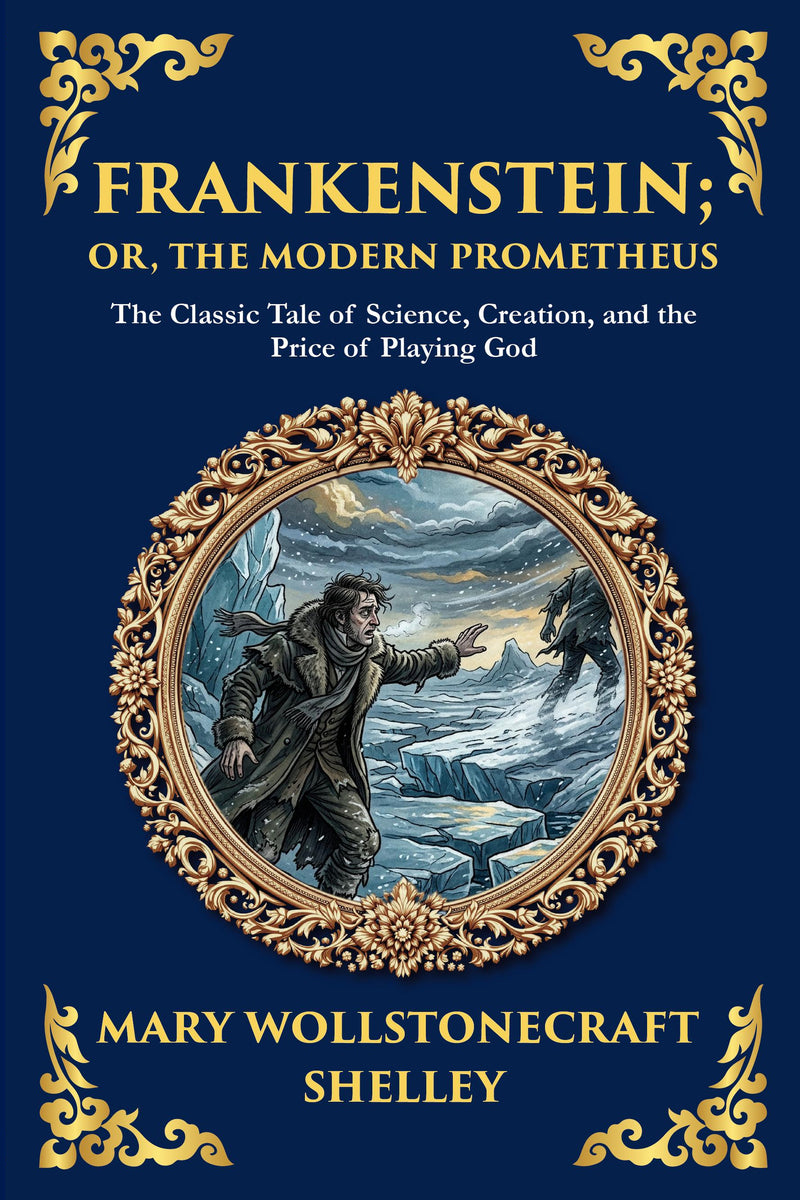
Frankenstein; Or, The Modern Prometheus
A young scientist, Victor Frankenstein, driven by boundless ambition, unlocks the secret of life itself. From lifeless matter, he creates a being—only to recoil in horror at his own work.
or free app
10,000+ hrs library
30-day guarantee
The complete Frankenstein; Or, The Modern appears in modern English through Library of Alexandria Press, available online with audiobook narration included for members.
Have you ever wondered why humanity’s greatest discoveries often come at the highest cost? Mary Shelley’s Frankenstein; Or, The Modern Prometheus stands as one of the most enduring and influential novels in world literature. Written when Shelley was only eighteen, this masterpiece fuses gothic horror with deep philosophical reflection on science, morality, and the essence of humanity.
Victor Frankenstein’s quest to create life pushes him beyond natural limits. But when his experiment succeeds, he recoils in horror at his creation and abandons it. Alone and rejected, the creature yearns for love but finds only hatred and fear.
His suffering transforms into vengeance, leading to a tragic struggle between creator and creation that reverberates with questions as urgent today as they were in Shelley’s time.
What you’ll discover in this modern edition
- The Birth of Science Fiction – Explore the groundbreaking novel that laid the foundation for an entire genre.
- A Story of Creation and Responsibility – Confront timeless questions about ambition, ethics, and the role of science in human progress.
- The Creature’s Perspective – Experience one of literature’s most haunting explorations of loneliness, rejection, and the need for belonging.
- A Gothic Masterpiece – Immerse yourself in Shelley’s atmospheric landscapes of icy mountains, stormy nights, and shadowed laboratories.
- A Warning Still Relevant Today – Reflect on themes of unchecked ambition, human pride, and the consequences of “playing God.”
| Formats | eBook (EPUB + PDF) · Audiobook · Paperback · Hardcover · Large Print |
| Language | English |
| Trim size (print) | 6 × 9 in |
| Binding | Paperback — perfect-bound · Hardcover — casewrap |
| Large Print edition | Same text in a larger, easy-read type — a larger font, not a larger trim |
| Print pricing | Every physical book at our true cost — at-cost, no profit (members) |
| Library | 873 restored titles, always growing |
| Length | 72,457 words · ~4 hr 50 min reading |
| Reading level | Grade 9 · a comfortable read (this modern-English edition) |
| Edition | Modern English translation · 2026 |
Member reviews for this edition are collected as readers finish it — be the first. Across the library: 12,000+ books shipped, every plan covered by a 365-day print guarantee.
About this edition
A faithful, unabridged modern-English edition by The Library of Alexandria — carefully rendered for today's reader and verified paragraph-by-paragraph against the public-domain source. Available as eBook, audiobook, paperback, hardcover, and large print.
- Complete & unabridgedVerified paragraph by paragraph against the source — never a scan, never abridged.
- Modern English, faithfulReadable today, with the author’s meaning kept intact. Readable — not simplified.
- Every format, one membershipRead in your browser or the free app, or listen to the full audiobook.
Included free with your membership
Cancel anytime, one click · 30-day money-back guarantee
Edition last updated July 2026
What’s inside
Frankenstein; Or, The Modern Prometheus — complete and unabridged: all 30 sections included with membership, plus the full audiobook.
Begin reading Frankenstein; Or, The Modern Prometheus
In clear modern English — the complete text is included with membership.
Introduction
There are very few books that escape the covers that contain them and take up residence in the collective imagination of the entire world. Frankenstein is one of them. Ask almost anyone, anywhere, and they will conjure an image: a towering figure with bolts in his neck, a flat green head, arms outstretched, lurching through the night. They will know the name. They may even know the famous cry—“It’s alive!”—though those exact words appear nowhere in the novel you are about to read. This is the strange and remarkable fate of Mary Shelley’s creation: it became so famous that it slipped free of its origins entirely, transformed by stage plays, comic books, breakfast cereals, and a century of cinema into something its author would scarcely recognize.
And so, before you turn the first page, it is worth pausing to acknowledge a quiet truth. The story most people think they know is not the story Mary Shelley wrote. The book in your hands is far stranger, far sadder, and far more profound than any movie monster could suggest. It is not a tale of mad laboratories and crackling lightning—though it has its share of midnight labor. It is a meditation on loneliness, on ambition, on what we owe to the things we create, and on the terrible consequences of turning away from responsibility at the precise moment it demands the most of us. To read the original is to discover, perhaps for the first time, that the most haunting figure in this novel is not a shambling brute but an articulate, grieving, eloquent being who longs only to be loved—and a brilliant young man whose greatest crime is not what he makes, but what he abandons.
This edition has been carefully prepared as a modern translation, adapted for the contemporary reader. That phrase deserves a moment of explanation, because it matters a great deal to the experience ahead of you. Mary Shelley wrote in the elaborate, ornamented prose of the early nineteenth century—a style rich in long, winding sentences, formal diction, and rhetorical flourishes that her first readers found natural and stirring. For the modern reader, however, that original language can sometimes form a wall between you and the powerful emotions surging beneath it. The intention of this adaptation is not to dilute or simplify the novel’s ideas, but to clear away the obstacles of antiquated phrasing so that the full force of the story—its dread, its tenderness, its philosophical depth—can reach you directly, as it reached Shelley’s contemporaries two centuries ago. The bones of the tale remain untouched. The voices remain distinct. What changes is only the ease with which you can hear them.
A Teenager, a Storm, and the Birth of a Monster
To understand the extraordinary nature of this book, you must first understand the almost impossible circumstances of its creation. In the summer of 1816, a young woman not yet nineteen years old sat among some of the most celebrated and notorious figures of her age, on the shores of Lake Geneva in Switzerland. Her name was Mary—at the time she was traveling under the name Mary Godwin, the daughter of two of the most radical thinkers of her generation. Her father was William Godwin, the political philosopher whose ideas shook the foundations of his era. Her mother was Mary Wollstonecraft, the pioneering writer whose A Vindication of the Rights of Woman remains a cornerstone of feminist thought to this day. Tragically, Mary never knew her mother, who died of complications shortly after giving birth to her. This early acquaintance with loss—the knowledge that her very existence had cost the life of the woman who created her—would echo, knowingly or not, throughout the pages she would one day write.
That summer she was accompanied by the poet Percy Bysshe Shelley, with whom she had eloped, and they had come to Geneva to be near another towering literary celebrity: Lord Byron, the most scandalous and admired poet in all of Europe. Also present was Byron’s physician, John Polidori. The summer of 1816 has become legendary in literary history as “the Year Without a Summer,” a season of bizarre and terrible weather caused by the eruption of a distant volcano. The skies were darkened, the rains relentless, the temperatures unnaturally low. Trapped indoors by the storms, this small circle of brilliant, restless minds passed the long, gloomy evenings reading German ghost stories aloud by candlelight.
It was Byron who issued the challenge that would change the course of literature: each member of the party should attempt to write a ghost story of their own. The famous poets, ironically, produced little of lasting value from this contest. It was the youngest member of the gathering, the quiet young woman in their midst, who would create something immortal. For days, Mary could think of nothing. The pressure mounted. Then, one sleepless night, as the conversation of the men had turned to the nature of life itself—to galvanism, to the recent experiments suggesting that electricity might animate dead tissue, to the very question of whether the spark of existence might be artificially generated—she fell into a waking dream. She would later describe seeing, with terrible vividness, “the pale student of unhallowed arts kneeling beside the thing he had put together.” She saw the hideous creature stir to life. She saw the horror on the face of its maker. And in that moment, she had her story.
Consider the magnitude of this. A teenage girl, surrounded by some of the most famous male writers of the age, produced in a single haunted summer a novel that would outlast and outshine them all. Frankenstein would go on to be recognized not merely as a Gothic thriller but as arguably the first true work of science fiction—a genre that did not yet exist, that she essentially invented by daring to ask what would happen if human beings used the emerging power of science to seize a power that had always been reserved for God or nature. She published the work anonymously in 1818, and many readers assumed it had been written by a man, perhaps even by her famous husband. It was years before the world fully understood that this dark and dazzling vision had sprung from the imagination of a young woman who had already known more grief than most people endure in a lifetime.
For Mary Shelley’s life was steeped in loss. She had lost her mother to her own birth. She would, in the years surrounding the novel’s creation and publication, lose several of her own children in infancy. She would lose her husband Percy to drowning. These were not abstract sorrows. They were the lived realities of a woman who understood, in her very flesh and bones, what it means to create life and to watch it slip away, to love something into being and then to lose it. When you read the passages in this novel that deal with death, with the longing for connection, with the agony of abandonment, you are reading the work of someone who knew these feelings intimately. This is why the book endures. Beneath its supernatural surface beats a profoundly human heart.
The full title of this work is Frankenstein; or, The Modern Prometheus. That second half—the part so often dropped and forgotten—is no idle decoration. It is the key that unlocks the deepest meaning of the entire book, and it rewards a moment of your attention before you begin.
In ancient Greek mythology, Prometheus was a Titan who defied the gods. According to the most famous version of the legend, he stole fire from the heavens and gave it to humanity, granting mortals the divine power of creation, warmth, and civilization. For this transgression—for daring to give human beings a power that the gods believed should remain beyond their reach—Prometheus was punished with unimaginable cruelty. He was chained to a rock, where each day an eagle came to devour his liver, which grew back each night so that the torment could begin anew, forever. Prometheus is, in this telling, both hero and cautionary figure: the bringer of light and progress, but also the symbol of the terrible price that comes from reaching beyond the boundaries the universe has set.
There is a second strand to the Prometheus myth, equally relevant here. In some versions, Prometheus is not merely the thief of fire but the very creator of humankind, who fashioned the first human beings out of clay. By calling her novel “The Modern Prometheus,” Mary Shelley invites us to see her protagonist as a man who plays both roles at once—who steals the divine fire of creation and who, like a god, gives shape to a new form of life. The question that haunts every page that follows is simple and devastating: what happens to the creator who seizes such power but lacks the wisdom, the compassion, or the courage to bear its consequences?
This is what makes the novel so astonishingly relevant to our own moment. Shelley wrote at the dawn of a great scientific age, when humanity was beginning to suspect that the mysteries of life and matter might be unlocked through experiment and reason. She sensed, with extraordinary foresight, that this new power would bring not only wonder but danger—that the ability to do a thing is not the same as the wisdom to know whether one should. Read this book today, in an age of genetic engineering, artificial intelligence, and technologies that increasingly blur the line between the living and the made, and you will find that her warnings have not aged a single day. The questions she raised in 1818 are the questions we are still struggling to answer. What are the limits of human ambition? What responsibilities does a creator owe to its creation? When we bring something new into the world, can we simply walk away from it when it frightens us or fails to meet our expectations? These are not the questions of a campy horror story. They are the questions of our century.
And yet—and this is crucial—Shelley does not preach. She does not stand above her characters and pronounce judgment. Instead, she does something far more subtle and far more powerful. She invites you inside the minds of those at the heart of the tragedy, and she lets you feel the pull of their longings as if they were your own. You will understand the intoxicating thrill of discovery, the seductive dream of pushing past every known boundary. And you will also feel, with mounting dread, the weight of what follows. This is not a book that tells you what to think. It is a book that makes you feel, and then leaves you to wrestle with the implications long after the final page.
One of the most surprising things you will discover as you read is how the novel is structured. This is not a straightforward narrative told from a single point of view. Instead, Shelley nests her stories inside one another like a set of Russian dolls. The tale opens not in a laboratory but on a ship bound for the frozen Arctic, in a series of letters written by an explorer named Robert Walton to his sister. It is Walton who first encounters the central figure of the story, and through Walton’s eyes that we begin to learn the strange history that brought a haunted man to the ends of the earth. From there, the perspective shifts, and we hear the story directly. And then, in one of the most remarkable narrative moves in all of literature, the perspective shifts again, and we are given the chance to hear the story from a point of view that the popular imagination has almost entirely erased. To say more would be to spoil one of the great revelations of the book. But know this: when you reach that shift, you will encounter a voice so eloquent, so wounded, and so morally complex that you may find your sympathies turning in directions you never expected. The genius of this structure is that it refuses to let you settle comfortably on any single villain or hero. It forces you to hold multiple truths at once, to see how each character is both wronged and wrong, both sympathetic and culpable.
How to Read This Book, and Why It Still Matters
If you have come to this novel expecting a fast-paced monster movie in prose, it is best to gently set that expectation aside. Frankenstein moves to a different rhythm. It is a book of moods and atmospheres, of sublime landscapes and inner storms. Shelley was deeply influenced by the Romantic movement, which prized intense emotion, the awe-inspiring power of nature, and the inner life of the solitary, suffering individual. You will find that the natural world plays an enormous role in these pages—the towering Alps, the icy wastes of the Arctic, the gentle valleys and the raging seas all serve as mirrors of the turbulent emotions of the characters who move through them. Allow yourself to slow down and absorb these passages. The landscapes are not mere scenery; they are part of the emotional architecture of the story, reflecting the grandeur of human aspiration and the desolation of human despair.
Cancel anytime, one click · 30-day money-back guarantee
Founding annual rate available now — your price locks for life when you join.
Not ready? Get this free chapter by email — read it anytime.
✓ Sent — check your inbox for Frankenstein; Or, The Modern Prometheus.
Questions about Frankenstein; Or, The Modern Prometheus
What is Frankenstein; Or, The Modern about?
A young scientist, Victor Frankenstein, driven by boundless ambition, unlocks the secret of life itself. From lifeless matter, he creates a being—only to recoil in horror at his own work. Abandoned and despised, the creature becomes both victim and avenger, forcing Victor into a relentless pursuit across the ends of the earth.
Who wrote Frankenstein; Or, The Modern?
Frankenstein; Or, The Modern was written by Mary Wollstonecraft Shelley. This edition presents the complete work in clear modern English, faithfully rendered from the public-domain original by Library of Alexandria Press.
Is Frankenstein; Or, The Modern free to read?
The opening chapter is free to read on this page. Members read and listen to the complete work — and the entire library — free, and can order any physical book at our true print cost.
How long is Frankenstein; Or, The Modern?
30 chapters (~72,457 words) — about 4 hr 50 min of reading in this modern-English edition.
Is this an abridged version of Frankenstein; Or, The Modern?
No. This is the complete, unabridged Frankenstein; Or, The Modern, carefully rendered into clear modern English and verified paragraph-by-paragraph against the public-domain source — nothing is cut or summarised.
What formats does Frankenstein; Or, The Modern come in?
Frankenstein; Or, The Modern is available as eBook, paperback, hardcover and large print. eBook and audiobook are included with membership; printed editions ship at our true print cost.
Shipping & returns
Billing & membership
More from the library


Explore Horror & Gothic
- The Strange Case of Dr. Jekyll and Mr. Hyde · Robert Louis Stevenson
- The Cask of Amontillado · Edgar Allan Poe
- Ghost Stories of an Antiquary · M. R. James
- The Monk: A Romance · M. G. Lewis
- The House of the Seven Gables · Nathaniel Hawthorne
- The Willows · Algernon Blackwood
- The Monkey’s Paw · W. W. Jacobs
- The Call of Cthulhu · H. P. Lovecraft
- The Life-Eater · Harold Ward
- The Black Kiss
- The Legend of Sleepy Hollow · Washington Irving
- Brood of the Dark Moon · Charles Willard Diffin
- The Night Land · William Hope Hodgson
- The Castle of Otranto · Horace Walpole
- Dracula · Bram Stoker
- Carmilla · Joseph Sheridan Le Fanu
- The King in Yellow · Robert W. Chambers
- Wuthering Heights · Emily Brontë
- The Vampyre: A Tale · John William Polidori
- A Christmas Carol · Charles Dickens
- Northanger Abbey · Jane Austen
- The Turn of the Screw · Henry James
- Metamorphosis · Franz Kafka
- The Yellow Wallpaper · Charlotte Perkins Gilman
- The Adventures of Ferdinand Count Fathom — Complete · T. Smollett
- The Picture of Dorian Gray · Oscar Wilde
Frankenstein; Or, The Modern Prometheus
Frankenstein; Or, The Modern Prometheus
The Classic Tale of Science, Creation, and the Price of Playing God
Mary Wollstonecraft Shelley
Contents
- Introduction
- Letter 1
- Letter 2
- Letter 3
- Letter 4
- Chapter 1
- Chapter 2
- Chapter 3
- Chapter 4
- Chapter 5
- Chapter 6
- Chapter 7
- Chapter 8
- Chapter 9
- Chapter 10
- Chapter 11
- Chapter 12
- Chapter 13
- Chapter 14
- Chapter 15
- Chapter 16
- Chapter 17
- Chapter 18
- Chapter 19
- Chapter 20
- Chapter 21
- Chapter 22
- Chapter 23
- Chapter 24
- Chapter 25
Introduction
There are very few books that escape the covers that contain them and take up residence in the collective imagination of the entire world. Frankenstein is one of them. Ask almost anyone, anywhere, and they will conjure an image: a towering figure with bolts in his neck, a flat green head, arms outstretched, lurching through the night. They will know the name. They may even know the famous cry—“It’s alive!”—though those exact words appear nowhere in the novel you are about to read. This is the strange and remarkable fate of Mary Shelley’s creation: it became so famous that it slipped free of its origins entirely, transformed by stage plays, comic books, breakfast cereals, and a century of cinema into something its author would scarcely recognize.
And so, before you turn the first page, it is worth pausing to acknowledge a quiet truth. The story most people think they know is not the story Mary Shelley wrote. The book in your hands is far stranger, far sadder, and far more profound than any movie monster could suggest. It is not a tale of mad laboratories and crackling lightning—though it has its share of midnight labor. It is a meditation on loneliness, on ambition, on what we owe to the things we create, and on the terrible consequences of turning away from responsibility at the precise moment it demands the most of us. To read the original is to discover, perhaps for the first time, that the most haunting figure in this novel is not a shambling brute but an articulate, grieving, eloquent being who longs only to be loved—and a brilliant young man whose greatest crime is not what he makes, but what he abandons.
This edition has been carefully prepared as a modern translation, adapted for the contemporary reader. That phrase deserves a moment of explanation, because it matters a great deal to the experience ahead of you. Mary Shelley wrote in the elaborate, ornamented prose of the early nineteenth century—a style rich in long, winding sentences, formal diction, and rhetorical flourishes that her first readers found natural and stirring. For the modern reader, however, that original language can sometimes form a wall between you and the powerful emotions surging beneath it. The intention of this adaptation is not to dilute or simplify the novel’s ideas, but to clear away the obstacles of antiquated phrasing so that the full force of the story—its dread, its tenderness, its philosophical depth—can reach you directly, as it reached Shelley’s contemporaries two centuries ago. The bones of the tale remain untouched. The voices remain distinct. What changes is only the ease with which you can hear them.
A Teenager, a Storm, and the Birth of a Monster
To understand the extraordinary nature of this book, you must first understand the almost impossible circumstances of its creation. In the summer of 1816, a young woman not yet nineteen years old sat among some of the most celebrated and notorious figures of her age, on the shores of Lake Geneva in Switzerland. Her name was Mary—at the time she was traveling under the name Mary Godwin, the daughter of two of the most radical thinkers of her generation. Her father was William Godwin, the political philosopher whose ideas shook the foundations of his era. Her mother was Mary Wollstonecraft, the pioneering writer whose A Vindication of the Rights of Woman remains a cornerstone of feminist thought to this day. Tragically, Mary never knew her mother, who died of complications shortly after giving birth to her. This early acquaintance with loss—the knowledge that her very existence had cost the life of the woman who created her—would echo, knowingly or not, throughout the pages she would one day write.
That summer she was accompanied by the poet Percy Bysshe Shelley, with whom she had eloped, and they had come to Geneva to be near another towering literary celebrity: Lord Byron, the most scandalous and admired poet in all of Europe. Also present was Byron’s physician, John Polidori. The summer of 1816 has become legendary in literary history as “the Year Without a Summer,” a season of bizarre and terrible weather caused by the eruption of a distant volcano. The skies were darkened, the rains relentless, the temperatures unnaturally low. Trapped indoors by the storms, this small circle of brilliant, restless minds passed the long, gloomy evenings reading German ghost stories aloud by candlelight.
It was Byron who issued the challenge that would change the course of literature: each member of the party should attempt to write a ghost story of their own. The famous poets, ironically, produced little of lasting value from this contest. It was the youngest member of the gathering, the quiet young woman in their midst, who would create something immortal. For days, Mary could think of nothing. The pressure mounted. Then, one sleepless night, as the conversation of the men had turned to the nature of life itself—to galvanism, to the recent experiments suggesting that electricity might animate dead tissue, to the very question of whether the spark of existence might be artificially generated—she fell into a waking dream. She would later describe seeing, with terrible vividness, “the pale student of unhallowed arts kneeling beside the thing he had put together.” She saw the hideous creature stir to life. She saw the horror on the face of its maker. And in that moment, she had her story.
Consider the magnitude of this. A teenage girl, surrounded by some of the most famous male writers of the age, produced in a single haunted summer a novel that would outlast and outshine them all. Frankenstein would go on to be recognized not merely as a Gothic thriller but as arguably the first true work of science fiction—a genre that did not yet exist, that she essentially invented by daring to ask what would happen if human beings used the emerging power of science to seize a power that had always been reserved for God or nature. She published the work anonymously in 1818, and many readers assumed it had been written by a man, perhaps even by her famous husband. It was years before the world fully understood that this dark and dazzling vision had sprung from the imagination of a young woman who had already known more grief than most people endure in a lifetime.
For Mary Shelley’s life was steeped in loss. She had lost her mother to her own birth. She would, in the years surrounding the novel’s creation and publication, lose several of her own children in infancy. She would lose her husband Percy to drowning. These were not abstract sorrows. They were the lived realities of a woman who understood, in her very flesh and bones, what it means to create life and to watch it slip away, to love something into being and then to lose it. When you read the passages in this novel that deal with death, with the longing for connection, with the agony of abandonment, you are reading the work of someone who knew these feelings intimately. This is why the book endures. Beneath its supernatural surface beats a profoundly human heart.
The full title of this work is Frankenstein; or, The Modern Prometheus. That second half—the part so often dropped and forgotten—is no idle decoration. It is the key that unlocks the deepest meaning of the entire book, and it rewards a moment of your attention before you begin.
In ancient Greek mythology, Prometheus was a Titan who defied the gods. According to the most famous version of the legend, he stole fire from the heavens and gave it to humanity, granting mortals the divine power of creation, warmth, and civilization. For this transgression—for daring to give human beings a power that the gods believed should remain beyond their reach—Prometheus was punished with unimaginable cruelty. He was chained to a rock, where each day an eagle came to devour his liver, which grew back each night so that the torment could begin anew, forever. Prometheus is, in this telling, both hero and cautionary figure: the bringer of light and progress, but also the symbol of the terrible price that comes from reaching beyond the boundaries the universe has set.
There is a second strand to the Prometheus myth, equally relevant here. In some versions, Prometheus is not merely the thief of fire but the very creator of humankind, who fashioned the first human beings out of clay. By calling her novel “The Modern Prometheus,” Mary Shelley invites us to see her protagonist as a man who plays both roles at once—who steals the divine fire of creation and who, like a god, gives shape to a new form of life. The question that haunts every page that follows is simple and devastating: what happens to the creator who seizes such power but lacks the wisdom, the compassion, or the courage to bear its consequences?
This is what makes the novel so astonishingly relevant to our own moment. Shelley wrote at the dawn of a great scientific age, when humanity was beginning to suspect that the mysteries of life and matter might be unlocked through experiment and reason. She sensed, with extraordinary foresight, that this new power would bring not only wonder but danger—that the ability to do a thing is not the same as the wisdom to know whether one should. Read this book today, in an age of genetic engineering, artificial intelligence, and technologies that increasingly blur the line between the living and the made, and you will find that her warnings have not aged a single day. The questions she raised in 1818 are the questions we are still struggling to answer. What are the limits of human ambition? What responsibilities does a creator owe to its creation? When we bring something new into the world, can we simply walk away from it when it frightens us or fails to meet our expectations? These are not the questions of a campy horror story. They are the questions of our century.
And yet—and this is crucial—Shelley does not preach. She does not stand above her characters and pronounce judgment. Instead, she does something far more subtle and far more powerful. She invites you inside the minds of those at the heart of the tragedy, and she lets you feel the pull of their longings as if they were your own. You will understand the intoxicating thrill of discovery, the seductive dream of pushing past every known boundary. And you will also feel, with mounting dread, the weight of what follows. This is not a book that tells you what to think. It is a book that makes you feel, and then leaves you to wrestle with the implications long after the final page.
One of the most surprising things you will discover as you read is how the novel is structured. This is not a straightforward narrative told from a single point of view. Instead, Shelley nests her stories inside one another like a set of Russian dolls. The tale opens not in a laboratory but on a ship bound for the frozen Arctic, in a series of letters written by an explorer named Robert Walton to his sister. It is Walton who first encounters the central figure of the story, and through Walton’s eyes that we begin to learn the strange history that brought a haunted man to the ends of the earth. From there, the perspective shifts, and we hear the story directly. And then, in one of the most remarkable narrative moves in all of literature, the perspective shifts again, and we are given the chance to hear the story from a point of view that the popular imagination has almost entirely erased. To say more would be to spoil one of the great revelations of the book. But know this: when you reach that shift, you will encounter a voice so eloquent, so wounded, and so morally complex that you may find your sympathies turning in directions you never expected. The genius of this structure is that it refuses to let you settle comfortably on any single villain or hero. It forces you to hold multiple truths at once, to see how each character is both wronged and wrong, both sympathetic and culpable.
How to Read This Book, and Why It Still Matters
If you have come to this novel expecting a fast-paced monster movie in prose, it is best to gently set that expectation aside. Frankenstein moves to a different rhythm. It is a book of moods and atmospheres, of sublime landscapes and inner storms. Shelley was deeply influenced by the Romantic movement, which prized intense emotion, the awe-inspiring power of nature, and the inner life of the solitary, suffering individual. You will find that the natural world plays an enormous role in these pages—the towering Alps, the icy wastes of the Arctic, the gentle valleys and the raging seas all serve as mirrors of the turbulent emotions of the characters who move through them. Allow yourself to slow down and absorb these passages. The landscapes are not mere scenery; they are part of the emotional architecture of the story, reflecting the grandeur of human aspiration and the desolation of human despair.
You’ll be happy to hear that nothing has gone wrong as I start this journey, despite your bad feelings about it. I arrived here yesterday, and my first priority is to let my dear sister know that I’m doing well and that I’m becoming more confident that my mission will succeed.
I’m already far north of London. As I walk the streets of St. Petersburg, I feel a cold northern breeze on my cheeks that sharpens my senses and fills me with excitement. Do you know that feeling? This breeze comes from the regions I’m heading toward, giving me a taste of those icy lands. This promising wind makes my daydreams even more intense and vivid. I can’t convince myself that the North Pole is just a place of frost and desolation; in my mind, it’s a land of beauty and wonder. There, Margaret, the sun never sets; its wide disk just brushes the horizon, creating a constant glow. There—and here I’m trusting the accounts of previous explorers—snow and frost are gone. Sailing across a calm sea, we might reach a land more wonderful and beautiful than anywhere else ever discovered on Earth. Its plants and landscapes might be unlike anything we’ve seen, just as the stars and planets in those unexplored wilds surely are. What couldn’t we find in a land of eternal light? I might discover the mysterious power that attracts the compass needle and solve a thousand astronomical puzzles that only this voyage can explain. I’ll satisfy my deep curiosity by seeing a part of the world no one has ever visited and walking on land where no human has ever stepped. These are the things drawing me in, and they’re enough to overcome any fear of danger or death. I’m starting this difficult journey with the same joy a child feels when he sets off in a little boat with his friends to explore his local river. Even if all these guesses are wrong, you can’t deny the incredible benefit I’d bring to all future generations by finding a polar route to countries that currently take months to reach, or by uncovering the secret of magnetism—something that can only be achieved through a mission like mine.
End of the free sample
Keep reading, free
Members read and listen to the complete book — and the entire library. Cancel anytime, one click · 30-day money-back guarantee.