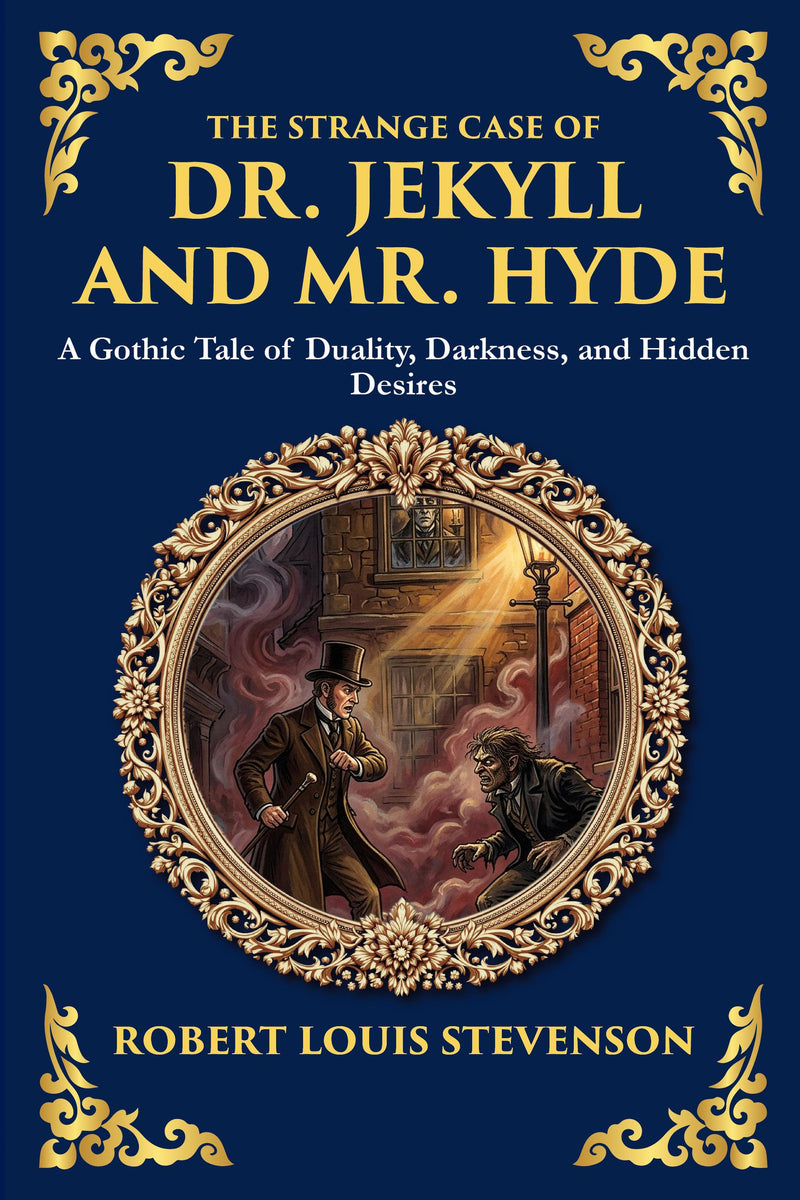
The Strange Case of Dr. Jekyll and Mr. Hyde
Behind the façade of every gentleman lies a shadow. In The Strange Case of Dr. Jekyll and Mr. Hyde, the line between civility and savagery is not just blurred—it’s shattered.
or free app
10,000+ hrs library
30-day guarantee
The complete The Strange Case of Dr. Jekyll and Mr. Hyde appears in modern English through Library of Alexandria Press, available online with audiobook narration included for members.
Have you ever wondered why the greatest monster lives inside us all? The Strange Case of Dr. Jekyll and Mr.
Hyde is Robert Louis Stevenson’s enduring tale of inner conflict, suppressed desires, and the terrifying split between a man’s public face and private impulses. A masterpiece of gothic horror and psychological suspense, this novella explores the eternal question: can man separate good from evil—or does one always give birth to the other? Dr.
Henry Jekyll, yearning to cast off the constraints of morality, creates a potion that allows him to become someone else entirely: Mr. Edward Hyde—a being of pure instinct and cruelty. But what begins as an experiment quickly becomes an addiction, and soon, Hyde threatens to consume not only Jekyll’s soul but his very existence.
This definitive edition brings Stevenson’s chilling vision to a modern audience with clarity and reverence, maintaining its original power to shock, disturb, and provoke reflection.
What you’ll discover in this modern edition
- A Riveting Psychological Exploration of Duality Witness the inner war between rationality and raw desire, control and chaos, identity and impulse.
- A Story That Defined the Genre Considered one of the earliest and finest psychological horror stories in literature.
- Timeless Reflections on Human Nature Explore moral ambiguity, repression, and the hidden parts of the self in a tale that resonates across centuries.
- A Dark, Atmospheric Journey Through Victorian London Feel the weight of secrecy and dread as the fog-covered streets mirror the shadowed soul of its characters.
- A Short but Profound Allegory In just a few pages, Stevenson offers insights still debated by psychologists, philosophers, and storytellers today. Whether you read it as horror, philosophy, or a cautionary tale, The Strange Case of Dr.
| Formats | eBook (EPUB + PDF) · Audiobook · Paperback · Hardcover · Large Print |
| Language | English |
| Trim size (print) | 6 × 9 in |
| Binding | Paperback — perfect-bound · Hardcover — casewrap |
| Large Print edition | Same text in a larger, easy-read type — a larger font, not a larger trim |
| Print pricing | Every physical book at our true cost — at-cost, no profit (members) |
| Library | 873 restored titles, always growing |
| Length | 26,678 words · ~1 hr 47 min reading |
| Reading level | Grade 7 · an easy, flowing read (this modern-English edition) |
| Edition | Modern English translation · 2026 |
Member reviews for this edition are collected as readers finish it — be the first. Across the library: 12,000+ books shipped, every plan covered by a 365-day print guarantee.
About this edition
A faithful, unabridged modern-English edition by The Library of Alexandria — carefully rendered for today's reader and verified paragraph-by-paragraph against the public-domain source. Available as eBook, audiobook, paperback, hardcover, and large print.
- Complete & unabridgedVerified paragraph by paragraph against the source — never a scan, never abridged.
- Modern English, faithfulReadable today, with the author’s meaning kept intact. Readable — not simplified.
- Every format, one membershipRead in your browser or the free app, or listen to the full audiobook.
Included free with your membership
Cancel anytime, one click · 30-day money-back guarantee
Edition last updated July 2026
What’s inside
The Strange Case of Dr. Jekyll and Mr. Hyde — complete and unabridged: all 11 sections included with membership, plus the full audiobook.
Begin reading The Strange Case of Dr. Jekyll and Mr. Hyde
In clear modern English — the complete text is included with membership.
Introduction
There are stories that frighten us, and there are stories that follow us home. Robert Louis Stevenson’s most famous tale belongs decisively to the second category. We have all heard the names—Jekyll, Hyde—so often that they have ceased to feel like characters in a book at all. They have become a kind of shorthand, a phrase we reach for whenever we want to describe a person whose behavior shifts unaccountably, whose public face conceals a private self, whose kindness one day curdles into cruelty the next. “He’s a real Jekyll and Hyde,” we say, and everyone nods, because everyone understands. That a novella published in 1886 should have entered the bloodstream of human language so completely is itself a remarkable fact, and it hints at something the casual reader may not expect when picking up this slim, electrifying volume for the first time: that beneath its surface as a Gothic shocker, this is a book about each one of us.
What makes the experience of reading the actual text so startling—particularly for those who arrive already “knowing” the story—is how little it resembles the cartoon version we have absorbed through a century of films, parodies, cereal boxes, and Halloween costumes. The popular imagination has flattened the tale into a simple potion-and-monster fable: a good doctor drinks a bubbling liquid and transforms into a hideous beast. But Stevenson wrote something far stranger, far subtler, and far more disturbing than that. The book you now hold is not a story about a scientist and his experiment gone wrong, at least not primarily. It is a study of secrecy, of the masks respectable people wear, of the dark passenger each of us carries within, and of what happens when a man decides—deliberately, with calculation and even a kind of relief—to set that passenger free. The horror here is not the horror of the laboratory. It is the horror of recognition.
This modern adaptation has been prepared with a single conviction in mind: that Stevenson’s genius deserves to be met fully, without the friction of fading vocabulary, antiquated sentence structures, or cultural references that have grown opaque with the passing of nearly a century and a half. The original prose is dense, lawyerly, and atmospheric, soaked in the particular textures of Victorian London. That density is part of its power, but it can also become a barrier, asking the contemporary reader to translate as they go, to pause and decode rather than to feel and to fear. What follows in these pages is an effort to carry the full force of the story across that gap—to preserve every shadow, every shudder, every moral weight, while allowing the language to move with the clarity and momentum that a reader today can receive directly into the imagination. Nothing essential has been lost. The aim has been to give you the experience Stevenson’s first readers had: that of being utterly, breathlessly caught.
The circumstances of the book’s creation are nearly as legendary as the book itself, and they are worth knowing, because they illuminate why the story carries such an oddly intimate, dreamlike charge. Robert Louis Stevenson was, by the mid-1880s, an established and admired writer—the author of Treasure Island, a man of restless intelligence and frail health who had spent much of his life chasing warmer climates and battling the lung ailments that would eventually kill him at the age of forty-four. He was living in the seaside town of Bournemouth, often confined to bed, when the seed of the story came to him not through reasoning or research but through sleep.
According to the account given by his wife, Fanny, Stevenson cried out in the night, in the grip of a nightmare. She woke him, and he was annoyed rather than grateful—he had been, he said, dreaming “a fine bogey tale,” and she had interrupted it. What he had seen, by his own description, were certain crucial scenes: the moment of transformation, the terrible duality, the figure pursued. He set to work in a fever of inspiration, and the speed of his composition has become part of the legend. He is said to have produced a complete draft in a matter of days—three, by some accounts—before, in a famous and debated episode, either he or his wife judged the first version wanting, and he burned it and wrote the entire thing again from scratch with equal speed. The book that resulted was written, revised, and finished in a few short weeks.
Whatever the precise truth of these stories—and Stevenson’s own recollections shifted over time—they capture something authentic about the texture of the finished work. The novella has the logic of a nightmare: its images arrive with the inevitability of dreams, its dread accumulates without our being able to point to exactly why, and its central transformation feels less like a scientific event than like the surfacing of something that was always there, waiting beneath the floorboards of an ordinary life. Stevenson was a deliberate and conscious artist, and he shaped the raw material of his dream with enormous craft. But he never quite tamed its primal force, and that is to our great fortune. The book frightens us the way nightmares frighten us, by speaking to fears we did not know we had until they were given a face.
It is also worth remembering the world into which this nightmare was released. Late-Victorian Britain was a society obsessed with respectability, with the rigid maintenance of appearances, with the careful separation of the proper from the improper. It was a culture of the closed door and the drawn curtain, where men of standing might lead double lives—pious by day, dissolute by night—and where the entire social machinery seemed designed to keep the surface immaculate whatever roiled beneath. The London of the story is a city of fog and gaslight, of handsome townhouses fronting on respectable squares while sinister back streets and hidden entrances lurked just around the corner. This geography is not mere set dressing. It is a moral map. The very layout of the city—genteel facade, secret rear—mirrors the architecture of the soul that the book sets out to anatomize. Readers in 1886 understood this in their bones, because they lived inside that contradiction. Stevenson held up a mirror, and his contemporaries saw, with a thrill of guilty recognition, the divided creatures they suspected themselves to be.
The book was an immediate sensation. It sold tens of thousands of copies in its first months, was pirated and adapted, preached about from pulpits, and discussed in newspapers as a kind of moral parable for the age. Within a year of publication it had been turned into a stage play, and that production—running in London at the very time the Whitechapel murders gripped the city—fused in the public mind the figure of Hyde with the figure of the real-life killer stalking the streets, lending the fiction a horrifying topical edge. From that moment on, the story belonged not only to its author but to the culture at large, and it has never let go. It is one of the rare works of literature that has achieved the status of myth—a story everyone knows even if they have never read a word of it.
It would be a disservice to spoil for any reader the precise unfolding of events, the careful way Stevenson parcels out his revelations, or the structure by which the truth is gradually assembled from fragments, testimonies, and documents. Part of the original audience’s experience was discovery—the slow, dawning horror of understanding what was actually happening—and although that experience is no longer fully available to us, since the central secret has long since passed into common knowledge, the architecture of the telling still rewards close attention. The novella is, among other things, a brilliantly constructed mystery, and the way Stevenson manages perspective, withholds information, and builds to his revelations remains a masterclass in suspense. So let us approach the meaning of the book without dismantling its mechanism.
At its deepest level, this is a story about the divided self—about the discovery that a single human being might contain not one coherent identity but two, or many, often at war. Stevenson was fascinated by the idea that what we call a “person” is in fact a kind of uneasy truce among competing impulses, that the dignified citizen and the appetite-driven animal might both reside behind the same forehead, that virtue and vice are not separate populations of saints and sinners but neighbors in every breast. The genius of the story is that it takes this abstract idea—familiar to philosophers and theologians for centuries—and gives it terrifying flesh. It asks: what if you could divide yourself? What if the better part of you and the worse part of you could be separated, each given its own body, its own freedom, its own life? Would you do it? And if you did, which half would prove stronger?
This is why the book is so much more unsettling than the monster movie it is often mistaken for. The true horror is not that a man becomes a beast. It is that the man wants to become a beast—that the transformation begins as a wish, a temptation, a forbidden pleasure, a way to indulge appetites without paying the social price. The arrangement is not, at first, a curse. It is a solution, a clever escape from the suffocating demands of respectability. The tragedy unfolds not because the experiment fails but because, in a sense, it succeeds all too well, and the success turns out to carry a cost that no one could have foreseen and no one can repay. There is something deeply modern in this. We live in an age acutely conscious of the gap between our curated public selves and our private realities, between the faces we present online and the people we actually are, between the impulses we admit to and the ones we keep locked away. The story speaks to that condition with uncanny directness, even though it was written in a world without screens, in a city lit by gas.
The figure who unleashes the darker self is, crucially, not a villain in the conventional sense, not a mad scientist cackling over his beakers. He is a man of standing and intelligence, a man who has spent his life maintaining an impeccable reputation, and who feels—precisely because of that lifelong discipline—a particular hunger for release. His downfall comes not from wickedness but from a very recognizable human longing: the wish to be free of consequences, to have one’s pleasures without one’s shame, to separate the doing from the being. Anyone who has ever wished they could behave badly without becoming the kind of person who behaves badly will understand the temptation at the heart of this book. And that is exactly what makes it so quietly devastating. The story does not let us stand outside it, pointing in horror at a monster. It draws us in and whispers that the monster’s logic is our own.
The book also explores, with remarkable acuity, the theme of secrecy and the corrosive power of the things we hide. Much of the narrative concerns the efforts of decent men—a lawyer, a doctor, friends and observers—to understand a mystery they sense but cannot name. They are bound by a code of discretion, by the gentlemanly understanding that a man’s private business is his own and that one does not pry. This very discretion, this collective agreement to look away from what is unseemly, becomes part of the tragedy. The respectable world is so committed to not seeing that it allows the horror to grow unchecked in its midst. There is a sharp social critique buried in the Gothic machinery here: a society that prizes appearances above honesty creates the perfect conditions for hidden monstrousness to flourish. The closed door protects not only privacy but evil.
Readers who come to the text expecting only thrills will find them—the atmosphere of dread, the famous scenes of violence and transformation, the mounting sense of something terribly wrong—but they will also find, threaded through every page, a meditation on conscience, identity, addiction, and the limits of the will. The latter portions of the book in particular, where the full account is finally laid bare, contain some of the most searching and psychologically penetrating writing in all of nineteenth-century fiction: a first-person confession of a soul coming apart, of a man who set out to master his own divided nature and discovered, too late, that the darker self he thought he could summon and dismiss at will had a will of its own. It is here that Stevenson rises from the level of a fine storyteller to that of a profound moral artist. The horror becomes tragedy, and the tragedy becomes something close to prophecy—a warning about the human capacity for self-deception, and about the price we pay when we imagine we can compartmentalize the soul.
Cancel anytime, one click · 30-day money-back guarantee
Founding annual rate available now — your price locks for life when you join.
Not ready? Get this free chapter by email — read it anytime.
✓ Sent — check your inbox for The Strange Case of Dr. Jekyll and Mr. Hyde.
Questions about The Strange Case of Dr. Jekyll and Mr. Hyde
What is The Strange Case of Dr. Jekyll and Mr. Hyde about?
Behind the façade of every gentleman lies a shadow. In The Strange Case of Dr. Jekyll and Mr.
Who wrote The Strange Case of Dr. Jekyll and Mr. Hyde?
The Strange Case of Dr. Jekyll and Mr. Hyde was written by Robert Louis Stevenson. This edition presents the complete work in clear modern English, faithfully rendered from the public-domain original by Library of Alexandria Press.
Is The Strange Case of Dr. Jekyll and Mr. Hyde free to read?
The opening chapter is free to read on this page. Members read and listen to the complete work — and the entire library — free, and can order any physical book at our true print cost.
How long is The Strange Case of Dr. Jekyll and Mr. Hyde?
11 chapters (~26,678 words) — about 1 hr 47 min of reading in this modern-English edition.
Is this an abridged version of The Strange Case of Dr. Jekyll and Mr. Hyde?
No. This is the complete, unabridged The Strange Case of Dr. Jekyll and Mr. Hyde, carefully rendered into clear modern English and verified paragraph-by-paragraph against the public-domain source — nothing is cut or summarised.
What formats does The Strange Case of Dr. Jekyll and Mr. Hyde come in?
The Strange Case of Dr. Jekyll and Mr. Hyde is available as eBook, paperback, hardcover and large print. eBook and audiobook are included with membership; printed editions ship at our true print cost.
Shipping & returns
Billing & membership
More from the library


Explore Horror & Gothic
- The Cask of Amontillado · Edgar Allan Poe
- Ghost Stories of an Antiquary · M. R. James
- The Monk: A Romance · M. G. Lewis
- The House of the Seven Gables · Nathaniel Hawthorne
- The Willows · Algernon Blackwood
- The Monkey’s Paw · W. W. Jacobs
- The Call of Cthulhu · H. P. Lovecraft
- The Life-Eater · Harold Ward
- The Black Kiss
- The Legend of Sleepy Hollow · Washington Irving
- Brood of the Dark Moon · Charles Willard Diffin
- The Night Land · William Hope Hodgson
- The Castle of Otranto · Horace Walpole
- Dracula · Bram Stoker
- Carmilla · Joseph Sheridan Le Fanu
- The King in Yellow · Robert W. Chambers
- Wuthering Heights · Emily Brontë
- The Vampyre: A Tale · John William Polidori
- A Christmas Carol · Charles Dickens
- Northanger Abbey · Jane Austen
- The Turn of the Screw · Henry James
- Metamorphosis · Franz Kafka
- The Yellow Wallpaper · Charlotte Perkins Gilman
- The Adventures of Ferdinand Count Fathom — Complete · T. Smollett
- The Picture of Dorian Gray · Oscar Wilde
- Frankenstein; Or, The Modern Prometheus · Mary Wollstonecraft Shelley
The Strange Case of Dr. Jekyll and Mr. Hyde
The Strange Case of Dr. Jekyll and Mr. Hyde
A Gothic Tale of Duality, Darkness, and Hidden Desires
Robert Louis Stevenson
Contents
- Introduction
- Chapter 1
- Chapter 2
- Chapter 3
- Chapter 4
- Chapter 5
- Chapter 6
- Chapter 7
- Chapter 8
- Chapter 9
- Chapter 10
Introduction
There are stories that frighten us, and there are stories that follow us home. Robert Louis Stevenson’s most famous tale belongs decisively to the second category. We have all heard the names—Jekyll, Hyde—so often that they have ceased to feel like characters in a book at all. They have become a kind of shorthand, a phrase we reach for whenever we want to describe a person whose behavior shifts unaccountably, whose public face conceals a private self, whose kindness one day curdles into cruelty the next. “He’s a real Jekyll and Hyde,” we say, and everyone nods, because everyone understands. That a novella published in 1886 should have entered the bloodstream of human language so completely is itself a remarkable fact, and it hints at something the casual reader may not expect when picking up this slim, electrifying volume for the first time: that beneath its surface as a Gothic shocker, this is a book about each one of us.
What makes the experience of reading the actual text so startling—particularly for those who arrive already “knowing” the story—is how little it resembles the cartoon version we have absorbed through a century of films, parodies, cereal boxes, and Halloween costumes. The popular imagination has flattened the tale into a simple potion-and-monster fable: a good doctor drinks a bubbling liquid and transforms into a hideous beast. But Stevenson wrote something far stranger, far subtler, and far more disturbing than that. The book you now hold is not a story about a scientist and his experiment gone wrong, at least not primarily. It is a study of secrecy, of the masks respectable people wear, of the dark passenger each of us carries within, and of what happens when a man decides—deliberately, with calculation and even a kind of relief—to set that passenger free. The horror here is not the horror of the laboratory. It is the horror of recognition.
This modern adaptation has been prepared with a single conviction in mind: that Stevenson’s genius deserves to be met fully, without the friction of fading vocabulary, antiquated sentence structures, or cultural references that have grown opaque with the passing of nearly a century and a half. The original prose is dense, lawyerly, and atmospheric, soaked in the particular textures of Victorian London. That density is part of its power, but it can also become a barrier, asking the contemporary reader to translate as they go, to pause and decode rather than to feel and to fear. What follows in these pages is an effort to carry the full force of the story across that gap—to preserve every shadow, every shudder, every moral weight, while allowing the language to move with the clarity and momentum that a reader today can receive directly into the imagination. Nothing essential has been lost. The aim has been to give you the experience Stevenson’s first readers had: that of being utterly, breathlessly caught.
The circumstances of the book’s creation are nearly as legendary as the book itself, and they are worth knowing, because they illuminate why the story carries such an oddly intimate, dreamlike charge. Robert Louis Stevenson was, by the mid-1880s, an established and admired writer—the author of Treasure Island, a man of restless intelligence and frail health who had spent much of his life chasing warmer climates and battling the lung ailments that would eventually kill him at the age of forty-four. He was living in the seaside town of Bournemouth, often confined to bed, when the seed of the story came to him not through reasoning or research but through sleep.
According to the account given by his wife, Fanny, Stevenson cried out in the night, in the grip of a nightmare. She woke him, and he was annoyed rather than grateful—he had been, he said, dreaming “a fine bogey tale,” and she had interrupted it. What he had seen, by his own description, were certain crucial scenes: the moment of transformation, the terrible duality, the figure pursued. He set to work in a fever of inspiration, and the speed of his composition has become part of the legend. He is said to have produced a complete draft in a matter of days—three, by some accounts—before, in a famous and debated episode, either he or his wife judged the first version wanting, and he burned it and wrote the entire thing again from scratch with equal speed. The book that resulted was written, revised, and finished in a few short weeks.
Whatever the precise truth of these stories—and Stevenson’s own recollections shifted over time—they capture something authentic about the texture of the finished work. The novella has the logic of a nightmare: its images arrive with the inevitability of dreams, its dread accumulates without our being able to point to exactly why, and its central transformation feels less like a scientific event than like the surfacing of something that was always there, waiting beneath the floorboards of an ordinary life. Stevenson was a deliberate and conscious artist, and he shaped the raw material of his dream with enormous craft. But he never quite tamed its primal force, and that is to our great fortune. The book frightens us the way nightmares frighten us, by speaking to fears we did not know we had until they were given a face.
It is also worth remembering the world into which this nightmare was released. Late-Victorian Britain was a society obsessed with respectability, with the rigid maintenance of appearances, with the careful separation of the proper from the improper. It was a culture of the closed door and the drawn curtain, where men of standing might lead double lives—pious by day, dissolute by night—and where the entire social machinery seemed designed to keep the surface immaculate whatever roiled beneath. The London of the story is a city of fog and gaslight, of handsome townhouses fronting on respectable squares while sinister back streets and hidden entrances lurked just around the corner. This geography is not mere set dressing. It is a moral map. The very layout of the city—genteel facade, secret rear—mirrors the architecture of the soul that the book sets out to anatomize. Readers in 1886 understood this in their bones, because they lived inside that contradiction. Stevenson held up a mirror, and his contemporaries saw, with a thrill of guilty recognition, the divided creatures they suspected themselves to be.
The book was an immediate sensation. It sold tens of thousands of copies in its first months, was pirated and adapted, preached about from pulpits, and discussed in newspapers as a kind of moral parable for the age. Within a year of publication it had been turned into a stage play, and that production—running in London at the very time the Whitechapel murders gripped the city—fused in the public mind the figure of Hyde with the figure of the real-life killer stalking the streets, lending the fiction a horrifying topical edge. From that moment on, the story belonged not only to its author but to the culture at large, and it has never let go. It is one of the rare works of literature that has achieved the status of myth—a story everyone knows even if they have never read a word of it.
It would be a disservice to spoil for any reader the precise unfolding of events, the careful way Stevenson parcels out his revelations, or the structure by which the truth is gradually assembled from fragments, testimonies, and documents. Part of the original audience’s experience was discovery—the slow, dawning horror of understanding what was actually happening—and although that experience is no longer fully available to us, since the central secret has long since passed into common knowledge, the architecture of the telling still rewards close attention. The novella is, among other things, a brilliantly constructed mystery, and the way Stevenson manages perspective, withholds information, and builds to his revelations remains a masterclass in suspense. So let us approach the meaning of the book without dismantling its mechanism.
At its deepest level, this is a story about the divided self—about the discovery that a single human being might contain not one coherent identity but two, or many, often at war. Stevenson was fascinated by the idea that what we call a “person” is in fact a kind of uneasy truce among competing impulses, that the dignified citizen and the appetite-driven animal might both reside behind the same forehead, that virtue and vice are not separate populations of saints and sinners but neighbors in every breast. The genius of the story is that it takes this abstract idea—familiar to philosophers and theologians for centuries—and gives it terrifying flesh. It asks: what if you could divide yourself? What if the better part of you and the worse part of you could be separated, each given its own body, its own freedom, its own life? Would you do it? And if you did, which half would prove stronger?
This is why the book is so much more unsettling than the monster movie it is often mistaken for. The true horror is not that a man becomes a beast. It is that the man wants to become a beast—that the transformation begins as a wish, a temptation, a forbidden pleasure, a way to indulge appetites without paying the social price. The arrangement is not, at first, a curse. It is a solution, a clever escape from the suffocating demands of respectability. The tragedy unfolds not because the experiment fails but because, in a sense, it succeeds all too well, and the success turns out to carry a cost that no one could have foreseen and no one can repay. There is something deeply modern in this. We live in an age acutely conscious of the gap between our curated public selves and our private realities, between the faces we present online and the people we actually are, between the impulses we admit to and the ones we keep locked away. The story speaks to that condition with uncanny directness, even though it was written in a world without screens, in a city lit by gas.
The figure who unleashes the darker self is, crucially, not a villain in the conventional sense, not a mad scientist cackling over his beakers. He is a man of standing and intelligence, a man who has spent his life maintaining an impeccable reputation, and who feels—precisely because of that lifelong discipline—a particular hunger for release. His downfall comes not from wickedness but from a very recognizable human longing: the wish to be free of consequences, to have one’s pleasures without one’s shame, to separate the doing from the being. Anyone who has ever wished they could behave badly without becoming the kind of person who behaves badly will understand the temptation at the heart of this book. And that is exactly what makes it so quietly devastating. The story does not let us stand outside it, pointing in horror at a monster. It draws us in and whispers that the monster’s logic is our own.
The book also explores, with remarkable acuity, the theme of secrecy and the corrosive power of the things we hide. Much of the narrative concerns the efforts of decent men—a lawyer, a doctor, friends and observers—to understand a mystery they sense but cannot name. They are bound by a code of discretion, by the gentlemanly understanding that a man’s private business is his own and that one does not pry. This very discretion, this collective agreement to look away from what is unseemly, becomes part of the tragedy. The respectable world is so committed to not seeing that it allows the horror to grow unchecked in its midst. There is a sharp social critique buried in the Gothic machinery here: a society that prizes appearances above honesty creates the perfect conditions for hidden monstrousness to flourish. The closed door protects not only privacy but evil.
Readers who come to the text expecting only thrills will find them—the atmosphere of dread, the famous scenes of violence and transformation, the mounting sense of something terribly wrong—but they will also find, threaded through every page, a meditation on conscience, identity, addiction, and the limits of the will. The latter portions of the book in particular, where the full account is finally laid bare, contain some of the most searching and psychologically penetrating writing in all of nineteenth-century fiction: a first-person confession of a soul coming apart, of a man who set out to master his own divided nature and discovered, too late, that the darker self he thought he could summon and dismiss at will had a will of its own. It is here that Stevenson rises from the level of a fine storyteller to that of a profound moral artist. The horror becomes tragedy, and the tragedy becomes something close to prophecy—a warning about the human capacity for self-deception, and about the price we pay when we imagine we can compartmentalize the soul.
Mr. Utterson, the lawyer, had a rugged face that never seemed to smile. He was cold, brief, and awkward in conversation, and he struggled to express his emotions. He was lean, long, and drab—a dreary man, yet somehow likable. At social gatherings, especially when the wine suited his taste, a deeply human spark would appear in his eyes. This side of him never came through in his speech, but it showed in the silent expressions of his face after dinner, and even more clearly in how he lived his life. He was strict with himself; he drank gin when he was alone to suppress his craving for fine wines, and although he loved the theater, he hadn’t stepped foot in one for twenty years. However, he was very tolerant of others. He sometimes wondered, almost with envy, at the high energy people put into their vices, and in a crisis, he was always more likely to help than to judge. “I follow Cain’s heresy,” he would say quirkily. “I let my brother go to hell in his own way.” Because of this, he often became the last respectable friend and the last positive influence in the lives of men heading for ruin. As long as these men visited his office, he never treated them with anything less than total respect.
This was easy for Mr. Utterson, as he was naturally reserved, and his friendships were based on a similar kind of open-mindedness. He was a modest man who simply accepted whoever happened to enter his social circle. His friends were either family members or people he had known for a long time; his affections grew slowly over time, like ivy, regardless of whether the person was particularly impressive. This explained his bond with Mr. Richard Enfield, a distant relative and a well-known socialite. Many people wondered what these two could possibly have in common or what they even talked about. Those who saw them on their Sunday walks reported that they said almost nothing, looked incredibly bored, and seemed visibly relieved whenever they ran into another acquaintance. Despite this, the two men valued these walks immensely, considering them the highlight of their week. They would turn down social invitations and even ignore business calls just to ensure their walks remained uninterrupted.
End of the free sample
Keep reading, free
Members read and listen to the complete book — and the entire library. Cancel anytime, one click · 30-day money-back guarantee.