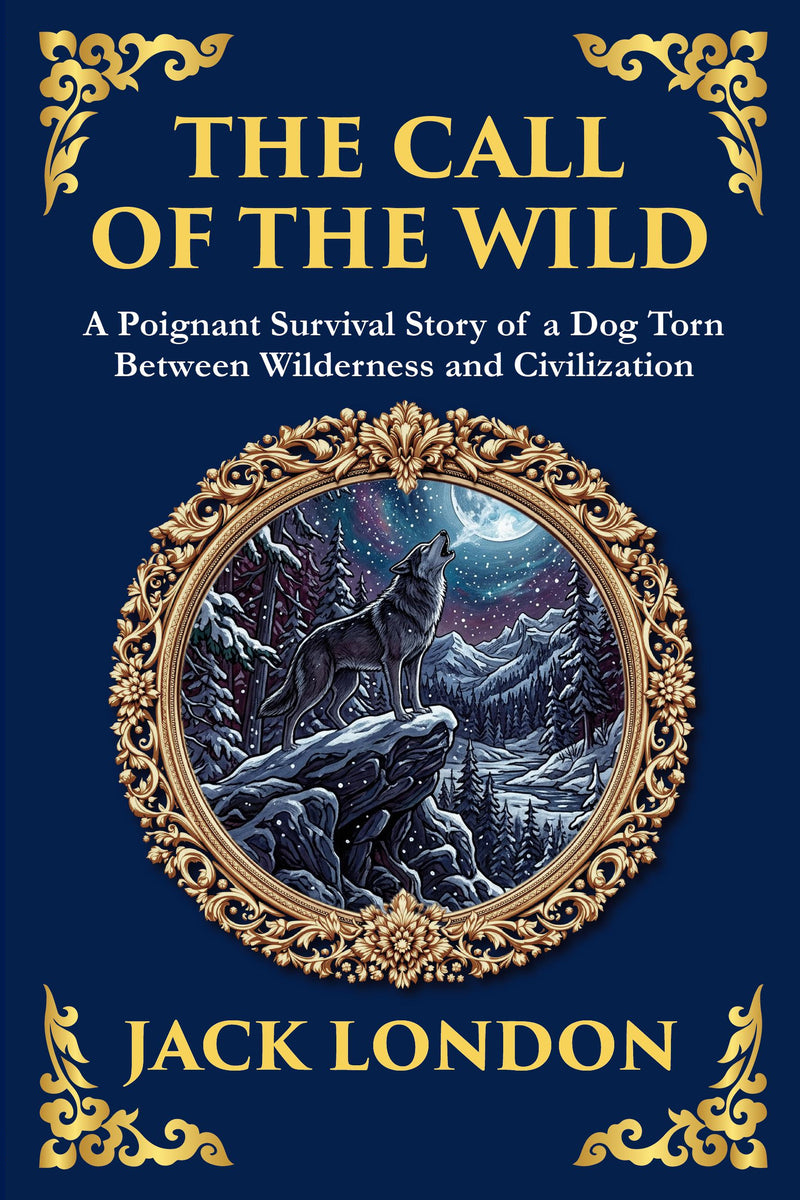
The Call of the Wild
When the call of the wild howls through the frozen wind, will you answer it—or resist? The Call of the Wild is Jack London’s legendary tale of primal instinct, raw survival, and the thin line between savagery and civilization.
or free app
10,000+ hrs library
30-day guarantee
The complete The Call of the Wild appears in modern English through Library of Alexandria Press, available online with audiobook narration included for members.
Have you ever wondered why the wild still calls to something deep inside us—even after we've left it behind? Jack London's The Call of the Wild is a visceral masterpiece that dives headfirst into the raw, untamed forces of nature and the instincts that sleep within us. Through the unforgettable journey of Buck, a once-pampered St.
Bernard-Scotch Shepherd mix, we confront the essential question: are we ever truly civilized, or merely domesticated by circumstance? After being stolen from a tranquil life in California, Buck is sold into the merciless world of Alaskan sled dogs, where violence and survival replace comfort and companionship. As he passes from one master to another—some cruel, others kind—Buck’s senses sharpen, his instincts awaken, and his spirit evolves.
With every mile, every hardship, and every howl beneath the aurora skies, Buck edges closer to the wild destiny he can no longer deny. London's prose is both stark and poetic, immersing readers in the icy brutality of the Yukon and the emotional complexity of a creature caught between two worlds. More than a story of adventure, The Call of the Wild is a spiritual odyssey, an exploration of instinct, freedom, and the primal truth that sometimes, to find our place, we must return to where we began.
What you’ll discover in this modern edition
- A Legendary Survival Tale – Buck’s transformation from a tame pet to a wild leader is as thrilling as it is profound.
- An Exploration of Instinct vs. Civilization – Delve into the struggle between obedience and freedom, loyalty and liberation.
- Rich Symbolism and Themes – Examine the layered meanings of dominance, identity, belonging, and the call of one’s true nature.
- Evocative Wilderness Settings – Feel the chill of the Yukon, the rush of the sled, and the grandeur of the untamed North.
- A Companion to Humanity’s Own Evolution – Buck’s awakening mirrors our own yearning to reconnect with nature, purpose, and authenticity.
| Formats | eBook (EPUB + PDF) · Audiobook · Paperback · Hardcover · Large Print |
| Language | English |
| Trim size (print) | 6 × 9 in |
| Binding | Paperback — perfect-bound · Hardcover — casewrap |
| Large Print edition | Same text in a larger, easy-read type — a larger font, not a larger trim |
| Print pricing | Every physical book at our true cost — at-cost, no profit (members) |
| Library | 873 restored titles, always growing |
| Length | 33,514 words · ~2 hr 14 min reading |
| Reading level | Grade 6 · an easy, flowing read (this modern-English edition) |
| Edition | Modern English translation · 2026 |
Member reviews for this edition are collected as readers finish it — be the first. Across the library: 12,000+ books shipped, every plan covered by a 365-day print guarantee.
About this edition
A faithful, unabridged modern-English edition by The Library of Alexandria — carefully rendered for today's reader and verified paragraph-by-paragraph against the public-domain source. Available as eBook, audiobook, paperback, hardcover, and large print.
- Complete & unabridgedVerified paragraph by paragraph against the source — never a scan, never abridged.
- Modern English, faithfulReadable today, with the author’s meaning kept intact. Readable — not simplified.
- Every format, one membershipRead in your browser or the free app, or listen to the full audiobook.
Included free with your membership
Cancel anytime, one click · 30-day money-back guarantee
Edition last updated July 2026
What’s inside
The Call of the Wild — complete and unabridged: all 8 sections included with membership, plus the full audiobook.
Begin reading The Call of the Wild
In clear modern English — the complete text is included with membership.
Introduction
There are stories that entertain, and there are stories that change the way we see the world. The Call of the Wild belongs firmly to the second category. First published in 1903, it arrived like a thunderclap in the American literary landscape—a slim, ferocious tale that managed to capture something primal and enduring about the relationship between the tame and the untamed, between the comforts of civilization and the irresistible pull of something older and wilder buried deep within every living creature. More than a century later, it remains one of the most widely read books ever written in the English language, beloved by children and scholars alike, and as alive and urgent today as it was when Jack London first set it loose upon the page.
This edition presents the story in a modern translation, carefully adapted for the contemporary reader. That phrase deserves a word of explanation, because it speaks to the spirit in which this book has been prepared. London wrote in a prose style that was, even in his own time, muscular and direct, but the English language has shifted in the decades since. Certain turns of phrase, certain rhythms of sentence construction, and certain vocabulary choices that felt natural to readers in 1903 can now slow a modern reader down or create a subtle barrier between them and the raw emotional power of the narrative. The aim of this adaptation is not to dilute or simplify London’s vision, but to clear away the dust of time so that the story can strike the reader with the same immediacy and force it possessed for its original audience. The bones of the tale remain exactly as London built them; the language has simply been brought forward so that nothing stands between you and the wild.
Before you begin, it is worth taking a moment to understand the extraordinary circumstances that produced this book, the remarkable man who wrote it, and the timeless themes that have kept it in print and in our hearts for well over a hundred years. To do so will deepen your appreciation of what you are about to read—not by revealing what happens, for that would spoil the pleasure of discovery, but by illuminating the rich soil from which this masterpiece grew.
Jack London was, in many respects, the perfect author to write a story about survival, transformation, and the thin membrane separating comfort from chaos. His own life was a kind of high-stakes adventure narrative, lived at full throttle and burned through with astonishing speed. Born in San Francisco in 1876, he came into a world of poverty and uncertainty. His early years were marked by hard labor and hard knocks: he worked in a cannery as a boy, putting in punishing hours for paltry wages, and he came to understand from bitter personal experience exactly what it meant to be a creature reduced to the raw struggle for daily existence. This was not a man writing about hardship from the comfort of an armchair. London knew hunger, knew exhaustion, knew the way that brutal circumstances strip away the niceties of polite society and lay bare what a living thing will do to survive.
As a young man, he embraced a restless, roving life. He became an oyster pirate in San Francisco Bay, then switched sides and worked for the fish patrol that hunted poachers like himself. He shipped out as a sailor on a sealing schooner that took him across the Pacific to Japan, an experience that gave him firsthand knowledge of the sea, of brutal weather, and of the hierarchy and discipline of life aboard a working vessel. He rode the rails as a tramp during the great economic depression of the 1890s, crisscrossing the United States and Canada with armies of unemployed men, sleeping rough, begging for food, and spending time in jail for vagrancy. Through all of it, he was absorbing the world with a hungry, observant intelligence, gathering the raw material that would later fuel his fiction.
But it was a single, defining episode that placed the landscape of The Call of the Wild directly before his eyes. In 1897, the Klondike Gold Rush erupted, drawing tens of thousands of hopeful prospectors into the frozen wilderness of Canada’s Yukon Territory in search of fortune. London, then twenty-one years old and burning with ambition, joined the stampede. He did not strike gold—almost no one did—but he found something far more valuable to a future writer. He found the North.
The far North that London encountered was a place of staggering extremity. Temperatures plunged so low that spit would freeze before it hit the ground. The trails were treacherous, the distances vast, and the margin for error razor-thin. Men and animals labored together against an indifferent and often merciless environment, and London watched closely as the veneer of civilization peeled away to reveal the elemental creatures beneath. He observed the sled dogs especially—their loyalty, their savagery, their intelligence, their suffering, and their capacity for transformation under the pressure of that unforgiving world. He saw how the wilderness tested every living thing it touched, and how it separated those who could adapt from those who could not. Though he fell ill with scurvy and returned home with empty pockets, London brought back from the Klondike a treasure that would make him famous: a deep, lived understanding of the wild and the law that governs it.
What truly set London apart, however, was the way he combined this hard-won experience with the great intellectual currents of his age. He was a voracious, self-taught reader who devoured the philosophical and scientific ideas swirling through the late nineteenth century. He was profoundly influenced by the theories of evolution and natural selection, by ideas about the struggle for existence and the survival of the fittest. He was fascinated by the tension between instinct and reason, between the primitive and the modern, between the individual creature and the vast, impersonal forces of nature. The Call of the Wild is, among other things, a brilliant fictional dramatization of these ideas—but London was far too gifted a storyteller to let philosophy ever overwhelm the narrative. He wrapped his profound questions in a tale so gripping, so emotionally true, and so propulsive that readers race through it, scarcely aware that they are being asked to ponder the deepest questions about what it means to be alive.
When the book appeared in 1903, it made London an international sensation almost overnight. He went on to become one of the most successful and well-paid authors of his era, producing an enormous body of work in his short life. He died in 1916 at the age of just forty, his body worn out by the same ferocious intensity with which he had lived. But the books endured, and The Call of the Wild endured most of all—a perfect distillation of everything its author knew about the wild places of the earth and the wild places within the soul.
One of the boldest and most enduring achievements of this novel is its point of view. London chose to tell his story not through the eyes of a man, but through the perceptions of a dog. This was a daring artistic decision, and it could easily have collapsed into sentimentality or whimsy in the hands of a lesser writer. Instead, London accomplished something remarkable: he created a narrative consciousness that feels genuinely animal, genuinely other, while remaining deeply and movingly relatable to human readers.
This is not a story in which a dog speaks in human words or thinks in human concepts. London was far too disciplined and too honest for that. Instead, he immerses us in a way of experiencing the world that is governed by sensation, instinct, memory, and feeling rather than by language and abstract reasoning. We come to understand the world as the protagonist understands it—through scent and sound and the immediate pressure of need, through the dawning recognition of new rules and new realities, through loyalty and fear and longing. The effect is hypnotic. London manages the extraordinary trick of keeping us firmly inside an animal mind while never condescending to his subject and never breaking the spell. By the time you have read a few pages, you will find that you have stopped thinking of the central figure as merely a dog and started experiencing the world alongside a fully realized consciousness whose journey you cannot help but care about with surprising intensity.
This perspective also allows London to comment on the human world from a fascinating angle. Because we see people through the eyes of an observer who does not share their assumptions, who cannot be fooled by their words and judges them only by their actions, the humans in this story are revealed with startling clarity. Cruelty, kindness, foolishness, courage, weakness, and strength all stand out in sharp relief when viewed through such an unsentimental lens. We see what people truly are, stripped of the explanations and justifications they offer one another. In this way, the animal point of view becomes a powerful instrument for moral truth.
The setting deserves attention as well, because it functions almost as a character in its own right. The frozen landscape of the North is rendered with extraordinary vividness and authority—you can practically feel the bite of the cold, hear the crunch of snow beneath laboring paws, and sense the vast, silent indifference of a land that neither loves nor hates the creatures struggling across it. London’s North is beautiful and terrible at once, a place of dazzling clarity and lethal danger. It is a stage upon which the deepest dramas of survival and transformation can play out without distraction, and London brings it to life with the unforgettable specificity of a man who walked those trails himself and never forgot them.
What gives the novel its peculiar power is the way these elements work together. The animal perspective, the savage and gorgeous landscape, the relentless forward momentum of the plot, and the great underlying themes all combine into something that feels less like a constructed story and more like an elemental force. Reading it, one has the sense of touching something true and ancient, something that bypasses the rational mind and speaks directly to whatever wildness still survives in us. This is why the book affects readers so deeply, and why it stays with them long after the final page. It awakens an awareness we usually keep buried—the knowledge that beneath the comforts and conventions of our managed lives, we too are creatures shaped by instinct, capable of both tenderness and ferocity, and connected by invisible threads to a wilder world from which we are never quite as separate as we like to believe.
It is worth saying a word here about the experience of reading the book itself, particularly for those coming to it for the first time. Do not be deceived by its modest length. The Call of the Wild is short—it can be read in a single long sitting—but it is dense with meaning and sensation, and it rewards the reader who slows down enough to absorb it fully. London’s prose, especially in this modern adaptation, moves with a clean, driving energy, but it is also studded with passages of remarkable beauty and emotional force. There are moments in this book that have stopped countless readers cold, moments of such intensity and truth that they take the breath away. Allow yourself to feel them. This is not a book to be skimmed or rushed through merely to find out what happens. It is a book to be experienced, to be lived through, to be felt in the body as much as understood in the mind.
You may also find that the book invites reflection long after you have set it down. The questions it raises do not resolve neatly. What is the proper balance between freedom and belonging? What do we owe to those who love us, and what do we owe to our own deepest nature? Is the call of the wild something to be feared, resisted, and overcome—or something to be answered, honored, and embraced? London does not lecture us with easy answers. Instead, he dramatizes these tensions with such honesty and force that we are left to wrestle with them ourselves, which is precisely what the greatest literature does. A lesser writer would have tied everything up with a tidy moral. London trusts his readers to sit with complexity, and that trust is part of what makes the book feel so adult and so true even though it is often given to young readers.
Cancel anytime, one click · 30-day money-back guarantee
Founding annual rate available now — your price locks for life when you join.
Not ready? Get this free chapter by email — read it anytime.
✓ Sent — check your inbox for The Call of the Wild.
Questions about The Call of the Wild
What is The Call of the Wild about?
When the call of the wild howls through the frozen wind, will you answer it—or resist? The Call of the Wild is Jack London’s legendary tale of primal instinct, raw survival, and the thin line between savagery and civilization. At the heart of the story is Buck, a domesticated dog torn from his peaceful California home and thrust into the brutal life of an Alaskan sled dog during the Klondike Gold Rush.
Who wrote The Call of the Wild?
The Call of the Wild was written by Jack London. This edition presents the complete work in clear modern English, faithfully rendered from the public-domain original by Library of Alexandria Press.
Is The Call of the Wild free to read?
The opening chapter is free to read on this page. Members read and listen to the complete work — and the entire library — free, and can order any physical book at our true print cost.
How long is The Call of the Wild?
8 chapters (~33,514 words) — about 2 hr 14 min of reading in this modern-English edition.
Is this an abridged version of The Call of the Wild?
No. This is the complete, unabridged The Call of the Wild, carefully rendered into clear modern English and verified paragraph-by-paragraph against the public-domain source — nothing is cut or summarised.
What formats does The Call of the Wild come in?
The Call of the Wild is available as eBook, paperback, hardcover and large print. eBook and audiobook are included with membership; printed editions ship at our true print cost.
Shipping & returns
Billing & membership
More from the library


Explore Adventure
- Tarzan of the Apes · Edgar Rice Burroughs
- The Wonderful Wizard of Oz · L. Frank Baum
- Peter Pan · J. M. Barrie
- Moby Dick; Or, The Whale · Herman Melville
- The Riddle of the Sands · Erskine Childers
- The Loss of the Swansea: A Story of the Florida Coast · W. L. Alden
- Sky Island · L. Frank Baum
- Vikram and the Vampire: Classic Hindu Tales of Adventure, Magic, and Romance · Unknown
- Tales of Unrest · Joseph Conrad
- The Tomb of Ts’in · Edgar Wallace
- Skinny McCord · Percy Keese Fitzhugh
- The Men of the Moss-Hags · S. R. Crockett
- The Hunniwell Boys and the Platinum Mystery · L. P. Wyman
- Allan Quatermain · H. Rider Haggard
- She · H. Rider Haggard
- Medical Life in the Navy · Gordon Stables
- The Thirty-Nine Steps · John Buchan
- The Story of Doctor Dolittle · Hugh Lofting
- The Princess and the Goblin · George MacDonald
- The Man Who Would Be King · Rudyard Kipling
- Lucian’s True History · Lucian of Samosata
- The Secret Adversary · Agatha Christie
- Lord Jim · Joseph Conrad
- The Marvelous Land of Oz · L. Frank Baum
- The Virginian: A Horseman of the Plains · Owen Wister
- Mars is My Destination · Frank Belknap Long
- Anabasis · Xenophon
- The Mississippi Saucer · Frank Belknap Long
- Sabotage in Space · Carey Rockwell
- Brood of the Dark Moon · Charles Willard Diffin
The Call of the Wild
The Call of the Wild
A Poignant Survival Story of a Dog Torn Between Wilderness and Civilization
Jack London
Contents
- Introduction
- Chapter 1
- Chapter 2
- Chapter 3
- Chapter 4
- Chapter 5
- Chapter 6
- Chapter 7
Introduction
There are stories that entertain, and there are stories that change the way we see the world. The Call of the Wild belongs firmly to the second category. First published in 1903, it arrived like a thunderclap in the American literary landscape—a slim, ferocious tale that managed to capture something primal and enduring about the relationship between the tame and the untamed, between the comforts of civilization and the irresistible pull of something older and wilder buried deep within every living creature. More than a century later, it remains one of the most widely read books ever written in the English language, beloved by children and scholars alike, and as alive and urgent today as it was when Jack London first set it loose upon the page.
This edition presents the story in a modern translation, carefully adapted for the contemporary reader. That phrase deserves a word of explanation, because it speaks to the spirit in which this book has been prepared. London wrote in a prose style that was, even in his own time, muscular and direct, but the English language has shifted in the decades since. Certain turns of phrase, certain rhythms of sentence construction, and certain vocabulary choices that felt natural to readers in 1903 can now slow a modern reader down or create a subtle barrier between them and the raw emotional power of the narrative. The aim of this adaptation is not to dilute or simplify London’s vision, but to clear away the dust of time so that the story can strike the reader with the same immediacy and force it possessed for its original audience. The bones of the tale remain exactly as London built them; the language has simply been brought forward so that nothing stands between you and the wild.
Before you begin, it is worth taking a moment to understand the extraordinary circumstances that produced this book, the remarkable man who wrote it, and the timeless themes that have kept it in print and in our hearts for well over a hundred years. To do so will deepen your appreciation of what you are about to read—not by revealing what happens, for that would spoil the pleasure of discovery, but by illuminating the rich soil from which this masterpiece grew.
Jack London was, in many respects, the perfect author to write a story about survival, transformation, and the thin membrane separating comfort from chaos. His own life was a kind of high-stakes adventure narrative, lived at full throttle and burned through with astonishing speed. Born in San Francisco in 1876, he came into a world of poverty and uncertainty. His early years were marked by hard labor and hard knocks: he worked in a cannery as a boy, putting in punishing hours for paltry wages, and he came to understand from bitter personal experience exactly what it meant to be a creature reduced to the raw struggle for daily existence. This was not a man writing about hardship from the comfort of an armchair. London knew hunger, knew exhaustion, knew the way that brutal circumstances strip away the niceties of polite society and lay bare what a living thing will do to survive.
As a young man, he embraced a restless, roving life. He became an oyster pirate in San Francisco Bay, then switched sides and worked for the fish patrol that hunted poachers like himself. He shipped out as a sailor on a sealing schooner that took him across the Pacific to Japan, an experience that gave him firsthand knowledge of the sea, of brutal weather, and of the hierarchy and discipline of life aboard a working vessel. He rode the rails as a tramp during the great economic depression of the 1890s, crisscrossing the United States and Canada with armies of unemployed men, sleeping rough, begging for food, and spending time in jail for vagrancy. Through all of it, he was absorbing the world with a hungry, observant intelligence, gathering the raw material that would later fuel his fiction.
But it was a single, defining episode that placed the landscape of The Call of the Wild directly before his eyes. In 1897, the Klondike Gold Rush erupted, drawing tens of thousands of hopeful prospectors into the frozen wilderness of Canada’s Yukon Territory in search of fortune. London, then twenty-one years old and burning with ambition, joined the stampede. He did not strike gold—almost no one did—but he found something far more valuable to a future writer. He found the North.
The far North that London encountered was a place of staggering extremity. Temperatures plunged so low that spit would freeze before it hit the ground. The trails were treacherous, the distances vast, and the margin for error razor-thin. Men and animals labored together against an indifferent and often merciless environment, and London watched closely as the veneer of civilization peeled away to reveal the elemental creatures beneath. He observed the sled dogs especially—their loyalty, their savagery, their intelligence, their suffering, and their capacity for transformation under the pressure of that unforgiving world. He saw how the wilderness tested every living thing it touched, and how it separated those who could adapt from those who could not. Though he fell ill with scurvy and returned home with empty pockets, London brought back from the Klondike a treasure that would make him famous: a deep, lived understanding of the wild and the law that governs it.
What truly set London apart, however, was the way he combined this hard-won experience with the great intellectual currents of his age. He was a voracious, self-taught reader who devoured the philosophical and scientific ideas swirling through the late nineteenth century. He was profoundly influenced by the theories of evolution and natural selection, by ideas about the struggle for existence and the survival of the fittest. He was fascinated by the tension between instinct and reason, between the primitive and the modern, between the individual creature and the vast, impersonal forces of nature. The Call of the Wild is, among other things, a brilliant fictional dramatization of these ideas—but London was far too gifted a storyteller to let philosophy ever overwhelm the narrative. He wrapped his profound questions in a tale so gripping, so emotionally true, and so propulsive that readers race through it, scarcely aware that they are being asked to ponder the deepest questions about what it means to be alive.
When the book appeared in 1903, it made London an international sensation almost overnight. He went on to become one of the most successful and well-paid authors of his era, producing an enormous body of work in his short life. He died in 1916 at the age of just forty, his body worn out by the same ferocious intensity with which he had lived. But the books endured, and The Call of the Wild endured most of all—a perfect distillation of everything its author knew about the wild places of the earth and the wild places within the soul.
One of the boldest and most enduring achievements of this novel is its point of view. London chose to tell his story not through the eyes of a man, but through the perceptions of a dog. This was a daring artistic decision, and it could easily have collapsed into sentimentality or whimsy in the hands of a lesser writer. Instead, London accomplished something remarkable: he created a narrative consciousness that feels genuinely animal, genuinely other, while remaining deeply and movingly relatable to human readers.
This is not a story in which a dog speaks in human words or thinks in human concepts. London was far too disciplined and too honest for that. Instead, he immerses us in a way of experiencing the world that is governed by sensation, instinct, memory, and feeling rather than by language and abstract reasoning. We come to understand the world as the protagonist understands it—through scent and sound and the immediate pressure of need, through the dawning recognition of new rules and new realities, through loyalty and fear and longing. The effect is hypnotic. London manages the extraordinary trick of keeping us firmly inside an animal mind while never condescending to his subject and never breaking the spell. By the time you have read a few pages, you will find that you have stopped thinking of the central figure as merely a dog and started experiencing the world alongside a fully realized consciousness whose journey you cannot help but care about with surprising intensity.
This perspective also allows London to comment on the human world from a fascinating angle. Because we see people through the eyes of an observer who does not share their assumptions, who cannot be fooled by their words and judges them only by their actions, the humans in this story are revealed with startling clarity. Cruelty, kindness, foolishness, courage, weakness, and strength all stand out in sharp relief when viewed through such an unsentimental lens. We see what people truly are, stripped of the explanations and justifications they offer one another. In this way, the animal point of view becomes a powerful instrument for moral truth.
The setting deserves attention as well, because it functions almost as a character in its own right. The frozen landscape of the North is rendered with extraordinary vividness and authority—you can practically feel the bite of the cold, hear the crunch of snow beneath laboring paws, and sense the vast, silent indifference of a land that neither loves nor hates the creatures struggling across it. London’s North is beautiful and terrible at once, a place of dazzling clarity and lethal danger. It is a stage upon which the deepest dramas of survival and transformation can play out without distraction, and London brings it to life with the unforgettable specificity of a man who walked those trails himself and never forgot them.
What gives the novel its peculiar power is the way these elements work together. The animal perspective, the savage and gorgeous landscape, the relentless forward momentum of the plot, and the great underlying themes all combine into something that feels less like a constructed story and more like an elemental force. Reading it, one has the sense of touching something true and ancient, something that bypasses the rational mind and speaks directly to whatever wildness still survives in us. This is why the book affects readers so deeply, and why it stays with them long after the final page. It awakens an awareness we usually keep buried—the knowledge that beneath the comforts and conventions of our managed lives, we too are creatures shaped by instinct, capable of both tenderness and ferocity, and connected by invisible threads to a wilder world from which we are never quite as separate as we like to believe.
It is worth saying a word here about the experience of reading the book itself, particularly for those coming to it for the first time. Do not be deceived by its modest length. The Call of the Wild is short—it can be read in a single long sitting—but it is dense with meaning and sensation, and it rewards the reader who slows down enough to absorb it fully. London’s prose, especially in this modern adaptation, moves with a clean, driving energy, but it is also studded with passages of remarkable beauty and emotional force. There are moments in this book that have stopped countless readers cold, moments of such intensity and truth that they take the breath away. Allow yourself to feel them. This is not a book to be skimmed or rushed through merely to find out what happens. It is a book to be experienced, to be lived through, to be felt in the body as much as understood in the mind.
You may also find that the book invites reflection long after you have set it down. The questions it raises do not resolve neatly. What is the proper balance between freedom and belonging? What do we owe to those who love us, and what do we owe to our own deepest nature? Is the call of the wild something to be feared, resisted, and overcome—or something to be answered, honored, and embraced? London does not lecture us with easy answers. Instead, he dramatizes these tensions with such honesty and force that we are left to wrestle with them ourselves, which is precisely what the greatest literature does. A lesser writer would have tied everything up with a tidy moral. London trusts his readers to sit with complexity, and that trust is part of what makes the book feel so adult and so true even though it is often given to young readers.
Buck didn’t read the news, or he would have known that trouble was coming—not just for him, but for every strong, long-haired coastal dog from Puget Sound to San Diego. Because men searching through the Arctic darkness had found gold, and because shipping companies were hyping the discovery, thousands of people were rushing north. These men needed dogs—specifically heavy, muscular dogs that could handle the hard work and had thick fur to protect them from the freezing cold.
Buck lived in a large house in the sunny Santa Clara Valley, known as Judge Miller’s place. The house sat back from the road, partially hidden by trees that offered glimpses of a wide, cool porch wrapping around all four sides. Gravel driveways led to the house, winding through expansive lawns and under the overlapping branches of tall poplar trees. The backyard was even more impressive than the front. There were massive stables managed by a dozen grooms and assistants, rows of vine-covered cottages for the staff, a long line of tidy outbuildings, grape trellises, green pastures, orchards, and berry patches. There was also a pumping station for the artesian well and a large concrete tank where the Judge’s sons dove in every morning and cooled off during hot afternoons.
Buck ruled over this vast estate. He was born there and had spent all four years of his life on the property. Of course, there were other dogs—a place this size was bound to have them—but they didn’t really matter. Some came and went, some lived in the crowded kennels, and others lived quietly in the corners of the house. These included Toots, a Japanese pug, and Ysabel, a Mexican hairless dog—strange little creatures who rarely went outside or even touched the ground. Then there were the fox terriers, at least twenty of them, who barked threats at Toots and Ysabel whenever the two looked out the windows, protected by a small army of maids armed with brooms and mops.
End of the free sample
Keep reading, free
Members read and listen to the complete book — and the entire library. Cancel anytime, one click · 30-day money-back guarantee.