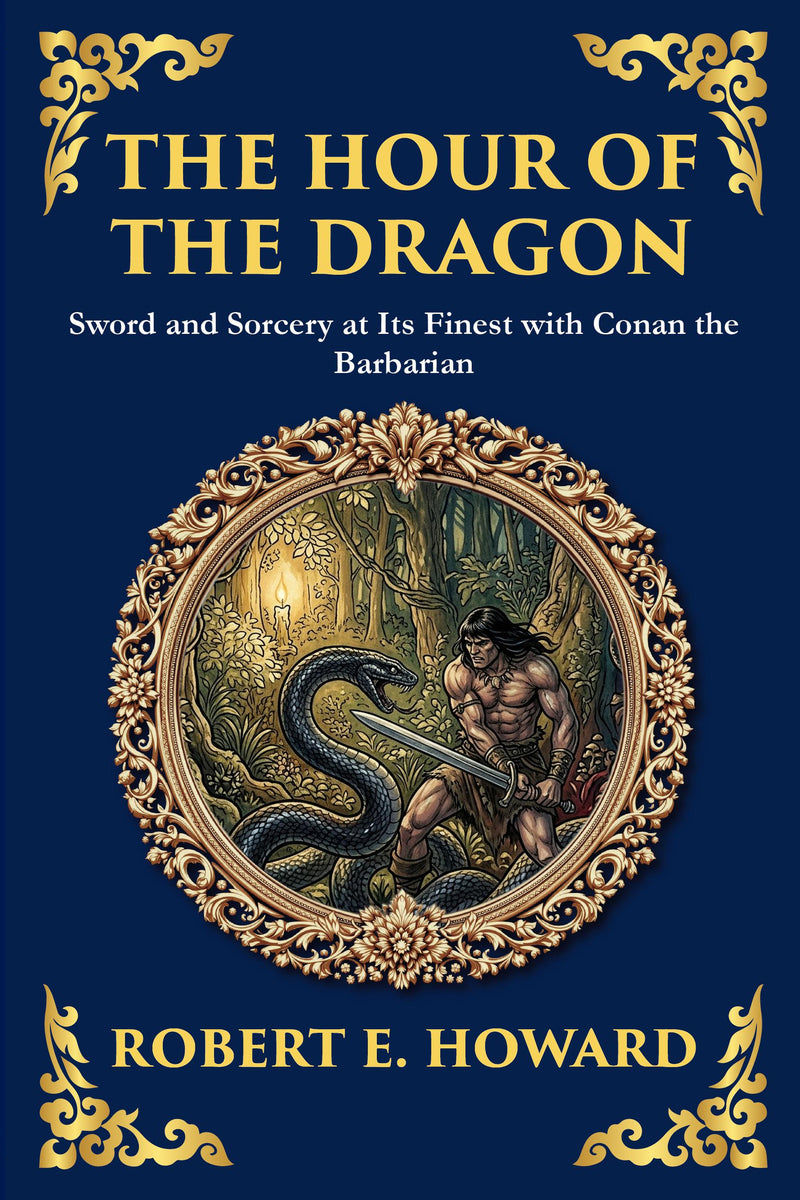
The Hour of the Dragon
Conan the Barbarian returns—not merely as a wandering sword-for-hire, but as a dethroned king fighting to reclaim his realm.
or free app
10,000+ hrs library
30-day guarantee
The complete The Hour of the Dragon appears in modern English through Library of Alexandria Press, available online with audiobook narration included for members.
Have you ever wondered why some kings rise not by birthright, but by blade? The Hour of the Dragon is Robert E. Howard’s sweeping masterpiece of fantasy and fury, the only full-length novel to feature Conan the Barbarian—arguably the most iconic hero in sword- and-sorcery history. In this spellbinding tale, Conan is no longer a lone wanderer or mercenary; he is King of Aquilonia, betrayed and cast down by a conspiracy rooted in ancient sorcery.
As a long-dead wizard named Xaltotun is resurrected to serve the ambitions of Conan’s enemies, the fate of kingdoms hangs by a thread. With his throne stolen, Conan embarks on a desperate quest across deserts, tombs, and hostile empires to find the Heart of Ahriman—a legendary jewel with the power to shatter the black magic that binds his foes. This is not just a tale of war and magic—it’s a testament to the indomitable will of a warrior who bows to no man or god.
What you’ll discover in this modern edition
- The Return of Conan the King Witness the legendary barbarian rise to fight for his stolen throne, facing both steel and sorcery.
| Formats | eBook (EPUB + PDF) · Audiobook · Paperback · Hardcover · Large Print |
| Language | English |
| Trim size (print) | 6 × 9 in |
| Binding | Paperback — perfect-bound · Hardcover — casewrap |
| Large Print edition | Same text in a larger, easy-read type — a larger font, not a larger trim |
| Print pricing | Every physical book at our true cost — at-cost, no profit (members) |
| Library | 873 restored titles, always growing |
| Length | 73,588 words · ~4 hr 54 min reading |
| Reading level | Grade 7 · an easy, flowing read (this modern-English edition) |
| Edition | Modern English translation · 2026 |
Member reviews for this edition are collected as readers finish it — be the first. Across the library: 12,000+ books shipped, every plan covered by a 365-day print guarantee.
About this edition
A faithful, unabridged modern-English edition by The Library of Alexandria — carefully rendered for today's reader and verified paragraph-by-paragraph against the public-domain source. Available as eBook, audiobook, paperback, hardcover, and large print.
- Complete & unabridgedVerified paragraph by paragraph against the source — never a scan, never abridged.
- Modern English, faithfulReadable today, with the author’s meaning kept intact. Readable — not simplified.
- Every format, one membershipRead in your browser or the free app, or listen to the full audiobook.
Included free with your membership
Cancel anytime, one click · 30-day money-back guarantee
Edition last updated July 2026
What’s inside
The Hour of the Dragon — complete and unabridged: all 23 sections included with membership, plus the full audiobook.
Begin reading The Hour of the Dragon
In clear modern English — the complete text is included with membership.
Introduction
There are stories that entertain, and there are stories that endure. The Hour of the Dragon belongs unmistakably to the second category. First serialized in the legendary pulp magazine Weird Tales in 1935 and 1936, this remains the only full-length novel that Robert E. Howard ever wrote featuring his most famous creation—a brooding, iron-thewed wanderer whose name has long since outgrown the printed page to become a fixture of global popular culture. To open this book is to step into the very fountainhead of an entire literary tradition: the genre we now call sword and sorcery, a phrase coined years after Howard’s death to describe precisely the kind of breathless, blood-quickening adventure he perfected. You are about to read not an imitation, not a tribute, but the genuine article, the source from which countless rivers of fantasy fiction, film, comics, and games have flowed.
Yet to call this merely “the original” risks underselling it. For all the warriors and wizards who have followed in its wake, few works have matched the raw vitality of Howard’s prose, the relentless momentum of his storytelling, or the strange, melancholy grandeur that haunts his imagined world. This is a tale of kings dethroned and crowns reclaimed, of ancient evils stirred from millennia of sleep, of treachery in marble halls and desperate flight through haunted nights. It moves with the speed of a charging cavalry and strikes with the force of a broadsword, but beneath its surface of relentless action lies a surprisingly thoughtful meditation on power, identity, mortality, and the thin, fragile membrane that separates civilization from the darkness it has always feared. Howard was a far more sophisticated writer than the lurid covers of the pulp magazines ever suggested, and this novel is perhaps the fullest expression of his particular genius.
This edition presents the work in a modern translation, carefully adapted for the contemporary reader. A word about what that means is in order, for it speaks to the spirit in which this book has been prepared and the experience that awaits you. Howard wrote in the idiom of his own time, in a dense, ornate, sometimes archaic register that was characteristic of the pulp era and that occasionally placed barriers between his thunderous narrative and the reader who simply wished to be swept along by it. The aim of this adaptation has been to honor the author’s voice—its muscular rhythms, its sweeping atmosphere, its gift for the unforgettable image—while gently clearing away those obstacles that might otherwise slow or confuse a reader nearly a century removed from the original publication. The intent is not to sanitize or simplify, but to illuminate; not to replace Howard’s vision with our own, but to let that vision shine through to a new generation as vividly as it once shone for the readers who first devoured it by lamplight. What you hold is meant to be read with pleasure and ease, the pages turning almost of their own accord, the story carrying you forward exactly as its author always intended.
To fully appreciate what unfolds in these pages, it helps to understand the extraordinary stage upon which Howard set his hero’s exploits. The events of this novel take place in what Howard called the Hyborian Age, a vast, invented prehistory that he placed in the dim gulf of time between the sinking of the legendary Atlantis and the dawn of recorded human history. This was a stroke of imaginative brilliance, and it remains one of Howard’s most influential contributions to fantasy. Rather than inventing a wholly separate universe with its own physical laws, as so many later fantasists would do, Howard imagined a forgotten chapter of our own world’s past—an age of warring kingdoms, crumbling empires, and sorcerous menace that supposedly preceded all the civilizations we know from the history books. The kingdoms he conjured—Aquilonia, Nemedia, Stygia, Zingara, and many more—carry the resonant echoes of real ancient cultures, half-familiar and half-strange, like names half-remembered from a dream.
This setting gives Howard’s work a peculiar and powerful flavor. It feels at once mythic and grounded, fantastical and oddly plausible. There is a weight of ages here, a sense that these glittering cities rise upon the ruins of older cities, themselves built upon ruins older still, stretching back into unfathomable antiquity. Howard had a deep, almost obsessive fascination with the rise and fall of civilizations, with the way that proud empires crumble into dust and forgotten races leave behind only their tombs and their curses. That fascination pulses through every chapter of this book. The threat that drives the story is not merely a wicked man or a marauding army, but something far older—a force out of the deep past, reaching its cold hand into the present to reclaim what time had buried. In Howard’s vision, the past is never truly dead; it merely sleeps, and woe to those who wake it.
Against this backdrop strides the protagonist, whose name needs no introduction to most modern readers, so thoroughly has he entered the common imagination. But it is worth setting aside whatever images you may have absorbed from films and adaptations, for the figure Howard created on the page is richer and more complex than his popular reputation suggests. Far from being a mere muscle-bound brute, he is a man of keen intelligence, hard-won wisdom, fierce loyalties, and a code of honor all his own. By the time of the events recounted here, he is no longer the youthful adventurer of Howard’s earlier tales—the thief, the mercenary, the pirate, the wandering soldier of fortune. He has risen to the highest station a man of his world can attain, and with that elevation has come responsibility, weariness, and the particular loneliness of command.
This maturity gives the novel an emotional depth that distinguishes it from many of the shorter adventures. Here is a man who has clawed his way to the summit of human ambition through sheer will and savage capability, only to discover that the summit is a cold and precarious place. He is surrounded by softer men who do not understand him, civilized men whose refinement masks a treachery far more poisonous than anything found among the barbarians he once ran with. There is, running through the whole of the book, a deep and characteristically Howardian skepticism about civilization itself—a suspicion that beneath the silks and the courtly manners lurks a corruption far more dangerous than the honest brutality of the wilderness. This theme, woven through so much of Howard’s work, finds its most extended treatment here, and it lends the swashbuckling adventure a philosophical undertow that rewards the attentive reader.
What makes the hero so compelling is precisely this tension between the wild man and the world he has come to rule. He carries the instincts of the wilderness into the gilded chambers of power, and those instincts—his refusal to despair, his animal vitality, his readiness to fight and flee and fight again—prove to be exactly the qualities that the soft men of civilization lack. When catastrophe strikes, when everything is stripped from him, it is the barbarian in him that endures, that adapts, that refuses to lie down and die. There is something profoundly inspiring in this, something that explains why the character has resonated with readers for nearly a century. He embodies a fantasy of self-reliance and indomitable will, of the individual who bends to no system and bows to no master, who carves his own destiny with his own two hands and the edge of his own blade.
To read this novel without knowing something of the man who wrote it is to miss half its poignancy. Robert E. Howard was born in 1906 in rural Texas, the son of a traveling country doctor, and he spent nearly his entire life in the small town of Cross Plains, a remote and dusty place far removed from the literary capitals of the world. From this unlikely setting, working largely in isolation, he produced one of the most influential bodies of work in twentieth-century popular fiction. He was a man of contradictions: physically powerful, a devoted bodybuilder who taught himself to box and wrestle, yet also a voracious reader, a poet of genuine gift, and a sensitive soul prone to brooding and melancholy. He earned his living by the typewriter at a time when professional writing meant churning out stories for the pulp magazines at a penny or two per word, racing against deadlines and the perpetual threat of poverty.
It is one of the great tragedies of American letters that Howard’s life was so brief. He died in 1936, by his own hand, at the age of thirty, just as this very novel was reaching its readers in the pages of Weird Tales. He never knew the extent of the influence he would come to have, never saw his creation become a household name, never witnessed the explosion of the genre he had done so much to invent. He wrote in obscurity and died in obscurity, and only in the decades after his death did the full magnitude of his achievement become apparent. There is something almost unbearably moving in the thought that a young man in a small Texas town, writing for survival in a despised commercial form, should have created characters and worlds that would outlast the work of countless more respectable and celebrated authors of his day.
What was the secret of his power? Part of it lay in his extraordinary visual imagination. Howard saw his scenes with cinematic clarity, and he rendered them with a vividness that leaps off the page. A torch-lit dungeon, a moonlit battlefield strewn with the dead, a galley plunging through a storm-wracked sea, a tomb sealed for three thousand years—Howard could conjure these images with a few bold strokes, and they lodge themselves in the reader’s mind with the permanence of memory. He had, too, an unerring instinct for pace. He understood, as few writers have, the music of action—when to accelerate and when to pause, how to build dread before a confrontation and how to release it in a sudden eruption of violence. Reading him is a visceral experience; the prose seems to quicken the pulse and tighten the muscles.
But there was more to Howard than spectacle. He was, at his best, a poet of mood, capable of evoking a brooding atmosphere of cosmic melancholy that rivals the work of his friend and correspondent H. P. Lovecraft, with whom he exchanged many letters debating the relative virtues of barbarism and civilization. Howard’s world is shadowed by a sense of doom, by the awareness that all things pass, that all glory fades, that the proudest kings will one day be dust and their cities sand. This elegiac quality runs beneath the surface of even his most rollicking adventures, lending them an unexpected gravity. The hero of this novel is, for all his vitality, a man acutely aware of his own mortality, a man who has seen too much death not to feel the cold breath of it at his own back. When Howard’s barbarian reflects, as he occasionally does, on the strangeness of fate and the vanity of human striving, we hear the voice of the author himself, that lonely young man in Cross Plains who understood far better than most the brevity and uncertainty of life.
It is precisely this blend of qualities—the headlong action and the underlying melancholy, the savage energy and the philosophical depth, the lurid color and the genuine craft—that has kept Howard’s work alive while so much pulp fiction of his era has been justly forgotten. He took a disreputable form and, by the sheer force of his talent and conviction, made of it something that approaches art. The genre of sword and sorcery, which has since produced countless authors and sold untold millions of books, descends in a direct and unbroken line from the stories Howard wrote in the brief decade of his career. Writers as varied and accomplished as Fritz Leiber, Michael Moorcock, and many of the architects of modern fantasy gaming have acknowledged their debt to him. To read this novel, then, is to encounter the source, to drink from the spring before it became a river. And like many sources, it possesses a clarity and a purity that the later, broader streams have sometimes lost.
Cancel anytime, one click · 30-day money-back guarantee
Founding annual rate available now — your price locks for life when you join.
Not ready? Get this free chapter by email — read it anytime.
✓ Sent — check your inbox for The Hour of the Dragon.
Questions about The Hour of the Dragon
What is The Hour of the Dragon about?
Conan the Barbarian returns—not merely as a wandering sword-for-hire, but as a dethroned king fighting to reclaim his realm. The Hour of the Dragon is Robert E. Howard’s only full-length Conan novel and the definitive epic of high adventure, black sorcery, and raw heroism. When ancient evil rises from the grave, armies fall under dark enchantments and tyrants claw their way to power.
Who wrote The Hour of the Dragon?
The Hour of the Dragon was written by Robert E. Howard. This edition presents the complete work in clear modern English, faithfully rendered from the public-domain original by Library of Alexandria Press.
Is The Hour of the Dragon free to read?
The opening chapter is free to read on this page. Members read and listen to the complete work — and the entire library — free, and can order any physical book at our true print cost.
How long is The Hour of the Dragon?
23 chapters (~73,588 words) — about 4 hr 54 min of reading in this modern-English edition.
Is this an abridged version of The Hour of the Dragon?
No. This is the complete, unabridged The Hour of the Dragon, carefully rendered into clear modern English and verified paragraph-by-paragraph against the public-domain source — nothing is cut or summarised.
What formats does The Hour of the Dragon come in?
The Hour of the Dragon is available as eBook, paperback, hardcover and large print. eBook and audiobook are included with membership; printed editions ship at our true print cost.
Shipping & returns
Billing & membership
More from the library


Explore Adventure
- Tarzan of the Apes · Edgar Rice Burroughs
- The Wonderful Wizard of Oz · L. Frank Baum
- Peter Pan · J. M. Barrie
- Moby Dick; Or, The Whale · Herman Melville
- The Riddle of the Sands · Erskine Childers
- The Loss of the Swansea: A Story of the Florida Coast · W. L. Alden
- Sky Island · L. Frank Baum
- Vikram and the Vampire: Classic Hindu Tales of Adventure, Magic, and Romance · Unknown
- Tales of Unrest · Joseph Conrad
- The Tomb of Ts’in · Edgar Wallace
- Skinny McCord · Percy Keese Fitzhugh
- The Men of the Moss-Hags · S. R. Crockett
- The Hunniwell Boys and the Platinum Mystery · L. P. Wyman
- Allan Quatermain · H. Rider Haggard
- She · H. Rider Haggard
- Medical Life in the Navy · Gordon Stables
- The Thirty-Nine Steps · John Buchan
- The Story of Doctor Dolittle · Hugh Lofting
- The Princess and the Goblin · George MacDonald
- The Man Who Would Be King · Rudyard Kipling
- Lucian’s True History · Lucian of Samosata
- The Secret Adversary · Agatha Christie
- Lord Jim · Joseph Conrad
- The Marvelous Land of Oz · L. Frank Baum
- The Virginian: A Horseman of the Plains · Owen Wister
- Mars is My Destination · Frank Belknap Long
- Anabasis · Xenophon
- The Mississippi Saucer · Frank Belknap Long
- Sabotage in Space · Carey Rockwell
- Brood of the Dark Moon · Charles Willard Diffin
The Hour of the Dragon
The Hour of the Dragon
Sword and Sorcery at Its Finest with Conan the Barbarian
Robert E. Howard
Contents
- Introduction
- Chapter 1
- Chapter 2
- Chapter 3
- Chapter 4
- Chapter 5
- Chapter 6
- Chapter 7
- Chapter 8
- Chapter 9
- Chapter 10
- Chapter 11
- Chapter 12
- Chapter 13
- Chapter 14
- Chapter 15
- Chapter 16
- Chapter 17
- Chapter 18
- Chapter 19
- Chapter 20
- Chapter 21
- Chapter 22
Introduction
There are stories that entertain, and there are stories that endure. The Hour of the Dragon belongs unmistakably to the second category. First serialized in the legendary pulp magazine Weird Tales in 1935 and 1936, this remains the only full-length novel that Robert E. Howard ever wrote featuring his most famous creation—a brooding, iron-thewed wanderer whose name has long since outgrown the printed page to become a fixture of global popular culture. To open this book is to step into the very fountainhead of an entire literary tradition: the genre we now call sword and sorcery, a phrase coined years after Howard’s death to describe precisely the kind of breathless, blood-quickening adventure he perfected. You are about to read not an imitation, not a tribute, but the genuine article, the source from which countless rivers of fantasy fiction, film, comics, and games have flowed.
Yet to call this merely “the original” risks underselling it. For all the warriors and wizards who have followed in its wake, few works have matched the raw vitality of Howard’s prose, the relentless momentum of his storytelling, or the strange, melancholy grandeur that haunts his imagined world. This is a tale of kings dethroned and crowns reclaimed, of ancient evils stirred from millennia of sleep, of treachery in marble halls and desperate flight through haunted nights. It moves with the speed of a charging cavalry and strikes with the force of a broadsword, but beneath its surface of relentless action lies a surprisingly thoughtful meditation on power, identity, mortality, and the thin, fragile membrane that separates civilization from the darkness it has always feared. Howard was a far more sophisticated writer than the lurid covers of the pulp magazines ever suggested, and this novel is perhaps the fullest expression of his particular genius.
This edition presents the work in a modern translation, carefully adapted for the contemporary reader. A word about what that means is in order, for it speaks to the spirit in which this book has been prepared and the experience that awaits you. Howard wrote in the idiom of his own time, in a dense, ornate, sometimes archaic register that was characteristic of the pulp era and that occasionally placed barriers between his thunderous narrative and the reader who simply wished to be swept along by it. The aim of this adaptation has been to honor the author’s voice—its muscular rhythms, its sweeping atmosphere, its gift for the unforgettable image—while gently clearing away those obstacles that might otherwise slow or confuse a reader nearly a century removed from the original publication. The intent is not to sanitize or simplify, but to illuminate; not to replace Howard’s vision with our own, but to let that vision shine through to a new generation as vividly as it once shone for the readers who first devoured it by lamplight. What you hold is meant to be read with pleasure and ease, the pages turning almost of their own accord, the story carrying you forward exactly as its author always intended.
To fully appreciate what unfolds in these pages, it helps to understand the extraordinary stage upon which Howard set his hero’s exploits. The events of this novel take place in what Howard called the Hyborian Age, a vast, invented prehistory that he placed in the dim gulf of time between the sinking of the legendary Atlantis and the dawn of recorded human history. This was a stroke of imaginative brilliance, and it remains one of Howard’s most influential contributions to fantasy. Rather than inventing a wholly separate universe with its own physical laws, as so many later fantasists would do, Howard imagined a forgotten chapter of our own world’s past—an age of warring kingdoms, crumbling empires, and sorcerous menace that supposedly preceded all the civilizations we know from the history books. The kingdoms he conjured—Aquilonia, Nemedia, Stygia, Zingara, and many more—carry the resonant echoes of real ancient cultures, half-familiar and half-strange, like names half-remembered from a dream.
This setting gives Howard’s work a peculiar and powerful flavor. It feels at once mythic and grounded, fantastical and oddly plausible. There is a weight of ages here, a sense that these glittering cities rise upon the ruins of older cities, themselves built upon ruins older still, stretching back into unfathomable antiquity. Howard had a deep, almost obsessive fascination with the rise and fall of civilizations, with the way that proud empires crumble into dust and forgotten races leave behind only their tombs and their curses. That fascination pulses through every chapter of this book. The threat that drives the story is not merely a wicked man or a marauding army, but something far older—a force out of the deep past, reaching its cold hand into the present to reclaim what time had buried. In Howard’s vision, the past is never truly dead; it merely sleeps, and woe to those who wake it.
Against this backdrop strides the protagonist, whose name needs no introduction to most modern readers, so thoroughly has he entered the common imagination. But it is worth setting aside whatever images you may have absorbed from films and adaptations, for the figure Howard created on the page is richer and more complex than his popular reputation suggests. Far from being a mere muscle-bound brute, he is a man of keen intelligence, hard-won wisdom, fierce loyalties, and a code of honor all his own. By the time of the events recounted here, he is no longer the youthful adventurer of Howard’s earlier tales—the thief, the mercenary, the pirate, the wandering soldier of fortune. He has risen to the highest station a man of his world can attain, and with that elevation has come responsibility, weariness, and the particular loneliness of command.
This maturity gives the novel an emotional depth that distinguishes it from many of the shorter adventures. Here is a man who has clawed his way to the summit of human ambition through sheer will and savage capability, only to discover that the summit is a cold and precarious place. He is surrounded by softer men who do not understand him, civilized men whose refinement masks a treachery far more poisonous than anything found among the barbarians he once ran with. There is, running through the whole of the book, a deep and characteristically Howardian skepticism about civilization itself—a suspicion that beneath the silks and the courtly manners lurks a corruption far more dangerous than the honest brutality of the wilderness. This theme, woven through so much of Howard’s work, finds its most extended treatment here, and it lends the swashbuckling adventure a philosophical undertow that rewards the attentive reader.
What makes the hero so compelling is precisely this tension between the wild man and the world he has come to rule. He carries the instincts of the wilderness into the gilded chambers of power, and those instincts—his refusal to despair, his animal vitality, his readiness to fight and flee and fight again—prove to be exactly the qualities that the soft men of civilization lack. When catastrophe strikes, when everything is stripped from him, it is the barbarian in him that endures, that adapts, that refuses to lie down and die. There is something profoundly inspiring in this, something that explains why the character has resonated with readers for nearly a century. He embodies a fantasy of self-reliance and indomitable will, of the individual who bends to no system and bows to no master, who carves his own destiny with his own two hands and the edge of his own blade.
To read this novel without knowing something of the man who wrote it is to miss half its poignancy. Robert E. Howard was born in 1906 in rural Texas, the son of a traveling country doctor, and he spent nearly his entire life in the small town of Cross Plains, a remote and dusty place far removed from the literary capitals of the world. From this unlikely setting, working largely in isolation, he produced one of the most influential bodies of work in twentieth-century popular fiction. He was a man of contradictions: physically powerful, a devoted bodybuilder who taught himself to box and wrestle, yet also a voracious reader, a poet of genuine gift, and a sensitive soul prone to brooding and melancholy. He earned his living by the typewriter at a time when professional writing meant churning out stories for the pulp magazines at a penny or two per word, racing against deadlines and the perpetual threat of poverty.
It is one of the great tragedies of American letters that Howard’s life was so brief. He died in 1936, by his own hand, at the age of thirty, just as this very novel was reaching its readers in the pages of Weird Tales. He never knew the extent of the influence he would come to have, never saw his creation become a household name, never witnessed the explosion of the genre he had done so much to invent. He wrote in obscurity and died in obscurity, and only in the decades after his death did the full magnitude of his achievement become apparent. There is something almost unbearably moving in the thought that a young man in a small Texas town, writing for survival in a despised commercial form, should have created characters and worlds that would outlast the work of countless more respectable and celebrated authors of his day.
What was the secret of his power? Part of it lay in his extraordinary visual imagination. Howard saw his scenes with cinematic clarity, and he rendered them with a vividness that leaps off the page. A torch-lit dungeon, a moonlit battlefield strewn with the dead, a galley plunging through a storm-wracked sea, a tomb sealed for three thousand years—Howard could conjure these images with a few bold strokes, and they lodge themselves in the reader’s mind with the permanence of memory. He had, too, an unerring instinct for pace. He understood, as few writers have, the music of action—when to accelerate and when to pause, how to build dread before a confrontation and how to release it in a sudden eruption of violence. Reading him is a visceral experience; the prose seems to quicken the pulse and tighten the muscles.
But there was more to Howard than spectacle. He was, at his best, a poet of mood, capable of evoking a brooding atmosphere of cosmic melancholy that rivals the work of his friend and correspondent H. P. Lovecraft, with whom he exchanged many letters debating the relative virtues of barbarism and civilization. Howard’s world is shadowed by a sense of doom, by the awareness that all things pass, that all glory fades, that the proudest kings will one day be dust and their cities sand. This elegiac quality runs beneath the surface of even his most rollicking adventures, lending them an unexpected gravity. The hero of this novel is, for all his vitality, a man acutely aware of his own mortality, a man who has seen too much death not to feel the cold breath of it at his own back. When Howard’s barbarian reflects, as he occasionally does, on the strangeness of fate and the vanity of human striving, we hear the voice of the author himself, that lonely young man in Cross Plains who understood far better than most the brevity and uncertainty of life.
It is precisely this blend of qualities—the headlong action and the underlying melancholy, the savage energy and the philosophical depth, the lurid color and the genuine craft—that has kept Howard’s work alive while so much pulp fiction of his era has been justly forgotten. He took a disreputable form and, by the sheer force of his talent and conviction, made of it something that approaches art. The genre of sword and sorcery, which has since produced countless authors and sold untold millions of books, descends in a direct and unbroken line from the stories Howard wrote in the brief decade of his career. Writers as varied and accomplished as Fritz Leiber, Michael Moorcock, and many of the architects of modern fantasy gaming have acknowledged their debt to him. To read this novel, then, is to encounter the source, to drink from the spring before it became a river. And like many sources, it possesses a clarity and a purity that the later, broader streams have sometimes lost.
Long candles flickered, casting dancing black shadows across the walls, and the velvet tapestries rippled. Yet there was no breeze in the room. Four men stood around an ebony table holding a green sarcophagus that shimmered like carved jade. Each man held a strange black candle in his raised right hand, burning with an eerie green light. Outside, it was night, and a lonely wind moaned through the dark trees.
A tense silence filled the room, broken only by the shifting shadows. Four pairs of intense eyes were locked on the long green casket, where mysterious hieroglyphics seemed to writhe and move in the unsteady light. The man at the foot of the sarcophagus leaned over it, moving his candle as if he were writing a mystical symbol in the air. He set the candle back into its black-gold holder and, mumbling a formula his companions couldn’t understand, reached into his fur-trimmed robe. When he pulled his hand back out, it looked as if he were holding a ball of living fire in his palm.
The other three gasped. The dark, powerful man at the head of the sarcophagus whispered, “The Heart of Ahriman!” The other man quickly signaled for silence. Somewhere, a dog began to howl mournfully, and a stealthy footstep sounded outside the locked and bolted door. But no one looked away from the mummy-case. The man in the ermine-trimmed robe moved the flaming jewel over the body while muttering an incantation that predated the sinking of Atlantis. The gem’s glare dazzled them, making it hard to tell what they were seeing; then, with a splintering crash, the carved lid burst open as if pushed by an irresistible force from within. The four men leaned forward eagerly and saw the occupant—a shrunken, withered figure with dried brown limbs like dead wood poking through rotting bandages.
End of the free sample
Keep reading, free
Members read and listen to the complete book — and the entire library. Cancel anytime, one click · 30-day money-back guarantee.