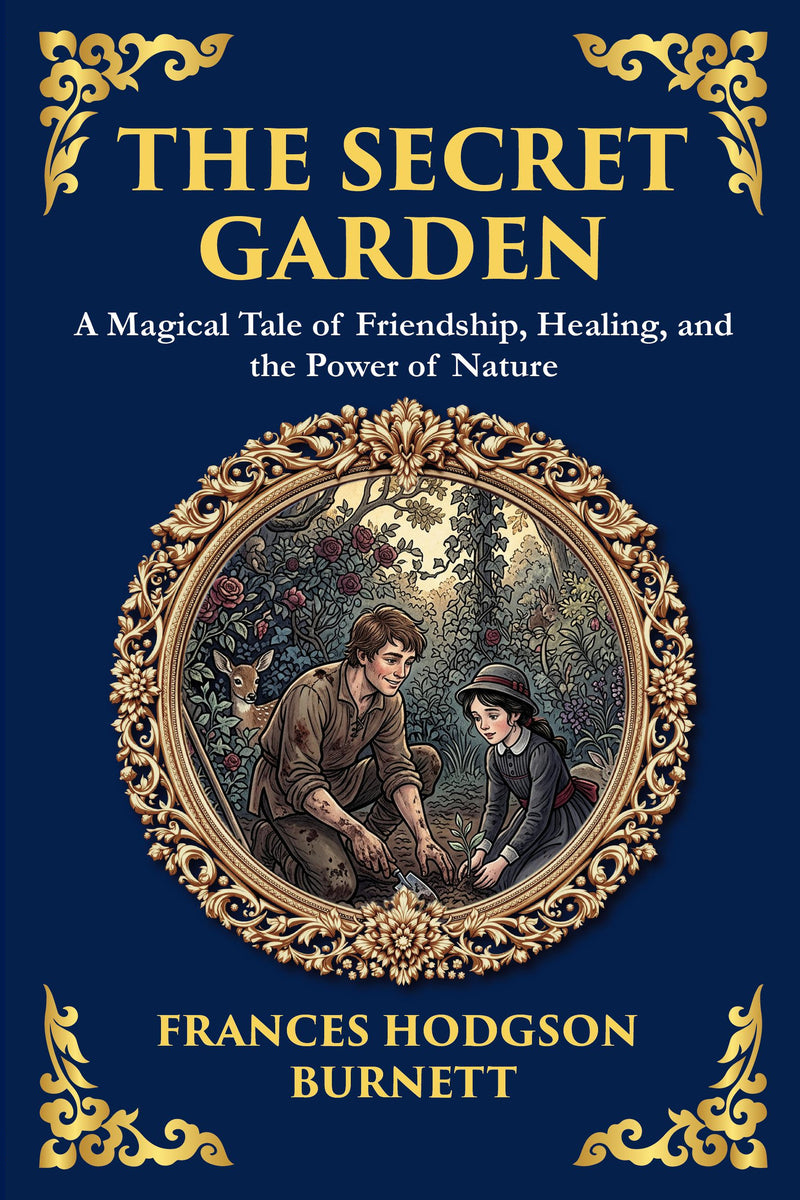
The Secret Garden
Behind the high walls of Misselthwaite Manor lies a garden that has been locked and forgotten —until a lonely orphan girl discovers the key.
or free app
10,000+ hrs library
30-day guarantee
The complete The Secret Garden appears in modern English through Library of Alexandria Press, available online with audiobook narration included for members.
Have you ever wondered why nature can heal wounds the heart cannot see? The Secret Garden is one of the most beloved novels in children’s and classic literature, treasured for its gentle message of renewal and its portrayal of the magical bond between nature and the human spirit. When spoiled and sullen Mary Lennox is sent from India to live with her uncle in the cold, gray Yorkshire moors, she finds herself isolated and unwanted.
But when she uncovers a long- forgotten walled garden, her life begins to change. With the help of new friends—a spirited boy named Dickon and her ailing cousin Colin—Mary begins to revive not only the neglected garden but also the joy and life buried deep within them all. This beautifully formatted edition presents a fresh, modern reading experience while preserving the original heart of Burnett’s storytelling.
It’s a book for all ages—whether you’re reading it for the first time or rediscovering its charm.
What you’ll discover in this modern edition
- A Story of Healing and Transformation – Follow Mary’s journey from bitterness to joy, mirroring the garden’s return to life.
- Nature as a Source of Magic – Discover how trees, flowers, and sunshine breathe hope into the lives of three children.
- Unforgettable Characters – Meet the wise and earthy Dickon, the once-bedridden Colin, and Mary, whose curiosity leads to rebirth.
- Themes of Friendship, Growth, and Renewal – A heartwarming portrayal of how love and care can mend what’s broken.
- A Captivating Setting – Lose yourself in the moors of Yorkshire and the mystery behind ivy-covered gates.
| Formats | eBook (EPUB + PDF) · Audiobook · Paperback · Hardcover · Large Print |
| Language | English |
| Trim size (print) | 6 × 9 in |
| Binding | Paperback — perfect-bound · Hardcover — casewrap |
| Large Print edition | Same text in a larger, easy-read type — a larger font, not a larger trim |
| Print pricing | Every physical book at our true cost — at-cost, no profit (members) |
| Library | 873 restored titles, always growing |
| Length | 76,962 words · ~5 hr 8 min reading |
| Reading level | Grade 6 · an easy, flowing read (this modern-English edition) |
| Edition | Modern English translation · 2026 |
Member reviews for this edition are collected as readers finish it — be the first. Across the library: 12,000+ books shipped, every plan covered by a 365-day print guarantee.
About this edition
A faithful, unabridged modern-English edition by The Library of Alexandria — carefully rendered for today's reader and verified paragraph-by-paragraph against the public-domain source. Available as eBook, audiobook, paperback, hardcover, and large print.
- Complete & unabridgedVerified paragraph by paragraph against the source — never a scan, never abridged.
- Modern English, faithfulReadable today, with the author’s meaning kept intact. Readable — not simplified.
- Every format, one membershipRead in your browser or the free app, or listen to the full audiobook.
Included free with your membership
Cancel anytime, one click · 30-day money-back guarantee
Edition last updated July 2026
What’s inside
The Secret Garden — complete and unabridged: all 28 sections included with membership, plus the full audiobook.
Begin reading The Secret Garden
In clear modern English — the complete text is included with membership.
Introduction
There are certain stories that seem to grow rather than to have been written, as if they sprang from some deep and living root in the human imagination and unfurled, leaf by leaf, into the light. This is one of them. For more than a century it has been pressed into the hands of children and adults alike, read aloud at bedsides, carried in coat pockets, dog-eared and underlined and returned to again and again across the long arc of a lifetime. It is a book that people remember not merely as a sequence of events but as a feeling—a green and secret hush, the creak of an old door swinging open, the first warm wind of spring after a hard winter. To open these pages is to step through a wall and into a place that has been waiting, quietly and patiently, for someone to find it.
This particular edition offers the story in a modern translation, gently adapted for the contemporary reader. That phrase deserves a word of explanation, because it touches on something delicate. When a book has lived as long as this one has, its original language can begin to acquire a patina—lovely in places, but occasionally obscuring. The dialect spoken by certain characters, rendered phonetically and at length, was once a source of charm and texture, but for many readers today it can become a thicket through which the meaning struggles to pass. Sentence structures that flowed easily a hundred years ago can now feel labored, and certain turns of phrase have drifted so far from common use that they trip the eye and break the spell. What this adaptation seeks to do is not to replace the author’s voice but to clear the path to it—to wipe the fog from the window so that the garden beyond can be seen as vividly as it was always meant to be seen.
Nothing essential has been lost in this process. The heart of the story beats exactly as it always did. The themes that have made it endure—the slow, almost miraculous healing of damaged hearts, the redemptive power of the natural world, the way friendship can coax life out of barren ground—remain wholly intact, perhaps even clarified. What you hold is an invitation rather than a substitution: an open door for the reader who might otherwise have hesitated at the threshold, and a fresh experience even for those who have walked this path many times before.
To understand why this book carries such an extraordinary emotional charge, it helps to know a little about the woman who wrote it and the life she had lived by the time she sat down to do so. Frances Hodgson Burnett was born in Manchester, England, in 1849, into a family of comfortable circumstances that fell into hardship after the early death of her father. The textile business that had sustained them faltered, and the family’s fortunes declined steadily through her childhood. When she was sixteen, they emigrated to the United States, settling near Knoxville, Tennessee, in conditions far humbler than those into which she had been born. This early experience of dramatic reversal—of having and then losing, of a refined world giving way to a rougher one—left its mark on everything she wrote. She understood from the inside what it meant to be uprooted, to be a child set down in an unfamiliar landscape and expected to make her way.
Burnett began publishing stories as a teenager, partly to help support her family, and she possessed from the start an unusual gift for understanding the inner lives of children—their loneliness, their fierce pride, their capacity for both cruelty and astonishing tenderness. She became one of the most successful and celebrated authors of her era on both sides of the Atlantic, a transatlantic literary figure who moved between England and America throughout her life. Her earlier triumph, the story of a little boy who unexpectedly inherits an English title, had made her famous and wealthy, but it was the work of her later years, written when she was in her sixties, that would prove the most enduring.
By the time she came to write this novel, Burnett had suffered the kind of grief that reshapes a person entirely. Her elder son had died in his teens, a loss from which she never fully recovered and which sent her searching, restlessly, for some philosophy or faith that could make sense of suffering. She explored various spiritual movements of her time, all of them concerned in one way or another with the relationship between the mind, the body, and the unseen forces of life. She became fascinated by the idea that thoughts themselves could shape health and happiness, that what one chose to dwell upon could either poison or heal. These convictions are woven into the very fabric of the story you are about to read, not as a heavy-handed sermon but as something felt rather than stated—a quiet, persistent belief that the world contains a vast generative power, available to anyone willing to put their hands in the soil and pay attention.
There is one more biographical detail worth knowing, because it grounds the story in a real place. Burnett spent several years living at a manor house in Kent, England, where she rented an old walled garden. She threw herself into its cultivation with passionate devotion, and it became for her a sanctuary, a place of work and contemplation and, ultimately, of recovery from her sorrows. She wrote about that garden as though it were a person, a companion who asked nothing and gave everything. When you read the descriptions of growing things in these pages—the way she notices the first green spears pushing through dark earth, the riot of roses gone wild, the particular hush of a place enclosed by walls—you are reading the testimony of someone who knew these things firsthand, who had knelt in the dirt and felt something heal inside her as she worked. This is not a writer imagining a garden. This is a writer remembering one, and offering it to us as the most precious gift she had.
It would be easy to describe this as a simple story for children, and in one sense it is: it can be read and loved by a child of nine or ten without any difficulty, and it has been, by generations of them. But to leave it there would be to badly underestimate the book. Beneath its accessible surface runs a current of psychological insight and moral seriousness that rewards the adult reader as fully as the young one, and arguably more so. This is a book about how human beings become what they are, and—more hopefully—about how they might become something different.
Consider the way the story begins. It does not flatter us with a charming, lovable protagonist whom we are meant to adore from the first page. On the contrary, it presents us with a child who is, by the narrator’s own frank admission, thoroughly disagreeable—sour, selfish, sickly, and unloved. Burnett takes a considerable risk here, and it is a measure of her artistry that it pays off so completely. She understood something that lesser writers miss: that we do not love characters because they are good, but because we watch them become good, because we are permitted to witness the slow and difficult labor of transformation. By beginning with a child no one likes, including herself, the author sets up the great central movement of the book, which is the movement from deadness to life, from coldness to warmth, from the clenched fist to the open hand.
And the brilliance of it is that this transformation is never achieved through lecture or punishment or the imposition of someone else’s will. It happens, instead, through ordinary contact with the world. Fresh air does its work. Plain food eaten after honest exercise does its work. The companionship of someone unpretentious and kind does its work. And above all, the act of caring for something living—of choosing to nurture rather than to take—does its work, slowly, almost imperceptibly, until one day the change is simply there, accomplished, like a flower that has bloomed overnight. The book’s deep wisdom is that healing is not an event but a process, not a miracle imposed from outside but a potential awakened from within. The garden does not save anyone. It simply provides the conditions in which people can begin to save themselves.
This is why the natural world is so much more than mere scenery in these pages. It functions as a living force, almost as a character in its own right, a presence that responds to attention and rewards devotion. There is a kind of theology in it, though never a doctrinaire one—a sense that the earth is endlessly generous, that it wants to grow, that life is straining at every moment to push through the smallest crack and the hardest ground. Burnett invites us to see that the same generative power at work in a seed is at work in a human soul, and that the conditions which make one flourish—warmth, attention, patience, the willingness to wait through the dark months—are the very same conditions that make the other flourish too. To tend a garden, in this book, is to learn how to tend a life.
The friendships at the center of the story carry this same weight and beauty. Burnett was deeply interested in the way that genuine connection can remake a person, and she draws her relationships with real subtlety. The bonds that form here are not sentimental or easy; they are forged through shared work, through quarrels and reconciliations, through the gradual lowering of defenses that have been built up over years of neglect and fear. There is a wonderful democratic spirit running through it all—a sense that what matters about a person has nothing to do with their station or their possessions, and everything to do with their kindness, their competence, their connection to real and useful things. The characters who possess the deepest wisdom in this book are not the wealthy or the educated, but those who know how to coax life from the ground and how to speak honestly to a creature, whether that creature has feathers, fur, or the form of a lonely child.
Readers who come to the story for the first time should know that it builds slowly, and that this slowness is one of its great virtues, not a flaw to be endured. We live now in a hurried age, accustomed to stories that grab us by the collar in the first sentence and never let go. This book asks something different of us. It asks us to settle, to quiet down, to attend to small things—the sound of the wind across the moor, the appearance of a particular bird, the discovery of a key half-buried in the earth. It rewards patience in the same way that gardening rewards patience: not with sudden explosions of excitement, but with the deep, accumulating satisfaction of watching something grow. If you allow yourself to fall into its rhythm, to slow your own pulse to the pulse of the seasons it describes, you will find that the story works on you the way the garden works on its characters—gradually, then all at once, until you realize that something inside you has shifted and warmed without your quite noticing how.
The setting deserves a particular note, because Burnett uses it with such mastery. The great brooding house on the edge of the windswept moor is one of the most atmospheric locations in all of literature—a place of locked rooms and long corridors, of secrets behind doors, of cries heard in the night that no one will explain. In the early portions of the book this atmosphere can feel almost gothic, heavy with mystery and a kind of melancholy enchantment. The genius of the structure is the way this oppressive interior world is set against the open, healing world of the outdoors. As the story moves from the shadowed corridors of the house toward the light and air of the garden, we feel the change as a physical relief, as though we ourselves have been let out of doors after a long confinement. The contrast is not accidental; it is the architecture of the entire book, the movement from enclosure to freedom, from secrecy to revelation, from a sickroom to a green and growing world.
It is worth saying, too, that the book treats childhood with a seriousness and respect that was rare in its time and remains rare now. Burnett does not condescend to children, nor does she sentimentalize them into little angels. She grants them their full complexity—their tempers, their fears, their occasional tyranny, their capacity for both selfishness and profound generosity. She takes their suffering seriously, and she takes their healing seriously too. Children in this book are not passive recipients of adult care; they are agents of their own transformation, capable of changing themselves and one another through their choices and their will. There is something deeply empowering in this, and it accounts for a good part of the book’s enduring appeal to young readers, who recognize in it a rare acknowledgment of their own inner lives and their own capacity for change.
Cancel anytime, one click · 30-day money-back guarantee
Founding annual rate available now — your price locks for life when you join.
Not ready? Get this free chapter by email — read it anytime.
✓ Sent — check your inbox for The Secret Garden.
Questions about The Secret Garden
What is The Secret Garden about?
Behind the high walls of Misselthwaite Manor lies a garden that has been locked and forgotten —until a lonely orphan girl discovers the key. As young Mary Lennox begins to tend the hidden garden, its magic slowly transforms not only the land, but also the hearts of those around her. The Secret Garden is a timeless classic about the healing power of nature, the strength of friendship, and the wonder of second chances.
Who wrote The Secret Garden?
The Secret Garden was written by Frances Hodgson Burnett. This edition presents the complete work in clear modern English, faithfully rendered from the public-domain original by Library of Alexandria Press.
Is The Secret Garden free to read?
The opening chapter is free to read on this page. Members read and listen to the complete work — and the entire library — free, and can order any physical book at our true print cost.
How long is The Secret Garden?
28 chapters (~76,962 words) — about 5 hr 8 min of reading in this modern-English edition.
Is this an abridged version of The Secret Garden?
No. This is the complete, unabridged The Secret Garden, carefully rendered into clear modern English and verified paragraph-by-paragraph against the public-domain source — nothing is cut or summarised.
What formats does The Secret Garden come in?
The Secret Garden is available as eBook, paperback, hardcover and large print. eBook and audiobook are included with membership; printed editions ship at our true print cost.
Shipping & returns
Billing & membership
More from the library


Explore Children's Classics
- Peter and Wendy · J. M. Barrie
- Jack and Jill · Louisa May Alcott
- The Wonderful Wizard of Oz · L. Frank Baum
- Anne of Green Gables · L. M. Montgomery
- The Tale of Peter Rabbit · Beatrix Potter
- Peter Pan · J. M. Barrie
- The Prince and the Pauper · Mark Twain
- The Red Fairy Book · Andrew Lang
- Old Christmas: from the Sketch Book of Washington Irving · Washington Irving
- A Houseful of Girls · Sarah Tytler
- In the hollow of His hand · Hesba Stretton
- Miss Primrose · Agnes Giberne
- Five Little Peppers and How They Grew · Margaret Sidney
- The Loss of the Swansea: A Story of the Florida Coast · W. L. Alden
- Sky Island · L. Frank Baum
- The Book of Dragons · E. Nesbit
- Wild Animals I Have Known · Ernest Thompson Seton
- Skinny McCord · Percy Keese Fitzhugh
- The Hunniwell Boys and the Platinum Mystery · L. P. Wyman
- Rainbow Valley · L. M. Montgomery
- "Us and Our Donkey" · Amy Le Feuvre
- Dorothy and the Wizard in Oz · L. Frank Baum
- The Home Book of Verse — Volume 4 · Burton Egbert Stevenson
- The Story of Doctor Dolittle · Hugh Lofting
- The Tale of Benjamin Bunny · Beatrix Potter
- Fifty Famous Stories Retold · James Baldwin
- Rilla of Ingleside · L. M. Montgomery
- The House at Pooh Corner · A. A. Milne
- Rich and Humble: A Story for Young People · Oliver Optic
- The Three Bears · A. E. Kennedy
The Secret Garden
The Secret Garden
A Magical Tale of Friendship, Healing, and the Power of Nature
Frances Hodgson Burnett
Contents
- Introduction
- Chapter 1
- Chapter 2
- Chapter 3
- Chapter 4
- Chapter 5
- Chapter 6
- Chapter 7
- Chapter 8
- Chapter 9
- Chapter 10
- Chapter 11
- Chapter 12
- Chapter 13
- Chapter 14
- Chapter 15
- Chapter 16
- Chapter 17
- Chapter 18
- Chapter 19
- Chapter 20
- Chapter 21
- Chapter 22
- Chapter 23
- Chapter 24
- Chapter 25
- Chapter 26
- Chapter 27
Introduction
There are certain stories that seem to grow rather than to have been written, as if they sprang from some deep and living root in the human imagination and unfurled, leaf by leaf, into the light. This is one of them. For more than a century it has been pressed into the hands of children and adults alike, read aloud at bedsides, carried in coat pockets, dog-eared and underlined and returned to again and again across the long arc of a lifetime. It is a book that people remember not merely as a sequence of events but as a feeling—a green and secret hush, the creak of an old door swinging open, the first warm wind of spring after a hard winter. To open these pages is to step through a wall and into a place that has been waiting, quietly and patiently, for someone to find it.
This particular edition offers the story in a modern translation, gently adapted for the contemporary reader. That phrase deserves a word of explanation, because it touches on something delicate. When a book has lived as long as this one has, its original language can begin to acquire a patina—lovely in places, but occasionally obscuring. The dialect spoken by certain characters, rendered phonetically and at length, was once a source of charm and texture, but for many readers today it can become a thicket through which the meaning struggles to pass. Sentence structures that flowed easily a hundred years ago can now feel labored, and certain turns of phrase have drifted so far from common use that they trip the eye and break the spell. What this adaptation seeks to do is not to replace the author’s voice but to clear the path to it—to wipe the fog from the window so that the garden beyond can be seen as vividly as it was always meant to be seen.
Nothing essential has been lost in this process. The heart of the story beats exactly as it always did. The themes that have made it endure—the slow, almost miraculous healing of damaged hearts, the redemptive power of the natural world, the way friendship can coax life out of barren ground—remain wholly intact, perhaps even clarified. What you hold is an invitation rather than a substitution: an open door for the reader who might otherwise have hesitated at the threshold, and a fresh experience even for those who have walked this path many times before.
To understand why this book carries such an extraordinary emotional charge, it helps to know a little about the woman who wrote it and the life she had lived by the time she sat down to do so. Frances Hodgson Burnett was born in Manchester, England, in 1849, into a family of comfortable circumstances that fell into hardship after the early death of her father. The textile business that had sustained them faltered, and the family’s fortunes declined steadily through her childhood. When she was sixteen, they emigrated to the United States, settling near Knoxville, Tennessee, in conditions far humbler than those into which she had been born. This early experience of dramatic reversal—of having and then losing, of a refined world giving way to a rougher one—left its mark on everything she wrote. She understood from the inside what it meant to be uprooted, to be a child set down in an unfamiliar landscape and expected to make her way.
Burnett began publishing stories as a teenager, partly to help support her family, and she possessed from the start an unusual gift for understanding the inner lives of children—their loneliness, their fierce pride, their capacity for both cruelty and astonishing tenderness. She became one of the most successful and celebrated authors of her era on both sides of the Atlantic, a transatlantic literary figure who moved between England and America throughout her life. Her earlier triumph, the story of a little boy who unexpectedly inherits an English title, had made her famous and wealthy, but it was the work of her later years, written when she was in her sixties, that would prove the most enduring.
By the time she came to write this novel, Burnett had suffered the kind of grief that reshapes a person entirely. Her elder son had died in his teens, a loss from which she never fully recovered and which sent her searching, restlessly, for some philosophy or faith that could make sense of suffering. She explored various spiritual movements of her time, all of them concerned in one way or another with the relationship between the mind, the body, and the unseen forces of life. She became fascinated by the idea that thoughts themselves could shape health and happiness, that what one chose to dwell upon could either poison or heal. These convictions are woven into the very fabric of the story you are about to read, not as a heavy-handed sermon but as something felt rather than stated—a quiet, persistent belief that the world contains a vast generative power, available to anyone willing to put their hands in the soil and pay attention.
There is one more biographical detail worth knowing, because it grounds the story in a real place. Burnett spent several years living at a manor house in Kent, England, where she rented an old walled garden. She threw herself into its cultivation with passionate devotion, and it became for her a sanctuary, a place of work and contemplation and, ultimately, of recovery from her sorrows. She wrote about that garden as though it were a person, a companion who asked nothing and gave everything. When you read the descriptions of growing things in these pages—the way she notices the first green spears pushing through dark earth, the riot of roses gone wild, the particular hush of a place enclosed by walls—you are reading the testimony of someone who knew these things firsthand, who had knelt in the dirt and felt something heal inside her as she worked. This is not a writer imagining a garden. This is a writer remembering one, and offering it to us as the most precious gift she had.
It would be easy to describe this as a simple story for children, and in one sense it is: it can be read and loved by a child of nine or ten without any difficulty, and it has been, by generations of them. But to leave it there would be to badly underestimate the book. Beneath its accessible surface runs a current of psychological insight and moral seriousness that rewards the adult reader as fully as the young one, and arguably more so. This is a book about how human beings become what they are, and—more hopefully—about how they might become something different.
Consider the way the story begins. It does not flatter us with a charming, lovable protagonist whom we are meant to adore from the first page. On the contrary, it presents us with a child who is, by the narrator’s own frank admission, thoroughly disagreeable—sour, selfish, sickly, and unloved. Burnett takes a considerable risk here, and it is a measure of her artistry that it pays off so completely. She understood something that lesser writers miss: that we do not love characters because they are good, but because we watch them become good, because we are permitted to witness the slow and difficult labor of transformation. By beginning with a child no one likes, including herself, the author sets up the great central movement of the book, which is the movement from deadness to life, from coldness to warmth, from the clenched fist to the open hand.
And the brilliance of it is that this transformation is never achieved through lecture or punishment or the imposition of someone else’s will. It happens, instead, through ordinary contact with the world. Fresh air does its work. Plain food eaten after honest exercise does its work. The companionship of someone unpretentious and kind does its work. And above all, the act of caring for something living—of choosing to nurture rather than to take—does its work, slowly, almost imperceptibly, until one day the change is simply there, accomplished, like a flower that has bloomed overnight. The book’s deep wisdom is that healing is not an event but a process, not a miracle imposed from outside but a potential awakened from within. The garden does not save anyone. It simply provides the conditions in which people can begin to save themselves.
This is why the natural world is so much more than mere scenery in these pages. It functions as a living force, almost as a character in its own right, a presence that responds to attention and rewards devotion. There is a kind of theology in it, though never a doctrinaire one—a sense that the earth is endlessly generous, that it wants to grow, that life is straining at every moment to push through the smallest crack and the hardest ground. Burnett invites us to see that the same generative power at work in a seed is at work in a human soul, and that the conditions which make one flourish—warmth, attention, patience, the willingness to wait through the dark months—are the very same conditions that make the other flourish too. To tend a garden, in this book, is to learn how to tend a life.
The friendships at the center of the story carry this same weight and beauty. Burnett was deeply interested in the way that genuine connection can remake a person, and she draws her relationships with real subtlety. The bonds that form here are not sentimental or easy; they are forged through shared work, through quarrels and reconciliations, through the gradual lowering of defenses that have been built up over years of neglect and fear. There is a wonderful democratic spirit running through it all—a sense that what matters about a person has nothing to do with their station or their possessions, and everything to do with their kindness, their competence, their connection to real and useful things. The characters who possess the deepest wisdom in this book are not the wealthy or the educated, but those who know how to coax life from the ground and how to speak honestly to a creature, whether that creature has feathers, fur, or the form of a lonely child.
Readers who come to the story for the first time should know that it builds slowly, and that this slowness is one of its great virtues, not a flaw to be endured. We live now in a hurried age, accustomed to stories that grab us by the collar in the first sentence and never let go. This book asks something different of us. It asks us to settle, to quiet down, to attend to small things—the sound of the wind across the moor, the appearance of a particular bird, the discovery of a key half-buried in the earth. It rewards patience in the same way that gardening rewards patience: not with sudden explosions of excitement, but with the deep, accumulating satisfaction of watching something grow. If you allow yourself to fall into its rhythm, to slow your own pulse to the pulse of the seasons it describes, you will find that the story works on you the way the garden works on its characters—gradually, then all at once, until you realize that something inside you has shifted and warmed without your quite noticing how.
The setting deserves a particular note, because Burnett uses it with such mastery. The great brooding house on the edge of the windswept moor is one of the most atmospheric locations in all of literature—a place of locked rooms and long corridors, of secrets behind doors, of cries heard in the night that no one will explain. In the early portions of the book this atmosphere can feel almost gothic, heavy with mystery and a kind of melancholy enchantment. The genius of the structure is the way this oppressive interior world is set against the open, healing world of the outdoors. As the story moves from the shadowed corridors of the house toward the light and air of the garden, we feel the change as a physical relief, as though we ourselves have been let out of doors after a long confinement. The contrast is not accidental; it is the architecture of the entire book, the movement from enclosure to freedom, from secrecy to revelation, from a sickroom to a green and growing world.
It is worth saying, too, that the book treats childhood with a seriousness and respect that was rare in its time and remains rare now. Burnett does not condescend to children, nor does she sentimentalize them into little angels. She grants them their full complexity—their tempers, their fears, their occasional tyranny, their capacity for both selfishness and profound generosity. She takes their suffering seriously, and she takes their healing seriously too. Children in this book are not passive recipients of adult care; they are agents of their own transformation, capable of changing themselves and one another through their choices and their will. There is something deeply empowering in this, and it accounts for a good part of the book’s enduring appeal to young readers, who recognize in it a rare acknowledgment of their own inner lives and their own capacity for change.
When Mary Lennox was sent to live with her uncle at Misselthwaite Manor, everyone said she was the most unpleasant-looking child they had ever seen. It was true, too. She had a thin face and a thin body, pale hair, and a sour expression. Her hair and skin were yellowish because she had been born in India and had always been sick with something. Her father worked for the English Government and was always busy and ill himself. Her mother was a great beauty who only cared about going to parties and hanging out with glamorous people. She hadn’t wanted a daughter at all, so when Mary was born, she handed her over to an Ayah. The nurse was made to understand that if she wanted to stay in the mistress’s good graces, she had to keep the child out of sight as much as possible.
Because of this, Mary was kept hidden away as a sickly, fretful baby, and she remained out of the way as a sickly, fretful toddler. She barely remembered seeing anyone other than her Ayah and the other local servants. Since they always obeyed her and let her have her way—knowing the mistress would be angry if the child’s crying disturbed her—Mary grew into a tyrannical, selfish little brat by the time she was six. The young English governess hired to teach her to read and write disliked her so much that she quit after three months. Every other governess who tried to take the job left even sooner. If Mary hadn’t actually wanted to learn how to read books, she probably would never have learned her alphabet at all.
One incredibly hot morning, when she was about nine years old, she woke up feeling very grumpy. She became even angrier when she saw that the servant standing by her bed wasn’t her Ayah.
End of the free sample
Keep reading, free
Members read and listen to the complete book — and the entire library. Cancel anytime, one click · 30-day money-back guarantee.