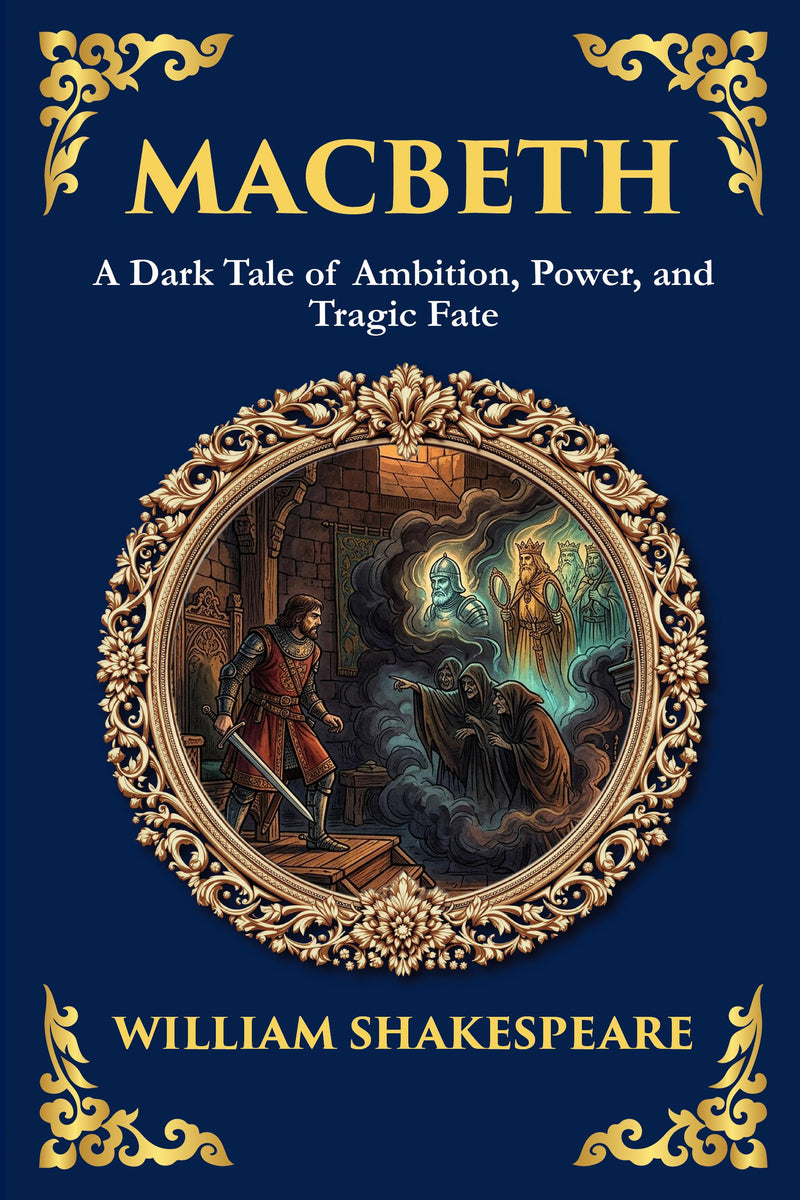
Macbeth
Driven by prophecy and consumed by a ruthless hunger for power, Macbeth, a once-noble Scottish general, descends into darkness.
or free app
10,000+ hrs library
30-day guarantee
The complete Macbeth appears in modern English through Library of Alexandria Press, available online with audiobook narration included for members.
Have you ever wondered why ambition can lead even the noblest hearts to ruin? Macbeth by William Shakespeare is a timeless tragedy that delves into the dark corridors of ambition, guilt, and destiny. Set in a brutal and atmospheric Scotland, this play follows Macbeth —a loyal warrior turned tyrant—whose thirst for power sets him on a path of murder, madness, and ruin.
Prompted by a prophetic encounter with three witches and manipulated by the seductive urgings of Lady Macbeth, he seizes the throne through bloodshed. But the crown comes at a terrible cost: paranoia, hallucinations, and a descent into chaos. Shakespeare’s language is vivid and poetic, rich with symbolism and psychological insight.
This edition offers a clean and modern presentation of the original text, suitable for new readers and seasoned scholars alike.
What you’ll discover in this modern edition
- A Chilling Psychological Portrait – Witness Macbeth’s inner torment as ambition twists his soul
- Lady Macbeth’s Downfall – Explore the haunting arc of one of literature’s most compelling female characters
- The Supernatural and the Unseen – Enter a world where witches whisper fate and ghosts demand justice
- The Cost of Power and Guilt – Examine how success without virtue leads to spiritual decay
- Themes of Fate, Free Will, and Moral Consequence – Challenge your understanding of choice and destiny
| Formats | eBook (EPUB + PDF) · Audiobook · Paperback · Hardcover · Large Print |
| Language | English |
| Trim size (print) | 6 × 9 in |
| Binding | Paperback — perfect-bound · Hardcover — casewrap |
| Large Print edition | Same text in a larger, easy-read type — a larger font, not a larger trim |
| Print pricing | Every physical book at our true cost — at-cost, no profit (members) |
| Library | 873 restored titles, always growing |
| Length | 14,900 words · ~1 hr 0 min reading |
| Reading level | Grade 8 · an easy, flowing read (this modern-English edition) |
| Edition | Modern English translation · 2026 |
Member reviews for this edition are collected as readers finish it — be the first. Across the library: 12,000+ books shipped, every plan covered by a 365-day print guarantee.
About this edition
A faithful, unabridged modern-English edition by The Library of Alexandria — carefully rendered for today's reader and verified paragraph-by-paragraph against the public-domain source. Available as eBook, audiobook, paperback, hardcover, and large print.
- Complete & unabridgedVerified paragraph by paragraph against the source — never a scan, never abridged.
- Modern English, faithfulReadable today, with the author’s meaning kept intact. Readable — not simplified.
- Every format, one membershipRead in your browser or the free app, or listen to the full audiobook.
Included free with your membership
Cancel anytime, one click · 30-day money-back guarantee
Edition last updated July 2026
What’s inside
Macbeth — complete and unabridged: all 30 sections included with membership, plus the full audiobook.
Begin reading Macbeth
In clear modern English — the complete text is included with membership.
Introduction
There are stories that entertain us, and there are stories that reach into something deeper — the secret chambers of the human heart where our most dangerous desires sleep, half-acknowledged, waiting for the right moment to wake. Macbeth belongs to the second kind. For more than four centuries, this play has held audiences and readers transfixed not because it shows us monsters, but because it shows us how an ordinary man — brave, admired, capable of greatness — can become a monster through a series of choices that feel, in the moment, almost reasonable. It is the shortest of Shakespeare’s tragedies, and also the swiftest, the darkest, and in many ways the most terrifying. There is no comic relief to lighten the mood for long, no extended subplot to slow the descent. Once the engine of ambition begins to turn, it does not stop, and we are carried with it into a night from which there is no easy return.
This edition presents Macbeth in a modern translation, adapted for the contemporary reader. That phrase deserves a moment of honest explanation, because what you hold is not a replacement for Shakespeare but a doorway into him. The original language of the play, written around 1606 for an audience that spoke and heard English very differently from the way we do today, is among the most magnificent ever composed in the language. It is also, for many modern readers, a genuine obstacle. The vocabulary has shifted; words that meant one thing then mean something else now, or nothing at all. Syntax that once flowed naturally to the ear can feel knotted and inverted on the page. Jokes have lost their punchlines, references have faded, and the sheer density of the imagery can leave even attentive readers feeling that they are wading through fog. The purpose of a modern translation is not to flatten the beauty of the work but to clear that fog — to let the story breathe, to let the characters speak in a way that lands immediately, so that the emotional and moral force of the play strikes you the way it struck its first audiences. The goal is comprehension in the service of feeling. When you understand what is being said the instant it is said, you are free to be moved by it.
Some readers may worry that a modernized version loses something essential. It is a fair concern, and it deserves a fair answer. Yes, certain musical qualities of Shakespeare’s verse are difficult to carry across into plainer language, and no adaptation can fully reproduce the hypnotic rhythm of the original at its greatest moments. But what survives — and what matters most — is the architecture of the drama: the relentless logic of the plot, the psychological complexity of the characters, the great themes of ambition and guilt and fate, and the unforgettable images that have entered the bloodstream of our culture. A modern rendering allows you to grasp all of this without the constant friction of translation happening inside your own head. And here is the happy secret: readers who first meet Macbeth through a clear, accessible version are far more likely to return later to the original with confidence and pleasure, because they already know the territory. This book can be a destination or a beginning. Either way, you are in good hands, and you are about to encounter one of the supreme achievements of the human imagination.
To read Macbeth well, it helps to understand a little of the world that produced it. Shakespeare wrote the play in the early years of the seventeenth century, during the reign of King James I of England, who had previously ruled as James VI of Scotland. This is no small detail. James was a Scottish king newly seated on the English throne, and a play set in the bloody history of medieval Scotland would have carried a particular charge for an audience aware that their monarch traced his own lineage back into that misty, violent past. James was also famously fascinated by witchcraft — he had personally written a treatise on the subject — and the supernatural elements that thread through Macbeth were calculated to appeal to a court and a public deeply preoccupied with the unseen forces that might shape human destiny.
There was, too, the matter of regicide. Only a year or so before the play was likely first performed, England had been shaken to its core by the discovery of a conspiracy to blow up the King and Parliament. The plot was foiled, but the trauma lingered: the idea that someone might murder a lawful king and seize power by violence was not an abstract philosophical question for Shakespeare’s audience. It was a recent nightmare. Macbeth is, among many other things, a meditation on exactly this horror — on what it means to destroy a rightful ruler, to violate the sacred bond between a king and his people, and on the catastrophic consequences, both political and spiritual, that such an act unleashes. The play treats the murder of a king not merely as a crime but as a kind of cosmic rupture, an act so unnatural that the very world recoils from it. Horses turn wild and devour one another. Darkness covers the land at midday. The natural order is thrown into chaos, mirroring the chaos that has erupted in the soul of the man who committed the deed.
Shakespeare drew the bones of his story from the historical chronicles available to him, which recounted the deeds of real Scottish kings, though he reshaped the material freely to serve his dramatic purposes. He was never a historian; he was an artist mining the past for truths about human nature. The actual history was far messier and less morally tidy than the play suggests, and Shakespeare took deliberate liberties — compressing events, sharpening characters, and inventing freely — in order to construct a tragedy of overwhelming concentration and intensity. He flattered his royal patron by connecting the play’s events to the supposed ancestry of King James, and he wove in the themes of legitimate succession and divine kingship that mattered so much to his audience. But none of this is necessary to enjoy the play today. It is simply useful background, the scaffolding that allows you to see what Shakespeare was building upon. The genius of Macbeth is that it transcends its moment completely. The questions it asks — about ambition, conscience, guilt, and the terrible cost of getting what we think we want — are as urgent now as they were four hundred years ago, and they will remain urgent as long as human beings continue to dream of more than they have.
It is also worth knowing that Macbeth has long carried a reputation as a cursed play, surrounded by theatrical superstition. Many actors will not speak its name inside a theater, referring to it instead as “the Scottish play” for fear of bad luck. The origins of this tradition are murky and probably owe more to the play’s grim subject matter and the genuine dangers of staging its battle scenes than to any actual supernatural jinx. But the superstition is itself a kind of tribute. No one fears to say the names of Shakespeare’s lighter comedies. The dread that clings to Macbeth is a measure of how powerfully it summons the dark — how completely it convinces us, while we are inside it, that we are in the presence of forces we would be wise not to provoke.
What makes Macbeth so enduring, so endlessly discussed and performed and studied, is that it is fundamentally a story about the inside of a person. The external events — the prophecies, the murders, the wars — are gripping, but they are not the heart of the matter. The heart of the matter is what happens within the minds of two people who decide to do something terrible, and what that decision does to them afterward. This is a play about psychology long before psychology existed as a discipline. Shakespeare understood, with a precision that still astonishes, how guilt corrodes the human spirit, how ambition can curdle into paranoia, and how the act of crossing a moral line forever changes the person who crosses it.
At the center of the play stands a man who begins as a hero. This is crucial, and it is easy to forget once the blood begins to flow. When we first hear of him, he is celebrated as a warrior of extraordinary courage, loyal to his king, honored by his peers. He is not a villain looking for an opportunity. He is a good man — or at least a man capable of good — who encounters a temptation and cannot resist it. The tragedy lies precisely in that fall. We are not watching evil triumph over good from the outside; we are watching good destroy itself from within. Shakespeare gives us privileged access to this man’s thoughts through extended passages in which he speaks his mind aloud, wrestling with himself, talking himself into and out of the unthinkable. We hear his fear, his self-disgust, his desperate rationalizations, his moments of clarity quickly swallowed by the dark. By the time the deed is done, we know him so intimately that we cannot simply condemn him. We are implicated. We have been inside the storm, and we have understood, with uncomfortable vividness, how a person arrives at such a place.
His partner in the drama is one of the most formidable characters Shakespeare ever created — a figure of fierce intelligence and burning will, whose role in the unfolding catastrophe is impossible to overstate. The relationship between these two is one of the most psychologically complex marriages in all of literature. It is a partnership of ambition, of intimacy, of mutual provocation and mutual dependence, and watching it strain and twist and ultimately break under the weight of what they have done together is one of the great experiences the play offers. There is genuine love here, or something that began as love, and there is also manipulation, and there is the dreadful loneliness that descends when two people who once shared everything can no longer bear to share the truth of what they have become. Pay attention to how they speak to each other at the beginning, and how that changes. Notice who grows stronger and who grows weaker, and how the balance of power between them shifts in ways neither of them anticipated. This is not a simple story of a man led astray by a wicked woman, nor of a woman betrayed by a weak man. It is far richer and stranger than that, and the play resists every easy interpretation we might be tempted to impose.
Then there is the question of fate. Early in the play, our protagonist receives a series of mysterious predictions, and the rest of the drama can be read as an extended meditation on what those predictions mean and how they work. Are the supernatural figures who deliver them showing the future, or shaping it? Do they cause what happens, or merely reveal what was always coming? Is our hero doomed from the moment he hears the prophecy, or does he remain free at every step to choose otherwise? Shakespeare deliberately refuses to answer these questions. He leaves the door open, and in that openness lies much of the play’s haunting power. The most disturbing possibility is that both things are true at once — that the future is foretold and that the man brings it about through his own free choices, that destiny and responsibility coexist in a way that human logic cannot fully untangle. This is one of the deepest puzzles the play poses, and readers have debated it for centuries without arriving at any final answer. As you read, watch how the predictions function: how they are interpreted, how they are misunderstood, how they lure their hearer forward with the appearance of certainty while concealing the most important truths. There is a cruel artistry in the way the play handles this, and the full design does not become clear until the very end.
Above all, Macbeth is a study in consequences. It understands that the doing of a terrible deed is only the beginning of the story, not the end. What follows — the sleeplessness, the visions, the spiraling violence, the corrosion of every human relationship, the slow draining away of meaning until life itself seems an empty performance — is rendered with a psychological accuracy that can take the breath away. There is a famous moment late in the play in which the protagonist, having achieved everything he set out to achieve, surveys the wasteland of his existence and delivers a meditation on the futility of life so bleak and so beautiful that it has become one of the most quoted passages in the language. I will not reveal it here, but I will tell you to watch for the moment when a man who once feared damnation arrives instead at something perhaps worse: a complete numbness, a state in which he can no longer feel horror or hope or anything at all. That is the true destination of his journey, and Shakespeare maps the road to it with merciless honesty. The play asks a question that haunts every ambitious soul: what is the use of winning, if winning costs you everything that made the prize worth having?
Cancel anytime, one click · 30-day money-back guarantee
Founding annual rate available now — your price locks for life when you join.
Not ready? Get this free chapter by email — read it anytime.
✓ Sent — check your inbox for Macbeth.
Questions about Macbeth
What is Macbeth about?
Driven by prophecy and consumed by a ruthless hunger for power, Macbeth, a once-noble Scottish general, descends into darkness. When three mysterious witches foretell his rise to the throne, Macbeth’s ambition ignites, leading to betrayal, madness, and bloodshed. One of Shakespeare’s most chilling and psychologically complex tragedies, Macbeth explores the devastating consequences of unchecked ambition and the moral decay that follows.
Who wrote Macbeth?
Macbeth was written by William Shakespeare. This edition presents the complete work in clear modern English, faithfully rendered from the public-domain original by Library of Alexandria Press.
Is Macbeth free to read?
The opening chapter is free to read on this page. Members read and listen to the complete work — and the entire library — free, and can order any physical book at our true print cost.
How long is Macbeth?
30 chapters (~14,900 words) — about 1 hr 0 min of reading in this modern-English edition.
Is this an abridged version of Macbeth?
No. This is the complete, unabridged Macbeth, carefully rendered into clear modern English and verified paragraph-by-paragraph against the public-domain source — nothing is cut or summarised.
What formats does Macbeth come in?
Macbeth is available as eBook, paperback, hardcover and large print. eBook and audiobook are included with membership; printed editions ship at our true print cost.
Shipping & returns
Billing & membership
More from the library


Explore Poetry & Drama
- As You Like It · William Shakespeare
- The Raven · Edgar Allan Poe
- The Merchant of Venice · William Shakespeare
- A Midsummer Night’s Dream · William Shakespeare
- Romeo and Juliet · William Shakespeare
- The Imaginary Invalid · Molière
- A Woman of No Importance · Oscar Wilde
- Gitanjali · Rabindranath Tagore
- Sonnets from the Portuguese · Elizabeth Barrett Browning
- The New Life (La Vita Nuova) · Dante Alighieri
- The Rime of the Ancient Mariner · Samuel Taylor Coleridge
- Lady Windermere’s Fan · Oscar Wilde
- The Home Book of Verse — Volume 4 · Burton Egbert Stevenson
- Ghosts · Henrik Ibsen
- Mrs. Warren’s Profession · Bernard Shaw
- An Enemy of the People · Henrik Ibsen
- Gawayne and the Green Knight: A Fairy Tale · Charlton M. Lewis
- The Nibelungenlied · G. H. Needler
- Julius Caesar · William Shakespeare
- The Aeneid of Virgil · Virgil
- Troilus and Criseyde · Geoffrey Chaucer
- The Post Office · Rabindranath Tagore
- Lamia · John Keats
- The Ballad of the White Horse · G. K. Chesterton
- A Shropshire Lad · A. E. Housman
- The Birth of the War-God: A Poem by Kalidasa · Kálidása
- Riders to the Sea · J. M. Synge
- The Prophet · Kahlil Gibran
- Twelfth Night; Or, What You Will · William Shakespeare
- Othello, the Moor of Venice · William Shakespeare
Macbeth
Macbeth
A Dark Tale of Ambition, Power, and Tragic Fate
William Shakespeare
Contents
- Introduction
- Cast of Characters
- Act 1, Scene 1
- Act 1, Scene 2
- Act 1, Scene 3
- Act 1, Scene 4
- Act 1, Scene 5
- Act 1, Scene 6
- Act 1, Scene 7
- Act 2, Scene 1
- Act 2, Scene 2
- Act 2, Scene 3
- Act 2, Scene 4
- Act 3, Scene 1
- Act 3, Scene 2
- Act 3, Scene 3
- Act 3, Scene 4
- Act 3, Scene 5
- Act 3, Scene 6
- Act 4, Scene 1
- Act 4, Scene 2
- Act 4, Scene 3
- Act 5, Scene 1
- Act 5, Scene 2
- Act 5, Scene 3
- Act 5, Scene 4
- Act 5, Scene 5
- Act 5, Scene 6
- Act 5, Scene 7
- Act 5, Scene 8
Introduction
There are stories that entertain us, and there are stories that reach into something deeper — the secret chambers of the human heart where our most dangerous desires sleep, half-acknowledged, waiting for the right moment to wake. Macbeth belongs to the second kind. For more than four centuries, this play has held audiences and readers transfixed not because it shows us monsters, but because it shows us how an ordinary man — brave, admired, capable of greatness — can become a monster through a series of choices that feel, in the moment, almost reasonable. It is the shortest of Shakespeare’s tragedies, and also the swiftest, the darkest, and in many ways the most terrifying. There is no comic relief to lighten the mood for long, no extended subplot to slow the descent. Once the engine of ambition begins to turn, it does not stop, and we are carried with it into a night from which there is no easy return.
This edition presents Macbeth in a modern translation, adapted for the contemporary reader. That phrase deserves a moment of honest explanation, because what you hold is not a replacement for Shakespeare but a doorway into him. The original language of the play, written around 1606 for an audience that spoke and heard English very differently from the way we do today, is among the most magnificent ever composed in the language. It is also, for many modern readers, a genuine obstacle. The vocabulary has shifted; words that meant one thing then mean something else now, or nothing at all. Syntax that once flowed naturally to the ear can feel knotted and inverted on the page. Jokes have lost their punchlines, references have faded, and the sheer density of the imagery can leave even attentive readers feeling that they are wading through fog. The purpose of a modern translation is not to flatten the beauty of the work but to clear that fog — to let the story breathe, to let the characters speak in a way that lands immediately, so that the emotional and moral force of the play strikes you the way it struck its first audiences. The goal is comprehension in the service of feeling. When you understand what is being said the instant it is said, you are free to be moved by it.
Some readers may worry that a modernized version loses something essential. It is a fair concern, and it deserves a fair answer. Yes, certain musical qualities of Shakespeare’s verse are difficult to carry across into plainer language, and no adaptation can fully reproduce the hypnotic rhythm of the original at its greatest moments. But what survives — and what matters most — is the architecture of the drama: the relentless logic of the plot, the psychological complexity of the characters, the great themes of ambition and guilt and fate, and the unforgettable images that have entered the bloodstream of our culture. A modern rendering allows you to grasp all of this without the constant friction of translation happening inside your own head. And here is the happy secret: readers who first meet Macbeth through a clear, accessible version are far more likely to return later to the original with confidence and pleasure, because they already know the territory. This book can be a destination or a beginning. Either way, you are in good hands, and you are about to encounter one of the supreme achievements of the human imagination.
To read Macbeth well, it helps to understand a little of the world that produced it. Shakespeare wrote the play in the early years of the seventeenth century, during the reign of King James I of England, who had previously ruled as James VI of Scotland. This is no small detail. James was a Scottish king newly seated on the English throne, and a play set in the bloody history of medieval Scotland would have carried a particular charge for an audience aware that their monarch traced his own lineage back into that misty, violent past. James was also famously fascinated by witchcraft — he had personally written a treatise on the subject — and the supernatural elements that thread through Macbeth were calculated to appeal to a court and a public deeply preoccupied with the unseen forces that might shape human destiny.
There was, too, the matter of regicide. Only a year or so before the play was likely first performed, England had been shaken to its core by the discovery of a conspiracy to blow up the King and Parliament. The plot was foiled, but the trauma lingered: the idea that someone might murder a lawful king and seize power by violence was not an abstract philosophical question for Shakespeare’s audience. It was a recent nightmare. Macbeth is, among many other things, a meditation on exactly this horror — on what it means to destroy a rightful ruler, to violate the sacred bond between a king and his people, and on the catastrophic consequences, both political and spiritual, that such an act unleashes. The play treats the murder of a king not merely as a crime but as a kind of cosmic rupture, an act so unnatural that the very world recoils from it. Horses turn wild and devour one another. Darkness covers the land at midday. The natural order is thrown into chaos, mirroring the chaos that has erupted in the soul of the man who committed the deed.
Shakespeare drew the bones of his story from the historical chronicles available to him, which recounted the deeds of real Scottish kings, though he reshaped the material freely to serve his dramatic purposes. He was never a historian; he was an artist mining the past for truths about human nature. The actual history was far messier and less morally tidy than the play suggests, and Shakespeare took deliberate liberties — compressing events, sharpening characters, and inventing freely — in order to construct a tragedy of overwhelming concentration and intensity. He flattered his royal patron by connecting the play’s events to the supposed ancestry of King James, and he wove in the themes of legitimate succession and divine kingship that mattered so much to his audience. But none of this is necessary to enjoy the play today. It is simply useful background, the scaffolding that allows you to see what Shakespeare was building upon. The genius of Macbeth is that it transcends its moment completely. The questions it asks — about ambition, conscience, guilt, and the terrible cost of getting what we think we want — are as urgent now as they were four hundred years ago, and they will remain urgent as long as human beings continue to dream of more than they have.
It is also worth knowing that Macbeth has long carried a reputation as a cursed play, surrounded by theatrical superstition. Many actors will not speak its name inside a theater, referring to it instead as “the Scottish play” for fear of bad luck. The origins of this tradition are murky and probably owe more to the play’s grim subject matter and the genuine dangers of staging its battle scenes than to any actual supernatural jinx. But the superstition is itself a kind of tribute. No one fears to say the names of Shakespeare’s lighter comedies. The dread that clings to Macbeth is a measure of how powerfully it summons the dark — how completely it convinces us, while we are inside it, that we are in the presence of forces we would be wise not to provoke.
What makes Macbeth so enduring, so endlessly discussed and performed and studied, is that it is fundamentally a story about the inside of a person. The external events — the prophecies, the murders, the wars — are gripping, but they are not the heart of the matter. The heart of the matter is what happens within the minds of two people who decide to do something terrible, and what that decision does to them afterward. This is a play about psychology long before psychology existed as a discipline. Shakespeare understood, with a precision that still astonishes, how guilt corrodes the human spirit, how ambition can curdle into paranoia, and how the act of crossing a moral line forever changes the person who crosses it.
At the center of the play stands a man who begins as a hero. This is crucial, and it is easy to forget once the blood begins to flow. When we first hear of him, he is celebrated as a warrior of extraordinary courage, loyal to his king, honored by his peers. He is not a villain looking for an opportunity. He is a good man — or at least a man capable of good — who encounters a temptation and cannot resist it. The tragedy lies precisely in that fall. We are not watching evil triumph over good from the outside; we are watching good destroy itself from within. Shakespeare gives us privileged access to this man’s thoughts through extended passages in which he speaks his mind aloud, wrestling with himself, talking himself into and out of the unthinkable. We hear his fear, his self-disgust, his desperate rationalizations, his moments of clarity quickly swallowed by the dark. By the time the deed is done, we know him so intimately that we cannot simply condemn him. We are implicated. We have been inside the storm, and we have understood, with uncomfortable vividness, how a person arrives at such a place.
His partner in the drama is one of the most formidable characters Shakespeare ever created — a figure of fierce intelligence and burning will, whose role in the unfolding catastrophe is impossible to overstate. The relationship between these two is one of the most psychologically complex marriages in all of literature. It is a partnership of ambition, of intimacy, of mutual provocation and mutual dependence, and watching it strain and twist and ultimately break under the weight of what they have done together is one of the great experiences the play offers. There is genuine love here, or something that began as love, and there is also manipulation, and there is the dreadful loneliness that descends when two people who once shared everything can no longer bear to share the truth of what they have become. Pay attention to how they speak to each other at the beginning, and how that changes. Notice who grows stronger and who grows weaker, and how the balance of power between them shifts in ways neither of them anticipated. This is not a simple story of a man led astray by a wicked woman, nor of a woman betrayed by a weak man. It is far richer and stranger than that, and the play resists every easy interpretation we might be tempted to impose.
Then there is the question of fate. Early in the play, our protagonist receives a series of mysterious predictions, and the rest of the drama can be read as an extended meditation on what those predictions mean and how they work. Are the supernatural figures who deliver them showing the future, or shaping it? Do they cause what happens, or merely reveal what was always coming? Is our hero doomed from the moment he hears the prophecy, or does he remain free at every step to choose otherwise? Shakespeare deliberately refuses to answer these questions. He leaves the door open, and in that openness lies much of the play’s haunting power. The most disturbing possibility is that both things are true at once — that the future is foretold and that the man brings it about through his own free choices, that destiny and responsibility coexist in a way that human logic cannot fully untangle. This is one of the deepest puzzles the play poses, and readers have debated it for centuries without arriving at any final answer. As you read, watch how the predictions function: how they are interpreted, how they are misunderstood, how they lure their hearer forward with the appearance of certainty while concealing the most important truths. There is a cruel artistry in the way the play handles this, and the full design does not become clear until the very end.
Above all, Macbeth is a study in consequences. It understands that the doing of a terrible deed is only the beginning of the story, not the end. What follows — the sleeplessness, the visions, the spiraling violence, the corrosion of every human relationship, the slow draining away of meaning until life itself seems an empty performance — is rendered with a psychological accuracy that can take the breath away. There is a famous moment late in the play in which the protagonist, having achieved everything he set out to achieve, surveys the wasteland of his existence and delivers a meditation on the futility of life so bleak and so beautiful that it has become one of the most quoted passages in the language. I will not reveal it here, but I will tell you to watch for the moment when a man who once feared damnation arrives instead at something perhaps worse: a complete numbness, a state in which he can no longer feel horror or hope or anything at all. That is the true destination of his journey, and Shakespeare maps the road to it with merciless honesty. The play asks a question that haunts every ambitious soul: what is the use of winning, if winning costs you everything that made the prize worth having?
Alarms sound within. Enter King Duncan, Malcolm, Donalbain, and Lennox with attendants, meeting a bleeding captain.
Who is this bloody man? Judging by his condition, he can give us the latest report on the rebellion.
This is the sergeant who fought like a brave and hardy soldier to keep me from being captured. Hail, brave friend! Tell the King what you saw of the battle before you left.
it was like two exhausted swimmers clinging to each other,
which only makes them both drown. The ruthless Macdonwald
(who is a natural-born rebel, since every
by soldiers and mercenaries from the Western Isles.
acting like a rebel’s mistress. But it wasn’t enough;
for brave Macbeth (and he truly deserves that name),
ignoring luck, charged in with his sword,
which was smoking from the blood of those he killed.
Like a favorite of Courage, he carved his way through
but sliced him open from the navel to the jaw,
so did disaster strike just when things seemed to be improving.
no sooner had justice, armed with bravery,
forced those fleeing soldiers to run for their lives,
than the Norwegian lord, seeing an advantage,
with polished armor and fresh reinforcements,
as much as eagles are alarmed by sparrows, or lions by hares.
like cannons overloaded with double charges;
Unless they intended to bathe in steaming blood,
but I am exhausted; my wounds are crying out for help.
Your words are as impressive as your wounds:
both speak of honor.—Go, find him some surgeons.
Look at the urgency in his eyes! That is how a man looks
where the Norwegian banners fly high in the sky,
and the help of that treacherous traitor,
the Thane of Cawdor, began a terrible conflict;
End of the free sample
Keep reading, free
Members read and listen to the complete book — and the entire library. Cancel anytime, one click · 30-day money-back guarantee.