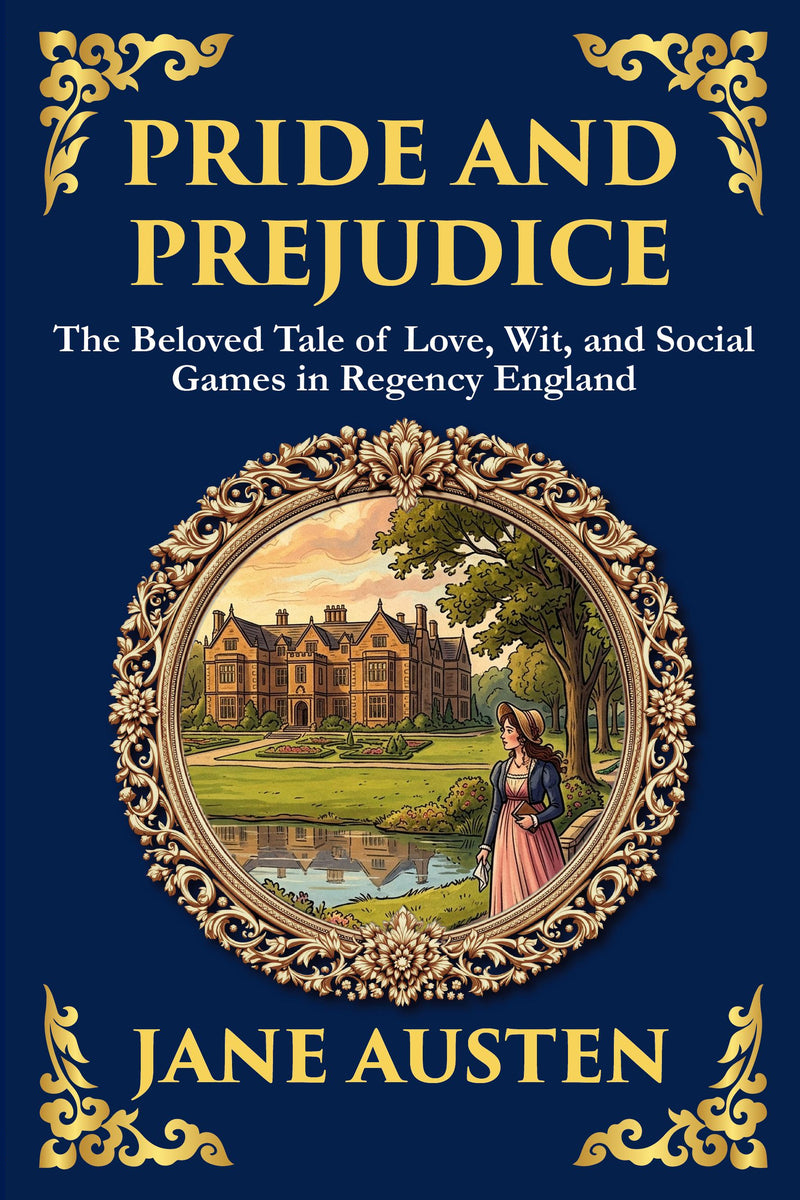
Pride and Prejudice
In a world ruled by manners, marriage, and money, can love overcome the games of pride and prejudice? Jane Austen’s timeless masterpiece invites you into the lives of the Bennet sisters— especially the clever, spirited Elizabeth—as they navigate the glittering yet rigid social structure of Regency England.
or free app
10,000+ hrs library
30-day guarantee
The complete Pride and Prejudice appears in modern English through Library of Alexandria Press, available online with audiobook narration included for members.
Have you ever wondered why love so often hides behind pride—and how truth finally brings it to light? Pride and Prejudice is Jane Austen’s enduring classic of love, misunderstanding, and the fragile social dance of Regency-era England. First published in 1813 and still read around the world today, this novel remains one of literature’s most captivating portrayals of romantic tension, social expectations, and personal growth.
The story centers around Elizabeth Bennet, an intelligent and independent young woman who refuses to conform to society’s shallow expectations for marriage. Enter Mr. Darcy: wealthy, handsome, proud—and seemingly insufferable.
From their sharp-tongued exchanges to moments of reluctant vulnerability, their relationship evolves amidst a backdrop of class pressures, family drama, and scandalous rumor. Jane Austen’s brilliant satire and insight into human nature turn this story into much more than a romance. It’s a narrative about dignity, humility, and what it takes to recognize one’s own faults —and to forgive those of others.
This modern edition presents the original text with a clean, elegant design to invite today’s readers into a world where love must earn its way past judgment.
What you’ll discover in this modern edition
- A Sharp and Witty Heroine Ahead of Her Time – Elizabeth Bennet’s independence and intelligence continue to inspire readers across generations.
- The Iconic Slow-Burn Romance – Experience the legendary chemistry and emotional tension between Elizabeth and Mr. Darcy.
- A Thoughtful Satire of Social Norms – Austen masterfully critiques class, gender roles, and the pressures of propriety in her time.
- Themes That Still Resonate Today – From pride and misjudgment to self-awareness and second chances, these universal ideas feel as fresh as ever.
- An Elegant and Accessible Format – Designed for modern readers while preserving the original voice of Jane Austen.
| Formats | eBook (EPUB + PDF) · Audiobook · Paperback · Hardcover · Large Print |
| Language | English |
| Trim size (print) | 6 × 9 in |
| Binding | Paperback — perfect-bound · Hardcover — casewrap |
| Large Print edition | Same text in a larger, easy-read type — a larger font, not a larger trim |
| Print pricing | Every physical book at our true cost — at-cost, no profit (members) |
| Library | 873 restored titles, always growing |
| Length | 113,059 words · ~7 hr 32 min reading |
| Reading level | Grade 8 · an easy, flowing read (this modern-English edition) |
| Edition | Modern English translation · 2026 |
Member reviews for this edition are collected as readers finish it — be the first. Across the library: 12,000+ books shipped, every plan covered by a 365-day print guarantee.
About this edition
A faithful, unabridged modern-English edition by The Library of Alexandria — carefully rendered for today's reader and verified paragraph-by-paragraph against the public-domain source. Available as eBook, audiobook, paperback, hardcover, and large print.
- Complete & unabridgedVerified paragraph by paragraph against the source — never a scan, never abridged.
- Modern English, faithfulReadable today, with the author’s meaning kept intact. Readable — not simplified.
- Every format, one membershipRead in your browser or the free app, or listen to the full audiobook.
Included free with your membership
Cancel anytime, one click · 30-day money-back guarantee
Edition last updated July 2026
What’s inside
Pride and Prejudice — complete and unabridged: all 60 sections included with membership, plus the full audiobook.
Begin reading Pride and Prejudice
In clear modern English — the complete text is included with membership.
Introduction
There are novels we read once and admire, and there are novels we return to throughout our lives, finding in them something new each time—a phrase we had overlooked, a glance between characters that suddenly carries the weight of an entire relationship, a piece of wit so sharp it seems freshly minted. Pride and Prejudice belongs unmistakably to the second category. For more than two centuries, readers across every conceivable boundary of geography, class, language, and temperament have found their way into this story and emerged convinced that the author had somehow written it directly to them. That intimacy, that sense of personal address from a writer who died long before any of us were born, is one of the great mysteries and pleasures of literature. This edition, a modern translation adapted for the contemporary reader, exists to remove whatever small barriers time may have placed between you and that experience, while preserving everything that makes the original immortal.
To open this book is to enter a world both vanished and astonishingly familiar. The petticoats, the carriages, the entailed estates, and the elaborate codes of courtship belong to a society that disappeared two hundred years ago. Yet the human comedy at the heart of the narrative—the misunderstandings between proud and clever people, the wounds inflicted by careless first impressions, the slow and reluctant softening of a stubborn heart—is as alive today as it was when the novel first appeared in 1813. You will recognize these people. You have met them. Perhaps, on certain honest days, you have been them. That recognition is the secret engine of the story’s enduring power, and it is the reason that generations of readers have closed the final page only to begin contemplating when they might read it all over again.
Jane Austen was born in 1775 in the village of Steventon, in the English county of Hampshire, the seventh of eight children in the family of a country clergyman. Her world was small in the geographic sense—she rarely traveled far from home, and the great public events of her era, the wars and revolutions that shook Europe, appear in her fiction only as distant rumbles, glimpsed through the windows of drawing rooms. But to mistake the smallness of her stage for smallness of vision would be a profound error. Austen understood that the largest human dramas play out in the smallest spaces: in a conversation across a dinner table, in the choice of whether to accept or refuse an invitation to dance, in the difference between what a person says and what that person actually means.
She came of age in a household that valued reading, conversation, and laughter. Books were plentiful, and the Austen children were encouraged to write, perform plays, and entertain one another with their wit. From an early age, Jane was composing stories—often parodies and burlesques that mocked the sentimental fiction of her day, the overwrought tales of swooning heroines and dastardly villains that filled the lending libraries. This early instinct for satire never left her. Even at her most tender and romantic, Austen never abandoned her clear-eyed amusement at human folly, her refusal to take seriously the things that did not deserve to be taken seriously. It is this balance—warmth without sentimentality, sharpness without cruelty—that gives her work its distinctive flavor.
When she began the manuscript that would eventually become Pride and Prejudice, Austen was in her early twenties, and she titled it First Impressions. A publisher rejected it sight unseen. It would be more than fifteen years before the revised and refined version reached print, by which time the author had matured into the full command of her powers. She called it, with characteristic modesty and irony, “my own darling child,” and confessed in a letter that she worried the work was “rather too light, and bright, and sparkling.” Posterity has rendered its verdict: that brightness, far from being a flaw, is precisely the quality that has kept the novel luminous through two centuries of changing tastes. Austen published her novels anonymously during her lifetime—the title pages credited only “A Lady”—and she earned modest sums and modest fame before her death in 1817 at the age of forty-one. She could not have imagined the global devotion her work would one day inspire, the films and adaptations and sequels and scholarly volumes, the readers in every corner of the earth who would speak of her characters as though they were old friends. Yet the seeds of all that devotion are present on every page she wrote.
What makes Austen extraordinary is not the grandeur of her subject matter but the precision of her instrument. She was, above all, a master of irony—that delicate art of saying one thing while meaning another, of allowing the reader to perceive truths that the characters themselves cannot see. From the very first sentence of this novel, one of the most famous opening lines in all of English literature, she establishes a tone of sly, knowing amusement that invites the reader into a kind of conspiracy. We are made to feel that we and the author share a private understanding of the way the world really works, a understanding that the foolish characters lack. This is a deeply pleasurable sensation, and Austen sustains it with such consistency that reading her work feels less like observing a story and more like being taken into the confidence of the wittiest, most perceptive friend one could ever hope to have.
Her achievement in the technique of fiction was, in its quiet way, revolutionary. Austen perfected a method of narration that allows us to slip seamlessly into a character’s thoughts and perceptions, to see the world as that person sees it, while still retaining the author’s ironic distance. This means that we often share a character’s mistakes, adopt a character’s prejudices, and feel a character’s certainties—only to discover, as the story unfolds, how thoroughly we have been misled. The novel becomes an education in humility, a demonstration of how easily intelligent people deceive themselves. We come to understand the dangers of judging too quickly, of trusting first impressions, of allowing wounded vanity or unexamined pride to distort our perception of others. These are lessons that never go out of date, because they describe permanent features of the human heart.
To read Pride and Prejudice with full appreciation, it helps to understand something of the society in which it is set—a world governed by rules and expectations that may seem strange to modern eyes but which shaped every choice the characters make. The novel takes place in what is now called the Regency era, a brief and brilliant period in English history named for the years when the Prince of Wales ruled as regent in place of his ailing father, King George III. It was an age of elegance and contradiction: of refined manners and rigid hierarchies, of dazzling wit and stifling constraint, of beautiful surfaces concealing real anxieties about money, status, and survival.
For the class of people Austen writes about—the landed gentry and those who hovered hopefully at its edges—life was organized around a handful of unforgiving realities. Chief among these was the question of marriage, which for a young woman of the period was not merely a matter of romance but of economic necessity and social survival. Women of this class could not, with rare exceptions, earn their own livelihoods or inherit family property in the way their brothers could. A daughter’s future depended almost entirely on the marriage she made. To marry well meant security, respectability, and a place in the world; to marry badly meant struggle and diminished status; to fail to marry at all could mean a lifetime of dependence on the charity of relatives, a precarious and often humiliating existence. This is why the question of who will marry whom, which might seem in our own age a purely personal matter, carries such enormous weight in Austen’s fiction. Behind every flirtation and every proposal lies a calculation about the rest of a life.
The matter of property compounds these pressures. Many estates in this period were governed by legal arrangements that dictated they must pass intact to a male heir, regardless of whether the current owner had sons of his own. A family with several daughters and no son might therefore face the prospect of watching their home pass, upon the father’s death, to some distant male relative, leaving the women without a roof or an income. This is no abstract concern in the novel; it is the shadow that falls across one particular family and lends urgency to the marital ambitions that drive much of the plot. When you read of the anxiety surrounding the daughters’ marriages, remember that what is at stake is nothing less than their entire future—their homes, their comfort, their dignity, their very place in the world.
Yet within these constraints, the people of Austen’s world conducted their lives with remarkable ceremony and grace. Social life revolved around visits, dinners, and above all balls—the great occasions where young people could meet, observe one another, and conduct the elaborate dance of courtship under the watchful eyes of their elders. A ball was far more than entertainment; it was a marketplace, a theater, a battlefield, and a stage all at once. The choice of partners, the order of dances, the snatched conversations between figures of a quadrille—all of these carried meaning, all of them were watched and interpreted and gossiped about. To be asked to dance was a form of recognition; to be declined was a public humiliation. Austen understood the immense significance of these small social rituals, and she uses them brilliantly, allowing entire relationships to advance or collapse across the length of a dance.
The codes of conduct that governed conversation and behavior were similarly precise. People of this class were expected to maintain a polished surface of politeness regardless of what they actually felt. Direct expression of strong emotion was considered vulgar; everything had to be managed through implication, restraint, and the careful navigation of propriety. This is why so much of the drama in the novel takes place beneath the surface of perfectly civil exchanges. Two characters may be conducting a fierce battle of wills while saying nothing that an eavesdropper would find improper. A declaration of feeling, when it finally comes, has the force of an explosion precisely because so much has been held back. The modern reader, accustomed to a culture of open emotional expression, may need a moment to attune to this register—but once attuned, the rewards are immense. There is a thrilling tension in watching characters who must communicate everything through the smallest of signals: a look held a moment too long, a sentence left unfinished, a sudden change in color or composure.
Money, throughout, is never far from anyone’s mind, and Austen is refreshingly frank about its importance. Characters are routinely described in terms of their annual incomes, and the numbers carry real meaning to those who hear them. The size of a woman’s dowry, the value of a man’s estate, the income attached to a profession—these figures determine who may aspire to whom, who is considered a brilliant match and who a hopeless one. Austen neither romanticizes this mercenary calculation nor condemns it outright; she simply observes it with her usual unflinching clarity, and she allows us to see both its practical logic and its capacity to corrupt and distort the genuine feelings of the heart. One of the novel’s deepest concerns is the difficult question of how love and money relate to each other—whether one can marry purely for affection without regard to security, whether one can marry purely for security without betraying one’s soul, and where, between these extremes, true wisdom lies.
Understanding all of this enriches the reading immeasurably, but it should be said that none of it is strictly necessary to enjoy the book. Austen was such a gifted dramatist that the human realities shine through even when the historical particulars are unfamiliar. The fear of being left without security translates instantly into our own anxieties; the social pressures of family and reputation are recognizable in any age; the universal experiences of attraction, misjudgment, embarrassment, and reconciliation need no footnotes. This edition’s careful modernization is designed precisely to let those timeless elements come through with maximum clarity, smoothing away the occasional obscurities of two-hundred-year-old prose while preserving the wit, the rhythm, and the irreplaceable voice of the original.
Cancel anytime, one click · 30-day money-back guarantee
Founding annual rate available now — your price locks for life when you join.
Not ready? Get this free chapter by email — read it anytime.
✓ Sent — check your inbox for Pride and Prejudice.
Questions about Pride and Prejudice
What is Pride and Prejudice about?
In a world ruled by manners, marriage, and money, can love overcome the games of pride and prejudice? Jane Austen’s timeless masterpiece invites you into the lives of the Bennet sisters— especially the clever, spirited Elizabeth—as they navigate the glittering yet rigid social structure of Regency England. When the wealthy but aloof Mr.
Who wrote Pride and Prejudice?
Pride and Prejudice was written by Jane Austen. This edition presents the complete work in clear modern English, faithfully rendered from the public-domain original by Library of Alexandria Press.
Is Pride and Prejudice free to read?
The opening chapter is free to read on this page. Members read and listen to the complete work — and the entire library — free, and can order any physical book at our true print cost.
How long is Pride and Prejudice?
60 chapters (~113,059 words) — about 7 hr 32 min of reading in this modern-English edition.
Is this an abridged version of Pride and Prejudice?
No. This is the complete, unabridged Pride and Prejudice, carefully rendered into clear modern English and verified paragraph-by-paragraph against the public-domain source — nothing is cut or summarised.
What formats does Pride and Prejudice come in?
Pride and Prejudice is available as eBook, paperback, hardcover and large print. eBook and audiobook are included with membership; printed editions ship at our true print cost.
Shipping & returns
Billing & membership
More from the library


Explore Romance
- As You Like It · William Shakespeare
- Anna Karenina · Leo Tolstoy
- A Midsummer Night’s Dream · William Shakespeare
- Romeo and Juliet · William Shakespeare
- Sonnets from the Portuguese · Elizabeth Barrett Browning
- Miss Primrose · Agnes Giberne
- The Gay Adventure: A Romance · Richard Bird
- The Belle of Bowling Green · Amelia E. Barr
- The Monk: A Romance · M. G. Lewis
- She · H. Rider Haggard
- The Mill on the Floss · George Eliot
- The Glad Lady · Amy Ella Blanchard
- The Red Lily — Complete · Anatole France
- The Blue Goose · Frank Lewis Nason
- The History of Sir Richard Calmady: A Romance · Lucas Malet
- The Quest of the Silver Fleece: A Novel · W. E. B. Du Bois
- The Love Letters of Mary Wollstonecraft to Gilbert Imlay · Mary Wollstonecraft
- Daddy-Long-Legs · Jean Webster
- The Age of Innocence · Edith Wharton
- The Portrait of a Lady — Volume 1 · Henry James
- Wuthering Heights · Emily Brontë
- The Lady of the Lake · Walter Scott
- Lady Chatterley’s Lover · D. H. Lawrence
- Jane Eyre: An Autobiography · Charlotte Brontë
- A Connecticut Yankee in King Arthur’s Court · Mark Twain
- Northanger Abbey · Jane Austen
- Mansfield Park · Jane Austen
- Anthem · Ayn Rand
- This Side of Paradise · F. Scott Fitzgerald
- Persuasion · Jane Austen
Pride and Prejudice
Pride and Prejudice
The Beloved Tale of Love, Wit, and Social Games in Regency England
Jane Austen
Contents
- Introduction
- Chapter 1
- Chapter 2
- Chapter 3
- Chapter 4
- Chapter 5
- Chapter 6
- Chapter 7
- Chapter 8
- Chapter 9
- Chapter 10
- Chapter 11
- Chapter 12
- Chapter 13
- Chapter 14
- Chapter 15
- Chapter 16
- Chapter 17
- Chapter 18
- Chapter 19
- Chapter 20
- Chapter 21
- Chapter 22
- Chapter 23
- Chapter 24
- Chapter 25
- Chapter 26
- Chapter 27
- Chapter 28
- Chapter 29
- Chapter 30
- Chapter 31
- Chapter 32
- Chapter 33
- Chapter 34
- Chapter 35
- Chapter 36
- Chapter 37
- Chapter 38
- Chapter 39
- … and 20 more chapters
Introduction
There are novels we read once and admire, and there are novels we return to throughout our lives, finding in them something new each time—a phrase we had overlooked, a glance between characters that suddenly carries the weight of an entire relationship, a piece of wit so sharp it seems freshly minted. Pride and Prejudice belongs unmistakably to the second category. For more than two centuries, readers across every conceivable boundary of geography, class, language, and temperament have found their way into this story and emerged convinced that the author had somehow written it directly to them. That intimacy, that sense of personal address from a writer who died long before any of us were born, is one of the great mysteries and pleasures of literature. This edition, a modern translation adapted for the contemporary reader, exists to remove whatever small barriers time may have placed between you and that experience, while preserving everything that makes the original immortal.
To open this book is to enter a world both vanished and astonishingly familiar. The petticoats, the carriages, the entailed estates, and the elaborate codes of courtship belong to a society that disappeared two hundred years ago. Yet the human comedy at the heart of the narrative—the misunderstandings between proud and clever people, the wounds inflicted by careless first impressions, the slow and reluctant softening of a stubborn heart—is as alive today as it was when the novel first appeared in 1813. You will recognize these people. You have met them. Perhaps, on certain honest days, you have been them. That recognition is the secret engine of the story’s enduring power, and it is the reason that generations of readers have closed the final page only to begin contemplating when they might read it all over again.
Jane Austen was born in 1775 in the village of Steventon, in the English county of Hampshire, the seventh of eight children in the family of a country clergyman. Her world was small in the geographic sense—she rarely traveled far from home, and the great public events of her era, the wars and revolutions that shook Europe, appear in her fiction only as distant rumbles, glimpsed through the windows of drawing rooms. But to mistake the smallness of her stage for smallness of vision would be a profound error. Austen understood that the largest human dramas play out in the smallest spaces: in a conversation across a dinner table, in the choice of whether to accept or refuse an invitation to dance, in the difference between what a person says and what that person actually means.
She came of age in a household that valued reading, conversation, and laughter. Books were plentiful, and the Austen children were encouraged to write, perform plays, and entertain one another with their wit. From an early age, Jane was composing stories—often parodies and burlesques that mocked the sentimental fiction of her day, the overwrought tales of swooning heroines and dastardly villains that filled the lending libraries. This early instinct for satire never left her. Even at her most tender and romantic, Austen never abandoned her clear-eyed amusement at human folly, her refusal to take seriously the things that did not deserve to be taken seriously. It is this balance—warmth without sentimentality, sharpness without cruelty—that gives her work its distinctive flavor.
When she began the manuscript that would eventually become Pride and Prejudice, Austen was in her early twenties, and she titled it First Impressions. A publisher rejected it sight unseen. It would be more than fifteen years before the revised and refined version reached print, by which time the author had matured into the full command of her powers. She called it, with characteristic modesty and irony, “my own darling child,” and confessed in a letter that she worried the work was “rather too light, and bright, and sparkling.” Posterity has rendered its verdict: that brightness, far from being a flaw, is precisely the quality that has kept the novel luminous through two centuries of changing tastes. Austen published her novels anonymously during her lifetime—the title pages credited only “A Lady”—and she earned modest sums and modest fame before her death in 1817 at the age of forty-one. She could not have imagined the global devotion her work would one day inspire, the films and adaptations and sequels and scholarly volumes, the readers in every corner of the earth who would speak of her characters as though they were old friends. Yet the seeds of all that devotion are present on every page she wrote.
What makes Austen extraordinary is not the grandeur of her subject matter but the precision of her instrument. She was, above all, a master of irony—that delicate art of saying one thing while meaning another, of allowing the reader to perceive truths that the characters themselves cannot see. From the very first sentence of this novel, one of the most famous opening lines in all of English literature, she establishes a tone of sly, knowing amusement that invites the reader into a kind of conspiracy. We are made to feel that we and the author share a private understanding of the way the world really works, a understanding that the foolish characters lack. This is a deeply pleasurable sensation, and Austen sustains it with such consistency that reading her work feels less like observing a story and more like being taken into the confidence of the wittiest, most perceptive friend one could ever hope to have.
Her achievement in the technique of fiction was, in its quiet way, revolutionary. Austen perfected a method of narration that allows us to slip seamlessly into a character’s thoughts and perceptions, to see the world as that person sees it, while still retaining the author’s ironic distance. This means that we often share a character’s mistakes, adopt a character’s prejudices, and feel a character’s certainties—only to discover, as the story unfolds, how thoroughly we have been misled. The novel becomes an education in humility, a demonstration of how easily intelligent people deceive themselves. We come to understand the dangers of judging too quickly, of trusting first impressions, of allowing wounded vanity or unexamined pride to distort our perception of others. These are lessons that never go out of date, because they describe permanent features of the human heart.
To read Pride and Prejudice with full appreciation, it helps to understand something of the society in which it is set—a world governed by rules and expectations that may seem strange to modern eyes but which shaped every choice the characters make. The novel takes place in what is now called the Regency era, a brief and brilliant period in English history named for the years when the Prince of Wales ruled as regent in place of his ailing father, King George III. It was an age of elegance and contradiction: of refined manners and rigid hierarchies, of dazzling wit and stifling constraint, of beautiful surfaces concealing real anxieties about money, status, and survival.
For the class of people Austen writes about—the landed gentry and those who hovered hopefully at its edges—life was organized around a handful of unforgiving realities. Chief among these was the question of marriage, which for a young woman of the period was not merely a matter of romance but of economic necessity and social survival. Women of this class could not, with rare exceptions, earn their own livelihoods or inherit family property in the way their brothers could. A daughter’s future depended almost entirely on the marriage she made. To marry well meant security, respectability, and a place in the world; to marry badly meant struggle and diminished status; to fail to marry at all could mean a lifetime of dependence on the charity of relatives, a precarious and often humiliating existence. This is why the question of who will marry whom, which might seem in our own age a purely personal matter, carries such enormous weight in Austen’s fiction. Behind every flirtation and every proposal lies a calculation about the rest of a life.
The matter of property compounds these pressures. Many estates in this period were governed by legal arrangements that dictated they must pass intact to a male heir, regardless of whether the current owner had sons of his own. A family with several daughters and no son might therefore face the prospect of watching their home pass, upon the father’s death, to some distant male relative, leaving the women without a roof or an income. This is no abstract concern in the novel; it is the shadow that falls across one particular family and lends urgency to the marital ambitions that drive much of the plot. When you read of the anxiety surrounding the daughters’ marriages, remember that what is at stake is nothing less than their entire future—their homes, their comfort, their dignity, their very place in the world.
Yet within these constraints, the people of Austen’s world conducted their lives with remarkable ceremony and grace. Social life revolved around visits, dinners, and above all balls—the great occasions where young people could meet, observe one another, and conduct the elaborate dance of courtship under the watchful eyes of their elders. A ball was far more than entertainment; it was a marketplace, a theater, a battlefield, and a stage all at once. The choice of partners, the order of dances, the snatched conversations between figures of a quadrille—all of these carried meaning, all of them were watched and interpreted and gossiped about. To be asked to dance was a form of recognition; to be declined was a public humiliation. Austen understood the immense significance of these small social rituals, and she uses them brilliantly, allowing entire relationships to advance or collapse across the length of a dance.
The codes of conduct that governed conversation and behavior were similarly precise. People of this class were expected to maintain a polished surface of politeness regardless of what they actually felt. Direct expression of strong emotion was considered vulgar; everything had to be managed through implication, restraint, and the careful navigation of propriety. This is why so much of the drama in the novel takes place beneath the surface of perfectly civil exchanges. Two characters may be conducting a fierce battle of wills while saying nothing that an eavesdropper would find improper. A declaration of feeling, when it finally comes, has the force of an explosion precisely because so much has been held back. The modern reader, accustomed to a culture of open emotional expression, may need a moment to attune to this register—but once attuned, the rewards are immense. There is a thrilling tension in watching characters who must communicate everything through the smallest of signals: a look held a moment too long, a sentence left unfinished, a sudden change in color or composure.
Money, throughout, is never far from anyone’s mind, and Austen is refreshingly frank about its importance. Characters are routinely described in terms of their annual incomes, and the numbers carry real meaning to those who hear them. The size of a woman’s dowry, the value of a man’s estate, the income attached to a profession—these figures determine who may aspire to whom, who is considered a brilliant match and who a hopeless one. Austen neither romanticizes this mercenary calculation nor condemns it outright; she simply observes it with her usual unflinching clarity, and she allows us to see both its practical logic and its capacity to corrupt and distort the genuine feelings of the heart. One of the novel’s deepest concerns is the difficult question of how love and money relate to each other—whether one can marry purely for affection without regard to security, whether one can marry purely for security without betraying one’s soul, and where, between these extremes, true wisdom lies.
Understanding all of this enriches the reading immeasurably, but it should be said that none of it is strictly necessary to enjoy the book. Austen was such a gifted dramatist that the human realities shine through even when the historical particulars are unfamiliar. The fear of being left without security translates instantly into our own anxieties; the social pressures of family and reputation are recognizable in any age; the universal experiences of attraction, misjudgment, embarrassment, and reconciliation need no footnotes. This edition’s careful modernization is designed precisely to let those timeless elements come through with maximum clarity, smoothing away the occasional obscurities of two-hundred-year-old prose while preserving the wit, the rhythm, and the irreplaceable voice of the original.
It is a universally acknowledged truth that a single man with a large fortune must be in need of a wife.
No matter how little is known about a man’s feelings or opinions when he first moves into a neighborhood, the local families are so convinced of one particular truth: that he is the rightful prize for one of their daughters.
“My dear Mr. Bennet,” his wife said to him one day, “have you heard that Netherfield Park has finally been rented?”
“But it has,” she replied. “Mrs. Long was just here, and she told me all about it.”
“Don’t you want to know who rented it?” his wife asked impatiently.
“You want to tell me, and I don’t mind hearing it.”
“Well, my dear, you must know that Mrs. Long says Netherfield was rented by a wealthy young man from northern England. She said he arrived on Monday in a carriage with four horses to see the place, and he liked it so much that he agreed to the terms with Mr. Morris immediately. He’s supposed to move in before the end of September, and some of his servants will be there by the end of next week.”
“Oh, single, of course! A single man with a huge fortune—four or five thousand a year. What a wonderful opportunity for our girls!”
“My dear Mr. Bennet,” his wife replied, “how can you be so difficult? You know I’m hoping he’ll marry one of them.”
“Why? That’s nonsense! Why would you say that? But it’s very likely he’ll fall in love with one of them, so you must visit him as soon as he arrives.”
“I don’t see any reason for that. You and the girls can go—or you can just send them by themselves, which might actually be better. Since you’re as beautiful as any of them, Mr. Bingley might like you best of all.”
End of the free sample
Keep reading, free
Members read and listen to the complete book — and the entire library. Cancel anytime, one click · 30-day money-back guarantee.