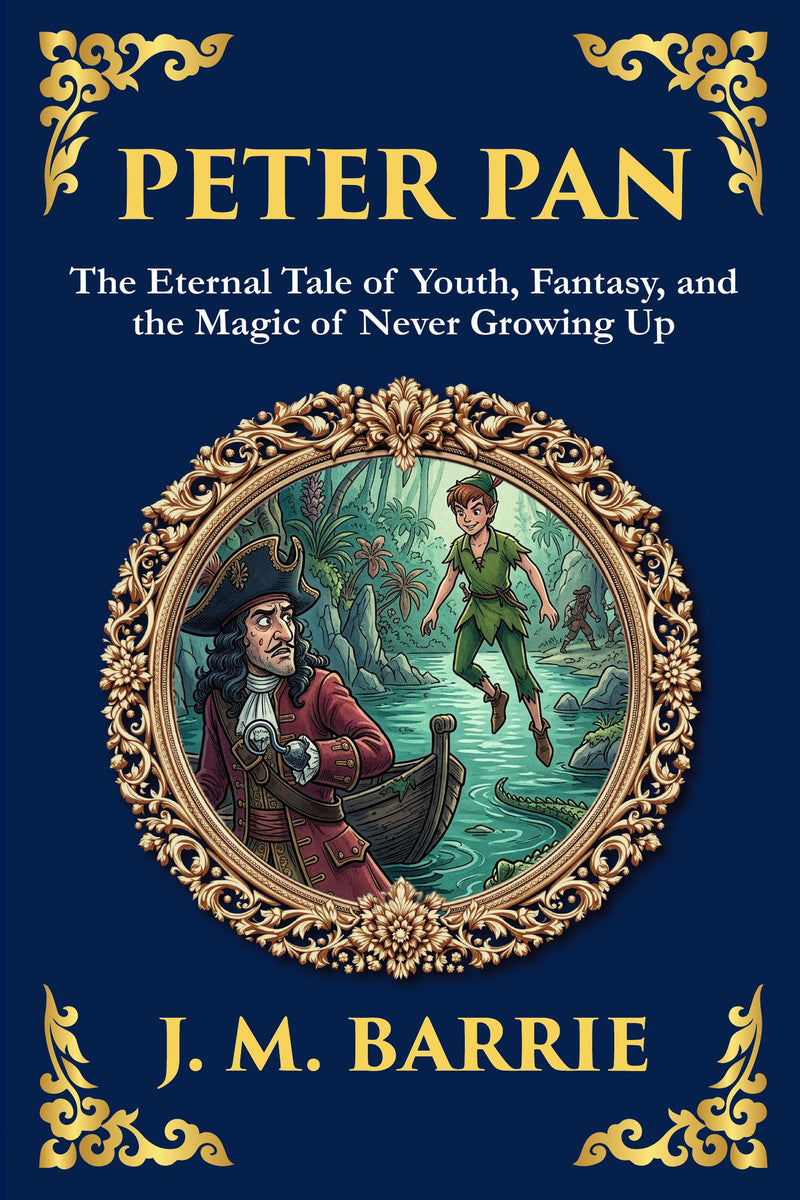
Peter Pan
One night, a boy who refuses to grow up flies through an open window—and nothing is ever the same again. Peter Pan whisks Wendy, John, and Michael away from the ordinary world to Neverland: a fantastical island filled with fairies, pirates, mermaids, and the Lost Boys.
or free app
10,000+ hrs library
30-day guarantee
The complete Peter Pan appears in modern English through Library of Alexandria Press, available online with audiobook narration included for members.
Have you ever wondered why we must grow up, even when our hearts still dream? J. M. Barrie’s Peter Pan is more than a beloved children’s tale—it is a richly layered fantasy that explores the magic of youth and the pain of letting go. At its heart is Peter, the boy who won’t grow up, and Wendy, the girl torn between childhood dreams and adult responsibilities.
Together, they soar through a story filled with sword fights and lullabies, make-believe and memory, joy and quiet sorrow. Neverland is more than just a fantasy island. It is the embodiment of wonder, imagination, and the fleeting nature of childhood.
With vivid characters—from the vengeful Captain Hook to the mischievous Tinker Bell—Barrie paints a world that is both whimsical and wise.
What you’ll discover in this modern edition
- A Story of Eternal Childhood – Follow Peter Pan, the boy who won’t grow up, and experience the joy and tragedy of never changing.
- Wendy’s Journey Between Two Worlds – Discover the subtle power of choice, love, and growing up through Wendy’s eyes.
- Neverland in All Its Wonder – Mermaids, pirates, fairies, and fantastical creatures come to life in this vivid landscape of dreams.
- A Tale That Balances Light and Shadow – Barrie’s prose hides sorrow beneath sparkle, reminding us that even magic has its price.
- A Classic for All Ages – Whether you’re reading it for the first time or returning years later, Peter Pan remains one of literature’s most enduring gifts.
| Formats | eBook (EPUB + PDF) · Audiobook · Paperback · Hardcover · Large Print |
| Language | English |
| Trim size (print) | 6 × 9 in |
| Binding | Paperback — perfect-bound · Hardcover — casewrap |
| Large Print edition | Same text in a larger, easy-read type — a larger font, not a larger trim |
| Print pricing | Every physical book at our true cost — at-cost, no profit (members) |
| Library | 873 restored titles, always growing |
| Length | 46,464 words · ~3 hr 6 min reading |
| Reading level | Grade 7 · an easy, flowing read (this modern-English edition) |
| Edition | Modern English translation · 2026 |
Member reviews for this edition are collected as readers finish it — be the first. Across the library: 12,000+ books shipped, every plan covered by a 365-day print guarantee.
About this edition
A faithful, unabridged modern-English edition by The Library of Alexandria — carefully rendered for today's reader and verified paragraph-by-paragraph against the public-domain source. Available as eBook, audiobook, paperback, hardcover, and large print.
- Complete & unabridgedVerified paragraph by paragraph against the source — never a scan, never abridged.
- Modern English, faithfulReadable today, with the author’s meaning kept intact. Readable — not simplified.
- Every format, one membershipRead in your browser or the free app, or listen to the full audiobook.
Included free with your membership
Cancel anytime, one click · 30-day money-back guarantee
Edition last updated July 2026
What’s inside
Peter Pan — complete and unabridged: all 18 sections included with membership, plus the full audiobook.
Begin reading Peter Pan
In clear modern English — the complete text is included with membership.
Introduction
There are stories we read once and set aside, and there are stories that take up permanent residence somewhere deep inside us, waiting quietly to be remembered. The tale you are about to enter belongs unmistakably to the second kind. It is a story that has crossed oceans and generations, that has been whispered to children at bedtime and pondered by adults long past their own childhoods, that has been performed on stages, painted onto canvases, and carried in the imaginations of millions who may never have read the original words at all. And yet, for all its fame, the genuine experience of meeting this story on the page — of following its sentences as they shimmer between joy and melancholy, mischief and tenderness — remains something rare and precious. That experience is what this edition hopes to give you.
What you hold is a modern translation, an adaptation crafted with the contemporary reader in mind. This is worth pausing over, because it shapes everything about how you will encounter the pages ahead. The original was written more than a century ago, in a voice that belonged to its own particular moment — a voice full of Edwardian flourishes, sly asides, and turns of phrase that delighted the audiences of its day but can occasionally feel like a locked door to readers now. This version gently opens that door. It preserves the spirit, the wit, the strange and aching beauty of the original, while smoothing the language into something a present-day reader can move through without stumbling. Nothing essential has been lost. The magic remains intact. What changes is only the ease with which you can reach it.
It is one of the great curiosities of literature that some books seem to age while others remain forever young — and this one, fittingly, belongs entirely to the latter category. The very subject of the story is the refusal to grow up, and the book itself has performed exactly that feat. More than a hundred years after its first appearance, it continues to feel alive, urgent, and surprisingly new. Each generation discovers it again as though for the first time, and each generation finds in it something slightly different, something that speaks to its own particular hopes and fears.
Part of this endurance comes from the simple, irresistible power of the premise. There is a boy who never grows older. There is a place where childhood goes on forever, untouched by clocks and calendars and the slow erosions of adult life. There are pirates and fairies, mermaids and lost children, adventures that begin the moment the lights go out and the window opens to the night sky. These images have become so deeply woven into our shared imagination that you may feel, opening this book, as though you already know it. And in a sense you do. But knowing the shape of a thing is not the same as knowing the thing itself. Many readers come to these pages carrying a version assembled from films, cartoons, and half-remembered references — and they are astonished to find that the real story is richer, stranger, funnier, and far more emotionally complex than any of its imitations.
What the adaptations rarely capture is the voice. The original author wrote with an extraordinary blend of playfulness and sorrow, a narrator who teases his characters one moment and breaks your heart the next, who interrupts the action to share an observation so true about human nature that you have to set the book down for a moment. This narrative voice is the secret engine of the whole work. It is what transforms a simple fantasy adventure into something closer to a meditation on time, memory, and the bittersweet experience of being alive. As you read, you will notice this voice slipping between the perspective of a child and the perspective of an adult who remembers what it was like to be a child — and who knows, with quiet certainty, that the remembering can never bring it fully back. This double vision gives the story its peculiar emotional depth. It is a book that can be enjoyed wholeheartedly by a young reader as a tale of pure adventure, and read again decades later as something almost unbearably poignant.
There is also a remarkable honesty in the way the story portrays children. It does not sentimentalize them or wrap them in false innocence. The young people in these pages can be selfish, forgetful, careless, even a little cruel — exactly as real children are, and exactly as the adults reading about them once were. They forget those who love them. They are heartless in the casual way that only the very young can be, not from malice but simply because they have not yet learned that other people’s feelings are as real as their own. The author understood this perfectly, and he refused to pretend otherwise. The result is a story that respects its readers, young and old alike, by telling the truth about the human heart even while it spins a tale of fairies and flight.
This refusal to oversimplify is one of the reasons the book rewards rereading so generously. A child encountering it for the first time will be swept up in the wonder of it — the flying, the island, the battles, the narrow escapes. But the same reader returning years later will begin to notice the shadows beneath the brightness: the loneliness at the center of the boy who never grows up, the longing of those who must choose between adventure and home, the quiet grief that runs like an underground river beneath all the laughter. These two readings do not contradict each other. They coexist, layered together, so that the book becomes a kind of mirror that shows you something different depending on where you stand in your own life. Read it as a child and it is a glorious dream. Read it as an adult and it becomes something closer to an elegy — a love letter to a country we have all visited and can never return to.
The Pleasures and Treasures Waiting Inside
Let us speak, then, of what awaits you, without giving away the particular turns and surprises that make the journey so delightful. For a story this beloved, there is always a temptation to assume one knows everything in advance. Resist that temptation. Allow yourself to read as though you know nothing, because the pleasures of this book live in its details, and the details are easy to miss when you think you already have the measure of the whole.
You will find, first of all, a world of astonishing vividness. The island where much of the action unfolds is not a flat backdrop but a living, breathing place with its own logic and its own moods. It is the kind of landscape that exists in the mind of every child who has ever invented a game — a place stitched together from adventures and dangers and half-glimpsed wonders, where lagoons hold secrets and forests hide whole kingdoms. The author understood that the true geography of childhood is not the world outside the window but the world inside the imagination, and he rendered that inner world with such precision that it feels more real than many places you could find on a map. As you read, you may notice your own childhood imaginings stirring, the games and fantasies you had forgotten, the maps you drew in your head before you ever knew the names of real countries.
Then there are the characters, who are among the most memorable ever committed to the page. There is the boy at the heart of it all, of course — joyful and infuriating, brave and thoughtless, magnificent and tragic all at once. There is the girl who follows him into adventure, carrying with her a wisdom and a tenderness that anchors the whole story, a young heart already beginning the long passage toward growing up even as she savors one last glorious season of make-believe. There are her brothers, the band of lost children, a crew of fearsome pirates led by one of literature’s most gloriously theatrical villains, and a host of other figures both human and fantastical. Each of them is drawn with a few deft strokes that somehow contain whole personalities. You will come to know them quickly and remember them long after the final page.
And there is the humor — for this is, above everything, a funny book. The author had a gift for the absurd, for the gentle skewering of pomposity, for the comic logic of children and the equally comic vanity of adults. There are passages that will make you laugh out loud, scenes of such delicious silliness that you will want to read them aloud to someone nearby. This humor is not separate from the book’s deeper feeling; it is part of the same fabric. The laughter and the sorrow are braided together so tightly that you often cannot tell where one ends and the other begins, and this is precisely what gives the story its texture of real life, in which the funny and the sad are never far apart.
Beneath the adventures and the jokes runs a current of genuine philosophical depth. The book asks questions that have no easy answers. What is the cost of never growing up? What do we give up when we cross from childhood into adulthood, and what do we gain? Is the refusal to age a blessing or a curse? Can we have both the freedom of the child and the love and belonging of the grown-up, or must we always choose one and lose the other? These questions are never stated as lessons or morals — the author was far too skilled for that. They are simply woven into the events of the story, so that you arrive at them naturally, feeling their weight without being told what to think. Long after you finish, you may find yourself turning them over, applying them to your own life, your own choices, your own relationship to the child you once were.
This modern adaptation has been prepared with great care to ensure that all of these treasures remain fully available to you. The language has been clarified where the original might have puzzled a contemporary reader, but the rhythm and the magic of the prose have been faithfully preserved. The aim throughout has been to remove obstacles without removing the soul — to let you experience the story as freshly and fully as its first readers did, before time and unfamiliarity built their barriers. Words and references that have faded from common use have been gently updated. Sentences that wound in long, elaborate spirals have been opened up where doing so aids understanding. But the wit remains witty, the wonder remains wonderful, and the heartbreak still breaks the heart. You are not reading a watered-down version. You are reading the same beautiful story, given a clearer voice for your particular moment in time.
A word, too, about how best to read it. This is a book that rewards a certain kind of attention — not the rushed, distracted reading we so often give to things now, but the slower, more open kind that allows the imagery and the feeling to do their work. Give it your evenings. Read it in a quiet place where you can let your mind wander into the world it builds. If you can, read parts of it aloud, for the language was written to be spoken and heard, and it comes alive in a way that silent reading cannot quite match. If you have children, read it to them — but be prepared for the possibility that it will move you more than it moves them, for there are passages that land differently once you have learned what it means to lose things, and to remember them. And if you are reading it alone, simply as one adult returning to a story from your own childhood, allow yourself to feel whatever it stirs. Many readers find themselves unexpectedly tearful at moments they did not anticipate. This is not a flaw in the reading; it is the whole point. The book is designed to reach the part of you that still remembers being young.
It would be easy to dismiss a tale of fairies and flying children as mere entertainment, a charming diversion with no claim on our serious attention. To do so would be a profound mistake. This is a book that has earned its place among the genuine classics of world literature, not because it is old or famous, but because it tells the truth about something fundamental to human experience — and tells it with a beauty and an originality that have never been surpassed.
Cancel anytime, one click · 30-day money-back guarantee
Founding annual rate available now — your price locks for life when you join.
Not ready? Get this free chapter by email — read it anytime.
✓ Sent — check your inbox for Peter Pan.
Questions about Peter Pan
What is Peter Pan about?
One night, a boy who refuses to grow up flies through an open window—and nothing is ever the same again. Peter Pan whisks Wendy, John, and Michael away from the ordinary world to Neverland: a fantastical island filled with fairies, pirates, mermaids, and the Lost Boys. But beneath the enchantment lies something deeper—a tale of innocence, freedom, and the bittersweet cost of staying young forever.
Who wrote Peter Pan?
Peter Pan was written by J. M. Barrie. This edition presents the complete work in clear modern English, faithfully rendered from the public-domain original by Library of Alexandria Press.
Is Peter Pan free to read?
The opening chapter is free to read on this page. Members read and listen to the complete work — and the entire library — free, and can order any physical book at our true print cost.
How long is Peter Pan?
18 chapters (~46,464 words) — about 3 hr 6 min of reading in this modern-English edition.
Is this an abridged version of Peter Pan?
No. This is the complete, unabridged Peter Pan, carefully rendered into clear modern English and verified paragraph-by-paragraph against the public-domain source — nothing is cut or summarised.
What formats does Peter Pan come in?
Peter Pan is available as eBook, paperback, hardcover and large print. eBook and audiobook are included with membership; printed editions ship at our true print cost.
Shipping & returns
Billing & membership
More from the library


Explore Adventure
- Tarzan of the Apes · Edgar Rice Burroughs
- The Wonderful Wizard of Oz · L. Frank Baum
- Moby Dick; Or, The Whale · Herman Melville
- The Riddle of the Sands · Erskine Childers
- The Loss of the Swansea: A Story of the Florida Coast · W. L. Alden
- Sky Island · L. Frank Baum
- Vikram and the Vampire: Classic Hindu Tales of Adventure, Magic, and Romance · Unknown
- Tales of Unrest · Joseph Conrad
- The Tomb of Ts’in · Edgar Wallace
- Skinny McCord · Percy Keese Fitzhugh
- The Men of the Moss-Hags · S. R. Crockett
- The Hunniwell Boys and the Platinum Mystery · L. P. Wyman
- Allan Quatermain · H. Rider Haggard
- She · H. Rider Haggard
- Medical Life in the Navy · Gordon Stables
- The Thirty-Nine Steps · John Buchan
- The Story of Doctor Dolittle · Hugh Lofting
- The Princess and the Goblin · George MacDonald
- The Man Who Would Be King · Rudyard Kipling
- Lucian’s True History · Lucian of Samosata
- The Secret Adversary · Agatha Christie
- Lord Jim · Joseph Conrad
- The Marvelous Land of Oz · L. Frank Baum
- The Virginian: A Horseman of the Plains · Owen Wister
- Mars is My Destination · Frank Belknap Long
- Anabasis · Xenophon
- The Mississippi Saucer · Frank Belknap Long
- Sabotage in Space · Carey Rockwell
- Brood of the Dark Moon · Charles Willard Diffin
- The Misplaced Battleship · Harry Harrison
Peter Pan
Peter Pan
The Eternal Tale of Youth, Fantasy, and the Magic of Never Growing Up
J. M. Barrie
Contents
- Introduction
- Chapter 1
- Chapter 2
- Chapter 3
- Chapter 4
- Chapter 5
- Chapter 6
- Chapter 7
- Chapter 8
- Chapter 9
- Chapter 10
- Chapter 11
- Chapter 12
- Chapter 13
- Chapter 14
- Chapter 15
- Chapter 16
- Chapter 17
Introduction
There are stories we read once and set aside, and there are stories that take up permanent residence somewhere deep inside us, waiting quietly to be remembered. The tale you are about to enter belongs unmistakably to the second kind. It is a story that has crossed oceans and generations, that has been whispered to children at bedtime and pondered by adults long past their own childhoods, that has been performed on stages, painted onto canvases, and carried in the imaginations of millions who may never have read the original words at all. And yet, for all its fame, the genuine experience of meeting this story on the page — of following its sentences as they shimmer between joy and melancholy, mischief and tenderness — remains something rare and precious. That experience is what this edition hopes to give you.
What you hold is a modern translation, an adaptation crafted with the contemporary reader in mind. This is worth pausing over, because it shapes everything about how you will encounter the pages ahead. The original was written more than a century ago, in a voice that belonged to its own particular moment — a voice full of Edwardian flourishes, sly asides, and turns of phrase that delighted the audiences of its day but can occasionally feel like a locked door to readers now. This version gently opens that door. It preserves the spirit, the wit, the strange and aching beauty of the original, while smoothing the language into something a present-day reader can move through without stumbling. Nothing essential has been lost. The magic remains intact. What changes is only the ease with which you can reach it.
It is one of the great curiosities of literature that some books seem to age while others remain forever young — and this one, fittingly, belongs entirely to the latter category. The very subject of the story is the refusal to grow up, and the book itself has performed exactly that feat. More than a hundred years after its first appearance, it continues to feel alive, urgent, and surprisingly new. Each generation discovers it again as though for the first time, and each generation finds in it something slightly different, something that speaks to its own particular hopes and fears.
Part of this endurance comes from the simple, irresistible power of the premise. There is a boy who never grows older. There is a place where childhood goes on forever, untouched by clocks and calendars and the slow erosions of adult life. There are pirates and fairies, mermaids and lost children, adventures that begin the moment the lights go out and the window opens to the night sky. These images have become so deeply woven into our shared imagination that you may feel, opening this book, as though you already know it. And in a sense you do. But knowing the shape of a thing is not the same as knowing the thing itself. Many readers come to these pages carrying a version assembled from films, cartoons, and half-remembered references — and they are astonished to find that the real story is richer, stranger, funnier, and far more emotionally complex than any of its imitations.
What the adaptations rarely capture is the voice. The original author wrote with an extraordinary blend of playfulness and sorrow, a narrator who teases his characters one moment and breaks your heart the next, who interrupts the action to share an observation so true about human nature that you have to set the book down for a moment. This narrative voice is the secret engine of the whole work. It is what transforms a simple fantasy adventure into something closer to a meditation on time, memory, and the bittersweet experience of being alive. As you read, you will notice this voice slipping between the perspective of a child and the perspective of an adult who remembers what it was like to be a child — and who knows, with quiet certainty, that the remembering can never bring it fully back. This double vision gives the story its peculiar emotional depth. It is a book that can be enjoyed wholeheartedly by a young reader as a tale of pure adventure, and read again decades later as something almost unbearably poignant.
There is also a remarkable honesty in the way the story portrays children. It does not sentimentalize them or wrap them in false innocence. The young people in these pages can be selfish, forgetful, careless, even a little cruel — exactly as real children are, and exactly as the adults reading about them once were. They forget those who love them. They are heartless in the casual way that only the very young can be, not from malice but simply because they have not yet learned that other people’s feelings are as real as their own. The author understood this perfectly, and he refused to pretend otherwise. The result is a story that respects its readers, young and old alike, by telling the truth about the human heart even while it spins a tale of fairies and flight.
This refusal to oversimplify is one of the reasons the book rewards rereading so generously. A child encountering it for the first time will be swept up in the wonder of it — the flying, the island, the battles, the narrow escapes. But the same reader returning years later will begin to notice the shadows beneath the brightness: the loneliness at the center of the boy who never grows up, the longing of those who must choose between adventure and home, the quiet grief that runs like an underground river beneath all the laughter. These two readings do not contradict each other. They coexist, layered together, so that the book becomes a kind of mirror that shows you something different depending on where you stand in your own life. Read it as a child and it is a glorious dream. Read it as an adult and it becomes something closer to an elegy — a love letter to a country we have all visited and can never return to.
The Pleasures and Treasures Waiting Inside
Let us speak, then, of what awaits you, without giving away the particular turns and surprises that make the journey so delightful. For a story this beloved, there is always a temptation to assume one knows everything in advance. Resist that temptation. Allow yourself to read as though you know nothing, because the pleasures of this book live in its details, and the details are easy to miss when you think you already have the measure of the whole.
You will find, first of all, a world of astonishing vividness. The island where much of the action unfolds is not a flat backdrop but a living, breathing place with its own logic and its own moods. It is the kind of landscape that exists in the mind of every child who has ever invented a game — a place stitched together from adventures and dangers and half-glimpsed wonders, where lagoons hold secrets and forests hide whole kingdoms. The author understood that the true geography of childhood is not the world outside the window but the world inside the imagination, and he rendered that inner world with such precision that it feels more real than many places you could find on a map. As you read, you may notice your own childhood imaginings stirring, the games and fantasies you had forgotten, the maps you drew in your head before you ever knew the names of real countries.
Then there are the characters, who are among the most memorable ever committed to the page. There is the boy at the heart of it all, of course — joyful and infuriating, brave and thoughtless, magnificent and tragic all at once. There is the girl who follows him into adventure, carrying with her a wisdom and a tenderness that anchors the whole story, a young heart already beginning the long passage toward growing up even as she savors one last glorious season of make-believe. There are her brothers, the band of lost children, a crew of fearsome pirates led by one of literature’s most gloriously theatrical villains, and a host of other figures both human and fantastical. Each of them is drawn with a few deft strokes that somehow contain whole personalities. You will come to know them quickly and remember them long after the final page.
And there is the humor — for this is, above everything, a funny book. The author had a gift for the absurd, for the gentle skewering of pomposity, for the comic logic of children and the equally comic vanity of adults. There are passages that will make you laugh out loud, scenes of such delicious silliness that you will want to read them aloud to someone nearby. This humor is not separate from the book’s deeper feeling; it is part of the same fabric. The laughter and the sorrow are braided together so tightly that you often cannot tell where one ends and the other begins, and this is precisely what gives the story its texture of real life, in which the funny and the sad are never far apart.
Beneath the adventures and the jokes runs a current of genuine philosophical depth. The book asks questions that have no easy answers. What is the cost of never growing up? What do we give up when we cross from childhood into adulthood, and what do we gain? Is the refusal to age a blessing or a curse? Can we have both the freedom of the child and the love and belonging of the grown-up, or must we always choose one and lose the other? These questions are never stated as lessons or morals — the author was far too skilled for that. They are simply woven into the events of the story, so that you arrive at them naturally, feeling their weight without being told what to think. Long after you finish, you may find yourself turning them over, applying them to your own life, your own choices, your own relationship to the child you once were.
This modern adaptation has been prepared with great care to ensure that all of these treasures remain fully available to you. The language has been clarified where the original might have puzzled a contemporary reader, but the rhythm and the magic of the prose have been faithfully preserved. The aim throughout has been to remove obstacles without removing the soul — to let you experience the story as freshly and fully as its first readers did, before time and unfamiliarity built their barriers. Words and references that have faded from common use have been gently updated. Sentences that wound in long, elaborate spirals have been opened up where doing so aids understanding. But the wit remains witty, the wonder remains wonderful, and the heartbreak still breaks the heart. You are not reading a watered-down version. You are reading the same beautiful story, given a clearer voice for your particular moment in time.
A word, too, about how best to read it. This is a book that rewards a certain kind of attention — not the rushed, distracted reading we so often give to things now, but the slower, more open kind that allows the imagery and the feeling to do their work. Give it your evenings. Read it in a quiet place where you can let your mind wander into the world it builds. If you can, read parts of it aloud, for the language was written to be spoken and heard, and it comes alive in a way that silent reading cannot quite match. If you have children, read it to them — but be prepared for the possibility that it will move you more than it moves them, for there are passages that land differently once you have learned what it means to lose things, and to remember them. And if you are reading it alone, simply as one adult returning to a story from your own childhood, allow yourself to feel whatever it stirs. Many readers find themselves unexpectedly tearful at moments they did not anticipate. This is not a flaw in the reading; it is the whole point. The book is designed to reach the part of you that still remembers being young.
It would be easy to dismiss a tale of fairies and flying children as mere entertainment, a charming diversion with no claim on our serious attention. To do so would be a profound mistake. This is a book that has earned its place among the genuine classics of world literature, not because it is old or famous, but because it tells the truth about something fundamental to human experience — and tells it with a beauty and an originality that have never been surpassed.
All children, except one, grow up. They soon realize it’s inevitable, and this is how Wendy found out. When she was two years old, she was playing in a garden. She picked a flower and ran to give it to her mother. She must have looked adorable, because Mrs. Darling put her hand to her heart and cried, “Oh, why can’t you stay like this forever!” That was the only time they ever discussed it, but from then on, Wendy knew she had to grow up. You always know once you turn two. Two is the beginning of the end.
They lived at number 14, and until Wendy arrived, her mother was the center of the home. She was a lovely woman with a romantic soul and a sweet, playful smile. Her imagination was like those nesting boxes from the East—no matter how many you open, there is always another one inside. And her sweet smile had one particular kiss that Wendy could never quite reach, even though it was right there, clearly visible in the corner of her mouth.
This is how Mr. Darling won her heart: many men who had been boys when she was a girl suddenly realized they loved her. They all rushed to her house to propose, except for Mr. Darling, who took a cab and beat them all to the door. That’s how he got her. He won everything about her except for that innermost box and the kiss. He never knew the box existed, and eventually, he stopped trying for the kiss. Wendy thought Napoleon might have succeeded, but she could imagine him trying, failing, and then storming out in a rage, slamming the door behind him.
Mr. Darling used to brag to Wendy that her mother didn’t just love him, but respected him. He was one of those “serious” men who understood stocks and shares. Of course, nobody truly understands them, but he sounded like he did. He often mentioned that stocks were up and shares were down in a way that would make any woman respect him.
End of the free sample
Keep reading, free
Members read and listen to the complete book — and the entire library. Cancel anytime, one click · 30-day money-back guarantee.