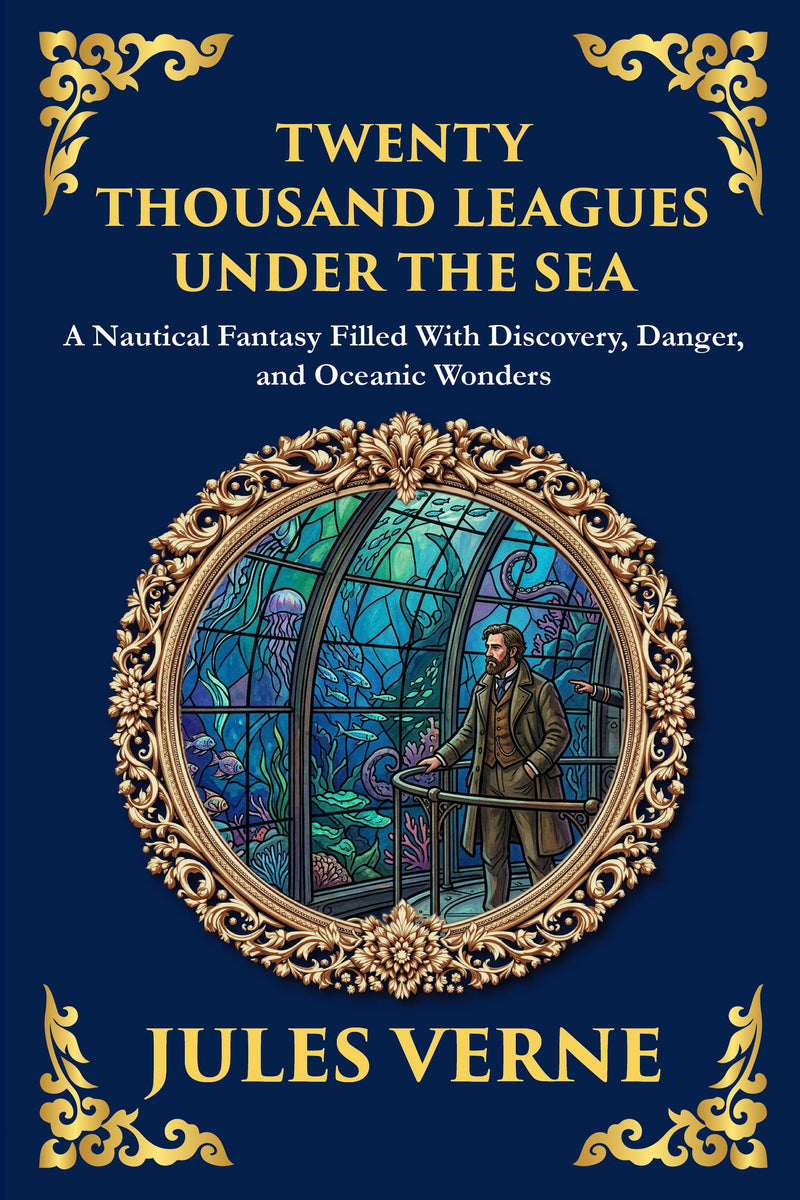
Twenty Thousand Leagues Under the Sea
Dive deep into the uncharted mysteries of the ocean in Twenty Thousand Leagues under the Sea, Jules Verne’s groundbreaking voyage of science, suspense, and the spirit of adventure.
or free app
10,000+ hrs library
30-day guarantee
The complete Twenty Thousand Leagues Under the Sea appears in modern English through Library of Alexandria Press, available online with audiobook narration included for members.
Have you ever wondered why the ocean fascinates, terrifies, and calls to us all at once? Twenty Thousand Leagues under the Sea by Jules Verne is one of the most influential science fiction novels ever written—a visionary masterpiece that dives beyond adventure into the unexplored depths of both the sea and the human condition. When mysterious sightings of a “sea monster” stir global alarm, a French scientific expedition sets out to investigate.
But what they discover is no creature—it is Nautilus, a revolutionary submarine captained by the mysterious and brilliant Captain Nemo. Taken aboard after an encounter at sea, Professor Aronnax, Conseil, and Ned Land embark on a journey that will change their lives forever. As they traverse undersea forests, ice tunnels, coral kingdoms, and deep-sea trenches, the crew confronts astonishing marine life, ancient shipwrecks, and the haunting remnants of human civilization lost to the tides.
Yet, the real enigma lies within Nemo himself—a man driven by secrets, sorrow, and a relentless disdain for the surface world. Verne’s richly detailed worldbuilding, scientific foresight, and philosophical insight create a story that is more than a nautical escapade—it is a journey into the unknown limits of knowledge, nature, and morality.
What you’ll discover in this modern edition
- A High-Seas Tale Like No Other – Submerge into a thrilling expedition aboard the Nautilus
- Visionary Science Fiction from the Father of the Genre – Featuring predictions of underwater technology decades before their time
- A Mysterious and Tragic Antihero – Captain Nemo is one of literature’s most compelling and enigmatic figures
- An Ocean Full of Wonders and Terrors – Explore giant squids, sunken cities, and the raw majesty of the marine world
| Formats | eBook (EPUB + PDF) · Audiobook · Paperback · Hardcover · Large Print |
| Language | English |
| Trim size (print) | 6 × 9 in |
| Binding | Paperback — perfect-bound · Hardcover — casewrap |
| Large Print edition | Same text in a larger, easy-read type — a larger font, not a larger trim |
| Print pricing | Every physical book at our true cost — at-cost, no profit (members) |
| Library | 873 restored titles, always growing |
| Length | 97,261 words · ~6 hr 29 min reading |
| Reading level | Grade 8 · an easy, flowing read (this modern-English edition) |
| Edition | Modern English translation · 2026 |
Member reviews for this edition are collected as readers finish it — be the first. Across the library: 12,000+ books shipped, every plan covered by a 365-day print guarantee.
About this edition
A faithful, unabridged modern-English edition by The Library of Alexandria — carefully rendered for today's reader and verified paragraph-by-paragraph against the public-domain source. Available as eBook, audiobook, paperback, hardcover, and large print.
- Complete & unabridgedVerified paragraph by paragraph against the source — never a scan, never abridged.
- Modern English, faithfulReadable today, with the author’s meaning kept intact. Readable — not simplified.
- Every format, one membershipRead in your browser or the free app, or listen to the full audiobook.
Included free with your membership
Cancel anytime, one click · 30-day money-back guarantee
Edition last updated July 2026
What’s inside
Twenty Thousand Leagues Under the Sea — complete and unabridged: all 26 sections included with membership, plus the full audiobook.
Begin reading Twenty Thousand Leagues Under the Sea
In clear modern English — the complete text is included with membership.
Introduction
There are books that entertain, and there are books that change the way we look at the world. Twenty Thousand Leagues Under the Sea belongs firmly in the second category. When Jules Verne first sent his readers plunging beneath the waves in the late nineteenth century, he did far more than spin an exciting yarn about a mysterious submarine and the men trapped aboard it. He opened a door into a realm that, for most people of his era, was as distant and unknowable as the surface of the moon. The deep ocean was, in Verne’s day, the planet’s last great frontier — vast, dark, and almost entirely unexplored. To venture there in the imagination was to step into the unknown with a guide who made every fathom feel both scientifically plausible and breathtakingly strange.
This modern translation, adapted for the contemporary reader, has been prepared with a single guiding purpose: to let Verne’s extraordinary vision shine without the barriers that older editions sometimes place between the story and the person reading it. Earlier English versions of this novel were, frankly, often clumsy. Some were rushed, others heavily abridged, and a few were so riddled with mistranslations that they actually distorted the author’s meaning, turning Verne’s careful prose into something garbled or wooden. The goal here has been to honor the spirit, intelligence, and momentum of the original French while presenting it in language that flows naturally for readers today. You will find the wonder intact, the suspense undiminished, and the ideas as provocative as ever — but the experience of reading should feel smooth, immediate, and alive.
Before you descend into the depths alongside Verne’s narrator, it is worth taking a moment to understand what makes this particular voyage so enduring, why it has captivated generations of readers across more than a century and a half, and how you might best approach it to draw out its full richness. This introduction will offer you a few keys to unlock the experience — without, you may rest assured, revealing any of the surprises that await you in the pages ahead.
A Voyage Born from a Restless and Visionary Mind
To appreciate what you are about to read, it helps to understand the remarkable man who wrote it. Jules Verne was a writer unlike any who had come before him. Born in the French port city of Nantes in 1828, he grew up surrounded by the sights and sounds of the sea — the tall ships, the harbor traffic, the comings and goings of sailors with stories of faraway places. That early exposure planted a seed of wanderlust that would never leave him. As a young man, he was sent to study law, following in his father’s footsteps, but his heart belonged elsewhere. He was drawn instead to the theater, to literature, and above all to the dazzling scientific discoveries that were transforming the world around him.
Verne lived in an age of astonishing change. The nineteenth century was a period of relentless invention and exploration. Steam power was revolutionizing travel and industry. Electricity, still mysterious and barely harnessed, promised wonders that few could yet imagine. Explorers were charting the interiors of continents, scaling unmapped mountains, and pushing toward the poles. Naturalists were cataloging thousands of newly discovered species and beginning to grasp the staggering complexity of life on Earth. To a curious and ambitious mind like Verne’s, the world seemed to be unfolding new marvels with every passing year — and the future appeared limitless.
What set Verne apart was his gift for fusing this scientific enthusiasm with the timeless power of storytelling. He devoured journals, reports, and papers on every conceivable subject: geography, marine biology, engineering, physics, and the latest theories about the natural world. He filled notebooks with facts, figures, and ideas. Then he poured all of this knowledge into adventures that gripped the reader from the first page. He pioneered what we would now recognize as science fiction, though he himself preferred to think of his work as voyages extraordinaires — extraordinary journeys grounded in the real and the possible. His genius lay in making the speculative feel inevitable, in describing technologies that did not yet exist with such conviction that readers could practically reach out and touch them.
By the time he came to write this story of an undersea voyage, Verne had already achieved considerable fame. His earlier tales of balloon expeditions across Africa, journeys to the center of the Earth, and trips to the moon had established him as the most exciting and inventive author of his generation. But there is a strong argument to be made that the ocean depths brought out the very best in him. Perhaps it was the lingering influence of those childhood days by the harbor in Nantes; perhaps it was simply that the sea offered a setting of such limitless mystery that it gave his imagination room to soar. Whatever the reason, the result is a work of singular intensity — a novel in which Verne’s two great passions, the romance of discovery and the rigor of science, achieve a perfect and unforgettable balance.
It is worth noting, too, how strikingly prophetic Verne could be. Writing at a time when submarines were primitive, cramped, and barely functional contraptions, he envisioned a vessel of such sophistication, range, and elegance that it would not be fully realized in the real world for many decades. He anticipated, with uncanny precision, developments in underwater navigation, deep-sea diving, and even certain principles of marine technology that engineers would only achieve long after his death. Reading him now, with the benefit of more than a century of hindsight, you may find yourself astonished at how much he got right — and equally delighted by the imaginative leaps that make his vision feel timeless rather than dated. Verne was not merely guessing; he was extrapolating intelligently from the science of his day, and in doing so he frequently arrived at conclusions that the future would confirm.
Yet it would be a mistake to think of him only as a forecaster of technology. Verne was, at heart, a humanist and a dreamer. His fascination with machines was always in service of something larger: a celebration of human curiosity, courage, and the irrepressible urge to explore. He believed that the universe was knowable, that mysteries existed to be solved, and that the act of discovery ennobled those who undertook it. At the same time — and this is crucial to the depth of the novel you are about to read — he was acutely aware of the darker possibilities lurking within human ambition. He understood that knowledge could be used to liberate or to dominate, that genius could be turned toward creation or destruction, and that the same restless spirit that drove explorers across oceans could also drive men toward isolation, obsession, and ruin. These tensions run quietly but powerfully beneath the surface of the adventure, giving it a moral and emotional weight that elevates it far above mere spectacle.
The Strange and Wondrous World Beneath the Waves
When you begin this novel, you will find yourself drawn into a mystery that gripped the entire world of its fictional setting. Reports have been circulating of a strange and terrifying presence in the world’s oceans — something enormous, swift, and seemingly alive, encountered by ships across vast distances. Is it a monster? A natural phenomenon? Or something else entirely, something that defies easy explanation? The opening chapters crackle with the electric energy of a genuine puzzle, and Verne masterfully builds the sense of anticipation, drawing his characters — and his readers — inexorably toward the heart of the enigma.
I will say no more about where this mystery leads, for to do so would rob you of one of the great pleasures of the book: the unfolding of its central revelation and everything that follows from it. But I can tell you that the journey ahead is unlike any other in literature. Once Verne plunges his narrative beneath the surface of the sea, he transports you into an environment that even today retains much of its capacity to amaze. He describes coral forests, sunken landscapes, schools of luminous creatures, and the eerie, silent beauty of the deep with a vividness that makes you feel you are seeing these things with your own eyes. He takes you to regions of the globe that few human beings had ever glimpsed, and he populates his underwater world with such a wealth of detail that the experience becomes wholly immersive.
One of the distinctive features of Verne’s writing — and something worth preparing for as a reader — is his love of enumeration and detail. He delights in cataloging the marine life encountered on the voyage, in naming species, describing their characteristics, and conveying the sheer abundance and variety of life in the sea. To some modern readers, accustomed to a faster narrative pace, these passages might at first seem like digressions. I would encourage you to embrace them rather than skim past them. Understood in the right spirit, they are not interruptions to the adventure but an essential part of its texture. Verne is doing something quite deliberate here: he is recreating, on the page, the experience of genuine wonder that comes from confronting nature’s overwhelming richness. He wants you to feel the same astonishment his characters feel as they gaze through the windows of their vessel at a world that no human eyes had ever beheld in such abundance.
There is, moreover, a profound generosity in this approach. Verne wrote for a public that was hungry for knowledge, eager to learn about the natural world at a time when such information was difficult to come by. His novels were, in a very real sense, an education wrapped in entertainment — a way of bringing the discoveries of science to ordinary readers who might never have access to scholarly works. When you read his loving descriptions of marine creatures and undersea phenomena, you are participating in this same democratic spirit of shared discovery. You are being invited not merely to watch an adventure unfold but to learn, to expand your understanding of the world, and to share in the delight of knowing more than you did before. This blend of story and substance is one of the things that makes Verne’s work so nourishing and so durable.
That said, this modern adaptation has taken care to ensure that the descriptive passages serve the reader rather than overwhelming them. Where older translations sometimes rendered these sections in a dry or laborious manner, the aim here has been to preserve their richness and accuracy while keeping the prose engaging and readable. The result, I hope, is a version of the text that allows you to savor Verne’s encyclopedic enthusiasm without ever feeling that the story has stalled.
Beyond the natural wonders, the novel offers a series of genuinely thrilling set pieces — moments of danger, suspense, and high drama that have become legendary. Verne understood the rhythm of adventure perfectly: the way tension must build and release, the way periods of calm exploration must give way to sudden peril, and the way the natural world can shift in an instant from serene beauty to terrifying menace. There are encounters with the ocean’s most formidable creatures, confrontations with the elements, escapes from seemingly impossible situations, and passages of mounting dread that will keep you turning pages well past the hour you intended to stop. These episodes have inspired countless adaptations, imitations, and homages across film, television, and other media, and reading them in their original context — as Verne conceived them — is an experience that no adaptation can fully replicate.
But the deepest pleasures of the book, I would argue, lie not in its spectacle but in its atmosphere and its ideas. There is a haunting, dreamlike quality to much of the narrative — a sense of having left the ordinary world entirely behind and entered a realm governed by different rules. The vessel at the center of the story becomes a kind of self-contained universe, a floating refuge from the troubles of the surface world, equipped with comforts and wonders that seem almost magical. And presiding over this strange domain is one of the most compelling and enigmatic characters in all of literature — a figure of immense intellect, fierce conviction, and profound mystery. I will not describe him further, except to say that he is the true heart of the novel, and that your evolving understanding of who he is and what drives him will become one of the central fascinations of your reading. He is by turns admirable and disturbing, sympathetic and terrifying, and the ambiguity Verne builds around him is one of the work’s greatest achievements.
Cancel anytime, one click · 30-day money-back guarantee
Founding annual rate available now — your price locks for life when you join.
Not ready? Get this free chapter by email — read it anytime.
✓ Sent — check your inbox for Twenty Thousand Leagues Under the Sea.
Questions about Twenty Thousand Leagues Under the Sea
What is Twenty Thousand Leagues Under the Sea about?
Dive deep into the uncharted mysteries of the ocean in Twenty Thousand Leagues under the Sea, Jules Verne’s groundbreaking voyage of science, suspense, and the spirit of adventure. Join Professor Aronnax, his loyal servant Conseil, and the gruff harpooner Ned Land as they are swept into the world of Captain Nemo aboard the enigmatic submarine Nautilus. From the lost ruins of Atlantis to monstrous sea creatures, Verne's imagination brings to life a realm as beautiful as it is perilous.
Who wrote Twenty Thousand Leagues Under the Sea?
Twenty Thousand Leagues Under the Sea was written by Jules Verne. This edition presents the complete work in clear modern English, faithfully rendered from the public-domain original by Library of Alexandria Press.
Is Twenty Thousand Leagues Under the Sea free to read?
The opening chapter is free to read on this page. Members read and listen to the complete work — and the entire library — free, and can order any physical book at our true print cost.
How long is Twenty Thousand Leagues Under the Sea?
26 chapters (~97,261 words) — about 6 hr 29 min of reading in this modern-English edition.
Is this an abridged version of Twenty Thousand Leagues Under the Sea?
No. This is the complete, unabridged Twenty Thousand Leagues Under the Sea, carefully rendered into clear modern English and verified paragraph-by-paragraph against the public-domain source — nothing is cut or summarised.
What formats does Twenty Thousand Leagues Under the Sea come in?
Twenty Thousand Leagues Under the Sea is available as eBook, paperback, hardcover and large print. eBook and audiobook are included with membership; printed editions ship at our true print cost.
Shipping & returns
Billing & membership
More from the library


Explore Adventure
- Tarzan of the Apes · Edgar Rice Burroughs
- The Wonderful Wizard of Oz · L. Frank Baum
- Peter Pan · J. M. Barrie
- Moby Dick; Or, The Whale · Herman Melville
- The Riddle of the Sands · Erskine Childers
- The Loss of the Swansea: A Story of the Florida Coast · W. L. Alden
- Sky Island · L. Frank Baum
- Vikram and the Vampire: Classic Hindu Tales of Adventure, Magic, and Romance · Unknown
- Tales of Unrest · Joseph Conrad
- The Tomb of Ts’in · Edgar Wallace
- Skinny McCord · Percy Keese Fitzhugh
- The Men of the Moss-Hags · S. R. Crockett
- The Hunniwell Boys and the Platinum Mystery · L. P. Wyman
- Allan Quatermain · H. Rider Haggard
- She · H. Rider Haggard
- Medical Life in the Navy · Gordon Stables
- The Thirty-Nine Steps · John Buchan
- The Story of Doctor Dolittle · Hugh Lofting
- The Princess and the Goblin · George MacDonald
- The Man Who Would Be King · Rudyard Kipling
- Lucian’s True History · Lucian of Samosata
- The Secret Adversary · Agatha Christie
- Lord Jim · Joseph Conrad
- The Marvelous Land of Oz · L. Frank Baum
- The Virginian: A Horseman of the Plains · Owen Wister
- Mars is My Destination · Frank Belknap Long
- Anabasis · Xenophon
- The Mississippi Saucer · Frank Belknap Long
- Sabotage in Space · Carey Rockwell
- Brood of the Dark Moon · Charles Willard Diffin
Twenty Thousand Leagues Under the Sea
Twenty Thousand Leagues Under the Sea
A Nautical Fantasy Filled With Discovery, Danger, and Oceanic Wonders
Jules Verne
Contents
- Introduction
- Part 1
- Chapter 1
- Chapter 2
- Chapter 3
- Chapter 4
- Chapter 5
- Chapter 6
- Chapter 7
- Chapter 8
- Chapter 9
- Chapter 10
- Chapter 11
- Chapter 12
- Chapter 13
- Chapter 14
- Chapter 15
- Chapter 16
- Chapter 17
- Chapter 18
- Chapter 19
- Chapter 20
- Chapter 21
- Chapter 22
- Chapter 23
- Part 2
Introduction
There are books that entertain, and there are books that change the way we look at the world. Twenty Thousand Leagues Under the Sea belongs firmly in the second category. When Jules Verne first sent his readers plunging beneath the waves in the late nineteenth century, he did far more than spin an exciting yarn about a mysterious submarine and the men trapped aboard it. He opened a door into a realm that, for most people of his era, was as distant and unknowable as the surface of the moon. The deep ocean was, in Verne’s day, the planet’s last great frontier — vast, dark, and almost entirely unexplored. To venture there in the imagination was to step into the unknown with a guide who made every fathom feel both scientifically plausible and breathtakingly strange.
This modern translation, adapted for the contemporary reader, has been prepared with a single guiding purpose: to let Verne’s extraordinary vision shine without the barriers that older editions sometimes place between the story and the person reading it. Earlier English versions of this novel were, frankly, often clumsy. Some were rushed, others heavily abridged, and a few were so riddled with mistranslations that they actually distorted the author’s meaning, turning Verne’s careful prose into something garbled or wooden. The goal here has been to honor the spirit, intelligence, and momentum of the original French while presenting it in language that flows naturally for readers today. You will find the wonder intact, the suspense undiminished, and the ideas as provocative as ever — but the experience of reading should feel smooth, immediate, and alive.
Before you descend into the depths alongside Verne’s narrator, it is worth taking a moment to understand what makes this particular voyage so enduring, why it has captivated generations of readers across more than a century and a half, and how you might best approach it to draw out its full richness. This introduction will offer you a few keys to unlock the experience — without, you may rest assured, revealing any of the surprises that await you in the pages ahead.
A Voyage Born from a Restless and Visionary Mind
To appreciate what you are about to read, it helps to understand the remarkable man who wrote it. Jules Verne was a writer unlike any who had come before him. Born in the French port city of Nantes in 1828, he grew up surrounded by the sights and sounds of the sea — the tall ships, the harbor traffic, the comings and goings of sailors with stories of faraway places. That early exposure planted a seed of wanderlust that would never leave him. As a young man, he was sent to study law, following in his father’s footsteps, but his heart belonged elsewhere. He was drawn instead to the theater, to literature, and above all to the dazzling scientific discoveries that were transforming the world around him.
Verne lived in an age of astonishing change. The nineteenth century was a period of relentless invention and exploration. Steam power was revolutionizing travel and industry. Electricity, still mysterious and barely harnessed, promised wonders that few could yet imagine. Explorers were charting the interiors of continents, scaling unmapped mountains, and pushing toward the poles. Naturalists were cataloging thousands of newly discovered species and beginning to grasp the staggering complexity of life on Earth. To a curious and ambitious mind like Verne’s, the world seemed to be unfolding new marvels with every passing year — and the future appeared limitless.
What set Verne apart was his gift for fusing this scientific enthusiasm with the timeless power of storytelling. He devoured journals, reports, and papers on every conceivable subject: geography, marine biology, engineering, physics, and the latest theories about the natural world. He filled notebooks with facts, figures, and ideas. Then he poured all of this knowledge into adventures that gripped the reader from the first page. He pioneered what we would now recognize as science fiction, though he himself preferred to think of his work as voyages extraordinaires — extraordinary journeys grounded in the real and the possible. His genius lay in making the speculative feel inevitable, in describing technologies that did not yet exist with such conviction that readers could practically reach out and touch them.
By the time he came to write this story of an undersea voyage, Verne had already achieved considerable fame. His earlier tales of balloon expeditions across Africa, journeys to the center of the Earth, and trips to the moon had established him as the most exciting and inventive author of his generation. But there is a strong argument to be made that the ocean depths brought out the very best in him. Perhaps it was the lingering influence of those childhood days by the harbor in Nantes; perhaps it was simply that the sea offered a setting of such limitless mystery that it gave his imagination room to soar. Whatever the reason, the result is a work of singular intensity — a novel in which Verne’s two great passions, the romance of discovery and the rigor of science, achieve a perfect and unforgettable balance.
It is worth noting, too, how strikingly prophetic Verne could be. Writing at a time when submarines were primitive, cramped, and barely functional contraptions, he envisioned a vessel of such sophistication, range, and elegance that it would not be fully realized in the real world for many decades. He anticipated, with uncanny precision, developments in underwater navigation, deep-sea diving, and even certain principles of marine technology that engineers would only achieve long after his death. Reading him now, with the benefit of more than a century of hindsight, you may find yourself astonished at how much he got right — and equally delighted by the imaginative leaps that make his vision feel timeless rather than dated. Verne was not merely guessing; he was extrapolating intelligently from the science of his day, and in doing so he frequently arrived at conclusions that the future would confirm.
Yet it would be a mistake to think of him only as a forecaster of technology. Verne was, at heart, a humanist and a dreamer. His fascination with machines was always in service of something larger: a celebration of human curiosity, courage, and the irrepressible urge to explore. He believed that the universe was knowable, that mysteries existed to be solved, and that the act of discovery ennobled those who undertook it. At the same time — and this is crucial to the depth of the novel you are about to read — he was acutely aware of the darker possibilities lurking within human ambition. He understood that knowledge could be used to liberate or to dominate, that genius could be turned toward creation or destruction, and that the same restless spirit that drove explorers across oceans could also drive men toward isolation, obsession, and ruin. These tensions run quietly but powerfully beneath the surface of the adventure, giving it a moral and emotional weight that elevates it far above mere spectacle.
The Strange and Wondrous World Beneath the Waves
When you begin this novel, you will find yourself drawn into a mystery that gripped the entire world of its fictional setting. Reports have been circulating of a strange and terrifying presence in the world’s oceans — something enormous, swift, and seemingly alive, encountered by ships across vast distances. Is it a monster? A natural phenomenon? Or something else entirely, something that defies easy explanation? The opening chapters crackle with the electric energy of a genuine puzzle, and Verne masterfully builds the sense of anticipation, drawing his characters — and his readers — inexorably toward the heart of the enigma.
I will say no more about where this mystery leads, for to do so would rob you of one of the great pleasures of the book: the unfolding of its central revelation and everything that follows from it. But I can tell you that the journey ahead is unlike any other in literature. Once Verne plunges his narrative beneath the surface of the sea, he transports you into an environment that even today retains much of its capacity to amaze. He describes coral forests, sunken landscapes, schools of luminous creatures, and the eerie, silent beauty of the deep with a vividness that makes you feel you are seeing these things with your own eyes. He takes you to regions of the globe that few human beings had ever glimpsed, and he populates his underwater world with such a wealth of detail that the experience becomes wholly immersive.
One of the distinctive features of Verne’s writing — and something worth preparing for as a reader — is his love of enumeration and detail. He delights in cataloging the marine life encountered on the voyage, in naming species, describing their characteristics, and conveying the sheer abundance and variety of life in the sea. To some modern readers, accustomed to a faster narrative pace, these passages might at first seem like digressions. I would encourage you to embrace them rather than skim past them. Understood in the right spirit, they are not interruptions to the adventure but an essential part of its texture. Verne is doing something quite deliberate here: he is recreating, on the page, the experience of genuine wonder that comes from confronting nature’s overwhelming richness. He wants you to feel the same astonishment his characters feel as they gaze through the windows of their vessel at a world that no human eyes had ever beheld in such abundance.
There is, moreover, a profound generosity in this approach. Verne wrote for a public that was hungry for knowledge, eager to learn about the natural world at a time when such information was difficult to come by. His novels were, in a very real sense, an education wrapped in entertainment — a way of bringing the discoveries of science to ordinary readers who might never have access to scholarly works. When you read his loving descriptions of marine creatures and undersea phenomena, you are participating in this same democratic spirit of shared discovery. You are being invited not merely to watch an adventure unfold but to learn, to expand your understanding of the world, and to share in the delight of knowing more than you did before. This blend of story and substance is one of the things that makes Verne’s work so nourishing and so durable.
That said, this modern adaptation has taken care to ensure that the descriptive passages serve the reader rather than overwhelming them. Where older translations sometimes rendered these sections in a dry or laborious manner, the aim here has been to preserve their richness and accuracy while keeping the prose engaging and readable. The result, I hope, is a version of the text that allows you to savor Verne’s encyclopedic enthusiasm without ever feeling that the story has stalled.
Beyond the natural wonders, the novel offers a series of genuinely thrilling set pieces — moments of danger, suspense, and high drama that have become legendary. Verne understood the rhythm of adventure perfectly: the way tension must build and release, the way periods of calm exploration must give way to sudden peril, and the way the natural world can shift in an instant from serene beauty to terrifying menace. There are encounters with the ocean’s most formidable creatures, confrontations with the elements, escapes from seemingly impossible situations, and passages of mounting dread that will keep you turning pages well past the hour you intended to stop. These episodes have inspired countless adaptations, imitations, and homages across film, television, and other media, and reading them in their original context — as Verne conceived them — is an experience that no adaptation can fully replicate.
But the deepest pleasures of the book, I would argue, lie not in its spectacle but in its atmosphere and its ideas. There is a haunting, dreamlike quality to much of the narrative — a sense of having left the ordinary world entirely behind and entered a realm governed by different rules. The vessel at the center of the story becomes a kind of self-contained universe, a floating refuge from the troubles of the surface world, equipped with comforts and wonders that seem almost magical. And presiding over this strange domain is one of the most compelling and enigmatic characters in all of literature — a figure of immense intellect, fierce conviction, and profound mystery. I will not describe him further, except to say that he is the true heart of the novel, and that your evolving understanding of who he is and what drives him will become one of the central fascinations of your reading. He is by turns admirable and disturbing, sympathetic and terrifying, and the ambiguity Verne builds around him is one of the work’s greatest achievements.
The year 1866 was marked by a remarkable incident—a mysterious and puzzling phenomenon that people have likely not forgotten. Beyond the rumors that stirred up coastal towns and captured the public’s imagination even deep inland, sailors were especially agitated. Merchants, common sailors, ship captains, and skippers from both Europe and America, as well as naval officers from every nation and the governments of several states across two continents, were deeply interested in the matter.
For some time, ships had been encountering “an enormous thing”—a long, spindle-shaped object that occasionally glowed and was far larger and faster than any whale.
The reports of this sighting, recorded in various ship logs, mostly agreed on the object’s shape, its tireless speed, its surprising power, and the strange vitality it seemed to possess. If it were a whale, it would be larger than any species ever classified by science. By averaging the various observations—ignoring the cautious estimates of those who claimed it was two hundred feet long, as well as the exaggerated claims that it was a mile wide and three miles long—one could reasonably conclude that this mysterious creature far exceeded any dimensions known to the ichthyologists of the day, if it existed at all. But its existence was an undeniable fact. Given the human tendency to be drawn to the marvelous, it is easy to understand why this supernatural apparition caused such a global stir. The idea of dismissing it as a mere fable was out of the question.
On July 20, 1866, the steamer Governor Higginson, of the Calcutta and Burnach Steam Navigation Company, encountered this moving mass five miles off the east coast of Australia. Captain Baker initially thought he had found an unknown sandbank and even prepared to map its exact position. Suddenly, two columns of water shot 150 feet into the air with a hissing noise, blasted from the inexplicable object. Unless the sandbank had suddenly become a geyser, the Governor Higginson had encountered nothing less than a previously unknown aquatic mammal that sprayed columns of water, air, and vapor from its blowholes.
End of the free sample
Keep reading, free
Members read and listen to the complete book — and the entire library. Cancel anytime, one click · 30-day money-back guarantee.