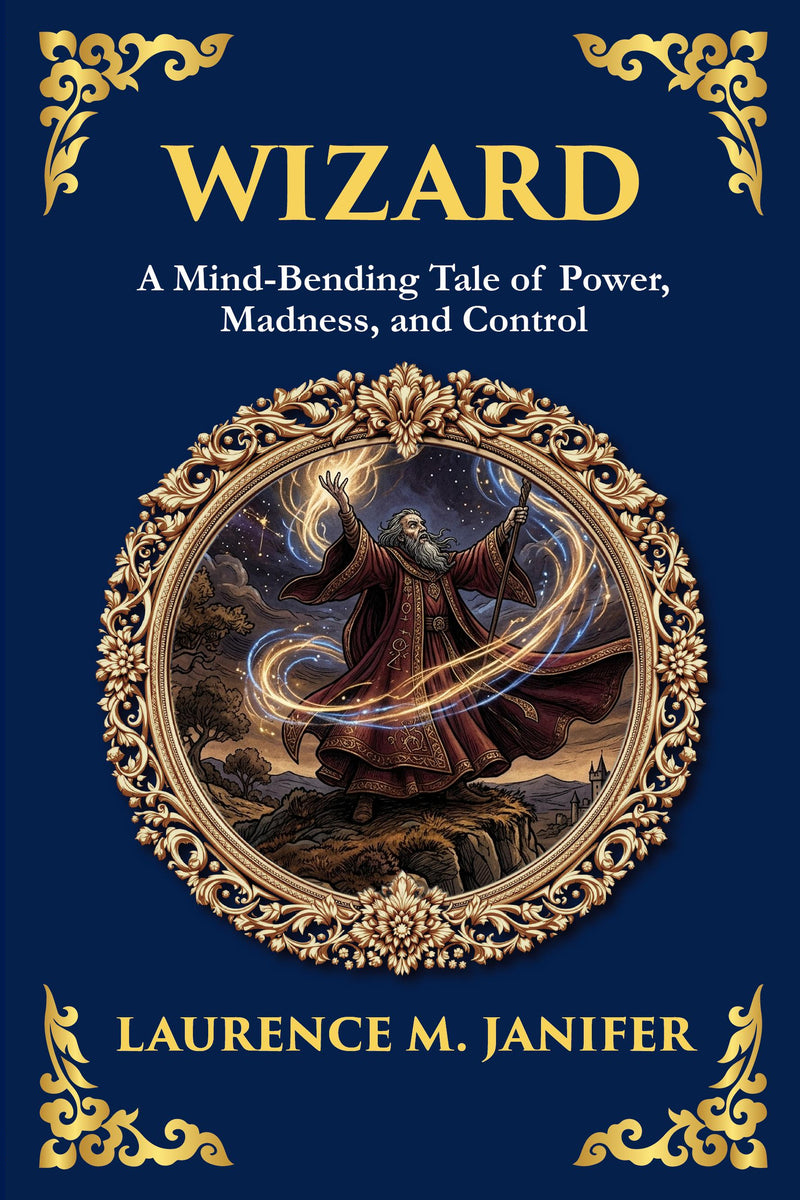
Wizard
What happens when one man discovers he has the ability to bend reality itself? In Wizard, Laurence M. Janifer crafts a gripping tale that blurs the line between genius and insanity, power and corruption.
or free app
10,000+ hrs library
30-day guarantee
The complete Wizard appears in modern English through Library of Alexandria Press, available online with audiobook narration included for members.
Have you ever wondered why those who wield the greatest power are often destroyed by it? Wizard: A Mind-Bending Tale of Power, Madness, and Control is a psychological science fiction masterpiece from Laurence M. Janifer, blending elements of speculative fiction, philosophy, and human psychology. At its core, the novel examines how extraordinary power can elevate—or unravel—the human spirit.
The “wizard” of this story is not a spell-caster in the traditional sense, but a man whose abilities to manipulate perception and bend the will of others make him appear superhuman. Yet with this power comes the slow erosion of self, a descent into obsession, paranoia, and madness. The novel explores timeless questions about autonomy, morality, and the terrifying thin line between brilliance and insanity.
This modern edition reintroduces Janifer’s dark and cerebral tale to a new generation of readers, offering both a chilling narrative and a thought-provoking exploration of the human mind.
What you’ll discover in this modern edition
- The Descent of a “Wizard” – Witness the journey of a man consumed by his own power and the creeping madness that follows.
- Power, Control, and Corruption – Explore how the ability to dominate others corrodes human morality.
- Psychological Science Fiction – Experience a genre-bending story that fuses speculative ideas with deep psychological insight.
- A Warning About Human Ambition – Confront timeless questions of free will, temptation, and the price of unchecked control.
| Formats | eBook (EPUB + PDF) · Audiobook · Paperback · Hardcover · Large Print |
| Language | English |
| Trim size (print) | 6 × 9 in |
| Binding | Paperback — perfect-bound · Hardcover — casewrap |
| Large Print edition | Same text in a larger, easy-read type — a larger font, not a larger trim |
| Print pricing | Every physical book at our true cost — at-cost, no profit (members) |
| Library | 873 restored titles, always growing |
| Length | 10,290 words · ~41 min reading |
| Reading level | Grade 3 · an easy, flowing read (this modern-English edition) |
| Edition | Modern English translation · 2026 |
Member reviews for this edition are collected as readers finish it — be the first. Across the library: 12,000+ books shipped, every plan covered by a 365-day print guarantee.
About this edition
A faithful, unabridged modern-English edition by The Library of Alexandria — carefully rendered for today's reader and verified paragraph-by-paragraph against the public-domain source. Available as eBook, audiobook, paperback, hardcover, and large print.
- Complete & unabridgedVerified paragraph by paragraph against the source — never a scan, never abridged.
- Modern English, faithfulReadable today, with the author’s meaning kept intact. Readable — not simplified.
- Every format, one membershipRead in your browser or the free app, or listen to the full audiobook.
Included free with your membership
Cancel anytime, one click · 30-day money-back guarantee
Edition last updated July 2026
What’s inside
Wizard — complete and unabridged, included in full with membership, plus the full audiobook.
Begin reading Wizard
In clear modern English — the complete text is included with membership.
Introduction
There are stories that entertain, and there are stories that linger—tales that crawl beneath the surface of the mind and refuse to leave, leaving the reader to wonder, long after the final page, exactly what they have just experienced. The book you are about to read belongs firmly to the second category. It is a work that wears the costume of science fiction, the mask of psychological thriller, and the cloak of philosophical inquiry all at once, refusing to commit fully to any single label because it knows that the most disturbing truths are the ones that slip between the cracks of our categories. What awaits you is not a comfortable journey. It is, instead, an unsettling and exhilarating descent into questions about authority, identity, and the slippery boundary between sanity and delusion.
Laurence M. Janifer, the author of this strange and provocative tale, was a writer who delighted in the friction between expectation and reality. A craftsman of mid-century speculative fiction who produced an extraordinary volume of work across decades, Janifer possessed a rare gift: he could take the familiar furniture of genre storytelling—the powers, the conspiracies, the larger-than-life characters—and rearrange it into something that felt newly dangerous. He was not content merely to thrill. He wanted to provoke, to needle, to leave the reader squirming in their chair with an idea they could not quite shake. In this respect, the work in your hands is among his most representative, and arguably among his most audacious. It does not ask you to sit back and be entertained. It asks you to think, to doubt, and ultimately to question the very ground on which you stand.
This particular edition has been prepared as a modern translation, adapted carefully for the contemporary reader. That phrase deserves a moment of explanation, because it speaks to the philosophy behind this volume and to the experience you are about to have. Janifer wrote in an era whose idioms, cadences, and cultural assumptions differ in subtle but meaningful ways from our own. A reader encountering the original text today might find certain turns of phrase quaint, certain references obscure, certain rhythms slightly out of step with the way we now process language. The work of adaptation undertaken here has been to preserve the essential voice, the wit, the menace, and the intellectual ferocity of the original while smoothing the path for a reader living in the twenty-first century. Nothing essential has been stripped away. The strangeness remains. The provocation remains. What has changed is the friction that comes from temporal distance—the small obstacles that might otherwise have stood between you and the full force of the story. Think of it as having the dust gently blown from a remarkable old painting so that its colors can strike you as vividly as they struck the first eyes to behold them.
To understand why this book matters, it helps to understand something about the man who wrote it and the world he was writing for. Janifer came of age as a writer during a period when speculative fiction was undergoing a profound transformation. The genre had begun, in its early decades, as a literature of gadgets and rockets, of square-jawed heroes solving problems with slide rules and pluck. But by the middle of the twentieth century, a new sensibility had taken hold. Writers began to realize that the most fertile territory for speculation was not outer space but inner space—the human mind, the structures of society, the architecture of power and belief. The question shifted from “What can technology do?” to “What does it mean to be human, and what happens to that humanity under pressure?”
Janifer was a creature of this new sensibility, but he brought to it a temperament all his own. He was, by temperament and craft, a skeptic. He distrusted easy answers and tidy resolutions. Where lesser writers might have used a premise about extraordinary power as an excuse for wish fulfillment—imagine the fun of being able to bend the world to your will!—Janifer was far more interested in the cost. What does power do to the person who holds it? Where is the line between mastery and madness? Can a mind that has learned to control others ever again trust its own perceptions? These are the questions that animate the pages ahead, and they are questions that Janifer approached not with the breathless enthusiasm of a believer but with the wary intelligence of someone who has thought long and hard about how easily the human mind can be deceived—including, most dangerously, by itself.
This is a writer who trusted his readers. He did not condescend. He did not pause to explain every implication or to reassure you that everything would turn out fine. He laid out his strange machinery and trusted you to be intelligent enough, curious enough, and brave enough to follow him into the dark. This trust is one of the great pleasures of reading him, but it also places a certain demand on you. You will need to pay attention. You will need to hold contradictory possibilities in your mind at once. You will need to resist the urge to settle prematurely on a single interpretation of what is happening. The reward for this effort is considerable: a reading experience that engages you as an active participant rather than a passive consumer, that respects your intelligence and rewards your attentiveness.
The subtitle of this edition—a mind-bending tale of power, madness, and control—is not idle marketing. Those three words, power, madness, and control, are the load-bearing pillars of the entire structure. They are deeply intertwined, and part of the genius of the narrative is the way it refuses to let you cleanly separate them. Power that becomes total tips inevitably toward madness. Madness that organizes itself around a coherent delusion can look indistinguishable from control. Control exercised over others may be the surest sign that one has lost control of oneself. Janifer plays these themes against one another like notes in a tense, dissonant chord, never resolving the tension into easy harmony. The result is a reading experience that hums with unease from the first page to the last.
It is worth saying a word here about the broader landscape of Janifer’s career, because it illuminates the qualities you will encounter in this book. He was an enormously prolific writer, working in collaboration as often as alone, and ranging across the full spectrum of speculative fiction—from broad adventure to sharp satire, from puzzle-box mysteries to meditations on the human condition. This breadth was not a sign of dilettantism but of restless intelligence. Janifer was always trying something, always testing the boundaries of what a story could do. He had a particular fascination with the workings of the mind, with perception and deception, with the way intelligence and identity could be twisted, manipulated, or unmoored. He returned again and again to characters operating at the edge of their own understanding, characters whose grip on reality is precarious, whose sense of self is under siege. The tale you are about to read distills this lifelong preoccupation into one of its most concentrated and disturbing forms.
There is also, running through Janifer’s work, a current of dark humor and intellectual mischief. He was not a grim writer in the way that some authors of psychological fiction can be grim—relentless, airless, suffocating. There is play in his prose, a glint in the eye, a sense that the author is enjoying the dance even as he leads you toward the cliff. This quality survives in the present edition, and you should be alert to it. Some of the most chilling moments in the book are also, in their way, the wittiest. Janifer understood that horror and comedy spring from the same source—the violation of expectation, the sudden lurch of the floor beneath our feet—and he was unafraid to let the two bleed into one another. Do not be surprised if you find yourself smiling at something that, a moment later, makes the hair on your neck stand up. That doubling of response is precisely what he was after.
Why bring this book to a contemporary audience now? Why undertake the careful work of translation and adaptation to place it once more in the hands of readers? The answer lies in how startlingly relevant its central concerns have become. When Janifer first explored the themes of power, madness, and control, he was working in a speculative register, imagining extremities of the human condition that might have seemed, to some readers, safely abstract. We do not have that luxury anymore. We live in an age preoccupied, even obsessed, with the manipulation of perception. We are surrounded by technologies and systems designed to influence what we believe, what we want, and how we behave. We have grown fluent in the vocabulary of disinformation, of psychological manipulation, of the strange new ways that reality itself can seem to fracture and multiply. The questions that once felt speculative now feel urgent, even intimate.
Consider the central anxiety that pulses beneath this narrative: the fear that one’s own mind might not be a reliable witness to the world. This is no longer a fanciful concern. It is, increasingly, the texture of daily life in a hyperconnected society, where every individual is the target of countless competing attempts to shape their perceptions, where the line between authentic experience and engineered influence grows blurrier by the day. Janifer’s protagonist wrestles with exactly this terror, and in doing so becomes a strange mirror for our own predicament. When you read of a character struggling to determine whether their extraordinary perceptions reflect reality or delusion, whether they are wielding power or being wielded by it, you may find the boundary between fiction and reality growing uncomfortably thin. This is not an accident. It is the deep prophetic power of the best speculative fiction, which is always, beneath its trappings, a literature about the present.
There is, too, the matter of control—who has it, who exercises it, who suffers under it. The book examines control not merely as a plot mechanism but as a moral and psychological phenomenon. What does it mean to control another person? What does it do to the one who controls and to the one controlled? Where is the line between guidance and tyranny, between persuasion and coercion, between leadership and domination? These are questions that resonate across every scale of human life, from the most intimate relationships to the grandest structures of politics and society. Janifer does not lecture. He does not hand you a thesis. Instead he dramatizes these questions through situation and character, allowing you to feel their weight in your gut before you ever articulate them in your mind. By the time you finish the book, you may find that your own assumptions about power and freedom have been subtly rearranged.
A few words of guidance may help you make the most of the experience that lies ahead. First, read slowly, at least at the beginning. Janifer establishes his premises with care, and the early chapters lay groundwork that will pay rich dividends later. Resist the temptation to rush. Allow the strangeness to accumulate. Notice the small details, the things characters say and do not say, the gaps and ambiguities in what you are told. This is a book that rewards close attention, and some of its most important effects depend on your having absorbed information that the narrative offers quietly, almost in passing.
Second, hold your judgments loosely. The narrative will, at various points, invite you to draw conclusions about what is real, who is trustworthy, and what is actually happening. Be wary of settling too quickly. Part of the artistry here lies in the way the ground keeps shifting beneath you. A conclusion that seems obvious in one chapter may look very different a few chapters later. The reader who keeps an open mind, who is willing to revise and reconsider, will find the experience far richer than the reader who locks in early and refuses to budge. This is, in a sense, a book about the dangers of certainty, and it is fitting that it should ask you to practice a kind of productive uncertainty as you read.
Cancel anytime, one click · 30-day money-back guarantee
Founding annual rate available now — your price locks for life when you join.
Not ready? Get this free chapter by email — read it anytime.
✓ Sent — check your inbox for Wizard.
Questions about Wizard
What is Wizard about?
What happens when one man discovers he has the ability to bend reality itself? In Wizard, Laurence M. Janifer crafts a gripping tale that blurs the line between genius and insanity, power and corruption. The story follows a man whose uncanny abilities give him influence over others, but as his control grows, so too does the madness within.
Who wrote Wizard?
Wizard was written by Laurence M. Janifer. This edition presents the complete work in clear modern English, faithfully rendered from the public-domain original by Library of Alexandria Press.
Is Wizard free to read?
The opening chapter is free to read on this page. Members read and listen to the complete work — and the entire library — free, and can order any physical book at our true print cost.
How long is Wizard?
2 chapters (~10,290 words) — about 41 min of reading in this modern-English edition.
Is this an abridged version of Wizard?
No. This is the complete, unabridged Wizard, carefully rendered into clear modern English and verified paragraph-by-paragraph against the public-domain source — nothing is cut or summarised.
What formats does Wizard come in?
Wizard is available as eBook, paperback, hardcover and large print. eBook and audiobook are included with membership; printed editions ship at our true print cost.
Shipping & returns
Billing & membership
More from the library


Explore Adventure
- Tarzan of the Apes · Edgar Rice Burroughs
- The Wonderful Wizard of Oz · L. Frank Baum
- Peter Pan · J. M. Barrie
- Moby Dick; Or, The Whale · Herman Melville
- The Riddle of the Sands · Erskine Childers
- The Loss of the Swansea: A Story of the Florida Coast · W. L. Alden
- Sky Island · L. Frank Baum
- Vikram and the Vampire: Classic Hindu Tales of Adventure, Magic, and Romance · Unknown
- Tales of Unrest · Joseph Conrad
- The Tomb of Ts’in · Edgar Wallace
- Skinny McCord · Percy Keese Fitzhugh
- The Men of the Moss-Hags · S. R. Crockett
- The Hunniwell Boys and the Platinum Mystery · L. P. Wyman
- Allan Quatermain · H. Rider Haggard
- She · H. Rider Haggard
- Medical Life in the Navy · Gordon Stables
- The Thirty-Nine Steps · John Buchan
- The Story of Doctor Dolittle · Hugh Lofting
- The Princess and the Goblin · George MacDonald
- The Man Who Would Be King · Rudyard Kipling
- Lucian’s True History · Lucian of Samosata
- The Secret Adversary · Agatha Christie
- Lord Jim · Joseph Conrad
- The Marvelous Land of Oz · L. Frank Baum
- The Virginian: A Horseman of the Plains · Owen Wister
- Mars is My Destination · Frank Belknap Long
- Anabasis · Xenophon
- The Mississippi Saucer · Frank Belknap Long
- Sabotage in Space · Carey Rockwell
- Brood of the Dark Moon · Charles Willard Diffin
Wizard
Wizard
A Mind-Bending Tale of Power, Madness, and Control
Laurence M. Janifer
Contents
- Introduction
- Wizard.
Introduction
There are stories that entertain, and there are stories that linger—tales that crawl beneath the surface of the mind and refuse to leave, leaving the reader to wonder, long after the final page, exactly what they have just experienced. The book you are about to read belongs firmly to the second category. It is a work that wears the costume of science fiction, the mask of psychological thriller, and the cloak of philosophical inquiry all at once, refusing to commit fully to any single label because it knows that the most disturbing truths are the ones that slip between the cracks of our categories. What awaits you is not a comfortable journey. It is, instead, an unsettling and exhilarating descent into questions about authority, identity, and the slippery boundary between sanity and delusion.
Laurence M. Janifer, the author of this strange and provocative tale, was a writer who delighted in the friction between expectation and reality. A craftsman of mid-century speculative fiction who produced an extraordinary volume of work across decades, Janifer possessed a rare gift: he could take the familiar furniture of genre storytelling—the powers, the conspiracies, the larger-than-life characters—and rearrange it into something that felt newly dangerous. He was not content merely to thrill. He wanted to provoke, to needle, to leave the reader squirming in their chair with an idea they could not quite shake. In this respect, the work in your hands is among his most representative, and arguably among his most audacious. It does not ask you to sit back and be entertained. It asks you to think, to doubt, and ultimately to question the very ground on which you stand.
This particular edition has been prepared as a modern translation, adapted carefully for the contemporary reader. That phrase deserves a moment of explanation, because it speaks to the philosophy behind this volume and to the experience you are about to have. Janifer wrote in an era whose idioms, cadences, and cultural assumptions differ in subtle but meaningful ways from our own. A reader encountering the original text today might find certain turns of phrase quaint, certain references obscure, certain rhythms slightly out of step with the way we now process language. The work of adaptation undertaken here has been to preserve the essential voice, the wit, the menace, and the intellectual ferocity of the original while smoothing the path for a reader living in the twenty-first century. Nothing essential has been stripped away. The strangeness remains. The provocation remains. What has changed is the friction that comes from temporal distance—the small obstacles that might otherwise have stood between you and the full force of the story. Think of it as having the dust gently blown from a remarkable old painting so that its colors can strike you as vividly as they struck the first eyes to behold them.
To understand why this book matters, it helps to understand something about the man who wrote it and the world he was writing for. Janifer came of age as a writer during a period when speculative fiction was undergoing a profound transformation. The genre had begun, in its early decades, as a literature of gadgets and rockets, of square-jawed heroes solving problems with slide rules and pluck. But by the middle of the twentieth century, a new sensibility had taken hold. Writers began to realize that the most fertile territory for speculation was not outer space but inner space—the human mind, the structures of society, the architecture of power and belief. The question shifted from “What can technology do?” to “What does it mean to be human, and what happens to that humanity under pressure?”
Janifer was a creature of this new sensibility, but he brought to it a temperament all his own. He was, by temperament and craft, a skeptic. He distrusted easy answers and tidy resolutions. Where lesser writers might have used a premise about extraordinary power as an excuse for wish fulfillment—imagine the fun of being able to bend the world to your will!—Janifer was far more interested in the cost. What does power do to the person who holds it? Where is the line between mastery and madness? Can a mind that has learned to control others ever again trust its own perceptions? These are the questions that animate the pages ahead, and they are questions that Janifer approached not with the breathless enthusiasm of a believer but with the wary intelligence of someone who has thought long and hard about how easily the human mind can be deceived—including, most dangerously, by itself.
This is a writer who trusted his readers. He did not condescend. He did not pause to explain every implication or to reassure you that everything would turn out fine. He laid out his strange machinery and trusted you to be intelligent enough, curious enough, and brave enough to follow him into the dark. This trust is one of the great pleasures of reading him, but it also places a certain demand on you. You will need to pay attention. You will need to hold contradictory possibilities in your mind at once. You will need to resist the urge to settle prematurely on a single interpretation of what is happening. The reward for this effort is considerable: a reading experience that engages you as an active participant rather than a passive consumer, that respects your intelligence and rewards your attentiveness.
The subtitle of this edition—a mind-bending tale of power, madness, and control—is not idle marketing. Those three words, power, madness, and control, are the load-bearing pillars of the entire structure. They are deeply intertwined, and part of the genius of the narrative is the way it refuses to let you cleanly separate them. Power that becomes total tips inevitably toward madness. Madness that organizes itself around a coherent delusion can look indistinguishable from control. Control exercised over others may be the surest sign that one has lost control of oneself. Janifer plays these themes against one another like notes in a tense, dissonant chord, never resolving the tension into easy harmony. The result is a reading experience that hums with unease from the first page to the last.
It is worth saying a word here about the broader landscape of Janifer’s career, because it illuminates the qualities you will encounter in this book. He was an enormously prolific writer, working in collaboration as often as alone, and ranging across the full spectrum of speculative fiction—from broad adventure to sharp satire, from puzzle-box mysteries to meditations on the human condition. This breadth was not a sign of dilettantism but of restless intelligence. Janifer was always trying something, always testing the boundaries of what a story could do. He had a particular fascination with the workings of the mind, with perception and deception, with the way intelligence and identity could be twisted, manipulated, or unmoored. He returned again and again to characters operating at the edge of their own understanding, characters whose grip on reality is precarious, whose sense of self is under siege. The tale you are about to read distills this lifelong preoccupation into one of its most concentrated and disturbing forms.
There is also, running through Janifer’s work, a current of dark humor and intellectual mischief. He was not a grim writer in the way that some authors of psychological fiction can be grim—relentless, airless, suffocating. There is play in his prose, a glint in the eye, a sense that the author is enjoying the dance even as he leads you toward the cliff. This quality survives in the present edition, and you should be alert to it. Some of the most chilling moments in the book are also, in their way, the wittiest. Janifer understood that horror and comedy spring from the same source—the violation of expectation, the sudden lurch of the floor beneath our feet—and he was unafraid to let the two bleed into one another. Do not be surprised if you find yourself smiling at something that, a moment later, makes the hair on your neck stand up. That doubling of response is precisely what he was after.
Why bring this book to a contemporary audience now? Why undertake the careful work of translation and adaptation to place it once more in the hands of readers? The answer lies in how startlingly relevant its central concerns have become. When Janifer first explored the themes of power, madness, and control, he was working in a speculative register, imagining extremities of the human condition that might have seemed, to some readers, safely abstract. We do not have that luxury anymore. We live in an age preoccupied, even obsessed, with the manipulation of perception. We are surrounded by technologies and systems designed to influence what we believe, what we want, and how we behave. We have grown fluent in the vocabulary of disinformation, of psychological manipulation, of the strange new ways that reality itself can seem to fracture and multiply. The questions that once felt speculative now feel urgent, even intimate.
Consider the central anxiety that pulses beneath this narrative: the fear that one’s own mind might not be a reliable witness to the world. This is no longer a fanciful concern. It is, increasingly, the texture of daily life in a hyperconnected society, where every individual is the target of countless competing attempts to shape their perceptions, where the line between authentic experience and engineered influence grows blurrier by the day. Janifer’s protagonist wrestles with exactly this terror, and in doing so becomes a strange mirror for our own predicament. When you read of a character struggling to determine whether their extraordinary perceptions reflect reality or delusion, whether they are wielding power or being wielded by it, you may find the boundary between fiction and reality growing uncomfortably thin. This is not an accident. It is the deep prophetic power of the best speculative fiction, which is always, beneath its trappings, a literature about the present.
There is, too, the matter of control—who has it, who exercises it, who suffers under it. The book examines control not merely as a plot mechanism but as a moral and psychological phenomenon. What does it mean to control another person? What does it do to the one who controls and to the one controlled? Where is the line between guidance and tyranny, between persuasion and coercion, between leadership and domination? These are questions that resonate across every scale of human life, from the most intimate relationships to the grandest structures of politics and society. Janifer does not lecture. He does not hand you a thesis. Instead he dramatizes these questions through situation and character, allowing you to feel their weight in your gut before you ever articulate them in your mind. By the time you finish the book, you may find that your own assumptions about power and freedom have been subtly rearranged.
A few words of guidance may help you make the most of the experience that lies ahead. First, read slowly, at least at the beginning. Janifer establishes his premises with care, and the early chapters lay groundwork that will pay rich dividends later. Resist the temptation to rush. Allow the strangeness to accumulate. Notice the small details, the things characters say and do not say, the gaps and ambiguities in what you are told. This is a book that rewards close attention, and some of its most important effects depend on your having absorbed information that the narrative offers quietly, almost in passing.
Second, hold your judgments loosely. The narrative will, at various points, invite you to draw conclusions about what is real, who is trustworthy, and what is actually happening. Be wary of settling too quickly. Part of the artistry here lies in the way the ground keeps shifting beneath you. A conclusion that seems obvious in one chapter may look very different a few chapters later. The reader who keeps an open mind, who is willing to revise and reconsider, will find the experience far richer than the reader who locks in early and refuses to budge. This is, in a sense, a book about the dangers of certainty, and it is fitting that it should ask you to practice a kind of productive uncertainty as you read.
While the Masquerade—a necessary shield against non-telepaths—wasn’t fully established until the late 17th century, groups of telepaths had been hiding in secret long before then. It is still unclear whether these groups resulted from natural mutations or some other cause, but we are certain that one existed in the Offenburg district of what is now Prussia. This group seems to have started its activities around 1594, though it took eleven years for them to achieve a major victory—the first, and perhaps the only one of its kind, until the Masquerade ended in 2103.
—Excerpt from “A Short History of the Masquerade,” by A. Milge, Crystal 704-54-368, Produced 2440.
Jonas whistled as he came over the hill, looking as if he didn’t have a care in the world. He knew that wasn’t even close to the truth, and the thought made him happy. He found total peace foreign and almost repulsive; he was at his best when he had a job to do, especially one that carried a slight, unavoidable risk.
This time, however, the risk was more than slight. He thought happily that he could actually be killed—and in a very painful way, too! With great satisfaction, he paused at the crest of the hill, hands on his hips, looking down at the town of Speyer baking in the May afternoon sun.
“Behold the tortoise: he makes no progress unless he sticks out his neck.” But he makes very little progress if he doesn’t pick the right time and place to do it—which can be a dangerous problem for a man living in a medieval society!
Despite his confident pose, Jonas didn’t look like a typical hero from a folk tale or a history book. He wasn’t seven feet tall, he didn’t have a handsome face with sparkling blue eyes, and he didn’t have a broad-shouldered, athletic build. Instead, he was slightly shorter than the average European man of 1605. He had small, recessed eyes that seemed to see everything but never made a scene about it. His body was a bit squat, and his face was even lumpier. To be honest, it was hard to tell where his nose ended and the various bruises, swellings, and marks on his head began.
End of the free sample
Keep reading, free
Members read and listen to the complete book — and the entire library. Cancel anytime, one click · 30-day money-back guarantee.