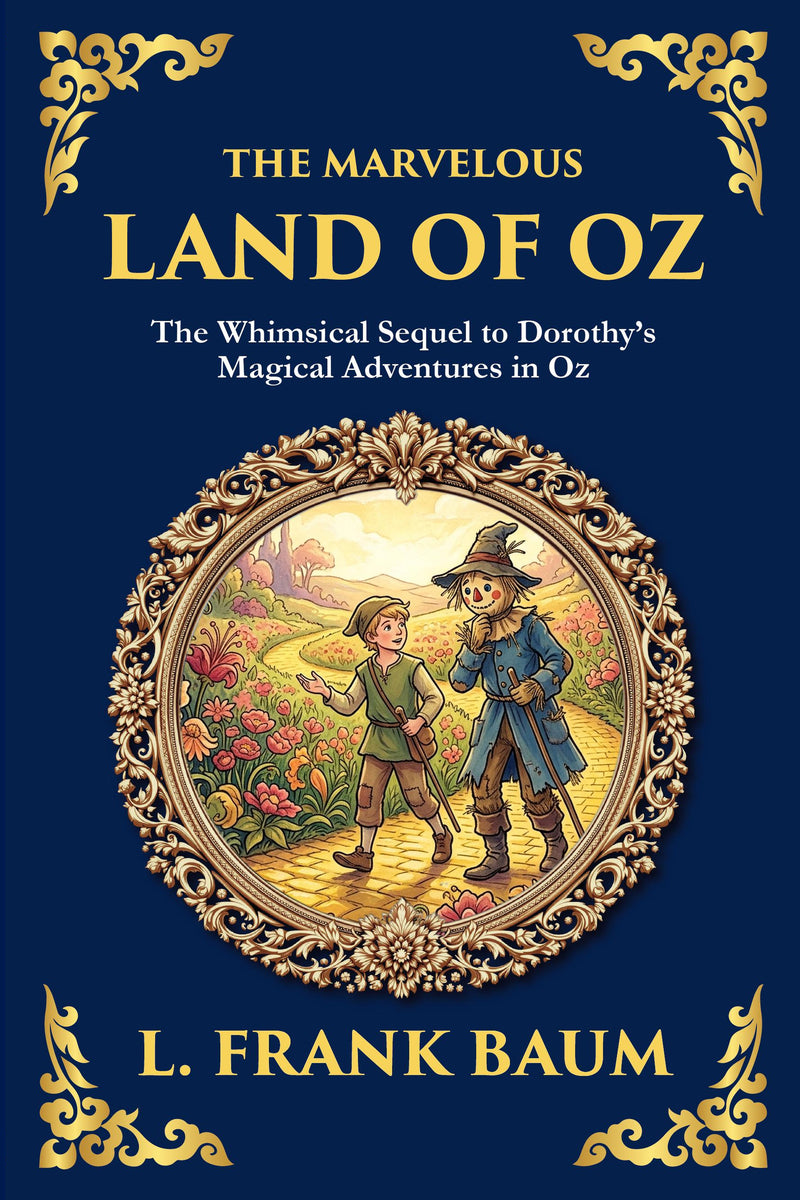
The Marvelous Land of Oz
Return to the magical world of Oz in this delightful sequel to The Wonderful Wizard of Oz. When a young boy named Tip escapes from the clutches of a wicked witch, he sets off on a fantastical journey filled with talking creatures, animated pumpkins, and enchanted adventures.
or free app
10,000+ hrs library
30-day guarantee
The complete The Marvelous Land of Oz appears in modern English through Library of Alexandria Press, available online with audiobook narration included for members.
Have you ever wondered why the Land of Oz remains one of the most beloved worlds in literature? The Marvelous Land of Oz is the captivating second installment in L. Frank Baum’s legendary Oz series. Unlike its predecessor, this enchanting tale introduces us to a new protagonist—Tip, a mischievous orphan boy who lives under the rule of the sinister witch Mombi.
When Tip escapes using a magical powder to animate his pumpkin-headed creation, Jack, a new adventure begins—one that will take readers on a whirlwind tour through the dazzling landscapes and quirky kingdoms of Oz. From battling armies made of girls to the discovery of a hidden royal lineage, Baum weaves a story brimming with whimsy, wit, and profound imagination. Readers young and old will delight in the vibrant characters and clever twists that make this sequel just as unforgettable as the original.
What you’ll discover in this modern edition
- A Hero's Wild Escape from Witchcraft – Follow Tip as he runs from the cruel Mombi and conjures up a world of animated companions.
| Formats | eBook (EPUB + PDF) · Audiobook · Paperback · Hardcover · Large Print |
| Language | English |
| Trim size (print) | 6 × 9 in |
| Binding | Paperback — perfect-bound · Hardcover — casewrap |
| Large Print edition | Same text in a larger, easy-read type — a larger font, not a larger trim |
| Print pricing | Every physical book at our true cost — at-cost, no profit (members) |
| Library | 873 restored titles, always growing |
| Length | 42,407 words · ~2 hr 50 min reading |
| Reading level | Grade 8 · an easy, flowing read (this modern-English edition) |
| Edition | Modern English translation · 2026 |
Member reviews for this edition are collected as readers finish it — be the first. Across the library: 12,000+ books shipped, every plan covered by a 365-day print guarantee.
About this edition
A faithful, unabridged modern-English edition by The Library of Alexandria — carefully rendered for today's reader and verified paragraph-by-paragraph against the public-domain source. Available as eBook, audiobook, paperback, hardcover, and large print.
- Complete & unabridgedVerified paragraph by paragraph against the source — never a scan, never abridged.
- Modern English, faithfulReadable today, with the author’s meaning kept intact. Readable — not simplified.
- Every format, one membershipRead in your browser or the free app, or listen to the full audiobook.
Included free with your membership
Cancel anytime, one click · 30-day money-back guarantee
Edition last updated July 2026
What’s inside
The Marvelous Land of Oz — complete and unabridged: all 27 sections included with membership, plus the full audiobook.
Begin reading The Marvelous Land of Oz
In clear modern English — the complete text is included with membership.
Introduction
When L. Frank Baum closed the covers of his runaway 1900 bestseller, The Wonderful Wizard of Oz, he believed he had said all he wished to say about the magical country beyond the deadly desert. He had given the world a heroine in gingham, a road paved with yellow brick, and a quartet of unforgettable companions whose longings for brains, heart, courage, and home had touched something deep in the American imagination. He fully expected to move on to other projects, other fairy tales, other landscapes of his fertile mind. But Baum had not reckoned with his readers. Children, by the thousands and then the hundreds of thousands, refused to let Oz go. They wrote him letters. They begged for more. They wanted to know what happened next—not necessarily to Dorothy, who had returned safely to Kansas, but to the wondrous land itself, to its Scarecrow and its Tin Woodman and to all the strange and delightful corners that the first book had only begun to explore.
And so, in 1904, four years after the original, Baum returned to the country he had created and gave the world this second book—a sequel that is at once a continuation and a fresh beginning, a story that honors what came before while striking out boldly in new directions. What you hold in your hands is a modern translation of that beloved tale, adapted with care for the contemporary reader so that the language, the rhythms, and the references feel inviting rather than dusty, while the irrepressible spirit of Baum’s original remains gloriously intact. This is a book to be savored slowly, read aloud if you have the chance, and returned to whenever the world feels too gray and you find yourself longing for somewhere greener.
Readers approaching this book with memories of Dorothy’s adventure should prepare for a few delightful surprises. This is not simply The Wonderful Wizard of Oz with the names changed and the scenery rearranged. Baum was far too inventive a storyteller to repeat himself, and in this second outing he made a number of bold choices that distinguish the sequel sharply from its predecessor. Most strikingly, the little girl from Kansas does not appear—at least not in the way one might expect. Baum deliberately stepped away from his original heroine, introducing instead an entirely new protagonist whose journey forms the beating heart of this tale. This decision, daring for an author whose fame rested almost entirely on a single child character, signals from the very first pages that the writer intended to expand the boundaries of his magical world rather than merely retread familiar ground.
The effect is invigorating. By shifting the perspective and the cast, Baum frees himself to show us parts of Oz we never glimpsed before, to introduce inventions and creatures and personalities that broaden our sense of just how vast and varied this country truly is. The land that seemed almost fully mapped at the end of the first book reveals itself here to be far larger, far stranger, and far more populous than we had ever imagined. There are kingdoms within kingdoms, characters whose ambitions and follies drive the plot forward with comic energy, and at least one creation so marvelously absurd that it has become a fixture of Oz lore ever since. Baum understood that a fairy land is only as interesting as the things we have not yet seen in it, and so he gives us, in this volume, a generous helping of the new.
At the same time, the sequel never abandons the friends we came to love in the first book. The Scarecrow returns, as wise and good-hearted and faintly ridiculous as ever, his stuffing of brains put to use in ways both clever and unexpectedly touching. The Tin Woodman, too, makes his appearance, gleaming and gentle, forever attentive to the feelings of those around him. To watch these familiar figures interact with the newcomers is one of the great pleasures of the book. Baum had a rare gift for character, and he understood that readers do not simply want to know what happens to the people they love—they want to spend time with them, to enjoy their company, to hear them banter and bicker and reason through their dilemmas with the peculiar logic that governs Oz. The conversations in this book are frequently its finest moments, full of gentle wit and absurd reasoning that somehow arrives at perfect sense.
There is, too, a quality of playfulness in this volume that pervades every chapter. The subtitle promises a “playful” sequel, and the description is apt. Where the first book carried a certain undertone of yearning—Dorothy’s homesickness, the companions’ sense of incompleteness—this second adventure is lighter on its feet, more given to comedy and to the sheer delight of invention. Baum seems to be enjoying himself enormously, tossing off marvelous ideas with the casual generosity of a man who has discovered a bottomless well of imagination. Magical transformations, impossible journeys, comic misunderstandings, and a cheerful disregard for the ordinary laws of nature tumble across the pages one after another. The reader is swept along not by suspense in the conventional sense, but by a constant, joyful curiosity about what extraordinary thing might appear next.
This is not to say the book lacks substance. Beneath its merry surface, Baum weaves in themes that reward attention. Questions of identity—of who a person truly is and how they come to know themselves—run quietly throughout the narrative. There are gentle reflections on power and its proper use, on the difference between cleverness and wisdom, on loyalty and friendship and the responsibilities we bear toward one another. Baum never lectures; he was congenitally incapable of preachiness, and he had a healthy distrust of the heavy-handed morals that weighed down so much children’s literature in his era. In the introduction to his first Oz book, he had famously declared his intention to write a “modernized fairy tale” in which “the wonderment and joy are retained and the heartaches and nightmares are left out.” The sequel honors that pledge. Its lessons, such as they are, arrive lightly, woven into the fabric of an adventure that never forgets its first duty is to delight.
One element of this book deserves particular mention, though to describe it in detail would spoil one of its loveliest surprises. Baum, writing in an age very different from our own, was nonetheless a man of unusually progressive sympathies in certain respects—his own mother-in-law was the celebrated suffragist Matilda Joslyn Gage, and the women of his life were strong, intelligent, and politically engaged. Something of that influence finds its way into the pages that follow, in a manner both comic and quietly subversive. Readers attuned to such things will find moments that feel surprisingly modern, even prescient, and that add an extra dimension of interest to a story that might otherwise seem purely whimsical. Baum’s Oz was always, in its gentle way, a place where the usual rules of the world could be questioned and overturned, and this book extends that tradition in directions that may catch the careful reader off guard.
The structure of the narrative follows the time-honored shape of the quest, that most ancient and satisfying of story patterns. A journey is undertaken; obstacles are met and overcome; companions are gathered along the way; and the whole moves toward a resolution that ties together the various threads in a manner both surprising and inevitable. Baum was a master of pacing, and he keeps the story moving briskly, rarely lingering too long in any one place before sweeping his characters—and his readers—onward to the next marvel. This episodic quality, in which each chapter brings a fresh encounter or a new wonder, makes the book ideally suited to reading in small portions, a chapter or two at a sitting, whether alone or shared aloud with a child at bedtime. Yet it also rewards the reader who chooses to devour it in a single long, happy session, for the cumulative effect of all these wonders piling one atop another is a kind of joyful intoxication.
To understand this book fully, it helps to understand a little about the remarkable man who wrote it. Lyman Frank Baum—he detested the name Lyman and went by Frank all his life—was born in 1856 in upstate New York, the son of a father who had made a considerable fortune in the oil business. He was a sickly child with a weak heart, much given to daydreaming, and from an early age he displayed the kind of restless, romantic imagination that finds the ordinary world insufficient. He tried his hand at an extraordinary number of careers before finding his true calling. He raised fancy chickens and wrote a treatise on poultry. He acted on the stage and wrote plays. He ran a variety store in a frontier town in the Dakota Territory, which failed. He edited a newspaper, which also failed. He sold china and glassware as a traveling salesman. He founded and edited a trade journal for shop-window decorators, an early form of what we would now call visual merchandising—a field in which his flair for spectacle and arrangement served him well.
Through all these ventures, two constants remained: he was forever short of money, and he was forever telling stories. Baum had a genius for spinning tales, and he honed it on his own four sons and on the neighborhood children who gathered around him. He did not set out to be a famous author; he stumbled into it almost by accident, encouraged by his formidable mother-in-law and by his devoted wife, Maud, who had a sharper head for practical matters than her dreamy husband. His first real success came with a collection of nursery rhymes, followed by a book of original fairy tales. But it was the publication of The Wonderful Wizard of Oz in 1900, illustrated by W. W. Denslow, that transformed his fortunes and made his name a household word.
The success of that first book was enormous and, for Baum, life-changing. After decades of struggle and failure, he had at last found the thing he was meant to do. But success brought its own complications. Baum was a spendthrift and a dreamer, perpetually pouring his earnings into ambitious projects—stage productions, early experiments in film, elaborate musical extravaganzas based on his books. He was, in the truest sense, a showman, and he could never resist the lure of a grand theatrical gesture. Indeed, this very book owes part of its existence to the stage. A wildly popular musical extravaganza based on the first Oz story had been touring the country, and Baum, ever the entrepreneur, conceived of the sequel partly with an eye toward adapting it for the theater as well. Some scholars detect in the book’s broad comedy and its memorable comic duo the influence of vaudeville and musical theater, the kind of knockabout humor that played well before a live audience. Whether or not one accepts this reading, there is no denying the theatrical energy that animates the story—the sense of a born entertainer working to keep his audience laughing and gasping by turns.
Baum would go on to write a great many more Oz books—fourteen in all before his death in 1919—along with dozens of other fairy tales and adventures, some published under pseudonyms. He never quite escaped Oz; he tried more than once to close the series and turn to other things, only to be drawn back by the inexhaustible appetite of his readers. In one famous attempt, he declared the magical country sealed off from the outside world forever, a barrier that conveniently proved permeable when commercial necessity required it. He came to call himself the “Royal Historian of Oz,” a charming conceit that positioned him not as the inventor of these tales but merely as their faithful recorder, transcribing reports that reached him from the magical land by various improbable means. It was a fiction his young readers happily embraced, and it lent the entire series a delightful air of being true.
What makes Baum’s work endure is harder to pin down. Part of it is the sheer fertility of his invention—few authors have ever populated their imaginary worlds with such an abundance of original creatures, characters, and contraptions. Part of it is his distinctively American sensibility. Baum consciously set out to create a fairy tale free of the European traditions of wicked witches and dark forests and grim moral lessons—though witches do appear, they are recognizably of the New World, brisk and businesslike rather than gothic and terrifying. His Oz is a land of practical magic, of inventions and gadgets, of democratic good sense rubbing shoulders with the marvelous. There is something quintessentially American in its optimism, its egalitarianism, its faith that ordinary individuals possessed of good hearts and willing hands can overcome any obstacle.
Cancel anytime, one click · 30-day money-back guarantee
Founding annual rate available now — your price locks for life when you join.
Not ready? Get this free chapter by email — read it anytime.
✓ Sent — check your inbox for The Marvelous Land of Oz.
Questions about The Marvelous Land of Oz
What is The Marvelous Land of Oz about?
Return to the magical world of Oz in this delightful sequel to The Wonderful Wizard of Oz. When a young boy named Tip escapes from the clutches of a wicked witch, he sets off on a fantastical journey filled with talking creatures, animated pumpkins, and enchanted adventures. Along the way, Tip meets unforgettable new characters and uncovers a secret that will shake the Emerald City to its core.
Who wrote The Marvelous Land of Oz?
The Marvelous Land of Oz was written by L. Frank Baum. This edition presents the complete work in clear modern English, faithfully rendered from the public-domain original by Library of Alexandria Press.
Is The Marvelous Land of Oz free to read?
The opening chapter is free to read on this page. Members read and listen to the complete work — and the entire library — free, and can order any physical book at our true print cost.
How long is The Marvelous Land of Oz?
27 chapters (~42,407 words) — about 2 hr 50 min of reading in this modern-English edition.
Is this an abridged version of The Marvelous Land of Oz?
No. This is the complete, unabridged The Marvelous Land of Oz, carefully rendered into clear modern English and verified paragraph-by-paragraph against the public-domain source — nothing is cut or summarised.
What formats does The Marvelous Land of Oz come in?
The Marvelous Land of Oz is available as eBook, paperback, hardcover and large print. eBook and audiobook are included with membership; printed editions ship at our true print cost.
Shipping & returns
Billing & membership
More from the library


Explore Adventure
- Tarzan of the Apes · Edgar Rice Burroughs
- The Wonderful Wizard of Oz · L. Frank Baum
- Peter Pan · J. M. Barrie
- Moby Dick; Or, The Whale · Herman Melville
- The Riddle of the Sands · Erskine Childers
- The Loss of the Swansea: A Story of the Florida Coast · W. L. Alden
- Sky Island · L. Frank Baum
- Vikram and the Vampire: Classic Hindu Tales of Adventure, Magic, and Romance · Unknown
- Tales of Unrest · Joseph Conrad
- The Tomb of Ts’in · Edgar Wallace
- Skinny McCord · Percy Keese Fitzhugh
- The Men of the Moss-Hags · S. R. Crockett
- The Hunniwell Boys and the Platinum Mystery · L. P. Wyman
- Allan Quatermain · H. Rider Haggard
- She · H. Rider Haggard
- Medical Life in the Navy · Gordon Stables
- The Thirty-Nine Steps · John Buchan
- The Story of Doctor Dolittle · Hugh Lofting
- The Princess and the Goblin · George MacDonald
- The Man Who Would Be King · Rudyard Kipling
- Lucian’s True History · Lucian of Samosata
- The Secret Adversary · Agatha Christie
- Lord Jim · Joseph Conrad
- The Virginian: A Horseman of the Plains · Owen Wister
- Mars is My Destination · Frank Belknap Long
- Anabasis · Xenophon
- The Mississippi Saucer · Frank Belknap Long
- Sabotage in Space · Carey Rockwell
- Brood of the Dark Moon · Charles Willard Diffin
- The Misplaced Battleship · Harry Harrison
The Marvelous Land of Oz
The Marvelous Land of Oz
The Playful Sequel to Dorothy’s Magical Adventures in Oz
L. Frank Baum
Contents
- Introduction
- Chapter 1
- Chapter 2
- Chapter 3
- Chapter 4
- Chapter 5
- Chapter 6
- Chapter 7
- Chapter 8
- Chapter 9
- Chapter 10
- Chapter 11
- Chapter 12
- Chapter 13
- Chapter 14
- Chapter 15
- Chapter 16
- Chapter 17
- Chapter 18
- Chapter 19
- Chapter 20
- Chapter 21
- Chapter 22
- Chapter 23
- Chapter 24
- Chapter 25
- Chapter 26
Introduction
When L. Frank Baum closed the covers of his runaway 1900 bestseller, The Wonderful Wizard of Oz, he believed he had said all he wished to say about the magical country beyond the deadly desert. He had given the world a heroine in gingham, a road paved with yellow brick, and a quartet of unforgettable companions whose longings for brains, heart, courage, and home had touched something deep in the American imagination. He fully expected to move on to other projects, other fairy tales, other landscapes of his fertile mind. But Baum had not reckoned with his readers. Children, by the thousands and then the hundreds of thousands, refused to let Oz go. They wrote him letters. They begged for more. They wanted to know what happened next—not necessarily to Dorothy, who had returned safely to Kansas, but to the wondrous land itself, to its Scarecrow and its Tin Woodman and to all the strange and delightful corners that the first book had only begun to explore.
And so, in 1904, four years after the original, Baum returned to the country he had created and gave the world this second book—a sequel that is at once a continuation and a fresh beginning, a story that honors what came before while striking out boldly in new directions. What you hold in your hands is a modern translation of that beloved tale, adapted with care for the contemporary reader so that the language, the rhythms, and the references feel inviting rather than dusty, while the irrepressible spirit of Baum’s original remains gloriously intact. This is a book to be savored slowly, read aloud if you have the chance, and returned to whenever the world feels too gray and you find yourself longing for somewhere greener.
Readers approaching this book with memories of Dorothy’s adventure should prepare for a few delightful surprises. This is not simply The Wonderful Wizard of Oz with the names changed and the scenery rearranged. Baum was far too inventive a storyteller to repeat himself, and in this second outing he made a number of bold choices that distinguish the sequel sharply from its predecessor. Most strikingly, the little girl from Kansas does not appear—at least not in the way one might expect. Baum deliberately stepped away from his original heroine, introducing instead an entirely new protagonist whose journey forms the beating heart of this tale. This decision, daring for an author whose fame rested almost entirely on a single child character, signals from the very first pages that the writer intended to expand the boundaries of his magical world rather than merely retread familiar ground.
The effect is invigorating. By shifting the perspective and the cast, Baum frees himself to show us parts of Oz we never glimpsed before, to introduce inventions and creatures and personalities that broaden our sense of just how vast and varied this country truly is. The land that seemed almost fully mapped at the end of the first book reveals itself here to be far larger, far stranger, and far more populous than we had ever imagined. There are kingdoms within kingdoms, characters whose ambitions and follies drive the plot forward with comic energy, and at least one creation so marvelously absurd that it has become a fixture of Oz lore ever since. Baum understood that a fairy land is only as interesting as the things we have not yet seen in it, and so he gives us, in this volume, a generous helping of the new.
At the same time, the sequel never abandons the friends we came to love in the first book. The Scarecrow returns, as wise and good-hearted and faintly ridiculous as ever, his stuffing of brains put to use in ways both clever and unexpectedly touching. The Tin Woodman, too, makes his appearance, gleaming and gentle, forever attentive to the feelings of those around him. To watch these familiar figures interact with the newcomers is one of the great pleasures of the book. Baum had a rare gift for character, and he understood that readers do not simply want to know what happens to the people they love—they want to spend time with them, to enjoy their company, to hear them banter and bicker and reason through their dilemmas with the peculiar logic that governs Oz. The conversations in this book are frequently its finest moments, full of gentle wit and absurd reasoning that somehow arrives at perfect sense.
There is, too, a quality of playfulness in this volume that pervades every chapter. The subtitle promises a “playful” sequel, and the description is apt. Where the first book carried a certain undertone of yearning—Dorothy’s homesickness, the companions’ sense of incompleteness—this second adventure is lighter on its feet, more given to comedy and to the sheer delight of invention. Baum seems to be enjoying himself enormously, tossing off marvelous ideas with the casual generosity of a man who has discovered a bottomless well of imagination. Magical transformations, impossible journeys, comic misunderstandings, and a cheerful disregard for the ordinary laws of nature tumble across the pages one after another. The reader is swept along not by suspense in the conventional sense, but by a constant, joyful curiosity about what extraordinary thing might appear next.
This is not to say the book lacks substance. Beneath its merry surface, Baum weaves in themes that reward attention. Questions of identity—of who a person truly is and how they come to know themselves—run quietly throughout the narrative. There are gentle reflections on power and its proper use, on the difference between cleverness and wisdom, on loyalty and friendship and the responsibilities we bear toward one another. Baum never lectures; he was congenitally incapable of preachiness, and he had a healthy distrust of the heavy-handed morals that weighed down so much children’s literature in his era. In the introduction to his first Oz book, he had famously declared his intention to write a “modernized fairy tale” in which “the wonderment and joy are retained and the heartaches and nightmares are left out.” The sequel honors that pledge. Its lessons, such as they are, arrive lightly, woven into the fabric of an adventure that never forgets its first duty is to delight.
One element of this book deserves particular mention, though to describe it in detail would spoil one of its loveliest surprises. Baum, writing in an age very different from our own, was nonetheless a man of unusually progressive sympathies in certain respects—his own mother-in-law was the celebrated suffragist Matilda Joslyn Gage, and the women of his life were strong, intelligent, and politically engaged. Something of that influence finds its way into the pages that follow, in a manner both comic and quietly subversive. Readers attuned to such things will find moments that feel surprisingly modern, even prescient, and that add an extra dimension of interest to a story that might otherwise seem purely whimsical. Baum’s Oz was always, in its gentle way, a place where the usual rules of the world could be questioned and overturned, and this book extends that tradition in directions that may catch the careful reader off guard.
The structure of the narrative follows the time-honored shape of the quest, that most ancient and satisfying of story patterns. A journey is undertaken; obstacles are met and overcome; companions are gathered along the way; and the whole moves toward a resolution that ties together the various threads in a manner both surprising and inevitable. Baum was a master of pacing, and he keeps the story moving briskly, rarely lingering too long in any one place before sweeping his characters—and his readers—onward to the next marvel. This episodic quality, in which each chapter brings a fresh encounter or a new wonder, makes the book ideally suited to reading in small portions, a chapter or two at a sitting, whether alone or shared aloud with a child at bedtime. Yet it also rewards the reader who chooses to devour it in a single long, happy session, for the cumulative effect of all these wonders piling one atop another is a kind of joyful intoxication.
To understand this book fully, it helps to understand a little about the remarkable man who wrote it. Lyman Frank Baum—he detested the name Lyman and went by Frank all his life—was born in 1856 in upstate New York, the son of a father who had made a considerable fortune in the oil business. He was a sickly child with a weak heart, much given to daydreaming, and from an early age he displayed the kind of restless, romantic imagination that finds the ordinary world insufficient. He tried his hand at an extraordinary number of careers before finding his true calling. He raised fancy chickens and wrote a treatise on poultry. He acted on the stage and wrote plays. He ran a variety store in a frontier town in the Dakota Territory, which failed. He edited a newspaper, which also failed. He sold china and glassware as a traveling salesman. He founded and edited a trade journal for shop-window decorators, an early form of what we would now call visual merchandising—a field in which his flair for spectacle and arrangement served him well.
Through all these ventures, two constants remained: he was forever short of money, and he was forever telling stories. Baum had a genius for spinning tales, and he honed it on his own four sons and on the neighborhood children who gathered around him. He did not set out to be a famous author; he stumbled into it almost by accident, encouraged by his formidable mother-in-law and by his devoted wife, Maud, who had a sharper head for practical matters than her dreamy husband. His first real success came with a collection of nursery rhymes, followed by a book of original fairy tales. But it was the publication of The Wonderful Wizard of Oz in 1900, illustrated by W. W. Denslow, that transformed his fortunes and made his name a household word.
The success of that first book was enormous and, for Baum, life-changing. After decades of struggle and failure, he had at last found the thing he was meant to do. But success brought its own complications. Baum was a spendthrift and a dreamer, perpetually pouring his earnings into ambitious projects—stage productions, early experiments in film, elaborate musical extravaganzas based on his books. He was, in the truest sense, a showman, and he could never resist the lure of a grand theatrical gesture. Indeed, this very book owes part of its existence to the stage. A wildly popular musical extravaganza based on the first Oz story had been touring the country, and Baum, ever the entrepreneur, conceived of the sequel partly with an eye toward adapting it for the theater as well. Some scholars detect in the book’s broad comedy and its memorable comic duo the influence of vaudeville and musical theater, the kind of knockabout humor that played well before a live audience. Whether or not one accepts this reading, there is no denying the theatrical energy that animates the story—the sense of a born entertainer working to keep his audience laughing and gasping by turns.
Baum would go on to write a great many more Oz books—fourteen in all before his death in 1919—along with dozens of other fairy tales and adventures, some published under pseudonyms. He never quite escaped Oz; he tried more than once to close the series and turn to other things, only to be drawn back by the inexhaustible appetite of his readers. In one famous attempt, he declared the magical country sealed off from the outside world forever, a barrier that conveniently proved permeable when commercial necessity required it. He came to call himself the “Royal Historian of Oz,” a charming conceit that positioned him not as the inventor of these tales but merely as their faithful recorder, transcribing reports that reached him from the magical land by various improbable means. It was a fiction his young readers happily embraced, and it lent the entire series a delightful air of being true.
What makes Baum’s work endure is harder to pin down. Part of it is the sheer fertility of his invention—few authors have ever populated their imaginary worlds with such an abundance of original creatures, characters, and contraptions. Part of it is his distinctively American sensibility. Baum consciously set out to create a fairy tale free of the European traditions of wicked witches and dark forests and grim moral lessons—though witches do appear, they are recognizably of the New World, brisk and businesslike rather than gothic and terrifying. His Oz is a land of practical magic, of inventions and gadgets, of democratic good sense rubbing shoulders with the marvelous. There is something quintessentially American in its optimism, its egalitarianism, its faith that ordinary individuals possessed of good hearts and willing hands can overcome any obstacle.
In the Country of the Gillikins, located in the north of the Land of Oz, lived a boy named Tip. His name was actually longer than that, as old Mombi often claimed his full name was Tippetarius; however, no one was expected to use such a long word when “Tip” worked perfectly fine.
The boy didn’t remember anything about his parents. He had been brought to be raised by an old woman named Mombi when he was very young. Unfortunately, Mombi did not have a very good reputation. The Gillikin people suspected her of practicing magic, so they were hesitant to spend time with her.
Mombi wasn’t exactly a Witch, because the Good Witch who ruled that part of the Land of Oz had banned any other Witches from living in her territory. Therefore, no matter how much Tip’s guardian wanted to perform magic, she knew it was illegal to be anything more than a Sorceress or, at most, a Wizardess.
Tip was forced to gather wood from the forest so the old woman could boil her pot. He also worked in the cornfields, weeding and husking; additionally, he fed the pigs and milked the four-horned cow, which was Mombi’s greatest pride.
However, don’t assume he worked constantly, as he felt that would be unhealthy for him. When sent to the forest, Tip often climbed trees to find birds’ eggs, chased fast white rabbits, or fished in the streams using bent pins. Afterward, he would quickly gather a bundle of wood and carry it home. When he was supposed to be working in the cornfields and the tall stalks hid him from Mombi’s sight, Tip would often explore gopher holes, or if he felt like it, lie on his back between the rows of corn and take a nap. By making sure not to wear himself out, he grew as strong and hardy as any boy could be.
End of the free sample
Keep reading, free
Members read and listen to the complete book — and the entire library. Cancel anytime, one click · 30-day money-back guarantee.