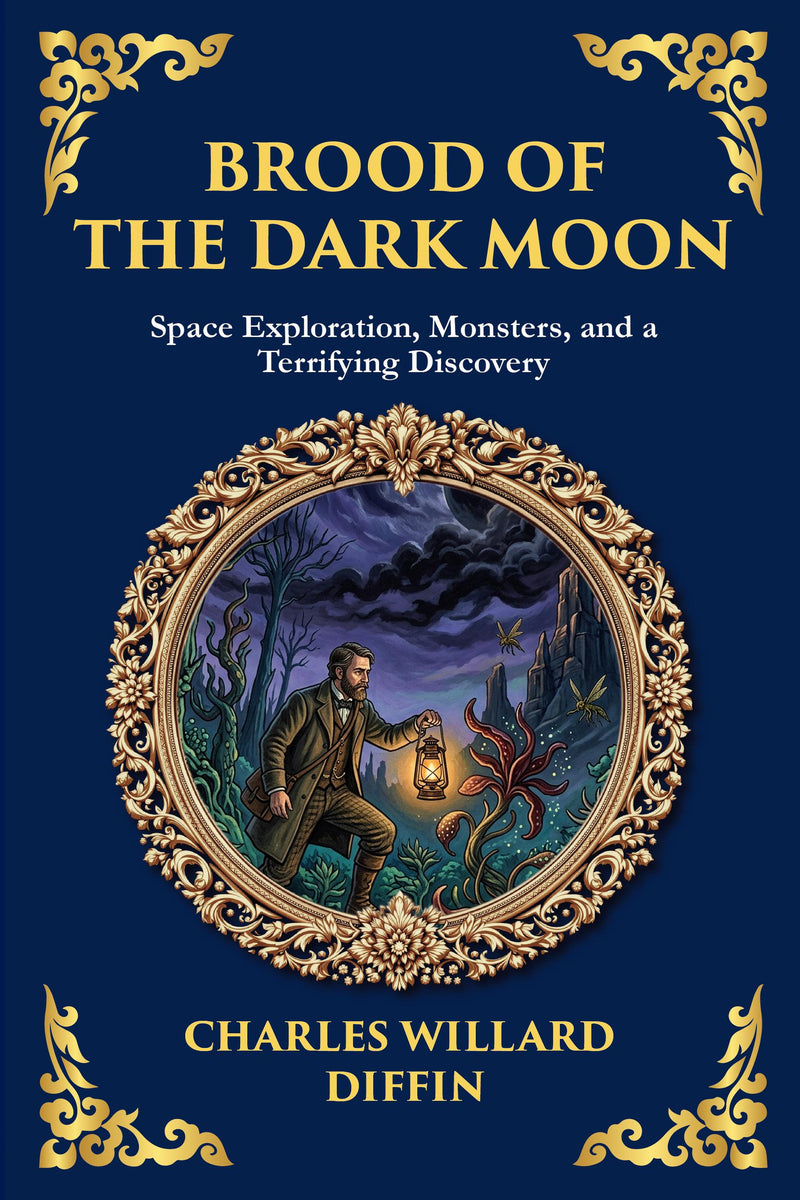
Brood of the Dark Moon
Brood of the Dark Moon hurls readers into the heart of cosmic terror and wonder. A bold crew of explorers, chasing the mysteries of space, ventures beyond the moon—and discovers something monstrous lurking in the void.
or free app
10,000+ hrs library
30-day guarantee
The complete Brood of the Dark Moon appears in modern English through Library of Alexandria Press, available online with audiobook narration included for members.
Have you ever wondered why some frontiers should never be crossed? In Brood of the Dark Moon, Charles Willard Diffin launches us beyond the stars and into the terrifying unknown. This thrilling science fiction adventure follows the crew of a spaceship dispatched to investigate a strange signal beyond the orbit of the Dark Moon.
But what they find waiting in the void is not a miracle—it is a menace beyond comprehension. A sequel to The Moon Master, this standalone classic continues the saga of daring spacefarers who uncover a hidden alien world teeming with grotesque lifeforms and ancient secrets. What begins as exploration turns into horror, as monstrous entities rise from the darkness—and humanity's survival hangs in the balance.
What you’ll discover in this modern edition
- An Expedition Beyond the Moon – Follow a fearless crew as they break through the boundaries of known space.
| Formats | eBook (EPUB + PDF) · Audiobook · Paperback · Hardcover · Large Print |
| Language | English |
| Trim size (print) | 6 × 9 in |
| Binding | Paperback — perfect-bound · Hardcover — casewrap |
| Large Print edition | Same text in a larger, easy-read type — a larger font, not a larger trim |
| Print pricing | Every physical book at our true cost — at-cost, no profit (members) |
| Library | 873 restored titles, always growing |
| Length | 61,097 words · ~4 hr 4 min reading |
| Reading level | Grade 8 · an easy, flowing read (this modern-English edition) |
| Edition | Modern English translation · 2026 |
Member reviews for this edition are collected as readers finish it — be the first. Across the library: 12,000+ books shipped, every plan covered by a 365-day print guarantee.
About this edition
A faithful, unabridged modern-English edition by The Library of Alexandria — carefully rendered for today's reader and verified paragraph-by-paragraph against the public-domain source. Available as eBook, audiobook, paperback, hardcover, and large print.
- Complete & unabridgedVerified paragraph by paragraph against the source — never a scan, never abridged.
- Modern English, faithfulReadable today, with the author’s meaning kept intact. Readable — not simplified.
- Every format, one membershipRead in your browser or the free app, or listen to the full audiobook.
Included free with your membership
Cancel anytime, one click · 30-day money-back guarantee
Edition last updated July 2026
What’s inside
Brood of the Dark Moon — complete and unabridged: all 24 sections included with membership, plus the full audiobook.
Begin reading Brood of the Dark Moon
In clear modern English — the complete text is included with membership.
Introduction
There is a particular kind of magic that lives in the pulp adventure stories of the early twentieth century—a raw, unfiltered sense of wonder that emerged at the precise moment when humanity first allowed itself to dream seriously about the void beyond our atmosphere. Before rockets had ever pierced the edge of space, before satellites traced their silent arcs across the night, before any human eye had gazed back at the blue marble of Earth from the cold reaches above, writers like Charles Willard Diffin were already there in imagination, charting the unknown with nothing more than ink, intuition, and an audacious willingness to ask: What if? The book you are about to read belongs to that golden, electrifying era—a time when the future was not yet written, when the cosmos shimmered with infinite possibility, and when the line between scientific speculation and pure adventure was gloriously, thrillingly thin.
To open these pages is to step into a world that crackles with the energy of discovery. This is a tale of space exploration undertaken not by committees and bureaucracies, but by daring individuals who hurled themselves into the dark out of courage, curiosity, and necessity. It is a story of monsters—not the cheap, throwaway creatures of lesser fiction, but genuinely unsettling presences that emerge from the shadows of an alien world, things that test the nerve and the resolve of those who dare to face them. And it is, above all, a story built upon a terrifying discovery, the kind of revelation that turns a journey of exploration into a desperate struggle for survival. The modern reader, accustomed to the polished spectacle of contemporary science fiction, will find here something older and stranger and, in many ways, more potent: a vision of the cosmos as a place of awe and dread in equal measure.
A Window Into the Dawn of Science Fiction
To fully appreciate what you hold in your hands, it helps to understand the remarkable moment in literary history from which it sprang. The late 1920s and early 1930s saw an extraordinary flowering of imaginative fiction in America, much of it published in the great pulp magazines whose lurid covers and breathless prose captivated a generation of readers hungry for escape and adventure. These were the publications that would launch the careers of writers who later became legends, and they served as the laboratory in which the very conventions of modern science fiction were forged. The genre as we know it today—with its spacecraft and its alien encounters, its planetary explorations and its cosmic mysteries—was being invented in real time, story by story, issue by issue, by writers working at a feverish pace to satisfy an insatiable readership.
Charles Willard Diffin was one of the notable contributors to this ferment. Writing during a period when the magazines that published him competed fiercely for the attention of readers, he developed a particular gift for the kind of high-stakes adventure that defined the best of the era. His tales tend to combine genuine scientific curiosity—a fascination with the mechanics of flight, the nature of other worlds, and the technologies that might one day carry humanity beyond Earth—with a relentless sense of momentum and danger. He understood, as the finest pulp writers did, that wonder and peril are two sides of the same coin: that the same vast unknown which beckons the explorer also conceals the threats that may destroy him.
What makes this particular era of writing so enduringly compelling is its sheer ambition coupled with its emotional directness. These stories were not written for academics or critics. They were written for ordinary people—for clerks and students and factory workers and dreamers of every stripe—who paid their dimes and quarters to be transported somewhere extraordinary. As a result, the prose moves. It does not linger in self-conscious literary games or bury its excitement beneath layers of irony. It plunges forward, eager to thrill, eager to astonish, eager to make the reader’s heart race with the next impossible turn. There is an honesty to this kind of storytelling, a generosity of spirit, that can feel almost startling to a contemporary audience weaned on more cynical fare. Diffin and his contemporaries believed in the romance of exploration, in the nobility of courage, and in the genuine terror of the unknown—and that belief radiates from every page.
It is worth pausing, too, to consider the scientific context in which these stories were composed. When Diffin wrote of voyages through space, no human had ever achieved such a thing. The rocketry pioneers were only beginning their experiments; the popular understanding of other worlds was a peculiar blend of hard astronomical fact and wild conjecture. This gives the science fiction of the period a fascinating dual character. On one hand, it reflects a sincere engagement with the cutting-edge knowledge of its day—the writers genuinely tried to imagine what travel beyond Earth might require, what conditions explorers might encounter, what dangers awaited them. On the other hand, the vast gaps in human knowledge left enormous room for imagination to roam free, populating the planets and moons of our solar system and beyond with possibilities both wondrous and horrifying. The result is a vision of the cosmos that is neither strictly accurate by modern standards nor entirely fanciful, but rather a bold extrapolation from the frontier of what was then known—a kind of speculative cartography of the unknown that retains its power to fascinate precisely because it represents humanity’s first serious attempt to dream the future into being.
The “dark moon” of this story’s title evokes exactly this spirit of mysterious possibility. A moon shrouded in darkness, harboring unknown life, concealing terrors and revelations—this is the stuff of which the imagination feasts. Where the bright, familiar face of our own Moon offered a known quantity, the idea of a dark, hidden world suggested everything that lay beyond the reach of telescopes and the limits of established science: the truly alien, the genuinely unexplored, the place where the rules might be different and where humanity’s assumptions about its place in the universe might be challenged, even shattered. It is in such settings that the deepest currents of science fiction have always flowed—the confrontation between human knowledge and cosmic mystery, between our small and fragile selves and the immensity of all we do not understand.
This particular tale carries forward a narrative that Diffin had developed across more than one story, building upon a foundation of characters and circumstances that readers of the era had come to follow with eager anticipation. The serialized and continuing nature of much pulp fiction meant that authors could develop their universes over time, deepening the stakes and expanding the scope of their imagined cosmos. You need not have encountered any earlier installment to be swept up in what follows, for the essential drama is self-contained and the momentum carries its own propulsive force. But it is worth knowing that you are stepping into a tradition of ongoing adventure, the kind that kept readers returning month after month, desperate to know what would happen next to characters they had come to care about. That sense of an unfolding saga, of a larger universe of which this story is one thrilling chapter, lends the whole an additional richness.
The Art of Reading This Modern Translation
The volume before you is described as a modern translation, adapted for the contemporary reader, and this deserves a few words of explanation, for it speaks directly to the experience you are about to have. The fiction of the early twentieth century, for all its glories, can present certain obstacles to the modern reader. The conventions of language shift over the decades. Sentence structures that felt natural and propulsive to readers in the 1930s can sometimes feel mannered or convoluted to us today. Vocabulary drifts; idioms fade; references that were instantly comprehensible to the original audience can become opaque with the passage of time. The pacing conventions of the pulps—their particular rhythms of exposition and action, their habits of address to the reader, their assumptions about what needed explaining and what could be taken for granted—can occasionally create friction for an audience nearly a century removed from the original moment of composition.
The purpose of a thoughtful modern adaptation is to clear away these obstacles while preserving—indeed, while honoring and amplifying—everything that makes the original story worth reading in the first place. The aim is not to rewrite the tale, not to impose contemporary sensibilities upon it or to sand away its distinctive period character, but rather to ensure that the wonder, the terror, and the headlong excitement that Diffin intended come through to you as vividly as they came through to his original readers. Think of it as the careful cleaning of an old painting: the goal is to remove the accumulated grime and discoloration of the intervening years so that the original colors—the vivid blues and burning reds that the artist laid down—can shine forth once more in their intended brilliance. The composition remains; the artist’s vision remains; what changes is only the clarity with which we are able to perceive it.
This means that as you read, you can give yourself over entirely to the story without the nagging interruptions that sometimes attend our encounters with older fiction. You will not find yourself stumbling over archaic constructions or pausing to puzzle out a faded reference. Instead, the narrative should flow with the same urgency and immediacy that made it a compelling read in its original form, allowing you to focus on what truly matters: the journey into the dark, the encounters with the unknown, the mounting dread of discovery, and the courage of those who press onward despite it all. The essence of Diffin’s storytelling—his gift for momentum, his sense of cosmic scale, his ability to make the reader feel the cold immensity of space and the hot pulse of danger—is preserved and presented in a form that speaks directly to the modern ear.
It is my hope that you will approach this reading with a particular mindset—one of openness and imaginative generosity. The science fiction of this era was written before many of the conventions we now take for granted had hardened into formula, and as a result it possesses a freshness, an unpredictability, that can be genuinely delightful. The writers of the period were free to imagine the cosmos in ways that later generations, constrained by accumulated knowledge and accumulated cliché, often could not. There is a wildness to their visions, an unconstrained quality, that rewards the reader who comes to them ready to be surprised. Do not measure what you find here against the standards of contemporary hard science fiction, with its painstaking technical accuracy and its careful adherence to known physics. Measure it instead against its own ambitions: to thrill, to astonish, to fill the reader with a sense of the vastness and strangeness of the universe, and to celebrate the human spirit that dares to venture into it.
I would also encourage you to read with an awareness of the historical context that produced this work. The attitudes, the assumptions, and even the prejudices of the early twentieth century inevitably leave their traces in the fiction of the time. Part of the value of reading older literature lies precisely in this encounter with a different sensibility, a different moment in the long human conversation. Where the story reflects the perspectives of its era, the modern reader has the opportunity to engage thoughtfully with those differences, to understand them as artifacts of their time, and to appreciate all the more the imaginative leaps that transcend their historical moment. The best of this fiction reaches across the decades to touch something timeless in us—our hunger for adventure, our fear of the dark, our determination to face the unknown and to understand it. These are the elements that endure, and they are present here in abundance.
Cancel anytime, one click · 30-day money-back guarantee
Founding annual rate available now — your price locks for life when you join.
Not ready? Get this free chapter by email — read it anytime.
✓ Sent — check your inbox for Brood of the Dark Moon.
Questions about Brood of the Dark Moon
What is Brood of the Dark Moon about?
Brood of the Dark Moon hurls readers into the heart of cosmic terror and wonder. A bold crew of explorers, chasing the mysteries of space, ventures beyond the moon—and discovers something monstrous lurking in the void. What began as a daring mission becomes a desperate battle for survival when alien horrors emerge from the shadows of the unknown.
Who wrote Brood of the Dark Moon?
Brood of the Dark Moon was written by Charles Willard Diffin. This edition presents the complete work in clear modern English, faithfully rendered from the public-domain original by Library of Alexandria Press.
Is Brood of the Dark Moon free to read?
The opening chapter is free to read on this page. Members read and listen to the complete work — and the entire library — free, and can order any physical book at our true print cost.
How long is Brood of the Dark Moon?
24 chapters (~61,097 words) — about 4 hr 4 min of reading in this modern-English edition.
Is this an abridged version of Brood of the Dark Moon?
No. This is the complete, unabridged Brood of the Dark Moon, carefully rendered into clear modern English and verified paragraph-by-paragraph against the public-domain source — nothing is cut or summarised.
What formats does Brood of the Dark Moon come in?
Brood of the Dark Moon is available as eBook, paperback, hardcover and large print. eBook and audiobook are included with membership; printed editions ship at our true print cost.
Shipping & returns
Billing & membership
More from the library


Explore Adventure
- Tarzan of the Apes · Edgar Rice Burroughs
- The Wonderful Wizard of Oz · L. Frank Baum
- Peter Pan · J. M. Barrie
- Moby Dick; Or, The Whale · Herman Melville
- The Riddle of the Sands · Erskine Childers
- The Loss of the Swansea: A Story of the Florida Coast · W. L. Alden
- Sky Island · L. Frank Baum
- Vikram and the Vampire: Classic Hindu Tales of Adventure, Magic, and Romance · Unknown
- Tales of Unrest · Joseph Conrad
- The Tomb of Ts’in · Edgar Wallace
- Skinny McCord · Percy Keese Fitzhugh
- The Men of the Moss-Hags · S. R. Crockett
- The Hunniwell Boys and the Platinum Mystery · L. P. Wyman
- Allan Quatermain · H. Rider Haggard
- She · H. Rider Haggard
- Medical Life in the Navy · Gordon Stables
- The Thirty-Nine Steps · John Buchan
- The Story of Doctor Dolittle · Hugh Lofting
- The Princess and the Goblin · George MacDonald
- The Man Who Would Be King · Rudyard Kipling
- Lucian’s True History · Lucian of Samosata
- The Secret Adversary · Agatha Christie
- Lord Jim · Joseph Conrad
- The Marvelous Land of Oz · L. Frank Baum
- The Virginian: A Horseman of the Plains · Owen Wister
- Mars is My Destination · Frank Belknap Long
- Anabasis · Xenophon
- The Mississippi Saucer · Frank Belknap Long
- Sabotage in Space · Carey Rockwell
- The Misplaced Battleship · Harry Harrison
Brood of the Dark Moon
Brood of the Dark Moon
Space Exploration, Monsters, and a Terrifying Discovery
Charles Willard Diffin
Contents
- Introduction
- Chapter 1
- Chapter 2
- Chapter 3
- Chapter 4
- Chapter 5
- Chapter 6
- Chapter 7
- Chapter 8
- Chapter 9
- Chapter 10
- Chapter 11
- Chapter 12
- Chapter 13
- Chapter 14
- Chapter 15
- Chapter 16
- Chapter 17
- Chapter 18
- Chapter 19
- Chapter 20
- Chapter 21
- Chapter 22
- Chapter 23
Introduction
There is a particular kind of magic that lives in the pulp adventure stories of the early twentieth century—a raw, unfiltered sense of wonder that emerged at the precise moment when humanity first allowed itself to dream seriously about the void beyond our atmosphere. Before rockets had ever pierced the edge of space, before satellites traced their silent arcs across the night, before any human eye had gazed back at the blue marble of Earth from the cold reaches above, writers like Charles Willard Diffin were already there in imagination, charting the unknown with nothing more than ink, intuition, and an audacious willingness to ask: What if? The book you are about to read belongs to that golden, electrifying era—a time when the future was not yet written, when the cosmos shimmered with infinite possibility, and when the line between scientific speculation and pure adventure was gloriously, thrillingly thin.
To open these pages is to step into a world that crackles with the energy of discovery. This is a tale of space exploration undertaken not by committees and bureaucracies, but by daring individuals who hurled themselves into the dark out of courage, curiosity, and necessity. It is a story of monsters—not the cheap, throwaway creatures of lesser fiction, but genuinely unsettling presences that emerge from the shadows of an alien world, things that test the nerve and the resolve of those who dare to face them. And it is, above all, a story built upon a terrifying discovery, the kind of revelation that turns a journey of exploration into a desperate struggle for survival. The modern reader, accustomed to the polished spectacle of contemporary science fiction, will find here something older and stranger and, in many ways, more potent: a vision of the cosmos as a place of awe and dread in equal measure.
A Window Into the Dawn of Science Fiction
To fully appreciate what you hold in your hands, it helps to understand the remarkable moment in literary history from which it sprang. The late 1920s and early 1930s saw an extraordinary flowering of imaginative fiction in America, much of it published in the great pulp magazines whose lurid covers and breathless prose captivated a generation of readers hungry for escape and adventure. These were the publications that would launch the careers of writers who later became legends, and they served as the laboratory in which the very conventions of modern science fiction were forged. The genre as we know it today—with its spacecraft and its alien encounters, its planetary explorations and its cosmic mysteries—was being invented in real time, story by story, issue by issue, by writers working at a feverish pace to satisfy an insatiable readership.
Charles Willard Diffin was one of the notable contributors to this ferment. Writing during a period when the magazines that published him competed fiercely for the attention of readers, he developed a particular gift for the kind of high-stakes adventure that defined the best of the era. His tales tend to combine genuine scientific curiosity—a fascination with the mechanics of flight, the nature of other worlds, and the technologies that might one day carry humanity beyond Earth—with a relentless sense of momentum and danger. He understood, as the finest pulp writers did, that wonder and peril are two sides of the same coin: that the same vast unknown which beckons the explorer also conceals the threats that may destroy him.
What makes this particular era of writing so enduringly compelling is its sheer ambition coupled with its emotional directness. These stories were not written for academics or critics. They were written for ordinary people—for clerks and students and factory workers and dreamers of every stripe—who paid their dimes and quarters to be transported somewhere extraordinary. As a result, the prose moves. It does not linger in self-conscious literary games or bury its excitement beneath layers of irony. It plunges forward, eager to thrill, eager to astonish, eager to make the reader’s heart race with the next impossible turn. There is an honesty to this kind of storytelling, a generosity of spirit, that can feel almost startling to a contemporary audience weaned on more cynical fare. Diffin and his contemporaries believed in the romance of exploration, in the nobility of courage, and in the genuine terror of the unknown—and that belief radiates from every page.
It is worth pausing, too, to consider the scientific context in which these stories were composed. When Diffin wrote of voyages through space, no human had ever achieved such a thing. The rocketry pioneers were only beginning their experiments; the popular understanding of other worlds was a peculiar blend of hard astronomical fact and wild conjecture. This gives the science fiction of the period a fascinating dual character. On one hand, it reflects a sincere engagement with the cutting-edge knowledge of its day—the writers genuinely tried to imagine what travel beyond Earth might require, what conditions explorers might encounter, what dangers awaited them. On the other hand, the vast gaps in human knowledge left enormous room for imagination to roam free, populating the planets and moons of our solar system and beyond with possibilities both wondrous and horrifying. The result is a vision of the cosmos that is neither strictly accurate by modern standards nor entirely fanciful, but rather a bold extrapolation from the frontier of what was then known—a kind of speculative cartography of the unknown that retains its power to fascinate precisely because it represents humanity’s first serious attempt to dream the future into being.
The “dark moon” of this story’s title evokes exactly this spirit of mysterious possibility. A moon shrouded in darkness, harboring unknown life, concealing terrors and revelations—this is the stuff of which the imagination feasts. Where the bright, familiar face of our own Moon offered a known quantity, the idea of a dark, hidden world suggested everything that lay beyond the reach of telescopes and the limits of established science: the truly alien, the genuinely unexplored, the place where the rules might be different and where humanity’s assumptions about its place in the universe might be challenged, even shattered. It is in such settings that the deepest currents of science fiction have always flowed—the confrontation between human knowledge and cosmic mystery, between our small and fragile selves and the immensity of all we do not understand.
This particular tale carries forward a narrative that Diffin had developed across more than one story, building upon a foundation of characters and circumstances that readers of the era had come to follow with eager anticipation. The serialized and continuing nature of much pulp fiction meant that authors could develop their universes over time, deepening the stakes and expanding the scope of their imagined cosmos. You need not have encountered any earlier installment to be swept up in what follows, for the essential drama is self-contained and the momentum carries its own propulsive force. But it is worth knowing that you are stepping into a tradition of ongoing adventure, the kind that kept readers returning month after month, desperate to know what would happen next to characters they had come to care about. That sense of an unfolding saga, of a larger universe of which this story is one thrilling chapter, lends the whole an additional richness.
The Art of Reading This Modern Translation
The volume before you is described as a modern translation, adapted for the contemporary reader, and this deserves a few words of explanation, for it speaks directly to the experience you are about to have. The fiction of the early twentieth century, for all its glories, can present certain obstacles to the modern reader. The conventions of language shift over the decades. Sentence structures that felt natural and propulsive to readers in the 1930s can sometimes feel mannered or convoluted to us today. Vocabulary drifts; idioms fade; references that were instantly comprehensible to the original audience can become opaque with the passage of time. The pacing conventions of the pulps—their particular rhythms of exposition and action, their habits of address to the reader, their assumptions about what needed explaining and what could be taken for granted—can occasionally create friction for an audience nearly a century removed from the original moment of composition.
The purpose of a thoughtful modern adaptation is to clear away these obstacles while preserving—indeed, while honoring and amplifying—everything that makes the original story worth reading in the first place. The aim is not to rewrite the tale, not to impose contemporary sensibilities upon it or to sand away its distinctive period character, but rather to ensure that the wonder, the terror, and the headlong excitement that Diffin intended come through to you as vividly as they came through to his original readers. Think of it as the careful cleaning of an old painting: the goal is to remove the accumulated grime and discoloration of the intervening years so that the original colors—the vivid blues and burning reds that the artist laid down—can shine forth once more in their intended brilliance. The composition remains; the artist’s vision remains; what changes is only the clarity with which we are able to perceive it.
This means that as you read, you can give yourself over entirely to the story without the nagging interruptions that sometimes attend our encounters with older fiction. You will not find yourself stumbling over archaic constructions or pausing to puzzle out a faded reference. Instead, the narrative should flow with the same urgency and immediacy that made it a compelling read in its original form, allowing you to focus on what truly matters: the journey into the dark, the encounters with the unknown, the mounting dread of discovery, and the courage of those who press onward despite it all. The essence of Diffin’s storytelling—his gift for momentum, his sense of cosmic scale, his ability to make the reader feel the cold immensity of space and the hot pulse of danger—is preserved and presented in a form that speaks directly to the modern ear.
It is my hope that you will approach this reading with a particular mindset—one of openness and imaginative generosity. The science fiction of this era was written before many of the conventions we now take for granted had hardened into formula, and as a result it possesses a freshness, an unpredictability, that can be genuinely delightful. The writers of the period were free to imagine the cosmos in ways that later generations, constrained by accumulated knowledge and accumulated cliché, often could not. There is a wildness to their visions, an unconstrained quality, that rewards the reader who comes to them ready to be surprised. Do not measure what you find here against the standards of contemporary hard science fiction, with its painstaking technical accuracy and its careful adherence to known physics. Measure it instead against its own ambitions: to thrill, to astonish, to fill the reader with a sense of the vastness and strangeness of the universe, and to celebrate the human spirit that dares to venture into it.
I would also encourage you to read with an awareness of the historical context that produced this work. The attitudes, the assumptions, and even the prejudices of the early twentieth century inevitably leave their traces in the fiction of the time. Part of the value of reading older literature lies precisely in this encounter with a different sensibility, a different moment in the long human conversation. Where the story reflects the perspectives of its era, the modern reader has the opportunity to engage thoughtfully with those differences, to understand them as artifacts of their time, and to appreciate all the more the imaginative leaps that transcend their historical moment. The best of this fiction reaches across the decades to touch something timeless in us—our hunger for adventure, our fear of the dark, our determination to face the unknown and to understand it. These are the elements that endure, and they are present here in abundance.
In a Vienna hospital, sunlight streamed through special ultraviolet-permeable crystal into a room where the walls changed color. Depending on the head surgeon’s orders, the walls shifted from fiery reds to cool yellows, grays, or calming greens. The blending colors seemed to pulse with life; it felt as though even the weakest spark of vitality could be fanned into a full flame in such a place.
Even the chart case on the wall sparkled with those same clean, bright colors from its glass and metal door. Behind the glass, the usual rotating paper disks were white. As they turned, the ink lines traced a story of the patient’s temperature, breathing, and every single heartbeat.
An identification plate displayed a name and a date: “Chet Bullard—23 years old. Admitted: August 10, 1973.” Below that, the current time ticked silently into the past: “August 15, 1973; World Standard Time: 10:38—10:39—10:40—”
For five days, the minutes had flowed by like a small stream, passing a bandaged figure in the bed below—a silent, motionless person who looked as if time had stopped for him. But the surgeons at the Allied Hospital in Vienna were skilled.
10:41—10:42—The bandaged man shifted uneasily on the snow-white bed....
A nurse was at his side instantly. Was her patient waking up? She checked the bandages covering a jagged wound in his side, and everything looked fine. From the outside, the man still seemed unconscious; the nurse had no way of knowing about the thoughts flashing through his mind—blurred at first, then slowly becoming clear.
They flashed, yet to the man struggling to understand them, they felt like a slow-motion review: one image followed another with frustrating slowness....
End of the free sample
Keep reading, free
Members read and listen to the complete book — and the entire library. Cancel anytime, one click · 30-day money-back guarantee.