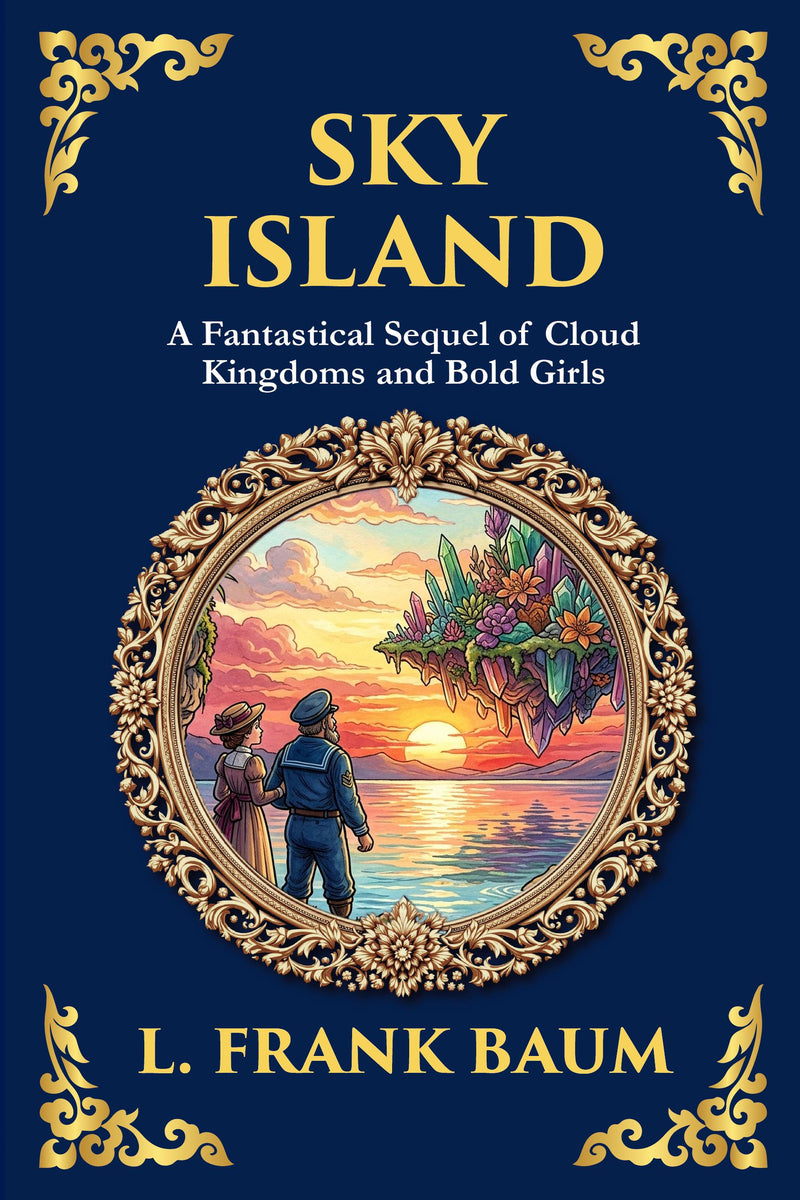
Sky Island
From the creator of The Wonderful Wizard of Oz comes a dazzling tale that whisks readers beyond the rainbow and into the skies.
or free app
10,000+ hrs library
30-day guarantee
The complete Sky Island appears in modern English through Library of Alexandria Press, available online with audiobook narration included for members.
Have you ever wondered why the greatest adventures often begin with a single wish—or a magic umbrella? Sky Island is a whimsical and thrilling sequel to The Sea Fairies, crafted by beloved fantasy author L. Frank Baum. This enchanting tale follows young heroine Trot, her loyal friend Cap’n Bill, and the curious Button-Bright as they journey to a floating island in the sky—an island sharply divided between two contrasting realms: the foggy, desolate Blue Country and the radiant, peaceful Pink Country.
What begins as an innocent airborne adventure quickly turns perilous, as the trio finds themselves imprisoned by the gloomy Boolooroo and entangled in royal succession, rebellion, and magical mishaps. But with clever thinking, steadfast friendship, and a dash of Baum’s signature wit, the children discover that courage and kindness can lift even the heaviest clouds. A literary gem for children and adults alike, Sky Island offers a world as vivid and imaginative as Oz—filled with flying umbrellas, invisible staircases, and heartwarming lessons that transcend time.
What you’ll discover in this modern edition
- A Daring Sequel from the Oz Universe Written by L. Frank Baum, creator of Dorothy and Oz, this tale stands alone while expanding his imaginative legacy.
- Two Contrasting Kingdoms in the Sky Explore the mysterious Blue Country and the joyful Pink Country—lands of enchantment, danger, and discovery.
- Three Unforgettable Heroes Travel with Trot, Button-Bright, and Cap’n Bill as they navigate trials and test their wit and will.
- A Story of Justice, Unity, and Bravery Witness how even the smallest heroes can change the fate of a divided world.
- A Timeless Fantasy Classic Ideal for fans of The Wizard of Oz, young readers, and lovers of inventive storytelling.
| Formats | eBook (EPUB + PDF) · Audiobook · Paperback · Hardcover · Large Print |
| Language | English |
| Trim size (print) | 6 × 9 in |
| Binding | Paperback — perfect-bound · Hardcover — casewrap |
| Large Print edition | Same text in a larger, easy-read type — a larger font, not a larger trim |
| Print pricing | Every physical book at our true cost — at-cost, no profit (members) |
| Library | 873 restored titles, always growing |
| Length | 55,700 words · ~3 hr 43 min reading |
| Reading level | Grade 8 · an easy, flowing read (this modern-English edition) |
| Edition | Modern English translation · 2026 |
Member reviews for this edition are collected as readers finish it — be the first. Across the library: 12,000+ books shipped, every plan covered by a 365-day print guarantee.
About this edition
A faithful, unabridged modern-English edition by The Library of Alexandria — carefully rendered for today's reader and verified paragraph-by-paragraph against the public-domain source. Available as eBook, audiobook, paperback, hardcover, and large print.
- Complete & unabridgedVerified paragraph by paragraph against the source — never a scan, never abridged.
- Modern English, faithfulReadable today, with the author’s meaning kept intact. Readable — not simplified.
- Every format, one membershipRead in your browser or the free app, or listen to the full audiobook.
Included free with your membership
Cancel anytime, one click · 30-day money-back guarantee
Edition last updated July 2026
What’s inside
Sky Island — complete and unabridged: all 32 sections included with membership, plus the full audiobook.
Begin reading Sky Island
In clear modern English — the complete text is included with membership.
Introduction
There is a particular kind of magic that belongs to the storyteller who refuses to let go of wonder. Some authors write a single great book and spend the rest of their lives trying to recapture the lightning they once caught in a bottle. Others, rarer and more generous, seem to live inside an endless wellspring of invention, returning again and again to the worlds they have made and finding in them not exhaustion but fresh delight. L. Frank Baum belonged unmistakably to this second kind. He was a man who could not stop dreaming, and in Sky Island he gives us one of his most exuberant, most colorful, and most quietly courageous dreams of all.
Published in 1912, Sky Island arrived at the height of Baum’s powers, written by an author who had already given the world the immortal land of Oz and who had discovered that his imagination was far too large to be contained by any single map. It is a book that floats, quite literally, above the ordinary concerns of children’s literature. It rises into the clouds, into a kingdom suspended between earth and heaven, and it carries with it a cast of characters so vivid, so stubborn, and so wonderfully alive that they continue to charm readers more than a century after they first took flight. This modern translation, prepared and adapted for the contemporary reader, has been crafted with the intention of preserving everything that makes the original sparkle while gently smoothing the passages that time has rendered unfamiliar, so that today’s reader may step into Baum’s cloud kingdoms with the same uncomplicated joy that greeted the book’s first audiences.
To open this book is to accept an invitation into a place where the impossible is not merely possible but routine, where umbrellas can carry travelers into the sky, where entire nations are organized by color, and where a young girl’s bravery proves to be the most powerful force in any realm, whether it floats among the clouds or rests upon solid ground. What follows in these pages is not a grim or weighty tale. It is an adventure, bright and buoyant, and yet beneath its glittering surface there runs a current of genuine wisdom about courage, friendship, fairness, and the strange and lovely business of finding your footing in a world that does not always make sense.
To understand why Sky Island delights as it does, it helps to understand the man who wrote it and the gentle revolution he brought to storytelling. Lyman Frank Baum was born in 1856 in Chittenango, New York, into a family of considerable means. His was not a straight or easy path to literary immortality. Before he ever wrote the words that would make him famous, Baum tried his hand at an extraordinary number of trades and ventures. He raised fancy poultry and wrote about it. He acted on the stage and managed theaters. He ran a variety store on the American frontier in South Dakota, where he extended so much credit to struggling neighbors that the business eventually collapsed. He edited a small-town newspaper. He sold china and glassware as a traveling salesman. He dabbled in window dressing and even published a trade journal on the art of decorating shop windows. In nearly every endeavor he revealed the same restless, generous, imaginative spirit, and in nearly every endeavor he struggled to make ends meet.
What carried Baum through these uncertain years, and what ultimately found its truest expression, was his gift for telling stories to children. He had married Maud Gage, the strong-willed daughter of the famous women’s suffrage activist Matilda Joslyn Gage, and the couple raised four sons. It was for children, and partly because of the influence of his mother-in-law’s fierce belief in the dignity and capability of girls and women, that Baum eventually found his calling. He began writing down the tales he had been spinning aloud, and in 1900 he published The Wonderful Wizard of Oz, a book that would change American children’s literature forever.
Baum had a theory about what stories for children ought to be, and he stated it plainly. He wanted to write a “modernized fairy tale,” one that kept the wonder and the marvel of the old European tales but stripped away their cruelty, their heavy moralizing, and their frequently terrifying punishments. The fairy tales he had grown up with were often dark, full of children boiled and eaten, wicked figures dancing to death in red-hot shoes, and lessons delivered through fear. Baum wanted something different. He wanted stories in which wonder existed for its own sake, in which kindness was rewarded and bravery celebrated, and in which a child reader could lose themselves in delight rather than be frightened into obedience. He wanted to keep the nightmares out and let the dreams flow freely.
This philosophy is everywhere in Sky Island, and it is part of what makes the book feel so refreshing even now. There is conflict here, and there is danger, but the tone never curdles into menace. Baum understood that children are perfectly capable of recognizing injustice and rooting against it, and that they do not need to be traumatized in order to be taught. The villainy in his books tends to be more foolish than fearsome, more vain and petty than genuinely evil, and the triumph of his heroes comes not through violence but through cleverness, kindness, and an unshakable sense of fairness. The result is a kind of storytelling that nourishes rather than merely entertains.
It is worth noting, too, that Baum was writing during a remarkable period of American history, the early years of the twentieth century, when the country was buzzing with new inventions, new ideas, and a sense of boundless possibility. Airplanes had only just begun to fly. Electricity was transforming cities. The frontier was closing and the modern age was opening. Baum’s fantasies, for all their fairy-tale trappings, are shot through with this distinctly modern optimism, this faith that wonder and progress might walk hand in hand. His marvelous mechanisms and his floating kingdoms feel less like the dusty enchantments of old Europe and more like the bright inventions of a new world that had not yet decided what it might become.
By the time he wrote Sky Island, Baum was a beloved and successful author, but he was also a man who had grown somewhat weary of being chained to a single creation. He had tried, more than once, to write his way out of the land of Oz, only to be drawn back by the affectionate demands of his young readers, who wrote him letters begging for more. Sky Island belongs to a small and special group of Baum’s fantasies that exist alongside the Oz books, sharing some of their characters and some of their geography while charting their own independent course. It is connected to that larger universe and yet stands wonderfully on its own, a complete and self-contained adventure that requires no prior acquaintance to be thoroughly enjoyed.
The premise of Sky Island is one of those gloriously simple ideas that opens up into endless possibility. Take an ordinary object, an everyday umbrella, and give it a single extraordinary property, and suddenly the whole sky becomes a frontier waiting to be explored. From this small spark Baum builds an entire civilization, a kingdom suspended high above the earth where no human foot was ever meant to tread. It is the kind of imaginative leap that seems obvious only after someone has made it, and Baum makes it with such effortless confidence that we accept the impossible at once.
What makes the sky kingdom so memorable is not merely that it floats but the way Baum organizes it. He divides his cloud world by color, and in doing so he creates one of the most visually striking settings in all of children’s literature. Color is not a mere decoration in this book. It is the very fabric of society, the principle by which an entire people order their lives, define their loyalties, and understand the world. The inhabitants of one region live amid a single hue, surrounded by it, dressed in it, eating it, seeing the world through it, while their neighbors live according to a different shade and regard the others with suspicion bordering on hostility. The boundary between these realms, and what lies along it, gives the story much of its tension and a good deal of its wit.
This conceit allows Baum to do something subtly clever beneath the surface of his entertainment. By inventing peoples who judge one another, who divide themselves, and who maintain old grievances on the basis of nothing more substantial than the color that happens to surround them, he holds up a gentle mirror to the readers’ own world without ever lecturing or moralizing. The reader, particularly the young reader, can see for themselves how absurd it is to dislike someone for so superficial a reason. The lesson lands all the more firmly because it is never stated as a lesson. It is simply lived, observed, and laughed at, and the laughter does the work that a sermon never could.
The visual imagination at play here deserves particular admiration. Baum was, after all, a man who had professionally studied the art of window display, the craft of arranging color and shape to catch the eye and stir the heart. That sensibility runs all through Sky Island. The book is a feast for the mind’s eye, a procession of vivid tableaux, fantastical costumes, peculiar customs, and strange and beautiful landscapes that seem designed to be seen as much as read. There is a painterly quality to Baum’s invention, a delight in spectacle, that makes the cloud kingdoms shimmer in the imagination long after the book is closed.
And yet for all its visual splendor, the sky world is more than a pretty backdrop. Baum populates it with a society that has politics, history, rivalries, and rules, some of them sensible and many of them gloriously ridiculous. He has great fun with bureaucracy, with the pomposity of officials, with the silly ceremonies and self-important pronouncements of those who hold power. There is a streak of sly humor running through every encounter, a knowing wink at the foolishness of the grown-up world, that adults reading the book aloud will appreciate as much as the children listening. Baum never talks down to his audience. He trusts them to catch the joke, and he rewards that trust on nearly every page.
The mechanics of how one arrives in such a place, how one might survive there, and what perils and wonders await are best left for the reader to discover firsthand. Part of the great pleasure of Sky Island lies in the steady unfolding of its surprises, the way each new region reveals fresh marvels and the way the rules of this floating world gradually become clear. To say too much would be to dim the delight. It is enough to know that the journey is full of incident, that the dangers are real enough to thrill without being so dire as to distress, and that the destination is more than worth the trouble of getting there.
Brave Girls and the Heart of the Adventure
If there is one quality that distinguishes Baum’s work from much of the children’s literature of his era, and indeed from a good deal of what came after, it is his abiding faith in the courage and capability of girls. This was not accidental. Baum’s mother-in-law, Matilda Joslyn Gage, was one of the great figures of the American women’s suffrage movement, a woman of formidable intellect and conviction who lived for a time in the Baum household and whose influence on her son-in-law was profound. Through her, and through his own evident sympathies, Baum absorbed a belief that was genuinely radical for his time: that girls could be heroes, that they could lead, that they could think and act and triumph on their own terms, and that they did not need to be rescued so much as they needed the freedom to do the rescuing themselves.
The heroines of Sky Island embody this conviction beautifully. They are not passive ornaments waiting to be carried along by the plot. They are active, clever, determined, and brave. When they are confronted with difficulty, they do not faint or weep helplessly. They think. They argue. They stand up for themselves and for what is right. They make mistakes, learn from them, and press on. Faced with rulers and rules they find unjust, they do not simply submit. They question, they resist, and ultimately they bring about change through a combination of courage, cleverness, and an unwavering moral compass.
Cancel anytime, one click · 30-day money-back guarantee
Founding annual rate available now — your price locks for life when you join.
Not ready? Get this free chapter by email — read it anytime.
✓ Sent — check your inbox for Sky Island.
Questions about Sky Island
What is Sky Island about?
From the creator of The Wonderful Wizard of Oz comes a dazzling tale that whisks readers beyond the rainbow and into the skies. In Sky Island, L. Frank Baum spins a spellbinding sequel where daring children soar above the clouds to a divided kingdom ruled by colors, courage, and strange creatures. Join Trot, Cap’n Bill, and the bold Button-Bright as they face enchantments, tyrants, and impossible choices in a land where blue-skinned people rule by law and pink ones by love.
Who wrote Sky Island?
Sky Island was written by L. Frank Baum. This edition presents the complete work in clear modern English, faithfully rendered from the public-domain original by Library of Alexandria Press.
Is Sky Island free to read?
The opening chapter is free to read on this page. Members read and listen to the complete work — and the entire library — free, and can order any physical book at our true print cost.
How long is Sky Island?
32 chapters (~55,700 words) — about 3 hr 43 min of reading in this modern-English edition.
Is this an abridged version of Sky Island?
No. This is the complete, unabridged Sky Island, carefully rendered into clear modern English and verified paragraph-by-paragraph against the public-domain source — nothing is cut or summarised.
What formats does Sky Island come in?
Sky Island is available as eBook, paperback, hardcover and large print. eBook and audiobook are included with membership; printed editions ship at our true print cost.
Shipping & returns
Billing & membership
More from the library


Explore Adventure
- Tarzan of the Apes · Edgar Rice Burroughs
- The Wonderful Wizard of Oz · L. Frank Baum
- Peter Pan · J. M. Barrie
- Moby Dick; Or, The Whale · Herman Melville
- The Riddle of the Sands · Erskine Childers
- The Loss of the Swansea: A Story of the Florida Coast · W. L. Alden
- Vikram and the Vampire: Classic Hindu Tales of Adventure, Magic, and Romance · Unknown
- Tales of Unrest · Joseph Conrad
- The Tomb of Ts’in · Edgar Wallace
- Skinny McCord · Percy Keese Fitzhugh
- The Men of the Moss-Hags · S. R. Crockett
- The Hunniwell Boys and the Platinum Mystery · L. P. Wyman
- Allan Quatermain · H. Rider Haggard
- She · H. Rider Haggard
- Medical Life in the Navy · Gordon Stables
- The Thirty-Nine Steps · John Buchan
- The Story of Doctor Dolittle · Hugh Lofting
- The Princess and the Goblin · George MacDonald
- The Man Who Would Be King · Rudyard Kipling
- Lucian’s True History · Lucian of Samosata
- The Secret Adversary · Agatha Christie
- Lord Jim · Joseph Conrad
- The Marvelous Land of Oz · L. Frank Baum
- The Virginian: A Horseman of the Plains · Owen Wister
- Mars is My Destination · Frank Belknap Long
- Anabasis · Xenophon
- The Mississippi Saucer · Frank Belknap Long
- Sabotage in Space · Carey Rockwell
- Brood of the Dark Moon · Charles Willard Diffin
- The Misplaced Battleship · Harry Harrison
Sky Island
Sky Island
A Fantasy Sequel Featuring Cloud Kingdoms and Brave Girls
L. Frank Baum
Contents
- Introduction
- A short message to my readers
- Chapter 1
- Chapter 2
- Chapter 3
- Chapter 4
- Chapter 5
- Chapter 6
- Chapter 7
- Chapter 8
- Chapter 9
- Chapter 10
- Chapter 11
- Chapter 12
- Chapter 13
- Chapter 14
- Chapter 15
- Chapter 16
- Chapter 17
- Chapter 18
- Chapter 19
- Chapter 20
- Chapter 21
- Chapter 22
- Chapter 23
- Chapter 24
- Chapter 25
- Chapter 26
- Chapter 27
- Chapter 28
- Chapter 29
- Chapter 30
Introduction
There is a particular kind of magic that belongs to the storyteller who refuses to let go of wonder. Some authors write a single great book and spend the rest of their lives trying to recapture the lightning they once caught in a bottle. Others, rarer and more generous, seem to live inside an endless wellspring of invention, returning again and again to the worlds they have made and finding in them not exhaustion but fresh delight. L. Frank Baum belonged unmistakably to this second kind. He was a man who could not stop dreaming, and in Sky Island he gives us one of his most exuberant, most colorful, and most quietly courageous dreams of all.
Published in 1912, Sky Island arrived at the height of Baum’s powers, written by an author who had already given the world the immortal land of Oz and who had discovered that his imagination was far too large to be contained by any single map. It is a book that floats, quite literally, above the ordinary concerns of children’s literature. It rises into the clouds, into a kingdom suspended between earth and heaven, and it carries with it a cast of characters so vivid, so stubborn, and so wonderfully alive that they continue to charm readers more than a century after they first took flight. This modern translation, prepared and adapted for the contemporary reader, has been crafted with the intention of preserving everything that makes the original sparkle while gently smoothing the passages that time has rendered unfamiliar, so that today’s reader may step into Baum’s cloud kingdoms with the same uncomplicated joy that greeted the book’s first audiences.
To open this book is to accept an invitation into a place where the impossible is not merely possible but routine, where umbrellas can carry travelers into the sky, where entire nations are organized by color, and where a young girl’s bravery proves to be the most powerful force in any realm, whether it floats among the clouds or rests upon solid ground. What follows in these pages is not a grim or weighty tale. It is an adventure, bright and buoyant, and yet beneath its glittering surface there runs a current of genuine wisdom about courage, friendship, fairness, and the strange and lovely business of finding your footing in a world that does not always make sense.
To understand why Sky Island delights as it does, it helps to understand the man who wrote it and the gentle revolution he brought to storytelling. Lyman Frank Baum was born in 1856 in Chittenango, New York, into a family of considerable means. His was not a straight or easy path to literary immortality. Before he ever wrote the words that would make him famous, Baum tried his hand at an extraordinary number of trades and ventures. He raised fancy poultry and wrote about it. He acted on the stage and managed theaters. He ran a variety store on the American frontier in South Dakota, where he extended so much credit to struggling neighbors that the business eventually collapsed. He edited a small-town newspaper. He sold china and glassware as a traveling salesman. He dabbled in window dressing and even published a trade journal on the art of decorating shop windows. In nearly every endeavor he revealed the same restless, generous, imaginative spirit, and in nearly every endeavor he struggled to make ends meet.
What carried Baum through these uncertain years, and what ultimately found its truest expression, was his gift for telling stories to children. He had married Maud Gage, the strong-willed daughter of the famous women’s suffrage activist Matilda Joslyn Gage, and the couple raised four sons. It was for children, and partly because of the influence of his mother-in-law’s fierce belief in the dignity and capability of girls and women, that Baum eventually found his calling. He began writing down the tales he had been spinning aloud, and in 1900 he published The Wonderful Wizard of Oz, a book that would change American children’s literature forever.
Baum had a theory about what stories for children ought to be, and he stated it plainly. He wanted to write a “modernized fairy tale,” one that kept the wonder and the marvel of the old European tales but stripped away their cruelty, their heavy moralizing, and their frequently terrifying punishments. The fairy tales he had grown up with were often dark, full of children boiled and eaten, wicked figures dancing to death in red-hot shoes, and lessons delivered through fear. Baum wanted something different. He wanted stories in which wonder existed for its own sake, in which kindness was rewarded and bravery celebrated, and in which a child reader could lose themselves in delight rather than be frightened into obedience. He wanted to keep the nightmares out and let the dreams flow freely.
This philosophy is everywhere in Sky Island, and it is part of what makes the book feel so refreshing even now. There is conflict here, and there is danger, but the tone never curdles into menace. Baum understood that children are perfectly capable of recognizing injustice and rooting against it, and that they do not need to be traumatized in order to be taught. The villainy in his books tends to be more foolish than fearsome, more vain and petty than genuinely evil, and the triumph of his heroes comes not through violence but through cleverness, kindness, and an unshakable sense of fairness. The result is a kind of storytelling that nourishes rather than merely entertains.
It is worth noting, too, that Baum was writing during a remarkable period of American history, the early years of the twentieth century, when the country was buzzing with new inventions, new ideas, and a sense of boundless possibility. Airplanes had only just begun to fly. Electricity was transforming cities. The frontier was closing and the modern age was opening. Baum’s fantasies, for all their fairy-tale trappings, are shot through with this distinctly modern optimism, this faith that wonder and progress might walk hand in hand. His marvelous mechanisms and his floating kingdoms feel less like the dusty enchantments of old Europe and more like the bright inventions of a new world that had not yet decided what it might become.
By the time he wrote Sky Island, Baum was a beloved and successful author, but he was also a man who had grown somewhat weary of being chained to a single creation. He had tried, more than once, to write his way out of the land of Oz, only to be drawn back by the affectionate demands of his young readers, who wrote him letters begging for more. Sky Island belongs to a small and special group of Baum’s fantasies that exist alongside the Oz books, sharing some of their characters and some of their geography while charting their own independent course. It is connected to that larger universe and yet stands wonderfully on its own, a complete and self-contained adventure that requires no prior acquaintance to be thoroughly enjoyed.
The premise of Sky Island is one of those gloriously simple ideas that opens up into endless possibility. Take an ordinary object, an everyday umbrella, and give it a single extraordinary property, and suddenly the whole sky becomes a frontier waiting to be explored. From this small spark Baum builds an entire civilization, a kingdom suspended high above the earth where no human foot was ever meant to tread. It is the kind of imaginative leap that seems obvious only after someone has made it, and Baum makes it with such effortless confidence that we accept the impossible at once.
What makes the sky kingdom so memorable is not merely that it floats but the way Baum organizes it. He divides his cloud world by color, and in doing so he creates one of the most visually striking settings in all of children’s literature. Color is not a mere decoration in this book. It is the very fabric of society, the principle by which an entire people order their lives, define their loyalties, and understand the world. The inhabitants of one region live amid a single hue, surrounded by it, dressed in it, eating it, seeing the world through it, while their neighbors live according to a different shade and regard the others with suspicion bordering on hostility. The boundary between these realms, and what lies along it, gives the story much of its tension and a good deal of its wit.
This conceit allows Baum to do something subtly clever beneath the surface of his entertainment. By inventing peoples who judge one another, who divide themselves, and who maintain old grievances on the basis of nothing more substantial than the color that happens to surround them, he holds up a gentle mirror to the readers’ own world without ever lecturing or moralizing. The reader, particularly the young reader, can see for themselves how absurd it is to dislike someone for so superficial a reason. The lesson lands all the more firmly because it is never stated as a lesson. It is simply lived, observed, and laughed at, and the laughter does the work that a sermon never could.
The visual imagination at play here deserves particular admiration. Baum was, after all, a man who had professionally studied the art of window display, the craft of arranging color and shape to catch the eye and stir the heart. That sensibility runs all through Sky Island. The book is a feast for the mind’s eye, a procession of vivid tableaux, fantastical costumes, peculiar customs, and strange and beautiful landscapes that seem designed to be seen as much as read. There is a painterly quality to Baum’s invention, a delight in spectacle, that makes the cloud kingdoms shimmer in the imagination long after the book is closed.
And yet for all its visual splendor, the sky world is more than a pretty backdrop. Baum populates it with a society that has politics, history, rivalries, and rules, some of them sensible and many of them gloriously ridiculous. He has great fun with bureaucracy, with the pomposity of officials, with the silly ceremonies and self-important pronouncements of those who hold power. There is a streak of sly humor running through every encounter, a knowing wink at the foolishness of the grown-up world, that adults reading the book aloud will appreciate as much as the children listening. Baum never talks down to his audience. He trusts them to catch the joke, and he rewards that trust on nearly every page.
The mechanics of how one arrives in such a place, how one might survive there, and what perils and wonders await are best left for the reader to discover firsthand. Part of the great pleasure of Sky Island lies in the steady unfolding of its surprises, the way each new region reveals fresh marvels and the way the rules of this floating world gradually become clear. To say too much would be to dim the delight. It is enough to know that the journey is full of incident, that the dangers are real enough to thrill without being so dire as to distress, and that the destination is more than worth the trouble of getting there.
Brave Girls and the Heart of the Adventure
If there is one quality that distinguishes Baum’s work from much of the children’s literature of his era, and indeed from a good deal of what came after, it is his abiding faith in the courage and capability of girls. This was not accidental. Baum’s mother-in-law, Matilda Joslyn Gage, was one of the great figures of the American women’s suffrage movement, a woman of formidable intellect and conviction who lived for a time in the Baum household and whose influence on her son-in-law was profound. Through her, and through his own evident sympathies, Baum absorbed a belief that was genuinely radical for his time: that girls could be heroes, that they could lead, that they could think and act and triumph on their own terms, and that they did not need to be rescued so much as they needed the freedom to do the rescuing themselves.
The heroines of Sky Island embody this conviction beautifully. They are not passive ornaments waiting to be carried along by the plot. They are active, clever, determined, and brave. When they are confronted with difficulty, they do not faint or weep helplessly. They think. They argue. They stand up for themselves and for what is right. They make mistakes, learn from them, and press on. Faced with rulers and rules they find unjust, they do not simply submit. They question, they resist, and ultimately they bring about change through a combination of courage, cleverness, and an unwavering moral compass.
With “The Sea Fairies,” my 1911 book, I tried something new in fairy tales. I was thrilled that my longtime readers loved it, and many told me they like Trot “almost as much as Dorothy.” Since Dorothy is a very old friend and Trot is new, I feel this is a wonderful compliment for Cap’n Bill’s young companion. Cap’n Bill is also a new character who seems to be popular, so both Trot and the old sailor return in this story. This can be considered the second adventure in the series featuring Trot and Cap’n Bill.
However, you will recognize a few other familiar faces in “Sky Island.” For example, Button-Bright is here; he previously had an adventure with Dorothy in Oz. You will notice that without Button-Bright and his Magic Umbrella, the story of “Sky Island” could not have happened. Since Polychrome, the Rainbow’s Daughter, lives in the sky, it makes sense that Trot and Button-Bright would meet her while exploring.
The story of Sky Island really surprised me, and I believe it will surprise you too. The land in the sky is certainly a beautiful and remarkable place, but after reading about it, I am sure you will agree that our own Mother Earth is a wonderful place to live. Trot, Button-Bright, and Cap’n Bill were very lucky to return home.
Also, one of my young readers suggested that I include my address in this book so that children know where to send their letters. As you can see, I am doing exactly that, and I hope many of you will write to tell me if you enjoyed “Sky Island.” The letters I receive from my readers are my most prized possessions, and I am always happy to get them.
End of the free sample
Keep reading, free
Members read and listen to the complete book — and the entire library. Cancel anytime, one click · 30-day money-back guarantee.