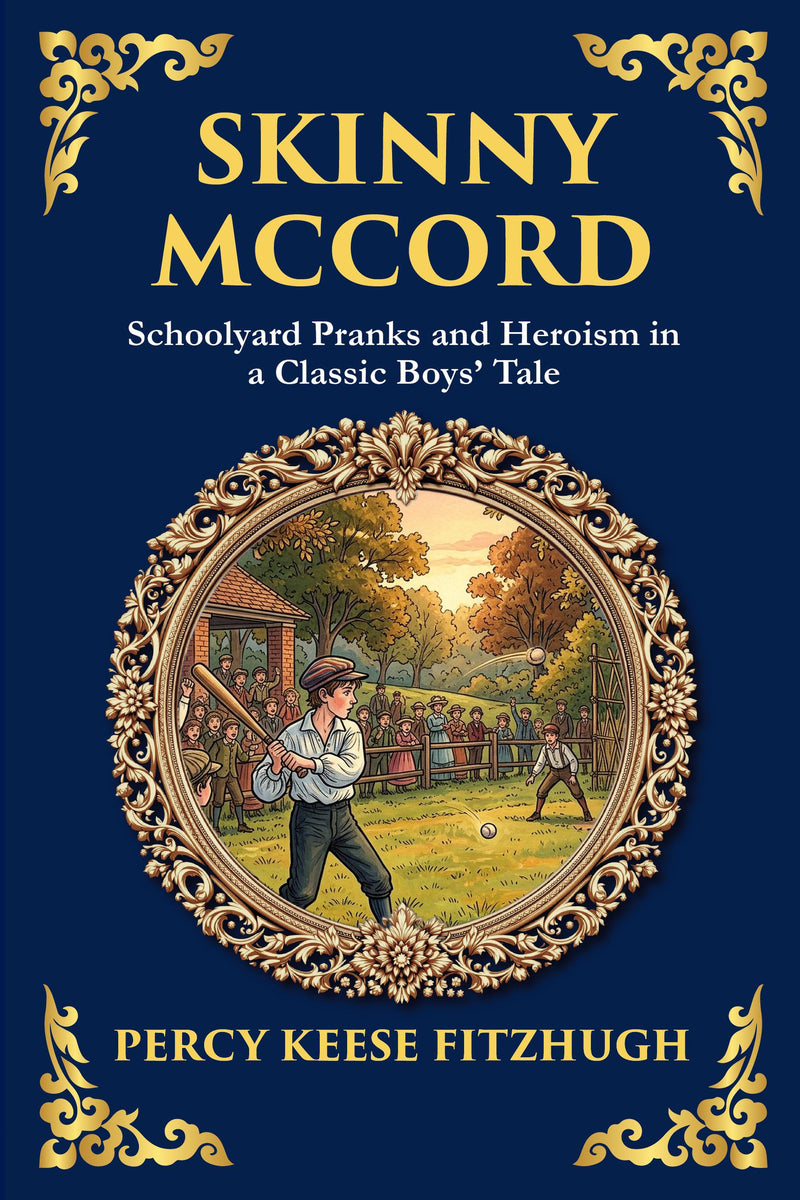
Skinny McCord
In a town where mischief is currency and loyalty is everything, Skinny McCord stands out—not for his size, but for his heart.
or free app
10,000+ hrs library
30-day guarantee
The complete Skinny McCord appears in modern English through Library of Alexandria Press, available online with audiobook narration included for members.
Have you ever wondered why the smallest kid in school always ends up doing the biggest things? Skinny McCord by Percy Keese Fitzhugh is a delightful and mischievous tale of school pranks, loyalty, daring escapades, and unexpected heroism. Set in the nostalgic backdrop of early 20th- century small-town America, this story follows Skinny—a lanky, underestimated kid with a knack for getting into (and out of) trouble.
But beneath his boyish grin and prankster reputation lies a spirit of loyalty, bravery, and wit that inspires everyone around him. In a world of bullies, baseball games, and bewildered teachers, Skinny must navigate growing up with nothing more than his smarts, his humor, and his unshakable belief in doing what's right.
What you’ll discover in this modern edition
- Schoolyard Shenanigans with a Twist – Join Skinny and his friends as they pull pranks, outwit authority, and defend their classmates
- A Hero Hidden in Plain Sight – Despite his size, Skinny’s moral courage and quick thinking earn him a place of honor
- The Charm of Small-Town Americana – Relive the world of corner stores, chalkboards, and daring playground feats
- Laughter with a Lesson – Every hilarious misadventure carries a deeper meaning about friendship, integrity, and resilience
- A Perfect Read for All Ages – Whether you’re a nostalgic adult or a young reader meeting Skinny for the first time, this classic tale delivers timeless fun.
| Formats | eBook (EPUB + PDF) · Audiobook · Paperback · Hardcover · Large Print |
| Language | English |
| Trim size (print) | 6 × 9 in |
| Binding | Paperback — perfect-bound · Hardcover — casewrap |
| Large Print edition | Same text in a larger, easy-read type — a larger font, not a larger trim |
| Print pricing | Every physical book at our true cost — at-cost, no profit (members) |
| Library | 873 restored titles, always growing |
| Length | 47,013 words · ~3 hr 8 min reading |
| Reading level | Grade 7 · an easy, flowing read (this modern-English edition) |
| Edition | Modern English translation · 2026 |
Member reviews for this edition are collected as readers finish it — be the first. Across the library: 12,000+ books shipped, every plan covered by a 365-day print guarantee.
About this edition
A faithful, unabridged modern-English edition by The Library of Alexandria — carefully rendered for today's reader and verified paragraph-by-paragraph against the public-domain source. Available as eBook, audiobook, paperback, hardcover, and large print.
- Complete & unabridgedVerified paragraph by paragraph against the source — never a scan, never abridged.
- Modern English, faithfulReadable today, with the author’s meaning kept intact. Readable — not simplified.
- Every format, one membershipRead in your browser or the free app, or listen to the full audiobook.
Included free with your membership
Cancel anytime, one click · 30-day money-back guarantee
Edition last updated July 2026
What’s inside
Skinny McCord — complete and unabridged: all 35 sections included with membership, plus the full audiobook.
Begin reading Skinny McCord
In clear modern English — the complete text is included with membership.
Introduction
There is a particular pleasure in opening a book that knows exactly what it wants to be. Some stories announce their ambitions with thunder and spectacle; others, quieter and warmer, simply pull up a chair beside you and begin to talk. Skinny McCord belongs firmly to the second kind. It is a tale told with the easy confidence of a writer who understood boys—their loyalties and rivalries, their secret codes and unspoken oaths, the way a single afternoon could feel like an entire epoch when you were young enough to believe that the world began and ended at the edge of the schoolyard. To step into these pages is to step into a vanished American world, and yet, paradoxically, to recognize something deeply and stubbornly familiar: the human heart in its earliest and most generous form.
This edition presents Percy Keese Fitzhugh’s story in a modern translation, carefully adapted for the contemporary reader. That phrase deserves a moment of explanation, because it shapes everything about the experience you are about to have. Fitzhugh wrote in an era when popular fiction for young people carried its own particular rhythms, idioms, and assumptions. Much of that charm survives untouched here. But the language has been gently brought forward so that nothing stands between you and the story itself—no archaic turn of phrase you must puzzle over, no dated expression that breaks the spell. The aim has been to preserve the soul of the original while ensuring that a reader today, whether twelve or seventy, can move through the book as smoothly as its first audience once did. What remains is the warmth, the humor, the suspense, and above all the heart. What has been smoothed away is only the friction of a century’s distance.
To understand why Skinny McCord feels the way it does—so sure-footed, so affectionate toward its characters, so attuned to the inner life of an ordinary boy—it helps to know a little about the man who created it. Percy Keese Fitzhugh was one of the most prolific and beloved authors of boys’ fiction in the early twentieth century, a writer whose name was once as familiar to young American readers as the heroes he invented. Born in 1876, he came of age during a period when the United States was rapidly transforming itself, when the great outdoor movements that would shape the century—the founding of organizations devoted to camping, woodcraft, and the moral education of the young—were sweeping across the land. Fitzhugh did not merely observe this world; he helped to write its mythology.
He is remembered above all for his association with the early Scouting movement, and for a long parade of characters who became fixtures in the imaginations of his readers. His most famous creation, the irrepressible Pee-Wee Harris, and his patient, resourceful hero Tom Slade, anchored series that ran for years and earned a devotion that few authors ever achieve. Fitzhugh wrote quickly and abundantly, but he never wrote carelessly. There is in even his lightest tales a craftsman’s attention to the things that matter: a believable boy speaking in a believable voice, a moral dilemma rendered without preaching, a small act of courage made to feel as weighty as any battlefield charge. He understood that for a child, the stakes of daily life are absolute. A broken promise, a dare accepted, a friendship tested—these were, to Fitzhugh, the genuine drama of youth, and he treated them with the seriousness they deserve.
What set Fitzhugh apart from many of his contemporaries was his refusal to talk down to his audience. The boys in his stories are not idealized cardboard models of virtue, scrubbed clean of mischief and presented as examples to imitate. They are real—exasperating, funny, prone to schemes that backfire and grand plans that collapse under their own ambition. They get into trouble. They tease and squabble and occasionally behave badly. And yet, when the moment of testing arrives, they reveal the better selves they did not always know they possessed. This is the great theme that runs through Fitzhugh’s work, and it pulses at the very center of Skinny McCord: that character is not something you are born with, fully formed, but something you discover in yourself when circumstances demand it. The boy who seems least likely to be a hero may turn out to be exactly the hero the moment requires.
Fitzhugh wrote during what we now think of as a golden age of series fiction for young readers, a time when publishers churned out adventure after adventure to satisfy an enormous appetite among American boys for stories of their own kind. It was a crowded marketplace, and much of what was produced has long since faded from memory, deservedly so. The work was often formulaic, hastily assembled, thin in feeling. Fitzhugh rose above the field because he genuinely liked the children he wrote about. You can feel it on every page—an unforced affection, a sympathy that never curdles into sentimentality. He did not view boyhood as a problem to be solved or a stage to be hurried through. He saw it as a country worth visiting in its own right, full of its own customs and treasures, and he wrote as a faithful correspondent reporting back from that bright, brief territory.
The title before you is part of a body of work that captures a specific moment in American life with the accidental precision of a photograph. These stories were not written as history; they were written as entertainment, for an audience living inside the very world the author described. And that is precisely what makes them so valuable to us now. Fitzhugh recorded, without meaning to, the texture of an age—the way children spoke to one another, the games they played, the codes of honor that governed the small society of the schoolyard, the fears and ambitions that animated their days. Reading him today is a kind of time travel, an immersion in a vanished landscape that nonetheless feels astonishingly alive.
A World of Pranks, Loyalty, and Quiet Courage
The subtitle of this volume promises Schoolyard Pranks and Heroism in a Classic Boys’ Story, and those two words—pranks and heroism—tell you almost everything about the spirit of what follows. Fitzhugh understood that the comic and the heroic are not opposites but neighbors, living side by side in the same restless boy. The same energy that drives a child to engineer an elaborate practical joke is the energy that, redirected, might drive him to an act of real bravery. The trick, as Fitzhugh knew, is that you can rarely tell in advance which way that energy will run. A boy who is all mischief on Monday may surprise everyone—himself most of all—by Friday.
Without giving away the particulars of the story, it is fair to say that Skinny McCord lives in this rich middle ground between laughter and consequence. There is a great deal of fun here, the kind of fun that anyone who has ever been part of a tight-knit group of friends will recognize at once. There are schemes and counter-schemes, misunderstandings that spiral delightfully out of control, and the particular comedy that arises when young people take themselves entirely too seriously. Fitzhugh has a wonderful ear for the way boys talk—the boasting and the backtracking, the elaborate justifications for plans that any adult could see were doomed from the start, the fierce debates over matters of cosmic importance that will be entirely forgotten by next week. The humor never feels manufactured. It rises naturally out of character and situation, the way the best comedy always does.
But beneath the laughter runs a current of genuine feeling. Fitzhugh’s boys care deeply about things—about fairness, about loyalty, about being seen as worthy by the friends whose opinions matter more to them than anything in the world. The schoolyard, in his hands, is not a trivial place. It is a proving ground, a small republic with its own laws and its own forms of justice, where reputations are made and lost, where a boy learns what he is and what he might become. The stakes feel real because, to the characters, they are real. And so when the moment of true testing arrives—when laughter gives way to something more serious, when a situation demands more than cleverness—the emotional payoff lands with surprising force.
This is where the heroism of the subtitle comes into play. Fitzhugh was never interested in the cheap heroism of the superhuman, the impossible feats that strain belief and ask nothing real of the reader. His heroes are ordinary boys who do extraordinary things only in the sense that they rise, for a moment, above their own smallness and fear. The courage on display in his stories is the kind available to anyone: the courage to do right when it would be easier to do wrong, to stand by a friend when standing aside would be safer, to admit a fault, to face a consequence, to be brave when no one is watching and no reward is promised. It is, in other words, the courage of character, and it is exactly the kind worth celebrating in a story for the young, because it is the kind they might actually be called upon to show.
There is something deeply reassuring in this vision. Fitzhugh believed—and he persuades the reader to believe along with him—that goodness is real, that loyalty matters, that the choices a boy makes in the small theater of his daily life are the rehearsal for the larger choices of his life to come. He does not pretend that being good is easy, or that being brave is comfortable. His characters struggle, hesitate, sometimes fail before they succeed. But the moral universe of his fiction is one in which effort counts, in which trying to be better is itself a kind of victory. In an age that often prizes irony and detachment, there is something bracing about a writer who simply believed in the things he wrote about.
The figure at the center of this particular tale—the boy whose name gives the book its title—is a creation worth meeting. Nicknames carry enormous weight in the world of boys, and a name like the one this character bears tells you something about how he is seen by those around him, about the role he has been assigned in the social order of his peers. Part of the quiet pleasure of the story lies in watching the gap between how a boy is perceived and who he actually is—a gap that Fitzhugh delights in revealing, slowly and satisfyingly, until the reader sees the character whole. There is a generosity in this, a gentle insistence that we never quite know what is inside another person until we have seen them tested. The boy others overlook, dismiss, or underestimate may be carrying within him a capacity that no one has yet had occasion to notice.
For the modern reader, there is an added layer of pleasure in encountering this world of a century ago. The rhythms of life that Fitzhugh describes—the freedom of children to roam and explore, the absence of the digital screens that now mediate so much of childhood, the close-knit communities where everyone knew everyone—can feel like dispatches from a lost paradise. There is a wholesomeness here, but it is not a saccharine or false wholesomeness. It is simply the natural texture of a particular time and place, rendered faithfully by a writer who lived inside it. Children today, raised in a faster and more crowded world, may find in these pages a glimpse of a kind of childhood they have only heard about—slower, more physical, more reliant on imagination and the company of friends. And adults may find something even more poignant: a return to the country of their own beginnings, or at least to the country their grandparents knew, preserved here as if in amber.
It would be a disservice to pretend that a book written so long ago can be read exactly as a book written yesterday. The world has changed, and so have its readers. This is precisely why the present edition exists, and why the work of careful modern adaptation matters so much. The goal of this translation has not been to alter the substance of Fitzhugh’s story, nor to impose contemporary attitudes upon a tale that belongs to its own time. The goal has been far more modest and, in a way, far more respectful: to remove the obstacles of dated language that might otherwise keep a modern reader at arm’s length, so that the genuine pleasures of the story can be enjoyed without distraction.
Cancel anytime, one click · 30-day money-back guarantee
Founding annual rate available now — your price locks for life when you join.
Not ready? Get this free chapter by email — read it anytime.
✓ Sent — check your inbox for Skinny McCord.
Questions about Skinny McCord
What is Skinny McCord about?
In a town where mischief is currency and loyalty is everything, Skinny McCord stands out—not for his size, but for his heart. Whether dodging demerits, masterminding the next big prank, or standing up for what’s right, Skinny proves that true strength comes from courage and character. Written by beloved storyteller Percy Keese Fitzhugh, Skinny McCord is a hilarious, heartwarming, and often heroic journey through the triumphs and tribulations of American boyhood in the golden age of schoolyard tales.
Who wrote Skinny McCord?
Skinny McCord was written by Percy Keese Fitzhugh. This edition presents the complete work in clear modern English, faithfully rendered from the public-domain original by Library of Alexandria Press.
Is Skinny McCord free to read?
The opening chapter is free to read on this page. Members read and listen to the complete work — and the entire library — free, and can order any physical book at our true print cost.
How long is Skinny McCord?
35 chapters (~47,013 words) — about 3 hr 8 min of reading in this modern-English edition.
Is this an abridged version of Skinny McCord?
No. This is the complete, unabridged Skinny McCord, carefully rendered into clear modern English and verified paragraph-by-paragraph against the public-domain source — nothing is cut or summarised.
What formats does Skinny McCord come in?
Skinny McCord is available as eBook, paperback, hardcover and large print. eBook and audiobook are included with membership; printed editions ship at our true print cost.
Shipping & returns
Billing & membership
More from the library


Explore Adventure
- Tarzan of the Apes · Edgar Rice Burroughs
- The Wonderful Wizard of Oz · L. Frank Baum
- Peter Pan · J. M. Barrie
- Moby Dick; Or, The Whale · Herman Melville
- The Riddle of the Sands · Erskine Childers
- The Loss of the Swansea: A Story of the Florida Coast · W. L. Alden
- Sky Island · L. Frank Baum
- Vikram and the Vampire: Classic Hindu Tales of Adventure, Magic, and Romance · Unknown
- Tales of Unrest · Joseph Conrad
- The Tomb of Ts’in · Edgar Wallace
- The Men of the Moss-Hags · S. R. Crockett
- The Hunniwell Boys and the Platinum Mystery · L. P. Wyman
- Allan Quatermain · H. Rider Haggard
- She · H. Rider Haggard
- Medical Life in the Navy · Gordon Stables
- The Thirty-Nine Steps · John Buchan
- The Story of Doctor Dolittle · Hugh Lofting
- The Princess and the Goblin · George MacDonald
- The Man Who Would Be King · Rudyard Kipling
- Lucian’s True History · Lucian of Samosata
- The Secret Adversary · Agatha Christie
- Lord Jim · Joseph Conrad
- The Marvelous Land of Oz · L. Frank Baum
- The Virginian: A Horseman of the Plains · Owen Wister
- Mars is My Destination · Frank Belknap Long
- Anabasis · Xenophon
- The Mississippi Saucer · Frank Belknap Long
- Sabotage in Space · Carey Rockwell
- Brood of the Dark Moon · Charles Willard Diffin
- The Misplaced Battleship · Harry Harrison
Skinny McCord
Skinny McCord
Schoolyard Pranks and Heroism in a Classic Boys’ Story
Percy Keese Fitzhugh
Contents
- Introduction
- Chapter 1
- Chapter 2
- Chapter 3
- Chapter 4
- Chapter 5
- Chapter 6
- Chapter 7
- Chapter 8
- Chapter 9
- Chapter 10
- Chapter 11
- Chapter 12
- Chapter 13
- Chapter 14
- Chapter 15
- Chapter 16
- Chapter 17
- Chapter 18
- Chapter 19
- Chapter 20
- Chapter 21
- Chapter 22
- Chapter 23
- Chapter 24
- Chapter 25
- Chapter 26
- Chapter 27
- Chapter 28
- Chapter 29
- Chapter 30
- Chapter 31
- Chapter 32
- Chapter 33
- Chapter 34
Introduction
There is a particular pleasure in opening a book that knows exactly what it wants to be. Some stories announce their ambitions with thunder and spectacle; others, quieter and warmer, simply pull up a chair beside you and begin to talk. Skinny McCord belongs firmly to the second kind. It is a tale told with the easy confidence of a writer who understood boys—their loyalties and rivalries, their secret codes and unspoken oaths, the way a single afternoon could feel like an entire epoch when you were young enough to believe that the world began and ended at the edge of the schoolyard. To step into these pages is to step into a vanished American world, and yet, paradoxically, to recognize something deeply and stubbornly familiar: the human heart in its earliest and most generous form.
This edition presents Percy Keese Fitzhugh’s story in a modern translation, carefully adapted for the contemporary reader. That phrase deserves a moment of explanation, because it shapes everything about the experience you are about to have. Fitzhugh wrote in an era when popular fiction for young people carried its own particular rhythms, idioms, and assumptions. Much of that charm survives untouched here. But the language has been gently brought forward so that nothing stands between you and the story itself—no archaic turn of phrase you must puzzle over, no dated expression that breaks the spell. The aim has been to preserve the soul of the original while ensuring that a reader today, whether twelve or seventy, can move through the book as smoothly as its first audience once did. What remains is the warmth, the humor, the suspense, and above all the heart. What has been smoothed away is only the friction of a century’s distance.
To understand why Skinny McCord feels the way it does—so sure-footed, so affectionate toward its characters, so attuned to the inner life of an ordinary boy—it helps to know a little about the man who created it. Percy Keese Fitzhugh was one of the most prolific and beloved authors of boys’ fiction in the early twentieth century, a writer whose name was once as familiar to young American readers as the heroes he invented. Born in 1876, he came of age during a period when the United States was rapidly transforming itself, when the great outdoor movements that would shape the century—the founding of organizations devoted to camping, woodcraft, and the moral education of the young—were sweeping across the land. Fitzhugh did not merely observe this world; he helped to write its mythology.
He is remembered above all for his association with the early Scouting movement, and for a long parade of characters who became fixtures in the imaginations of his readers. His most famous creation, the irrepressible Pee-Wee Harris, and his patient, resourceful hero Tom Slade, anchored series that ran for years and earned a devotion that few authors ever achieve. Fitzhugh wrote quickly and abundantly, but he never wrote carelessly. There is in even his lightest tales a craftsman’s attention to the things that matter: a believable boy speaking in a believable voice, a moral dilemma rendered without preaching, a small act of courage made to feel as weighty as any battlefield charge. He understood that for a child, the stakes of daily life are absolute. A broken promise, a dare accepted, a friendship tested—these were, to Fitzhugh, the genuine drama of youth, and he treated them with the seriousness they deserve.
What set Fitzhugh apart from many of his contemporaries was his refusal to talk down to his audience. The boys in his stories are not idealized cardboard models of virtue, scrubbed clean of mischief and presented as examples to imitate. They are real—exasperating, funny, prone to schemes that backfire and grand plans that collapse under their own ambition. They get into trouble. They tease and squabble and occasionally behave badly. And yet, when the moment of testing arrives, they reveal the better selves they did not always know they possessed. This is the great theme that runs through Fitzhugh’s work, and it pulses at the very center of Skinny McCord: that character is not something you are born with, fully formed, but something you discover in yourself when circumstances demand it. The boy who seems least likely to be a hero may turn out to be exactly the hero the moment requires.
Fitzhugh wrote during what we now think of as a golden age of series fiction for young readers, a time when publishers churned out adventure after adventure to satisfy an enormous appetite among American boys for stories of their own kind. It was a crowded marketplace, and much of what was produced has long since faded from memory, deservedly so. The work was often formulaic, hastily assembled, thin in feeling. Fitzhugh rose above the field because he genuinely liked the children he wrote about. You can feel it on every page—an unforced affection, a sympathy that never curdles into sentimentality. He did not view boyhood as a problem to be solved or a stage to be hurried through. He saw it as a country worth visiting in its own right, full of its own customs and treasures, and he wrote as a faithful correspondent reporting back from that bright, brief territory.
The title before you is part of a body of work that captures a specific moment in American life with the accidental precision of a photograph. These stories were not written as history; they were written as entertainment, for an audience living inside the very world the author described. And that is precisely what makes them so valuable to us now. Fitzhugh recorded, without meaning to, the texture of an age—the way children spoke to one another, the games they played, the codes of honor that governed the small society of the schoolyard, the fears and ambitions that animated their days. Reading him today is a kind of time travel, an immersion in a vanished landscape that nonetheless feels astonishingly alive.
A World of Pranks, Loyalty, and Quiet Courage
The subtitle of this volume promises Schoolyard Pranks and Heroism in a Classic Boys’ Story, and those two words—pranks and heroism—tell you almost everything about the spirit of what follows. Fitzhugh understood that the comic and the heroic are not opposites but neighbors, living side by side in the same restless boy. The same energy that drives a child to engineer an elaborate practical joke is the energy that, redirected, might drive him to an act of real bravery. The trick, as Fitzhugh knew, is that you can rarely tell in advance which way that energy will run. A boy who is all mischief on Monday may surprise everyone—himself most of all—by Friday.
Without giving away the particulars of the story, it is fair to say that Skinny McCord lives in this rich middle ground between laughter and consequence. There is a great deal of fun here, the kind of fun that anyone who has ever been part of a tight-knit group of friends will recognize at once. There are schemes and counter-schemes, misunderstandings that spiral delightfully out of control, and the particular comedy that arises when young people take themselves entirely too seriously. Fitzhugh has a wonderful ear for the way boys talk—the boasting and the backtracking, the elaborate justifications for plans that any adult could see were doomed from the start, the fierce debates over matters of cosmic importance that will be entirely forgotten by next week. The humor never feels manufactured. It rises naturally out of character and situation, the way the best comedy always does.
But beneath the laughter runs a current of genuine feeling. Fitzhugh’s boys care deeply about things—about fairness, about loyalty, about being seen as worthy by the friends whose opinions matter more to them than anything in the world. The schoolyard, in his hands, is not a trivial place. It is a proving ground, a small republic with its own laws and its own forms of justice, where reputations are made and lost, where a boy learns what he is and what he might become. The stakes feel real because, to the characters, they are real. And so when the moment of true testing arrives—when laughter gives way to something more serious, when a situation demands more than cleverness—the emotional payoff lands with surprising force.
This is where the heroism of the subtitle comes into play. Fitzhugh was never interested in the cheap heroism of the superhuman, the impossible feats that strain belief and ask nothing real of the reader. His heroes are ordinary boys who do extraordinary things only in the sense that they rise, for a moment, above their own smallness and fear. The courage on display in his stories is the kind available to anyone: the courage to do right when it would be easier to do wrong, to stand by a friend when standing aside would be safer, to admit a fault, to face a consequence, to be brave when no one is watching and no reward is promised. It is, in other words, the courage of character, and it is exactly the kind worth celebrating in a story for the young, because it is the kind they might actually be called upon to show.
There is something deeply reassuring in this vision. Fitzhugh believed—and he persuades the reader to believe along with him—that goodness is real, that loyalty matters, that the choices a boy makes in the small theater of his daily life are the rehearsal for the larger choices of his life to come. He does not pretend that being good is easy, or that being brave is comfortable. His characters struggle, hesitate, sometimes fail before they succeed. But the moral universe of his fiction is one in which effort counts, in which trying to be better is itself a kind of victory. In an age that often prizes irony and detachment, there is something bracing about a writer who simply believed in the things he wrote about.
The figure at the center of this particular tale—the boy whose name gives the book its title—is a creation worth meeting. Nicknames carry enormous weight in the world of boys, and a name like the one this character bears tells you something about how he is seen by those around him, about the role he has been assigned in the social order of his peers. Part of the quiet pleasure of the story lies in watching the gap between how a boy is perceived and who he actually is—a gap that Fitzhugh delights in revealing, slowly and satisfyingly, until the reader sees the character whole. There is a generosity in this, a gentle insistence that we never quite know what is inside another person until we have seen them tested. The boy others overlook, dismiss, or underestimate may be carrying within him a capacity that no one has yet had occasion to notice.
For the modern reader, there is an added layer of pleasure in encountering this world of a century ago. The rhythms of life that Fitzhugh describes—the freedom of children to roam and explore, the absence of the digital screens that now mediate so much of childhood, the close-knit communities where everyone knew everyone—can feel like dispatches from a lost paradise. There is a wholesomeness here, but it is not a saccharine or false wholesomeness. It is simply the natural texture of a particular time and place, rendered faithfully by a writer who lived inside it. Children today, raised in a faster and more crowded world, may find in these pages a glimpse of a kind of childhood they have only heard about—slower, more physical, more reliant on imagination and the company of friends. And adults may find something even more poignant: a return to the country of their own beginnings, or at least to the country their grandparents knew, preserved here as if in amber.
It would be a disservice to pretend that a book written so long ago can be read exactly as a book written yesterday. The world has changed, and so have its readers. This is precisely why the present edition exists, and why the work of careful modern adaptation matters so much. The goal of this translation has not been to alter the substance of Fitzhugh’s story, nor to impose contemporary attitudes upon a tale that belongs to its own time. The goal has been far more modest and, in a way, far more respectful: to remove the obstacles of dated language that might otherwise keep a modern reader at arm’s length, so that the genuine pleasures of the story can be enjoyed without distraction.
There was a lot of commotion around the campfire. Skinny McCord had lost his compass. He had dropped it and it rolled away, and all the boys were pretending to be very eager to help him find it. They weren’t doing this entirely out of kindness.
Skinny was a sensitive boy, and his friends loved seeing him flustered, which always happened whenever he became the topic of conversation or the center of attention. This didn’t mean they wouldn’t have helped him in a heartbeat. They liked him a great deal and would have done anything for him. However, the scouts at Temple Camp were a playful group, and they enjoyed teasing him and seeing him uncomfortable whenever the spotlight was on him. They liked his timid nature and his bashful smile. This was his second summer at camp and he was still shy; he would probably always be shy.
The compass he lost wasn’t anything special; it was just a cheap little tin one. He regretted deciding to move it from one pocket to another, because now he was the main attraction for the crowd around the fire. “It—it’s not even that useful anyway,” he said, “don’t worry about it.”
But they did worry. They had Skinny right where they wanted him and couldn’t pass up the opportunity. He would just have to endure this ordeal. He often suffered this kind of teasing from these scouts, the same boys who would have fought anyone who actually tried to hurt him.
“Everyone look for Skinny’s compass!” Roy Blakeley shouted. (He was definitely the worst of the group.) “Move over,” he told Pee-wee Harris, rolling him across the ground and pretending to examine the area very carefully. “Don’t just sit there staring while Skinny’s compass is missing.” It was a perfect imitation of Boy Scouts searching for a lost compass that didn’t even know which way it was rolling.
End of the free sample
Keep reading, free
Members read and listen to the complete book — and the entire library. Cancel anytime, one click · 30-day money-back guarantee.