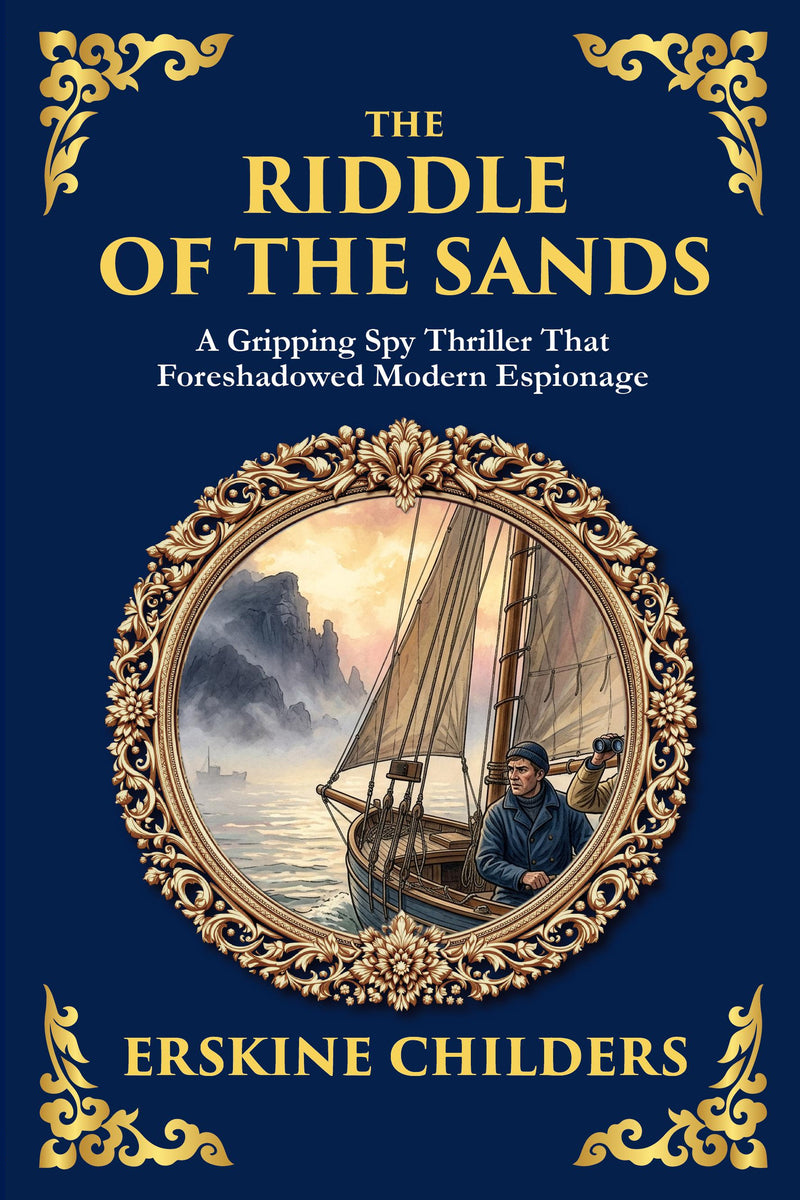
The Riddle of the Sands
Before James Bond, before George Smiley, there was The Riddle of the Sands. First published in 1903, this trailblazing spy novel stunned readers with its realism, tension, and prophetic insight into geopolitical conflict.
or free app
10,000+ hrs library
30-day guarantee
The complete The Riddle of the Sands appears in modern English through Library of Alexandria Press, available online with audiobook narration included for members.
Have you ever wondered why the first great spy thriller still holds us captive today? Long before the Cold War, Erskine Childers launched an entirely new genre with The Riddle of the Sands—a gripping tale of espionage, patriotism, and maritime danger that predicted the tensions leading up to World War I. When Carruthers, a British Foreign Office man, accepts an invitation for a sailing holiday off the coast of Germany, he expects leisure, sport, and fresh air. But his host, Davies, reveals a far more dangerous agenda: he suspects German military preparations hidden among the labyrinthine sandbanks of the Frisian coast.
As the two amateur sailors navigate treacherous waters—both literal and political—they uncover a chilling conspiracy that could reshape the future of Europe. What follows is a taut, intellectual game of cat-and-mouse, where every clue must be deciphered, and every action could spark an international crisis. This modern edition preserves the technical authenticity and detailed realism that made The Riddle of the Sands a sensation—while presenting it in a clear, compelling format for today’s readers.
Part travelogue, part naval manual, and entirely riveting, this novel is essential for fans of spy stories, seafaring adventures, and historical thrillers alike.
What you’ll discover in this modern edition
- The Birth of the Spy Thriller – A pioneering narrative that laid the foundation for 20th- century espionage fiction.
- A Chilling Political Prophecy – Childers eerily predicted German aggression a decade before World War I.
- Riveting Maritime Detail – A unique blend of sailing expertise and high-stakes intrigue.
- Timeless Themes of Loyalty and Patriotism – Explore how individual action can impact the fate of nations.
- A Richly Atmospheric Setting – The shifting sands and moody coasts of the North Sea become characters in their own right.
| Formats | eBook (EPUB + PDF) · Audiobook · Paperback · Hardcover · Large Print |
| Language | English |
| Trim size (print) | 6 × 9 in |
| Binding | Paperback — perfect-bound · Hardcover — casewrap |
| Large Print edition | Same text in a larger, easy-read type — a larger font, not a larger trim |
| Print pricing | Every physical book at our true cost — at-cost, no profit (members) |
| Library | 873 restored titles, always growing |
| Length | 107,770 words · ~7 hr 11 min reading |
| Reading level | Grade 8 · an easy, flowing read (this modern-English edition) |
| Edition | Modern English translation · 2026 |
Member reviews for this edition are collected as readers finish it — be the first. Across the library: 12,000+ books shipped, every plan covered by a 365-day print guarantee.
About this edition
A faithful, unabridged modern-English edition by The Library of Alexandria — carefully rendered for today's reader and verified paragraph-by-paragraph against the public-domain source. Available as eBook, audiobook, paperback, hardcover, and large print.
- Complete & unabridgedVerified paragraph by paragraph against the source — never a scan, never abridged.
- Modern English, faithfulReadable today, with the author’s meaning kept intact. Readable — not simplified.
- Every format, one membershipRead in your browser or the free app, or listen to the full audiobook.
Included free with your membership
Cancel anytime, one click · 30-day money-back guarantee
Edition last updated July 2026
What’s inside
The Riddle of the Sands — complete and unabridged: all 60 sections included with membership, plus the full audiobook.
Begin reading The Riddle of the Sands
In clear modern English — the complete text is included with membership.
Introduction
A Fog-Bound Masterpiece and the World It Made
There is a particular kind of novel that arrives in the world at precisely the right moment, answers a question its readers did not yet know they were asking, and then quietly refuses to go away. Erskine Childers published his only work of fiction in 1903, and it did all three of those things with a modesty that is itself part of its genius. More than a century later, the book remains in print in dozens of editions, has never been out of fashion for long, and continues to be read by people who have no particular interest in Edwardian politics, German naval strategy, or the tidal geography of the Frisian Islands — and who find, to their considerable surprise, that they cannot put it down. That is a remarkable achievement for any novel. For a novel that is, on its surface, about two young Englishmen sailing a small and uncomfortable boat through some of the most treacherous shallow waters in Europe, it is close to miraculous.
To understand why the book works as well as it does, it helps to understand something of the world into which it arrived, and something of the man who wrote it — though the latter is a subject that requires a degree of care. Erskine Childers was born in 1870 and died, by firing squad, in 1922, executed by the Irish Free State government during the Irish Civil War. Between those two dates he lived a life of such extraordinary range and contradiction that biographers have sometimes struggled to reconcile its parts into a coherent whole. He served as a clerk in the House of Commons, fought with distinction in the Boer War, became a passionate Irish nationalist, ran guns for the Irish Volunteers in 1914 aboard his own yacht, served the British cause in the First World War with conspicuous bravery, and ultimately died for the republican cause he had come to believe in with the fervour of a convert. He was, by most accounts, a man of deep personal integrity and considerable physical courage, and the tension between those qualities and the political contradictions of his life gives his biography a tragic dimension that his fiction, in its own quieter way, also carries.
What can be said with confidence about the origins of this novel is that Childers knew the waters he was writing about from direct personal experience. He had sailed the Frisian coast and the Baltic approaches, and the navigational detail in these pages — the tides, the channels, the sandbanks, the particular quality of North Sea light and North Sea weather — carries the unmistakable authority of a man who has been cold and wet and uncertain of his position in exactly the places he describes. Whether every detail of the political and military intelligence that forms the novel’s spine was drawn from equally direct knowledge is a question that has occupied historians and enthusiasts for decades, and it is not one that can be definitively answered here. What matters for the reader is that the book feels true in the way that only genuine experience, carefully observed and honestly rendered, can make a piece of fiction feel true.
The year 1903 was, in retrospect, a hinge moment in European history. The long Victorian peace — already badly dented by the Boer War and the various imperial skirmishes of the 1890s — was beginning to show the deeper cracks that would eventually split it open in 1914. Germany under Kaiser Wilhelm II had embarked on a programme of naval expansion that was causing serious anxiety in British strategic circles, and the question of what Germany might do with a large modern navy was one that thoughtful people were beginning to ask in earnest. The British public, however, was largely unaware of the specific geographical vulnerabilities that a German naval strategy might exploit, and the popular imagination had not yet caught up with the strategic reality. Into this gap Childers inserted his novel with the precision of a man who had thought carefully about both the geography and the politics, and who believed — correctly, as it turned out — that fiction might communicate what official reports and parliamentary debates could not.
The book was, among other things, a deliberate act of public warning. Childers wanted his readers to understand that the shallow, fog-bound, tide-riven waters of the Frisian coast were not merely a navigational curiosity but a potential theatre of war, and that Britain’s complacent assumption of naval supremacy might not survive contact with a determined and well-prepared enemy operating in waters that British sailors barely knew. He made this argument not through polemic but through story, and the story he chose to tell is one of the most effective vehicles for that kind of argument that the English novel has ever produced. The thriller — the genre he was, in effect, helping to invent — turns out to be an extraordinarily efficient machine for delivering geopolitical anxiety to a general audience, because it personalises the abstract, makes the strategic visceral, and gives the reader a pair of eyes through which to see the danger rather than a set of arguments through which to understand it.
The novel presents itself, with characteristic slyness, as a document rather than a fiction. The narrator, a young Foreign Office man named Carruthers, claims to be editing the account of an adventure that actually happened, and the book is furnished with maps, charts, and appendices that reinforce this pretence of documentary authenticity. Modern readers should lean into this conceit rather than seeing through it. The maps are not decorative — they are functional, and consulting them as you read will repay the effort handsomely. The Frisian Islands, the channels between them, the sandbanks that shift with the tides, the harbours and anchorages that punctuate the narrative: these are real places, and the knowledge that they are real places, that the waters described are actual waters with actual dangers, gives the story a grounding that purely invented geography could never provide. If you have access to a modern atlas or an online map, a few minutes spent locating the relevant coastline before you begin will orient you in a way that enriches everything that follows.
The narrative voice is also worth attending to from the first page. Carruthers, as we meet him in the opening chapter, is a particular kind of Edwardian type — clever, self-aware, socially ambitious, and thoroughly, almost comically, dissatisfied with his own life. His opening meditation on the miseries of being a fashionable young man stranded in London during the social season is written with a wit and a self-deprecating precision that establishes him immediately as a narrator worth trusting, not because he is always right, but because he is always honest about his own limitations. He knows he is being ridiculous. He knows that his sense of social martyrdom is absurd. And this self-knowledge, which he wears lightly and uses to comic effect, is what makes him so effective as a guide to the more serious business that follows. When Carruthers is frightened, the reader is frightened, because Carruthers is not the kind of man who frightens easily or admits fear without cause.
Davies, the friend whose letter arrives to rescue Carruthers from his London misery, is a different kind of character entirely, and the contrast between the two men is one of the novel’s great pleasures. Where Carruthers is polished, articulate, and socially at ease, Davies is awkward, inarticulate, and apparently oblivious to the social codes that Carruthers navigates with such practiced ease. He is also, it gradually becomes clear, a man of exceptional practical competence, physical courage, and moral seriousness — qualities that Carruthers initially underestimates and comes to admire with a warmth that gives the book much of its emotional weight. The friendship between these two men, developing under pressure in cramped and uncomfortable conditions, is as convincing a portrait of male friendship as the Edwardian novel produced, and it is rendered without sentimentality or false notes.
The boat they sail together, the Dulcibella, is the third major character in the story, and she deserves to be taken as seriously as her human crew. She is small, she is old, she is not comfortable, and she is, in the hands of a skilled sailor who understands her particular qualities, entirely adequate to the demands placed upon her. Childers writes about sailing with the authority of a man who loves it, and the passages of seamanship — the navigation of difficult channels, the management of tides and winds, the constant small calculations that keep a small boat safe in dangerous waters — are written with a clarity and a precision that make them accessible to readers with no sailing experience while remaining entirely satisfying to those who have spent time on the water. The sea, in this novel, is not a backdrop. It is an active presence, with its own moods and demands, and the relationship between the sailors and their environment is as central to the book’s meaning as any of the human relationships it contains.
It is a commonplace of literary history that this novel helped to invent the modern spy thriller, and like most commonplaces this one is both true and slightly misleading. It is true in the sense that the book established a template — the amateur hero, the foreign threat, the combination of adventure and intelligence-gathering, the use of real geography and real political anxieties as the scaffolding for a fictional plot — that subsequent writers from John Buchan to Ian Fleming to John le Carré have drawn on, consciously or not. It is misleading in the sense that it implies the book is primarily interesting as a historical artefact, a prototype for something better that came later, rather than as a living work of fiction that can be read and enjoyed on its own terms.
The truth is that in several important respects this novel has never been surpassed by the genre it helped to create. The authenticity of its setting, the quality of its characterisation, the intelligence of its political analysis, and the genuine tension of its central mystery are all achieved without the mechanical plotting, the cartoonish villainy, and the ideological simplifications that have disfigured much of the thriller genre in the century since. The antagonists in this story are not monsters. They are men operating according to a logic that the novel takes seriously and even, in certain moments, treats with something approaching sympathy. The threat they represent is real and carefully argued, not merely asserted. And the heroes are not superhuman agents of a righteous state but two ordinary young men who are, for most of the book, not entirely sure what they have stumbled into or what they ought to do about it.
This moral seriousness is part of what makes the book feel so contemporary. We live, as Childers lived, in a world where the boundaries between peace and war are blurred, where intelligence and counter-intelligence operate in the grey spaces between nations, and where the consequences of strategic miscalculation can be catastrophic. The specific geography has changed, the specific nations have changed, the specific technologies have changed beyond recognition. But the underlying situation — small actors trying to understand a large and dangerous game being played around them, with incomplete information and uncertain authority — is one that resonates as strongly now as it did in 1903. Perhaps more strongly, because we have the benefit of knowing how the story that Childers was warning about actually ended, and the knowledge does not make his warnings seem alarmist. It makes them seem prescient.
There is also, running beneath the adventure and the politics, a strain of feeling about England and Englishness that is worth noticing. Carruthers begins the novel as a representative of a certain kind of Edwardian complacency — the well-connected young man who takes his country’s greatness for granted and has never been required to think seriously about what that greatness costs or what might threaten it. The adventure he undergoes is, among other things, an education in the gap between the England he has assumed and the England that actually exists, between the comfortable social world of Pall Mall and the cold, fog-bound reality of a coastline that nobody in that world has bothered to understand. This education is not delivered through lectures or arguments but through experience, through the accumulated weight of days spent in difficult conditions doing difficult things, and it changes Carruthers in ways that are shown rather than stated. By the end of the book he is a different man from the one who opened it, and the difference is not merely a matter of having had an adventure. It is a matter of having been forced to take the world seriously.
Cancel anytime, one click · 30-day money-back guarantee
Founding annual rate available now — your price locks for life when you join.
Not ready? Get this free chapter by email — read it anytime.
✓ Sent — check your inbox for The Riddle of the Sands.
Questions about The Riddle of the Sands
What is The Riddle of the Sands about?
Before James Bond, before George Smiley, there was The Riddle of the Sands. First published in 1903, this trailblazing spy novel stunned readers with its realism, tension, and prophetic insight into geopolitical conflict. When two Englishmen uncover a sinister German naval plot hidden among the windswept Frisian Islands, their sailing expedition turns into a deadly race against time.
Who wrote The Riddle of the Sands?
The Riddle of the Sands was written by Erskine Childers. This edition presents the complete work in clear modern English, faithfully rendered from the public-domain original by Library of Alexandria Press.
Is The Riddle of the Sands free to read?
The opening chapter is free to read on this page. Members read and listen to the complete work — and the entire library — free, and can order any physical book at our true print cost.
How long is The Riddle of the Sands?
60 chapters (~107,770 words) — about 7 hr 11 min of reading in this modern-English edition.
Is this an abridged version of The Riddle of the Sands?
No. This is the complete, unabridged The Riddle of the Sands, carefully rendered into clear modern English and verified paragraph-by-paragraph against the public-domain source — nothing is cut or summarised.
What formats does The Riddle of the Sands come in?
The Riddle of the Sands is available as eBook, paperback, hardcover and large print. eBook and audiobook are included with membership; printed editions ship at our true print cost.
Shipping & returns
Billing & membership
More from the library


Explore Adventure
- Tarzan of the Apes · Edgar Rice Burroughs
- The Wonderful Wizard of Oz · L. Frank Baum
- Peter Pan · J. M. Barrie
- Moby Dick; Or, The Whale · Herman Melville
- The Loss of the Swansea: A Story of the Florida Coast · W. L. Alden
- Sky Island · L. Frank Baum
- Vikram and the Vampire: Classic Hindu Tales of Adventure, Magic, and Romance · Unknown
- Tales of Unrest · Joseph Conrad
- The Tomb of Ts’in · Edgar Wallace
- Skinny McCord · Percy Keese Fitzhugh
- The Men of the Moss-Hags · S. R. Crockett
- The Hunniwell Boys and the Platinum Mystery · L. P. Wyman
- Allan Quatermain · H. Rider Haggard
- She · H. Rider Haggard
- Medical Life in the Navy · Gordon Stables
- The Thirty-Nine Steps · John Buchan
- The Story of Doctor Dolittle · Hugh Lofting
- The Princess and the Goblin · George MacDonald
- The Man Who Would Be King · Rudyard Kipling
- Lucian’s True History · Lucian of Samosata
- The Secret Adversary · Agatha Christie
- Lord Jim · Joseph Conrad
- The Marvelous Land of Oz · L. Frank Baum
- The Virginian: A Horseman of the Plains · Owen Wister
- Mars is My Destination · Frank Belknap Long
- Anabasis · Xenophon
- The Mississippi Saucer · Frank Belknap Long
- Sabotage in Space · Carey Rockwell
- Brood of the Dark Moon · Charles Willard Diffin
- The Misplaced Battleship · Harry Harrison
The Riddle of the Sands
The Riddle of the Sands
A Modern Translation
Erskine Childers
Contents
- Introduction
- Chapter 1
- Chapter 2
- Chapter 3
- Chapter 4
- Chapter 5
- Chapter 6
- Chapter 7
- Chapter 8
- Chapter 9
- Chapter 10
- Chapter 11
- Chapter 12
- Chapter 13
- Chapter 14
- Chapter 15
- Chapter 16
- Chapter 17
- Chapter 18
- Chapter 19
- Chapter 20
- Chapter 21
- Chapter 22
- Chapter 23
- Chapter 24
- Chapter 25
- Chapter 26
- Chapter 27
- Chapter 28
- Chapter 29
- Chapter 30
- Chapter 31
- Chapter 32
- Chapter 33
- Chapter 34
- Chapter 35
- Chapter 36
- Chapter 37
- Chapter 38
- Chapter 39
- … and 20 more chapters
Introduction
A Fog-Bound Masterpiece and the World It Made
There is a particular kind of novel that arrives in the world at precisely the right moment, answers a question its readers did not yet know they were asking, and then quietly refuses to go away. Erskine Childers published his only work of fiction in 1903, and it did all three of those things with a modesty that is itself part of its genius. More than a century later, the book remains in print in dozens of editions, has never been out of fashion for long, and continues to be read by people who have no particular interest in Edwardian politics, German naval strategy, or the tidal geography of the Frisian Islands — and who find, to their considerable surprise, that they cannot put it down. That is a remarkable achievement for any novel. For a novel that is, on its surface, about two young Englishmen sailing a small and uncomfortable boat through some of the most treacherous shallow waters in Europe, it is close to miraculous.
To understand why the book works as well as it does, it helps to understand something of the world into which it arrived, and something of the man who wrote it — though the latter is a subject that requires a degree of care. Erskine Childers was born in 1870 and died, by firing squad, in 1922, executed by the Irish Free State government during the Irish Civil War. Between those two dates he lived a life of such extraordinary range and contradiction that biographers have sometimes struggled to reconcile its parts into a coherent whole. He served as a clerk in the House of Commons, fought with distinction in the Boer War, became a passionate Irish nationalist, ran guns for the Irish Volunteers in 1914 aboard his own yacht, served the British cause in the First World War with conspicuous bravery, and ultimately died for the republican cause he had come to believe in with the fervour of a convert. He was, by most accounts, a man of deep personal integrity and considerable physical courage, and the tension between those qualities and the political contradictions of his life gives his biography a tragic dimension that his fiction, in its own quieter way, also carries.
What can be said with confidence about the origins of this novel is that Childers knew the waters he was writing about from direct personal experience. He had sailed the Frisian coast and the Baltic approaches, and the navigational detail in these pages — the tides, the channels, the sandbanks, the particular quality of North Sea light and North Sea weather — carries the unmistakable authority of a man who has been cold and wet and uncertain of his position in exactly the places he describes. Whether every detail of the political and military intelligence that forms the novel’s spine was drawn from equally direct knowledge is a question that has occupied historians and enthusiasts for decades, and it is not one that can be definitively answered here. What matters for the reader is that the book feels true in the way that only genuine experience, carefully observed and honestly rendered, can make a piece of fiction feel true.
The year 1903 was, in retrospect, a hinge moment in European history. The long Victorian peace — already badly dented by the Boer War and the various imperial skirmishes of the 1890s — was beginning to show the deeper cracks that would eventually split it open in 1914. Germany under Kaiser Wilhelm II had embarked on a programme of naval expansion that was causing serious anxiety in British strategic circles, and the question of what Germany might do with a large modern navy was one that thoughtful people were beginning to ask in earnest. The British public, however, was largely unaware of the specific geographical vulnerabilities that a German naval strategy might exploit, and the popular imagination had not yet caught up with the strategic reality. Into this gap Childers inserted his novel with the precision of a man who had thought carefully about both the geography and the politics, and who believed — correctly, as it turned out — that fiction might communicate what official reports and parliamentary debates could not.
The book was, among other things, a deliberate act of public warning. Childers wanted his readers to understand that the shallow, fog-bound, tide-riven waters of the Frisian coast were not merely a navigational curiosity but a potential theatre of war, and that Britain’s complacent assumption of naval supremacy might not survive contact with a determined and well-prepared enemy operating in waters that British sailors barely knew. He made this argument not through polemic but through story, and the story he chose to tell is one of the most effective vehicles for that kind of argument that the English novel has ever produced. The thriller — the genre he was, in effect, helping to invent — turns out to be an extraordinarily efficient machine for delivering geopolitical anxiety to a general audience, because it personalises the abstract, makes the strategic visceral, and gives the reader a pair of eyes through which to see the danger rather than a set of arguments through which to understand it.
The novel presents itself, with characteristic slyness, as a document rather than a fiction. The narrator, a young Foreign Office man named Carruthers, claims to be editing the account of an adventure that actually happened, and the book is furnished with maps, charts, and appendices that reinforce this pretence of documentary authenticity. Modern readers should lean into this conceit rather than seeing through it. The maps are not decorative — they are functional, and consulting them as you read will repay the effort handsomely. The Frisian Islands, the channels between them, the sandbanks that shift with the tides, the harbours and anchorages that punctuate the narrative: these are real places, and the knowledge that they are real places, that the waters described are actual waters with actual dangers, gives the story a grounding that purely invented geography could never provide. If you have access to a modern atlas or an online map, a few minutes spent locating the relevant coastline before you begin will orient you in a way that enriches everything that follows.
The narrative voice is also worth attending to from the first page. Carruthers, as we meet him in the opening chapter, is a particular kind of Edwardian type — clever, self-aware, socially ambitious, and thoroughly, almost comically, dissatisfied with his own life. His opening meditation on the miseries of being a fashionable young man stranded in London during the social season is written with a wit and a self-deprecating precision that establishes him immediately as a narrator worth trusting, not because he is always right, but because he is always honest about his own limitations. He knows he is being ridiculous. He knows that his sense of social martyrdom is absurd. And this self-knowledge, which he wears lightly and uses to comic effect, is what makes him so effective as a guide to the more serious business that follows. When Carruthers is frightened, the reader is frightened, because Carruthers is not the kind of man who frightens easily or admits fear without cause.
Davies, the friend whose letter arrives to rescue Carruthers from his London misery, is a different kind of character entirely, and the contrast between the two men is one of the novel’s great pleasures. Where Carruthers is polished, articulate, and socially at ease, Davies is awkward, inarticulate, and apparently oblivious to the social codes that Carruthers navigates with such practiced ease. He is also, it gradually becomes clear, a man of exceptional practical competence, physical courage, and moral seriousness — qualities that Carruthers initially underestimates and comes to admire with a warmth that gives the book much of its emotional weight. The friendship between these two men, developing under pressure in cramped and uncomfortable conditions, is as convincing a portrait of male friendship as the Edwardian novel produced, and it is rendered without sentimentality or false notes.
The boat they sail together, the Dulcibella, is the third major character in the story, and she deserves to be taken as seriously as her human crew. She is small, she is old, she is not comfortable, and she is, in the hands of a skilled sailor who understands her particular qualities, entirely adequate to the demands placed upon her. Childers writes about sailing with the authority of a man who loves it, and the passages of seamanship — the navigation of difficult channels, the management of tides and winds, the constant small calculations that keep a small boat safe in dangerous waters — are written with a clarity and a precision that make them accessible to readers with no sailing experience while remaining entirely satisfying to those who have spent time on the water. The sea, in this novel, is not a backdrop. It is an active presence, with its own moods and demands, and the relationship between the sailors and their environment is as central to the book’s meaning as any of the human relationships it contains.
It is a commonplace of literary history that this novel helped to invent the modern spy thriller, and like most commonplaces this one is both true and slightly misleading. It is true in the sense that the book established a template — the amateur hero, the foreign threat, the combination of adventure and intelligence-gathering, the use of real geography and real political anxieties as the scaffolding for a fictional plot — that subsequent writers from John Buchan to Ian Fleming to John le Carré have drawn on, consciously or not. It is misleading in the sense that it implies the book is primarily interesting as a historical artefact, a prototype for something better that came later, rather than as a living work of fiction that can be read and enjoyed on its own terms.
The truth is that in several important respects this novel has never been surpassed by the genre it helped to create. The authenticity of its setting, the quality of its characterisation, the intelligence of its political analysis, and the genuine tension of its central mystery are all achieved without the mechanical plotting, the cartoonish villainy, and the ideological simplifications that have disfigured much of the thriller genre in the century since. The antagonists in this story are not monsters. They are men operating according to a logic that the novel takes seriously and even, in certain moments, treats with something approaching sympathy. The threat they represent is real and carefully argued, not merely asserted. And the heroes are not superhuman agents of a righteous state but two ordinary young men who are, for most of the book, not entirely sure what they have stumbled into or what they ought to do about it.
This moral seriousness is part of what makes the book feel so contemporary. We live, as Childers lived, in a world where the boundaries between peace and war are blurred, where intelligence and counter-intelligence operate in the grey spaces between nations, and where the consequences of strategic miscalculation can be catastrophic. The specific geography has changed, the specific nations have changed, the specific technologies have changed beyond recognition. But the underlying situation — small actors trying to understand a large and dangerous game being played around them, with incomplete information and uncertain authority — is one that resonates as strongly now as it did in 1903. Perhaps more strongly, because we have the benefit of knowing how the story that Childers was warning about actually ended, and the knowledge does not make his warnings seem alarmist. It makes them seem prescient.
There is also, running beneath the adventure and the politics, a strain of feeling about England and Englishness that is worth noticing. Carruthers begins the novel as a representative of a certain kind of Edwardian complacency — the well-connected young man who takes his country’s greatness for granted and has never been required to think seriously about what that greatness costs or what might threaten it. The adventure he undergoes is, among other things, an education in the gap between the England he has assumed and the England that actually exists, between the comfortable social world of Pall Mall and the cold, fog-bound reality of a coastline that nobody in that world has bothered to understand. This education is not delivered through lectures or arguments but through experience, through the accumulated weight of days spent in difficult conditions doing difficult things, and it changes Carruthers in ways that are shown rather than stated. By the end of the book he is a different man from the one who opened it, and the difference is not merely a matter of having had an adventure. It is a matter of having been forced to take the world seriously.
I’ve read about men who, forced by their jobs to live in total isolation—with only a few local servants for company—make it a rule to dress up for dinner every night. They do this to maintain their self-respect and keep themselves from sliding into savagery. It was in a similar spirit, though with a bit more self-consciousness, that I was getting ready for dinner in my Pall Mall apartments at seven o’clock on the evening of September 23rd a few years ago. I felt the date and location made the comparison fitting, and even worked in my favor; an obscure administrator in Burma might be a man of dull sensibilities and coarse habits, and at least he is alone in nature. I, however—a young man of status and fashion, who knows the right people, belongs to the right clubs, and has a secure, perhaps even brilliant, future at the Foreign Office—might be forgiven for feeling like a pampered martyr when, fully aware of the social calendar, I am condemned to the loneliness of London in September. I call it “martyrdom,” but in reality, it was much worse. Feeling like a martyr is actually quite pleasurable, and the true tragedy of my situation was that I had moved past that stage. I had enjoyed the perks of my misery in decreasing amounts since mid-August, when social ties were still fresh and sympathy was plenty. I was aware that people missed me at the Morven Lodge party. Lady Ashleigh herself mentioned it in the kindest way possible when she wrote to acknowledge my letter, in which I explained—with a carefully calculated, austere reserve—that work required me to stay in the office. “We know how busy you must be right now,” she wrote, “and I really hope you don’t overwork yourself; we shall all miss you very much.” Friend after friend “got away” for sports and fresh air, sending promises to write and teasing condolences. As each one abandoned the sinking ship, I took a grim pleasure in my misery, almost enjoying the first week or two after my social circle had completely scattered to the four winds. I began to take a fake interest in the five million people left behind, writing several clever, slightly satirical letters that indirectly hinted at the sadness of my position, while suggesting I was open-minded enough to find intellectual amusement in the people and habits of London during the off-season. I even did “rational” things because others suggested them. Although I would have preferred total isolation, I discovered there was a residue of other unlucky people like me—people who, unlike me, saw the situation in a very boring, literal way. There were river trips after work, but I dislike the river at any time because it’s noisy and vulgar, especially during this season. So, I quit the “fresh air” group and turned down H——’s offer to share a riverside cottage and commute into town every morning. I spent a couple of weekends with the Catesbys in Kent, but I wasn’t devastated when they rented out their house and went abroad, as I found those partial escapes didn’t suit me. My taste for satirical observation didn’t last either. A passing craving for the kind of fascinating adventures described in the New Arabian Nights—a thirst I suspect many have felt—led me a few evenings into some shady spots in Soho and further east. That craving was finally killed one humid Saturday night after spending an hour in the stinking atmosphere of a cheap music hall on Ratcliffe Highway, where I sat next to a plump woman who was struggling with the heat and frequently refreshed herself and a baby with a bottle of lukewarm stout.
End of the free sample
Keep reading, free
Members read and listen to the complete book — and the entire library. Cancel anytime, one click · 30-day money-back guarantee.