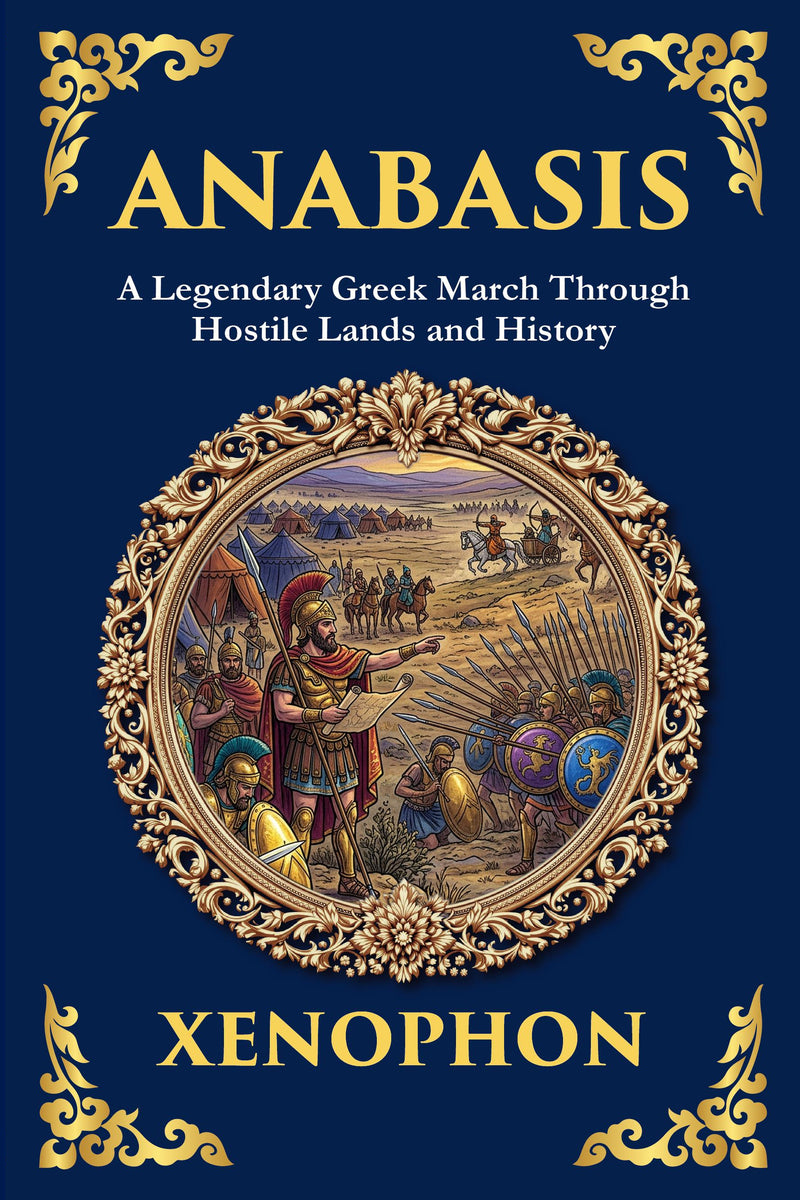
Anabasis
Anabasis is one of the most thrilling true accounts of survival and leadership in ancient literature. Written by Xenophon, a student of Socrates and a soldier-philosopher, it chronicles the perilous journey of ten thousand Greek mercenaries stranded deep within enemy territory after the death of their Persian employer.
or free app
10,000+ hrs library
30-day guarantee
The complete Anabasis appears in modern English through Library of Alexandria Press, available online with audiobook narration included for members.
Have you ever wondered why a journey through danger reveals the soul of a leader? Anabasis: A Legendary Greek March Through Hostile Lands and History is the gripping, firsthand account of a remarkable true story. Written by Xenophon, one of ancient Greece’s most brilliant thinkers and military leaders, Anabasis follows the retreat of ten thousand Greek soldiers from the heart of the Persian Empire—hundreds of miles from home, surrounded by enemies, and leaderless after a failed rebellion.
Xenophon, elected by necessity, rises to command and lead his men across mountains, deserts, and rivers in a march that would echo through military history. What unfolds is not just a tale of survival, but a profound study in leadership, morale, and decision-making under extreme pressure.
What you’ll discover in this modern edition
- An Unforgettable True Story of Survival Experience the treacherous journey of Greek mercenaries stranded behind enemy lines after their general is killed.
| Formats | eBook (EPUB + PDF) · Audiobook · Paperback · Hardcover · Large Print |
| Language | English |
| Trim size (print) | 6 × 9 in |
| Binding | Paperback — perfect-bound · Hardcover — casewrap |
| Large Print edition | Same text in a larger, easy-read type — a larger font, not a larger trim |
| Print pricing | Every physical book at our true cost — at-cost, no profit (members) |
| Library | 873 restored titles, always growing |
| Length | 80,216 words · ~5 hr 21 min reading |
| Reading level | Grade 10 · a comfortable read (this modern-English edition) |
| Edition | Modern English translation · 2026 |
Member reviews for this edition are collected as readers finish it — be the first. Across the library: 12,000+ books shipped, every plan covered by a 365-day print guarantee.
About this edition
A faithful, unabridged modern-English edition by The Library of Alexandria — carefully rendered for today's reader and verified paragraph-by-paragraph against the public-domain source. Available as eBook, audiobook, paperback, hardcover, and large print.
- Complete & unabridgedVerified paragraph by paragraph against the source — never a scan, never abridged.
- Modern English, faithfulReadable today, with the author’s meaning kept intact. Readable — not simplified.
- Every format, one membershipRead in your browser or the free app, or listen to the full audiobook.
Included free with your membership
Cancel anytime, one click · 30-day money-back guarantee
Edition last updated July 2026
What’s inside
Anabasis — complete and unabridged: all 18 sections included with membership, plus the full audiobook.
Begin reading Anabasis
In clear modern English — the complete text is included with membership.
Introduction
There are journeys that change the people who undertake them, and there are journeys that change the way the world tells its stories. The march recounted in these pages is both. It is a tale of ordinary soldiers thrown into an extraordinary predicament, far from home, surrounded by enemies, without leaders they could trust, in a landscape that seemed designed to swallow them. It is also one of the most influential accounts of human endurance ever set down, a work that has been read, studied, imitated, and admired for nearly two and a half thousand years. To open this book is to step into a moment when survival itself becomes an act of collective will, and to watch as a desperate band of men transforms, through hardship and decision, into something more than the sum of its parts.
What makes this account so remarkable is not merely the scale of the adventure, though the distances covered and the dangers faced are staggering even by modern standards. It is the way the story is told: from the inside, by a man who lived it, who marched the miles, suffered the cold, debated in the assemblies, and helped lead frightened men through territory no Greek army had crossed before. The narrator does not write as a distant historian compiling reports from a comfortable study. He writes as a participant, and that immediacy gives the work an urgency and a texture that few ancient texts can match. You feel the bite of the mountain wind, the gnaw of hunger, the relief of finding a friendly village, the terror of an ambush at a narrow pass. You hear the arguments among the men, the speeches that rally them, the doubts that nearly destroy them.
This is a book about leadership in its rawest, most tested form. Not the leadership of titles and thrones, but the leadership that emerges in crisis, when the established order has collapsed and men must decide, day by day, whom to follow and why. It is about how groups make decisions under pressure, how trust is built and broken, how morale rises and falls, and how a sense of shared purpose can be forged out of fear and exhaustion. Modern readers in business schools, military academies, and leadership seminars still turn to these pages for exactly this reason. The circumstances are ancient, but the human dynamics are timeless. Anyone who has ever had to motivate a discouraged team, navigate a political dispute, or hold a fragile coalition together will recognize the challenges that unfold here, even across the gulf of centuries.
To appreciate fully what you are about to read, it helps to know a little about the author, for his life was nearly as eventful as the story he tells. Xenophon was an Athenian, born into a comfortable family during the second half of the fifth century before the common era, a time of tremendous intellectual ferment in his city. He came of age in the orbit of Socrates, the philosopher whose probing questions and unconventional teaching would reshape Western thought. Xenophon counted himself among Socrates’s circle, and the influence shows throughout his writing. He had a deep interest in character, in how people behave under stress, in what makes a person admirable or contemptible. He paid attention to the moral dimension of action in a way that distinguishes his work from a mere chronicle of events.
Yet Xenophon was no cloistered scholar. He was a man of action who chose, at a pivotal moment in his youth, to join a military expedition into the heart of the vast Persian Empire. According to his own account, he received the invitation from a friend and consulted Socrates about whether to go. Socrates, characteristically, advised him to seek divine guidance before making such a momentous decision. Xenophon went to the oracle, though he framed his question in a way that revealed he had already half made up his mind. This small, telling detail tells us much about the man: ambitious, eager for experience, perhaps a little too clever, but also genuinely thoughtful about the rightness of his choices. That tension between worldly ambition and ethical reflection runs through everything he wrote.
When Xenophon set out, he did not go as a general or even as a soldier in the ordinary sense. He went as a kind of observer, a gentleman adventurer attached to the expedition through personal connection rather than formal command. He could not have known that circumstances would thrust him into a position of enormous responsibility, or that the experience would define his life and secure his place in history. The transformation of this young, untested Athenian into one of the leaders who would guide thousands of desperate men through hostile lands is one of the quiet dramas embedded in the larger narrative. We watch a man discover capacities he did not know he possessed, summoned forth by necessity.
After the events recounted here, Xenophon’s life continued along an unconventional path. He became closely associated with Sparta, Athens’s great rival, and even fought on the Spartan side in conflicts that may have included his own native city. This earned him exile from Athens, and he spent many years living on a country estate provided by his Spartan patrons, where he hunted, farmed, raised his sons, and wrote. His literary output was wide-ranging and influential. He composed memoirs of Socrates that, alongside the dialogues of Plato, form our principal sources for that philosopher’s life and ideas. He wrote on horsemanship, on hunting, on household management, on the duties of a cavalry commander, on the ideal education of a ruler. He produced a continuation of the great history of his time, picking up where an earlier historian had left off. Across all these works, certain preoccupations recur: the nature of good leadership, the importance of discipline and self-control, the relationship between the individual and the community, and the question of how a person ought to live.
But it is this account of the great march that has proven most enduring, most widely read, and most beloved. For generations of students learning the ancient Greek language, it served as the standard introductory text, prized for its clear, direct prose and its gripping subject matter. Countless people first encountered the classical world through these pages, puzzling out the grammar while being carried along by the narrative. The phrase that erupts from the soldiers at one of the story’s most famous moments has echoed through literature, art, and popular culture ever since, recognized even by people who have never read the book from which it comes. There is something about this story that lodges in the memory and refuses to leave.
It is worth pausing on the curious fact that Xenophon, when he came to write this account, did so under a pseudonym, referring to himself in the third person throughout, as though describing the deeds of another man. Scholars have long debated his reasons. Perhaps he wished to lend his narrative an air of objectivity, to make his own conduct seem more credible by appearing not to praise himself directly. Perhaps it was a literary convention of the time. Perhaps there were political reasons, given the controversies that surrounded his later life. Whatever the explanation, this device creates an intriguing distance between the author and his younger self, allowing us to watch the character of Xenophon develop almost as if he were a figure in a novel. We see his mistakes as well as his triumphs, his moments of doubt as well as his decisive interventions. Modern readers, attuned to the unreliability of self-justifying memoirs, may find themselves reading between the lines, weighing the narrator’s account of his own virtues against the inevitable temptation to cast oneself in a flattering light. This adds a layer of richness to the reading experience, an invitation to engage critically with the storyteller even as we are swept along by his story.
The events of this narrative unfold against the backdrop of one of the most consequential rivalries in ancient history: the long, uneasy confrontation between the fractious Greek city-states and the immense Persian Empire that stretched from the shores of the Mediterranean to the borders of India. To understand the stakes of the journey, it helps to grasp something of this larger world.
The Persian Empire was, in its day, the largest political entity the world had ever known, a sprawling realm of astonishing diversity encompassing dozens of peoples, languages, and customs. It was governed through a network of provinces, each overseen by a powerful governor who answered, at least in theory, to the king. The wealth of this empire was legendary among the Greeks, who regarded the Persian court as a place of almost unimaginable luxury and the Persian king as the very embodiment of earthly power. Yet the empire’s very size made it difficult to govern. Provincial governors sometimes harbored ambitions of their own, and the question of royal succession could spark deadly conflict, since the throne might be contested among brothers and rivals.
The Greeks, by contrast, were never a unified nation. They shared a common language, a common pantheon of gods, and a common set of cultural traditions, but they were divided into hundreds of independent city-states, fiercely proud of their autonomy and frequently at war with one another. This political fragmentation had not prevented them from achieving extraordinary things in art, philosophy, drama, and political experimentation. Nor had it prevented them, on the famous occasions when the Persian Empire attempted to conquer them, from banding together long enough to repel the invaders. Those earlier wars, in which a coalition of Greek states had defeated vastly larger Persian forces, loomed large in the Greek imagination. They had bred a certain confidence, even a sense of superiority, regarding the fighting qualities of free Greek soldiers compared to the subjects of the Persian king.
This confidence was bound up with one of the defining institutions of the Greek military world: the heavily armed infantryman who fought in a tight formation, shield overlapping shield, presenting a bristling wall of spears. These soldiers were famously disciplined and formidable in close combat, and their reputation extended far beyond the Greek world itself. So formidable were they that ambitious foreign rulers and rebels increasingly sought to hire them as mercenaries. A force of professional Greek fighting men could tip the balance in a contest for power, and there were always Greeks willing to sell their martial skills for pay, whether out of poverty, ambition, a taste for adventure, or simply because soldiering was the only trade they knew.
It is this phenomenon of Greek mercenary service that sets the entire story in motion. Men from all over the Greek world, drawn from many different cities and regions, came together in a force assembled for a great undertaking far from their homes. They were not a national army marching under a single flag, but a collection of contingents, each with its own commander, its own regional loyalties, and its own character. The men from one region might distrust the men from another; old rivalries from home could flare up around the campfires. Holding such a force together required constant effort, persuasion, and a delicate balancing of competing interests. This diversity, and the tensions it produced, becomes one of the central themes of the narrative, for when the original purpose of the expedition is thrown into chaos, the men must somehow remain united or perish.
The geography through which these soldiers traveled is itself a kind of character in the story. They moved through landscapes of bewildering variety: scorching plains, fertile river valleys, towering mountain ranges blanketed in snow, deep gorges, and wild highlands inhabited by peoples who had never bowed to any king and who regarded all strangers as enemies. The physical challenges of this terrain were as deadly as any human foe. Cold, hunger, exhaustion, and the sheer difficulty of finding a safe route through unmapped country tested the men relentlessly. Xenophon’s descriptions of these places, and of the peoples who lived in them, are among the earliest detailed accounts we have of regions that lay at the very edge of the Greek world’s knowledge. He notes their customs, their foods, their fighting methods, their strange and sometimes alarming practices, recording details that fascinate anthropologists and historians to this day. Reading these passages, one feels the wonder and apprehension of men venturing into the genuinely unknown, where every village might hold either salvation or destruction.
Cancel anytime, one click · 30-day money-back guarantee
Founding annual rate available now — your price locks for life when you join.
Not ready? Get this free chapter by email — read it anytime.
✓ Sent — check your inbox for Anabasis.
Questions about Anabasis
What is Anabasis about?
Anabasis is one of the most thrilling true accounts of survival and leadership in ancient literature. Written by Xenophon, a student of Socrates and a soldier-philosopher, it chronicles the perilous journey of ten thousand Greek mercenaries stranded deep within enemy territory after the death of their Persian employer. With no map, no allies, and no way home, they must fight their way back across hostile lands.
Who wrote Anabasis?
Anabasis was written by Xenophon. This edition presents the complete work in clear modern English, faithfully rendered from the public-domain original by Library of Alexandria Press.
Is Anabasis free to read?
The opening chapter is free to read on this page. Members read and listen to the complete work — and the entire library — free, and can order any physical book at our true print cost.
How long is Anabasis?
18 chapters (~80,216 words) — about 5 hr 21 min of reading in this modern-English edition.
Is this an abridged version of Anabasis?
No. This is the complete, unabridged Anabasis, carefully rendered into clear modern English and verified paragraph-by-paragraph against the public-domain source — nothing is cut or summarised.
What formats does Anabasis come in?
Anabasis is available as eBook, paperback, hardcover and large print. eBook and audiobook are included with membership; printed editions ship at our true print cost.
Shipping & returns
Billing & membership
More from the library


Explore Adventure
- Tarzan of the Apes · Edgar Rice Burroughs
- The Wonderful Wizard of Oz · L. Frank Baum
- Peter Pan · J. M. Barrie
- Moby Dick; Or, The Whale · Herman Melville
- The Riddle of the Sands · Erskine Childers
- The Loss of the Swansea: A Story of the Florida Coast · W. L. Alden
- Sky Island · L. Frank Baum
- Vikram and the Vampire: Classic Hindu Tales of Adventure, Magic, and Romance · Unknown
- Tales of Unrest · Joseph Conrad
- The Tomb of Ts’in · Edgar Wallace
- Skinny McCord · Percy Keese Fitzhugh
- The Men of the Moss-Hags · S. R. Crockett
- The Hunniwell Boys and the Platinum Mystery · L. P. Wyman
- Allan Quatermain · H. Rider Haggard
- She · H. Rider Haggard
- Medical Life in the Navy · Gordon Stables
- The Thirty-Nine Steps · John Buchan
- The Story of Doctor Dolittle · Hugh Lofting
- The Princess and the Goblin · George MacDonald
- The Man Who Would Be King · Rudyard Kipling
- Lucian’s True History · Lucian of Samosata
- The Secret Adversary · Agatha Christie
- Lord Jim · Joseph Conrad
- The Marvelous Land of Oz · L. Frank Baum
- The Virginian: A Horseman of the Plains · Owen Wister
- Mars is My Destination · Frank Belknap Long
- The Mississippi Saucer · Frank Belknap Long
- Sabotage in Space · Carey Rockwell
- Brood of the Dark Moon · Charles Willard Diffin
- The Misplaced Battleship · Harry Harrison
Anabasis
Anabasis
A Legendary Greek March Through Hostile Lands and History
Xenophon
Contents
- Introduction
- Book 1
- Chapter 1
- Chapter 2
- Chapter 3
- Chapter 4
- Chapter 5
- Chapter 6
- Chapter 7
- Chapter 8
- Chapter 9
- Chapter 10
- Book 2
- Book 3
- Book 4
- Book 5
- Book 6
- Book 7
Introduction
There are journeys that change the people who undertake them, and there are journeys that change the way the world tells its stories. The march recounted in these pages is both. It is a tale of ordinary soldiers thrown into an extraordinary predicament, far from home, surrounded by enemies, without leaders they could trust, in a landscape that seemed designed to swallow them. It is also one of the most influential accounts of human endurance ever set down, a work that has been read, studied, imitated, and admired for nearly two and a half thousand years. To open this book is to step into a moment when survival itself becomes an act of collective will, and to watch as a desperate band of men transforms, through hardship and decision, into something more than the sum of its parts.
What makes this account so remarkable is not merely the scale of the adventure, though the distances covered and the dangers faced are staggering even by modern standards. It is the way the story is told: from the inside, by a man who lived it, who marched the miles, suffered the cold, debated in the assemblies, and helped lead frightened men through territory no Greek army had crossed before. The narrator does not write as a distant historian compiling reports from a comfortable study. He writes as a participant, and that immediacy gives the work an urgency and a texture that few ancient texts can match. You feel the bite of the mountain wind, the gnaw of hunger, the relief of finding a friendly village, the terror of an ambush at a narrow pass. You hear the arguments among the men, the speeches that rally them, the doubts that nearly destroy them.
This is a book about leadership in its rawest, most tested form. Not the leadership of titles and thrones, but the leadership that emerges in crisis, when the established order has collapsed and men must decide, day by day, whom to follow and why. It is about how groups make decisions under pressure, how trust is built and broken, how morale rises and falls, and how a sense of shared purpose can be forged out of fear and exhaustion. Modern readers in business schools, military academies, and leadership seminars still turn to these pages for exactly this reason. The circumstances are ancient, but the human dynamics are timeless. Anyone who has ever had to motivate a discouraged team, navigate a political dispute, or hold a fragile coalition together will recognize the challenges that unfold here, even across the gulf of centuries.
To appreciate fully what you are about to read, it helps to know a little about the author, for his life was nearly as eventful as the story he tells. Xenophon was an Athenian, born into a comfortable family during the second half of the fifth century before the common era, a time of tremendous intellectual ferment in his city. He came of age in the orbit of Socrates, the philosopher whose probing questions and unconventional teaching would reshape Western thought. Xenophon counted himself among Socrates’s circle, and the influence shows throughout his writing. He had a deep interest in character, in how people behave under stress, in what makes a person admirable or contemptible. He paid attention to the moral dimension of action in a way that distinguishes his work from a mere chronicle of events.
Yet Xenophon was no cloistered scholar. He was a man of action who chose, at a pivotal moment in his youth, to join a military expedition into the heart of the vast Persian Empire. According to his own account, he received the invitation from a friend and consulted Socrates about whether to go. Socrates, characteristically, advised him to seek divine guidance before making such a momentous decision. Xenophon went to the oracle, though he framed his question in a way that revealed he had already half made up his mind. This small, telling detail tells us much about the man: ambitious, eager for experience, perhaps a little too clever, but also genuinely thoughtful about the rightness of his choices. That tension between worldly ambition and ethical reflection runs through everything he wrote.
When Xenophon set out, he did not go as a general or even as a soldier in the ordinary sense. He went as a kind of observer, a gentleman adventurer attached to the expedition through personal connection rather than formal command. He could not have known that circumstances would thrust him into a position of enormous responsibility, or that the experience would define his life and secure his place in history. The transformation of this young, untested Athenian into one of the leaders who would guide thousands of desperate men through hostile lands is one of the quiet dramas embedded in the larger narrative. We watch a man discover capacities he did not know he possessed, summoned forth by necessity.
After the events recounted here, Xenophon’s life continued along an unconventional path. He became closely associated with Sparta, Athens’s great rival, and even fought on the Spartan side in conflicts that may have included his own native city. This earned him exile from Athens, and he spent many years living on a country estate provided by his Spartan patrons, where he hunted, farmed, raised his sons, and wrote. His literary output was wide-ranging and influential. He composed memoirs of Socrates that, alongside the dialogues of Plato, form our principal sources for that philosopher’s life and ideas. He wrote on horsemanship, on hunting, on household management, on the duties of a cavalry commander, on the ideal education of a ruler. He produced a continuation of the great history of his time, picking up where an earlier historian had left off. Across all these works, certain preoccupations recur: the nature of good leadership, the importance of discipline and self-control, the relationship between the individual and the community, and the question of how a person ought to live.
But it is this account of the great march that has proven most enduring, most widely read, and most beloved. For generations of students learning the ancient Greek language, it served as the standard introductory text, prized for its clear, direct prose and its gripping subject matter. Countless people first encountered the classical world through these pages, puzzling out the grammar while being carried along by the narrative. The phrase that erupts from the soldiers at one of the story’s most famous moments has echoed through literature, art, and popular culture ever since, recognized even by people who have never read the book from which it comes. There is something about this story that lodges in the memory and refuses to leave.
It is worth pausing on the curious fact that Xenophon, when he came to write this account, did so under a pseudonym, referring to himself in the third person throughout, as though describing the deeds of another man. Scholars have long debated his reasons. Perhaps he wished to lend his narrative an air of objectivity, to make his own conduct seem more credible by appearing not to praise himself directly. Perhaps it was a literary convention of the time. Perhaps there were political reasons, given the controversies that surrounded his later life. Whatever the explanation, this device creates an intriguing distance between the author and his younger self, allowing us to watch the character of Xenophon develop almost as if he were a figure in a novel. We see his mistakes as well as his triumphs, his moments of doubt as well as his decisive interventions. Modern readers, attuned to the unreliability of self-justifying memoirs, may find themselves reading between the lines, weighing the narrator’s account of his own virtues against the inevitable temptation to cast oneself in a flattering light. This adds a layer of richness to the reading experience, an invitation to engage critically with the storyteller even as we are swept along by his story.
The events of this narrative unfold against the backdrop of one of the most consequential rivalries in ancient history: the long, uneasy confrontation between the fractious Greek city-states and the immense Persian Empire that stretched from the shores of the Mediterranean to the borders of India. To understand the stakes of the journey, it helps to grasp something of this larger world.
The Persian Empire was, in its day, the largest political entity the world had ever known, a sprawling realm of astonishing diversity encompassing dozens of peoples, languages, and customs. It was governed through a network of provinces, each overseen by a powerful governor who answered, at least in theory, to the king. The wealth of this empire was legendary among the Greeks, who regarded the Persian court as a place of almost unimaginable luxury and the Persian king as the very embodiment of earthly power. Yet the empire’s very size made it difficult to govern. Provincial governors sometimes harbored ambitions of their own, and the question of royal succession could spark deadly conflict, since the throne might be contested among brothers and rivals.
The Greeks, by contrast, were never a unified nation. They shared a common language, a common pantheon of gods, and a common set of cultural traditions, but they were divided into hundreds of independent city-states, fiercely proud of their autonomy and frequently at war with one another. This political fragmentation had not prevented them from achieving extraordinary things in art, philosophy, drama, and political experimentation. Nor had it prevented them, on the famous occasions when the Persian Empire attempted to conquer them, from banding together long enough to repel the invaders. Those earlier wars, in which a coalition of Greek states had defeated vastly larger Persian forces, loomed large in the Greek imagination. They had bred a certain confidence, even a sense of superiority, regarding the fighting qualities of free Greek soldiers compared to the subjects of the Persian king.
This confidence was bound up with one of the defining institutions of the Greek military world: the heavily armed infantryman who fought in a tight formation, shield overlapping shield, presenting a bristling wall of spears. These soldiers were famously disciplined and formidable in close combat, and their reputation extended far beyond the Greek world itself. So formidable were they that ambitious foreign rulers and rebels increasingly sought to hire them as mercenaries. A force of professional Greek fighting men could tip the balance in a contest for power, and there were always Greeks willing to sell their martial skills for pay, whether out of poverty, ambition, a taste for adventure, or simply because soldiering was the only trade they knew.
It is this phenomenon of Greek mercenary service that sets the entire story in motion. Men from all over the Greek world, drawn from many different cities and regions, came together in a force assembled for a great undertaking far from their homes. They were not a national army marching under a single flag, but a collection of contingents, each with its own commander, its own regional loyalties, and its own character. The men from one region might distrust the men from another; old rivalries from home could flare up around the campfires. Holding such a force together required constant effort, persuasion, and a delicate balancing of competing interests. This diversity, and the tensions it produced, becomes one of the central themes of the narrative, for when the original purpose of the expedition is thrown into chaos, the men must somehow remain united or perish.
The geography through which these soldiers traveled is itself a kind of character in the story. They moved through landscapes of bewildering variety: scorching plains, fertile river valleys, towering mountain ranges blanketed in snow, deep gorges, and wild highlands inhabited by peoples who had never bowed to any king and who regarded all strangers as enemies. The physical challenges of this terrain were as deadly as any human foe. Cold, hunger, exhaustion, and the sheer difficulty of finding a safe route through unmapped country tested the men relentlessly. Xenophon’s descriptions of these places, and of the peoples who lived in them, are among the earliest detailed accounts we have of regions that lay at the very edge of the Greek world’s knowledge. He notes their customs, their foods, their fighting methods, their strange and sometimes alarming practices, recording details that fascinate anthropologists and historians to this day. Reading these passages, one feels the wonder and apprehension of men venturing into the genuinely unknown, where every village might hold either salvation or destruction.
Darius and Parysatis had two sons: the older was named Artaxerxes and the younger was Cyrus. When Darius became ill and felt that his death was near, he wanted both of his sons by his side. The older son happened to be there already, but Cyrus had to be summoned from the province where he served as governor. Darius had also appointed him as the general of all the troops gathered in the plain of the Castolus. Cyrus traveled to his father, bringing along Tissaphernes as a friend and a group of three hundred heavily armed Greeks led by Xenias of Parrhasia.
After Darius died and Artaxerxes took the throne, Tissaphernes told the king that Cyrus was plotting against him. Believing these lies, Artaxerxes arrested Cyrus and intended to execute him. However, their mother pleaded for his life, and the king allowed Cyrus to return safely to his province. Having narrowly escaped death and disgrace, Cyrus began to plan. He wanted to ensure he would never be at his brother’s mercy again and, if possible, wanted to take the throne for himself. He first turned to his mother, Parysatis, because she loved Cyrus more than she loved Artaxerxes as king. Furthermore, Cyrus treated everyone who visited him from the royal court so well that when they left, they were more loyal to him than to the king. He also took care of the non-Greeks in his service, training them to be both skilled soldiers and devoted followers. Finally, he began secretly gathering a Greek army so he could surprise the king.
Cyrus organized his troops in the following way: First, he sent orders to the commanders of the garrisons in the cities he controlled. He told them to gather as many elite Peloponnesian soldiers as possible, claiming that Tissaphernes was plotting against their cities. These Ionian cities had originally been given to Tissaphernes by the king, but by this time, all of them except Miletus had switched their loyalty to Cyrus. In Miletus, Tissaphernes discovered the plot and stopped it by executing some of the conspirators and exiling the rest. Cyrus welcomed these refugees and built an army to besiege Miletus by land and sea, claiming he wanted to restore the exiles to their homes. This gave him another excuse to build up his military. At the same time, he wrote to the king, arguing that as the king’s brother, he should govern these cities instead of Tissaphernes. His mother, the queen, helped him with this plan. Because of her influence, the king did not suspect a coup; instead, he believed Cyrus was simply spending his own money on soldiers to fight Tissaphernes. The king didn’t mind the conflict between the two, especially since Cyrus continued to send the taxes from Tissaphernes’ cities to the royal treasury.
End of the free sample
Keep reading, free
Members read and listen to the complete book — and the entire library. Cancel anytime, one click · 30-day money-back guarantee.