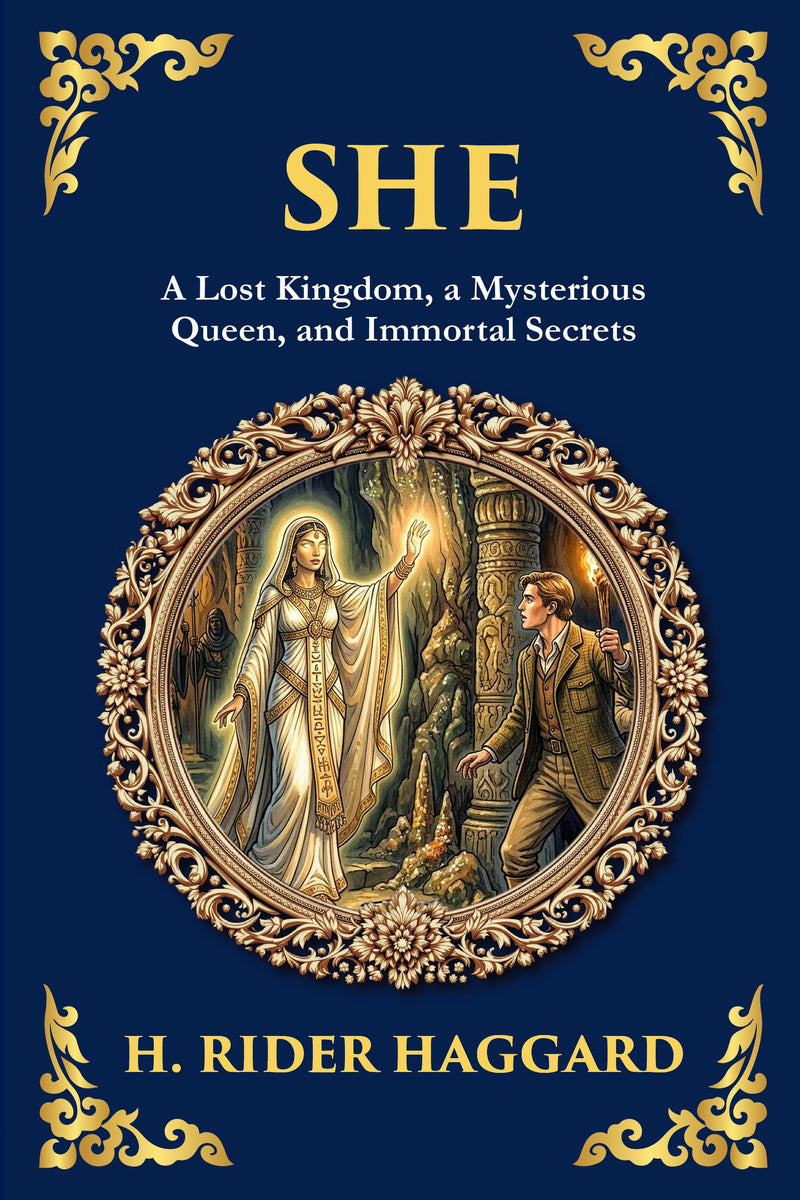
She
Adventure, myth, and mysticism collide in She, the groundbreaking tale of a hidden kingdom and an immortal queen who rules with both wisdom and terror.
or free app
10,000+ hrs library
30-day guarantee
The complete She appears in modern English through Library of Alexandria Press, available online with audiobook narration included for members.
Have you ever wondered why immortality might be the most dangerous gift of all? She is one of the most influential adventure novels ever written—an intoxicating blend of lost world fantasy, philosophical inquiry, and gothic romance. First published in 1887, H. Rider Haggard’s masterpiece has captivated readers for over a century with its imaginative scope and emotional depth.
The novel follows the journey of Horace Holly and his adopted son Leo Vincey as they follow an ancient clue to a forgotten land deep in the heart of Africa. There, hidden among ruins and eternal fire, they encounter the enigmatic Ayesha—“She-who-must-be-obeyed”—an immortal queen as alluring as she is terrifying. As she reveals her secrets, the two men are forced to confront their own pasts, their beliefs, and the seductive danger of eternal life.
At once a gripping tale of survival and a profound exploration of power, love, and fate, She explores timeless questions: What does it mean to live forever? Can love truly transcend death? And what happens when a mortal heart dares to challenge the divine?
What you’ll discover in this modern edition
- An Epic Quest into the Unknown Join a daring expedition to a lost civilization brimming with ancient prophecy and haunting mystery.
- The Legendary Ayesha Encounter one of literature’s most unforgettable characters: a queen of immortal beauty and dangerous love.
- Philosophical and Psychological Depth Delve into themes of obsession, colonialism, the nature of time, and the limits of human ambition.
- Thrilling Pacing and Lush Description Vividly rendered landscapes, hidden temples, and perilous rites make for an immersive reading experience.
- A Pioneering Work of Lost-World Fantasy The novel that inspired generations of writers from Tolkien to C.S. Lewis and Indiana Jones to modern fantasy epics.
| Formats | eBook (EPUB + PDF) · Audiobook · Paperback · Hardcover · Large Print |
| Language | English |
| Trim size (print) | 6 × 9 in |
| Binding | Paperback — perfect-bound · Hardcover — casewrap |
| Large Print edition | Same text in a larger, easy-read type — a larger font, not a larger trim |
| Print pricing | Every physical book at our true cost — at-cost, no profit (members) |
| Library | 873 restored titles, always growing |
| Length | 107,774 words · ~7 hr 11 min reading |
| Reading level | Grade 8 · an easy, flowing read (this modern-English edition) |
| Edition | Modern English translation · 2026 |
Member reviews for this edition are collected as readers finish it — be the first. Across the library: 12,000+ books shipped, every plan covered by a 365-day print guarantee.
About this edition
A faithful, unabridged modern-English edition by The Library of Alexandria — carefully rendered for today's reader and verified paragraph-by-paragraph against the public-domain source. Available as eBook, audiobook, paperback, hardcover, and large print.
- Complete & unabridgedVerified paragraph by paragraph against the source — never a scan, never abridged.
- Modern English, faithfulReadable today, with the author’s meaning kept intact. Readable — not simplified.
- Every format, one membershipRead in your browser or the free app, or listen to the full audiobook.
Included free with your membership
Cancel anytime, one click · 30-day money-back guarantee
Edition last updated July 2026
What’s inside
She — complete and unabridged: all 30 sections included with membership, plus the full audiobook.
Begin reading She
In clear modern English — the complete text is included with membership.
Introduction
There are certain books that, once read, refuse to leave the imagination. They linger in the mind like the memory of a vivid dream, surfacing unexpectedly years later, demanding to be revisited. The story you are about to begin belongs firmly to this rare category. First published in 1887, it has captivated generations of readers, inspired countless writers and filmmakers, and helped to define an entire genre of fiction that we now take for granted. Yet for all its fame, it remains a deeply personal experience for each reader who encounters it—a journey into the unknown that feels as fresh and unsettling today as it must have felt to the Victorians who first turned its pages by candlelight.
This particular edition has been prepared with you, the contemporary reader, firmly in mind. The original prose, magnificent as it is, was written in the rolling, ornate style of the late nineteenth century, a style that can occasionally feel distant or labyrinthine to those accustomed to modern storytelling. This adaptation seeks to preserve every ounce of the original’s atmosphere, mystery, and emotional power while gently smoothing the path for readers of our own time. Nothing essential has been lost. The strangeness, the wonder, the creeping sense of dread, and the philosophical weight of the tale all remain intact. What has changed is the accessibility—the ease with which you can now lose yourself in this extraordinary world without stumbling over archaic constructions or unfamiliar idioms.
Before you embark, it is worth pausing to consider what makes this story so enduring, and why it has earned its place among the most influential adventure novels ever written. To understand that, we must first understand a little about the man who wrote it, the era that produced it, and the peculiar magic that has kept it alive for well over a century.
Henry Rider Haggard was born in 1856 in Norfolk, England, the eighth of ten children in a family of modest country gentry. As a young man, he was sent to South Africa, where he served in various colonial administrative posts during a turbulent and formative period of his life. The vast, unmapped landscapes of the African continent—its deserts, its mountains, its dense and seemingly impenetrable interior—left an indelible mark upon his imagination. In an age when large portions of the world remained genuinely unexplored by Europeans, Africa represented to the Victorian mind a place of limitless possibility, where ancient secrets might still lie hidden, where lost civilizations might endure beyond the reach of the known world, and where a traveler might stumble upon wonders that defied all rational explanation.
Haggard absorbed these impressions deeply, and when he returned to England and turned his hand to writing, he poured them onto the page with remarkable vividness. His first great success, a tale of treasure-hunting and danger in the African wilderness, established him almost overnight as one of the most popular authors of his generation. The book before you, written shortly afterward, cemented his reputation and arguably surpassed his earlier triumph in both ambition and lasting influence.
It is said that Haggard wrote this novel in a fever of inspiration, completing the manuscript in a remarkably short span of weeks. Whether or not that account is strictly accurate, the finished work certainly possesses the breathless, headlong quality of something composed in a single sustained burst of creative energy. There is an urgency to the storytelling, a momentum that carries the reader forward almost against their will, that speaks to the intensity with which it was conceived.
To appreciate the novel fully, we should remember the world in which it appeared. The late Victorian era was a time of profound contradiction. On the one hand, it was an age of supreme confidence—an age of railways, telegraphs, scientific advancement, and imperial expansion, in which educated Englishmen believed that reason and progress would eventually illuminate every dark corner of the globe. On the other hand, it was an age riddled with anxiety. The certainties of religious faith were being shaken by new discoveries in geology and biology. The comfortable assumptions about humanity’s place in the universe were under siege. Beneath the surface of Victorian respectability ran deep currents of fascination with death, immortality, the supernatural, and the limits of human knowledge.
This novel speaks directly to those currents. It is, on its surface, a thrilling adventure—a quest into uncharted territory, full of physical danger and narrow escapes. But beneath that surface lies something far more profound and disturbing: a meditation on mortality, on the longing to escape the inevitability of death, and on the terrible consequences that such longing might bring. Haggard understood, perhaps better than any of his contemporaries, that the most powerful adventures are not merely about external dangers but about the internal landscapes of fear, desire, and existential doubt that we all carry within us.
It is no exaggeration to say that this book helped to invent the genre now known as the “lost world” adventure. The countless tales of explorers stumbling upon hidden kingdoms, of ancient mysteries preserved in remote corners of the earth, of ordinary men confronting forces beyond their comprehension—all of these owe an enormous debt to the pages you are about to read. Writers as diverse as those who created jungle adventurers, pulp heroes, and even modern cinematic treasure-hunters were working in a tradition that Haggard did more than anyone to establish. The famous archaeologist-adventurer of twentieth-century film, with his hat and his whip and his perilous expeditions, is in many ways a direct descendant of the characters in this story.
But to reduce the novel to its role as a genre pioneer would be to do it a grave disservice. Its influence extends far beyond adventure fiction. Some of the most respected psychologists and thinkers of the twentieth century found in this story a profound articulation of the human psyche. The figure at the heart of the tale—mysterious, powerful, alluring, and terrifying—came to be seen as one of literature’s great archetypal creations, a symbol of forces buried deep within the human unconscious. Serious scholars have written at length about the novel’s psychological dimensions, its exploration of the eternal feminine, and its dramatization of humanity’s most primal fears and desires. Few adventure novels have ever inspired such depth of intellectual engagement.
What is it, then, that has allowed this story to survive and flourish for so long, when so many of its contemporaries have faded into obscurity? Part of the answer lies in Haggard’s extraordinary gift for atmosphere. From the very first pages, he establishes a tone of mounting strangeness, a sense that the reader is being drawn ever deeper into a realm where the ordinary rules of life no longer apply. He understood that suspense is built not through constant action but through anticipation—through the slow accumulation of clues and omens, through the gradual revelation that something vast and ancient lies waiting just beyond the horizon.
The narrative is framed in a manner that was clever and innovative for its time, designed to lend the fantastic events an air of documentary authenticity. Haggard presents his tale as though it were a true account, recorded by reliable witnesses, complete with the kinds of small, telling details that make even the most incredible occurrences seem plausible. This technique—the pretense that the story is a found manuscript or a true testimony—was one that Haggard used to brilliant effect, and it draws the reader into a kind of complicity, a willingness to believe in wonders that the rational mind would otherwise reject.
The structure of the journey itself is masterfully designed. It begins in the familiar comfort of the known world, then moves by degrees into territory ever more remote and forbidding, until at last the travelers find themselves in a place utterly cut off from the rest of humanity—a hidden world with its own customs, its own history, and its own dark secrets. This progressive movement from the familiar to the utterly strange is one of the great pleasures of the reading experience. Each stage of the journey raises the stakes, deepens the mystery, and brings the characters closer to a confrontation that will test them in ways they could never have imagined.
At the center of it all stands one of the most remarkable characters in all of Victorian fiction—a figure of such power and complexity that she has fascinated readers and scholars for generations. To say too much about her would be to spoil the slow, deliberate unveiling that Haggard has so carefully constructed. It is enough to say that she is unlike any character you are likely to have encountered, a being who embodies both the highest aspirations and the deepest terrors of the human heart. She is beautiful and cruel, wise and deluded, ancient and yet ageless, and the questions she raises about love, power, mortality, and the price of forbidden knowledge will linger in your mind long after you have closed the book.
The supporting characters, too, are vividly drawn. The narrator, whose voice guides us through the entire adventure, is a man of learning and self-deprecating humor, an unlikely hero who nonetheless possesses reserves of courage and loyalty that emerge under pressure. His companion, younger and more impetuous, serves as a kind of catalyst for much of the drama. And there are others along the way—loyal servants, hostile strangers, and figures whose true natures remain ambiguous until the very end. Haggard had a keen eye for character, and even his minor figures are rendered with enough specificity to feel like real people caught up in extraordinary circumstances.
One of the most striking features of the novel is its treatment of time and history. The hidden world the travelers discover is a place where the past is not truly past—where ancient civilizations have left their mark in ruins and relics and customs that have endured for thousands of years. Haggard had a profound sense of the vastness of history, of the countless generations that have lived and died and been forgotten, and this sense infuses the entire novel with a kind of melancholy grandeur. There is something deeply moving about the contemplation of all that has been lost to time, of the empires that have risen and fallen, of the human striving that ultimately comes to nothing against the immense indifference of the ages.
This theme of mortality runs like a dark thread through the entire fabric of the story. The central question that drives the narrative—the question that gives the book its peculiar power—is one that has haunted humanity since the beginning of consciousness: Is it possible to escape death? And if it were possible, would it be a blessing or a curse? Haggard does not offer easy answers. Instead, he dramatizes the question with such intensity and such emotional honesty that the reader cannot help but be drawn into the dilemma. By the end of the novel, you may find that your own assumptions about life, death, love, and the desire for eternity have been challenged and complicated in ways you did not expect.
It is worth noting, as you prepare to read, that this is a novel very much of its era, and it reflects the attitudes and assumptions of the late Victorian period in which it was written. Some of the perspectives expressed within it—particularly regarding race, empire, and the relationship between European travelers and the peoples they encounter—belong to a worldview that modern readers will rightly find dated and, in places, troubling. This adaptation has been prepared with sensitivity to these issues, but it would be dishonest, and indeed disrespectful to history, to pretend that the novel does not bear the marks of its time. Rather than erase these elements, it is more valuable to read them with awareness—to appreciate the book as a window into the mind of a particular age, with all its blind spots as well as its brilliance. The greatest works of the past speak to us not because they are perfect, but because they capture so vividly the hopes, fears, and limitations of the human beings who created them.
Cancel anytime, one click · 30-day money-back guarantee
Founding annual rate available now — your price locks for life when you join.
Not ready? Get this free chapter by email — read it anytime.
✓ Sent — check your inbox for She.
Questions about She
What is She about?
Adventure, myth, and mysticism collide in She, the groundbreaking tale of a hidden kingdom and an immortal queen who rules with both wisdom and terror. When Cambridge professor Horace Holly and his ward Leo set off for Africa in search of an ancient legend, they are drawn into the lost realm of Kor, where secrets buried for thousands of years still live—and rule. At the heart of it all is Ayesha—“She-who-must-be-obeyed”—a woman of breathtaking beauty, supernatural power, and a tragic past that defies time.
Who wrote She?
She was written by H. Rider Haggard. This edition presents the complete work in clear modern English, faithfully rendered from the public-domain original by Library of Alexandria Press.
Is She free to read?
The opening chapter is free to read on this page. Members read and listen to the complete work — and the entire library — free, and can order any physical book at our true print cost.
How long is She?
30 chapters (~107,774 words) — about 7 hr 11 min of reading in this modern-English edition.
Is this an abridged version of She?
No. This is the complete, unabridged She, carefully rendered into clear modern English and verified paragraph-by-paragraph against the public-domain source — nothing is cut or summarised.
What formats does She come in?
She is available as eBook, paperback, hardcover and large print. eBook and audiobook are included with membership; printed editions ship at our true print cost.
Shipping & returns
Billing & membership
More from the library


Explore Adventure
- Tarzan of the Apes · Edgar Rice Burroughs
- The Wonderful Wizard of Oz · L. Frank Baum
- Peter Pan · J. M. Barrie
- Moby Dick; Or, The Whale · Herman Melville
- The Riddle of the Sands · Erskine Childers
- The Loss of the Swansea: A Story of the Florida Coast · W. L. Alden
- Sky Island · L. Frank Baum
- Vikram and the Vampire: Classic Hindu Tales of Adventure, Magic, and Romance · Unknown
- Tales of Unrest · Joseph Conrad
- The Tomb of Ts’in · Edgar Wallace
- Skinny McCord · Percy Keese Fitzhugh
- The Men of the Moss-Hags · S. R. Crockett
- The Hunniwell Boys and the Platinum Mystery · L. P. Wyman
- Allan Quatermain · H. Rider Haggard
- Medical Life in the Navy · Gordon Stables
- The Thirty-Nine Steps · John Buchan
- The Story of Doctor Dolittle · Hugh Lofting
- The Princess and the Goblin · George MacDonald
- The Man Who Would Be King · Rudyard Kipling
- Lucian’s True History · Lucian of Samosata
- The Secret Adversary · Agatha Christie
- Lord Jim · Joseph Conrad
- The Marvelous Land of Oz · L. Frank Baum
- The Virginian: A Horseman of the Plains · Owen Wister
- Mars is My Destination · Frank Belknap Long
- Anabasis · Xenophon
- The Mississippi Saucer · Frank Belknap Long
- Sabotage in Space · Carey Rockwell
- Brood of the Dark Moon · Charles Willard Diffin
- The Misplaced Battleship · Harry Harrison
She
She
A Lost Kingdom, a Mysterious Queen, and Immortal Secrets
H. Rider Haggard
Contents
- Introduction
- Preface by the Author
- Chapter 1
- Part 2
- Chapter 3
- Chapter 4
- Chapter 5
- Chapter 6
- Chapter 7
- Chapter 8
- Chapter 9
- Chapter 10
- Chapter 11
- Chapter 12
- Chapter 13
- Chapter 14
- Chapter 15
- Chapter 16
- Chapter 17
- Chapter 18
- Chapter 19
- Chapter 20
- Chapter 21
- Chapter 22
- Chapter 23
- Chapter 24
- Chapter 25
- Chapter 26
- Chapter 27
- Chapter 28
Introduction
There are certain books that, once read, refuse to leave the imagination. They linger in the mind like the memory of a vivid dream, surfacing unexpectedly years later, demanding to be revisited. The story you are about to begin belongs firmly to this rare category. First published in 1887, it has captivated generations of readers, inspired countless writers and filmmakers, and helped to define an entire genre of fiction that we now take for granted. Yet for all its fame, it remains a deeply personal experience for each reader who encounters it—a journey into the unknown that feels as fresh and unsettling today as it must have felt to the Victorians who first turned its pages by candlelight.
This particular edition has been prepared with you, the contemporary reader, firmly in mind. The original prose, magnificent as it is, was written in the rolling, ornate style of the late nineteenth century, a style that can occasionally feel distant or labyrinthine to those accustomed to modern storytelling. This adaptation seeks to preserve every ounce of the original’s atmosphere, mystery, and emotional power while gently smoothing the path for readers of our own time. Nothing essential has been lost. The strangeness, the wonder, the creeping sense of dread, and the philosophical weight of the tale all remain intact. What has changed is the accessibility—the ease with which you can now lose yourself in this extraordinary world without stumbling over archaic constructions or unfamiliar idioms.
Before you embark, it is worth pausing to consider what makes this story so enduring, and why it has earned its place among the most influential adventure novels ever written. To understand that, we must first understand a little about the man who wrote it, the era that produced it, and the peculiar magic that has kept it alive for well over a century.
Henry Rider Haggard was born in 1856 in Norfolk, England, the eighth of ten children in a family of modest country gentry. As a young man, he was sent to South Africa, where he served in various colonial administrative posts during a turbulent and formative period of his life. The vast, unmapped landscapes of the African continent—its deserts, its mountains, its dense and seemingly impenetrable interior—left an indelible mark upon his imagination. In an age when large portions of the world remained genuinely unexplored by Europeans, Africa represented to the Victorian mind a place of limitless possibility, where ancient secrets might still lie hidden, where lost civilizations might endure beyond the reach of the known world, and where a traveler might stumble upon wonders that defied all rational explanation.
Haggard absorbed these impressions deeply, and when he returned to England and turned his hand to writing, he poured them onto the page with remarkable vividness. His first great success, a tale of treasure-hunting and danger in the African wilderness, established him almost overnight as one of the most popular authors of his generation. The book before you, written shortly afterward, cemented his reputation and arguably surpassed his earlier triumph in both ambition and lasting influence.
It is said that Haggard wrote this novel in a fever of inspiration, completing the manuscript in a remarkably short span of weeks. Whether or not that account is strictly accurate, the finished work certainly possesses the breathless, headlong quality of something composed in a single sustained burst of creative energy. There is an urgency to the storytelling, a momentum that carries the reader forward almost against their will, that speaks to the intensity with which it was conceived.
To appreciate the novel fully, we should remember the world in which it appeared. The late Victorian era was a time of profound contradiction. On the one hand, it was an age of supreme confidence—an age of railways, telegraphs, scientific advancement, and imperial expansion, in which educated Englishmen believed that reason and progress would eventually illuminate every dark corner of the globe. On the other hand, it was an age riddled with anxiety. The certainties of religious faith were being shaken by new discoveries in geology and biology. The comfortable assumptions about humanity’s place in the universe were under siege. Beneath the surface of Victorian respectability ran deep currents of fascination with death, immortality, the supernatural, and the limits of human knowledge.
This novel speaks directly to those currents. It is, on its surface, a thrilling adventure—a quest into uncharted territory, full of physical danger and narrow escapes. But beneath that surface lies something far more profound and disturbing: a meditation on mortality, on the longing to escape the inevitability of death, and on the terrible consequences that such longing might bring. Haggard understood, perhaps better than any of his contemporaries, that the most powerful adventures are not merely about external dangers but about the internal landscapes of fear, desire, and existential doubt that we all carry within us.
It is no exaggeration to say that this book helped to invent the genre now known as the “lost world” adventure. The countless tales of explorers stumbling upon hidden kingdoms, of ancient mysteries preserved in remote corners of the earth, of ordinary men confronting forces beyond their comprehension—all of these owe an enormous debt to the pages you are about to read. Writers as diverse as those who created jungle adventurers, pulp heroes, and even modern cinematic treasure-hunters were working in a tradition that Haggard did more than anyone to establish. The famous archaeologist-adventurer of twentieth-century film, with his hat and his whip and his perilous expeditions, is in many ways a direct descendant of the characters in this story.
But to reduce the novel to its role as a genre pioneer would be to do it a grave disservice. Its influence extends far beyond adventure fiction. Some of the most respected psychologists and thinkers of the twentieth century found in this story a profound articulation of the human psyche. The figure at the heart of the tale—mysterious, powerful, alluring, and terrifying—came to be seen as one of literature’s great archetypal creations, a symbol of forces buried deep within the human unconscious. Serious scholars have written at length about the novel’s psychological dimensions, its exploration of the eternal feminine, and its dramatization of humanity’s most primal fears and desires. Few adventure novels have ever inspired such depth of intellectual engagement.
What is it, then, that has allowed this story to survive and flourish for so long, when so many of its contemporaries have faded into obscurity? Part of the answer lies in Haggard’s extraordinary gift for atmosphere. From the very first pages, he establishes a tone of mounting strangeness, a sense that the reader is being drawn ever deeper into a realm where the ordinary rules of life no longer apply. He understood that suspense is built not through constant action but through anticipation—through the slow accumulation of clues and omens, through the gradual revelation that something vast and ancient lies waiting just beyond the horizon.
The narrative is framed in a manner that was clever and innovative for its time, designed to lend the fantastic events an air of documentary authenticity. Haggard presents his tale as though it were a true account, recorded by reliable witnesses, complete with the kinds of small, telling details that make even the most incredible occurrences seem plausible. This technique—the pretense that the story is a found manuscript or a true testimony—was one that Haggard used to brilliant effect, and it draws the reader into a kind of complicity, a willingness to believe in wonders that the rational mind would otherwise reject.
The structure of the journey itself is masterfully designed. It begins in the familiar comfort of the known world, then moves by degrees into territory ever more remote and forbidding, until at last the travelers find themselves in a place utterly cut off from the rest of humanity—a hidden world with its own customs, its own history, and its own dark secrets. This progressive movement from the familiar to the utterly strange is one of the great pleasures of the reading experience. Each stage of the journey raises the stakes, deepens the mystery, and brings the characters closer to a confrontation that will test them in ways they could never have imagined.
At the center of it all stands one of the most remarkable characters in all of Victorian fiction—a figure of such power and complexity that she has fascinated readers and scholars for generations. To say too much about her would be to spoil the slow, deliberate unveiling that Haggard has so carefully constructed. It is enough to say that she is unlike any character you are likely to have encountered, a being who embodies both the highest aspirations and the deepest terrors of the human heart. She is beautiful and cruel, wise and deluded, ancient and yet ageless, and the questions she raises about love, power, mortality, and the price of forbidden knowledge will linger in your mind long after you have closed the book.
The supporting characters, too, are vividly drawn. The narrator, whose voice guides us through the entire adventure, is a man of learning and self-deprecating humor, an unlikely hero who nonetheless possesses reserves of courage and loyalty that emerge under pressure. His companion, younger and more impetuous, serves as a kind of catalyst for much of the drama. And there are others along the way—loyal servants, hostile strangers, and figures whose true natures remain ambiguous until the very end. Haggard had a keen eye for character, and even his minor figures are rendered with enough specificity to feel like real people caught up in extraordinary circumstances.
One of the most striking features of the novel is its treatment of time and history. The hidden world the travelers discover is a place where the past is not truly past—where ancient civilizations have left their mark in ruins and relics and customs that have endured for thousands of years. Haggard had a profound sense of the vastness of history, of the countless generations that have lived and died and been forgotten, and this sense infuses the entire novel with a kind of melancholy grandeur. There is something deeply moving about the contemplation of all that has been lost to time, of the empires that have risen and fallen, of the human striving that ultimately comes to nothing against the immense indifference of the ages.
This theme of mortality runs like a dark thread through the entire fabric of the story. The central question that drives the narrative—the question that gives the book its peculiar power—is one that has haunted humanity since the beginning of consciousness: Is it possible to escape death? And if it were possible, would it be a blessing or a curse? Haggard does not offer easy answers. Instead, he dramatizes the question with such intensity and such emotional honesty that the reader cannot help but be drawn into the dilemma. By the end of the novel, you may find that your own assumptions about life, death, love, and the desire for eternity have been challenged and complicated in ways you did not expect.
It is worth noting, as you prepare to read, that this is a novel very much of its era, and it reflects the attitudes and assumptions of the late Victorian period in which it was written. Some of the perspectives expressed within it—particularly regarding race, empire, and the relationship between European travelers and the peoples they encounter—belong to a worldview that modern readers will rightly find dated and, in places, troubling. This adaptation has been prepared with sensitivity to these issues, but it would be dishonest, and indeed disrespectful to history, to pretend that the novel does not bear the marks of its time. Rather than erase these elements, it is more valuable to read them with awareness—to appreciate the book as a window into the mind of a particular age, with all its blind spots as well as its brilliance. The greatest works of the past speak to us not because they are perfect, but because they capture so vividly the hopes, fears, and limitations of the human beings who created them.
Some events are etched into the memory so deeply that every single detail remains unforgettable, and that is how I feel about the scene I am about to describe. It is as clear in my mind right now as if it had happened only yesterday.
A little over twenty years ago, during this same month, I, Ludwig Horace Holly, was sitting in my Cambridge rooms one night. I was working hard on some math project, though I can’t remember which one. I was scheduled to apply for my fellowship within a week, and both my tutor and the rest of the college expected me to do something impressive. Eventually, exhausted, I threw my book aside, walked over to the mantel, and grabbed a pipe to fill. A candle was burning on the mantel, and there was a long, thin mirror behind it. As I was lighting my pipe, I noticed my own face in the glass and stopped to think. The lit match burned down until it scorched my fingers, forcing me to drop it, but I remained there, staring at myself in the mirror and reflecting.
“Well,” I finally said out loud, “I hope I can make something of what’s inside my head, because I certainly won’t achieve anything based on the outside.”
This comment will probably seem a bit vague to anyone reading it, but I was actually referring to my physical flaws. Most twenty-two-year-old men have at least some of the natural attractiveness of youth, but I was denied even that. I was short, stocky, and had a chest so deep it was almost a deformity. I had long, muscular arms, heavy facial features, deep-set grey eyes, and a low forehead partially covered by a mess of thick black hair, like a cleared patch of land that the forest had started to take back. That was how I looked nearly twenty-five years ago, and with a few changes, that is still how I look today. Like Cain, I was marked—branded by Nature as abnormally ugly, just as Nature had gifted me with iron strength and a powerful mind. I was so unattractive that the polished young men at my college, though they were proud of my physical strength and endurance, didn’t even want to be seen walking with me. Was it any surprise that I was moody and hated people? Was it any wonder that I spent my time brooding and working alone, with no friends—or rather, only one? Nature had destined me to live in solitude and find comfort only in her embrace. Women couldn’t stand the sight of me. Just a week earlier, I had overheard a woman call me a “monster” when she thought I couldn’t hear her, adding that I had convinced her that humans evolved from monkeys. Once, a woman pretended to love me, and I gave her all the affection I had been holding back. But when money that should have gone to me was diverted elsewhere, she dumped me. I begged her to stay with a desperation I have never felt for any other living thing, because I was captivated by her beautiful face and truly loved her. In the end, her only answer was to lead me to a mirror, stand beside me, and look at our reflections.
End of the free sample
Keep reading, free
Members read and listen to the complete book — and the entire library. Cancel anytime, one click · 30-day money-back guarantee.