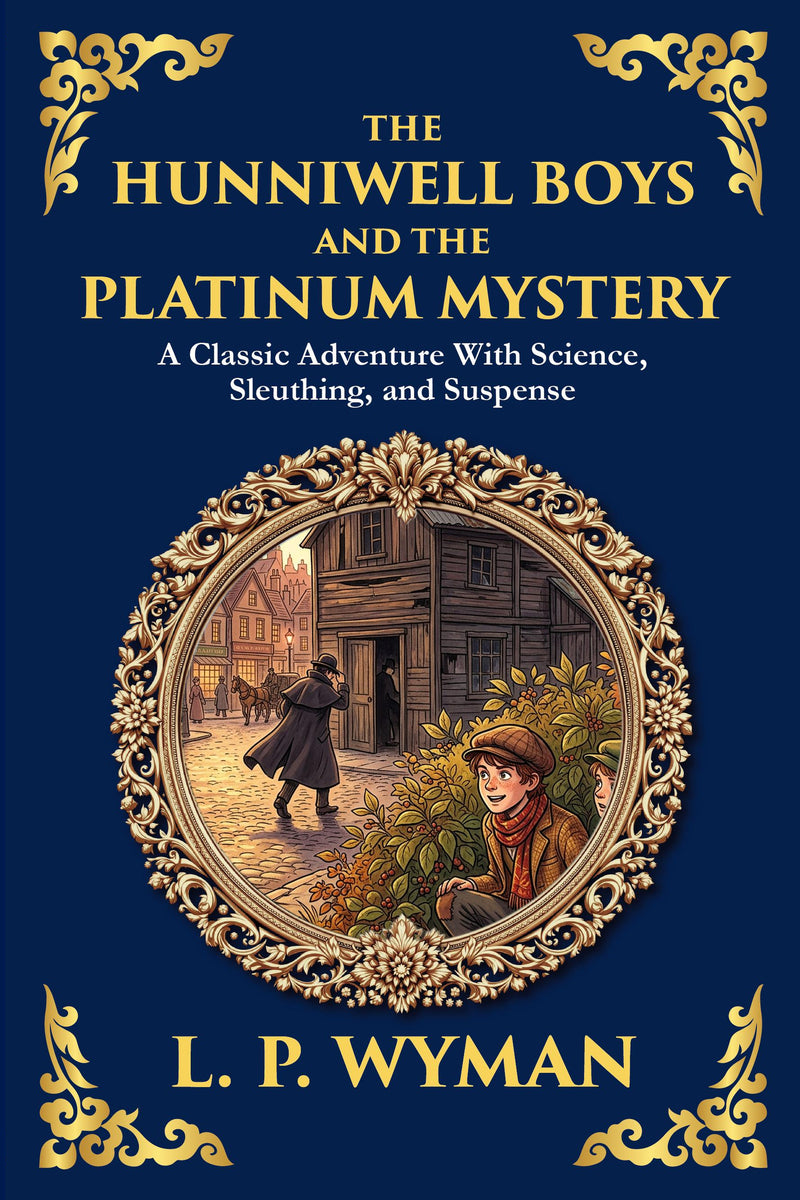
The Hunniwell Boys and the Platinum Mystery
Join the brilliant Hunniwell Boys as they dive headfirst into a case laced with scientific intrigue and thrilling mystery.
or free app
10,000+ hrs library
30-day guarantee
The complete The Hunniwell Boys and the Platinum Mystery appears in modern English through Library of Alexandria Press, available online with audiobook narration included for members.
Have you ever wondered why some mysteries require both courage and chemistry to solve? The Hunniwell Boys and the Platinum Mystery is a captivating blend of classic detective fiction and thrilling scientific adventure. Written by L. P. Wyman, this novel follows two bright and resourceful brothers who uncover a high-stakes conspiracy involving the rare and valuable metal—platinum.
When strange occurrences at a local mine spark their curiosity, the Hunniwell Boys begin to follow a trail that leads them through hidden tunnels, booby traps, encrypted messages, and strange scientific experiments. The stakes rise as they discover that international criminals may be involved in a plot that could change the fate of an entire industry. This is more than a simple whodunit—it’s a celebration of innovation, teamwork, and youthful determination in the face of danger.
What you’ll discover in this modern edition
- A Science-Driven Mystery – Chemistry, metallurgy, and forensic clues drive the plot forward
- Thrilling Detective Work – Follow the Hunniwell Boys as they connect cryptic dots across a web of deception
- High-Stakes Action – Booby traps, secret codes, and last-minute escapes bring suspense to every chapter
- Timeless Brotherhood and Bravery – At the heart of the story lies a bond of trust and courage between two determined brothers
- A Tribute to Golden-Age Adventure Fiction – Fans of Hardy Boys and Tom Swift will find much to love here Perfect for readers young and old, this novel brings together brainy problem-solving and edge- of-your-seat thrills.
| Formats | eBook (EPUB + PDF) · Audiobook · Paperback · Hardcover · Large Print |
| Language | English |
| Trim size (print) | 6 × 9 in |
| Binding | Paperback — perfect-bound · Hardcover — casewrap |
| Large Print edition | Same text in a larger, easy-read type — a larger font, not a larger trim |
| Print pricing | Every physical book at our true cost — at-cost, no profit (members) |
| Library | 873 restored titles, always growing |
| Length | 40,952 words · ~2 hr 44 min reading |
| Reading level | Grade 7 · an easy, flowing read (this modern-English edition) |
| Edition | Modern English translation · 2026 |
Member reviews for this edition are collected as readers finish it — be the first. Across the library: 12,000+ books shipped, every plan covered by a 365-day print guarantee.
About this edition
A faithful, unabridged modern-English edition by The Library of Alexandria — carefully rendered for today's reader and verified paragraph-by-paragraph against the public-domain source. Available as eBook, audiobook, paperback, hardcover, and large print.
- Complete & unabridgedVerified paragraph by paragraph against the source — never a scan, never abridged.
- Modern English, faithfulReadable today, with the author’s meaning kept intact. Readable — not simplified.
- Every format, one membershipRead in your browser or the free app, or listen to the full audiobook.
Included free with your membership
Cancel anytime, one click · 30-day money-back guarantee
Edition last updated July 2026
What’s inside
The Hunniwell Boys and the Platinum Mystery — complete and unabridged: all 16 sections included with membership, plus the full audiobook.
Begin reading The Hunniwell Boys and the Platinum Mystery
In clear modern English — the complete text is included with membership.
Introduction
There is a particular kind of magic that lives in the adventure stories written for young readers in the early decades of the twentieth century. They arrived in an America that was reinventing itself almost daily — a country wiring itself with electricity, threading itself together with telephone lines, taking to the skies in fragile machines of canvas and wire, and dreaming up machines and discoveries that would have seemed like sorcery a single generation earlier. Into this restless, hopeful, mechanically minded world stepped a host of fictional young heroes: boys and girls who tinkered with motors, decoded mysteries, chased thieves across lakes and mountains, and embodied the optimism of a nation convinced that intelligence, courage, and a willingness to work hard could solve nearly any problem. The Hunniwell Boys and the Platinum Mystery belongs squarely to that tradition, and in the pages that follow you will find all the breathless momentum, clever problem-solving, and good-hearted camaraderie that made these tales so beloved.
This particular volume comes to you in a modern translation — a phrase that may give a moment’s pause, since the book was written in English to begin with. What it means is that the text has been carefully and respectfully adapted for the contemporary reader. The original prose, charming as it is, was shaped by the conventions of its era: long, winding sentences; vocabulary that has drifted out of common use; idioms and turns of phrase that once landed instantly but now require a footnote or a furrowed brow. In adapting the story, the goal has been to preserve everything that makes it delightful — the personalities, the pacing, the cleverness, the sense of wonder — while smoothing away the small obstacles that can trip up a present-day reader and pull them out of the spell. Think of it not as a replacement for the original, but as a clear window through which the original can be seen, its colors as vivid as they were intended to be when the ink was still wet.
To understand why a story like this one resonated so deeply, and why it still rewards our attention today, it helps to step back and consider the moment that produced it. The author, who wrote under the name L. P. Wyman, was part of a great wave of writers turning out series fiction for young people during the 1920s and 1930s. This was the golden age of the juvenile adventure series — the era that gave us the Hardy Boys, Tom Swift, the Bobbsey Twins, Nancy Drew, and dozens of less famous but no less spirited heroes whose names filled the shelves of bookstores and the wish-lists of children everywhere. These books were affordable, plentiful, and consumed with an appetite that bordered on the ravenous. A young reader who finished one installment on a Saturday afternoon would be impatient for the next, and the publishers were happy to oblige, releasing volume after volume in handsome uniform editions with bright dust jackets promising thrills within.
What set these stories apart from earlier children’s literature was their thoroughly modern flavor. The heroes were not princes or knights or characters out of fairy tales; they were recognizable American boys and girls, often from ordinary towns, who happened to be unusually capable. They drove cars and flew planes. They understood radios and engines and chemistry. They lived in a world that looked very much like the reader’s own, only heightened — a world where a clever teenager might genuinely stumble onto a real mystery and, through pluck and ingenuity, see it through to a satisfying conclusion. This was tremendously empowering for young readers. The message, repeated across hundreds of volumes, was that knowledge was power, that curiosity was a virtue, and that a person willing to use their head and stand by their friends could meet whatever challenges the world threw at them.
The subtitle of this volume — featuring science, detective work, and suspense — captures the particular blend that makes the Hunniwell Boys’ adventures so satisfying. The science here is not the abstract, intimidating science of the classroom; it is practical, hands-on, and woven directly into the plot. Knowing how something works, understanding the properties of a metal or the behavior of a machine, becomes a tool the heroes use to outwit their adversaries. The detective work supplies the puzzle, the slow accumulation of clues, the thrill of deduction. And the suspense — well, the suspense is what keeps the pages turning, what makes you tell yourself “just one more chapter” long after you meant to put the book down. The marriage of these three elements creates a story that engages the mind even as it quickens the pulse.
The word “platinum” in the title is itself a window into the fascinations of the age. Today we may think of platinum chiefly as a precious metal for jewelry, but in the early twentieth century it carried an air of mystery and importance that went far beyond ornamentation. Platinum was rare, valuable, and increasingly vital to industry and science. It resisted corrosion, withstood extreme heat, and served crucial roles in laboratories and manufacturing. A substance that was at once beautiful, scientifically significant, and worth a small fortune made for the perfect centerpiece of a mystery aimed at young readers who were themselves caught up in the excitement of a rapidly advancing technological world. The very title would have promised, to its original audience, a story that combined the glamour of treasure with the intrigue of modern science — and that promise is one the book sets out to keep.
It is worth saying a word, too, about the Hunniwell boys themselves and the kind of heroism they represent. In the tradition of these series, the central characters are typically a pair — often brothers, or the closest of friends — whose differing temperaments complement one another. One may be more cautious, the other more headlong; one drawn to careful reasoning, the other to bold action. Together they form a unit greater than the sum of its parts, and much of the pleasure of reading lies in watching them bounce ideas off one another, tease each other, support each other, and ultimately combine their talents to triumph. Their relationship is the warm heart at the center of all the cold mechanics of the mystery. They are loyal, brave, generous, and fundamentally decent — and while modern readers may sometimes smile at how unfailingly upright these heroes are, there is something genuinely refreshing about spending time in the company of young people who try, sincerely and without irony, to do the right thing.
This emphasis on character was no accident. The writers and publishers of these series understood that they were not merely entertaining children; they were, in a sense, helping to shape them. The adventures were models of conduct as much as they were tales of excitement. The heroes demonstrated courage in the face of danger, kindness toward those weaker than themselves, respect for their elders, perseverance through difficulty, and quick thinking in moments of crisis. They made mistakes, certainly, but they learned from them. They encountered villains and rascals, but they overcame them through wit and honesty rather than brute force or trickery. A young reader closing one of these books had been thoroughly entertained, yes — but had also, almost without noticing, absorbed a set of values about how to face the world. That dual purpose gives the stories a depth and a sincerity that purely commercial entertainment often lacks.
When we pick up a book written nearly a century ago, we engage in a small act of time travel. We step into a world that is recognizably the ancestor of our own and yet startlingly different in its details. Part of the great pleasure of reading older fiction is precisely this sense of dislocation — the discovery of how people lived, spoke, thought, and dreamed in an era before our own. In the pages ahead you will encounter a world without smartphones, without the internet, without the constant electronic connectedness we now take entirely for granted. When the Hunniwell boys need to send a message, they cannot simply tap out a text; they must find a telephone, send a telegram, or travel in person. When they need information, they cannot summon it instantly from the air; they must seek it out, ask the right questions, consult the right people, puzzle it through. This very absence of our modern conveniences is part of what makes the adventure possible. The heroes must rely on their own resourcefulness, on their knowledge and their nerve, in ways that a modern protagonist, perpetually a few keystrokes from any answer, simply would not need to.
This is one of the quiet gifts that older adventure stories offer to readers today. They remind us of a kind of self-reliance that our convenient age has, in some measure, allowed to atrophy. The young heroes of these tales do not have a search engine to consult or a global positioning system to guide them. They have their eyes, their ears, their memories, their training, and one another. They observe carefully because observation is their only source of information. They reason carefully because reasoning is their only tool for connecting one fact to another. There is something bracing, even instructive, in watching them work through their problems with nothing but their own faculties — a reminder that the human mind, properly employed, is a remarkably capable instrument, and that the thrill of figuring something out for oneself is among the deepest satisfactions life affords.
At the same time, honesty compels us to acknowledge that books from this period sometimes carry attitudes and assumptions that reflect their time rather than ours. The early twentieth century was, in many respects, a less enlightened age than our own when it came to questions of race, class, gender, and the wider world beyond America’s borders. Readers of older fiction will occasionally encounter casual assumptions or characterizations that strike the modern ear as dated, narrow, or simply wrong. In preparing this modern translation, care has been taken to smooth away the worst of these jarring notes where they do not affect the integrity of the story — but it is neither possible nor desirable to scrub the past entirely clean. To do so would be to pretend that history was other than it was. Instead, the wiser approach is to read with a kind of double awareness: enjoying the story for its genuine virtues while recognizing that its authors were, like all of us, products of their particular moment, subject to the limitations and blind spots of their day. This need not diminish our pleasure in the least. If anything, it enriches it, lending the experience a layer of reflection that a purely contemporary story could not provide.
The matter of language deserves a fuller word here, because it bears directly on the nature of this edition. The prose style of the 1920s and 1930s juvenile adventure was, by our standards, somewhat formal and elaborate. Characters spoke in complete, carefully constructed sentences even in moments of peril. Narration tended toward fullness, describing scenes and actions with a thoroughness that modern readers, accustomed to leaner and faster storytelling, can sometimes find slow. Vocabulary that was everyday currency then — exclamations, slang, references to objects and customs now obsolete — can leave a present-day reader briefly puzzled. The modern translation you hold has worked to preserve the spirit and texture of the original voice while gently updating these elements: trimming the most cumbersome sentences, clarifying confusing references, replacing words that have fallen so far out of use that they now obscure rather than illuminate. The aim throughout has been a light touch — never to rewrite the story, never to impose a contemporary sensibility upon it, but simply to remove the small frictions that stand between today’s reader and the genuine enjoyment the book was always meant to provide.
Cancel anytime, one click · 30-day money-back guarantee
Founding annual rate available now — your price locks for life when you join.
Not ready? Get this free chapter by email — read it anytime.
✓ Sent — check your inbox for The Hunniwell Boys and the Platinum Mystery.
Questions about The Hunniwell Boys and the Platinum Mystery
What is The Hunniwell Boys and the Platinum Mystery about?
Join the brilliant Hunniwell Boys as they dive headfirst into a case laced with scientific intrigue and thrilling mystery. When a strange disappearance, a series of coded clues, and a rare element intersect, these daring young sleuths must rely on brains, bravery, and a touch of chemistry to crack the case. The Hunniwell Boys and the Platinum Mystery is a fast-paced tale of classic adventure, filled with secret experiments, cryptic puzzles, and heart-pounding moments.
Who wrote The Hunniwell Boys and the Platinum Mystery?
The Hunniwell Boys and the Platinum Mystery was written by L. P. Wyman. This edition presents the complete work in clear modern English, faithfully rendered from the public-domain original by Library of Alexandria Press.
Is The Hunniwell Boys and the Platinum Mystery free to read?
The opening chapter is free to read on this page. Members read and listen to the complete work — and the entire library — free, and can order any physical book at our true print cost.
How long is The Hunniwell Boys and the Platinum Mystery?
16 chapters (~40,952 words) — about 2 hr 44 min of reading in this modern-English edition.
Is this an abridged version of The Hunniwell Boys and the Platinum Mystery?
No. This is the complete, unabridged The Hunniwell Boys and the Platinum Mystery, carefully rendered into clear modern English and verified paragraph-by-paragraph against the public-domain source — nothing is cut or summarised.
What formats does The Hunniwell Boys and the Platinum Mystery come in?
The Hunniwell Boys and the Platinum Mystery is available as eBook, paperback, hardcover and large print. eBook and audiobook are included with membership; printed editions ship at our true print cost.
Shipping & returns
Billing & membership
More from the library


Explore Adventure
- Tarzan of the Apes · Edgar Rice Burroughs
- The Wonderful Wizard of Oz · L. Frank Baum
- Peter Pan · J. M. Barrie
- Moby Dick; Or, The Whale · Herman Melville
- The Riddle of the Sands · Erskine Childers
- The Loss of the Swansea: A Story of the Florida Coast · W. L. Alden
- Sky Island · L. Frank Baum
- Vikram and the Vampire: Classic Hindu Tales of Adventure, Magic, and Romance · Unknown
- Tales of Unrest · Joseph Conrad
- The Tomb of Ts’in · Edgar Wallace
- Skinny McCord · Percy Keese Fitzhugh
- The Men of the Moss-Hags · S. R. Crockett
- Allan Quatermain · H. Rider Haggard
- She · H. Rider Haggard
- Medical Life in the Navy · Gordon Stables
- The Thirty-Nine Steps · John Buchan
- The Story of Doctor Dolittle · Hugh Lofting
- The Princess and the Goblin · George MacDonald
- The Man Who Would Be King · Rudyard Kipling
- Lucian’s True History · Lucian of Samosata
- The Secret Adversary · Agatha Christie
- Lord Jim · Joseph Conrad
- The Marvelous Land of Oz · L. Frank Baum
- The Virginian: A Horseman of the Plains · Owen Wister
- Mars is My Destination · Frank Belknap Long
- Anabasis · Xenophon
- The Mississippi Saucer · Frank Belknap Long
- Sabotage in Space · Carey Rockwell
- Brood of the Dark Moon · Charles Willard Diffin
- The Misplaced Battleship · Harry Harrison
The Hunniwell Boys and the Platinum Mystery
The Hunniwell Boys and the Platinum Mystery
A classic adventure featuring science, detective work, and suspense
L. P. Wyman
Contents
- Introduction
- Chapter 1
- Chapter 2
- Chapter 3
- Chapter 4
- Chapter 5
- Chapter 6
- Chapter 7
- Chapter 8
- Chapter 9
- Chapter 10
- Chapter 11
- Chapter 12
- Chapter 13
- Chapter 14
- Chapter 15
Introduction
There is a particular kind of magic that lives in the adventure stories written for young readers in the early decades of the twentieth century. They arrived in an America that was reinventing itself almost daily — a country wiring itself with electricity, threading itself together with telephone lines, taking to the skies in fragile machines of canvas and wire, and dreaming up machines and discoveries that would have seemed like sorcery a single generation earlier. Into this restless, hopeful, mechanically minded world stepped a host of fictional young heroes: boys and girls who tinkered with motors, decoded mysteries, chased thieves across lakes and mountains, and embodied the optimism of a nation convinced that intelligence, courage, and a willingness to work hard could solve nearly any problem. The Hunniwell Boys and the Platinum Mystery belongs squarely to that tradition, and in the pages that follow you will find all the breathless momentum, clever problem-solving, and good-hearted camaraderie that made these tales so beloved.
This particular volume comes to you in a modern translation — a phrase that may give a moment’s pause, since the book was written in English to begin with. What it means is that the text has been carefully and respectfully adapted for the contemporary reader. The original prose, charming as it is, was shaped by the conventions of its era: long, winding sentences; vocabulary that has drifted out of common use; idioms and turns of phrase that once landed instantly but now require a footnote or a furrowed brow. In adapting the story, the goal has been to preserve everything that makes it delightful — the personalities, the pacing, the cleverness, the sense of wonder — while smoothing away the small obstacles that can trip up a present-day reader and pull them out of the spell. Think of it not as a replacement for the original, but as a clear window through which the original can be seen, its colors as vivid as they were intended to be when the ink was still wet.
To understand why a story like this one resonated so deeply, and why it still rewards our attention today, it helps to step back and consider the moment that produced it. The author, who wrote under the name L. P. Wyman, was part of a great wave of writers turning out series fiction for young people during the 1920s and 1930s. This was the golden age of the juvenile adventure series — the era that gave us the Hardy Boys, Tom Swift, the Bobbsey Twins, Nancy Drew, and dozens of less famous but no less spirited heroes whose names filled the shelves of bookstores and the wish-lists of children everywhere. These books were affordable, plentiful, and consumed with an appetite that bordered on the ravenous. A young reader who finished one installment on a Saturday afternoon would be impatient for the next, and the publishers were happy to oblige, releasing volume after volume in handsome uniform editions with bright dust jackets promising thrills within.
What set these stories apart from earlier children’s literature was their thoroughly modern flavor. The heroes were not princes or knights or characters out of fairy tales; they were recognizable American boys and girls, often from ordinary towns, who happened to be unusually capable. They drove cars and flew planes. They understood radios and engines and chemistry. They lived in a world that looked very much like the reader’s own, only heightened — a world where a clever teenager might genuinely stumble onto a real mystery and, through pluck and ingenuity, see it through to a satisfying conclusion. This was tremendously empowering for young readers. The message, repeated across hundreds of volumes, was that knowledge was power, that curiosity was a virtue, and that a person willing to use their head and stand by their friends could meet whatever challenges the world threw at them.
The subtitle of this volume — featuring science, detective work, and suspense — captures the particular blend that makes the Hunniwell Boys’ adventures so satisfying. The science here is not the abstract, intimidating science of the classroom; it is practical, hands-on, and woven directly into the plot. Knowing how something works, understanding the properties of a metal or the behavior of a machine, becomes a tool the heroes use to outwit their adversaries. The detective work supplies the puzzle, the slow accumulation of clues, the thrill of deduction. And the suspense — well, the suspense is what keeps the pages turning, what makes you tell yourself “just one more chapter” long after you meant to put the book down. The marriage of these three elements creates a story that engages the mind even as it quickens the pulse.
The word “platinum” in the title is itself a window into the fascinations of the age. Today we may think of platinum chiefly as a precious metal for jewelry, but in the early twentieth century it carried an air of mystery and importance that went far beyond ornamentation. Platinum was rare, valuable, and increasingly vital to industry and science. It resisted corrosion, withstood extreme heat, and served crucial roles in laboratories and manufacturing. A substance that was at once beautiful, scientifically significant, and worth a small fortune made for the perfect centerpiece of a mystery aimed at young readers who were themselves caught up in the excitement of a rapidly advancing technological world. The very title would have promised, to its original audience, a story that combined the glamour of treasure with the intrigue of modern science — and that promise is one the book sets out to keep.
It is worth saying a word, too, about the Hunniwell boys themselves and the kind of heroism they represent. In the tradition of these series, the central characters are typically a pair — often brothers, or the closest of friends — whose differing temperaments complement one another. One may be more cautious, the other more headlong; one drawn to careful reasoning, the other to bold action. Together they form a unit greater than the sum of its parts, and much of the pleasure of reading lies in watching them bounce ideas off one another, tease each other, support each other, and ultimately combine their talents to triumph. Their relationship is the warm heart at the center of all the cold mechanics of the mystery. They are loyal, brave, generous, and fundamentally decent — and while modern readers may sometimes smile at how unfailingly upright these heroes are, there is something genuinely refreshing about spending time in the company of young people who try, sincerely and without irony, to do the right thing.
This emphasis on character was no accident. The writers and publishers of these series understood that they were not merely entertaining children; they were, in a sense, helping to shape them. The adventures were models of conduct as much as they were tales of excitement. The heroes demonstrated courage in the face of danger, kindness toward those weaker than themselves, respect for their elders, perseverance through difficulty, and quick thinking in moments of crisis. They made mistakes, certainly, but they learned from them. They encountered villains and rascals, but they overcame them through wit and honesty rather than brute force or trickery. A young reader closing one of these books had been thoroughly entertained, yes — but had also, almost without noticing, absorbed a set of values about how to face the world. That dual purpose gives the stories a depth and a sincerity that purely commercial entertainment often lacks.
When we pick up a book written nearly a century ago, we engage in a small act of time travel. We step into a world that is recognizably the ancestor of our own and yet startlingly different in its details. Part of the great pleasure of reading older fiction is precisely this sense of dislocation — the discovery of how people lived, spoke, thought, and dreamed in an era before our own. In the pages ahead you will encounter a world without smartphones, without the internet, without the constant electronic connectedness we now take entirely for granted. When the Hunniwell boys need to send a message, they cannot simply tap out a text; they must find a telephone, send a telegram, or travel in person. When they need information, they cannot summon it instantly from the air; they must seek it out, ask the right questions, consult the right people, puzzle it through. This very absence of our modern conveniences is part of what makes the adventure possible. The heroes must rely on their own resourcefulness, on their knowledge and their nerve, in ways that a modern protagonist, perpetually a few keystrokes from any answer, simply would not need to.
This is one of the quiet gifts that older adventure stories offer to readers today. They remind us of a kind of self-reliance that our convenient age has, in some measure, allowed to atrophy. The young heroes of these tales do not have a search engine to consult or a global positioning system to guide them. They have their eyes, their ears, their memories, their training, and one another. They observe carefully because observation is their only source of information. They reason carefully because reasoning is their only tool for connecting one fact to another. There is something bracing, even instructive, in watching them work through their problems with nothing but their own faculties — a reminder that the human mind, properly employed, is a remarkably capable instrument, and that the thrill of figuring something out for oneself is among the deepest satisfactions life affords.
At the same time, honesty compels us to acknowledge that books from this period sometimes carry attitudes and assumptions that reflect their time rather than ours. The early twentieth century was, in many respects, a less enlightened age than our own when it came to questions of race, class, gender, and the wider world beyond America’s borders. Readers of older fiction will occasionally encounter casual assumptions or characterizations that strike the modern ear as dated, narrow, or simply wrong. In preparing this modern translation, care has been taken to smooth away the worst of these jarring notes where they do not affect the integrity of the story — but it is neither possible nor desirable to scrub the past entirely clean. To do so would be to pretend that history was other than it was. Instead, the wiser approach is to read with a kind of double awareness: enjoying the story for its genuine virtues while recognizing that its authors were, like all of us, products of their particular moment, subject to the limitations and blind spots of their day. This need not diminish our pleasure in the least. If anything, it enriches it, lending the experience a layer of reflection that a purely contemporary story could not provide.
The matter of language deserves a fuller word here, because it bears directly on the nature of this edition. The prose style of the 1920s and 1930s juvenile adventure was, by our standards, somewhat formal and elaborate. Characters spoke in complete, carefully constructed sentences even in moments of peril. Narration tended toward fullness, describing scenes and actions with a thoroughness that modern readers, accustomed to leaner and faster storytelling, can sometimes find slow. Vocabulary that was everyday currency then — exclamations, slang, references to objects and customs now obsolete — can leave a present-day reader briefly puzzled. The modern translation you hold has worked to preserve the spirit and texture of the original voice while gently updating these elements: trimming the most cumbersome sentences, clarifying confusing references, replacing words that have fallen so far out of use that they now obscure rather than illuminate. The aim throughout has been a light touch — never to rewrite the story, never to impose a contemporary sensibility upon it, but simply to remove the small frictions that stand between today’s reader and the genuine enjoyment the book was always meant to provide.
Bill Hunniwell dropped his paddle and grabbed the landing net as he spoke. His brother, Gordon, however, was too busy managing the five-ounce rod to answer. He was doing everything he could to keep the line tight on the large square-tail fish as it splashed in the water about sixty feet from the canoe.
But he had caught big fish before, and although he fought it for nearly half an hour, he finally managed to pull it close enough to net. A minute later, the big fish lay on the bottom of the canoe, too exhausted to even flop around.
“I bet he weighs ten pounds,” Bill declared, looking down at the fish.
“I think he’s the largest fish anyone has caught in Lost Pond during our time,” Gordon added, looking at his catch with pride.
“We’ll bring him home and get him mounted,” Bill announced, picking up the paddle and steering the canoe back toward the cabin.
“The phone is ringing,” Gordon said as they nearly arrived. “Hurry up, or they’ll hang up.”
With a few powerful strokes, the light canoe reached the wharf. Gordon jumped out and sprinted toward the cabin, which was only a few feet away. Bill pulled the boat onto the dock and started unloading the fishing rod and the fish. However, he wasn’t finished before Gordon came back.
“That was Mom calling,” he said. “She says Mr. Rogers is at the house and wants to see us.”
“She didn’t give any details, she just said he wanted to see us.”
“Naturally, you told her we would come down as soon as we finished locking up the cabin.”
“I did. We were planning to go down this afternoon anyway, and this way we won’t have to worry about making dinner. It’s only a few minutes past ten, so if we rush, we can get there by mealtime.”
End of the free sample
Keep reading, free
Members read and listen to the complete book — and the entire library. Cancel anytime, one click · 30-day money-back guarantee.