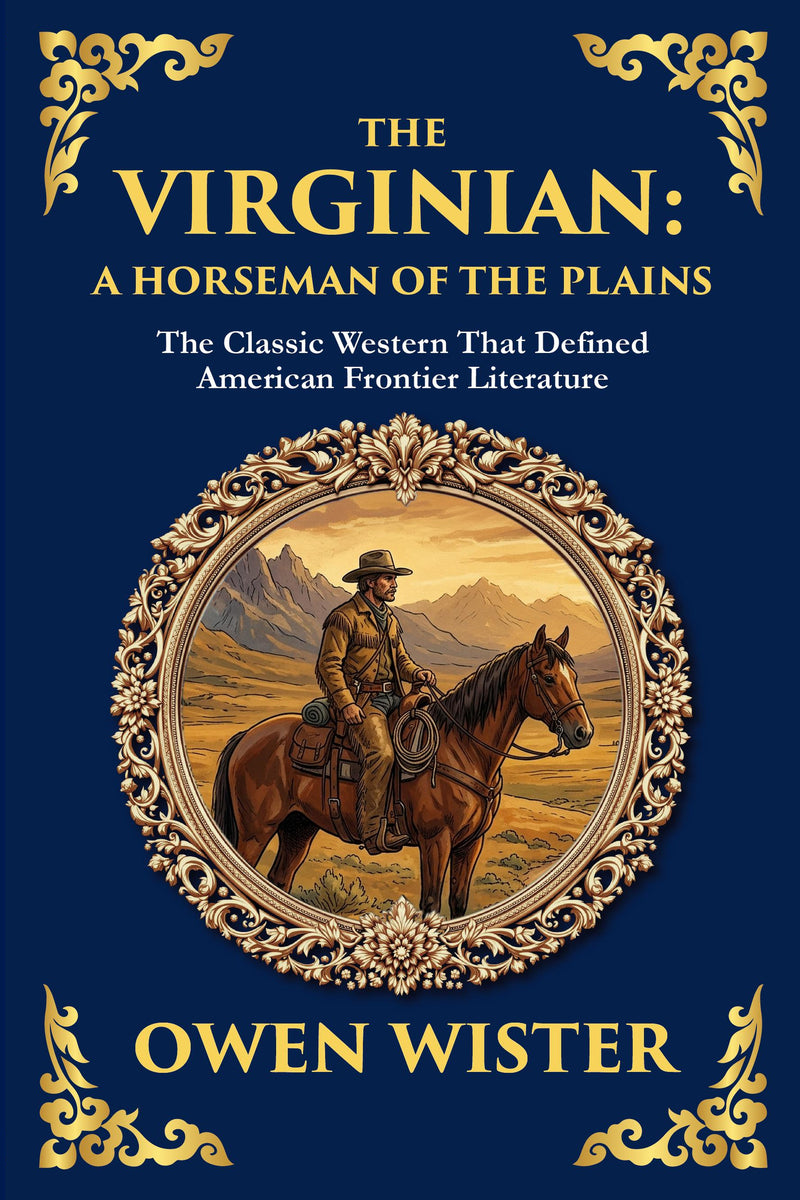
The Virginian: A Horseman of the Plains
A quiet stranger rides into the untamed West—and changes everything. He’s known only as The Virginian, a man of few words but unwavering honor.
or free app
10,000+ hrs library
30-day guarantee
The complete The Virginian: A Horseman of the Plains appears in modern English through Library of Alexandria Press, available online with audiobook narration included for members.
Have you ever wondered why the American cowboy became a timeless symbol of honor, strength, and solitude? Step into the windswept prairies of Wyoming Territory with The Virginian, the groundbreaking novel that launched the Western genre and etched its stoic hero into the heart of American culture. Owen Wister’s masterwork follows the journey of an unnamed cowboy—The Virginian—whose quiet strength, unwavering integrity, and deadly skill with a gun earn him respect in a land where justice is often written in bullets.
Amidst rising tension between ranchers and rustlers, The Virginian must confront not only the chaos of the frontier but also his own heart when he falls for the spirited schoolteacher Molly Stark Wood. This is more than just a Western—it’s a literary portrait of a changing America. From epic cattle drives to dramatic showdowns, The Virginian brings to life a world of dust, danger, and honor with poetic prose and gripping drama.
What you’ll discover in this modern edition
- The Birth of the Western Hero – Meet the original cowboy archetype that inspired countless films, books, and legends.
| Formats | eBook (EPUB + PDF) · Audiobook · Paperback · Hardcover · Large Print |
| Language | English |
| Trim size (print) | 6 × 9 in |
| Binding | Paperback — perfect-bound · Hardcover — casewrap |
| Large Print edition | Same text in a larger, easy-read type — a larger font, not a larger trim |
| Print pricing | Every physical book at our true cost — at-cost, no profit (members) |
| Library | 873 restored titles, always growing |
| Length | 128,613 words · ~8 hr 34 min reading |
| Reading level | Grade 4 · an easy, flowing read (this modern-English edition) |
| Edition | Modern English translation · 2026 |
Member reviews for this edition are collected as readers finish it — be the first. Across the library: 12,000+ books shipped, every plan covered by a 365-day print guarantee.
About this edition
A faithful, unabridged modern-English edition by The Library of Alexandria — carefully rendered for today's reader and verified paragraph-by-paragraph against the public-domain source. Available as eBook, audiobook, paperback, hardcover, and large print.
- Complete & unabridgedVerified paragraph by paragraph against the source — never a scan, never abridged.
- Modern English, faithfulReadable today, with the author’s meaning kept intact. Readable — not simplified.
- Every format, one membershipRead in your browser or the free app, or listen to the full audiobook.
Included free with your membership
Cancel anytime, one click · 30-day money-back guarantee
Edition last updated July 2026
What’s inside
The Virginian: A Horseman of the Plains — complete and unabridged: all 37 sections included with membership, plus the full audiobook.
Begin reading The Virginian: A Horseman of the Plains
In clear modern English — the complete text is included with membership.
Introduction
When The Virginian first appeared in 1902, American readers encountered something they had never quite seen before: a novel that took the rough, dusty, half-mythologized world of the cattle frontier and rendered it with the seriousness, craft, and emotional depth previously reserved for the drawing rooms of Boston or the salons of Europe. Owen Wister, a Philadelphia patrician trained in music and law, a friend of Theodore Roosevelt and a grandson of the celebrated actress Fanny Kemble, seemed an unlikely figure to give birth to the great American Western. Yet it was precisely his outsider’s eye—his cultivated, Eastern sensibility brought into collision with the vast spaces and rough-hewn men of Wyoming Territory—that allowed him to see the West not merely as a place of adventure but as a stage on which the deepest questions of American character could be played out. The book you are about to read is the fountainhead of an entire genre, the novel from which every cowboy hero who ever squinted into a setting sun ultimately descends.
This edition presents The Virginian in a carefully prepared modern adaptation, smoothing the occasional archaisms of phrasing and the denser thickets of period diction so that the contemporary reader may move through the story with the same ease and pleasure that Wister’s original audience enjoyed. The aim throughout has been to preserve what is essential—the cadence of the dialogue, the wry humor, the slow-building tension, the unmistakable voice of the narrator—while ensuring that nothing in the language stands as an unnecessary barrier between you and the experience of the tale. What remains is the heart of the book: a story about a man, a place, and a way of living that was already vanishing even as Wister set it down.
A Gentleman from the East Discovers the West
To understand why The Virginian matters, and why it has endured for well over a century, it helps to know something of the man who wrote it and the world that produced him. Owen Wister was born in 1860 into a family of considerable refinement and accomplishment. His mother, Sarah Butler Wister, was an intellectual woman of letters; his maternal grandmother was Fanny Kemble, one of the most famous actresses of the nineteenth century. Young Owen was educated at the best schools, studied music in Europe with serious ambitions toward a career as a composer, and graduated from Harvard, where he counted Theodore Roosevelt among his friends. By every outward sign, his life was charted toward the genteel professions of the Eastern establishment. He would, in time, study law and be admitted to the bar.
But Wister suffered from the nervous exhaustion and ill health that afflicted so many sensitive young men of his class and era. In 1885, on the advice of a physician—the same Dr. S. Weir Mitchell whose famous “rest cure” shaped the lives of many of his patients—Wister traveled west to Wyoming to recover his vigor. What he found there changed the course of his life and, ultimately, the course of American literature. The open ranges of the Wyoming Territory, the cattle outfits and their riders, the immense silences of the high plains under enormous skies—all of it struck him with the force of revelation. Here was a way of life utterly unlike the manicured world he had known, a place where a man’s worth was measured not by his pedigree or his bank account but by his competence, his courage, and his code. Wister returned again and again over the following years, keeping detailed journals, absorbing the speech and customs of the cowmen, and gradually formulating the idea that this world deserved to be commemorated in serious fiction before it disappeared forever.
It is worth pausing on that sense of impending loss, because it suffuses the entire book and gives it much of its peculiar melancholy power. By the time Wister was writing, the open-range cattle industry was already being fenced in, regulated, and transformed by the railroad, the homesteader, and the barbed-wire fence. The catastrophic winter of 1886–87 had wiped out vast herds and broken many of the great cattle operations. The frontier that the United States Census Bureau had declared “closed” in 1890 was passing into legend even as the men who had lived it still walked the earth. Wister understood that he was writing an elegy as much as an adventure—a record of something authentic and irretrievable. The cowboy he celebrated was, in his eyes, a kind of natural aristocrat, a figure who embodied an older and purer form of American manhood that the rising industrial age threatened to crush. There is, throughout the novel, a tension between the freedom of the unbounded range and the encroachment of civilization, law, and domesticity—a tension that Wister never fully resolves, and that gives the book its enduring emotional complexity.
The novel grew partly out of short stories Wister had been publishing in Harper’s Magazine and elsewhere throughout the 1890s. He stitched several of these together, reworked them, and added new material to create the continuous narrative we now possess. The result is a book with a somewhat episodic structure—scenes and incidents that sometimes feel like self-contained vignettes—but one bound together by the towering presence of its central figure and by the gradually deepening relationships among the characters. The publication of The Virginian in 1902 was an immediate and enormous success. It sold hundreds of thousands of copies, went through numerous printings, and made Wister famous. He dedicated the book to his friend Theodore Roosevelt, who by then had become President of the United States, and the two men shared a vision of the West as a crucible of American virtue. Roosevelt’s own writings on the strenuous life and the romance of the open country found a literary companion in Wister’s novel.
The book’s influence was incalculable. Before The Virginian, the figure of the cowboy existed largely in the cheap and sensational world of dime novels, where he appeared as a crude figure of gunplay and melodrama. Wister took that raw material and elevated it, investing the cowboy with dignity, moral seriousness, romantic appeal, and psychological depth. He established a template that would be imitated and elaborated for the next hundred years: the quiet, capable stranger of mysterious origins; the tenderfoot narrator who serves as our guide into the unfamiliar world; the schoolteacher from the East who represents the civilizing influence of women and culture; the villain whose menace simmers beneath a surface of cold courtesy; the climactic showdown that resolves the conflict through a test of nerve and honor. Every Western novel, film, and television series that followed—from the works of Zane Grey and Louis L’Amour to the great Hollywood Westerns of John Ford and the more elegiac films of later decades—owes a debt to the pattern that Wister laid down. The phrase “When you call me that, smile!”—spoken by the Virginian in one of the book’s most famous scenes—entered the American language and has been quoted, parodied, and revered for generations.
The Man, the Voice, and the World of the Story
At the center of the book stands a hero who is never given a name. He is known throughout simply as “the Virginian,” a young man from the South who has drifted west and made himself into a cowboy of exceptional skill and bearing. This namelessness is one of Wister’s quietest but most brilliant strokes. By withholding the man’s name, the author lifts him out of the merely individual and into the realm of the representative, even the archetypal. He is not just one cowboy; he is the cowboy, the embodiment of an ideal. And yet—and this is crucial—he is never a flat symbol. Wister takes great care to render him as a living, breathing, particular human being: humorous, sometimes mischievous, capable of tenderness and of hardness, possessed of a natural intelligence and dignity that the more formally educated characters come to recognize and respect.
The Virginian’s appeal lies precisely in this combination of the universal and the particular. He is tall, dark, easy in his movements, and quietly commanding. He speaks in a soft Southern drawl, and his humor often takes the form of elaborate practical jokes and deadpan tall tales that reveal a quick and subtle mind. But beneath the easy charm lies a bedrock of seriousness. He lives by a code—an unwritten set of principles about honor, loyalty, courage, and self-respect—that he will not violate even when violation would be easier or safer. The drama of the novel arises largely from the situations in which this code is tested, in which the Virginian must choose between competing loyalties, between mercy and justice, between his own desires and his sense of what a man must do.
The story is told to us by a narrator who, like Wister himself, is an Easterner come west for the first time. This narrator—a “tenderfoot” in the language of the country—arrives knowing nothing of the ways of the range, and his education becomes our education. Through his eyes we encounter the strange customs, the rough humor, the practical skills, and the unspoken hierarchies of the cattle world. This narrative device is one of Wister’s most effective inheritances from the tradition of the romance and the adventure tale, and it serves several purposes at once. It allows the author to explain the unfamiliar without seeming to lecture; it creates a bond of friendship between the narrator and the Virginian that the reader comes to share; and it establishes a subtle dialogue between East and West, between civilization and wilderness, that runs throughout the book. The narrator admires the Virginian, is sometimes baffled by him, and gradually comes to understand the deeper meanings of his conduct. In a sense, the narrator’s growth—from a comically helpless newcomer to a man capable of understanding and even participating in the life of the West—mirrors the larger theme of how the rough frontier and the cultivated East might be reconciled.
The third great figure of the novel is Molly Stark Wood, a young schoolteacher who comes west from Vermont to teach in the small Wyoming settlement of Bear Creek. Molly is descended from old New England stock, proud of her heritage and conscious of the cultural distance between her world and that of the cowboys among whom she finds herself. The relationship that develops between Molly and the Virginian forms the emotional spine of the book, and through it Wister explores his deepest themes: the meeting of East and West, of refinement and rawness, of the civilizing impulse and the wild freedom of the frontier. Molly is no mere romantic decoration. She is a woman of intelligence, principle, and will, and her struggle to understand and accept the man she comes to love—a man whose code sometimes leads him to actions she finds morally troubling—gives the novel a genuine moral and psychological tension. Their courtship is conducted with a delicacy and slowness that may surprise readers accustomed to faster fictions, but it rewards patience richly. Wister is interested in the way two very different people, from two very different worlds, might come to meet on common ground without either surrendering the essence of who they are.
The landscape itself is very nearly a character in the novel. Wister’s Wyoming is a place of immense beauty and indifference, of clear streams and towering mountains and grasslands stretching to the horizon. He writes about the country with the love of a convert, evoking the quality of the light, the silence of the high plains, the particular feel of a long ride under an open sky. This setting is not merely a backdrop for the action; it is essential to the meaning of the book. The freedom and grandeur of the land shape the men who live upon it, and the gradual taming of that land—the coming of the railroad, the fences, the settlements, the law—stands as the great historical drama that gives the more personal story its larger resonance. To read The Virginian attentively is to feel the weight of a whole epoch passing.
Cancel anytime, one click · 30-day money-back guarantee
Founding annual rate available now — your price locks for life when you join.
Not ready? Get this free chapter by email — read it anytime.
✓ Sent — check your inbox for The Virginian: A Horseman of the Plains.
Questions about The Virginian: A Horseman of the Plains
What is The Virginian: A Horseman of the Plains about?
A quiet stranger rides into the untamed West—and changes everything. He’s known only as The Virginian, a man of few words but unwavering honor. In a lawless land of cattle rustlers, gunfights, and shifting loyalties, his strength and integrity set him apart.
Who wrote The Virginian: A Horseman of the Plains?
The Virginian: A Horseman of the Plains was written by Owen Wister. This edition presents the complete work in clear modern English, faithfully rendered from the public-domain original by Library of Alexandria Press.
Is The Virginian: A Horseman of the Plains free to read?
The opening chapter is free to read on this page. Members read and listen to the complete work — and the entire library — free, and can order any physical book at our true print cost.
How long is The Virginian: A Horseman of the Plains?
37 chapters (~128,613 words) — about 8 hr 34 min of reading in this modern-English edition.
Is this an abridged version of The Virginian: A Horseman of the Plains?
No. This is the complete, unabridged The Virginian: A Horseman of the Plains, carefully rendered into clear modern English and verified paragraph-by-paragraph against the public-domain source — nothing is cut or summarised.
What formats does The Virginian: A Horseman of the Plains come in?
The Virginian: A Horseman of the Plains is available as eBook, paperback, hardcover and large print. eBook and audiobook are included with membership; printed editions ship at our true print cost.
Shipping & returns
Billing & membership
More from the library


Explore Adventure
- Tarzan of the Apes · Edgar Rice Burroughs
- The Wonderful Wizard of Oz · L. Frank Baum
- Peter Pan · J. M. Barrie
- Moby Dick; Or, The Whale · Herman Melville
- The Riddle of the Sands · Erskine Childers
- The Loss of the Swansea: A Story of the Florida Coast · W. L. Alden
- Sky Island · L. Frank Baum
- Vikram and the Vampire: Classic Hindu Tales of Adventure, Magic, and Romance · Unknown
- Tales of Unrest · Joseph Conrad
- The Tomb of Ts’in · Edgar Wallace
- Skinny McCord · Percy Keese Fitzhugh
- The Men of the Moss-Hags · S. R. Crockett
- The Hunniwell Boys and the Platinum Mystery · L. P. Wyman
- Allan Quatermain · H. Rider Haggard
- She · H. Rider Haggard
- Medical Life in the Navy · Gordon Stables
- The Thirty-Nine Steps · John Buchan
- The Story of Doctor Dolittle · Hugh Lofting
- The Princess and the Goblin · George MacDonald
- The Man Who Would Be King · Rudyard Kipling
- Lucian’s True History · Lucian of Samosata
- The Secret Adversary · Agatha Christie
- Lord Jim · Joseph Conrad
- The Marvelous Land of Oz · L. Frank Baum
- Mars is My Destination · Frank Belknap Long
- Anabasis · Xenophon
- The Mississippi Saucer · Frank Belknap Long
- Sabotage in Space · Carey Rockwell
- Brood of the Dark Moon · Charles Willard Diffin
- The Misplaced Battleship · Harry Harrison
The Virginian: A Horseman of the Plains
The Virginian: A Horseman of the Plains
The classic Western that shaped American frontier literature
Owen Wister
Contents
- Introduction
- Chapter 1
- Chapter 2
- Chapter 3
- Chapter 4
- Chapter 5
- Chapter 6
- Chapter 7
- Chapter 8
- Chapter 9
- Chapter 10
- Chapter 11
- Chapter 12
- Chapter 13
- Chapter 14
- Chapter 15
- Chapter 16
- Chapter 17
- Chapter 18
- Chapter 19
- Chapter 20
- Chapter 21
- Chapter 22
- Chapter 23
- Chapter 24
- Chapter 25
- Chapter 26
- Chapter 27
- Chapter 28
- Chapter 29
- Chapter 30
- Chapter 31
- Chapter 32
- Chapter 33
- Chapter 34
- Chapter 35
- Chapter 36
Introduction
When The Virginian first appeared in 1902, American readers encountered something they had never quite seen before: a novel that took the rough, dusty, half-mythologized world of the cattle frontier and rendered it with the seriousness, craft, and emotional depth previously reserved for the drawing rooms of Boston or the salons of Europe. Owen Wister, a Philadelphia patrician trained in music and law, a friend of Theodore Roosevelt and a grandson of the celebrated actress Fanny Kemble, seemed an unlikely figure to give birth to the great American Western. Yet it was precisely his outsider’s eye—his cultivated, Eastern sensibility brought into collision with the vast spaces and rough-hewn men of Wyoming Territory—that allowed him to see the West not merely as a place of adventure but as a stage on which the deepest questions of American character could be played out. The book you are about to read is the fountainhead of an entire genre, the novel from which every cowboy hero who ever squinted into a setting sun ultimately descends.
This edition presents The Virginian in a carefully prepared modern adaptation, smoothing the occasional archaisms of phrasing and the denser thickets of period diction so that the contemporary reader may move through the story with the same ease and pleasure that Wister’s original audience enjoyed. The aim throughout has been to preserve what is essential—the cadence of the dialogue, the wry humor, the slow-building tension, the unmistakable voice of the narrator—while ensuring that nothing in the language stands as an unnecessary barrier between you and the experience of the tale. What remains is the heart of the book: a story about a man, a place, and a way of living that was already vanishing even as Wister set it down.
A Gentleman from the East Discovers the West
To understand why The Virginian matters, and why it has endured for well over a century, it helps to know something of the man who wrote it and the world that produced him. Owen Wister was born in 1860 into a family of considerable refinement and accomplishment. His mother, Sarah Butler Wister, was an intellectual woman of letters; his maternal grandmother was Fanny Kemble, one of the most famous actresses of the nineteenth century. Young Owen was educated at the best schools, studied music in Europe with serious ambitions toward a career as a composer, and graduated from Harvard, where he counted Theodore Roosevelt among his friends. By every outward sign, his life was charted toward the genteel professions of the Eastern establishment. He would, in time, study law and be admitted to the bar.
But Wister suffered from the nervous exhaustion and ill health that afflicted so many sensitive young men of his class and era. In 1885, on the advice of a physician—the same Dr. S. Weir Mitchell whose famous “rest cure” shaped the lives of many of his patients—Wister traveled west to Wyoming to recover his vigor. What he found there changed the course of his life and, ultimately, the course of American literature. The open ranges of the Wyoming Territory, the cattle outfits and their riders, the immense silences of the high plains under enormous skies—all of it struck him with the force of revelation. Here was a way of life utterly unlike the manicured world he had known, a place where a man’s worth was measured not by his pedigree or his bank account but by his competence, his courage, and his code. Wister returned again and again over the following years, keeping detailed journals, absorbing the speech and customs of the cowmen, and gradually formulating the idea that this world deserved to be commemorated in serious fiction before it disappeared forever.
It is worth pausing on that sense of impending loss, because it suffuses the entire book and gives it much of its peculiar melancholy power. By the time Wister was writing, the open-range cattle industry was already being fenced in, regulated, and transformed by the railroad, the homesteader, and the barbed-wire fence. The catastrophic winter of 1886–87 had wiped out vast herds and broken many of the great cattle operations. The frontier that the United States Census Bureau had declared “closed” in 1890 was passing into legend even as the men who had lived it still walked the earth. Wister understood that he was writing an elegy as much as an adventure—a record of something authentic and irretrievable. The cowboy he celebrated was, in his eyes, a kind of natural aristocrat, a figure who embodied an older and purer form of American manhood that the rising industrial age threatened to crush. There is, throughout the novel, a tension between the freedom of the unbounded range and the encroachment of civilization, law, and domesticity—a tension that Wister never fully resolves, and that gives the book its enduring emotional complexity.
The novel grew partly out of short stories Wister had been publishing in Harper’s Magazine and elsewhere throughout the 1890s. He stitched several of these together, reworked them, and added new material to create the continuous narrative we now possess. The result is a book with a somewhat episodic structure—scenes and incidents that sometimes feel like self-contained vignettes—but one bound together by the towering presence of its central figure and by the gradually deepening relationships among the characters. The publication of The Virginian in 1902 was an immediate and enormous success. It sold hundreds of thousands of copies, went through numerous printings, and made Wister famous. He dedicated the book to his friend Theodore Roosevelt, who by then had become President of the United States, and the two men shared a vision of the West as a crucible of American virtue. Roosevelt’s own writings on the strenuous life and the romance of the open country found a literary companion in Wister’s novel.
The book’s influence was incalculable. Before The Virginian, the figure of the cowboy existed largely in the cheap and sensational world of dime novels, where he appeared as a crude figure of gunplay and melodrama. Wister took that raw material and elevated it, investing the cowboy with dignity, moral seriousness, romantic appeal, and psychological depth. He established a template that would be imitated and elaborated for the next hundred years: the quiet, capable stranger of mysterious origins; the tenderfoot narrator who serves as our guide into the unfamiliar world; the schoolteacher from the East who represents the civilizing influence of women and culture; the villain whose menace simmers beneath a surface of cold courtesy; the climactic showdown that resolves the conflict through a test of nerve and honor. Every Western novel, film, and television series that followed—from the works of Zane Grey and Louis L’Amour to the great Hollywood Westerns of John Ford and the more elegiac films of later decades—owes a debt to the pattern that Wister laid down. The phrase “When you call me that, smile!”—spoken by the Virginian in one of the book’s most famous scenes—entered the American language and has been quoted, parodied, and revered for generations.
The Man, the Voice, and the World of the Story
At the center of the book stands a hero who is never given a name. He is known throughout simply as “the Virginian,” a young man from the South who has drifted west and made himself into a cowboy of exceptional skill and bearing. This namelessness is one of Wister’s quietest but most brilliant strokes. By withholding the man’s name, the author lifts him out of the merely individual and into the realm of the representative, even the archetypal. He is not just one cowboy; he is the cowboy, the embodiment of an ideal. And yet—and this is crucial—he is never a flat symbol. Wister takes great care to render him as a living, breathing, particular human being: humorous, sometimes mischievous, capable of tenderness and of hardness, possessed of a natural intelligence and dignity that the more formally educated characters come to recognize and respect.
The Virginian’s appeal lies precisely in this combination of the universal and the particular. He is tall, dark, easy in his movements, and quietly commanding. He speaks in a soft Southern drawl, and his humor often takes the form of elaborate practical jokes and deadpan tall tales that reveal a quick and subtle mind. But beneath the easy charm lies a bedrock of seriousness. He lives by a code—an unwritten set of principles about honor, loyalty, courage, and self-respect—that he will not violate even when violation would be easier or safer. The drama of the novel arises largely from the situations in which this code is tested, in which the Virginian must choose between competing loyalties, between mercy and justice, between his own desires and his sense of what a man must do.
The story is told to us by a narrator who, like Wister himself, is an Easterner come west for the first time. This narrator—a “tenderfoot” in the language of the country—arrives knowing nothing of the ways of the range, and his education becomes our education. Through his eyes we encounter the strange customs, the rough humor, the practical skills, and the unspoken hierarchies of the cattle world. This narrative device is one of Wister’s most effective inheritances from the tradition of the romance and the adventure tale, and it serves several purposes at once. It allows the author to explain the unfamiliar without seeming to lecture; it creates a bond of friendship between the narrator and the Virginian that the reader comes to share; and it establishes a subtle dialogue between East and West, between civilization and wilderness, that runs throughout the book. The narrator admires the Virginian, is sometimes baffled by him, and gradually comes to understand the deeper meanings of his conduct. In a sense, the narrator’s growth—from a comically helpless newcomer to a man capable of understanding and even participating in the life of the West—mirrors the larger theme of how the rough frontier and the cultivated East might be reconciled.
The third great figure of the novel is Molly Stark Wood, a young schoolteacher who comes west from Vermont to teach in the small Wyoming settlement of Bear Creek. Molly is descended from old New England stock, proud of her heritage and conscious of the cultural distance between her world and that of the cowboys among whom she finds herself. The relationship that develops between Molly and the Virginian forms the emotional spine of the book, and through it Wister explores his deepest themes: the meeting of East and West, of refinement and rawness, of the civilizing impulse and the wild freedom of the frontier. Molly is no mere romantic decoration. She is a woman of intelligence, principle, and will, and her struggle to understand and accept the man she comes to love—a man whose code sometimes leads him to actions she finds morally troubling—gives the novel a genuine moral and psychological tension. Their courtship is conducted with a delicacy and slowness that may surprise readers accustomed to faster fictions, but it rewards patience richly. Wister is interested in the way two very different people, from two very different worlds, might come to meet on common ground without either surrendering the essence of who they are.
The landscape itself is very nearly a character in the novel. Wister’s Wyoming is a place of immense beauty and indifference, of clear streams and towering mountains and grasslands stretching to the horizon. He writes about the country with the love of a convert, evoking the quality of the light, the silence of the high plains, the particular feel of a long ride under an open sky. This setting is not merely a backdrop for the action; it is essential to the meaning of the book. The freedom and grandeur of the land shape the men who live upon it, and the gradual taming of that land—the coming of the railroad, the fences, the settlements, the law—stands as the great historical drama that gives the more personal story its larger resonance. To read The Virginian attentively is to feel the weight of a whole epoch passing.
Something interesting was drawing the passengers, both men and women, to the windows, so I got up and walked across the car to see what it was. Near the tracks, I saw a fenced-in area with laughing men gathered around it. Inside, horses were dodging and crowding through clouds of swirling dust. They were cow ponies in a corral, and one of them refused to be caught, no matter who threw a rope. We had plenty of time to watch the spectacle because our train had stopped so the engine could take on water before pulling up to the Medicine Bow station platform. We were also six hours behind schedule and desperate for some entertainment. The pony in the corral was smart and quick. Have you ever seen a skilled boxer watch his opponent with a steady, unwavering gaze? That was exactly how the pony watched whoever held the rope. A man might pretend to check the weather—which was beautiful—or act like he was having a serious conversation with someone nearby, but it was useless. The pony saw right through it. No trick could fool him. This animal was a total professional. His focused eyes stayed locked on his deceptive enemy, and the serious look on the horse’s face made the whole scene hilarious. Then, a rope would fly toward him, but he was already gone; if horses can laugh, that corral must have been full of it. Sometimes the pony would run alone; the next moment, he would vanish into the herd, and they would all whip around the corral like a school of playful fish, kicking up dust and, I imagine, roaring with laughter. Through the glass of our Pullman car, we could hear the thud of their mischievous hooves and the loud, funny cursing of the cowboys. Then, for the first time, I noticed a man sitting on the high gate of the corral, watching. He climbed down with the fluid grace of a tiger, smooth and easy, as if his muscles flowed beneath his skin. The other men had clearly swung their ropes, some even shoulder-high. I didn’t see his arm lift or move. He seemed to hold the rope low by his leg. But then, like a sudden snake, I saw the loop shoot out and land perfectly; the job was done. As the captured pony walked in with a sweet, innocent expression, our train slowly moved toward the station, and a passenger remarked, “That man knows his business.”
End of the free sample
Keep reading, free
Members read and listen to the complete book — and the entire library. Cancel anytime, one click · 30-day money-back guarantee.