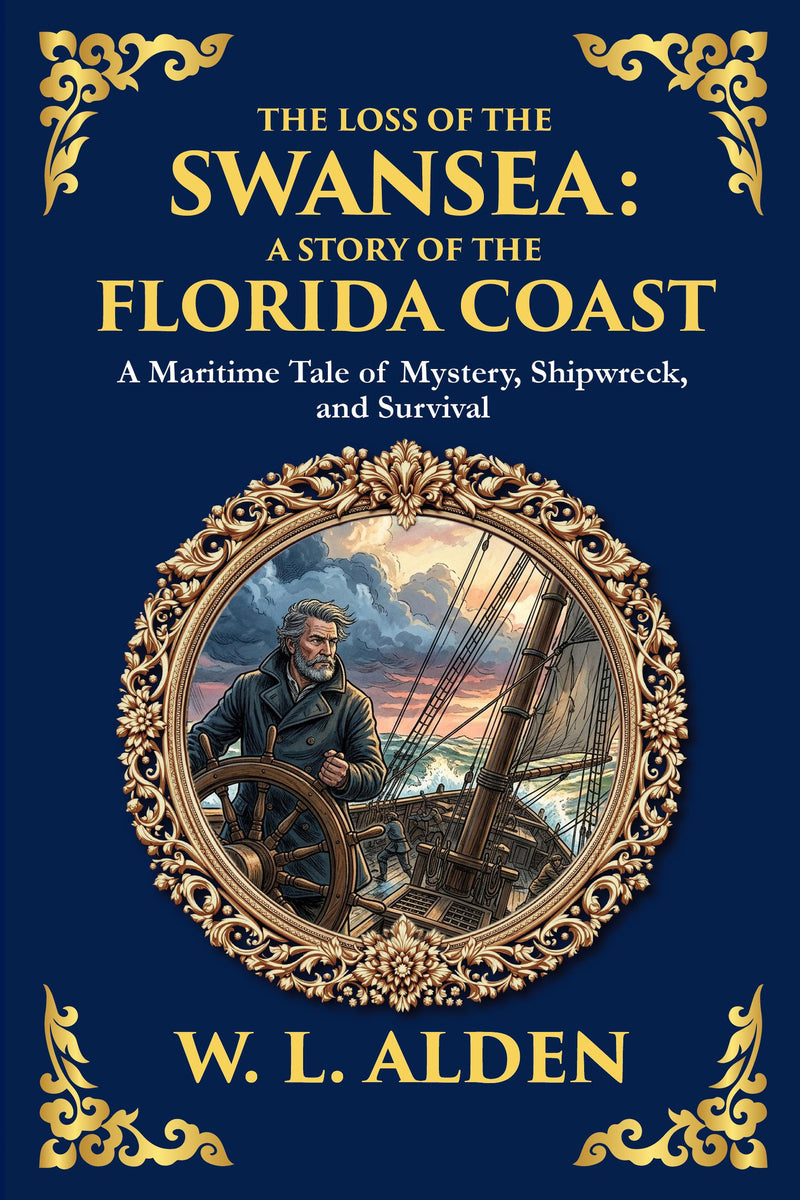
The Loss of the Swansea: A Story of the Florida Coast
In the quiet waters of the Florida coast, a mysterious voyage turns into a tale of disaster, danger, and determination. The Loss of the Swansea is more than a story of shipwreck—it is a gripping portrait of human willpower in the face of nature’s wrath.
or free app
10,000+ hrs library
30-day guarantee
The complete The Loss of the Swansea: A Story of the Florida Coast appears in modern English through Library of Alexandria Press, available online with audiobook narration included for members.
Have you ever wondered why the ocean keeps its deadliest secrets hidden in plain sight? The Loss of the Swansea: A Story of the Florida Coast is a maritime novella that plunges readers into a world of treacherous waters, haunting loss, and unrelenting survival. Originally penned by W. L. Alden, this powerful story captures the peril of seafaring life and the quiet heroism that often goes unseen.
As the Swansea—a small but capable vessel—embarks on what should be a routine voyage, the crew finds themselves facing more than unpredictable weather. What unfolds is a series of misfortunes and mysteries that culminate in disaster, testing the resolve of every man aboard. With his characteristic sharp prose and deep understanding of nautical life, Alden crafts a tale that combines suspense, character, and the timeless allure of the sea.
It’s a story for readers who revel in classic maritime fiction, and for those drawn to the quiet, noble battles fought far from land.
What you’ll discover in this modern edition
- The Tragic Voyage of the Swansea Follow a doomed journey along the Florida coast and the events that led to disaster.
- Vivid Nautical Detail and Atmosphere Feel the wind, the salt, the creak of timbers—and the weight of approaching ruin.
- Themes of Bravery, Duty, and the Sea’s Wrath Explore what it means to face danger with resolve when there’s no turning back.
- A Forgotten Gem of American Sea Literature Reintroduce yourself to W. L. Alden, a once-renowned writer of nautical fiction and quiet thrillers.
- A Snapshot of the Maritime World in the 19th Century Discover how ships, sailors, and the sea defined a life of peril and principle.
| Formats | eBook (EPUB + PDF) · Audiobook · Paperback · Hardcover · Large Print |
| Language | English |
| Trim size (print) | 6 × 9 in |
| Binding | Paperback — perfect-bound · Hardcover — casewrap |
| Large Print edition | Same text in a larger, easy-read type — a larger font, not a larger trim |
| Print pricing | Every physical book at our true cost — at-cost, no profit (members) |
| Library | 873 restored titles, always growing |
| Length | 33,236 words · ~2 hr 13 min reading |
| Reading level | Grade 9 · a comfortable read (this modern-English edition) |
| Edition | Modern English translation · 2026 |
Member reviews for this edition are collected as readers finish it — be the first. Across the library: 12,000+ books shipped, every plan covered by a 365-day print guarantee.
About this edition
A faithful, unabridged modern-English edition by The Library of Alexandria — carefully rendered for today's reader and verified paragraph-by-paragraph against the public-domain source. Available as eBook, audiobook, paperback, hardcover, and large print.
- Complete & unabridgedVerified paragraph by paragraph against the source — never a scan, never abridged.
- Modern English, faithfulReadable today, with the author’s meaning kept intact. Readable — not simplified.
- Every format, one membershipRead in your browser or the free app, or listen to the full audiobook.
Included free with your membership
Cancel anytime, one click · 30-day money-back guarantee
Edition last updated July 2026
What’s inside
The Loss of the Swansea: A Story of the Florida Coast — complete and unabridged: all 13 sections included with membership, plus the full audiobook.
Begin reading The Loss of the Swansea: A Story of the Florida Coast
In clear modern English — the complete text is included with membership.
Introduction
There is a particular kind of pleasure that comes from a sea story told well. It is not merely the spectacle of waves and wind, nor the drama of a vessel laboring against forces far larger than itself. It is something deeper and stranger: the sense that the ocean, for all its indifference, becomes a mirror in which human character is reflected with merciless clarity. Put men and women aboard a small craft, surround them with water in every direction, strip away the comforts and distractions of life ashore, and you will very quickly learn what they are made of. Courage and cowardice, loyalty and treachery, ingenuity and despair—all of these rise to the surface when there is nowhere left to hide. The story you are about to read understands this truth intimately, and it uses the wide, deceptive waters off the Florida coast as its stage for a drama that is at once thrilling, mysterious, and quietly profound.
This edition has been prepared as a modern translation, carefully adapted for the contemporary reader. That phrase deserves a moment of explanation, because it shapes the experience you are about to have. The original text was written in an age when prose moved at a different pace, when sentences could wind through several clauses before arriving at their destination, and when certain words, idioms, and turns of phrase carried meanings that have since faded or shifted. In preparing this version, the goal has been to honor the author’s voice and intentions while smoothing the path for readers who live more than a century later. Archaic constructions have been gently updated, obscure references clarified where necessary, and the rhythm of the language tuned so that it reads naturally to the modern ear. What has emphatically not been changed is the heart of the thing: the characters, the events, the suspense, the moral texture, and the salt-spray atmosphere that gives the book its lasting appeal. You are reading the same story that delighted audiences in its own time, but you are reading it without the friction that older language can sometimes impose. Think of it as polishing a window rather than repainting the view.
Before we go further, a word about what this introduction will and will not do. It will set the scene, introduce you to the author and the world he inhabited, and prepare you to appreciate the craft and the context of the tale. It will not spoil the plot. The particular delights of this book—its surprises, its reversals, the slow unfolding of its mystery, and the trials its characters must endure—are yours to discover at the pace the author intended. There is a great deal to be said about the kind of story this is and the tradition it belongs to without revealing a single one of its secrets, and that is precisely what the following pages aim to provide.
W. L. Alden—William Livingston Alden—was a man whose life was almost as varied and eventful as the fiction he produced. Born in the middle of the nineteenth century, he came of age during a period of remarkable transformation in the United States and abroad. He was, by turns, a journalist, an essayist, a humorist, a diplomat, and a novelist, and he carried into his fiction the curiosity and worldliness of a man who had genuinely seen and done a great deal. He is often remembered as one of the early champions of certain leisure pursuits in America, and he possessed an enduring fascination with boats, water, and the practical business of getting from one place to another by sail and oar. This was not the affectation of a writer borrowing nautical flavor for effect; it was the genuine enthusiasm of someone who understood the mechanics of the thing and loved them.
That authenticity matters enormously when you are reading a story set upon the water. There is a profound difference between an author who describes the sea from the safety of a writing desk, relying on borrowed vocabulary and secondhand impressions, and one who knows how a hull behaves in a following sea, how the wind shifts before a squall, how exhaustion and thirst and fear gnaw at the resolve of even the bravest sailor. Alden belonged to the latter category. When you read his descriptions of a vessel at sea, of the labor required to keep her afloat, of the small decisions that separate survival from disaster, you are in the hands of a man who knew whereof he wrote. This lends the story a grounded, lived-in quality that elevates it above the merely adventurous. The danger feels real because the seamanship is real.
Alden also worked in an era when fiction served a broad and hungry readership. Magazines, story papers, and inexpensive volumes carried tales of adventure and mystery to an audience eager for excitement and uplift in equal measure. Writers of the period understood that they were competing for attention, and the best of them—Alden among them—learned to construct narratives that gripped the reader from the opening pages and refused to let go. This was storytelling with a craftsman’s discipline: every scene had to earn its place, every chapter had to leave the reader wanting more, and the whole had to deliver a satisfying arc of tension and resolution. The book in your hands is a product of that demanding school, and it shows in the brisk, purposeful way the narrative moves.
It is worth pausing, too, on the particular geography that gives this tale its setting. The Florida coast in the period Alden wrote about was a frontier of a peculiar sort—not the dusty frontier of the American West, with its cattle drives and gold rushes, but a watery frontier of reefs, shoals, mangrove shores, and treacherous currents. The waters off Florida were among the most dangerous in the hemisphere for sailing vessels. The Gulf Stream surged northward with tremendous force, hurricanes could materialize with little warning, and a maze of submerged reefs lay in wait for any captain who misjudged his position. Ships were lost here with grim regularity, and an entire economy grew up around the salvage of wrecked vessels and their cargoes. This was a region where the line between civilization and wilderness, between safety and catastrophe, was thin and constantly shifting. It is the perfect setting for a story of shipwreck and survival, because the danger is not invented—it is woven into the very nature of the place. Alden understood this, and he used the landscape (or rather, the seascape) not as mere backdrop but as an active force in the narrative, a presence that shapes and tests every character who ventures upon it.
The title itself signals the central event around which the story turns, and yet—as you will discover—the loss of a vessel is rarely a simple matter. A shipwreck is an ending, but it is also a beginning. It strips away the ordinary structures of life and casts those who survive into a new and pitiless reality where the rules are rewritten. What happens after disaster is often where the true story lies, and the human drama that emerges in such circumstances is what gives this kind of tale its enduring power. The promise of mystery, too, runs through the book like a deep current beneath the surface action. Not everything is as it first appears, and the reader is invited to puzzle alongside the characters, sifting through clues and impressions, wondering what is true and whom to trust.
To fully appreciate what you are about to read, it helps to understand the literary tradition into which this book fits. The sea story is one of the oldest and most durable forms of storytelling in human culture. From the wanderings of Odysseus to the great voyages of exploration, from the whaling epics of the nineteenth century to the modern thriller set aboard a stricken ship, humanity has always been drawn to tales of the ocean. There is something archetypal about the journey across water—it speaks to our deepest fears and our highest aspirations, our terror of the unknown and our longing to test ourselves against it.
In the period when Alden wrote, the sea story occupied a privileged place in popular literature. The great age of sail was beginning its slow decline, giving way to steam and steel, and there was a powerful sense that an entire way of life was passing into history. Writers and readers alike felt the pull of nostalgia for the romance of sailing ships, even as they marveled at the new technologies transforming the maritime world. This tension—between the old world of wind and canvas and the new world of engines and iron—charges much of the maritime fiction of the era with a particular poignancy. The sea was both a place of timeless danger and a frontier being rapidly conquered, and the stories that emerged from this moment carry that doubled awareness within them.
The best sea stories share certain qualities, and you will find them all here. First, there is the matter of authentic detail—the rigging and sails, the navigation, the daily rhythms of life aboard a vessel, the specialized vocabulary that has accumulated over centuries of seafaring. A good sea story respects this knowledge and uses it to build a convincing world. Second, there is the element of confinement and pressure. A ship is a sealed environment, a small society floating upon an enormous and hostile element, and the dynamics that develop among those aboard can become intense and revealing. Hierarchies are tested, alliances form and dissolve, and the social order that seems so stable on land proves fragile when set adrift. Third, there is the constant presence of mortal danger, which gives every decision weight and every moment of calm a quality of held breath. And finally, there is the moral dimension—the sense that the sea, in its vast indifference, somehow demands of those who venture upon it a reckoning with their own character.
Alden was a master of weaving these elements together, and he brought to them a distinctive sensibility. He had a journalist’s eye for the telling detail and a humorist’s appreciation for the absurdities of human behavior, even in dire circumstances. His writing is never grim for grimness’s sake; there is a vitality and a wit to it, a sense that life is to be relished even amid danger. At the same time, he does not shrink from the genuine perils and hardships of the maritime world. The balance he strikes—between excitement and realism, between humor and gravity, between adventure and reflection—is one of the chief pleasures of his work.
It is also worth noting that stories of this kind often functioned as more than mere entertainment. They carried within them lessons about courage, resourcefulness, perseverance, and the importance of keeping one’s head in a crisis. The protagonists of such tales were frequently young people thrust into circumstances far beyond their experience, forced to grow up quickly and to discover reserves of strength they did not know they possessed. There is an inherently optimistic strain in this tradition—a belief that human beings, properly tested, will rise to the occasion, that ingenuity and grit can overcome even the most desperate odds. This is not naive cheerfulness; the danger is real and the cost is sometimes high. But there runs through these stories a fundamental faith in human capability and human decency that modern readers may find both refreshing and quietly moving.
As you read, you may find yourself reflecting on how different the world was for those who went to sea in the age of sail. There were no satellites to fix one’s position, no radios to call for help, no engines to power through a calm or against a contrary wind. A ship and her crew were genuinely alone, dependent entirely upon their own skill, judgment, and resolve. A navigational error, a sudden change in the weather, a failure of nerve or seamanship—any of these could spell disaster, and rescue was never guaranteed. This profound isolation gives the maritime fiction of the period a tension that is difficult to replicate in our connected modern world. When something goes wrong at sea in such a story, the characters cannot summon help with the press of a button. They must save themselves, or perish. This is the crucible in which the drama of survival is forged, and it is what makes the genre so enduringly compelling.
Cancel anytime, one click · 30-day money-back guarantee
Founding annual rate available now — your price locks for life when you join.
Not ready? Get this free chapter by email — read it anytime.
✓ Sent — check your inbox for The Loss of the Swansea: A Story of the Florida Coast.
Questions about The Loss of the Swansea: A Story of the Florida Coast
What is The Loss of the Swansea: A Story of the Florida Coast about?
In the quiet waters of the Florida coast, a mysterious voyage turns into a tale of disaster, danger, and determination. The Loss of the Swansea is more than a story of shipwreck—it is a gripping portrait of human willpower in the face of nature’s wrath. Told with realism and suspense, this forgotten gem of maritime fiction follows the ill-fated voyage of the Swansea and the lives that hung in the balance as storm and circumstance conspired to bring her down.
Who wrote The Loss of the Swansea: A Story of the Florida Coast?
The Loss of the Swansea: A Story of the Florida Coast was written by W. L. Alden. This edition presents the complete work in clear modern English, faithfully rendered from the public-domain original by Library of Alexandria Press.
Is The Loss of the Swansea: A Story of the Florida Coast free to read?
The opening chapter is free to read on this page. Members read and listen to the complete work — and the entire library — free, and can order any physical book at our true print cost.
How long is The Loss of the Swansea: A Story of the Florida Coast?
13 chapters (~33,236 words) — about 2 hr 13 min of reading in this modern-English edition.
Is this an abridged version of The Loss of the Swansea: A Story of the Florida Coast?
No. This is the complete, unabridged The Loss of the Swansea: A Story of the Florida Coast, carefully rendered into clear modern English and verified paragraph-by-paragraph against the public-domain source — nothing is cut or summarised.
What formats does The Loss of the Swansea: A Story of the Florida Coast come in?
The Loss of the Swansea: A Story of the Florida Coast is available as eBook, paperback, hardcover and large print. eBook and audiobook are included with membership; printed editions ship at our true print cost.
Shipping & returns
Billing & membership
More from the library


Explore Adventure
- Tarzan of the Apes · Edgar Rice Burroughs
- The Wonderful Wizard of Oz · L. Frank Baum
- Peter Pan · J. M. Barrie
- Moby Dick; Or, The Whale · Herman Melville
- The Riddle of the Sands · Erskine Childers
- Sky Island · L. Frank Baum
- Vikram and the Vampire: Classic Hindu Tales of Adventure, Magic, and Romance · Unknown
- Tales of Unrest · Joseph Conrad
- The Tomb of Ts’in · Edgar Wallace
- Skinny McCord · Percy Keese Fitzhugh
- The Men of the Moss-Hags · S. R. Crockett
- The Hunniwell Boys and the Platinum Mystery · L. P. Wyman
- Allan Quatermain · H. Rider Haggard
- She · H. Rider Haggard
- Medical Life in the Navy · Gordon Stables
- The Thirty-Nine Steps · John Buchan
- The Story of Doctor Dolittle · Hugh Lofting
- The Princess and the Goblin · George MacDonald
- The Man Who Would Be King · Rudyard Kipling
- Lucian’s True History · Lucian of Samosata
- The Secret Adversary · Agatha Christie
- Lord Jim · Joseph Conrad
- The Marvelous Land of Oz · L. Frank Baum
- The Virginian: A Horseman of the Plains · Owen Wister
- Mars is My Destination · Frank Belknap Long
- Anabasis · Xenophon
- The Mississippi Saucer · Frank Belknap Long
- Sabotage in Space · Carey Rockwell
- Brood of the Dark Moon · Charles Willard Diffin
- The Misplaced Battleship · Harry Harrison
The Loss of the Swansea: A Story of the Florida Coast
The Loss of the Swansea: A Story of the Florida Coast
A nautical story of mystery, shipwreck, and survival
W. L. Alden
Contents
- Introduction
- Chapter 1
- Chapter 2
- Chapter 3
- Chapter 4
- Chapter 5
- Chapter 6
- Chapter 7
- Chapter 8
- Chapter 9
- Chapter 10
- Chapter 11
- Chapter 12
Introduction
There is a particular kind of pleasure that comes from a sea story told well. It is not merely the spectacle of waves and wind, nor the drama of a vessel laboring against forces far larger than itself. It is something deeper and stranger: the sense that the ocean, for all its indifference, becomes a mirror in which human character is reflected with merciless clarity. Put men and women aboard a small craft, surround them with water in every direction, strip away the comforts and distractions of life ashore, and you will very quickly learn what they are made of. Courage and cowardice, loyalty and treachery, ingenuity and despair—all of these rise to the surface when there is nowhere left to hide. The story you are about to read understands this truth intimately, and it uses the wide, deceptive waters off the Florida coast as its stage for a drama that is at once thrilling, mysterious, and quietly profound.
This edition has been prepared as a modern translation, carefully adapted for the contemporary reader. That phrase deserves a moment of explanation, because it shapes the experience you are about to have. The original text was written in an age when prose moved at a different pace, when sentences could wind through several clauses before arriving at their destination, and when certain words, idioms, and turns of phrase carried meanings that have since faded or shifted. In preparing this version, the goal has been to honor the author’s voice and intentions while smoothing the path for readers who live more than a century later. Archaic constructions have been gently updated, obscure references clarified where necessary, and the rhythm of the language tuned so that it reads naturally to the modern ear. What has emphatically not been changed is the heart of the thing: the characters, the events, the suspense, the moral texture, and the salt-spray atmosphere that gives the book its lasting appeal. You are reading the same story that delighted audiences in its own time, but you are reading it without the friction that older language can sometimes impose. Think of it as polishing a window rather than repainting the view.
Before we go further, a word about what this introduction will and will not do. It will set the scene, introduce you to the author and the world he inhabited, and prepare you to appreciate the craft and the context of the tale. It will not spoil the plot. The particular delights of this book—its surprises, its reversals, the slow unfolding of its mystery, and the trials its characters must endure—are yours to discover at the pace the author intended. There is a great deal to be said about the kind of story this is and the tradition it belongs to without revealing a single one of its secrets, and that is precisely what the following pages aim to provide.
W. L. Alden—William Livingston Alden—was a man whose life was almost as varied and eventful as the fiction he produced. Born in the middle of the nineteenth century, he came of age during a period of remarkable transformation in the United States and abroad. He was, by turns, a journalist, an essayist, a humorist, a diplomat, and a novelist, and he carried into his fiction the curiosity and worldliness of a man who had genuinely seen and done a great deal. He is often remembered as one of the early champions of certain leisure pursuits in America, and he possessed an enduring fascination with boats, water, and the practical business of getting from one place to another by sail and oar. This was not the affectation of a writer borrowing nautical flavor for effect; it was the genuine enthusiasm of someone who understood the mechanics of the thing and loved them.
That authenticity matters enormously when you are reading a story set upon the water. There is a profound difference between an author who describes the sea from the safety of a writing desk, relying on borrowed vocabulary and secondhand impressions, and one who knows how a hull behaves in a following sea, how the wind shifts before a squall, how exhaustion and thirst and fear gnaw at the resolve of even the bravest sailor. Alden belonged to the latter category. When you read his descriptions of a vessel at sea, of the labor required to keep her afloat, of the small decisions that separate survival from disaster, you are in the hands of a man who knew whereof he wrote. This lends the story a grounded, lived-in quality that elevates it above the merely adventurous. The danger feels real because the seamanship is real.
Alden also worked in an era when fiction served a broad and hungry readership. Magazines, story papers, and inexpensive volumes carried tales of adventure and mystery to an audience eager for excitement and uplift in equal measure. Writers of the period understood that they were competing for attention, and the best of them—Alden among them—learned to construct narratives that gripped the reader from the opening pages and refused to let go. This was storytelling with a craftsman’s discipline: every scene had to earn its place, every chapter had to leave the reader wanting more, and the whole had to deliver a satisfying arc of tension and resolution. The book in your hands is a product of that demanding school, and it shows in the brisk, purposeful way the narrative moves.
It is worth pausing, too, on the particular geography that gives this tale its setting. The Florida coast in the period Alden wrote about was a frontier of a peculiar sort—not the dusty frontier of the American West, with its cattle drives and gold rushes, but a watery frontier of reefs, shoals, mangrove shores, and treacherous currents. The waters off Florida were among the most dangerous in the hemisphere for sailing vessels. The Gulf Stream surged northward with tremendous force, hurricanes could materialize with little warning, and a maze of submerged reefs lay in wait for any captain who misjudged his position. Ships were lost here with grim regularity, and an entire economy grew up around the salvage of wrecked vessels and their cargoes. This was a region where the line between civilization and wilderness, between safety and catastrophe, was thin and constantly shifting. It is the perfect setting for a story of shipwreck and survival, because the danger is not invented—it is woven into the very nature of the place. Alden understood this, and he used the landscape (or rather, the seascape) not as mere backdrop but as an active force in the narrative, a presence that shapes and tests every character who ventures upon it.
The title itself signals the central event around which the story turns, and yet—as you will discover—the loss of a vessel is rarely a simple matter. A shipwreck is an ending, but it is also a beginning. It strips away the ordinary structures of life and casts those who survive into a new and pitiless reality where the rules are rewritten. What happens after disaster is often where the true story lies, and the human drama that emerges in such circumstances is what gives this kind of tale its enduring power. The promise of mystery, too, runs through the book like a deep current beneath the surface action. Not everything is as it first appears, and the reader is invited to puzzle alongside the characters, sifting through clues and impressions, wondering what is true and whom to trust.
To fully appreciate what you are about to read, it helps to understand the literary tradition into which this book fits. The sea story is one of the oldest and most durable forms of storytelling in human culture. From the wanderings of Odysseus to the great voyages of exploration, from the whaling epics of the nineteenth century to the modern thriller set aboard a stricken ship, humanity has always been drawn to tales of the ocean. There is something archetypal about the journey across water—it speaks to our deepest fears and our highest aspirations, our terror of the unknown and our longing to test ourselves against it.
In the period when Alden wrote, the sea story occupied a privileged place in popular literature. The great age of sail was beginning its slow decline, giving way to steam and steel, and there was a powerful sense that an entire way of life was passing into history. Writers and readers alike felt the pull of nostalgia for the romance of sailing ships, even as they marveled at the new technologies transforming the maritime world. This tension—between the old world of wind and canvas and the new world of engines and iron—charges much of the maritime fiction of the era with a particular poignancy. The sea was both a place of timeless danger and a frontier being rapidly conquered, and the stories that emerged from this moment carry that doubled awareness within them.
The best sea stories share certain qualities, and you will find them all here. First, there is the matter of authentic detail—the rigging and sails, the navigation, the daily rhythms of life aboard a vessel, the specialized vocabulary that has accumulated over centuries of seafaring. A good sea story respects this knowledge and uses it to build a convincing world. Second, there is the element of confinement and pressure. A ship is a sealed environment, a small society floating upon an enormous and hostile element, and the dynamics that develop among those aboard can become intense and revealing. Hierarchies are tested, alliances form and dissolve, and the social order that seems so stable on land proves fragile when set adrift. Third, there is the constant presence of mortal danger, which gives every decision weight and every moment of calm a quality of held breath. And finally, there is the moral dimension—the sense that the sea, in its vast indifference, somehow demands of those who venture upon it a reckoning with their own character.
Alden was a master of weaving these elements together, and he brought to them a distinctive sensibility. He had a journalist’s eye for the telling detail and a humorist’s appreciation for the absurdities of human behavior, even in dire circumstances. His writing is never grim for grimness’s sake; there is a vitality and a wit to it, a sense that life is to be relished even amid danger. At the same time, he does not shrink from the genuine perils and hardships of the maritime world. The balance he strikes—between excitement and realism, between humor and gravity, between adventure and reflection—is one of the chief pleasures of his work.
It is also worth noting that stories of this kind often functioned as more than mere entertainment. They carried within them lessons about courage, resourcefulness, perseverance, and the importance of keeping one’s head in a crisis. The protagonists of such tales were frequently young people thrust into circumstances far beyond their experience, forced to grow up quickly and to discover reserves of strength they did not know they possessed. There is an inherently optimistic strain in this tradition—a belief that human beings, properly tested, will rise to the occasion, that ingenuity and grit can overcome even the most desperate odds. This is not naive cheerfulness; the danger is real and the cost is sometimes high. But there runs through these stories a fundamental faith in human capability and human decency that modern readers may find both refreshing and quietly moving.
As you read, you may find yourself reflecting on how different the world was for those who went to sea in the age of sail. There were no satellites to fix one’s position, no radios to call for help, no engines to power through a calm or against a contrary wind. A ship and her crew were genuinely alone, dependent entirely upon their own skill, judgment, and resolve. A navigational error, a sudden change in the weather, a failure of nerve or seamanship—any of these could spell disaster, and rescue was never guaranteed. This profound isolation gives the maritime fiction of the period a tension that is difficult to replicate in our connected modern world. When something goes wrong at sea in such a story, the characters cannot summon help with the press of a button. They must save themselves, or perish. This is the crucible in which the drama of survival is forged, and it is what makes the genre so enduringly compelling.
I was almost fifteen and my brother Tom was slightly over sixteen when our father passed away. We were the only ones left, as our mother had died when I was so young that I barely remembered her. Our only living relative was an uncle we had never met, who lived in the American colony of the Carolinas.
Our father worked as a British channel pilot, and Tom and I had spent our entire lives in Bristol, except for one single week. People tell me it is the greatest city in England, even though everyone knows it isn’t quite as large as London. Father owned a part of a pilot boat, and he often brought us along when he was searching for ships returning home. We helped the crew run the boat, and we were more skilled sailors than the two apprentices.
One time, a man hired our father to sail a new brig from Bristol to Penzance, and we joined him. That was the one week I mentioned where we didn’t live in Bristol. We loved the trip and learned a lot about square-rigged ships during our time on the brig.
Pilots didn’t earn much money back then, and father left us nothing but half a crown and his share of the pilot boat. Before he died, he asked his partners to sell his share and use the funds to send Tom and me to our uncle in America. Being honest men, the two partners bought the share themselves for thirty pounds, which was its full value. After they paid for our trip to America on the brig Swansea, they gave us the remaining two pounds, ten shillings, and threepence.
The captain of the Swansea agreed to treat us as first-class passengers. We lived with him in the main cabin and weren’t required to do any work. It wasn’t that we were unwilling to work for our travel costs, but Captain Robinson—my father’s oldest business partner—said, “No; your late partner’s instructions were that you be sent to America, and that didn’t mean you had to work for it. We’ll follow those orders, because a dead man’s wishes should be honored if possible; you don’t want ghosts coming to visit you.”
End of the free sample
Keep reading, free
Members read and listen to the complete book — and the entire library. Cancel anytime, one click · 30-day money-back guarantee.