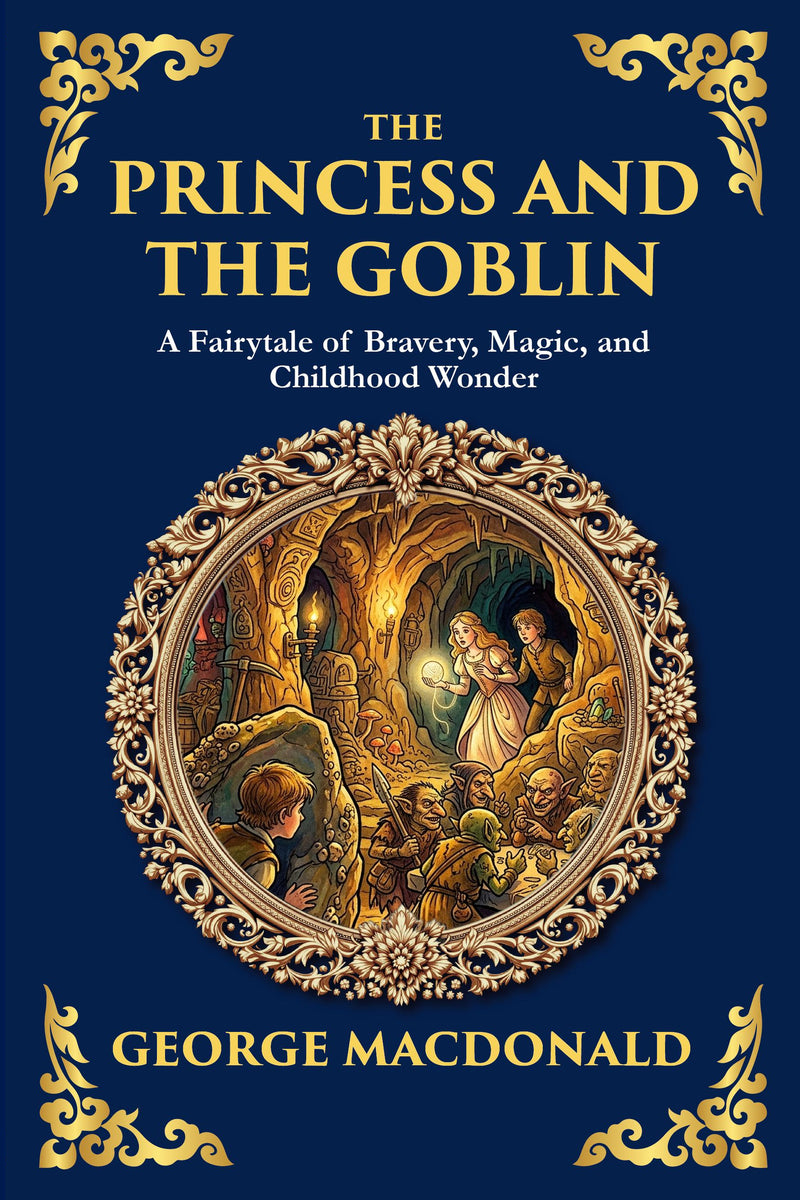
The Princess and the Goblin
In a world where magic stirs beneath the mountains, a young princess must summon courage beyond her years. When sinister goblins threaten her kingdom, it is not her royal status but her bravery, kindness, and trust in the unseen that will determine her fate.
or free app
10,000+ hrs library
30-day guarantee
The complete The Princess and the Goblin appears in modern English through Library of Alexandria Press, available online with audiobook narration included for members.
Have you ever wondered why some fairytales feel like they speak to your soul—no matter your age? The Princess and the Goblin is not just a children's story—it’s a deeply enchanting narrative that explores the timeless power of courage, virtue, and belief in what cannot always be seen. George MacDonald, the 19th-century master of fantasy and mentor to C.S. Lewis, crafts a rich allegory that is as spiritually nourishing as it is thrilling.
Beneath a mysterious mountain lies a realm of goblins—twisted, scheming creatures who harbor resentment and plot revenge on the world above. Unaware of the looming threat, young Princess Irene lives in a lonely castle, until one night she discovers a magical thread left by her mysterious great-great-grandmother—a thread that will guide her when all seems lost. Alongside the brave and honest miner boy, Curdie, Irene faces fear, deception, and darkness.
This modern edition preserves the poetic charm of the original while inviting a new generation of readers to uncover the deeper truths woven into this magical tale.
What you’ll discover in this modern edition
- A Tale of Inner Strength and Innocence Follow Princess Irene as she overcomes fear, not with weapons, but with faith and love.
- A Battle Between Light and Darkness Enter a world where goblins lurk beneath the surface, and only those who trust in the unseen can defeat them.
- An Allegory of Spiritual Faith and Intuition The mysterious guiding thread becomes a symbol of divine guidance and personal conviction.
- Enduring Wisdom From a Literary Master George MacDonald’s writing influenced J.R.R. Tolkien and C.S. Lewis—discover why this tale is so foundational.
- A Fantasy for All Ages Whether read aloud to children or explored by adults, the themes of this story resonate universally. Let this unforgettable fairytale lead you through tunnels of danger and into the light of wonder.
| Formats | eBook (EPUB + PDF) · Audiobook · Paperback · Hardcover · Large Print |
| Language | English |
| Trim size (print) | 6 × 9 in |
| Binding | Paperback — perfect-bound · Hardcover — casewrap |
| Large Print edition | Same text in a larger, easy-read type — a larger font, not a larger trim |
| Print pricing | Every physical book at our true cost — at-cost, no profit (members) |
| Library | 873 restored titles, always growing |
| Length | 50,795 words · ~3 hr 23 min reading |
| Reading level | Grade 8 · an easy, flowing read (this modern-English edition) |
| Edition | Modern English translation · 2026 |
Member reviews for this edition are collected as readers finish it — be the first. Across the library: 12,000+ books shipped, every plan covered by a 365-day print guarantee.
About this edition
A faithful, unabridged modern-English edition by The Library of Alexandria — carefully rendered for today's reader and verified paragraph-by-paragraph against the public-domain source. Available as eBook, audiobook, paperback, hardcover, and large print.
- Complete & unabridgedVerified paragraph by paragraph against the source — never a scan, never abridged.
- Modern English, faithfulReadable today, with the author’s meaning kept intact. Readable — not simplified.
- Every format, one membershipRead in your browser or the free app, or listen to the full audiobook.
Included free with your membership
Cancel anytime, one click · 30-day money-back guarantee
Edition last updated July 2026
What’s inside
The Princess and the Goblin — complete and unabridged: all 33 sections included with membership, plus the full audiobook.
Begin reading The Princess and the Goblin
In clear modern English — the complete text is included with membership.
Introduction
There are books we read once and set aside, and there are books that quietly take up residence inside us, shaping the way we imagine courage, goodness, and the unseen world long after we have closed their covers. The Princess and the Goblin belongs unmistakably to the second kind. First published in 1872, this slender, luminous tale has outlived nearly all the children’s fiction of its era, and it continues to enchant new generations precisely because it speaks to something that does not age: the longing to believe that the world is larger and more wondrous than it appears, that ordinary people are capable of extraordinary bravery, and that there is a thread of love running invisibly through all things, waiting to be trusted.
George MacDonald, the Scottish minister, poet, and storyteller who created this book, was a man who understood children not as miniature adults to be instructed, but as imaginative beings to be honored. He did not write down to his readers, nor did he flatter them with empty entertainment. Instead, he offered them stories that took their inner lives seriously—stories in which fear was real, danger was genuine, and goodness cost something. The result is a fairy tale that has the simplicity of a nursery rhyme and the depth of a parable, a story a child can follow with delight and an adult can ponder for a lifetime. This edition presents that timeless tale in a fresh, modern translation, carefully adapted so that today’s reader can move through MacDonald’s enchanted world without stumbling over the dated turns of phrase and Victorian sentence rhythms that can sometimes obscure the brightness of the original. The aim throughout has been to preserve the spirit, the warmth, and the moral seriousness of MacDonald’s voice while making the prose feel as immediate and inviting as it must have felt to the children who first heard it read aloud by candlelight.
Before you begin, it is worth pausing to consider what kind of book you are holding, and why it has earned the devotion of readers as different as the curious child reading under the covers and the grown novelist seeking to understand the roots of modern fantasy. For The Princess and the Goblin is no mere quaint relic. It is one of the foundational works of the entire fantasy tradition, a story whose influence runs like an underground river beneath the great imaginative literature of the twentieth century. To read it well is to read it both as the charming adventure it is on its surface and as the rich, resonant fable it reveals itself to be on closer acquaintance.
George MacDonald was born in 1824 in Huntly, a small town in the northeast of Scotland, into a family of farmers and weavers whose Calvinist faith shaped the air he breathed as a boy. From the start his life was marked by both hardship and a deep, abiding sense of the sacred. He lost his mother early, struggled through poverty, and battled ill health for much of his life, including the tuberculosis that would eventually take several of his own beloved children. Yet from this soil of loss and difficulty grew a man of remarkable tenderness and an almost startling generosity of spirit. He came to reject the harsher elements of the theology he had inherited—the notion of a wrathful, arbitrary God consigning souls to endless punishment—and embraced instead a vision of divine love so wide and patient that it scandalized some of his more rigid contemporaries. When his views cost him his pulpit as a young minister, he turned to writing, and in doing so discovered that he could preach to far more people through stories than he ever could from behind a lectern.
What makes MacDonald so unusual, and so important, is the conviction that ran through everything he wrote: that the imagination is not a frivolous escape from reality but a faculty for perceiving deeper truths. He believed that fairy tales, far from being childish nonsense, could carry meanings too large and too living to be captured in plain argument. “The best thing you can do for your fellow,” he once wrote, “is to wake things up that are in him; or to make him think things for himself.” He did not want to hand his readers tidy lessons; he wanted to stir something awake in them, to set their minds and hearts in motion toward goodness, beauty, and faith. This is why his stories never feel like sermons in disguise, even when they are unmistakably about the deepest things. He trusted the story to do its own work.
It is impossible to overstate the influence MacDonald had on the writers who came after him. C. S. Lewis famously said that he had never written a book in which he did not quote from MacDonald, and he described picking up MacDonald’s Phantastes as a young man as the moment that “baptized” his imagination, beginning the long process that would lead him to faith and, eventually, to the creation of Narnia. J. R. R. Tolkien knew and admired his work; the goblins of this very book are among the literary ancestors of the goblins and orcs who would later populate Middle-earth. G. K. Chesterton called The Princess and the Goblin a book that “made a difference to my whole existence,” praising it for capturing the truth that the real fight of life takes place inside the home and the heart, and that the things which threaten us most often hide in the cellars and dark places just beneath our daily lives. W. H. Auden, Madeleine L’Engle, and countless others have acknowledged the debt. When you read this book, in other words, you are not reading a curiosity from a forgotten corner of literary history. You are reading one of the wellsprings from which an entire genre flowed.
But MacDonald would have been the first to insist that none of this matters unless the story itself delights you. And it will. He had a particular genius for the texture of childhood—the way a great house feels enormous and full of secrets to a small person, the way a kind face can banish terror, the way the line between the magical and the ordinary is so thin for a child that it is hardly worth drawing. He remembered, as few adults manage to, exactly what it felt like to be young and uncertain and brave in spite of being afraid. That remembered truthfulness is everywhere in these pages, and it is the reason the story still feels alive.
Without giving away the turns of the tale that await you, it is worth saying a little about the landscape in which this story unfolds, because MacDonald’s settings are never merely backdrops. They are part of the meaning. At the heart of the book is a great rambling house set high on the side of a mountain—a house with countless rooms, winding staircases, and passages that seem to go on forever, the kind of place where exploration is both an invitation and a risk. Above the house rise the slopes and peaks; below it, and within the mountain itself, lies another realm entirely, a world of dim caverns and subterranean tunnels inhabited by creatures who long ago withdrew from the light of day.
MacDonald draws these two worlds—the bright, airy world above and the cramped, shadowy world below—with wonderful clarity, and part of the pleasure of the book lies simply in moving between them. There is the comfort of warm firelight and the company of those who love us, and there is the genuine thrill of darkness, of cold passages and listening silences and the dread of what might be coming through the dark. MacDonald understood that children are not made braver by being protected from fear, but by being shown that fear can be faced and overcome. His underground world is genuinely frightening—he does not pretend otherwise—and yet the story never abandons its young readers to despair. There is always, somewhere, a light to be found, a thread to be followed, a hand to take hold of.
The mountain setting also carries an old and resonant symbolism. Heights have always stood for aspiration, for the things we reach toward, for clarity and hope; depths have always represented danger, the unknown, the primal forces that lurk beneath the polished surface of our lives. By placing his story across these two zones, MacDonald gives his simple adventure a quiet mythic grandeur. We feel, without being told, that the journey up and down the mountain is also a journey of the soul.
And then there is the matter of the staircase—or rather, of a certain staircase that leads, against all expectation, not down into the dark but up into rooms that should not exist, rooms full of moonlight and mystery. I will say no more about what is found there, only that it is among the most beautiful inventions in all of children’s literature, and that MacDonald handles it with a delicacy and restraint that lesser writers could never have managed. He does not over-explain. He lets the wonder be wondrous. When you encounter it, you will understand why generations of readers have carried the memory of it with them into adulthood.
The creatures who dwell beneath the mountain deserve a word as well, for MacDonald’s goblins are among his most original creations. They are not the cute, comical goblins of later children’s stories, nor are they figures of pure malice. They are something stranger and more interesting—a people with their own history, their own grievances, their own peculiar customs and weaknesses, who once lived above ground and were driven below long ago. MacDonald gives them a society, a king and queen, schemes and ambitions. This refusal to make his villains simply monstrous, this insistence on understanding even the dark powers as creatures with their own logic, is one of the marks of his moral imagination, and it gives the story a depth and seriousness that elevate it far above the ordinary tale of good and evil. The goblins are dangerous, yes, and you will tremble for the characters when the goblins are near. But MacDonald never lets you forget that they were not always so, and that the line between the dwellers above and the dwellers below was not drawn by nature but by old choices and old wrongs.
Courage, Faith, and the Thread We Cannot See
If there is a single golden thread—and the image is deliberate—running through this book, it is the question of trust. Again and again, MacDonald’s young heroine is asked to believe in something she cannot prove, to follow a guidance she cannot fully see, to walk forward in the dark on the strength of a promise. This is, of course, an image of faith, and MacDonald meant it to be. But it is faith of a particular and beautiful kind, very different from blind obedience or fearful submission. It is the faith of a child who trusts because she has been loved, who follows because she has learned that the one who guides her has never failed her, who finds that her courage grows not from certainty but from relationship.
This is why the book never feels preachy, even though it is profoundly concerned with the deepest things. MacDonald does not lecture us about virtue; he shows us a child discovering, through real danger and real choices, what it means to be brave, to be truthful, to keep a promise even when keeping it is hard, to believe in goodness even when the evidence of the senses points the other way. He understood that the great virtues are not abstractions to be memorized but living realities to be practiced, and he dramatizes them with such gentleness and such honesty that we absorb them almost without noticing.
There is also a remarkable companion to the princess in this tale—a young miner’s boy, a child of the working people who labor in the depths near where the goblins dwell. Through him MacDonald introduces a different but equally important kind of courage: the steady, practical, unglamorous bravery of ordinary people doing their work and protecting those they love. The friendship between these two children, born across the gulf of class that so rigidly divided Victorian society, is one of the quiet glories of the book. MacDonald, who never forgot the poverty of his own beginnings and who saw in working people a dignity that his society too often denied them, gives this boy a nobility of soul every bit as real as the princess’s royal blood. The story insists, without ever saying so directly, that true nobility is a matter of character rather than birth—a radical and lovely idea, then as now.
Cancel anytime, one click · 30-day money-back guarantee
Founding annual rate available now — your price locks for life when you join.
Not ready? Get this free chapter by email — read it anytime.
✓ Sent — check your inbox for The Princess and the Goblin.
Questions about The Princess and the Goblin
What is The Princess and the Goblin about?
In a world where magic stirs beneath the mountains, a young princess must summon courage beyond her years. When sinister goblins threaten her kingdom, it is not her royal status but her bravery, kindness, and trust in the unseen that will determine her fate. George MacDonald’s The Princess and the Goblin is a classic tale that has inspired generations with its blend of fantasy, faith, and moral imagination.
Who wrote The Princess and the Goblin?
The Princess and the Goblin was written by George MacDonald. This edition presents the complete work in clear modern English, faithfully rendered from the public-domain original by Library of Alexandria Press.
Is The Princess and the Goblin free to read?
The opening chapter is free to read on this page. Members read and listen to the complete work — and the entire library — free, and can order any physical book at our true print cost.
How long is The Princess and the Goblin?
33 chapters (~50,795 words) — about 3 hr 23 min of reading in this modern-English edition.
Is this an abridged version of The Princess and the Goblin?
No. This is the complete, unabridged The Princess and the Goblin, carefully rendered into clear modern English and verified paragraph-by-paragraph against the public-domain source — nothing is cut or summarised.
What formats does The Princess and the Goblin come in?
The Princess and the Goblin is available as eBook, paperback, hardcover and large print. eBook and audiobook are included with membership; printed editions ship at our true print cost.
Shipping & returns
Billing & membership
More from the library


Explore Adventure
- Tarzan of the Apes · Edgar Rice Burroughs
- The Wonderful Wizard of Oz · L. Frank Baum
- Peter Pan · J. M. Barrie
- Moby Dick; Or, The Whale · Herman Melville
- The Riddle of the Sands · Erskine Childers
- The Loss of the Swansea: A Story of the Florida Coast · W. L. Alden
- Sky Island · L. Frank Baum
- Vikram and the Vampire: Classic Hindu Tales of Adventure, Magic, and Romance · Unknown
- Tales of Unrest · Joseph Conrad
- The Tomb of Ts’in · Edgar Wallace
- Skinny McCord · Percy Keese Fitzhugh
- The Men of the Moss-Hags · S. R. Crockett
- The Hunniwell Boys and the Platinum Mystery · L. P. Wyman
- Allan Quatermain · H. Rider Haggard
- She · H. Rider Haggard
- Medical Life in the Navy · Gordon Stables
- The Thirty-Nine Steps · John Buchan
- The Story of Doctor Dolittle · Hugh Lofting
- The Man Who Would Be King · Rudyard Kipling
- Lucian’s True History · Lucian of Samosata
- The Secret Adversary · Agatha Christie
- Lord Jim · Joseph Conrad
- The Marvelous Land of Oz · L. Frank Baum
- The Virginian: A Horseman of the Plains · Owen Wister
- Mars is My Destination · Frank Belknap Long
- Anabasis · Xenophon
- The Mississippi Saucer · Frank Belknap Long
- Sabotage in Space · Carey Rockwell
- Brood of the Dark Moon · Charles Willard Diffin
- The Misplaced Battleship · Harry Harrison
The Princess and the Goblin
The Princess and the Goblin
A Fairytale of Courage, Magic, and Childhood Wonder
George MacDonald
Contents
- Introduction
- Chapter 1
- Chapter 2
- Chapter 3
- Chapter 4
- Chapter 5
- Chapter 6
- Chapter 7
- Chapter 8
- Chapter 9
- Chapter 10
- Chapter 11
- Chapter 12
- Chapter 13
- Chapter 14
- Chapter 15
- Chapter 16
- Chapter 17
- Chapter 18
- Chapter 19
- Chapter 20
- Chapter 21
- Chapter 22
- Chapter 23
- Chapter 24
- Chapter 25
- Chapter 26
- Chapter 27
- Chapter 28
- Chapter 29
- Chapter 30
- Chapter 31
- Chapter 32
Introduction
There are books we read once and set aside, and there are books that quietly take up residence inside us, shaping the way we imagine courage, goodness, and the unseen world long after we have closed their covers. The Princess and the Goblin belongs unmistakably to the second kind. First published in 1872, this slender, luminous tale has outlived nearly all the children’s fiction of its era, and it continues to enchant new generations precisely because it speaks to something that does not age: the longing to believe that the world is larger and more wondrous than it appears, that ordinary people are capable of extraordinary bravery, and that there is a thread of love running invisibly through all things, waiting to be trusted.
George MacDonald, the Scottish minister, poet, and storyteller who created this book, was a man who understood children not as miniature adults to be instructed, but as imaginative beings to be honored. He did not write down to his readers, nor did he flatter them with empty entertainment. Instead, he offered them stories that took their inner lives seriously—stories in which fear was real, danger was genuine, and goodness cost something. The result is a fairy tale that has the simplicity of a nursery rhyme and the depth of a parable, a story a child can follow with delight and an adult can ponder for a lifetime. This edition presents that timeless tale in a fresh, modern translation, carefully adapted so that today’s reader can move through MacDonald’s enchanted world without stumbling over the dated turns of phrase and Victorian sentence rhythms that can sometimes obscure the brightness of the original. The aim throughout has been to preserve the spirit, the warmth, and the moral seriousness of MacDonald’s voice while making the prose feel as immediate and inviting as it must have felt to the children who first heard it read aloud by candlelight.
Before you begin, it is worth pausing to consider what kind of book you are holding, and why it has earned the devotion of readers as different as the curious child reading under the covers and the grown novelist seeking to understand the roots of modern fantasy. For The Princess and the Goblin is no mere quaint relic. It is one of the foundational works of the entire fantasy tradition, a story whose influence runs like an underground river beneath the great imaginative literature of the twentieth century. To read it well is to read it both as the charming adventure it is on its surface and as the rich, resonant fable it reveals itself to be on closer acquaintance.
George MacDonald was born in 1824 in Huntly, a small town in the northeast of Scotland, into a family of farmers and weavers whose Calvinist faith shaped the air he breathed as a boy. From the start his life was marked by both hardship and a deep, abiding sense of the sacred. He lost his mother early, struggled through poverty, and battled ill health for much of his life, including the tuberculosis that would eventually take several of his own beloved children. Yet from this soil of loss and difficulty grew a man of remarkable tenderness and an almost startling generosity of spirit. He came to reject the harsher elements of the theology he had inherited—the notion of a wrathful, arbitrary God consigning souls to endless punishment—and embraced instead a vision of divine love so wide and patient that it scandalized some of his more rigid contemporaries. When his views cost him his pulpit as a young minister, he turned to writing, and in doing so discovered that he could preach to far more people through stories than he ever could from behind a lectern.
What makes MacDonald so unusual, and so important, is the conviction that ran through everything he wrote: that the imagination is not a frivolous escape from reality but a faculty for perceiving deeper truths. He believed that fairy tales, far from being childish nonsense, could carry meanings too large and too living to be captured in plain argument. “The best thing you can do for your fellow,” he once wrote, “is to wake things up that are in him; or to make him think things for himself.” He did not want to hand his readers tidy lessons; he wanted to stir something awake in them, to set their minds and hearts in motion toward goodness, beauty, and faith. This is why his stories never feel like sermons in disguise, even when they are unmistakably about the deepest things. He trusted the story to do its own work.
It is impossible to overstate the influence MacDonald had on the writers who came after him. C. S. Lewis famously said that he had never written a book in which he did not quote from MacDonald, and he described picking up MacDonald’s Phantastes as a young man as the moment that “baptized” his imagination, beginning the long process that would lead him to faith and, eventually, to the creation of Narnia. J. R. R. Tolkien knew and admired his work; the goblins of this very book are among the literary ancestors of the goblins and orcs who would later populate Middle-earth. G. K. Chesterton called The Princess and the Goblin a book that “made a difference to my whole existence,” praising it for capturing the truth that the real fight of life takes place inside the home and the heart, and that the things which threaten us most often hide in the cellars and dark places just beneath our daily lives. W. H. Auden, Madeleine L’Engle, and countless others have acknowledged the debt. When you read this book, in other words, you are not reading a curiosity from a forgotten corner of literary history. You are reading one of the wellsprings from which an entire genre flowed.
But MacDonald would have been the first to insist that none of this matters unless the story itself delights you. And it will. He had a particular genius for the texture of childhood—the way a great house feels enormous and full of secrets to a small person, the way a kind face can banish terror, the way the line between the magical and the ordinary is so thin for a child that it is hardly worth drawing. He remembered, as few adults manage to, exactly what it felt like to be young and uncertain and brave in spite of being afraid. That remembered truthfulness is everywhere in these pages, and it is the reason the story still feels alive.
Without giving away the turns of the tale that await you, it is worth saying a little about the landscape in which this story unfolds, because MacDonald’s settings are never merely backdrops. They are part of the meaning. At the heart of the book is a great rambling house set high on the side of a mountain—a house with countless rooms, winding staircases, and passages that seem to go on forever, the kind of place where exploration is both an invitation and a risk. Above the house rise the slopes and peaks; below it, and within the mountain itself, lies another realm entirely, a world of dim caverns and subterranean tunnels inhabited by creatures who long ago withdrew from the light of day.
MacDonald draws these two worlds—the bright, airy world above and the cramped, shadowy world below—with wonderful clarity, and part of the pleasure of the book lies simply in moving between them. There is the comfort of warm firelight and the company of those who love us, and there is the genuine thrill of darkness, of cold passages and listening silences and the dread of what might be coming through the dark. MacDonald understood that children are not made braver by being protected from fear, but by being shown that fear can be faced and overcome. His underground world is genuinely frightening—he does not pretend otherwise—and yet the story never abandons its young readers to despair. There is always, somewhere, a light to be found, a thread to be followed, a hand to take hold of.
The mountain setting also carries an old and resonant symbolism. Heights have always stood for aspiration, for the things we reach toward, for clarity and hope; depths have always represented danger, the unknown, the primal forces that lurk beneath the polished surface of our lives. By placing his story across these two zones, MacDonald gives his simple adventure a quiet mythic grandeur. We feel, without being told, that the journey up and down the mountain is also a journey of the soul.
And then there is the matter of the staircase—or rather, of a certain staircase that leads, against all expectation, not down into the dark but up into rooms that should not exist, rooms full of moonlight and mystery. I will say no more about what is found there, only that it is among the most beautiful inventions in all of children’s literature, and that MacDonald handles it with a delicacy and restraint that lesser writers could never have managed. He does not over-explain. He lets the wonder be wondrous. When you encounter it, you will understand why generations of readers have carried the memory of it with them into adulthood.
The creatures who dwell beneath the mountain deserve a word as well, for MacDonald’s goblins are among his most original creations. They are not the cute, comical goblins of later children’s stories, nor are they figures of pure malice. They are something stranger and more interesting—a people with their own history, their own grievances, their own peculiar customs and weaknesses, who once lived above ground and were driven below long ago. MacDonald gives them a society, a king and queen, schemes and ambitions. This refusal to make his villains simply monstrous, this insistence on understanding even the dark powers as creatures with their own logic, is one of the marks of his moral imagination, and it gives the story a depth and seriousness that elevate it far above the ordinary tale of good and evil. The goblins are dangerous, yes, and you will tremble for the characters when the goblins are near. But MacDonald never lets you forget that they were not always so, and that the line between the dwellers above and the dwellers below was not drawn by nature but by old choices and old wrongs.
Courage, Faith, and the Thread We Cannot See
If there is a single golden thread—and the image is deliberate—running through this book, it is the question of trust. Again and again, MacDonald’s young heroine is asked to believe in something she cannot prove, to follow a guidance she cannot fully see, to walk forward in the dark on the strength of a promise. This is, of course, an image of faith, and MacDonald meant it to be. But it is faith of a particular and beautiful kind, very different from blind obedience or fearful submission. It is the faith of a child who trusts because she has been loved, who follows because she has learned that the one who guides her has never failed her, who finds that her courage grows not from certainty but from relationship.
This is why the book never feels preachy, even though it is profoundly concerned with the deepest things. MacDonald does not lecture us about virtue; he shows us a child discovering, through real danger and real choices, what it means to be brave, to be truthful, to keep a promise even when keeping it is hard, to believe in goodness even when the evidence of the senses points the other way. He understood that the great virtues are not abstractions to be memorized but living realities to be practiced, and he dramatizes them with such gentleness and such honesty that we absorb them almost without noticing.
There is also a remarkable companion to the princess in this tale—a young miner’s boy, a child of the working people who labor in the depths near where the goblins dwell. Through him MacDonald introduces a different but equally important kind of courage: the steady, practical, unglamorous bravery of ordinary people doing their work and protecting those they love. The friendship between these two children, born across the gulf of class that so rigidly divided Victorian society, is one of the quiet glories of the book. MacDonald, who never forgot the poverty of his own beginnings and who saw in working people a dignity that his society too often denied them, gives this boy a nobility of soul every bit as real as the princess’s royal blood. The story insists, without ever saying so directly, that true nobility is a matter of character rather than birth—a radical and lovely idea, then as now.
Once there was a little princess whose father ruled a vast land filled with mountains and valleys. His palace, built atop one of those mountains, was magnificent and beautiful. The princess, named Irene, was born there. However, because her mother was frail, she was sent shortly after birth to be raised by country folk. She lived in a large house—part castle and part farmhouse—situated on the slope of another mountain, about halfway between the bottom and the summit.
The princess was a sweet little girl. When my story begins, I believe she was about eight years old, though she grew up very quickly. Her face was fair and lovely, and her eyes looked like two pieces of the night sky, each with a star shimmering in the blue. You would think those eyes knew where they came from, as she so often gazed upward. The ceiling of her nursery was painted blue with stars, made to look as much like the real sky as possible. But I doubt she ever saw the actual starry sky, for a reason I should explain right now.
These mountains were filled with underground hollows: massive caverns and twisting tunnels. Some had water flowing through them, and others sparkled with every color of the rainbow whenever a light was carried inside. People wouldn’t have known much about these places if there hadn’t been mines—deep pits with long galleries and passages branching off—dug to reach the ore that filled the mountains. While digging, the miners discovered many of these natural caves. A few of them had distant openings that led out onto the mountainside or into a ravine.
A strange race of creatures lived in these underground caverns; some called them gnomes, some kobolds, and others goblins. Local legend claimed that they once lived on the surface and looked very much like ordinary people. However, for various reasons—depending on which legend you believed—the king had either taxed them too heavily, forced them to follow customs they disliked, or simply become too harsh and strict with his laws. As a result, they all vanished from the land. According to the stories, instead of moving to another country, they sought shelter in the underground caves. They never left these caves except at night, and even then, they rarely appeared in groups or showed themselves to many people at once. It was said that they only gathered in the open air at night in the most remote and difficult parts of the mountains. Those who had seen them claimed that the creatures had changed drastically over many generations. This wasn’t surprising, given that they lived away from the sun in cold, damp, and dark places. They were no longer just plain-looking; they were either completely hideous or ridiculously distorted in both face and body. People claimed that no artist, no matter how wild their imagination, could draw something more bizarre than these creatures. However, I suspect those people were confusing the goblins’ animal companions with the goblins themselves—which I will explain later. The goblins were not actually as different from humans as those descriptions suggest. As their bodies became deformed, they became more knowledgeable and clever, eventually learning to do things that no human could even imagine. But as they grew more cunning, they became more malicious. Their greatest joy was finding any possible way to annoy the people living on the surface above them. They still cared enough for one another to avoid being completely cruel just for the sake of it, but they held a deep, ancestral grudge against those living in their former homes—especially the descendants of the king who had driven them out. They looked for every chance to torment these people in ways as strange as they were. Despite being short and misshapen, they were as strong as they were sly. Over time, they established their own king and government, whose primary job, aside from managing their own simple affairs, was to create trouble for their neighbors. It is now quite clear why the little princess had never seen the night sky. Her guardians were far too afraid of the goblins to let her leave the house at night, even with many attendants to protect her; and as we will see soon, they had a very good reason to be afraid.
End of the free sample
Keep reading, free
Members read and listen to the complete book — and the entire library. Cancel anytime, one click · 30-day money-back guarantee.