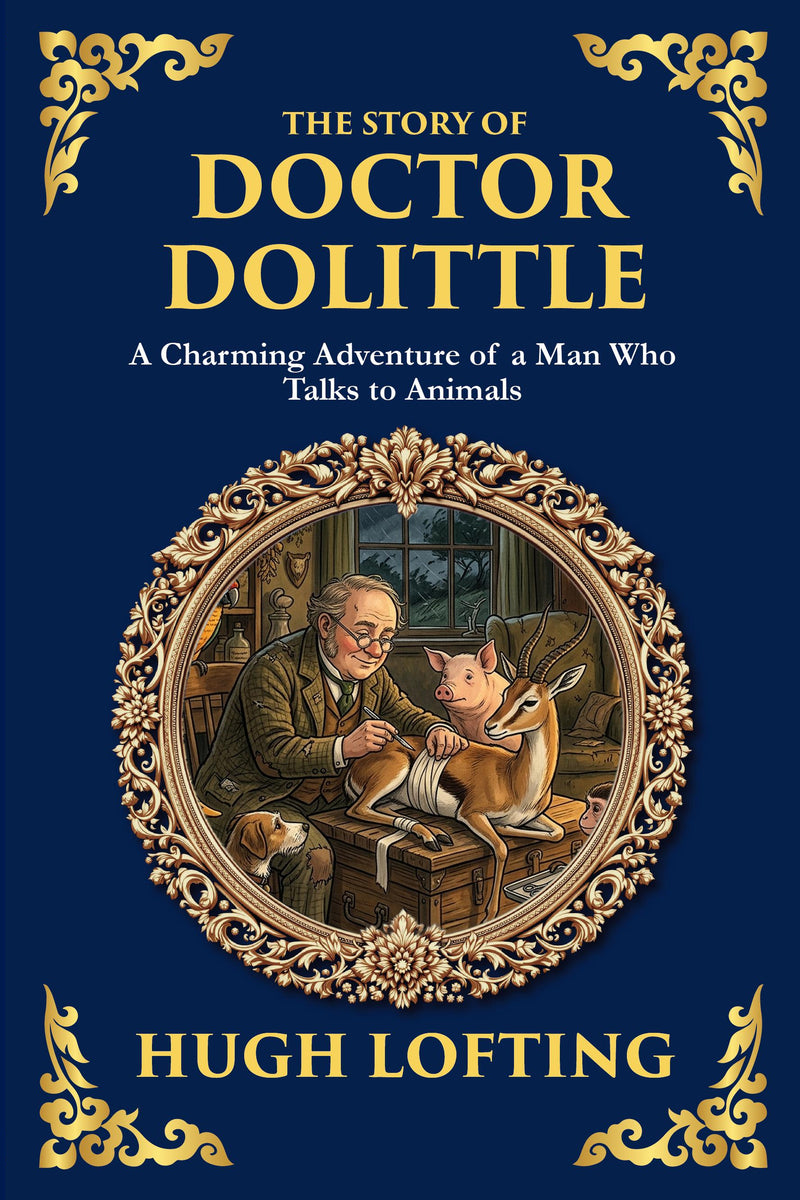
The Story of Doctor Dolittle
Step into a world where animals speak, adventures await, and kindness rules. The Story of Doctor Dolittle introduces readers to the beloved physician who abandons his human practice to care for creatures great and small.
or free app
10,000+ hrs library
30-day guarantee
The complete The Story of Doctor Dolittle appears in modern English through Library of Alexandria Press, available online with audiobook narration included for members.
Have you ever wondered why kindness is the greatest adventure of all? In The Story of Doctor Dolittle, Hugh Lofting presents an unforgettable tale that speaks to the wonder of understanding those different from ourselves. When a kind-hearted country doctor learns he can talk to animals, his life changes forever.
Trading his human patients for parrots and polar bears, he becomes the world’s most beloved animal doctor—and sets sail on a mission to help those in need, no matter how wild or far away. From his loyal companion Polynesia the parrot to the exotic Pushmi-Pullyu, Doctor Dolittle’s journey is a celebration of imagination, empathy, and the joy of communication across species. This beautifully formatted edition preserves Lofting’s original magic while bringing the tale to a new generation of readers.
What you’ll discover in this modern edition
- A Doctor Who Listens to the World – Follow the extraordinary story of Doctor Dolittle, the man who talks to animals and treats them with compassion.
- Unforgettable Animal Friends – Meet Polynesia the parrot, Gub-Gub the pig, Dab-Dab the duck, and the rare Pushmi-Pullyu on a thrilling voyage across the sea.
- An Exotic Journey of Discovery – Travel from quaint English villages to far-off lands filled with wonder, danger, and hilarious surprises.
- A Timeless Message of Kindness – Explore themes of empathy, understanding, and what it means to care for all living things.
- A Literary Classic for All Ages – This modern presentation of Lofting’s charming tale makes it a perfect read for young readers, families, and collectors alike.
| Formats | eBook (EPUB + PDF) · Audiobook · Paperback · Hardcover · Large Print |
| Language | English |
| Trim size (print) | 6 × 9 in |
| Binding | Paperback — perfect-bound · Hardcover — casewrap |
| Large Print edition | Same text in a larger, easy-read type — a larger font, not a larger trim |
| Print pricing | Every physical book at our true cost — at-cost, no profit (members) |
| Library | 873 restored titles, always growing |
| Length | 27,022 words · ~1 hr 48 min reading |
| Reading level | Grade 7 · an easy, flowing read (this modern-English edition) |
| Edition | Modern English translation · 2026 |
Member reviews for this edition are collected as readers finish it — be the first. Across the library: 12,000+ books shipped, every plan covered by a 365-day print guarantee.
About this edition
A faithful, unabridged modern-English edition by The Library of Alexandria — carefully rendered for today's reader and verified paragraph-by-paragraph against the public-domain source. Available as eBook, audiobook, paperback, hardcover, and large print.
- Complete & unabridgedVerified paragraph by paragraph against the source — never a scan, never abridged.
- Modern English, faithfulReadable today, with the author’s meaning kept intact. Readable — not simplified.
- Every format, one membershipRead in your browser or the free app, or listen to the full audiobook.
Included free with your membership
Cancel anytime, one click · 30-day money-back guarantee
Edition last updated July 2026
What’s inside
The Story of Doctor Dolittle — complete and unabridged: all 22 sections included with membership, plus the full audiobook.
Begin reading The Story of Doctor Dolittle
In clear modern English — the complete text is included with membership.
Introduction
There are certain books that arrive in childhood like a key turning quietly in a lock, opening a door into a room we did not know existed. Once inside, we never quite leave. The story you are about to read is one of those rare and luminous works—a tale so gentle in its wisdom, so playful in its invention, and so generous in its spirit that it has charmed readers across more than a century and continues to do so today. First published in 1920, it introduced the world to a figure who has since become one of the most beloved characters in all of children’s literature: a modest country doctor who, through curiosity, kindness, and a willingness to listen, discovers that the boundary between human and animal is not nearly so solid as everyone had always assumed.
What makes this book endure is not spectacle or cleverness for its own sake. It is something quieter and far more lasting. At its heart lies a simple, radiant idea—that to truly understand another creature, you must first be willing to learn its language, to sit patiently beside it, and to treat its concerns as worthy of your attention. That idea, dressed up in adventure and comedy and the warm absurdity of a man who can chat with a parrot or argue with a pig, turns out to be one of the great moral lessons a young reader can encounter. It is a story about empathy disguised as a story about talking animals, and that disguise is so delightful that the lesson slips in without ever feeling like a lesson at all.
This particular edition has been prepared as a modern translation, carefully adapted for the contemporary reader. That phrase deserves a word of explanation, because it speaks to both the spirit and the responsibility behind this volume. The original text, written more than a hundred years ago, carries the cadences and conventions of its time. Some of its language has grown unfamiliar; some of its phrasing, once perfectly natural, now sits awkwardly on the modern tongue. More importantly, certain passages and attitudes embedded in early twentieth-century writing reflect assumptions that we have since recognized as harmful, and which no thoughtful reader today would wish to pass uncritically to a child. The work of adaptation, therefore, is one of preservation and care in equal measure: to keep alive everything that makes the story wonderful while gently smoothing away what time has rendered either confusing or troubling. The goal is not to replace the author’s voice but to let it be heard clearly again, as if a fine old painting had been cleaned of the grime of decades so that its true colors might shine through once more.
A Doctor, a Parrot, and the Birth of a Beloved World
The origins of this story are as touching as the story itself, and knowing them adds a quiet poignancy to every page. Hugh Lofting did not set out to be a famous author. Born in England in 1886, he trained as a civil engineer and traveled widely in his early career, working on railways and other projects in places as far-flung as West Africa and the West Indies. He was a practical man with a wandering eye and a deep, abiding affection for the natural world. But it was not engineering that made his name. It was a war, and a promise to his children.
When the First World War broke out, Lofting served in the British Army. From the trenches—amid the mud, the noise, and the unimaginable strain of that conflict—he wrote letters home to his young children. He found, as so many parents have found, that the truth of what was happening around him was far too terrible to share with them. Yet he wanted to give them something. And so, rather than describe the horrors he witnessed, he invented. In particular, he was struck by the plight of the horses caught up in the fighting, animals that suffered grievously and received little of the care that wounded soldiers were given. From this small seed of compassion grew a question that became a story: what if there were a doctor who treated animals not as beasts but as patients, who could understand them as well as any physician understands a human being?
That doctor, sketched first in illustrated letters to children far away, became the gentle hero of this book. The illustrations that Lofting drew himself—simple, expressive, and full of charm—were part of the tale from the very beginning, and they remain inseparable from its character. There is something deeply moving in the thought that this sunny, hopeful, endlessly inventive world was born in one of the darkest places the modern age has known. It is as though the author, surrounded by destruction, deliberately chose to imagine its opposite: a world where a kind man could heal, where animals could speak and be heard, where the worst troubles could be solved by patience, cleverness, and good humor. The book’s warmth, in other words, was hard-won. It is the warmth of a man who had seen the cold and chose hope anyway.
When the story was eventually published, it found an immediate and enthusiastic audience. Readers responded to its freshness, its humor, and the irresistible appeal of its central character. It won acclaim, spawned a series of sequels, and established Lofting as one of the most successful children’s writers of his generation. Generations of children since have grown up turning these pages, and the story has been adapted for stage and screen many times over. Yet through all the adaptations and reimaginings, the original tale retains a particular freshness—an unhurried, conversational quality, as if the author were sitting beside you and telling it aloud, pausing now and then to chuckle at his own characters.
What strikes the reader most, perhaps, is the sheer abundance of imagination on display. Once the premise is established—that this doctor can communicate with animals—Lofting follows it everywhere with delighted thoroughness. He thinks carefully about what it would actually mean. How would such knowledge change a household? What would the animals want? How would they organize themselves, argue, help, and complicate the doctor’s life? The book is full of these small, satisfying logical pleasures, the kind that make a reader nod and grin and think, yes, of course, that’s exactly how it would be. It is invention grounded in observation, fantasy built on a real love of how creatures behave. The result is a world that feels not merely whimsical but genuinely alive.
It is worth saying, too, that the doctor himself is an unusual hero. He is not handsome, not rich, not powerful, not particularly worldly. He is, in fact, comically impractical about money and almost entirely indifferent to social standing. What he possesses instead is something far rarer: a boundless curiosity and an even more boundless kindness. He would rather understand a snail than impress a duchess. He gives away his comfort, his savings, and his peace of quiet without a second thought when an animal needs him. In an age that often celebrates ambition and cleverness above all, there is something quietly radical about a hero whose greatest qualities are gentleness and attention. Children sense this instinctively. They love him not because he is mighty but because he is good, and because his goodness is the practical, rolled-up-sleeves kind that actually does something in the world.
Reading the Story Today: Notes on This Modern Edition
A book that has lived for more than a century inevitably carries the fingerprints of its origins. To read an old story honestly is to read it as a kind of conversation across time—to enjoy its enduring delights while also recognizing that the world has moved on in important ways. This edition has been prepared with exactly that double awareness, and a few words about the approach taken here will help you settle into the experience with confidence.
The first and most important thing to understand is that the heart of the story has been left wholly intact. The adventures, the characters, the comedy, the gentle morals, the satisfying turns of plot—all of these remain just as Lofting intended them. The famous menagerie of animal companions, each with a distinct and memorable personality, is here in full. The journeys and rescues and small domestic dramas unfold as they always have. Nothing essential to the pleasure or the meaning of the tale has been removed. When you finish, you will have read the real story, the one that has enchanted readers for generations.
What has been attended to, carefully and respectfully, is language. Over a century, the English language shifts in countless small ways. Words fall out of use; phrasings that once felt natural come to sound stiff or archaic; sentence structures grow more cumbersome to modern ears. A modern translation, as this edition describes itself, gently updates such elements so that the prose flows easily for a reader today. The aim throughout has been to make the reading experience smooth and inviting, especially for younger readers who might otherwise stumble over outdated constructions and lose the thread of the fun. Think of it as a faithful retelling in the voice the author might have used had he been writing for the children of our own time—the same warmth, the same humor, the same gentle authority, simply rendered in language that meets the contemporary reader halfway.
There is also a more serious dimension to the work of adaptation, and it would be dishonest not to address it openly. Children’s books from the early twentieth century frequently contain depictions of people from other parts of the world that reflect the prejudices of their era. These attitudes, woven into the assumptions of the time, sit very uncomfortably with us now—as they should. In particular, certain elements of the original story, especially in passages involving an African setting and characters, carry stereotypes and language that are clearly hurtful and that no responsible publisher would reproduce unaltered for young readers today. This has long been recognized, and over the decades various editions have grappled with how to handle it. Some have removed problematic chapters entirely; others have rewritten them; others have added explanatory notes.
This edition takes the view that a beloved story can be preserved without preserving its faults. The work of adaptation here includes the careful revision of such material so that the spirit of adventure and discovery remains while the dehumanizing attitudes are set aside. The result is a version that honors what is genuinely valuable in the original—its kindness, its imagination, its celebration of understanding across differences—without asking young readers to absorb assumptions that contradict the very lessons the book otherwise teaches. There is no contradiction in loving a story and also improving upon the places where its author, a product of his time, fell short. Indeed, doing so is itself an act of the kind of thoughtful attention the book champions.
For the adult reading this story to a child, or alongside one, this opens up a valuable opportunity. Children are naturally curious about why old things change, and a story like this can become a doorway to gentle, age-appropriate conversations about how the world’s understanding grows over time—how people in the past sometimes believed unkind things, how we have learned to do better, and how the central idea of the book, that every creature deserves to be understood and treated with respect, applies to people just as surely as it applies to animals. The story’s deepest message, properly understood, is profoundly inclusive. It teaches that the way to bridge any divide—between species, between strangers, between those who seem utterly different—is to listen, to learn the other’s language, and to extend kindness without condition. Read in that light, this book becomes more than a charming entertainment. It becomes a small but genuine lesson in empathy.
It should be emphasized that none of this scholarly throat-clearing need intrude upon a child’s enjoyment of the tale. A young reader picking up this book will simply find a wonderful story, told warmly and well, full of laughter and adventure and animals who feel like friends. The careful editorial work that lies beneath the surface is meant to be invisible, like the quiet labor of restoring an old garden so that visitors may stroll through it and see only the flowers. The point of the effort is to let the story shine for new readers exactly as it deserves to, free of the things that would distract or distress, full of everything that makes it a classic.
Cancel anytime, one click · 30-day money-back guarantee
Founding annual rate available now — your price locks for life when you join.
Not ready? Get this free chapter by email — read it anytime.
✓ Sent — check your inbox for The Story of Doctor Dolittle.
Questions about The Story of Doctor Dolittle
What is The Story of Doctor Dolittle about?
Step into a world where animals speak, adventures await, and kindness rules. The Story of Doctor Dolittle introduces readers to the beloved physician who abandons his human practice to care for creatures great and small. Guided by his gift of animal speech, Doctor Dolittle embarks on a fantastical journey filled with daring rescues, exotic lands, and heartwarming friendships.
Who wrote The Story of Doctor Dolittle?
The Story of Doctor Dolittle was written by Hugh Lofting. This edition presents the complete work in clear modern English, faithfully rendered from the public-domain original by Library of Alexandria Press.
Is The Story of Doctor Dolittle free to read?
The opening chapter is free to read on this page. Members read and listen to the complete work — and the entire library — free, and can order any physical book at our true print cost.
How long is The Story of Doctor Dolittle?
22 chapters (~27,022 words) — about 1 hr 48 min of reading in this modern-English edition.
Is this an abridged version of The Story of Doctor Dolittle?
No. This is the complete, unabridged The Story of Doctor Dolittle, carefully rendered into clear modern English and verified paragraph-by-paragraph against the public-domain source — nothing is cut or summarised.
What formats does The Story of Doctor Dolittle come in?
The Story of Doctor Dolittle is available as eBook, paperback, hardcover and large print. eBook and audiobook are included with membership; printed editions ship at our true print cost.
Shipping & returns
Billing & membership
More from the library


Explore Adventure
- Tarzan of the Apes · Edgar Rice Burroughs
- The Wonderful Wizard of Oz · L. Frank Baum
- Peter Pan · J. M. Barrie
- Moby Dick; Or, The Whale · Herman Melville
- The Riddle of the Sands · Erskine Childers
- The Loss of the Swansea: A Story of the Florida Coast · W. L. Alden
- Sky Island · L. Frank Baum
- Vikram and the Vampire: Classic Hindu Tales of Adventure, Magic, and Romance · Unknown
- Tales of Unrest · Joseph Conrad
- The Tomb of Ts’in · Edgar Wallace
- Skinny McCord · Percy Keese Fitzhugh
- The Men of the Moss-Hags · S. R. Crockett
- The Hunniwell Boys and the Platinum Mystery · L. P. Wyman
- Allan Quatermain · H. Rider Haggard
- She · H. Rider Haggard
- Medical Life in the Navy · Gordon Stables
- The Thirty-Nine Steps · John Buchan
- The Princess and the Goblin · George MacDonald
- The Man Who Would Be King · Rudyard Kipling
- Lucian’s True History · Lucian of Samosata
- The Secret Adversary · Agatha Christie
- Lord Jim · Joseph Conrad
- The Marvelous Land of Oz · L. Frank Baum
- The Virginian: A Horseman of the Plains · Owen Wister
- Mars is My Destination · Frank Belknap Long
- Anabasis · Xenophon
- The Mississippi Saucer · Frank Belknap Long
- Sabotage in Space · Carey Rockwell
- Brood of the Dark Moon · Charles Willard Diffin
- The Misplaced Battleship · Harry Harrison
The Story of Doctor Dolittle
The Story of Doctor Dolittle
A Delightful Adventure About a Man Who Speaks to Animals
Hugh Lofting
Contents
- Introduction
- Chapter 1
- Chapter 2
- Chapter 3
- Chapter 4
- Chapter 5
- Chapter 6
- Chapter 7
- Chapter 8
- Chapter 9
- Chapter 10
- Chapter 11
- Chapter 12
- Chapter 13
- Chapter 14
- Chapter 15
- Chapter 16
- Chapter 17
- Chapter 18
- Chapter 19
- Chapter 20
- Chapter 21
Introduction
There are certain books that arrive in childhood like a key turning quietly in a lock, opening a door into a room we did not know existed. Once inside, we never quite leave. The story you are about to read is one of those rare and luminous works—a tale so gentle in its wisdom, so playful in its invention, and so generous in its spirit that it has charmed readers across more than a century and continues to do so today. First published in 1920, it introduced the world to a figure who has since become one of the most beloved characters in all of children’s literature: a modest country doctor who, through curiosity, kindness, and a willingness to listen, discovers that the boundary between human and animal is not nearly so solid as everyone had always assumed.
What makes this book endure is not spectacle or cleverness for its own sake. It is something quieter and far more lasting. At its heart lies a simple, radiant idea—that to truly understand another creature, you must first be willing to learn its language, to sit patiently beside it, and to treat its concerns as worthy of your attention. That idea, dressed up in adventure and comedy and the warm absurdity of a man who can chat with a parrot or argue with a pig, turns out to be one of the great moral lessons a young reader can encounter. It is a story about empathy disguised as a story about talking animals, and that disguise is so delightful that the lesson slips in without ever feeling like a lesson at all.
This particular edition has been prepared as a modern translation, carefully adapted for the contemporary reader. That phrase deserves a word of explanation, because it speaks to both the spirit and the responsibility behind this volume. The original text, written more than a hundred years ago, carries the cadences and conventions of its time. Some of its language has grown unfamiliar; some of its phrasing, once perfectly natural, now sits awkwardly on the modern tongue. More importantly, certain passages and attitudes embedded in early twentieth-century writing reflect assumptions that we have since recognized as harmful, and which no thoughtful reader today would wish to pass uncritically to a child. The work of adaptation, therefore, is one of preservation and care in equal measure: to keep alive everything that makes the story wonderful while gently smoothing away what time has rendered either confusing or troubling. The goal is not to replace the author’s voice but to let it be heard clearly again, as if a fine old painting had been cleaned of the grime of decades so that its true colors might shine through once more.
A Doctor, a Parrot, and the Birth of a Beloved World
The origins of this story are as touching as the story itself, and knowing them adds a quiet poignancy to every page. Hugh Lofting did not set out to be a famous author. Born in England in 1886, he trained as a civil engineer and traveled widely in his early career, working on railways and other projects in places as far-flung as West Africa and the West Indies. He was a practical man with a wandering eye and a deep, abiding affection for the natural world. But it was not engineering that made his name. It was a war, and a promise to his children.
When the First World War broke out, Lofting served in the British Army. From the trenches—amid the mud, the noise, and the unimaginable strain of that conflict—he wrote letters home to his young children. He found, as so many parents have found, that the truth of what was happening around him was far too terrible to share with them. Yet he wanted to give them something. And so, rather than describe the horrors he witnessed, he invented. In particular, he was struck by the plight of the horses caught up in the fighting, animals that suffered grievously and received little of the care that wounded soldiers were given. From this small seed of compassion grew a question that became a story: what if there were a doctor who treated animals not as beasts but as patients, who could understand them as well as any physician understands a human being?
That doctor, sketched first in illustrated letters to children far away, became the gentle hero of this book. The illustrations that Lofting drew himself—simple, expressive, and full of charm—were part of the tale from the very beginning, and they remain inseparable from its character. There is something deeply moving in the thought that this sunny, hopeful, endlessly inventive world was born in one of the darkest places the modern age has known. It is as though the author, surrounded by destruction, deliberately chose to imagine its opposite: a world where a kind man could heal, where animals could speak and be heard, where the worst troubles could be solved by patience, cleverness, and good humor. The book’s warmth, in other words, was hard-won. It is the warmth of a man who had seen the cold and chose hope anyway.
When the story was eventually published, it found an immediate and enthusiastic audience. Readers responded to its freshness, its humor, and the irresistible appeal of its central character. It won acclaim, spawned a series of sequels, and established Lofting as one of the most successful children’s writers of his generation. Generations of children since have grown up turning these pages, and the story has been adapted for stage and screen many times over. Yet through all the adaptations and reimaginings, the original tale retains a particular freshness—an unhurried, conversational quality, as if the author were sitting beside you and telling it aloud, pausing now and then to chuckle at his own characters.
What strikes the reader most, perhaps, is the sheer abundance of imagination on display. Once the premise is established—that this doctor can communicate with animals—Lofting follows it everywhere with delighted thoroughness. He thinks carefully about what it would actually mean. How would such knowledge change a household? What would the animals want? How would they organize themselves, argue, help, and complicate the doctor’s life? The book is full of these small, satisfying logical pleasures, the kind that make a reader nod and grin and think, yes, of course, that’s exactly how it would be. It is invention grounded in observation, fantasy built on a real love of how creatures behave. The result is a world that feels not merely whimsical but genuinely alive.
It is worth saying, too, that the doctor himself is an unusual hero. He is not handsome, not rich, not powerful, not particularly worldly. He is, in fact, comically impractical about money and almost entirely indifferent to social standing. What he possesses instead is something far rarer: a boundless curiosity and an even more boundless kindness. He would rather understand a snail than impress a duchess. He gives away his comfort, his savings, and his peace of quiet without a second thought when an animal needs him. In an age that often celebrates ambition and cleverness above all, there is something quietly radical about a hero whose greatest qualities are gentleness and attention. Children sense this instinctively. They love him not because he is mighty but because he is good, and because his goodness is the practical, rolled-up-sleeves kind that actually does something in the world.
Reading the Story Today: Notes on This Modern Edition
A book that has lived for more than a century inevitably carries the fingerprints of its origins. To read an old story honestly is to read it as a kind of conversation across time—to enjoy its enduring delights while also recognizing that the world has moved on in important ways. This edition has been prepared with exactly that double awareness, and a few words about the approach taken here will help you settle into the experience with confidence.
The first and most important thing to understand is that the heart of the story has been left wholly intact. The adventures, the characters, the comedy, the gentle morals, the satisfying turns of plot—all of these remain just as Lofting intended them. The famous menagerie of animal companions, each with a distinct and memorable personality, is here in full. The journeys and rescues and small domestic dramas unfold as they always have. Nothing essential to the pleasure or the meaning of the tale has been removed. When you finish, you will have read the real story, the one that has enchanted readers for generations.
What has been attended to, carefully and respectfully, is language. Over a century, the English language shifts in countless small ways. Words fall out of use; phrasings that once felt natural come to sound stiff or archaic; sentence structures grow more cumbersome to modern ears. A modern translation, as this edition describes itself, gently updates such elements so that the prose flows easily for a reader today. The aim throughout has been to make the reading experience smooth and inviting, especially for younger readers who might otherwise stumble over outdated constructions and lose the thread of the fun. Think of it as a faithful retelling in the voice the author might have used had he been writing for the children of our own time—the same warmth, the same humor, the same gentle authority, simply rendered in language that meets the contemporary reader halfway.
There is also a more serious dimension to the work of adaptation, and it would be dishonest not to address it openly. Children’s books from the early twentieth century frequently contain depictions of people from other parts of the world that reflect the prejudices of their era. These attitudes, woven into the assumptions of the time, sit very uncomfortably with us now—as they should. In particular, certain elements of the original story, especially in passages involving an African setting and characters, carry stereotypes and language that are clearly hurtful and that no responsible publisher would reproduce unaltered for young readers today. This has long been recognized, and over the decades various editions have grappled with how to handle it. Some have removed problematic chapters entirely; others have rewritten them; others have added explanatory notes.
This edition takes the view that a beloved story can be preserved without preserving its faults. The work of adaptation here includes the careful revision of such material so that the spirit of adventure and discovery remains while the dehumanizing attitudes are set aside. The result is a version that honors what is genuinely valuable in the original—its kindness, its imagination, its celebration of understanding across differences—without asking young readers to absorb assumptions that contradict the very lessons the book otherwise teaches. There is no contradiction in loving a story and also improving upon the places where its author, a product of his time, fell short. Indeed, doing so is itself an act of the kind of thoughtful attention the book champions.
For the adult reading this story to a child, or alongside one, this opens up a valuable opportunity. Children are naturally curious about why old things change, and a story like this can become a doorway to gentle, age-appropriate conversations about how the world’s understanding grows over time—how people in the past sometimes believed unkind things, how we have learned to do better, and how the central idea of the book, that every creature deserves to be understood and treated with respect, applies to people just as surely as it applies to animals. The story’s deepest message, properly understood, is profoundly inclusive. It teaches that the way to bridge any divide—between species, between strangers, between those who seem utterly different—is to listen, to learn the other’s language, and to extend kindness without condition. Read in that light, this book becomes more than a charming entertainment. It becomes a small but genuine lesson in empathy.
It should be emphasized that none of this scholarly throat-clearing need intrude upon a child’s enjoyment of the tale. A young reader picking up this book will simply find a wonderful story, told warmly and well, full of laughter and adventure and animals who feel like friends. The careful editorial work that lies beneath the surface is meant to be invisible, like the quiet labor of restoring an old garden so that visitors may stroll through it and see only the flowers. The point of the effort is to let the story shine for new readers exactly as it deserves to, free of the things that would distract or distress, full of everything that makes it a classic.
Long ago, back when our grandfathers were just children, there was a man named Doctor John Dolittle. The “M.D.” after his name meant he was a fully qualified physician who knew a great deal.
He lived in a small town called Puddleby-on-the-Marsh. Everyone there, from the kids to the elderly, recognized him. Whenever he walked down the street wearing his top hat, people would remark, “There goes the Doctor! He’s a brilliant man.” Dogs and children would rush to follow him, and even the crows nesting in the church tower would caw and nod their heads at him.
His house sat on the edge of town and was rather small, but he had a huge garden with a wide lawn, stone benches, and drooping willow trees. His sister, Sarah Dolittle, managed the housework, but the Doctor took care of the garden himself.
He loved animals and kept many different kinds of pets. In addition to the goldfish in the pond at the back of his garden, he had rabbits in the pantry, white mice inside his piano, a squirrel in the linen closet, and a hedgehog in the cellar. He also had a cow and her calf, a twenty-five-year-old horse that was lame in one leg, chickens, pigeons, two lambs, and various other creatures. However, his favorite pets were Dab-Dab the duck, Jip the dog, Gub-Gub the piglet, Polynesia the parrot, and Too-Too the owl.
His sister often complained about all the animals, claiming they made the house a mess. One day, an elderly woman with arthritis came to visit the doctor and accidentally sat on a hedgehog sleeping on the sofa. She never returned to his office; instead, every Saturday, she drove ten miles to another town called Oxenthorpe to see a different doctor.
End of the free sample
Keep reading, free
Members read and listen to the complete book — and the entire library. Cancel anytime, one click · 30-day money-back guarantee.