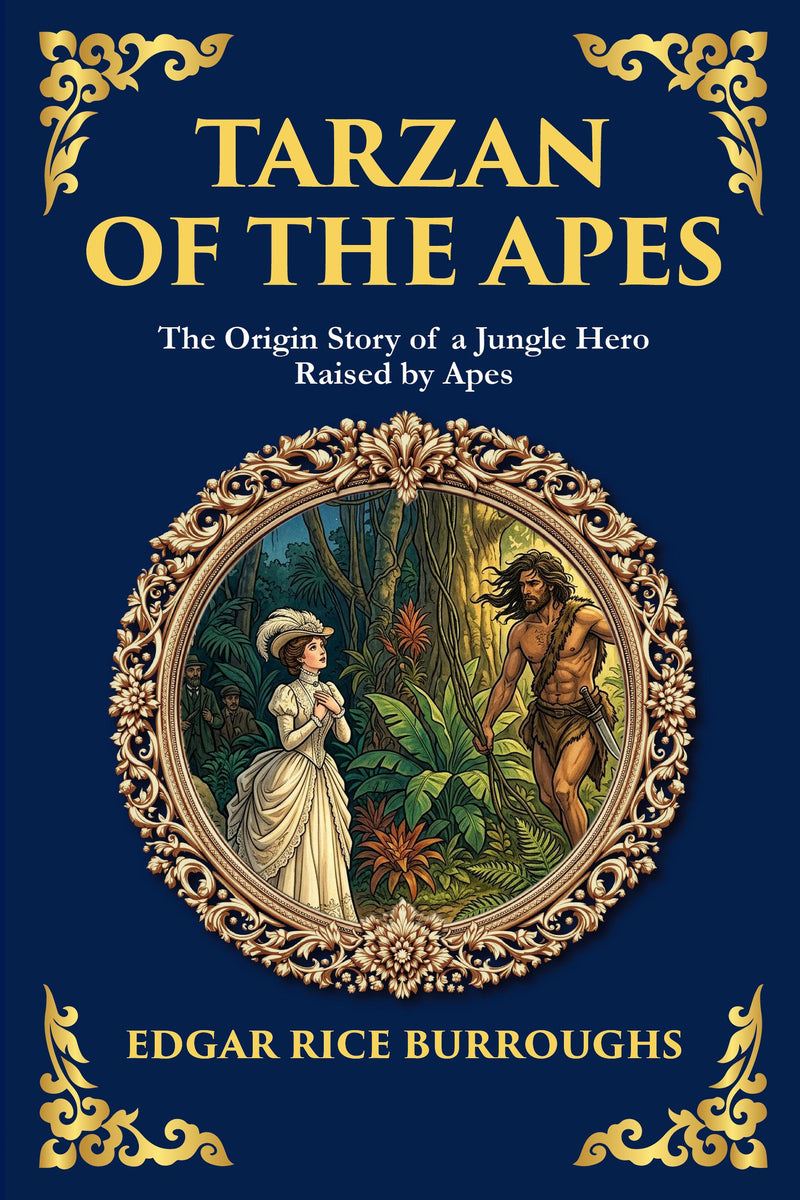
Tarzan of the Apes
Abandoned in the African jungle and raised by apes, a child of English nobility grows into a powerful and agile man known as Tarzan.
or free app
10,000+ hrs library
30-day guarantee
The complete Tarzan of the Apes appears in modern English through Library of Alexandria Press, available online with audiobook narration included for members.
Have you ever wondered why the jungle still calls to our deepest instincts—and what it truly means to be human? Tarzan of the Apes by Edgar Rice Burroughs is the electrifying origin story of a boy left behind in the unforgiving wilderness, adopted by a tribe of great apes, and molded by the primal forces of nature into a fierce, intelligent, and noble warrior. From his first steps through the shadowy jungle to his astonishing discovery of his human lineage, Tarzan’s story is one of heart, instinct, and transformation.
Burroughs blends adventure, philosophy, and raw emotion to craft a narrative that still captivates over a century later. This edition preserves the spirit and excitement of the original classic while offering a beautifully formatted and reader-friendly presentation for today’s audience.
What you’ll discover in this modern edition
- The Origins of Tarzan, Lord of the Jungle Witness the gripping tale of how an orphaned child was raised by apes and grew into a symbol of strength, independence, and honor.
- A Story of Survival and Self-Discovery Follow Tarzan’s coming-of-age in the wild—his battles, his discoveries, and the internal conflict between beast and man.
- A Clash Between Nature and Civilization Explore Tarzan’s first encounters with outsiders, technology, and the complicated truths of his birthright.
- Timeless Themes of Identity, Belonging, and Nobility Through thrilling action and emotional depth, Burroughs poses timeless questions about the nature of humanity.
- The Beginning of a Literary Legend This is where it all started—the first book in a series that would inspire films, comics, and imaginations across generations.
| Formats | eBook (EPUB + PDF) · Audiobook · Paperback · Hardcover · Large Print |
| Language | English |
| Trim size (print) | 6 × 9 in |
| Binding | Paperback — perfect-bound · Hardcover — casewrap |
| Large Print edition | Same text in a larger, easy-read type — a larger font, not a larger trim |
| Print pricing | Every physical book at our true cost — at-cost, no profit (members) |
| Library | 873 restored titles, always growing |
| Length | 85,364 words · ~5 hr 41 min reading |
| Reading level | Grade 9 · a comfortable read (this modern-English edition) |
| Edition | Modern English translation · 2026 |
Member reviews for this edition are collected as readers finish it — be the first. Across the library: 12,000+ books shipped, every plan covered by a 365-day print guarantee.
About this edition
A faithful, unabridged modern-English edition by The Library of Alexandria — carefully rendered for today's reader and verified paragraph-by-paragraph against the public-domain source. Available as eBook, audiobook, paperback, hardcover, and large print.
- Complete & unabridgedVerified paragraph by paragraph against the source — never a scan, never abridged.
- Modern English, faithfulReadable today, with the author’s meaning kept intact. Readable — not simplified.
- Every format, one membershipRead in your browser or the free app, or listen to the full audiobook.
Included free with your membership
Cancel anytime, one click · 30-day money-back guarantee
Edition last updated July 2026
What’s inside
Tarzan of the Apes — complete and unabridged: all 29 sections included with membership, plus the full audiobook.
Begin reading Tarzan of the Apes
In clear modern English — the complete text is included with membership.
Introduction
When Edgar Rice Burroughs sat down in 1912 to write the story of a boy raised by apes in the African jungle, he was a struggling pencil-sharpener salesman who had failed at nearly every business he had ever attempted. He had no literary pedigree, no formal training in writing, and no particular reason to believe that the world would care about the fantastic adventures forming in his imagination. What he possessed instead was an extraordinary gift for storytelling and an audacious willingness to dream on an enormous scale. The result of that dreaming was a character who would become one of the most recognizable figures in the history of popular fiction—a name known on every continent, translated into dozens of languages, and reimagined across more than a century in films, comics, radio plays, and television. The story you are about to read launched all of that. It is the original, the source, the place where a legend was born.
This modern translation has been prepared with a single guiding purpose: to make that original experience as vivid and immediate for today’s reader as it was for the audiences who first encountered it in the pages of a pulp magazine over a hundred years ago. Burroughs wrote in the elaborate, ornamented prose style of his era, full of long winding sentences, archaic vocabulary, and the formal cadences of early twentieth-century popular fiction. That style had its own grandeur, but it can also create distance for contemporary readers, asking them to work through dense thickets of language before reaching the thrilling story underneath. This adaptation gently clears those thickets. It preserves the spirit, the structure, the characters, and the sweeping adventure that made the book a phenomenon, while rendering the language in a way that flows naturally for a reader in the present day. Nothing essential has been lost; rather, the goal has been to remove the barriers that time inevitably places between a great story and the people who deserve to enjoy it.
To approach this book well, it helps to understand a little about the man who wrote it, the world that shaped it, and the remarkable cultural journey it set in motion. It also helps to come prepared with a thoughtful awareness of the fact that this is a work of its time—a story that reflects both the boundless imagination and the limitations of the age that produced it. With that understanding in hand, the reader can settle in and enjoy one of the most influential adventure tales ever written, alive to its strengths and clear-eyed about its context.
The Man Behind the Legend and the World That Made Him
Edgar Rice Burroughs was born in Chicago in 1875, into a comfortable middle-class family, and his early life gave little indication of the literary fame that awaited him. He attended a series of schools, served briefly in the United States Cavalry in Arizona, and then drifted through a long and often discouraging string of jobs and business ventures. He tried his hand at gold mining, at running a stationery store, at selling everything from candy to those pencil sharpeners. By his mid-thirties, he was a married man with children, deeply anxious about money, and uncertain about his future. It was during this period of frustration that he turned, almost out of desperation, to writing.
His decision was driven less by artistic ambition than by a practical observation. While working in a job that involved checking advertisements in pulp magazines, he read a great deal of the fiction those magazines published. The pulps—cheap, mass-produced periodicals printed on rough paper and sold for a dime—were enormously popular in the early twentieth century, offering readers a steady diet of adventure, romance, mystery, and the fantastic. Burroughs, reading these stories, concluded that much of what was being published was not very good, and that if such writing could earn money, he could surely do at least as well. He was right. His first published work, a science-fiction tale set on Mars that would eventually become the John Carter series, established him as a writer audiences wanted to read. But it was his next major creation that would make him immortal.
The story of the jungle-raised hero appeared first in 1912 in the pages of The All-Story magazine, and the public response was immediate and overwhelming. Readers were captivated. The character struck a nerve so deep and so wide that demand for more grew almost instantly, and Burroughs would go on to write more than two dozen books featuring this protagonist, alongside his other prolific output. He became one of the first authors to treat his own creation as a brand, carefully managing the rights and licensing that would build him a fortune and even, eventually, lend his name to a community in California. From a failed salesman, he transformed himself into one of the most commercially successful authors of his generation.
To understand why this particular story landed with such force, we have to consider the moment in which it was written. The early twentieth century was an era fascinated by exploration and by the parts of the globe that, to Western readers, still seemed mysterious and unmapped. Africa loomed large in the popular imagination as a vast, wild continent of unknown dangers and untold wonders—a place onto which writers and readers projected their fears, fantasies, and curiosities. This was also an age preoccupied with new and unsettling ideas about human nature. Charles Darwin’s theories of evolution had reshaped the way people thought about humanity’s place in the natural world, raising questions that fascinated and disturbed in equal measure. What separates the human from the animal? Is our character the product of our blood and ancestry, or of the environment in which we are raised? Are the markers of civilization—language, manners, morality—essential to who we are, or merely a thin veneer over something more primal?
These are precisely the questions the story explores, and it does so not through dry philosophy but through a gripping narrative that forces the issue into dramatic life. By imagining a child of refined European parentage raised entirely apart from human society, in the wilderness, among creatures, Burroughs created a kind of thought experiment dressed in the clothing of pure adventure. The result was a story that entertained on the surface while quietly engaging some of the deepest debates of its era. This combination—visceral excitement layered over genuine ideas—is part of what gives the book its enduring power. It is never merely a chase through the trees; it is also a meditation on what it means to be human, even if Burroughs would have been the last to call it anything so grand.
It is worth noting, too, that Burroughs wrote almost entirely from imagination rather than experience. He had never set foot in Africa. His jungle is a creation of the mind, assembled from books, magazines, and the romantic notions of his time. This is not a flaw to be apologized for but a fact that shapes the entire character of the work. The setting is a dreamscape, a stage built for adventure rather than a documentary record of any real place. The animals behave in ways that serve the story rather than zoology. The geography bends to the needs of the plot. Reading the book as an imaginative fantasy rather than a faithful portrait of the natural world is essential to appreciating what it actually offers, which is the pure, unfiltered pleasure of myth-making.
A Story of Two Worlds and the Reader's Best Approach
At its heart, this is a story about belonging and identity, told through the collision of two utterly different worlds. On one side stands the wild—untamed, dangerous, governed by instinct and the laws of survival. On the other stands civilization—ordered, refined, bound by manners and inheritance and social expectation. The central figure of the story exists between these two worlds, belonging fully to neither and yet shaped by both, and it is from this tension that the entire narrative draws its energy. Without revealing the particulars of how events unfold, it is enough to say that the book takes a remarkable premise and pursues it with relentless momentum, sweeping the reader from one extraordinary situation to the next while never losing sight of the deeper question that animates the whole: who is this person, really, when stripped of everything but his own nature?
What makes the story so compelling is the way it refuses to give easy answers. The hero is neither simply a noble savage nor simply a civilized man wearing the disguise of a wild creature. He is something genuinely new, a figure who embodies both the freedom and ferocity of the wilderness and the dignity and intelligence associated with his heritage. He learns, he adapts, he discovers, and in doing so he becomes a mirror in which readers can examine their own assumptions about strength, refinement, courage, and worth. The adventure carries you forward at breakneck speed, but it is this underlying character study that makes the journey feel meaningful rather than merely exciting.
Burroughs was a master of pacing, and even in this, his foundational work, that mastery is on full display. He understood instinctively how to build suspense, how to time a revelation, how to leave a chapter hanging on a moment of peril so that the reader cannot resist turning the page. This was a skill honed in the demanding marketplace of pulp fiction, where writers were paid by the word and rewarded by reader loyalty, and where a story that failed to grip its audience simply vanished. The book moves. It does not linger or meander; it propels. Modern readers accustomed to fast-moving entertainment will find that the storytelling instincts here feel surprisingly contemporary, which is one of the reasons the work has aged better than much of its contemporary fiction.
To get the most from your reading, it helps to approach the book in the spirit in which it was written and first received—as a grand, romantic adventure designed above all to thrill and delight. Surrender to the sweep of it. Let yourself be carried into a world where the impossible becomes plausible, where a single extraordinary individual can confront overwhelming odds, where the boundaries between civilization and wilderness blur and shift in fascinating ways. This is a book that rewards immersion. It is not meant to be analyzed coldly from a distance but experienced from the inside, with the same sense of wonder that captivated its first readers a century ago.
At the same time, the thoughtful modern reader will want to keep a clear and honest perspective on the fact that this is a product of its historical moment, and that moment carried with it attitudes and assumptions that we rightly find troubling today. Like a great deal of popular adventure fiction from the early twentieth century, the book reflects the prejudices of its era, particularly in its depictions of African peoples and in its underlying assumptions about race, heredity, and the supposed natural superiority of certain bloodlines. These elements are woven into the fabric of the original text, and they cannot be entirely separated from the story’s themes about nature versus nurture and the influence of ancestry. This modern adaptation does not pretend these aspects away, nor does it preserve them uncritically; rather, it invites the reader to engage with the book as a historical artifact—a window into how people of a particular time and place understood the world.
There is real value in reading older works with this kind of double awareness. We can appreciate the genuine artistry, the imaginative power, and the storytelling brilliance of a book while also recognizing where its vision falls short of our own values and understanding. Indeed, doing so makes us better readers and more thoughtful people. To encounter the prejudices of the past honestly is to understand how far we have come and to remain vigilant about the assumptions of our own time, which future generations will no doubt examine just as critically. The point is not to dismiss the work, nor to excuse its flaws, but to hold both truths at once: that it is a thrilling and influential masterpiece of adventure fiction, and that it reflects a worldview shaped by the limitations and biases of its age. Reading with this dual perspective enriches the experience rather than diminishing it.
Cancel anytime, one click · 30-day money-back guarantee
Founding annual rate available now — your price locks for life when you join.
Not ready? Get this free chapter by email — read it anytime.
✓ Sent — check your inbox for Tarzan of the Apes.
Questions about Tarzan of the Apes
What is Tarzan of the Apes about?
Abandoned in the African jungle and raised by apes, a child of English nobility grows into a powerful and agile man known as Tarzan. Straddling two worlds—savage wilderness and sophisticated civilization—Tarzan must discover who he truly is. A timeless tale of survival, identity, and primal instinct, Tarzan of the Apes launches one of literature’s most iconic adventure heroes.
Who wrote Tarzan of the Apes?
Tarzan of the Apes was written by Edgar Rice Burroughs. This edition presents the complete work in clear modern English, faithfully rendered from the public-domain original by Library of Alexandria Press.
Is Tarzan of the Apes free to read?
The opening chapter is free to read on this page. Members read and listen to the complete work — and the entire library — free, and can order any physical book at our true print cost.
How long is Tarzan of the Apes?
29 chapters (~85,364 words) — about 5 hr 41 min of reading in this modern-English edition.
Is this an abridged version of Tarzan of the Apes?
No. This is the complete, unabridged Tarzan of the Apes, carefully rendered into clear modern English and verified paragraph-by-paragraph against the public-domain source — nothing is cut or summarised.
What formats does Tarzan of the Apes come in?
Tarzan of the Apes is available as eBook, paperback, hardcover and large print. eBook and audiobook are included with membership; printed editions ship at our true print cost.
Shipping & returns
Billing & membership
More from the library


Explore Adventure
- The Wonderful Wizard of Oz · L. Frank Baum
- Peter Pan · J. M. Barrie
- Moby Dick; Or, The Whale · Herman Melville
- The Riddle of the Sands · Erskine Childers
- The Loss of the Swansea: A Story of the Florida Coast · W. L. Alden
- Sky Island · L. Frank Baum
- Vikram and the Vampire: Classic Hindu Tales of Adventure, Magic, and Romance · Unknown
- Tales of Unrest · Joseph Conrad
- The Tomb of Ts’in · Edgar Wallace
- Skinny McCord · Percy Keese Fitzhugh
- The Men of the Moss-Hags · S. R. Crockett
- The Hunniwell Boys and the Platinum Mystery · L. P. Wyman
- Allan Quatermain · H. Rider Haggard
- She · H. Rider Haggard
- Medical Life in the Navy · Gordon Stables
- The Thirty-Nine Steps · John Buchan
- The Story of Doctor Dolittle · Hugh Lofting
- The Princess and the Goblin · George MacDonald
- The Man Who Would Be King · Rudyard Kipling
- Lucian’s True History · Lucian of Samosata
- The Secret Adversary · Agatha Christie
- Lord Jim · Joseph Conrad
- The Marvelous Land of Oz · L. Frank Baum
- The Virginian: A Horseman of the Plains · Owen Wister
- Mars is My Destination · Frank Belknap Long
- Anabasis · Xenophon
- The Mississippi Saucer · Frank Belknap Long
- Sabotage in Space · Carey Rockwell
- Brood of the Dark Moon · Charles Willard Diffin
- The Misplaced Battleship · Harry Harrison
Tarzan of the Apes
Tarzan of the Apes
The origin story of a jungle hero raised by apes
Edgar Rice Burroughs
Contents
- Introduction
- Chapter 1
- Chapter 2
- Chapter 3
- Chapter 4
- Chapter 5
- Chapter 6
- Chapter 7
- Chapter 8
- Chapter 9
- Chapter 10
- Chapter 11
- Chapter 12
- Chapter 13
- Chapter 14
- Chapter 15
- Chapter 16
- Chapter 17
- Chapter 18
- Chapter 19
- Chapter 20
- Chapter 21
- Chapter 22
- Chapter 23
- Chapter 24
- Chapter 25
- Chapter 26
- Chapter 27
- Chapter 28
Introduction
When Edgar Rice Burroughs sat down in 1912 to write the story of a boy raised by apes in the African jungle, he was a struggling pencil-sharpener salesman who had failed at nearly every business he had ever attempted. He had no literary pedigree, no formal training in writing, and no particular reason to believe that the world would care about the fantastic adventures forming in his imagination. What he possessed instead was an extraordinary gift for storytelling and an audacious willingness to dream on an enormous scale. The result of that dreaming was a character who would become one of the most recognizable figures in the history of popular fiction—a name known on every continent, translated into dozens of languages, and reimagined across more than a century in films, comics, radio plays, and television. The story you are about to read launched all of that. It is the original, the source, the place where a legend was born.
This modern translation has been prepared with a single guiding purpose: to make that original experience as vivid and immediate for today’s reader as it was for the audiences who first encountered it in the pages of a pulp magazine over a hundred years ago. Burroughs wrote in the elaborate, ornamented prose style of his era, full of long winding sentences, archaic vocabulary, and the formal cadences of early twentieth-century popular fiction. That style had its own grandeur, but it can also create distance for contemporary readers, asking them to work through dense thickets of language before reaching the thrilling story underneath. This adaptation gently clears those thickets. It preserves the spirit, the structure, the characters, and the sweeping adventure that made the book a phenomenon, while rendering the language in a way that flows naturally for a reader in the present day. Nothing essential has been lost; rather, the goal has been to remove the barriers that time inevitably places between a great story and the people who deserve to enjoy it.
To approach this book well, it helps to understand a little about the man who wrote it, the world that shaped it, and the remarkable cultural journey it set in motion. It also helps to come prepared with a thoughtful awareness of the fact that this is a work of its time—a story that reflects both the boundless imagination and the limitations of the age that produced it. With that understanding in hand, the reader can settle in and enjoy one of the most influential adventure tales ever written, alive to its strengths and clear-eyed about its context.
The Man Behind the Legend and the World That Made Him
Edgar Rice Burroughs was born in Chicago in 1875, into a comfortable middle-class family, and his early life gave little indication of the literary fame that awaited him. He attended a series of schools, served briefly in the United States Cavalry in Arizona, and then drifted through a long and often discouraging string of jobs and business ventures. He tried his hand at gold mining, at running a stationery store, at selling everything from candy to those pencil sharpeners. By his mid-thirties, he was a married man with children, deeply anxious about money, and uncertain about his future. It was during this period of frustration that he turned, almost out of desperation, to writing.
His decision was driven less by artistic ambition than by a practical observation. While working in a job that involved checking advertisements in pulp magazines, he read a great deal of the fiction those magazines published. The pulps—cheap, mass-produced periodicals printed on rough paper and sold for a dime—were enormously popular in the early twentieth century, offering readers a steady diet of adventure, romance, mystery, and the fantastic. Burroughs, reading these stories, concluded that much of what was being published was not very good, and that if such writing could earn money, he could surely do at least as well. He was right. His first published work, a science-fiction tale set on Mars that would eventually become the John Carter series, established him as a writer audiences wanted to read. But it was his next major creation that would make him immortal.
The story of the jungle-raised hero appeared first in 1912 in the pages of The All-Story magazine, and the public response was immediate and overwhelming. Readers were captivated. The character struck a nerve so deep and so wide that demand for more grew almost instantly, and Burroughs would go on to write more than two dozen books featuring this protagonist, alongside his other prolific output. He became one of the first authors to treat his own creation as a brand, carefully managing the rights and licensing that would build him a fortune and even, eventually, lend his name to a community in California. From a failed salesman, he transformed himself into one of the most commercially successful authors of his generation.
To understand why this particular story landed with such force, we have to consider the moment in which it was written. The early twentieth century was an era fascinated by exploration and by the parts of the globe that, to Western readers, still seemed mysterious and unmapped. Africa loomed large in the popular imagination as a vast, wild continent of unknown dangers and untold wonders—a place onto which writers and readers projected their fears, fantasies, and curiosities. This was also an age preoccupied with new and unsettling ideas about human nature. Charles Darwin’s theories of evolution had reshaped the way people thought about humanity’s place in the natural world, raising questions that fascinated and disturbed in equal measure. What separates the human from the animal? Is our character the product of our blood and ancestry, or of the environment in which we are raised? Are the markers of civilization—language, manners, morality—essential to who we are, or merely a thin veneer over something more primal?
These are precisely the questions the story explores, and it does so not through dry philosophy but through a gripping narrative that forces the issue into dramatic life. By imagining a child of refined European parentage raised entirely apart from human society, in the wilderness, among creatures, Burroughs created a kind of thought experiment dressed in the clothing of pure adventure. The result was a story that entertained on the surface while quietly engaging some of the deepest debates of its era. This combination—visceral excitement layered over genuine ideas—is part of what gives the book its enduring power. It is never merely a chase through the trees; it is also a meditation on what it means to be human, even if Burroughs would have been the last to call it anything so grand.
It is worth noting, too, that Burroughs wrote almost entirely from imagination rather than experience. He had never set foot in Africa. His jungle is a creation of the mind, assembled from books, magazines, and the romantic notions of his time. This is not a flaw to be apologized for but a fact that shapes the entire character of the work. The setting is a dreamscape, a stage built for adventure rather than a documentary record of any real place. The animals behave in ways that serve the story rather than zoology. The geography bends to the needs of the plot. Reading the book as an imaginative fantasy rather than a faithful portrait of the natural world is essential to appreciating what it actually offers, which is the pure, unfiltered pleasure of myth-making.
A Story of Two Worlds and the Reader's Best Approach
At its heart, this is a story about belonging and identity, told through the collision of two utterly different worlds. On one side stands the wild—untamed, dangerous, governed by instinct and the laws of survival. On the other stands civilization—ordered, refined, bound by manners and inheritance and social expectation. The central figure of the story exists between these two worlds, belonging fully to neither and yet shaped by both, and it is from this tension that the entire narrative draws its energy. Without revealing the particulars of how events unfold, it is enough to say that the book takes a remarkable premise and pursues it with relentless momentum, sweeping the reader from one extraordinary situation to the next while never losing sight of the deeper question that animates the whole: who is this person, really, when stripped of everything but his own nature?
What makes the story so compelling is the way it refuses to give easy answers. The hero is neither simply a noble savage nor simply a civilized man wearing the disguise of a wild creature. He is something genuinely new, a figure who embodies both the freedom and ferocity of the wilderness and the dignity and intelligence associated with his heritage. He learns, he adapts, he discovers, and in doing so he becomes a mirror in which readers can examine their own assumptions about strength, refinement, courage, and worth. The adventure carries you forward at breakneck speed, but it is this underlying character study that makes the journey feel meaningful rather than merely exciting.
Burroughs was a master of pacing, and even in this, his foundational work, that mastery is on full display. He understood instinctively how to build suspense, how to time a revelation, how to leave a chapter hanging on a moment of peril so that the reader cannot resist turning the page. This was a skill honed in the demanding marketplace of pulp fiction, where writers were paid by the word and rewarded by reader loyalty, and where a story that failed to grip its audience simply vanished. The book moves. It does not linger or meander; it propels. Modern readers accustomed to fast-moving entertainment will find that the storytelling instincts here feel surprisingly contemporary, which is one of the reasons the work has aged better than much of its contemporary fiction.
To get the most from your reading, it helps to approach the book in the spirit in which it was written and first received—as a grand, romantic adventure designed above all to thrill and delight. Surrender to the sweep of it. Let yourself be carried into a world where the impossible becomes plausible, where a single extraordinary individual can confront overwhelming odds, where the boundaries between civilization and wilderness blur and shift in fascinating ways. This is a book that rewards immersion. It is not meant to be analyzed coldly from a distance but experienced from the inside, with the same sense of wonder that captivated its first readers a century ago.
At the same time, the thoughtful modern reader will want to keep a clear and honest perspective on the fact that this is a product of its historical moment, and that moment carried with it attitudes and assumptions that we rightly find troubling today. Like a great deal of popular adventure fiction from the early twentieth century, the book reflects the prejudices of its era, particularly in its depictions of African peoples and in its underlying assumptions about race, heredity, and the supposed natural superiority of certain bloodlines. These elements are woven into the fabric of the original text, and they cannot be entirely separated from the story’s themes about nature versus nurture and the influence of ancestry. This modern adaptation does not pretend these aspects away, nor does it preserve them uncritically; rather, it invites the reader to engage with the book as a historical artifact—a window into how people of a particular time and place understood the world.
There is real value in reading older works with this kind of double awareness. We can appreciate the genuine artistry, the imaginative power, and the storytelling brilliance of a book while also recognizing where its vision falls short of our own values and understanding. Indeed, doing so makes us better readers and more thoughtful people. To encounter the prejudices of the past honestly is to understand how far we have come and to remain vigilant about the assumptions of our own time, which future generations will no doubt examine just as critically. The point is not to dismiss the work, nor to excuse its flaws, but to hold both truths at once: that it is a thrilling and influential masterpiece of adventure fiction, and that it reflects a worldview shaped by the limitations and biases of its age. Reading with this dual perspective enriches the experience rather than diminishing it.
I heard this story from someone who had no right to tell it to me, or to anyone else. I believe the narrator first started sharing it because he had too much old wine, and I only heard the rest of the strange tale because I was so skeptical in the days that followed.
When my friendly host realized how much he had revealed and saw that I was doubtful, his pride took over where the wine had left off. To prove his point, he dug up old, dusty manuscripts and dry official records from the British Colonial Office to back up the main parts of his incredible story.
I am not claiming the story is true, since I didn’t see these events happen myself. However, the fact that I have used fake names for the main characters while telling this to you shows that I sincerely believe it could be true.
The yellowed, moldy pages of a long-dead man’s diary and the files from the Colonial Office match my friendly host’s account perfectly. Therefore, I am presenting the story to you exactly as I carefully reconstructed it from these different sources.
Even if you find the story hard to believe, you will likely agree with me that it is unique, extraordinary, and fascinating.
According to the Colonial Office records and the diary, a young English nobleman—whom we will call John Clayton, Lord Greystoke—was assigned to a sensitive mission. He was sent to investigate conditions in a British colony on Africa’s west coast. Another European power was known to be recruiting soldiers from the local population for its own native army. This army was used exclusively to forcibly take rubber and ivory from the wild tribes living along the Congo and Aruwimi rivers. The people of the British colony complained that many of their young men were lured away with flattering promises, but almost none of them ever returned home.
End of the free sample
Keep reading, free
Members read and listen to the complete book — and the entire library. Cancel anytime, one click · 30-day money-back guarantee.