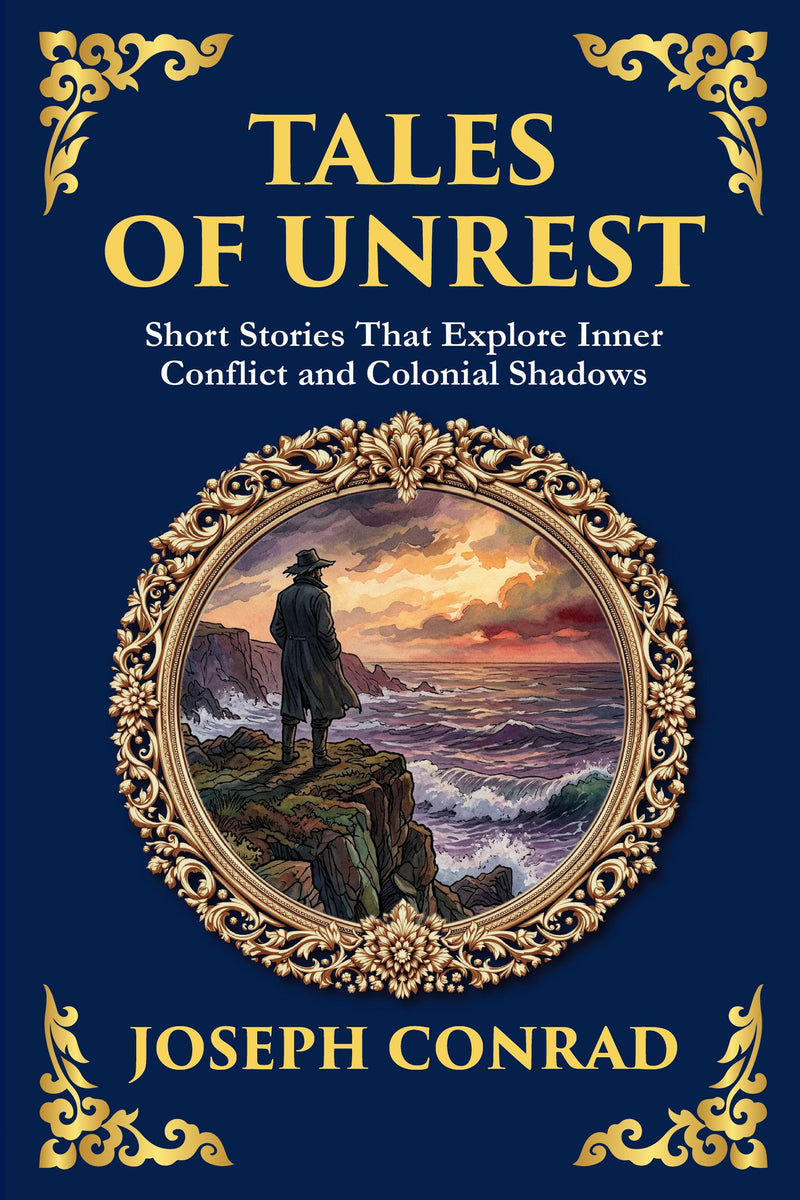
Tales of Unrest
In Tales of Unrest, Joseph Conrad unveils five powerful short stories that expose the uneasy interplay between civilization and chaos, between the refined surface of society and the dark tensions that simmer beneath.
or free app
10,000+ hrs library
30-day guarantee
The complete Tales of Unrest appears in modern English through Library of Alexandria Press, available online with audiobook narration included for members.
Have you ever wondered why silence unsettles us more than noise? In Tales of Unrest, Joseph Conrad masterfully dissects the murky boundaries between order and chaos, man and empire, conscience and impulse. This remarkable collection of five short stories showcases Conrad’s early experiments with narrative tension, moral ambiguity, and psychological realism—themes that would define his later masterpieces.
Set against the backdrop of imperial outposts, distant rivers, and European society, each story uncovers the hidden conflicts that lie beneath human interactions. Through vivid landscapes and complex inner worlds, Conrad explores the dissonance between personal honor and societal expectation, between action and paralysis, and between colonizer and colonized. Whether capturing the mystical sorrow of a dying boatman in The Lagoon or the grim irony of An Outpost of Progress, these tales remind us that the most profound unrest often comes from within.
This modern edition presents Conrad’s powerful collection with renewed clarity and accessibility, offering readers an intimate look into the mind of one of literature’s most introspective writers.
What you’ll discover in this modern edition
- The Lagoon – A haunting story of loss, loyalty, and regret in the remote jungle.
- An Outpost of Progress – A dark satire of imperialism and moral decay in a colonial trading post.
- Karain: A Memory – A mystical tale of vengeance and the psychological scars of power.
- The Return – A domestic drama that exposes the quiet turbulence of married life and societal expectations.
- The Idiots – A grim portrait of rural tragedy, superstition, and inherited guilt.
- Themes of Colonialism, Guilt, and Moral Collapse – Each tale provides insight into the human soul under pressure.
- Conrad’s Early Literary Brilliance – Witness the seeds of Heart of Darkness and Lord Jim in these compact masterpieces.
| Formats | eBook (EPUB + PDF) · Audiobook · Paperback · Hardcover · Large Print |
| Language | English |
| Trim size (print) | 6 × 9 in |
| Binding | Paperback — perfect-bound · Hardcover — casewrap |
| Large Print edition | Same text in a larger, easy-read type — a larger font, not a larger trim |
| Print pricing | Every physical book at our true cost — at-cost, no profit (members) |
| Library | 873 restored titles, always growing |
| Length | 65,181 words · ~4 hr 21 min reading |
| Reading level | Grade 3 · an easy, flowing read (this modern-English edition) |
| Edition | Modern English translation · 2026 |
Member reviews for this edition are collected as readers finish it — be the first. Across the library: 12,000+ books shipped, every plan covered by a 365-day print guarantee.
About this edition
A faithful, unabridged modern-English edition by The Library of Alexandria — carefully rendered for today's reader and verified paragraph-by-paragraph against the public-domain source. Available as eBook, audiobook, paperback, hardcover, and large print.
- Complete & unabridgedVerified paragraph by paragraph against the source — never a scan, never abridged.
- Modern English, faithfulReadable today, with the author’s meaning kept intact. Readable — not simplified.
- Every format, one membershipRead in your browser or the free app, or listen to the full audiobook.
Included free with your membership
Cancel anytime, one click · 30-day money-back guarantee
Edition last updated July 2026
What’s inside
Tales of Unrest — complete and unabridged: all 7 sections included with membership, plus the full audiobook.
Begin reading Tales of Unrest
In clear modern English — the complete text is included with membership.
Introduction
There are writers we read for the comfort of resolution, and there are writers we read because they refuse to let us look away from the things we would rather not see. Joseph Conrad belongs decisively to the second group. To open this collection is to step into the company of a storyteller who understood, perhaps better than any of his contemporaries, that the most dangerous frontiers a human being can cross are not the ones marked on maps. They are the borders within the self — the thin partitions that separate loyalty from betrayal, courage from cowardice, civilization from the wilderness that lives quietly beneath it. These five stories, gathered under a title that announces its own preoccupation, are dispatches from those interior frontiers, written by a man who had spent decades watching people meet the limits of who they believed themselves to be.
When this volume first appeared in 1898, Conrad was still establishing his reputation in the English-speaking world. He was, after all, a Polish-born former sea captain who had not begun writing fiction in his adopted language until he was in his late thirties. English was his third language, learned in adulthood, spoken with an accent so thick that some who met him struggled to follow his conversation. And yet on the page he achieved a density of perception, a richness of atmosphere, and a moral seriousness that few native writers of his era could match. This early collection captures him at a fascinating moment — a writer who has found his subjects but is still testing the full range of his powers, experimenting with settings that span the steaming rivers of Southeast Asia, the unforgiving sea, and the deceptively ordinary parlors of European domestic life. The result is a book that feels both unified and exploratory, like watching an artist circle the obsessions that will define an entire career.
This edition presents these works in a modern translation adapted for the contemporary reader, and a word about what that means may be helpful before you begin. Conrad’s original prose, magnificent as it is, was shaped by the conventions of the late Victorian period — long periodic sentences, dense subordinate clauses, vocabulary and idioms that have drifted from common use over the intervening century. For some readers, those qualities are part of the pleasure; for others, they form a barrier that keeps the emotional power of the stories at arm’s length. The aim here has been to preserve the architecture of Conrad’s vision — his moral complexity, his atmospheric intensity, his unflinching gaze — while smoothing the path for readers who want to meet these characters without the friction of unfamiliar syntax. The shadows remain. The unrest remains. What has changed is the accessibility of the doorway through which you enter them.
To understand why these tales carry the weight they do, it helps to understand the man who wrote them. Józef Teodor Konrad Korzeniowski was born in 1857 in a part of Poland then under Russian control, into a family of patriots and dreamers. His father was a poet, translator, and political activist whose resistance to imperial rule led to the family’s exile when Conrad was a small child. Both his parents died young, worn down by the hardships of that exile, and Conrad was orphaned before he reached adolescence. From the very beginning, then, his life was marked by displacement, loss, and the experience of living under the shadow of empires far larger and more ruthless than any individual could resist. These were not abstract themes he would later choose as a writer. They were the conditions of his existence.
As a young man he went to sea, first in the French merchant marine and then in the British, eventually earning his master’s certificate and commanding ships. For roughly two decades the ocean was his profession and his home. He sailed to the Far East, to Australia, to South America, and — fatefully — up the Congo River into the heart of the Belgian colonial enterprise, an experience that would scar him physically and psychologically and provide the raw material for some of his most famous work. The sea gave Conrad more than scenery. It gave him a laboratory for studying human nature under pressure. On a ship, far from the comforting structures of society, a person’s true character emerges. Authority can be tested, solidarity can fracture, and a single moment of weakness can carry consequences that ripple outward for years. Conrad watched all of this with the eye of a man who had himself been tested, and who never afterward trusted easy answers about what people would do when everything was at stake.
When ill health and the slow decline of the sailing trade pushed him toward retirement from the sea, he turned to writing, and he brought to it everything he had learned. The places he had visited became his settings, but he was never a writer of mere adventure or exotic travelogue. The exotic locations in his fiction are always pressure chambers, environments designed to strip away the protective coverings of habit and convention until the bare human being stands exposed. This is the central insight of his art: that we do not know who we are until circumstance forces the question, and that the answer is often not the one we would have wished for.
The era in which he wrote was itself profoundly restless. The European powers were at the height of their imperial expansion, carving up Africa and Asia and proclaiming their right to rule over peoples they barely understood. The confidence of that age was immense — confidence in progress, in the civilizing mission, in the superiority of European culture. Conrad lived inside that confidence and saw through it. Having grown up as a colonized subject himself, and having witnessed firsthand the greed and brutality that the rhetoric of civilization so often concealed, he could not share the comfortable assumptions of his neighbors. His colonial stories are not celebrations of empire. They are interrogations of it. They ask what happens to the colonizer’s soul when he holds absolute power over others in a place where no one is watching, and they ask what it costs the colonized to be reduced to figures in someone else’s drama. These are questions that have lost none of their urgency. If anything, the passage of a century has only sharpened our ability to perceive what Conrad was getting at, and to appreciate how far ahead of his time he stood.
It is worth saying plainly that Conrad was a writer of his period, and these stories occasionally reflect attitudes and language that belong to that period rather than to ours. But the remarkable thing about his work is how often it transcends the limitations of its moment. Where lesser writers of the imperial age treated colonized peoples as scenery or as objects of condescension, Conrad granted them interiority, dignity, and the full weight of tragic experience. He understood that the encounter between cultures was a collision in which everyone was changed, and not always for the better. The “colonial shadows” of this book’s subtitle are cast in both directions — over those who came to dominate and over those who were dominated — and Conrad’s refusal to let his readers feel comfortable about any of it is precisely what makes him worth reading still.
What unites the stories in this collection is the theme announced in its very title: unrest. Not the dramatic unrest of battle or catastrophe, though violence is never far away, but the deeper, quieter unrest of the divided self — the person at war with his own nature, his own past, his own desires. Conrad was fascinated by the gap between who we believe ourselves to be and who we turn out to be when the test arrives. He returns to this gap again and again, examining it from different angles, in different climates, among different kinds of people, as though he were a scientist studying a single phenomenon under varying conditions.
The collection ranges widely in its settings, and this variety is one of its pleasures. Some of the tales unfold in the lush, oppressive landscapes of the tropics, where the heat and the dense vegetation seem almost to weigh upon the characters, where European traders and adventurers find themselves entangled in worlds whose rules they neither understand nor respect. In these stories the wilderness is not merely a backdrop but an active force, a presence that exposes the fragility of the imported certainties the characters carry with them. The trappings of European order — the clothes, the customs, the sense of superiority — prove almost laughably inadequate against the vast indifference of the land and the complex human realities it contains. Conrad shows us men who came to such places believing they would master them, and who discover instead that they have stumbled into something that masters them. The drama lies not in the external events but in the slow internal unraveling, the dawning recognition that the self one brought along is not equal to the situation in which it finds itself.
Other stories turn away from the tropics entirely. The sea makes its appearance, of course — it would be strange if it did not, given Conrad’s history — and with it comes his profound understanding of the bonds and obligations that hold men together when they are isolated together in a small vessel on a vast ocean. Loyalty, duty, the unspoken codes by which crews survive: these were realities Conrad had lived, and he renders them with an authority that no amount of research could supply. And then, in a striking shift of register, the collection brings us indoors, into the domestic world of a European household, where the unrest is no less acute for being confined to a quiet home. Here Conrad demonstrates that he did not need exotic locations to find his great subject. The conflict between husband and wife, the slow corrosion of a relationship by misunderstanding and pride, the loneliness that can exist within the closest of human bonds — these too are frontiers, and the failures of nerve and feeling that occur within them can be every bit as devastating as anything that happens on a tropical river. This range is part of what makes the collection so rewarding. It shows us a writer demonstrating that his themes are universal, that the human heart is the same battleground whether it beats beneath the deck of a ship, in a trader’s bungalow at the edge of the jungle, or in a comfortable house surrounded by the rituals of ordinary life.
Across all of these settings, Conrad maintains a remarkable consistency of moral vision. He is interested above all in moments of decision — the instant when a character must choose, when the accumulated pressure of circumstance forces an action that reveals the truth of a soul. And he is unflinching about the consequences. There are few easy redemptions in Conrad. People fail, and their failures matter; they betray, and the betrayal cannot be undone; they make choices in moments of weakness or passion or fear that shape the rest of their lives and the lives of others. This refusal to console is sometimes mistaken for pessimism, but it is something more like respect — respect for the reader’s intelligence, respect for the genuine difficulty of being human, respect for the weight of the choices we make. Conrad does not flatter us with the comforting fiction that everything works out, that good intentions are enough, that the better self always triumphs in the end. He shows us life as it is actually lived, by people as flawed and fearful and capable of greatness as we ourselves are.
One of the great pleasures of reading these stories lies in Conrad’s method of revelation. He rarely tells us directly what a character is feeling. Instead, he builds atmosphere — the suffocating heat, the silence of a room, the way light falls across a face — and lets the emotional truth emerge from the accumulation of detail. He is a master of the telling gesture, the moment when a single physical action carries the entire weight of a psychological crisis. This is a kind of writing that rewards attention. The reader who hurries through, looking only for plot, will miss the deeper currents that give these tales their power. But the reader who slows down, who attends to the textures and rhythms of Conrad’s vision, will find a richness that few writers can offer. The modern adaptation of the prose in this edition is designed precisely to make this kind of attentive reading easier — to clear away the obstacles so that the genuine subtleties, the ones Conrad intended, can shine through.
Cancel anytime, one click · 30-day money-back guarantee
Founding annual rate available now — your price locks for life when you join.
Not ready? Get this free chapter by email — read it anytime.
✓ Sent — check your inbox for Tales of Unrest.
Questions about Tales of Unrest
What is Tales of Unrest about?
In Tales of Unrest, Joseph Conrad unveils five powerful short stories that expose the uneasy interplay between civilization and chaos, between the refined surface of society and the dark tensions that simmer beneath. Set across colonial outposts, distant jungles, and shadowy European drawing rooms, each tale examines the unrest within the human soul—fueled by ambition, pride, fear, and doubt. From the eerie silence of “The Lagoon” to the psychological unraveling in “An Outpost of Progress,” these stories serve as m
Who wrote Tales of Unrest?
Tales of Unrest was written by Joseph Conrad. This edition presents the complete work in clear modern English, faithfully rendered from the public-domain original by Library of Alexandria Press.
Is Tales of Unrest free to read?
The opening chapter is free to read on this page. Members read and listen to the complete work — and the entire library — free, and can order any physical book at our true print cost.
How long is Tales of Unrest?
7 chapters (~65,181 words) — about 4 hr 21 min of reading in this modern-English edition.
Is this an abridged version of Tales of Unrest?
No. This is the complete, unabridged Tales of Unrest, carefully rendered into clear modern English and verified paragraph-by-paragraph against the public-domain source — nothing is cut or summarised.
What formats does Tales of Unrest come in?
Tales of Unrest is available as eBook, paperback, hardcover and large print. eBook and audiobook are included with membership; printed editions ship at our true print cost.
Shipping & returns
Billing & membership
More from the library


Explore Adventure
- Tarzan of the Apes · Edgar Rice Burroughs
- The Wonderful Wizard of Oz · L. Frank Baum
- Peter Pan · J. M. Barrie
- Moby Dick; Or, The Whale · Herman Melville
- The Riddle of the Sands · Erskine Childers
- The Loss of the Swansea: A Story of the Florida Coast · W. L. Alden
- Sky Island · L. Frank Baum
- Vikram and the Vampire: Classic Hindu Tales of Adventure, Magic, and Romance · Unknown
- The Tomb of Ts’in · Edgar Wallace
- Skinny McCord · Percy Keese Fitzhugh
- The Men of the Moss-Hags · S. R. Crockett
- The Hunniwell Boys and the Platinum Mystery · L. P. Wyman
- Allan Quatermain · H. Rider Haggard
- She · H. Rider Haggard
- Medical Life in the Navy · Gordon Stables
- The Thirty-Nine Steps · John Buchan
- The Story of Doctor Dolittle · Hugh Lofting
- The Princess and the Goblin · George MacDonald
- The Man Who Would Be King · Rudyard Kipling
- Lucian’s True History · Lucian of Samosata
- The Secret Adversary · Agatha Christie
- Lord Jim · Joseph Conrad
- The Marvelous Land of Oz · L. Frank Baum
- The Virginian: A Horseman of the Plains · Owen Wister
- Mars is My Destination · Frank Belknap Long
- Anabasis · Xenophon
- The Mississippi Saucer · Frank Belknap Long
- Sabotage in Space · Carey Rockwell
- Brood of the Dark Moon · Charles Willard Diffin
- The Misplaced Battleship · Harry Harrison
Tales of Unrest
Tales of Unrest
Short Stories That Explore Inner Conflict and Colonial Shadows
Joseph Conrad
Contents
- Introduction
- Preface by the Author
- Chapter 1
- Chapter 2
- Chapter 3
- Chapter 4
- Chapter 5
Introduction
There are writers we read for the comfort of resolution, and there are writers we read because they refuse to let us look away from the things we would rather not see. Joseph Conrad belongs decisively to the second group. To open this collection is to step into the company of a storyteller who understood, perhaps better than any of his contemporaries, that the most dangerous frontiers a human being can cross are not the ones marked on maps. They are the borders within the self — the thin partitions that separate loyalty from betrayal, courage from cowardice, civilization from the wilderness that lives quietly beneath it. These five stories, gathered under a title that announces its own preoccupation, are dispatches from those interior frontiers, written by a man who had spent decades watching people meet the limits of who they believed themselves to be.
When this volume first appeared in 1898, Conrad was still establishing his reputation in the English-speaking world. He was, after all, a Polish-born former sea captain who had not begun writing fiction in his adopted language until he was in his late thirties. English was his third language, learned in adulthood, spoken with an accent so thick that some who met him struggled to follow his conversation. And yet on the page he achieved a density of perception, a richness of atmosphere, and a moral seriousness that few native writers of his era could match. This early collection captures him at a fascinating moment — a writer who has found his subjects but is still testing the full range of his powers, experimenting with settings that span the steaming rivers of Southeast Asia, the unforgiving sea, and the deceptively ordinary parlors of European domestic life. The result is a book that feels both unified and exploratory, like watching an artist circle the obsessions that will define an entire career.
This edition presents these works in a modern translation adapted for the contemporary reader, and a word about what that means may be helpful before you begin. Conrad’s original prose, magnificent as it is, was shaped by the conventions of the late Victorian period — long periodic sentences, dense subordinate clauses, vocabulary and idioms that have drifted from common use over the intervening century. For some readers, those qualities are part of the pleasure; for others, they form a barrier that keeps the emotional power of the stories at arm’s length. The aim here has been to preserve the architecture of Conrad’s vision — his moral complexity, his atmospheric intensity, his unflinching gaze — while smoothing the path for readers who want to meet these characters without the friction of unfamiliar syntax. The shadows remain. The unrest remains. What has changed is the accessibility of the doorway through which you enter them.
To understand why these tales carry the weight they do, it helps to understand the man who wrote them. Józef Teodor Konrad Korzeniowski was born in 1857 in a part of Poland then under Russian control, into a family of patriots and dreamers. His father was a poet, translator, and political activist whose resistance to imperial rule led to the family’s exile when Conrad was a small child. Both his parents died young, worn down by the hardships of that exile, and Conrad was orphaned before he reached adolescence. From the very beginning, then, his life was marked by displacement, loss, and the experience of living under the shadow of empires far larger and more ruthless than any individual could resist. These were not abstract themes he would later choose as a writer. They were the conditions of his existence.
As a young man he went to sea, first in the French merchant marine and then in the British, eventually earning his master’s certificate and commanding ships. For roughly two decades the ocean was his profession and his home. He sailed to the Far East, to Australia, to South America, and — fatefully — up the Congo River into the heart of the Belgian colonial enterprise, an experience that would scar him physically and psychologically and provide the raw material for some of his most famous work. The sea gave Conrad more than scenery. It gave him a laboratory for studying human nature under pressure. On a ship, far from the comforting structures of society, a person’s true character emerges. Authority can be tested, solidarity can fracture, and a single moment of weakness can carry consequences that ripple outward for years. Conrad watched all of this with the eye of a man who had himself been tested, and who never afterward trusted easy answers about what people would do when everything was at stake.
When ill health and the slow decline of the sailing trade pushed him toward retirement from the sea, he turned to writing, and he brought to it everything he had learned. The places he had visited became his settings, but he was never a writer of mere adventure or exotic travelogue. The exotic locations in his fiction are always pressure chambers, environments designed to strip away the protective coverings of habit and convention until the bare human being stands exposed. This is the central insight of his art: that we do not know who we are until circumstance forces the question, and that the answer is often not the one we would have wished for.
The era in which he wrote was itself profoundly restless. The European powers were at the height of their imperial expansion, carving up Africa and Asia and proclaiming their right to rule over peoples they barely understood. The confidence of that age was immense — confidence in progress, in the civilizing mission, in the superiority of European culture. Conrad lived inside that confidence and saw through it. Having grown up as a colonized subject himself, and having witnessed firsthand the greed and brutality that the rhetoric of civilization so often concealed, he could not share the comfortable assumptions of his neighbors. His colonial stories are not celebrations of empire. They are interrogations of it. They ask what happens to the colonizer’s soul when he holds absolute power over others in a place where no one is watching, and they ask what it costs the colonized to be reduced to figures in someone else’s drama. These are questions that have lost none of their urgency. If anything, the passage of a century has only sharpened our ability to perceive what Conrad was getting at, and to appreciate how far ahead of his time he stood.
It is worth saying plainly that Conrad was a writer of his period, and these stories occasionally reflect attitudes and language that belong to that period rather than to ours. But the remarkable thing about his work is how often it transcends the limitations of its moment. Where lesser writers of the imperial age treated colonized peoples as scenery or as objects of condescension, Conrad granted them interiority, dignity, and the full weight of tragic experience. He understood that the encounter between cultures was a collision in which everyone was changed, and not always for the better. The “colonial shadows” of this book’s subtitle are cast in both directions — over those who came to dominate and over those who were dominated — and Conrad’s refusal to let his readers feel comfortable about any of it is precisely what makes him worth reading still.
What unites the stories in this collection is the theme announced in its very title: unrest. Not the dramatic unrest of battle or catastrophe, though violence is never far away, but the deeper, quieter unrest of the divided self — the person at war with his own nature, his own past, his own desires. Conrad was fascinated by the gap between who we believe ourselves to be and who we turn out to be when the test arrives. He returns to this gap again and again, examining it from different angles, in different climates, among different kinds of people, as though he were a scientist studying a single phenomenon under varying conditions.
The collection ranges widely in its settings, and this variety is one of its pleasures. Some of the tales unfold in the lush, oppressive landscapes of the tropics, where the heat and the dense vegetation seem almost to weigh upon the characters, where European traders and adventurers find themselves entangled in worlds whose rules they neither understand nor respect. In these stories the wilderness is not merely a backdrop but an active force, a presence that exposes the fragility of the imported certainties the characters carry with them. The trappings of European order — the clothes, the customs, the sense of superiority — prove almost laughably inadequate against the vast indifference of the land and the complex human realities it contains. Conrad shows us men who came to such places believing they would master them, and who discover instead that they have stumbled into something that masters them. The drama lies not in the external events but in the slow internal unraveling, the dawning recognition that the self one brought along is not equal to the situation in which it finds itself.
Other stories turn away from the tropics entirely. The sea makes its appearance, of course — it would be strange if it did not, given Conrad’s history — and with it comes his profound understanding of the bonds and obligations that hold men together when they are isolated together in a small vessel on a vast ocean. Loyalty, duty, the unspoken codes by which crews survive: these were realities Conrad had lived, and he renders them with an authority that no amount of research could supply. And then, in a striking shift of register, the collection brings us indoors, into the domestic world of a European household, where the unrest is no less acute for being confined to a quiet home. Here Conrad demonstrates that he did not need exotic locations to find his great subject. The conflict between husband and wife, the slow corrosion of a relationship by misunderstanding and pride, the loneliness that can exist within the closest of human bonds — these too are frontiers, and the failures of nerve and feeling that occur within them can be every bit as devastating as anything that happens on a tropical river. This range is part of what makes the collection so rewarding. It shows us a writer demonstrating that his themes are universal, that the human heart is the same battleground whether it beats beneath the deck of a ship, in a trader’s bungalow at the edge of the jungle, or in a comfortable house surrounded by the rituals of ordinary life.
Across all of these settings, Conrad maintains a remarkable consistency of moral vision. He is interested above all in moments of decision — the instant when a character must choose, when the accumulated pressure of circumstance forces an action that reveals the truth of a soul. And he is unflinching about the consequences. There are few easy redemptions in Conrad. People fail, and their failures matter; they betray, and the betrayal cannot be undone; they make choices in moments of weakness or passion or fear that shape the rest of their lives and the lives of others. This refusal to console is sometimes mistaken for pessimism, but it is something more like respect — respect for the reader’s intelligence, respect for the genuine difficulty of being human, respect for the weight of the choices we make. Conrad does not flatter us with the comforting fiction that everything works out, that good intentions are enough, that the better self always triumphs in the end. He shows us life as it is actually lived, by people as flawed and fearful and capable of greatness as we ourselves are.
One of the great pleasures of reading these stories lies in Conrad’s method of revelation. He rarely tells us directly what a character is feeling. Instead, he builds atmosphere — the suffocating heat, the silence of a room, the way light falls across a face — and lets the emotional truth emerge from the accumulation of detail. He is a master of the telling gesture, the moment when a single physical action carries the entire weight of a psychological crisis. This is a kind of writing that rewards attention. The reader who hurries through, looking only for plot, will miss the deeper currents that give these tales their power. But the reader who slows down, who attends to the textures and rhythms of Conrad’s vision, will find a richness that few writers can offer. The modern adaptation of the prose in this edition is designed precisely to make this kind of attentive reading easier — to clear away the obstacles so that the genuine subtleties, the ones Conrad intended, can shine through.
We knew him back in those vulnerable days when we were happy to take full responsibility for our own lives and belongings. I believe none of us owns any property now, and I’ve heard that many have carelessly lost their lives. However, I am certain that the few of us still alive are not so blind that they miss the reports of various local uprisings in the Eastern Archipelago, hidden within the dull, formal tone of the newspapers. Between the lines of those brief articles, sunshine glimmers—sunlight and the sparkle of the ocean. A strange name can trigger old memories; the printed words faintly cut through today’s smoggy air with a subtle, sharp scent, like land breezes blowing through the starlight of long-ago nights. A signal fire shines like a gem on the high peak of a dark cliff; massive trees, acting as the front guards of vast forests, stand silent and watchful over sleeping stretches of open water. A line of white surf crashes against a deserted beach, and foam swirls over the reefs in the shallows. Small green islands, scattered across the midday calm, rest upon the flat, polished sea like a handful of emeralds on a steel shield.
I also remember the faces—dark, aggressive, and smiling; the bold, daring faces of men who were barefoot, well-armed, and silent. They crowded the narrow decks of our schooner, a colorful and wild group wearing checkered sarongs, red turbans, white jackets, and intricate embroidery. Everything shimmered, from the scabbards and gold rings to the charms, armbands, spearheads, and jeweled weapon handles. They carried themselves with independence, had determined eyes, and remained composed. It feels as if we can still hear their quiet voices talking about wars, journeys, and narrow escapes; boasting calmly and joking softly. Sometimes they spoke in polite whispers, praising their own bravery or our kindness, or speaking with loyal passion about the virtues of their leader. We remember those faces, eyes, and voices; we can still see the glint of silk and metal and the humming energy of that brilliant, festive, and warlike crowd. We can almost feel the touch of friendly brown hands that, after a brief handshake, returned to rest on carved sword hilts. These were Karain’s people—his devoted followers. They waited for his every word and read his thoughts in his eyes. He spoke to them casually about life and death, and they accepted his words humbly, as if they were gifts of fate. Though they were all free men, they called themselves “your slave” when speaking to him. As he walked, voices faded away as if he were guarded by silence, followed only by awestruck whispers. They called him their war-chief. He ruled three villages on a small plain, mastering a tiny piece of land—a conquered territory shaped like a crescent moon, lying forgotten between the hills and the sea.
End of the free sample
Keep reading, free
Members read and listen to the complete book — and the entire library. Cancel anytime, one click · 30-day money-back guarantee.