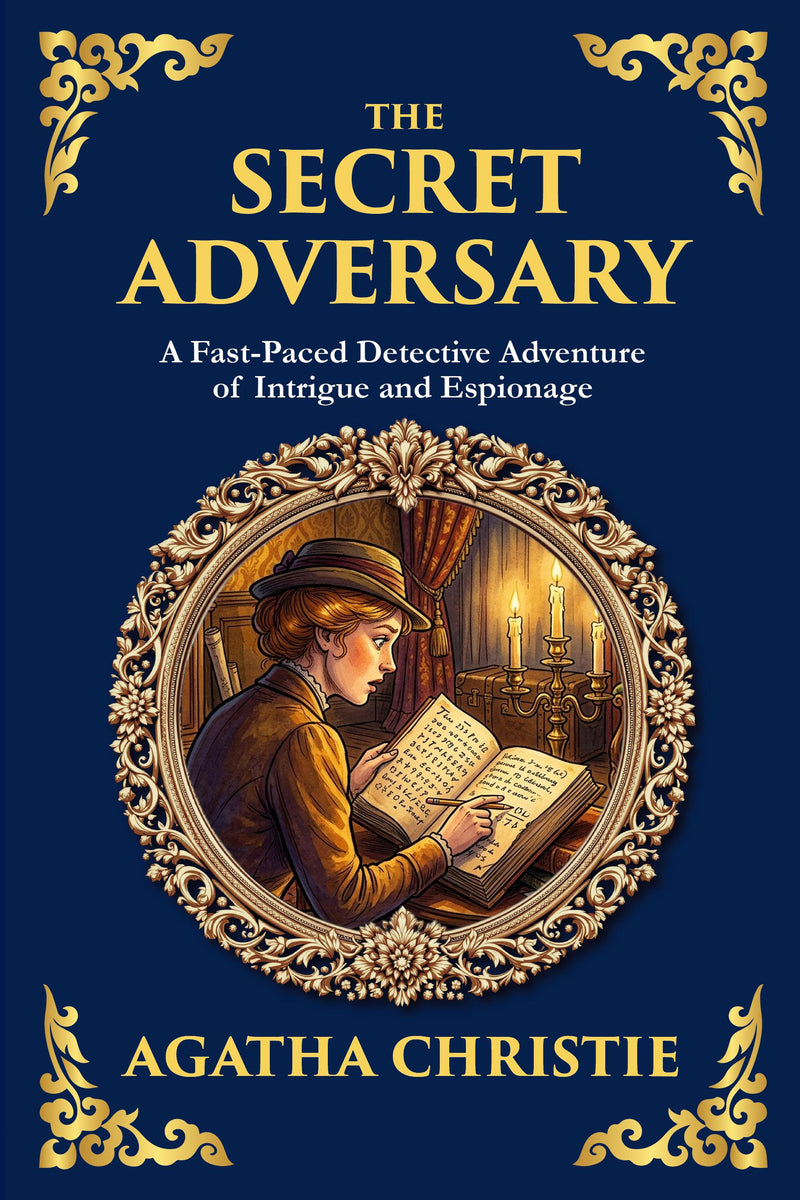
The Secret Adversary
In the chaotic aftermath of World War I, danger lurks not just on battlefields, but in drawing rooms, docks, and darkened alleys.
or free app
10,000+ hrs library
30-day guarantee
The complete The Secret Adversary appears in modern English through Library of Alexandria Press, available online with audiobook narration included for members.
Have you ever wondered why ordinary people sometimes make the most extraordinary detectives? Set in post-war London and teeming with suspense, The Secret Adversary is a gripping tale of deception, danger, and daring feats. In her second published novel, Agatha Christie unveils the debut of Tommy Beresford and Prudence “Tuppence” Cowley—two plucky young friends who decide, on a whim, to launch their own detective agency.
But what begins as a playful pursuit soon turns deadly serious. A missing girl. A cryptic note.
A secret so powerful it could destabilize the entire British government. As Tommy and Tuppence find themselves embroiled in a treacherous web of espionage and political intrigue, their courage and cunning are pushed to the limit. Will they uncover the truth before becoming the next victims of the elusive “Mr.
Brown”? Christie’s talent for razor-sharp plotting, sharp dialogue, and electrifying suspense shines throughout this early masterpiece. With fast-paced action, unpredictable villains, and an unforgettable partnership at its core, The Secret Adversary is a timeless adventure that still thrills modern readers.
What you’ll discover in this modern edition
- The Origin of Tommy & Tuppence Meet Agatha Christie’s most charming and unconventional sleuthing duo in their very first outing.
- A Story of Intrigue and Espionage Explore a tense narrative of missing identities, secret documents, and a conspiracy that spans nations.
- A Clever Blend of Mystery and Wit Enjoy Christie’s signature mix of suspenseful plotting, spirited dialogue, and clever twists.
- A Snapshot of Post-WWI Britain Delve into a world reshaped by war, ripe with uncertainty, and vulnerable to subversion.
- A Tale of Bravery and Banter Watch two unlikely heroes use brains, bravery, and blind luck to solve a case that has stumped the professionals.
| Formats | eBook (EPUB + PDF) · Audiobook · Paperback · Hardcover · Large Print |
| Language | English |
| Trim size (print) | 6 × 9 in |
| Binding | Paperback — perfect-bound · Hardcover — casewrap |
| Large Print edition | Same text in a larger, easy-read type — a larger font, not a larger trim |
| Print pricing | Every physical book at our true cost — at-cost, no profit (members) |
| Library | 873 restored titles, always growing |
| Length | 75,233 words · ~5 hr 1 min reading |
| Reading level | Grade 6 · an easy, flowing read (this modern-English edition) |
| Edition | Modern English translation · 2026 |
Member reviews for this edition are collected as readers finish it — be the first. Across the library: 12,000+ books shipped, every plan covered by a 365-day print guarantee.
About this edition
A faithful, unabridged modern-English edition by The Library of Alexandria — carefully rendered for today's reader and verified paragraph-by-paragraph against the public-domain source. Available as eBook, audiobook, paperback, hardcover, and large print.
- Complete & unabridgedVerified paragraph by paragraph against the source — never a scan, never abridged.
- Modern English, faithfulReadable today, with the author’s meaning kept intact. Readable — not simplified.
- Every format, one membershipRead in your browser or the free app, or listen to the full audiobook.
Included free with your membership
Cancel anytime, one click · 30-day money-back guarantee
Edition last updated July 2026
What’s inside
The Secret Adversary — complete and unabridged: all 30 sections included with membership, plus the full audiobook.
Begin reading The Secret Adversary
In clear modern English — the complete text is included with membership.
Introduction
There are books that arrive quietly and slowly earn their place in the world, and there are books that seem to capture the exact mood of their moment, vibrating with the energy of the times in which they were written. The Secret Adversary belongs firmly to the second category. Published in 1922, it is a novel that crackles with the restless optimism, the lingering anxiety, and the irrepressible youthful spirit of a generation that had just survived the most catastrophic war the world had ever known. To open its pages is to step into a London still shaking off the dust of conflict, a city of returning soldiers, demobilized nurses, empty pockets, and enormous, almost reckless hope. It is a place where two young people with no money, no prospects, and an abundance of nerve decide that the most sensible thing to do is to advertise themselves as adventurers for hire — and in doing so, stumble headlong into a conspiracy that reaches to the very heart of national security.
This was only the second novel that Agatha Christie ever published, and it represents something rather different from the work that would eventually make her the best-selling novelist of all time. Her debut had introduced the meticulous, mustachioed Belgian detective who would become her most enduring creation, a figure of order and method and quiet psychological insight. But here, in her sophomore effort, Christie did something bold and unexpected. She set aside the careful drawing-room puzzle and instead reached for something faster, looser, and more exuberant — a thriller, a spy story, a romp through secret meetings and false identities and shadowy international plots. In place of a single brilliant detective, she gave us a pair of amateur sleuths, ordinary young people thrown into extraordinary circumstances, learning the dangerous trade of espionage as they go.
What makes this novel such a delight, even a full century after its first appearance, is precisely this sense of improvisation and play. Christie was writing in a genre that was wildly popular at the time — the breathless adventure thriller of secret societies, master criminals, and stolen documents — and she was clearly having a tremendous amount of fun with it. There is a lightness here, a willingness to wink at the conventions of the form even as she deploys them with real skill. The pace never flags. The reversals come thick and fast. And underneath the surface excitement runs a current of genuine wit and warmth that lifts the book well above the run-of-the-mill adventure stories of its day.
This edition has been carefully prepared as a modern translation, adapted for the contemporary reader. That phrase deserves a moment of explanation, because it goes to the heart of what we hope to offer you. Christie’s original prose, written in the idiom of the early 1920s, is studded with slang, references, and turns of phrase that would have been instantly recognizable to her first readers but which can occasionally puzzle or slow down a reader approaching the book today. The world she described — its currency, its social codes, its casual assumptions, its now-vanished technologies and customs — was a living, breathing reality for her audience. For us, a century later, some of it requires a footnote, a gloss, a gentle hand to smooth the way. This adaptation has been undertaken with great care and respect, preserving everything that makes the story sing while easing those small obstacles that might otherwise interrupt your enjoyment. The aim throughout has been to honor the author’s voice, her humor, and her ingenuity, while ensuring that nothing stands between you and the sheer pleasure of the tale.
It is worth pausing, too, to appreciate just how astonishing a feat this novel represented for a writer at the very start of her career. Christie was a young woman, largely self-taught in the craft of fiction, working without the apparatus of creative-writing programs or literary mentorship that later generations would enjoy. She had grown up devouring stories, soaking in the rhythms of the popular fiction of her age, and she possessed an instinct for structure and surprise that was, frankly, prodigious. In The Secret Adversary she set herself an enormous technical challenge: to keep a complex web of intrigue spinning, to plant clues and red herrings, to misdirect the reader at every turn, and to bring the whole edifice crashing together in a final revelation that would feel both shocking and inevitable. That she managed all this in only her second book is a testament to the gifts that would, over the following decades, produce dozens of beloved masterpieces.
But for all its cleverness, the novel never feels cold or mechanical. This is one of the great secrets of Christie’s enduring appeal, and it is on full display here. She understood that a puzzle alone is not enough; that the reader must care about the people moving through the maze. And so she gave us characters to love — chief among them a young man and a young woman whose partnership forms the beating heart of the story. They banter and bicker, they tease and support one another, they are brave and foolish and resourceful and occasionally completely out of their depth. Watching them blunder and bluff their way through situations far more dangerous than they ever anticipated is one of the chief joys of the book. There is something deeply appealing about heroes who are not infallible, who make mistakes, who get frightened and carry on anyway. They feel real in a way that the grand, omniscient detectives of fiction sometimes do not. They feel like people you might actually know — people you might, in different circumstances, have been.
To read The Secret Adversary well, it helps to understand a little about the world from which it sprang. The novel opens, in fact, with a brief prologue set against the backdrop of one of the most famous maritime tragedies of the twentieth century — a disaster at sea that had seared itself into the collective memory of an entire generation. This is no idle choice. Christie was tapping directly into a shared cultural trauma, a real event whose echoes still reverberated through the public consciousness when she sat down to write. By anchoring her fictional intrigue to this moment of genuine catastrophe, she lent her invented conspiracy a weight and plausibility that pure fantasy could never achieve. The line between the real and the imagined blurs in those opening pages, drawing the reader immediately into a world where the stakes feel authentic and the dangers entirely possible.
The era in which the book is set was one of profound transition and uncertainty. The Great War had ended only a few years before, leaving in its wake a society utterly transformed. Millions of young men had been killed or maimed. Women had taken on roles in factories, hospitals, and offices that would have been unthinkable a decade earlier, and they were not inclined to surrender their newfound independence quietly. The old certainties of class and station, while far from abolished, had been shaken. There was a sense, particularly among the young, that the rules had changed — that the world their parents had known was gone, and that something new and uncertain was rushing in to take its place.
This atmosphere of flux saturates the novel. Its young protagonists are, in a very real sense, products of the war’s aftermath. They have served their country, seen something of the wider world, and returned home to find that the comfortable futures they might once have expected have evaporated. They are broke. They are unemployed. They are, in the language of the day, demobilized and adrift. And yet they are not despairing. There is a marvelous spirit of make-do-and-mend resilience about them, a refusal to be defeated by circumstance, a determination to seize whatever opportunities the chaotic new world might offer. When they decide to set themselves up as professional adventurers, it is partly a joke, partly an act of genuine desperation, and partly an expression of the buoyant, devil-may-care attitude that defined so much of that postwar generation.
The political anxieties of the period also loom large in the background of the story. The years following the war were a time of considerable upheaval and fear. Revolutionary movements were stirring across Europe; established orders had been overthrown in dramatic and violent fashion; and many in Britain looked nervously at the possibility that similar forces might take root at home. There was widespread suspicion of secret organizations, foreign agitators, and shadowy conspiracies working to undermine the social fabric. Christie, like many popular novelists of her time, drew on these very real fears to construct her plot. The threat at the center of the novel is precisely the kind of hidden, far-reaching menace that haunted the imagination of the early 1920s — a conspiracy that aims to throw the nation into chaos for the benefit of unseen masters.
Modern readers should approach these elements with an understanding of their historical context. The fears and prejudices of a hundred years ago were real, and they shaped the popular fiction of the period in ways that can sometimes feel dated or simplistic to us now. Part of the pleasure of reading older fiction is precisely this glimpse into the mindset of another age — the chance to see how people of the past understood their world, what they feared, what they hoped for, and how they made sense of events that we now view through the long lens of history. This adaptation has been mindful of these matters, and where the original text reflects attitudes or assumptions that have not aged gracefully, the aim has been to present the story honestly while allowing the contemporary reader to engage with it thoughtfully. The intention is never to sanitize the past, but rather to make it accessible — to clear away the incidental obstacles so that the essential brilliance of the storytelling can shine through.
It is also fascinating to consider the technological and social texture of the world the characters inhabit. This is a London of telegrams and motor cars that were still something of a novelty, of grand hotels and shabby boarding houses, of servants and society hostesses, of a class structure that was rigid in many ways and surprisingly porous in others. Communication was slow by our standards; a person could vanish far more easily than they can today, simply by stepping onto a train or boarding a ship. The absence of the instant connectivity we take for granted is, in fact, essential to the workings of the plot. Mysteries that would be solved in moments with a smartphone instead require legwork, deduction, patience, and no small amount of luck. There is something genuinely refreshing about returning to a world where information had to be hunted down rather than summoned with a tap, where a clue might be lost forever if it was not seized at the right moment, where the simple act of finding a particular person could become the engine of an entire adventure.
Christie herself knew this world intimately. She had lived through the war, had worked as a nurse and later in a hospital dispensary — an experience that gave her the extensive knowledge of poisons that would prove so useful throughout her long career. She understood the textures of English social life across its many strata, the manners and speech of duchesses and chambermaids alike. She had an ear for dialogue and a sharp eye for the small absurdities of human behavior. All of these gifts are present in this early novel, often in a rawer, more energetic form than in her later, more polished works. Reading it, we catch a writer in the act of discovering her own powers — testing her range, experimenting with form, learning what she could do.
How to Read This Book — and Why It Still Delights
If you are coming to this novel for the first time, you are in for a particular kind of treat, and it may help to know what sort of experience to expect. This is not a slow-burning, intricate puzzle to be pondered at leisure over many evenings, though it certainly rewards attention. It is, above all, a story of momentum. It is built for speed. The chapters are short, the scenes propulsive, the cliffhangers frequent and effective. Christie was writing in the great tradition of the page-turner, and she understood that her chief obligation was to keep the reader turning those pages, eager to know what would happen next. She fulfills that obligation handsomely. Once the engine of the plot begins to turn, you may well find that an evening you had intended to spend on a single chapter has somehow stretched into the small hours.
Cancel anytime, one click · 30-day money-back guarantee
Founding annual rate available now — your price locks for life when you join.
Not ready? Get this free chapter by email — read it anytime.
✓ Sent — check your inbox for The Secret Adversary.
Questions about The Secret Adversary
What is The Secret Adversary about?
In the chaotic aftermath of World War I, danger lurks not just on battlefields, but in drawing rooms, docks, and darkened alleys. When a mysterious young woman vanishes with a secret that could change the world, two spirited adventurers—Tommy and Tuppence—plunge headfirst into a deadly conspiracy of spies, double-crosses, and coded messages. Agatha Christie’s The Secret Adversary marks the dazzling debut of one of literature’s most beloved detective duos.
Who wrote The Secret Adversary?
The Secret Adversary was written by Agatha Christie. This edition presents the complete work in clear modern English, faithfully rendered from the public-domain original by Library of Alexandria Press.
Is The Secret Adversary free to read?
The opening chapter is free to read on this page. Members read and listen to the complete work — and the entire library — free, and can order any physical book at our true print cost.
How long is The Secret Adversary?
30 chapters (~75,233 words) — about 5 hr 1 min of reading in this modern-English edition.
Is this an abridged version of The Secret Adversary?
No. This is the complete, unabridged The Secret Adversary, carefully rendered into clear modern English and verified paragraph-by-paragraph against the public-domain source — nothing is cut or summarised.
What formats does The Secret Adversary come in?
The Secret Adversary is available as eBook, paperback, hardcover and large print. eBook and audiobook are included with membership; printed editions ship at our true print cost.
Shipping & returns
Billing & membership
More from the library


Explore Adventure
- Tarzan of the Apes · Edgar Rice Burroughs
- The Wonderful Wizard of Oz · L. Frank Baum
- Peter Pan · J. M. Barrie
- Moby Dick; Or, The Whale · Herman Melville
- The Riddle of the Sands · Erskine Childers
- The Loss of the Swansea: A Story of the Florida Coast · W. L. Alden
- Sky Island · L. Frank Baum
- Vikram and the Vampire: Classic Hindu Tales of Adventure, Magic, and Romance · Unknown
- Tales of Unrest · Joseph Conrad
- The Tomb of Ts’in · Edgar Wallace
- Skinny McCord · Percy Keese Fitzhugh
- The Men of the Moss-Hags · S. R. Crockett
- The Hunniwell Boys and the Platinum Mystery · L. P. Wyman
- Allan Quatermain · H. Rider Haggard
- She · H. Rider Haggard
- Medical Life in the Navy · Gordon Stables
- The Thirty-Nine Steps · John Buchan
- The Story of Doctor Dolittle · Hugh Lofting
- The Princess and the Goblin · George MacDonald
- The Man Who Would Be King · Rudyard Kipling
- Lucian’s True History · Lucian of Samosata
- Lord Jim · Joseph Conrad
- The Marvelous Land of Oz · L. Frank Baum
- The Virginian: A Horseman of the Plains · Owen Wister
- Mars is My Destination · Frank Belknap Long
- Anabasis · Xenophon
- The Mississippi Saucer · Frank Belknap Long
- Sabotage in Space · Carey Rockwell
- Brood of the Dark Moon · Charles Willard Diffin
- The Misplaced Battleship · Harry Harrison
The Secret Adversary
The Secret Adversary
A fast-paced detective story full of mystery and spying
Agatha Christie
Contents
- Introduction
- Prologue
- Chapter 1
- Chapter 2
- Chapter 3
- Chapter 4
- Chapter 5
- Chapter 6
- Chapter 7
- Chapter 8
- Chapter 9
- Chapter 10
- Chapter 11
- Chapter 12
- Chapter 13
- Chapter 14
- Chapter 15
- Chapter 16
- Chapter 17
- Chapter 18
- Chapter 19
- Chapter 20
- Chapter 21
- Chapter 22
- Chapter 23
- Chapter 24
- Chapter 25
- Chapter 26
- Chapter 27
- Chapter 28
Introduction
There are books that arrive quietly and slowly earn their place in the world, and there are books that seem to capture the exact mood of their moment, vibrating with the energy of the times in which they were written. The Secret Adversary belongs firmly to the second category. Published in 1922, it is a novel that crackles with the restless optimism, the lingering anxiety, and the irrepressible youthful spirit of a generation that had just survived the most catastrophic war the world had ever known. To open its pages is to step into a London still shaking off the dust of conflict, a city of returning soldiers, demobilized nurses, empty pockets, and enormous, almost reckless hope. It is a place where two young people with no money, no prospects, and an abundance of nerve decide that the most sensible thing to do is to advertise themselves as adventurers for hire — and in doing so, stumble headlong into a conspiracy that reaches to the very heart of national security.
This was only the second novel that Agatha Christie ever published, and it represents something rather different from the work that would eventually make her the best-selling novelist of all time. Her debut had introduced the meticulous, mustachioed Belgian detective who would become her most enduring creation, a figure of order and method and quiet psychological insight. But here, in her sophomore effort, Christie did something bold and unexpected. She set aside the careful drawing-room puzzle and instead reached for something faster, looser, and more exuberant — a thriller, a spy story, a romp through secret meetings and false identities and shadowy international plots. In place of a single brilliant detective, she gave us a pair of amateur sleuths, ordinary young people thrown into extraordinary circumstances, learning the dangerous trade of espionage as they go.
What makes this novel such a delight, even a full century after its first appearance, is precisely this sense of improvisation and play. Christie was writing in a genre that was wildly popular at the time — the breathless adventure thriller of secret societies, master criminals, and stolen documents — and she was clearly having a tremendous amount of fun with it. There is a lightness here, a willingness to wink at the conventions of the form even as she deploys them with real skill. The pace never flags. The reversals come thick and fast. And underneath the surface excitement runs a current of genuine wit and warmth that lifts the book well above the run-of-the-mill adventure stories of its day.
This edition has been carefully prepared as a modern translation, adapted for the contemporary reader. That phrase deserves a moment of explanation, because it goes to the heart of what we hope to offer you. Christie’s original prose, written in the idiom of the early 1920s, is studded with slang, references, and turns of phrase that would have been instantly recognizable to her first readers but which can occasionally puzzle or slow down a reader approaching the book today. The world she described — its currency, its social codes, its casual assumptions, its now-vanished technologies and customs — was a living, breathing reality for her audience. For us, a century later, some of it requires a footnote, a gloss, a gentle hand to smooth the way. This adaptation has been undertaken with great care and respect, preserving everything that makes the story sing while easing those small obstacles that might otherwise interrupt your enjoyment. The aim throughout has been to honor the author’s voice, her humor, and her ingenuity, while ensuring that nothing stands between you and the sheer pleasure of the tale.
It is worth pausing, too, to appreciate just how astonishing a feat this novel represented for a writer at the very start of her career. Christie was a young woman, largely self-taught in the craft of fiction, working without the apparatus of creative-writing programs or literary mentorship that later generations would enjoy. She had grown up devouring stories, soaking in the rhythms of the popular fiction of her age, and she possessed an instinct for structure and surprise that was, frankly, prodigious. In The Secret Adversary she set herself an enormous technical challenge: to keep a complex web of intrigue spinning, to plant clues and red herrings, to misdirect the reader at every turn, and to bring the whole edifice crashing together in a final revelation that would feel both shocking and inevitable. That she managed all this in only her second book is a testament to the gifts that would, over the following decades, produce dozens of beloved masterpieces.
But for all its cleverness, the novel never feels cold or mechanical. This is one of the great secrets of Christie’s enduring appeal, and it is on full display here. She understood that a puzzle alone is not enough; that the reader must care about the people moving through the maze. And so she gave us characters to love — chief among them a young man and a young woman whose partnership forms the beating heart of the story. They banter and bicker, they tease and support one another, they are brave and foolish and resourceful and occasionally completely out of their depth. Watching them blunder and bluff their way through situations far more dangerous than they ever anticipated is one of the chief joys of the book. There is something deeply appealing about heroes who are not infallible, who make mistakes, who get frightened and carry on anyway. They feel real in a way that the grand, omniscient detectives of fiction sometimes do not. They feel like people you might actually know — people you might, in different circumstances, have been.
To read The Secret Adversary well, it helps to understand a little about the world from which it sprang. The novel opens, in fact, with a brief prologue set against the backdrop of one of the most famous maritime tragedies of the twentieth century — a disaster at sea that had seared itself into the collective memory of an entire generation. This is no idle choice. Christie was tapping directly into a shared cultural trauma, a real event whose echoes still reverberated through the public consciousness when she sat down to write. By anchoring her fictional intrigue to this moment of genuine catastrophe, she lent her invented conspiracy a weight and plausibility that pure fantasy could never achieve. The line between the real and the imagined blurs in those opening pages, drawing the reader immediately into a world where the stakes feel authentic and the dangers entirely possible.
The era in which the book is set was one of profound transition and uncertainty. The Great War had ended only a few years before, leaving in its wake a society utterly transformed. Millions of young men had been killed or maimed. Women had taken on roles in factories, hospitals, and offices that would have been unthinkable a decade earlier, and they were not inclined to surrender their newfound independence quietly. The old certainties of class and station, while far from abolished, had been shaken. There was a sense, particularly among the young, that the rules had changed — that the world their parents had known was gone, and that something new and uncertain was rushing in to take its place.
This atmosphere of flux saturates the novel. Its young protagonists are, in a very real sense, products of the war’s aftermath. They have served their country, seen something of the wider world, and returned home to find that the comfortable futures they might once have expected have evaporated. They are broke. They are unemployed. They are, in the language of the day, demobilized and adrift. And yet they are not despairing. There is a marvelous spirit of make-do-and-mend resilience about them, a refusal to be defeated by circumstance, a determination to seize whatever opportunities the chaotic new world might offer. When they decide to set themselves up as professional adventurers, it is partly a joke, partly an act of genuine desperation, and partly an expression of the buoyant, devil-may-care attitude that defined so much of that postwar generation.
The political anxieties of the period also loom large in the background of the story. The years following the war were a time of considerable upheaval and fear. Revolutionary movements were stirring across Europe; established orders had been overthrown in dramatic and violent fashion; and many in Britain looked nervously at the possibility that similar forces might take root at home. There was widespread suspicion of secret organizations, foreign agitators, and shadowy conspiracies working to undermine the social fabric. Christie, like many popular novelists of her time, drew on these very real fears to construct her plot. The threat at the center of the novel is precisely the kind of hidden, far-reaching menace that haunted the imagination of the early 1920s — a conspiracy that aims to throw the nation into chaos for the benefit of unseen masters.
Modern readers should approach these elements with an understanding of their historical context. The fears and prejudices of a hundred years ago were real, and they shaped the popular fiction of the period in ways that can sometimes feel dated or simplistic to us now. Part of the pleasure of reading older fiction is precisely this glimpse into the mindset of another age — the chance to see how people of the past understood their world, what they feared, what they hoped for, and how they made sense of events that we now view through the long lens of history. This adaptation has been mindful of these matters, and where the original text reflects attitudes or assumptions that have not aged gracefully, the aim has been to present the story honestly while allowing the contemporary reader to engage with it thoughtfully. The intention is never to sanitize the past, but rather to make it accessible — to clear away the incidental obstacles so that the essential brilliance of the storytelling can shine through.
It is also fascinating to consider the technological and social texture of the world the characters inhabit. This is a London of telegrams and motor cars that were still something of a novelty, of grand hotels and shabby boarding houses, of servants and society hostesses, of a class structure that was rigid in many ways and surprisingly porous in others. Communication was slow by our standards; a person could vanish far more easily than they can today, simply by stepping onto a train or boarding a ship. The absence of the instant connectivity we take for granted is, in fact, essential to the workings of the plot. Mysteries that would be solved in moments with a smartphone instead require legwork, deduction, patience, and no small amount of luck. There is something genuinely refreshing about returning to a world where information had to be hunted down rather than summoned with a tap, where a clue might be lost forever if it was not seized at the right moment, where the simple act of finding a particular person could become the engine of an entire adventure.
Christie herself knew this world intimately. She had lived through the war, had worked as a nurse and later in a hospital dispensary — an experience that gave her the extensive knowledge of poisons that would prove so useful throughout her long career. She understood the textures of English social life across its many strata, the manners and speech of duchesses and chambermaids alike. She had an ear for dialogue and a sharp eye for the small absurdities of human behavior. All of these gifts are present in this early novel, often in a rawer, more energetic form than in her later, more polished works. Reading it, we catch a writer in the act of discovering her own powers — testing her range, experimenting with form, learning what she could do.
How to Read This Book — and Why It Still Delights
If you are coming to this novel for the first time, you are in for a particular kind of treat, and it may help to know what sort of experience to expect. This is not a slow-burning, intricate puzzle to be pondered at leisure over many evenings, though it certainly rewards attention. It is, above all, a story of momentum. It is built for speed. The chapters are short, the scenes propulsive, the cliffhangers frequent and effective. Christie was writing in the great tradition of the page-turner, and she understood that her chief obligation was to keep the reader turning those pages, eager to know what would happen next. She fulfills that obligation handsomely. Once the engine of the plot begins to turn, you may well find that an evening you had intended to spend on a single chapter has somehow stretched into the small hours.
It was 2:00 p.m. on May 7, 1915. The Lusitania had been hit by two torpedoes one after another and was sinking fast, while the lifeboats were being lowered as quickly as possible. Women and children stood in line, waiting for their turn. Some clung tightly to their husbands and fathers, while others held their children close to their chests. One girl stood by herself, slightly away from the crowd. She was very young, no more than eighteen. She didn’t look scared, and her serious, steady eyes stared straight ahead.
A man’s voice beside her startled her, making her turn around. She had noticed him several times among the first-class passengers. There was something mysterious about him that had caught her interest. He didn’t talk to anyone, and if someone tried to start a conversation, he quickly shut them down. He also had a nervous habit of glancing over his shoulder with a sharp, suspicious look.
She saw now that he was very upset. Beads of sweat were forming on his forehead. He was clearly terrified. Even so, he didn’t seem like the type of person who would be afraid to die.
“Yes?” she asked, her serious eyes meeting his with curiosity.
He stood there staring at her, looking desperately undecided.
“It has to be!” he whispered to himself. “Yes—that’s the only explanation.” Then, he suddenly asked out loud, “You’re American?”
“I don’t think you have any right to ask me that! Of course I am!”
“Please don’t be upset. You wouldn’t be if you realized how much is at risk. But I have to trust someone—and it has to be a woman.”
“Because of the rule ‘women and children first.’” He glanced around and spoke more quietly. “I’m carrying some documents—extremely important papers. They could change everything for the Allies in this war. Do you understand? These papers must be protected! They are safer with you than with me. Will you take them?”
End of the free sample
Keep reading, free
Members read and listen to the complete book — and the entire library. Cancel anytime, one click · 30-day money-back guarantee.