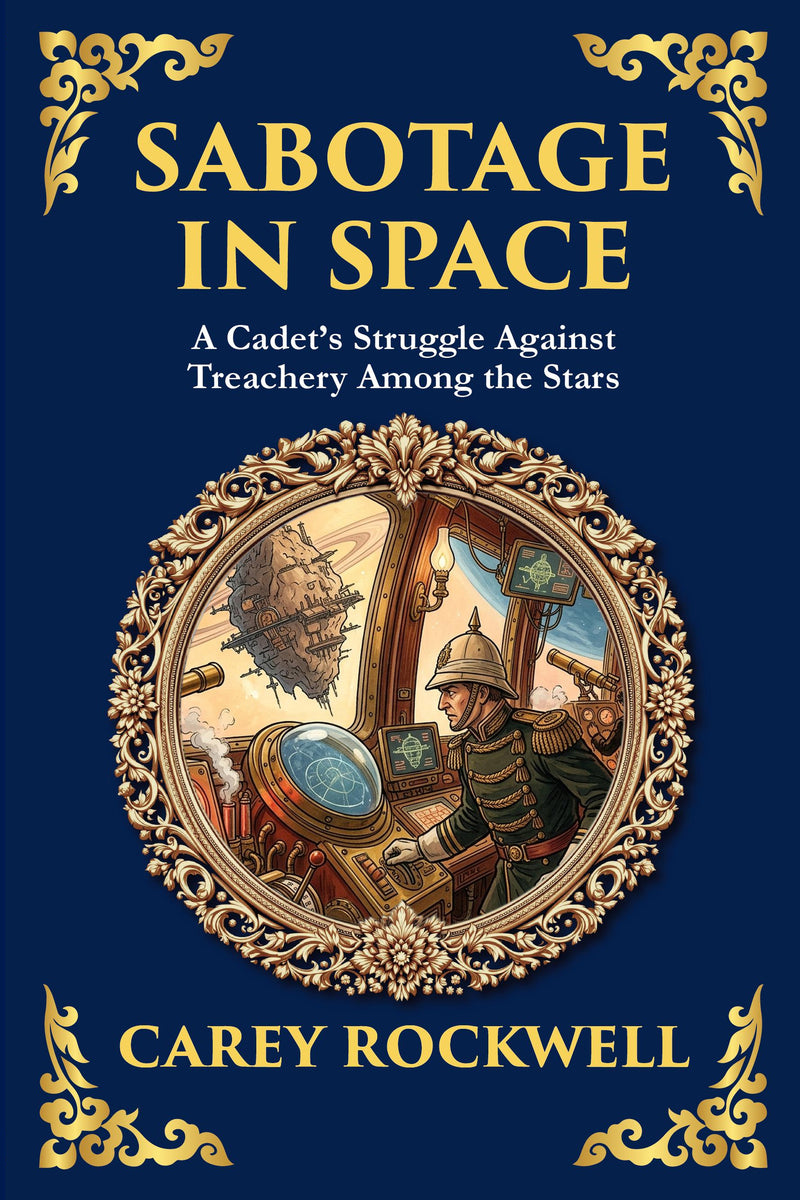
Sabotage in Space
In the silence of space, trust is the only lifeline—and betrayal cuts deeper than any laser beam. Sabotage in Space is a pulse-pounding, classic space adventure from the golden age of science fiction.
or free app
10,000+ hrs library
30-day guarantee
The complete Sabotage in Space appears in modern English through Library of Alexandria Press, available online with audiobook narration included for members.
Have you ever wondered why the greatest threat in space might not come from aliens— but from within your own crew? Sabotage in Space is a thrilling entry in the Tom Corbett, Space Cadet series by Carey Rockwell—perfect for readers who love heroic coming-of-age stories set against the high-stakes backdrop of space exploration. Cadet Tom Corbett is young, brave, and on the fast track to command.
But when a series of mysterious malfunctions threaten the Polaris mission to Saturn’s moons, Tom suspects the truth: sabotage. Now, he and his fellow cadets must navigate the dangers of space, political deceit, and personal betrayal to uncover the saboteur hiding in plain sight. As tensions rise aboard the ship, and dangers mount from cosmic storms and enemy ambushes, Tom’s leadership, loyalty, and quick thinking will be tested like never before.
One mistake could doom them all—and someone is counting on it.
What you’ll discover in this modern edition
- A thrilling space mystery where courage collides with conspiracy
- A gripping coming-of-age story of a cadet rising to meet impossible odds
| Formats | eBook (EPUB + PDF) · Audiobook · Paperback · Hardcover · Large Print |
| Language | English |
| Trim size (print) | 6 × 9 in |
| Binding | Paperback — perfect-bound · Hardcover — casewrap |
| Large Print edition | Same text in a larger, easy-read type — a larger font, not a larger trim |
| Print pricing | Every physical book at our true cost — at-cost, no profit (members) |
| Library | 873 restored titles, always growing |
| Length | 46,624 words · ~3 hr 6 min reading |
| Reading level | Grade 7 · an easy, flowing read (this modern-English edition) |
| Edition | Modern English translation · 2026 |
Member reviews for this edition are collected as readers finish it — be the first. Across the library: 12,000+ books shipped, every plan covered by a 365-day print guarantee.
About this edition
A faithful, unabridged modern-English edition by The Library of Alexandria — carefully rendered for today's reader and verified paragraph-by-paragraph against the public-domain source. Available as eBook, audiobook, paperback, hardcover, and large print.
- Complete & unabridgedVerified paragraph by paragraph against the source — never a scan, never abridged.
- Modern English, faithfulReadable today, with the author’s meaning kept intact. Readable — not simplified.
- Every format, one membershipRead in your browser or the free app, or listen to the full audiobook.
Included free with your membership
Cancel anytime, one click · 30-day money-back guarantee
Edition last updated July 2026
What’s inside
Sabotage in Space — complete and unabridged: all 21 sections included with membership, plus the full audiobook.
Begin reading Sabotage in Space
In clear modern English — the complete text is included with membership.
Introduction
There is a particular kind of magic that lives in the science fiction of the mid-twentieth century—a sense of wonder so pure, so unburdened by cynicism, that it can feel almost like a forgotten dialect of the imagination. To open a book like the one you now hold is to step back into an era when the stars were not yet conquered, when the surface of distant moons remained the province of dreamers, and when the very idea of human beings hurtling between planets carried with it a thrill that bordered on the spiritual. This story belongs to that golden moment, and reading it today offers something rare: the chance to recover a kind of optimism about the future that our own age has too often misplaced.
The work before you is part of the beloved Tom Corbett, Space Cadet series, a body of adventure fiction that captured the imaginations of countless young readers during the early 1950s. Published under the name Carey Rockwell—a house pseudonym that has long fascinated scholars and enthusiasts of the genre—these novels arrived at a pivotal moment in American cultural history. The atomic age had dawned, rockets were no longer pure fantasy, and the public hunger for tales of space travel had reached a fever pitch. Into this charged atmosphere came Tom Corbett and his fellow cadets at the Space Academy, young men training to become the guardians of a unified solar system, learning the disciplines of astrogation, rocketry, and reactor control while testing their courage against the dangers of the void. The adventures that follow are, in the best tradition of juvenile science fiction, simultaneously thrilling escapism and quiet lessons in loyalty, integrity, and the value of working together toward a common goal.
This particular volume—a modern translation adapted for the contemporary reader—has been carefully prepared so that the wonder of the original survives intact while the prose meets you on familiar ground. Before you begin, it is worth taking a few moments to understand where this story comes from, what made it so cherished in its day, and how best to approach it so that your reading experience is as rich and rewarding as possible.
The World of Tom Corbett and the Dream of the Space Age
To appreciate fully the tale you are about to read, it helps to understand the remarkable cultural phenomenon from which it sprang. The Tom Corbett, Space Cadet franchise was an enormous multimedia enterprise that flourished in the United States from roughly 1950 to 1955. It existed not merely as a series of novels but as a television program, a radio show, a newspaper comic strip, comic books, and a dizzying array of merchandise—everything from lunch boxes and View-Master reels to ray guns and coloring books. For a generation of children growing up in the early 1950s, Tom Corbett was as recognizable a hero as any cowboy or comic-book crusader, a figure who embodied the gleaming, hopeful promise of the future.
The conceptual roots of the franchise reach back to the work of the celebrated rocket scientist and science fiction author Robert A. Heinlein, whose 1948 novel Space Cadet provided much of the inspiration for the setting and themes. Heinlein, who would go on to become one of the towering figures of twentieth-century science fiction, brought to his work a rigorous interest in the actual mechanics of space travel, and that influence echoes throughout the Tom Corbett stories. The producers of the franchise even employed the renowned space-travel theorist Willy Ley as a technical adviser, lending the adventures a veneer of scientific plausibility that distinguished them from the more fantastical space operas of the pulp era. When the cadets discuss orbital mechanics, fuel reserves, or the perils of acceleration, there is a genuine attempt to ground the drama in the realities of physics as they were understood at the time.
The stories unfold in the year 2350, in a future where humanity has not only mastered space travel but has unified the inner planets—Earth, Mars, and Venus—under a single governing body known as the Solar Alliance. The keepers of peace and order in this interplanetary civilization are the men of the Solar Guard, and the institution that trains its finest officers is Space Academy, U.S.A. It is here that we find our young protagonists: Tom Corbett himself, earnest and capable; the brilliant but irascible Astro, the Venusian power-deck specialist with an instinctive genius for engines; and Roger Manning, the sharp-tongued, sometimes arrogant astrogator whose prickly exterior conceals a fierce loyalty. Together they form the crew of the rocket cruiser Polaris, a unit bound by the friction of clashing personalities and the deeper bonds forged through shared danger.
What makes this trio so enduring is the way their differences both threaten and strengthen them. Their relationship is far from frictionless; indeed, much of the human drama in these books arises from the way three very different young men must learn to subordinate their egos and their irritations to the demands of teamwork. In the unforgiving environment of space, where a single error can mean death for all, cooperation is not a pleasant ideal but an absolute necessity. This theme—the transformation of individual talent into collective strength—runs like a bright thread through the entire series and gives the adventures a moral seriousness that elevates them above mere thrill-seeking.
The figure presiding over the cadets’ training is Captain Steve Strong of the Solar Guard, a mentor whose steady wisdom and unwavering principles model the kind of leader the cadets aspire to become. Through Strong and the other officers of the Academy, the books quietly transmit a code of values: honesty, courage, fairness, respect for authority tempered by independent judgment, and above all a commitment to something larger than oneself. These were the virtues that mid-century America wished to instill in its young people, and the Tom Corbett stories functioned, in their gentle way, as vessels for that aspiration.
It would be a mistake, however, to imagine that these books are merely didactic. They are, first and foremost, rollicking adventures, full of suspense, peril, and the kind of breathless pacing that keeps the pages turning. The young cadets find themselves confronting sabotage, treachery, mysterious phenomena, and the constant dangers of an environment that does not forgive mistakes. The genius of the series lies in its ability to weave its moral lessons so seamlessly into the fabric of exciting storytelling that the reader absorbs them almost without noticing. One reads for the adventure and comes away, almost incidentally, having spent time in the company of admirable people facing difficult situations with grace and determination.
The mystery of the author’s identity adds a fascinating dimension to the history of these books. “Carey Rockwell” was a pen name, and the true author or authors behind the novels have never been conclusively identified—a circumstance not at all unusual for series fiction of this kind, which was often produced under house names by writers working to a publisher’s specifications. There is something fitting, perhaps, about this anonymity. The Tom Corbett books were never about the cult of the individual author; they were collaborative cultural products, designed to deliver a particular experience to a particular audience, and they did so with a craftsmanship that has allowed them to endure long after the television broadcasts faded from the airwaves and the lunch boxes were packed away in attics.
Reading Across the Decades: What This Modern Translation Offers
Picking up a book written more than seventy years ago presents both delights and challenges. The delights are obvious: there is the pleasure of immersion in a vanished sensibility, the charm of encountering a vision of the future imagined before humans had ever left the Earth, and the satisfaction of discovering that good storytelling transcends the era of its making. But there are challenges too. The English language is a living thing, constantly evolving, and prose that felt crisp and contemporary to a reader in 1955 can sometimes feel stiff, dated, or oblique to a reader today. Slang shifts, sentence structures change, certain turns of phrase fall out of use, and references that were once instantly understood become obscure. These small frictions, accumulating page after page, can create a subtle barrier between the modern reader and the pleasures the story has to offer.
This edition has been prepared as a modern translation, adapted for the contemporary reader, precisely to dissolve that barrier. The aim throughout has been to preserve everything that makes the original wonderful—its pacing, its characters, its sense of adventure, its underlying warmth—while gently smoothing the linguistic surface so that nothing stands between you and the story. Think of it as a careful restoration of a beloved old painting: the goal is not to repaint the work or impose a new vision upon it, but to clean away the accumulated grime of time so that the original colors can shine through with their intended brilliance.
What does this mean in practice? It means that archaic constructions have been eased into more familiar rhythms, that overly convoluted sentences have been clarified, and that vocabulary which might send a modern reader reaching for a dictionary has been thoughtfully updated where doing so serves comprehension without sacrificing flavor. At the same time, great care has been taken to retain the distinctive voice of the period. The future-slang of the cadets—their exclamations and expressions, the colorful idioms unique to their imagined world—has been preserved wherever it adds character and atmosphere, because these elements are part of what gives the story its particular charm. A translation that scrubbed away every trace of the original era would be a poorer thing than the work it sought to improve.
It is worth dwelling for a moment on this delicate balance, because it touches on questions that matter to thoughtful readers. There is a school of thought that holds that older works should be presented exactly as they were written, with every dated phrase and antique construction left untouched, on the grounds that any alteration is a kind of violation. There is real merit in this view, and the original texts remain available for those who wish to encounter them in their unmodified form. But there is also a strong case for editions like this one, which seek to keep these stories alive and accessible for new generations of readers who might otherwise find the period prose an insurmountable obstacle. A book that goes unread, however faithfully preserved, is a book whose magic has gone dormant. The purpose of this adaptation is to reawaken that magic, to ensure that the adventures of Tom Corbett and his crewmates can continue to thrill and inspire readers in our own century just as they did so many decades ago.
You will find, then, that this is a book you can simply enjoy. You need not constantly translate the prose in your own head or pause to puzzle out unfamiliar expressions. The narrative flows smoothly, the dialogue feels natural, and the action carries you forward without the small stumbles that so often interrupt the reading of older fiction. And yet the essential character of the work remains intact. You are still reading a story from the dawn of the space age, still inhabiting a future imagined by minds that had never seen a photograph of Earth from orbit, still encountering the optimism and the values of a particular moment in history. The translation is a bridge, not a transformation—a way of crossing the distance of years without losing sight of the far shore from which the story departed.
There is one more aspect of reading across the decades that deserves mention, and that is the matter of perspective. When we read older fiction, we encounter not only different language but different assumptions—about society, about technology, about what the future might hold. Part of the pleasure of this kind of reading lies in noticing these differences, in seeing how the writers of the past projected their hopes and anxieties onto the canvas of imagined tomorrows. The future depicted in these books is, in many ways, a future as the 1950s imagined it: a world of analog instruments and human pilots, of vacuum tubes and slide rules transposed somehow onto interplanetary rockets. There is a delicious irony in reading these visions today, knowing both how much the writers got right about the spirit of space exploration and how charmingly they could not anticipate the digital revolution that would actually reshape our world. Rather than diminishing the story, these quaint anachronisms add a layer of poignancy and delight, reminding us that every imagined future is also a mirror reflecting the age that dreamed it.
Cancel anytime, one click · 30-day money-back guarantee
Founding annual rate available now — your price locks for life when you join.
Not ready? Get this free chapter by email — read it anytime.
✓ Sent — check your inbox for Sabotage in Space.
Questions about Sabotage in Space
What is Sabotage in Space about?
In the silence of space, trust is the only lifeline—and betrayal cuts deeper than any laser beam. Sabotage in Space is a pulse-pounding, classic space adventure from the golden age of science fiction. When a promising Space Cadet stumbles upon a deadly plot aboard a vital deep-space mission, he must confront not only interstellar enemies but treachery within his own ranks.
Who wrote Sabotage in Space?
Sabotage in Space was written by Carey Rockwell. This edition presents the complete work in clear modern English, faithfully rendered from the public-domain original by Library of Alexandria Press.
Is Sabotage in Space free to read?
The opening chapter is free to read on this page. Members read and listen to the complete work — and the entire library — free, and can order any physical book at our true print cost.
How long is Sabotage in Space?
21 chapters (~46,624 words) — about 3 hr 6 min of reading in this modern-English edition.
Is this an abridged version of Sabotage in Space?
No. This is the complete, unabridged Sabotage in Space, carefully rendered into clear modern English and verified paragraph-by-paragraph against the public-domain source — nothing is cut or summarised.
What formats does Sabotage in Space come in?
Sabotage in Space is available as eBook, paperback, hardcover and large print. eBook and audiobook are included with membership; printed editions ship at our true print cost.
Shipping & returns
Billing & membership
More from the library


Explore Adventure
- Tarzan of the Apes · Edgar Rice Burroughs
- The Wonderful Wizard of Oz · L. Frank Baum
- Peter Pan · J. M. Barrie
- Moby Dick; Or, The Whale · Herman Melville
- The Riddle of the Sands · Erskine Childers
- The Loss of the Swansea: A Story of the Florida Coast · W. L. Alden
- Sky Island · L. Frank Baum
- Vikram and the Vampire: Classic Hindu Tales of Adventure, Magic, and Romance · Unknown
- Tales of Unrest · Joseph Conrad
- The Tomb of Ts’in · Edgar Wallace
- Skinny McCord · Percy Keese Fitzhugh
- The Men of the Moss-Hags · S. R. Crockett
- The Hunniwell Boys and the Platinum Mystery · L. P. Wyman
- Allan Quatermain · H. Rider Haggard
- She · H. Rider Haggard
- Medical Life in the Navy · Gordon Stables
- The Thirty-Nine Steps · John Buchan
- The Story of Doctor Dolittle · Hugh Lofting
- The Princess and the Goblin · George MacDonald
- The Man Who Would Be King · Rudyard Kipling
- Lucian’s True History · Lucian of Samosata
- The Secret Adversary · Agatha Christie
- Lord Jim · Joseph Conrad
- The Marvelous Land of Oz · L. Frank Baum
- The Virginian: A Horseman of the Plains · Owen Wister
- Mars is My Destination · Frank Belknap Long
- Anabasis · Xenophon
- The Mississippi Saucer · Frank Belknap Long
- Brood of the Dark Moon · Charles Willard Diffin
- The Misplaced Battleship · Harry Harrison
Sabotage in Space
Sabotage in Space
A Cadet’s Fight Against Betrayal Among the Stars
Carey Rockwell
Contents
- Introduction
- Chapter 1
- Chapter 2
- Chapter 3
- Chapter 4
- Chapter 5
- Chapter 6
- Chapter 7
- Chapter 8
- Chapter 9
- Chapter 10
- Chapter 11
- Chapter 12
- Chapter 13
- Chapter 14
- Chapter 15
- Chapter 16
- Chapter 17
- Chapter 18
- Chapter 19
- Chapter 20
Introduction
There is a particular kind of magic that lives in the science fiction of the mid-twentieth century—a sense of wonder so pure, so unburdened by cynicism, that it can feel almost like a forgotten dialect of the imagination. To open a book like the one you now hold is to step back into an era when the stars were not yet conquered, when the surface of distant moons remained the province of dreamers, and when the very idea of human beings hurtling between planets carried with it a thrill that bordered on the spiritual. This story belongs to that golden moment, and reading it today offers something rare: the chance to recover a kind of optimism about the future that our own age has too often misplaced.
The work before you is part of the beloved Tom Corbett, Space Cadet series, a body of adventure fiction that captured the imaginations of countless young readers during the early 1950s. Published under the name Carey Rockwell—a house pseudonym that has long fascinated scholars and enthusiasts of the genre—these novels arrived at a pivotal moment in American cultural history. The atomic age had dawned, rockets were no longer pure fantasy, and the public hunger for tales of space travel had reached a fever pitch. Into this charged atmosphere came Tom Corbett and his fellow cadets at the Space Academy, young men training to become the guardians of a unified solar system, learning the disciplines of astrogation, rocketry, and reactor control while testing their courage against the dangers of the void. The adventures that follow are, in the best tradition of juvenile science fiction, simultaneously thrilling escapism and quiet lessons in loyalty, integrity, and the value of working together toward a common goal.
This particular volume—a modern translation adapted for the contemporary reader—has been carefully prepared so that the wonder of the original survives intact while the prose meets you on familiar ground. Before you begin, it is worth taking a few moments to understand where this story comes from, what made it so cherished in its day, and how best to approach it so that your reading experience is as rich and rewarding as possible.
The World of Tom Corbett and the Dream of the Space Age
To appreciate fully the tale you are about to read, it helps to understand the remarkable cultural phenomenon from which it sprang. The Tom Corbett, Space Cadet franchise was an enormous multimedia enterprise that flourished in the United States from roughly 1950 to 1955. It existed not merely as a series of novels but as a television program, a radio show, a newspaper comic strip, comic books, and a dizzying array of merchandise—everything from lunch boxes and View-Master reels to ray guns and coloring books. For a generation of children growing up in the early 1950s, Tom Corbett was as recognizable a hero as any cowboy or comic-book crusader, a figure who embodied the gleaming, hopeful promise of the future.
The conceptual roots of the franchise reach back to the work of the celebrated rocket scientist and science fiction author Robert A. Heinlein, whose 1948 novel Space Cadet provided much of the inspiration for the setting and themes. Heinlein, who would go on to become one of the towering figures of twentieth-century science fiction, brought to his work a rigorous interest in the actual mechanics of space travel, and that influence echoes throughout the Tom Corbett stories. The producers of the franchise even employed the renowned space-travel theorist Willy Ley as a technical adviser, lending the adventures a veneer of scientific plausibility that distinguished them from the more fantastical space operas of the pulp era. When the cadets discuss orbital mechanics, fuel reserves, or the perils of acceleration, there is a genuine attempt to ground the drama in the realities of physics as they were understood at the time.
The stories unfold in the year 2350, in a future where humanity has not only mastered space travel but has unified the inner planets—Earth, Mars, and Venus—under a single governing body known as the Solar Alliance. The keepers of peace and order in this interplanetary civilization are the men of the Solar Guard, and the institution that trains its finest officers is Space Academy, U.S.A. It is here that we find our young protagonists: Tom Corbett himself, earnest and capable; the brilliant but irascible Astro, the Venusian power-deck specialist with an instinctive genius for engines; and Roger Manning, the sharp-tongued, sometimes arrogant astrogator whose prickly exterior conceals a fierce loyalty. Together they form the crew of the rocket cruiser Polaris, a unit bound by the friction of clashing personalities and the deeper bonds forged through shared danger.
What makes this trio so enduring is the way their differences both threaten and strengthen them. Their relationship is far from frictionless; indeed, much of the human drama in these books arises from the way three very different young men must learn to subordinate their egos and their irritations to the demands of teamwork. In the unforgiving environment of space, where a single error can mean death for all, cooperation is not a pleasant ideal but an absolute necessity. This theme—the transformation of individual talent into collective strength—runs like a bright thread through the entire series and gives the adventures a moral seriousness that elevates them above mere thrill-seeking.
The figure presiding over the cadets’ training is Captain Steve Strong of the Solar Guard, a mentor whose steady wisdom and unwavering principles model the kind of leader the cadets aspire to become. Through Strong and the other officers of the Academy, the books quietly transmit a code of values: honesty, courage, fairness, respect for authority tempered by independent judgment, and above all a commitment to something larger than oneself. These were the virtues that mid-century America wished to instill in its young people, and the Tom Corbett stories functioned, in their gentle way, as vessels for that aspiration.
It would be a mistake, however, to imagine that these books are merely didactic. They are, first and foremost, rollicking adventures, full of suspense, peril, and the kind of breathless pacing that keeps the pages turning. The young cadets find themselves confronting sabotage, treachery, mysterious phenomena, and the constant dangers of an environment that does not forgive mistakes. The genius of the series lies in its ability to weave its moral lessons so seamlessly into the fabric of exciting storytelling that the reader absorbs them almost without noticing. One reads for the adventure and comes away, almost incidentally, having spent time in the company of admirable people facing difficult situations with grace and determination.
The mystery of the author’s identity adds a fascinating dimension to the history of these books. “Carey Rockwell” was a pen name, and the true author or authors behind the novels have never been conclusively identified—a circumstance not at all unusual for series fiction of this kind, which was often produced under house names by writers working to a publisher’s specifications. There is something fitting, perhaps, about this anonymity. The Tom Corbett books were never about the cult of the individual author; they were collaborative cultural products, designed to deliver a particular experience to a particular audience, and they did so with a craftsmanship that has allowed them to endure long after the television broadcasts faded from the airwaves and the lunch boxes were packed away in attics.
Reading Across the Decades: What This Modern Translation Offers
Picking up a book written more than seventy years ago presents both delights and challenges. The delights are obvious: there is the pleasure of immersion in a vanished sensibility, the charm of encountering a vision of the future imagined before humans had ever left the Earth, and the satisfaction of discovering that good storytelling transcends the era of its making. But there are challenges too. The English language is a living thing, constantly evolving, and prose that felt crisp and contemporary to a reader in 1955 can sometimes feel stiff, dated, or oblique to a reader today. Slang shifts, sentence structures change, certain turns of phrase fall out of use, and references that were once instantly understood become obscure. These small frictions, accumulating page after page, can create a subtle barrier between the modern reader and the pleasures the story has to offer.
This edition has been prepared as a modern translation, adapted for the contemporary reader, precisely to dissolve that barrier. The aim throughout has been to preserve everything that makes the original wonderful—its pacing, its characters, its sense of adventure, its underlying warmth—while gently smoothing the linguistic surface so that nothing stands between you and the story. Think of it as a careful restoration of a beloved old painting: the goal is not to repaint the work or impose a new vision upon it, but to clean away the accumulated grime of time so that the original colors can shine through with their intended brilliance.
What does this mean in practice? It means that archaic constructions have been eased into more familiar rhythms, that overly convoluted sentences have been clarified, and that vocabulary which might send a modern reader reaching for a dictionary has been thoughtfully updated where doing so serves comprehension without sacrificing flavor. At the same time, great care has been taken to retain the distinctive voice of the period. The future-slang of the cadets—their exclamations and expressions, the colorful idioms unique to their imagined world—has been preserved wherever it adds character and atmosphere, because these elements are part of what gives the story its particular charm. A translation that scrubbed away every trace of the original era would be a poorer thing than the work it sought to improve.
It is worth dwelling for a moment on this delicate balance, because it touches on questions that matter to thoughtful readers. There is a school of thought that holds that older works should be presented exactly as they were written, with every dated phrase and antique construction left untouched, on the grounds that any alteration is a kind of violation. There is real merit in this view, and the original texts remain available for those who wish to encounter them in their unmodified form. But there is also a strong case for editions like this one, which seek to keep these stories alive and accessible for new generations of readers who might otherwise find the period prose an insurmountable obstacle. A book that goes unread, however faithfully preserved, is a book whose magic has gone dormant. The purpose of this adaptation is to reawaken that magic, to ensure that the adventures of Tom Corbett and his crewmates can continue to thrill and inspire readers in our own century just as they did so many decades ago.
You will find, then, that this is a book you can simply enjoy. You need not constantly translate the prose in your own head or pause to puzzle out unfamiliar expressions. The narrative flows smoothly, the dialogue feels natural, and the action carries you forward without the small stumbles that so often interrupt the reading of older fiction. And yet the essential character of the work remains intact. You are still reading a story from the dawn of the space age, still inhabiting a future imagined by minds that had never seen a photograph of Earth from orbit, still encountering the optimism and the values of a particular moment in history. The translation is a bridge, not a transformation—a way of crossing the distance of years without losing sight of the far shore from which the story departed.
There is one more aspect of reading across the decades that deserves mention, and that is the matter of perspective. When we read older fiction, we encounter not only different language but different assumptions—about society, about technology, about what the future might hold. Part of the pleasure of this kind of reading lies in noticing these differences, in seeing how the writers of the past projected their hopes and anxieties onto the canvas of imagined tomorrows. The future depicted in these books is, in many ways, a future as the 1950s imagined it: a world of analog instruments and human pilots, of vacuum tubes and slide rules transposed somehow onto interplanetary rockets. There is a delicious irony in reading these visions today, knowing both how much the writers got right about the spirit of space exploration and how charmingly they could not anticipate the digital revolution that would actually reshape our world. Rather than diminishing the story, these quaint anachronisms add a layer of poignancy and delight, reminding us that every imagined future is also a mirror reflecting the age that dreamed it.
The electronic time signal from the Tower of Galileo rang out, striking nine o’clock with a deep, hollow boom that sounded like the clock towers of the eighteenth and nineteenth centuries. As the sound echoed across the massive Space Academy, U.S.A. campus, the lights in the cadet dorms began to turn off, and the moving walkways that linked the various buildings came to a stop. Once the final, sad note faded away into the distant hills, the school became dark and silent. The only movement was the slow pace of the cadet watch officers on patrol; the only sound was the steady click of their boots against the metal strips of the walkways.
On the north side of the quad near the tower, a young watch officer stopped in front of one of the dorms and looked across the dark windows of the building, which was made of crystal and durasteel. After confirming everything was fine, he continued on his solitary patrol. A moment later, a dark figure emerged from the bushes across from the dormitory entrance, stepping forward quickly and carefully. The figure stopped on the walkway to watch the officer disappear, and was briefly lit by the dim light from the lobby. He was a young man dressed in the royal-blue Space Cadet uniform. Tall and lean, with a square face and short-cropped blond hair, he stood on his toes, ready to bolt if another guard appeared.
After a quick check of his wrist watch, the young cadet rushed across the walkway toward the crystal doors of the dormitory. He paused just long enough to make sure the hallway was empty, then slid the door open, ducked inside, and ran toward a large black panel on the wall near the bottom of the stairs. The panel listed the names of every cadet living in the dormitory in five long columns. Next to each name were the words IN and OUT, with a small slider used to mark one or the other.
End of the free sample
Keep reading, free
Members read and listen to the complete book — and the entire library. Cancel anytime, one click · 30-day money-back guarantee.