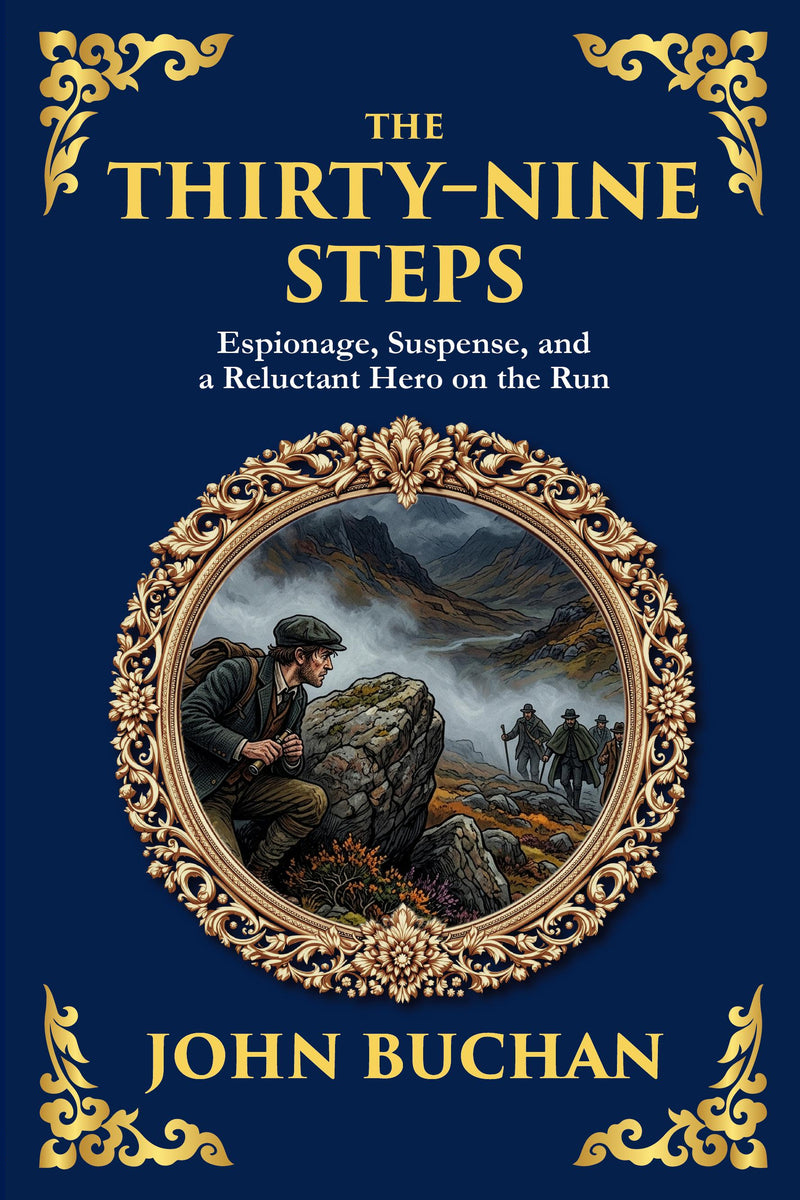
The Thirty-Nine Steps
A quiet life shattered. A man falsely accused. A plot that threatens the fate of nations. The Thirty-Nine Steps is the electrifying tale that launched the modern spy thriller genre.
or free app
10,000+ hrs library
30-day guarantee
The complete The Thirty-Nine Steps appears in modern English through Library of Alexandria Press, available online with audiobook narration included for members.
A dead man in his London flat leaves Richard Hannay with a secret notebook—and nowhere safe to turn.
Richard Hannay, a mining engineer back from southern Africa, finds London dull. Then his American neighbour, Franklin P. Scudder, claims to know of a plot to murder a foreign statesman. When Scudder is killed in Hannay’s flat, boredom gives way to danger: the police suspect Hannay, and the killers want the dead man’s secrets.
Hannay heads north into the Scottish hills, with police and foreign agents on his trail. He changes his appearance, sleeps in barns and cottages, and relies on quick thinking to keep moving. In John Buchan’s short spy novel, a cryptic puzzle—the thirty-nine steps—may hold the key to stopping a national disaster.
What you'll discover
- A reluctant man of action – Watch a restless engineer discover what his wits and outdoor skills can do under pressure.
- Escape across the moors – Follow Hannay through open country where pursuit comes by land and air.
- A dead man’s notebook – Trace the clues Scudder leaves behind as Hannay searches for the plot beneath them.
- Danger behind every disguise – A milkman’s coat offers one escape, but staying ahead demands fresh invention.
- A calm, dry voice – Hannay tells his own story with understated humour that makes each wild scrape feel believable.
Perfect for readers who enjoy a quick, clean adventure, a resourceful hero, and a glimpse of where the modern thriller began.
Open the first page now and follow Hannay from London boredom into a chase across the Scottish hills.
| Formats | eBook (EPUB + PDF) · Audiobook · Paperback · Hardcover · Large Print |
| Language | English |
| Trim size (print) | 6 × 9 in |
| Binding | Paperback — perfect-bound · Hardcover — casewrap |
| Large Print edition | Same text in a larger, easy-read type — a larger font, not a larger trim |
| Print pricing | Every physical book at our true cost — at-cost, no profit (members) |
| Library | 873 restored titles, always growing |
| Length | 43,675 words · ~2 hr 55 min reading |
| Reading level | Grade 6 · an easy, flowing read (this modern-English edition) |
| Edition | Modern English translation · 2026 |
Member reviews for this edition are collected as readers finish it — be the first. Across the library: 12,000+ books shipped, every plan covered by a 365-day print guarantee.
About this edition
A faithful, unabridged modern-English edition by The Library of Alexandria — carefully rendered for today's reader and verified paragraph-by-paragraph against the public-domain source. Available as eBook, audiobook, paperback, hardcover, and large print.
- Complete & unabridgedVerified paragraph by paragraph against the source — never a scan, never abridged.
- Modern English, faithfulReadable today, with the author’s meaning kept intact. Readable — not simplified.
- Every format, one membershipRead in your browser or the free app, or listen to the full audiobook.
Included free with your membership
Cancel anytime, one click · 30-day money-back guarantee
Edition last updated July 2026
What’s inside
The Thirty-Nine Steps — complete and unabridged: all 11 sections included with membership, plus the full audiobook.
Begin reading The Thirty-Nine Steps
In clear modern English — the complete text is included with membership.
Introduction
There are certain books that seem to vibrate with the very moment in which they were written, capturing not just a story but the nervous heartbeat of an entire age. When John Buchan sat down to write this slim, electrifying tale during the spring of 1914, he was a man in poor health, confined to bed with a duodenal ulcer, looking for something to occupy his restless mind. He could hardly have imagined that the modest adventure he scribbled out to amuse himself would go on to define an entire genre, inspire generations of writers and filmmakers, and become one of the most influential thrillers ever committed to paper. What began as a private diversion would soon read like a prophecy, published just as the world tipped over the edge into the catastrophe of the First World War.
The novel you are about to read is short—deceptively so. It can be devoured in a single sitting, and indeed Buchan intended it that way. He called this kind of story a “shocker,” by which he meant a tale “where the incidents defy the probabilities, and march just inside the borders of the possible.” There is a wonderful honesty in that phrase. Buchan never pretended to be writing high literature or psychological realism. He wanted to grab the reader by the collar and not let go until the final page. The remarkable thing is that, more than a century later, he still succeeds. The pace is breathless, the tension relentless, and the sense of a man trapped in a tightening net remains as gripping as it must have been to the soldiers who carried tattered copies of it through the trenches of France and Flanders.
This edition has been carefully prepared as a modern translation, adapted for the contemporary reader. That phrase deserves a word of explanation, because some readers may approach it with a degree of suspicion—and rightly so, for the original text is a cherished thing. The intention here is not to rewrite Buchan or to strip away his voice, but to smooth the path for readers who might otherwise stumble over the dense regional dialects, the obscure period references, and the occasionally tangled Edwardian sentence structure that can make the original heavy going for those unaccustomed to it. The spirit of the story, its momentum, its atmosphere, and its essential character remain entirely intact. Think of it as having a knowledgeable friend at your elbow, quietly clearing away the brambles so that you can move swiftly along the path the author intended. The goal, always, is to honor the experience Buchan wanted to give his readers: that headlong, heart-in-the-mouth chase across a wild and beautiful landscape.
To understand this book, it helps to understand the extraordinary man who wrote it, for John Buchan was every bit as adventurous and accomplished as the heroes he created. Born in Perth, Scotland, in 1875, the son of a Free Church minister, he was a child of modest means and immense ambition. He devoured books, walked the hills, and absorbed the rhythms of Scottish speech and the textures of the Scottish countryside—all of which would later pour into his fiction. He won scholarships, studied at the University of Glasgow and then at Oxford, and even while still a student began publishing essays and stories. By the time he reached adulthood, it was clear that this was a person of almost alarming energy and range.
Buchan’s life reads like the curriculum vitae of three or four different men. He was a barrister, a publisher, a war correspondent, a politician, a historian, and a prolific author who turned out novels, biographies, and works of history at a pace that would exhaust most professional writers. He served as a colonial administrator in South Africa in the years following the Boer War, an experience that shaped his views of empire, duty, and the wide spaces of the world. During the First World War, he worked in intelligence and propaganda, eventually becoming Director of Information for the British government—a role that gave him intimate knowledge of the shadowy machinery of espionage and statecraft that hums beneath the surface of his fiction. And in the final chapter of his remarkable life, he was appointed Governor General of Canada, a post he held until his death in 1940, by which time he had been elevated to the peerage as Lord Tweedsmuir.
What matters most for our purposes is that Buchan brought to his writing a rare combination of qualities. He had genuine literary gifts—an eye for landscape, a feel for character, a command of pace—but he also had firsthand experience of the corridors of power and the realities of international intrigue. He knew the men who ran intelligence networks; he understood how rumors spread, how secrets were kept and lost, how a single piece of information could alter the fate of nations. When he wrote about plots and counterplots, about agents and assassins, he was drawing on something real, even if he dressed it up in the bright, improbable colors of the “shocker.”
It is worth dwelling, too, on Buchan’s deep love of the natural world, because it is one of the secret engines of this novel. He was a passionate walker and outdoorsman, intimately familiar with the moors, hills, and glens that form the backdrop of much of the action. The landscape in these pages is not mere scenery; it is a living, breathing presence—sometimes a refuge, sometimes a trap, always magnificent. The reader who has never set foot in Scotland will nonetheless come away with the sensation of having tramped across heather under a wide and changing sky, of having hidden in a thicket while the drone of an aircraft circles overhead, of having felt the particular loneliness and exhilaration of open country. Buchan understood that the chase becomes infinitely more thrilling when it unfolds across terrain that is itself a character—beautiful, indifferent, and full of hiding places and hazards alike.
The hero Buchan created here, Richard Hannay, would go on to appear in several further novels, becoming one of the great recurring protagonists of British adventure fiction. He is a particular kind of figure: capable, resourceful, physically brave, but emphatically an ordinary man rather than a superhuman one. He is not a trained spy or a brilliant detective. He is, when we first meet him, simply a man who has returned to Britain after years abroad and finds himself profoundly bored, longing for something to happen. Be careful what you wish for. The genius of Hannay as a character is precisely his relatability. He blunders, he improvises, he is frightened, he makes mistakes, and he relies heavily on luck and on the kindness of strangers. He is the prototype of what we might call the “reluctant hero”—the unremarkable person thrust into extraordinary circumstances who must discover reserves of courage and ingenuity he never knew he possessed.
It is difficult to overstate the influence this book has had on the literature and cinema that followed it. When we speak of the modern thriller—the tale of the innocent man wrongly accused, pursued by both the villains and the authorities, racing against time to clear his name and prevent a catastrophe—we are speaking of a template that Buchan did more than anyone to establish. The “man on the run” plot, in which the protagonist must keep moving, keep improvising, keep one step ahead of his pursuers while the reader’s pulse quickens with every near-miss, is one of the most durable and beloved structures in all of popular storytelling. And so much of it traces back to these pages.
Consider for a moment how many later works owe a debt to this slim volume. The espionage novels of Eric Ambler, Graham Greene, Ian Fleming, and John le Carré all build on foundations that Buchan helped to lay. The countless films in which an ordinary man is suddenly plunged into a world of conspiracy and danger—pursued across landscapes both urban and wild, unable to trust anyone, forced to rely on his wits—are descendants of this story. The great director Alfred Hitchcock, who adapted the novel for the screen in 1935, was so taken with its central premise that he returned again and again throughout his career to the theme of the wrongly accused man fleeing across country. Hitchcock’s later masterpieces, including the iconic chase films of his American period, are in many ways elaborations of the dynamic that Buchan perfected here. When you watch a hero clinging to the side of a monument, or running across an open field as danger closes in, you are watching the long shadow of this novel.
But to read the book purely as a historical artifact, a museum piece of literary influence, would be to miss the point entirely. The reason it has endured—the reason it continues to be read, adapted, and loved—is that it remains genuinely, thrillingly entertaining. From the moment the story sets its machinery in motion, it does not let up. There is a murder, a flight, a chase, a series of hairsbreadth escapes and ingenious disguises, a deepening mystery, and a final race against the clock with the fate of the nation hanging in the balance. The structure is almost musical in its precision, building tension, releasing it just enough to let the reader breathe, then ratcheting it tighter again. Buchan was a master of pace, and that mastery is on full display.
There is also a particular flavor to the tension in this book that distinguishes it from later, more cynical works in the genre. Written on the very eve of the First World War, it captures a world that still believed, however precariously, in honor, in the gentleman’s code, in the fundamental decency of the ordinary person. Yet it is also shot through with a creeping sense of unease, a premonition that dark forces are gathering, that the comfortable certainties of Edwardian Britain are about to be swept away. There is something almost uncanny about reading it now, knowing what was about to befall the world. Buchan’s villains plot in the shadows while the unsuspecting public goes about its business; a great conflict looms; the safety of the realm depends on whether one ordinary man can piece together a deadly puzzle in time. The book throbs with the anxieties of its moment, and that authenticity gives it a weight that mere escapism could never achieve.
The plot itself is built around a tantalizing central mystery, one that gives the book its memorable and enigmatic title. I will not spoil the pleasures of discovery here—part of the joy of this story is the way its secrets unfold, the way meanings shift and clarify as Hannay races toward understanding. Suffice it to say that the title refers to a riddle, a code, a fragment of crucial information that must be deciphered before it is too late, and that the slow revelation of its meaning provides one of the great satisfactions of the reading experience. Buchan understood the power of the partial clue, the half-glimpsed pattern, the sense that the protagonist—and the reader—is groping toward a truth that is just out of reach. He doles out information with the skill of a master magician, always keeping us guessing, always staying just ahead of our expectations.
What also strikes the modern reader is the sheer physicality of the adventure. This is not a story of clever men sitting in rooms exchanging cryptic dialogue. It is a story of running, climbing, hiding, fighting, and surviving in the open. Hannay is forced to live by his wits and his body, to endure cold and hunger and exhaustion, to throw himself off moving trains and scramble across rocky hillsides and squeeze through impossibly tight spots. There is a tactile, almost cinematic vividness to these passages that explains why the story has proved so irresistible to filmmakers. You can feel the heather scratching at your legs, the wind in your face, the burning in your lungs as you flee across the moor with the hunters closing in. Buchan’s prose, even in adaptation, retains this kinetic energy, this sense of perpetual forward motion.
A few words may help the contemporary reader get the most from the experience that lies ahead. First, it is worth approaching the book in the spirit in which it was written—as entertainment, as a rollicking adventure meant to be enjoyed at speed. Buchan dedicated the original to a friend with a charming note in which he confessed his fondness for the kind of tale “where the incidents defy the probabilities.” He was not being falsely modest; he genuinely delighted in the breathless improbabilities of the form. So should we. If, here and there, a coincidence seems a little too convenient, an escape a little too lucky, that is not a flaw but a feature. These are the conventions of the genre Buchan was helping to invent, and they are part of the fun. Surrender to the momentum, and you will be richly rewarded.
Cancel anytime, one click · 30-day money-back guarantee
Founding annual rate available now — your price locks for life when you join.
Not ready? Get this free chapter by email — read it anytime.
✓ Sent — check your inbox for The Thirty-Nine Steps.
Questions about The Thirty-Nine Steps
What is The Thirty-Nine Steps about?
It follows Richard Hannay, who is blamed for a murder in London and runs to Scotland with a coded notebook, chased by police and by spies who want to start a war.
When was The Thirty-Nine Steps written?
John Buchan wrote it in 1915, early in the First World War. The story itself is set just before the war begins, in the spring and summer of 1914.
Is The Thirty-Nine Steps a true story?
No, it is fiction. Buchan drew on real fears of German spies and on his love of the Scottish hills, but Hannay, Scudder and the plot are invented.
Is The Thirty-Nine Steps hard to read?
No. It is short, written in a clear first-person voice, and paced like a chase. Some period words and references may be unfamiliar, but the plot is easy to follow.
Shipping & returns
Billing & membership
More from the library


Explore Adventure
- The Prince and the Pauper · Mark Twain
- Tarzan of the Apes · Edgar Rice Burroughs
- Peter Pan · J. M. Barrie
- Moby-Dick · Herman Melville
- The Virginian: A Horseman of the Plains — Large Print · Owen Wister
- Italian Hours — Large Print · Henry James
- Italian Hours · Henry James
- The Riddle of the Sands — Large Print · Erskine Childers
- The Lost World — Large Print · Arthur Conan Doyle
- Anabasis — Large Print · Xenophon
- White Fang — Large Print · Jack London
- The Three Musketeers — Large Print · Alexandre Dumas; Auguste Maquet
- Candide · Voltaire
- The Tomb of Ts'in — Large Print · Edgar Wallace
- Candide — Large Print · Voltaire
- Peter Pan — Large Print · J. M. Barrie
- Red Nails — Large Print · Robert E. Howard
- Gulliver of Mars — Large Print · Edwin Lester Arnold
- Out of Time's Abyss — Large Print · Edgar Rice Burroughs
- Jewels of Gwahlur — Large Print · Robert E. Howard
- The Doomsman — Large Print · Van Tassel Sutphen
- Armageddon—2419 A.D. · Philip Francis Nowlan
- Armageddon—2419 A.D. — Large Print · Philip Francis Nowlan
- The Hunniwell Boys and the Platinum Mystery — Large Print · L. P. Wyman
- The Railway Children — Large Print · E. Nesbit
- She — Large Print · H. Rider Haggard
- The People of the Black Circle — Large Print · Robert E. Howard
- The Thirty-Nine Steps — Large Print · John Buchan
- Around the World in Eighty Days — Large Print · Jules Verne
- The Hour of the Dragon — Large Print · Robert E. Howard
The Thirty-Nine Steps
The Thirty-Nine Steps
Espionage, Suspense, and a Reluctant Hero on the Run
John Buchan
Contents
- Introduction
- Chapter 1
- Chapter 2
- Chapter 3
- Chapter 4
- Chapter 5
- Chapter 6
- Chapter 7
- Chapter 8
- Chapter 9
- Chapter 10
Introduction
There are certain books that seem to vibrate with the very moment in which they were written, capturing not just a story but the nervous heartbeat of an entire age. When John Buchan sat down to write this slim, electrifying tale during the spring of 1914, he was a man in poor health, confined to bed with a duodenal ulcer, looking for something to occupy his restless mind. He could hardly have imagined that the modest adventure he scribbled out to amuse himself would go on to define an entire genre, inspire generations of writers and filmmakers, and become one of the most influential thrillers ever committed to paper. What began as a private diversion would soon read like a prophecy, published just as the world tipped over the edge into the catastrophe of the First World War.
The novel you are about to read is short—deceptively so. It can be devoured in a single sitting, and indeed Buchan intended it that way. He called this kind of story a “shocker,” by which he meant a tale “where the incidents defy the probabilities, and march just inside the borders of the possible.” There is a wonderful honesty in that phrase. Buchan never pretended to be writing high literature or psychological realism. He wanted to grab the reader by the collar and not let go until the final page. The remarkable thing is that, more than a century later, he still succeeds. The pace is breathless, the tension relentless, and the sense of a man trapped in a tightening net remains as gripping as it must have been to the soldiers who carried tattered copies of it through the trenches of France and Flanders.
This edition has been carefully prepared as a modern translation, adapted for the contemporary reader. That phrase deserves a word of explanation, because some readers may approach it with a degree of suspicion—and rightly so, for the original text is a cherished thing. The intention here is not to rewrite Buchan or to strip away his voice, but to smooth the path for readers who might otherwise stumble over the dense regional dialects, the obscure period references, and the occasionally tangled Edwardian sentence structure that can make the original heavy going for those unaccustomed to it. The spirit of the story, its momentum, its atmosphere, and its essential character remain entirely intact. Think of it as having a knowledgeable friend at your elbow, quietly clearing away the brambles so that you can move swiftly along the path the author intended. The goal, always, is to honor the experience Buchan wanted to give his readers: that headlong, heart-in-the-mouth chase across a wild and beautiful landscape.
To understand this book, it helps to understand the extraordinary man who wrote it, for John Buchan was every bit as adventurous and accomplished as the heroes he created. Born in Perth, Scotland, in 1875, the son of a Free Church minister, he was a child of modest means and immense ambition. He devoured books, walked the hills, and absorbed the rhythms of Scottish speech and the textures of the Scottish countryside—all of which would later pour into his fiction. He won scholarships, studied at the University of Glasgow and then at Oxford, and even while still a student began publishing essays and stories. By the time he reached adulthood, it was clear that this was a person of almost alarming energy and range.
Buchan’s life reads like the curriculum vitae of three or four different men. He was a barrister, a publisher, a war correspondent, a politician, a historian, and a prolific author who turned out novels, biographies, and works of history at a pace that would exhaust most professional writers. He served as a colonial administrator in South Africa in the years following the Boer War, an experience that shaped his views of empire, duty, and the wide spaces of the world. During the First World War, he worked in intelligence and propaganda, eventually becoming Director of Information for the British government—a role that gave him intimate knowledge of the shadowy machinery of espionage and statecraft that hums beneath the surface of his fiction. And in the final chapter of his remarkable life, he was appointed Governor General of Canada, a post he held until his death in 1940, by which time he had been elevated to the peerage as Lord Tweedsmuir.
What matters most for our purposes is that Buchan brought to his writing a rare combination of qualities. He had genuine literary gifts—an eye for landscape, a feel for character, a command of pace—but he also had firsthand experience of the corridors of power and the realities of international intrigue. He knew the men who ran intelligence networks; he understood how rumors spread, how secrets were kept and lost, how a single piece of information could alter the fate of nations. When he wrote about plots and counterplots, about agents and assassins, he was drawing on something real, even if he dressed it up in the bright, improbable colors of the “shocker.”
It is worth dwelling, too, on Buchan’s deep love of the natural world, because it is one of the secret engines of this novel. He was a passionate walker and outdoorsman, intimately familiar with the moors, hills, and glens that form the backdrop of much of the action. The landscape in these pages is not mere scenery; it is a living, breathing presence—sometimes a refuge, sometimes a trap, always magnificent. The reader who has never set foot in Scotland will nonetheless come away with the sensation of having tramped across heather under a wide and changing sky, of having hidden in a thicket while the drone of an aircraft circles overhead, of having felt the particular loneliness and exhilaration of open country. Buchan understood that the chase becomes infinitely more thrilling when it unfolds across terrain that is itself a character—beautiful, indifferent, and full of hiding places and hazards alike.
The hero Buchan created here, Richard Hannay, would go on to appear in several further novels, becoming one of the great recurring protagonists of British adventure fiction. He is a particular kind of figure: capable, resourceful, physically brave, but emphatically an ordinary man rather than a superhuman one. He is not a trained spy or a brilliant detective. He is, when we first meet him, simply a man who has returned to Britain after years abroad and finds himself profoundly bored, longing for something to happen. Be careful what you wish for. The genius of Hannay as a character is precisely his relatability. He blunders, he improvises, he is frightened, he makes mistakes, and he relies heavily on luck and on the kindness of strangers. He is the prototype of what we might call the “reluctant hero”—the unremarkable person thrust into extraordinary circumstances who must discover reserves of courage and ingenuity he never knew he possessed.
It is difficult to overstate the influence this book has had on the literature and cinema that followed it. When we speak of the modern thriller—the tale of the innocent man wrongly accused, pursued by both the villains and the authorities, racing against time to clear his name and prevent a catastrophe—we are speaking of a template that Buchan did more than anyone to establish. The “man on the run” plot, in which the protagonist must keep moving, keep improvising, keep one step ahead of his pursuers while the reader’s pulse quickens with every near-miss, is one of the most durable and beloved structures in all of popular storytelling. And so much of it traces back to these pages.
Consider for a moment how many later works owe a debt to this slim volume. The espionage novels of Eric Ambler, Graham Greene, Ian Fleming, and John le Carré all build on foundations that Buchan helped to lay. The countless films in which an ordinary man is suddenly plunged into a world of conspiracy and danger—pursued across landscapes both urban and wild, unable to trust anyone, forced to rely on his wits—are descendants of this story. The great director Alfred Hitchcock, who adapted the novel for the screen in 1935, was so taken with its central premise that he returned again and again throughout his career to the theme of the wrongly accused man fleeing across country. Hitchcock’s later masterpieces, including the iconic chase films of his American period, are in many ways elaborations of the dynamic that Buchan perfected here. When you watch a hero clinging to the side of a monument, or running across an open field as danger closes in, you are watching the long shadow of this novel.
But to read the book purely as a historical artifact, a museum piece of literary influence, would be to miss the point entirely. The reason it has endured—the reason it continues to be read, adapted, and loved—is that it remains genuinely, thrillingly entertaining. From the moment the story sets its machinery in motion, it does not let up. There is a murder, a flight, a chase, a series of hairsbreadth escapes and ingenious disguises, a deepening mystery, and a final race against the clock with the fate of the nation hanging in the balance. The structure is almost musical in its precision, building tension, releasing it just enough to let the reader breathe, then ratcheting it tighter again. Buchan was a master of pace, and that mastery is on full display.
There is also a particular flavor to the tension in this book that distinguishes it from later, more cynical works in the genre. Written on the very eve of the First World War, it captures a world that still believed, however precariously, in honor, in the gentleman’s code, in the fundamental decency of the ordinary person. Yet it is also shot through with a creeping sense of unease, a premonition that dark forces are gathering, that the comfortable certainties of Edwardian Britain are about to be swept away. There is something almost uncanny about reading it now, knowing what was about to befall the world. Buchan’s villains plot in the shadows while the unsuspecting public goes about its business; a great conflict looms; the safety of the realm depends on whether one ordinary man can piece together a deadly puzzle in time. The book throbs with the anxieties of its moment, and that authenticity gives it a weight that mere escapism could never achieve.
The plot itself is built around a tantalizing central mystery, one that gives the book its memorable and enigmatic title. I will not spoil the pleasures of discovery here—part of the joy of this story is the way its secrets unfold, the way meanings shift and clarify as Hannay races toward understanding. Suffice it to say that the title refers to a riddle, a code, a fragment of crucial information that must be deciphered before it is too late, and that the slow revelation of its meaning provides one of the great satisfactions of the reading experience. Buchan understood the power of the partial clue, the half-glimpsed pattern, the sense that the protagonist—and the reader—is groping toward a truth that is just out of reach. He doles out information with the skill of a master magician, always keeping us guessing, always staying just ahead of our expectations.
What also strikes the modern reader is the sheer physicality of the adventure. This is not a story of clever men sitting in rooms exchanging cryptic dialogue. It is a story of running, climbing, hiding, fighting, and surviving in the open. Hannay is forced to live by his wits and his body, to endure cold and hunger and exhaustion, to throw himself off moving trains and scramble across rocky hillsides and squeeze through impossibly tight spots. There is a tactile, almost cinematic vividness to these passages that explains why the story has proved so irresistible to filmmakers. You can feel the heather scratching at your legs, the wind in your face, the burning in your lungs as you flee across the moor with the hunters closing in. Buchan’s prose, even in adaptation, retains this kinetic energy, this sense of perpetual forward motion.
A few words may help the contemporary reader get the most from the experience that lies ahead. First, it is worth approaching the book in the spirit in which it was written—as entertainment, as a rollicking adventure meant to be enjoyed at speed. Buchan dedicated the original to a friend with a charming note in which he confessed his fondness for the kind of tale “where the incidents defy the probabilities.” He was not being falsely modest; he genuinely delighted in the breathless improbabilities of the form. So should we. If, here and there, a coincidence seems a little too convenient, an escape a little too lucky, that is not a flaw but a feature. These are the conventions of the genre Buchan was helping to invent, and they are part of the fun. Surrender to the momentum, and you will be richly rewarded.
I came back from the City around three o’clock that May afternoon, feeling completely fed up with everything. I had been back in my home country for three months, and I was sick of it. If someone had told me a year ago that I would feel this way, I would have laughed in their face; but that was the reality. The weather made me irritable, and the conversations of the average Englishman bored me to tears. I wasn’t getting enough exercise, and London’s entertainment felt as flat as a soda that had been sitting in the sun. “Richard Hannay,” I kept telling myself, “you’ve landed in the wrong place, and it’s time to get out.”
It was frustrating to remember the plans I had made over the last few years in Buluwayo. I had built up a decent amount of money—not a fortune, but plenty for my needs—and I had imagined all sorts of ways to enjoy myself. My father had taken me away from Scotland when I was six, and I hadn’t been back since; because of that, England seemed like a fairy tale to me, and I had planned to spend the rest of my life there.
However, I was disappointed from the very start. Within a week, I was tired of sightseeing, and in less than a month, I had had enough of fancy restaurants, theaters, and horse races. I didn’t have a real friend to hang out with, which probably explains why I felt this way. Plenty of people invited me over, but they didn’t seem genuinely interested in me. They would ask a couple of questions about South Africa and then immediately start talking about their own lives. Many patriotic ladies invited me to tea to meet teachers from New Zealand or editors from Vancouver, which was the most depressing part of all. There I was, thirty-seven years old, healthy and strong, with plenty of money to have fun, yet I spent my days yawning with boredom. I had almost decided to pack up and head back to the veld, because I was officially the most bored man in the United Kingdom.
End of the free sample
Keep reading, free
Members read and listen to the complete book — and the entire library. Cancel anytime, one click · 30-day money-back guarantee.