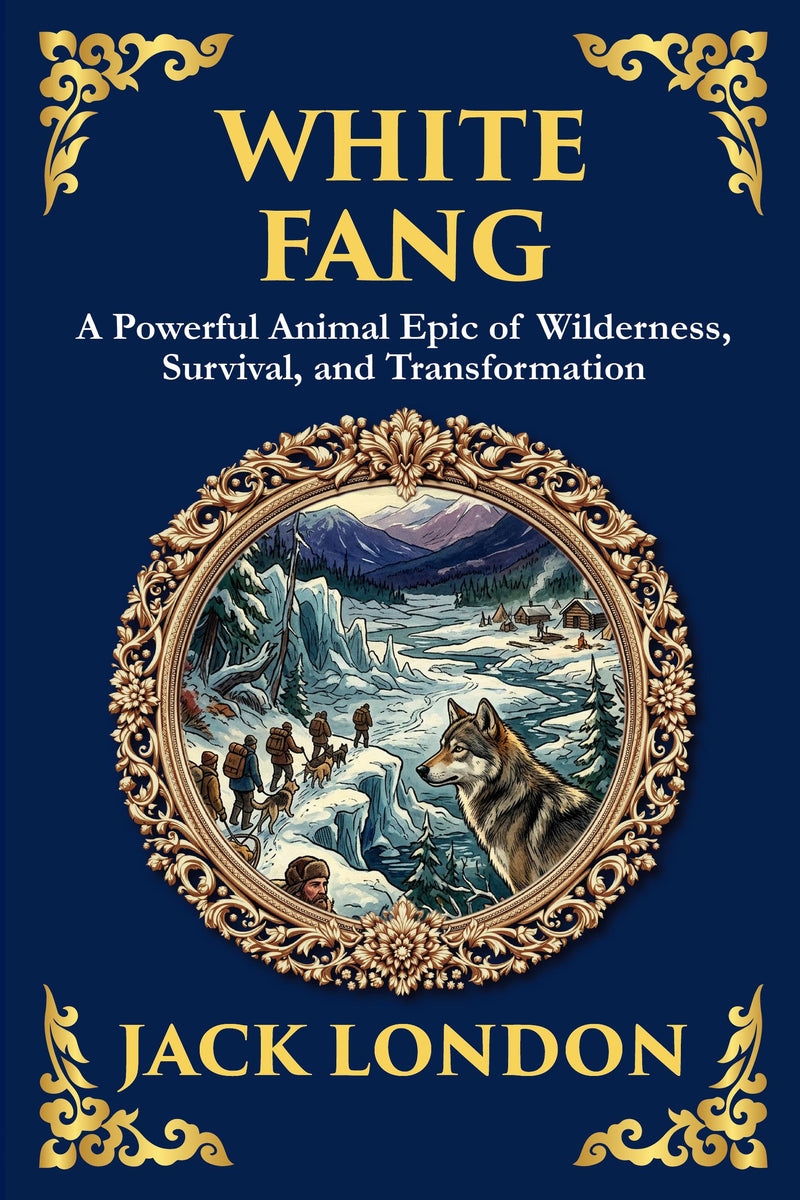
White Fang — Large Print
Deep in the unforgiving wilderness of the Yukon, a wild wolf-dog named White Fang struggles to survive against nature’s harshest challenges and mankind’s cruelty.
or free app
10,000+ hrs library
30-day guarantee
The complete White Fang appears in modern English through Library of Alexandria Press, available online with audiobook narration included for members.
Have you ever wondered why some creatures thrive in the wild while others are shaped by the hands of men? Jack London’s White Fang is a spellbinding masterpiece of survival, transformation, and the primal conflict between savagery and civilization. Set against the rugged backdrop of the Yukon during the Klondike Gold Rush, this novel tells the powerful journey of a wolf-dog born into the brutal wilderness, only to be thrust into the dangerous and often cruel world of men.
At its core, White Fang is a story about struggle, redemption, and the possibility of change, even in the most hostile environments. Through White Fang’s eyes, readers experience both the relentless brutality of the natural world and the complexity of human nature.
What you’ll discover in this modern edition
- The Harsh Beauty of the Wild – Explore the majestic but unforgiving landscapes of the Yukon, where survival depends on strength, cunning, and instinct.
- The Wolf-Dog’s Journey – Follow White Fang as he evolves from a wild creature to a loyal companion, facing challenges that test his spirit at every turn.
- The Dark Side of Humanity – Witness the cruelty and greed of men who exploit animals and nature for their own gain.
- The Power of Compassion and Redemption – Experience the transformative power of kindness as White Fang encounters a human who changes his life forever.
- A Profound Allegory – Delve into Jack London’s deeper themes of freedom, dominance, love, and the eternal struggle between the wild and the civilized.
| Formats | eBook (EPUB + PDF) · Audiobook · Paperback · Hardcover · Large Print |
| Language | English |
| Trim size (print) | 6 × 9 in |
| Binding | Paperback — perfect-bound · Hardcover — casewrap |
| Large Print edition | Same text in a larger, easy-read type — a larger font, not a larger trim |
| Print pricing | Every physical book at our true cost — at-cost, no profit (members) |
| Library | 873 restored titles, always growing |
| Length | 69,408 words · ~4 hr 38 min reading |
| Reading level | Grade 7 · an easy, flowing read (this modern-English edition) |
| Edition | Modern English translation · 2026 |
Member reviews for this edition are collected as readers finish it — be the first. Across the library: 12,000+ books shipped, every plan covered by a 365-day print guarantee.
About this edition
A faithful, unabridged modern-English edition by The Library of Alexandria — carefully rendered for today's reader and verified paragraph-by-paragraph against the public-domain source. Available as eBook, audiobook, paperback, hardcover, and large print.
- Complete & unabridgedVerified paragraph by paragraph against the source — never a scan, never abridged.
- Modern English, faithfulReadable today, with the author’s meaning kept intact. Readable — not simplified.
- Every format, one membershipRead in your browser or the free app, or listen to the full audiobook.
Included free with your membership
Cancel anytime, one click · 30-day money-back guarantee
Edition last updated July 2026
What’s inside
White Fang — Large Print — complete and unabridged: all 12 sections included with membership, plus the full audiobook.
Begin reading White Fang — Large Print
In clear modern English — the complete text is included with membership.
Introduction
There are some books that do not simply tell a story but plunge you bodily into a world—into its cold, its hunger, its terror, and its fragile, hard-won moments of warmth. White Fang is such a book. From its opening pages, set against the merciless silence of the frozen North, Jack London grips the reader with a vision of nature so vast and indifferent that human beings and animals alike seem small, vulnerable specks struggling against forces older and greater than themselves. And yet, out of this bleak landscape, London draws one of literature’s most extraordinary portraits of a single life: the slow, painful, magnificent journey of a creature shaped by cruelty who learns, against all odds, what it means to be loved.
Published in 1906, White Fang arrived at the height of London’s fame, written as a deliberate companion and mirror to his earlier triumph, The Call of the Wild. Where that earlier novel traced the path of a domesticated dog reverting to the wild, answering the ancestral pull of the wilderness, White Fang reverses the journey entirely. It begins in wildness—in the snowbound, lawless North where survival is the only law—and moves gradually, unsteadily, toward civilization, toward trust, toward the possibility of tenderness. The two books form a kind of philosophical diptych, each illuminating the other, each asking the same fundamental questions about nature and nurture, freedom and belonging, the instincts we are born with and the choices that remake us.
This modern translation has been carefully prepared to bring London’s powerful narrative to the contemporary reader without sacrificing the rhythm, intensity, and emotional force that have made it a beloved classic for more than a century. The aim is not to dilute London’s voice but to clear away the small obstacles of dated phrasing and unfamiliar usage that can stand between a modern reader and the raw immediacy of the experience he sought to create. What remains is the essential thing: a story that grips the heart and refuses to let go.
What makes White Fang so remarkable—and what sets it apart from the countless animal stories that came before and after it—is the boldness of its central narrative experiment. For much of the novel, London asks us to see the world not as humans see it, but as it might be perceived by a creature without language, without abstraction, without the comforting illusions of meaning and morality that we take for granted. We experience the world through senses sharpened by necessity: the smell of approaching danger, the sound of breaking branches, the changing texture of light and snow, the deep, wordless logic of hunger and fear.
This is an astonishing achievement, and London accomplishes it without ever lapsing into sentimentality or cheap anthropomorphism. He does not put human thoughts into an animal’s mind, nor does he pretend that his subject reasons as we do. Instead, he tries to imagine, with extraordinary discipline and imaginative sympathy, what consciousness might feel like when it is built entirely out of instinct and experience. He shows us how knowledge is acquired through pain and repetition, how the world reveals itself piece by piece as a series of laws to be learned, how a young creature comes to understand cause and effect, danger and safety, the difference between what may be approached and what must be feared.
There is a famous passage early in the book in which the world is described as it first appears to a creature emerging from the dim safety of a lair into the blinding, terrifying openness of the outside. The wall of the cave, which had always yielded to the explorations of a curious body, suddenly does not yield, and the discovery that some things are solid and others are not becomes a kind of primal physics lesson. London renders these moments of dawning awareness with such precision and tenderness that we feel them as discoveries of our own. We are reminded, perhaps, of how strange and overwhelming the world must once have seemed to each of us, before familiarity dulled its edges.
This interior perspective is the engine that drives the entire novel. Because we understand the world as our subject understands it, we feel every blow, every betrayal, every fleeting moment of comfort with an intimacy that would be impossible from a purely external vantage point. When cruelty is inflicted, we do not merely witness it—we comprehend the logic it builds in a developing mind, the lessons it teaches, the hardness it forges. And when, much later in the story, something gentler enters that life, we understand precisely how alien, how incomprehensible, and how transformative such gentleness must be to a being who has known only the law of club and fang.
This is also what makes the novel’s emotional payoff so profound. London does not ask us to feel pity for his protagonist as we might feel pity for a suffering creature in a parable. He asks us to inhabit a life, to understand it from within, and so the eventual movement toward trust and affection is not merely touching—it is earned, hard-won, and almost unbearably moving. We have walked every step of the journey. We know exactly what has been overcome.
It is worth saying a word here about London’s philosophical preoccupations, because they animate every page of this book and give it a depth that rewards careful reading. London was deeply influenced by the intellectual currents of his age—by Darwin’s theory of evolution, by Herbert Spencer’s notion of the “survival of the fittest,” and by a broadly materialist view of life as a struggle for existence in which environment shapes the organism. He was also, paradoxically, a passionate believer in the redemptive power of love and the capacity of living beings to be changed by their circumstances. White Fang is, in many ways, an extended meditation on these ideas. It asks whether a creature is merely the sum of its environment, or whether something can intervene—whether kindness, patience, and connection can reshape a nature that cruelty has hardened. The answer the novel offers is neither simple nor sentimental, and it is all the more powerful for its honesty.
The wilderness itself is one of the book’s most unforgettable characters. London opens the novel not with his animal protagonist but with two men struggling through the frozen waste, hunted by a pack of starving wolves, and in these early chapters he establishes the iron law that will govern everything that follows. The North is described with a kind of awful majesty—as a place that does not hate life so much as remain utterly indifferent to it, a vast white silence that swallows up sound and motion and ambition alike. “Life is an offense to it,” London writes of the Wild, “for life is movement; and the Wild aims always to destroy movement.” This is the world into which our protagonist is born, and it is against this implacable backdrop that the small, flickering drama of one life’s survival takes on its tremendous significance.
To understand White Fang, it helps to understand something of the extraordinary man who wrote it, for few authors have lived so much of what they put on the page. Jack London was born in San Francisco in 1876, into poverty and uncertainty, and his early life was a series of hard struggles that would have crushed a lesser spirit. He worked in a cannery as a boy, laboring brutal hours for pennies. He became an oyster pirate, raiding the commercial beds of San Francisco Bay, and then switched sides to work for the Fish Patrol. He sailed the Pacific on a sealing schooner. He rode the rails as a tramp, was jailed for vagrancy, and tasted the bitter underside of American life during the economic depressions of the 1890s.
But it was the Klondike Gold Rush of 1897 that would prove the crucible of London’s imagination. Like thousands of others, he journeyed north to the Yukon in search of gold, and though he found little of the metal itself, he discovered something far more valuable: the raw material that would fuel his greatest work. He endured the savage cold, the isolation, the hunger, and the desperate camaraderie of men pushed to the limits of endurance. He listened to the stories of trappers and prospectors and Native peoples. He watched the sled dogs that were the lifeblood of northern travel—their loyalty, their ferocity, their endurance, their place in the brutal economy of survival. And he came to know intimately the great, terrible, beautiful landscape that would become the setting for his most enduring fiction.
When London returned from the Klondike, he was determined to become a writer, and he pursued that goal with the same ferocious will that had carried him through every earlier hardship. He taught himself the craft through sheer discipline, reportedly setting himself a quota of a thousand words a day, devouring books on philosophy, science, and literature, and submitting story after story until the rejections finally gave way to acceptance. By the early 1900s, he had become one of the most popular and highly paid writers in America, his vivid tales of adventure and survival capturing the imagination of a vast readership. The Call of the Wild, published in 1903, made him internationally famous. White Fang followed three years later and confirmed his place among the great American storytellers.
What London brought to his fiction was not merely adventure but a profound seriousness of purpose. He was a man of fierce contradictions—a self-made individualist who became a committed socialist, a celebrant of raw physical struggle who was also a voracious intellectual, a writer of thrilling popular entertainments who wove into them the deepest questions of his age. His prose has a muscular directness, a vigor and momentum that pull the reader forward, but beneath the surface excitement there is always a thinking mind at work, wrestling with the great problems of existence: the relationship between the individual and the environment, the meaning of suffering, the nature of cruelty and kindness, the possibility of transformation.
It is this combination—the visceral power of the storytelling married to the depth of the underlying vision—that has kept London’s work alive long after most of his contemporaries have been forgotten. White Fang is adventure of the highest order, full of danger and violence and narrow escapes, and it can be read simply as a thrilling tale. But it is also a serious work of art, a sustained inquiry into how a living being is made and remade by the forces that act upon it. The reader who comes for the adventure will stay for something deeper, often without quite realizing when the transition occurred.
London understood, too, the peculiar power of the animal protagonist as a vehicle for human truths. By telling his story through the consciousness of a creature, he could strip away the layers of self-deception and social convention that complicate human behavior and reveal the elemental forces underneath. The struggle for survival, the shaping power of fear and love, the way cruelty breeds cruelty and kindness can, in time, breed trust—these things show themselves with a stark clarity in the life of an animal that they rarely achieve in the tangled affairs of human beings. And yet, paradoxically, the more deeply we enter into the experience of London’s animal protagonist, the more we recognize ourselves. We too are shaped by our environments. We too carry the marks of how we have been treated. We too are capable, under the right conditions, of remarkable change. The animal becomes a mirror in which we glimpse the truth of our own nature.
It should be noted that White Fang is, in places, a hard book. London does not flinch from the violence of the world he depicts. There is cruelty in these pages—the casual cruelty of nature, the deliberate cruelty of certain human beings, the savagery of conflict between creatures driven by hunger and fear. London believed that to soften these realities would be to falsify them, and to falsify the suffering would be to cheapen the eventual redemption. The darkness in the novel is not gratuitous; it is the necessary foundation upon which the book’s ultimate affirmation is built. The light shines brightest against the deepest shadow, and the transformation at the heart of the story would mean nothing if we did not fully understand the conditions from which it arises. Readers should be prepared for moments of genuine harshness, but they should also trust that London is taking them somewhere worth going.
Cancel anytime, one click · 30-day money-back guarantee
Founding annual rate available now — your price locks for life when you join.
Not ready? Get this free chapter by email — read it anytime.
✓ Sent — check your inbox for White Fang — Large Print.
Questions about White Fang — Large Print
What is White Fang about?
Deep in the unforgiving wilderness of the Yukon, a wild wolf-dog named White Fang struggles to survive against nature’s harshest challenges and mankind’s cruelty. Born in the wild but thrust into the world of men, he must navigate the fragile balance between savagery and civilization. From the icy silence of the northern wild to the bustling towns of the gold rush, White Fang’s journey is a tale of resilience, transformation, and the unbreakable spirit of survival.
Who wrote White Fang?
White Fang was written by Jack London. This edition presents the complete work in clear modern English, faithfully rendered from the public-domain original by Library of Alexandria Press.
Is White Fang free to read?
The opening chapter is free to read on this page. Members read and listen to the complete work — and the entire library — free, and can order any physical book at our true print cost.
How long is White Fang?
12 chapters (~69,408 words) — about 4 hr 38 min of reading in this modern-English edition.
Is this an abridged version of White Fang?
No. This is the complete, unabridged White Fang, carefully rendered into clear modern English and verified paragraph-by-paragraph against the public-domain source — nothing is cut or summarised.
What formats does White Fang come in?
White Fang is available as eBook, paperback, hardcover and large print. eBook and audiobook are included with membership; printed editions ship at our true print cost.
Shipping & returns
Billing & membership
More from the library


Explore Adventure
- Tarzan of the Apes · Edgar Rice Burroughs
- The Wonderful Wizard of Oz · L. Frank Baum
- Peter Pan · J. M. Barrie
- Moby Dick; Or, The Whale · Herman Melville
- The Riddle of the Sands · Erskine Childers
- The Loss of the Swansea: A Story of the Florida Coast · W. L. Alden
- Sky Island · L. Frank Baum
- Vikram and the Vampire: Classic Hindu Tales of Adventure, Magic, and Romance · Unknown
- Tales of Unrest · Joseph Conrad
- The Tomb of Ts’in · Edgar Wallace
- Skinny McCord · Percy Keese Fitzhugh
- The Men of the Moss-Hags · S. R. Crockett
- The Hunniwell Boys and the Platinum Mystery · L. P. Wyman
- Allan Quatermain · H. Rider Haggard
- She · H. Rider Haggard
- Medical Life in the Navy · Gordon Stables
- The Thirty-Nine Steps · John Buchan
- The Story of Doctor Dolittle · Hugh Lofting
- The Princess and the Goblin · George MacDonald
- The Man Who Would Be King · Rudyard Kipling
- Lucian’s True History · Lucian of Samosata
- The Secret Adversary · Agatha Christie
- Lord Jim · Joseph Conrad
- The Marvelous Land of Oz · L. Frank Baum
- The Virginian: A Horseman of the Plains · Owen Wister
- Mars is My Destination · Frank Belknap Long
- Anabasis · Xenophon
- The Mississippi Saucer · Frank Belknap Long
- Sabotage in Space · Carey Rockwell
- Brood of the Dark Moon · Charles Willard Diffin
White Fang — Large Print
White Fang — Large Print
A Powerful Animal Epic of Wilderness, Survival, and Transformation
Jack London
Contents
- Introduction
- Part 1
- Chapter 1
- Chapter 2
- Chapter 3
- Part 2
- Chapter 4
- Chapter 5
- Part 3
- Chapter 6
- Part 4
- Part 5
Introduction
There are some books that do not simply tell a story but plunge you bodily into a world—into its cold, its hunger, its terror, and its fragile, hard-won moments of warmth. White Fang is such a book. From its opening pages, set against the merciless silence of the frozen North, Jack London grips the reader with a vision of nature so vast and indifferent that human beings and animals alike seem small, vulnerable specks struggling against forces older and greater than themselves. And yet, out of this bleak landscape, London draws one of literature’s most extraordinary portraits of a single life: the slow, painful, magnificent journey of a creature shaped by cruelty who learns, against all odds, what it means to be loved.
Published in 1906, White Fang arrived at the height of London’s fame, written as a deliberate companion and mirror to his earlier triumph, The Call of the Wild. Where that earlier novel traced the path of a domesticated dog reverting to the wild, answering the ancestral pull of the wilderness, White Fang reverses the journey entirely. It begins in wildness—in the snowbound, lawless North where survival is the only law—and moves gradually, unsteadily, toward civilization, toward trust, toward the possibility of tenderness. The two books form a kind of philosophical diptych, each illuminating the other, each asking the same fundamental questions about nature and nurture, freedom and belonging, the instincts we are born with and the choices that remake us.
This modern translation has been carefully prepared to bring London’s powerful narrative to the contemporary reader without sacrificing the rhythm, intensity, and emotional force that have made it a beloved classic for more than a century. The aim is not to dilute London’s voice but to clear away the small obstacles of dated phrasing and unfamiliar usage that can stand between a modern reader and the raw immediacy of the experience he sought to create. What remains is the essential thing: a story that grips the heart and refuses to let go.
What makes White Fang so remarkable—and what sets it apart from the countless animal stories that came before and after it—is the boldness of its central narrative experiment. For much of the novel, London asks us to see the world not as humans see it, but as it might be perceived by a creature without language, without abstraction, without the comforting illusions of meaning and morality that we take for granted. We experience the world through senses sharpened by necessity: the smell of approaching danger, the sound of breaking branches, the changing texture of light and snow, the deep, wordless logic of hunger and fear.
This is an astonishing achievement, and London accomplishes it without ever lapsing into sentimentality or cheap anthropomorphism. He does not put human thoughts into an animal’s mind, nor does he pretend that his subject reasons as we do. Instead, he tries to imagine, with extraordinary discipline and imaginative sympathy, what consciousness might feel like when it is built entirely out of instinct and experience. He shows us how knowledge is acquired through pain and repetition, how the world reveals itself piece by piece as a series of laws to be learned, how a young creature comes to understand cause and effect, danger and safety, the difference between what may be approached and what must be feared.
There is a famous passage early in the book in which the world is described as it first appears to a creature emerging from the dim safety of a lair into the blinding, terrifying openness of the outside. The wall of the cave, which had always yielded to the explorations of a curious body, suddenly does not yield, and the discovery that some things are solid and others are not becomes a kind of primal physics lesson. London renders these moments of dawning awareness with such precision and tenderness that we feel them as discoveries of our own. We are reminded, perhaps, of how strange and overwhelming the world must once have seemed to each of us, before familiarity dulled its edges.
This interior perspective is the engine that drives the entire novel. Because we understand the world as our subject understands it, we feel every blow, every betrayal, every fleeting moment of comfort with an intimacy that would be impossible from a purely external vantage point. When cruelty is inflicted, we do not merely witness it—we comprehend the logic it builds in a developing mind, the lessons it teaches, the hardness it forges. And when, much later in the story, something gentler enters that life, we understand precisely how alien, how incomprehensible, and how transformative such gentleness must be to a being who has known only the law of club and fang.
This is also what makes the novel’s emotional payoff so profound. London does not ask us to feel pity for his protagonist as we might feel pity for a suffering creature in a parable. He asks us to inhabit a life, to understand it from within, and so the eventual movement toward trust and affection is not merely touching—it is earned, hard-won, and almost unbearably moving. We have walked every step of the journey. We know exactly what has been overcome.
It is worth saying a word here about London’s philosophical preoccupations, because they animate every page of this book and give it a depth that rewards careful reading. London was deeply influenced by the intellectual currents of his age—by Darwin’s theory of evolution, by Herbert Spencer’s notion of the “survival of the fittest,” and by a broadly materialist view of life as a struggle for existence in which environment shapes the organism. He was also, paradoxically, a passionate believer in the redemptive power of love and the capacity of living beings to be changed by their circumstances. White Fang is, in many ways, an extended meditation on these ideas. It asks whether a creature is merely the sum of its environment, or whether something can intervene—whether kindness, patience, and connection can reshape a nature that cruelty has hardened. The answer the novel offers is neither simple nor sentimental, and it is all the more powerful for its honesty.
The wilderness itself is one of the book’s most unforgettable characters. London opens the novel not with his animal protagonist but with two men struggling through the frozen waste, hunted by a pack of starving wolves, and in these early chapters he establishes the iron law that will govern everything that follows. The North is described with a kind of awful majesty—as a place that does not hate life so much as remain utterly indifferent to it, a vast white silence that swallows up sound and motion and ambition alike. “Life is an offense to it,” London writes of the Wild, “for life is movement; and the Wild aims always to destroy movement.” This is the world into which our protagonist is born, and it is against this implacable backdrop that the small, flickering drama of one life’s survival takes on its tremendous significance.
To understand White Fang, it helps to understand something of the extraordinary man who wrote it, for few authors have lived so much of what they put on the page. Jack London was born in San Francisco in 1876, into poverty and uncertainty, and his early life was a series of hard struggles that would have crushed a lesser spirit. He worked in a cannery as a boy, laboring brutal hours for pennies. He became an oyster pirate, raiding the commercial beds of San Francisco Bay, and then switched sides to work for the Fish Patrol. He sailed the Pacific on a sealing schooner. He rode the rails as a tramp, was jailed for vagrancy, and tasted the bitter underside of American life during the economic depressions of the 1890s.
But it was the Klondike Gold Rush of 1897 that would prove the crucible of London’s imagination. Like thousands of others, he journeyed north to the Yukon in search of gold, and though he found little of the metal itself, he discovered something far more valuable: the raw material that would fuel his greatest work. He endured the savage cold, the isolation, the hunger, and the desperate camaraderie of men pushed to the limits of endurance. He listened to the stories of trappers and prospectors and Native peoples. He watched the sled dogs that were the lifeblood of northern travel—their loyalty, their ferocity, their endurance, their place in the brutal economy of survival. And he came to know intimately the great, terrible, beautiful landscape that would become the setting for his most enduring fiction.
When London returned from the Klondike, he was determined to become a writer, and he pursued that goal with the same ferocious will that had carried him through every earlier hardship. He taught himself the craft through sheer discipline, reportedly setting himself a quota of a thousand words a day, devouring books on philosophy, science, and literature, and submitting story after story until the rejections finally gave way to acceptance. By the early 1900s, he had become one of the most popular and highly paid writers in America, his vivid tales of adventure and survival capturing the imagination of a vast readership. The Call of the Wild, published in 1903, made him internationally famous. White Fang followed three years later and confirmed his place among the great American storytellers.
What London brought to his fiction was not merely adventure but a profound seriousness of purpose. He was a man of fierce contradictions—a self-made individualist who became a committed socialist, a celebrant of raw physical struggle who was also a voracious intellectual, a writer of thrilling popular entertainments who wove into them the deepest questions of his age. His prose has a muscular directness, a vigor and momentum that pull the reader forward, but beneath the surface excitement there is always a thinking mind at work, wrestling with the great problems of existence: the relationship between the individual and the environment, the meaning of suffering, the nature of cruelty and kindness, the possibility of transformation.
It is this combination—the visceral power of the storytelling married to the depth of the underlying vision—that has kept London’s work alive long after most of his contemporaries have been forgotten. White Fang is adventure of the highest order, full of danger and violence and narrow escapes, and it can be read simply as a thrilling tale. But it is also a serious work of art, a sustained inquiry into how a living being is made and remade by the forces that act upon it. The reader who comes for the adventure will stay for something deeper, often without quite realizing when the transition occurred.
London understood, too, the peculiar power of the animal protagonist as a vehicle for human truths. By telling his story through the consciousness of a creature, he could strip away the layers of self-deception and social convention that complicate human behavior and reveal the elemental forces underneath. The struggle for survival, the shaping power of fear and love, the way cruelty breeds cruelty and kindness can, in time, breed trust—these things show themselves with a stark clarity in the life of an animal that they rarely achieve in the tangled affairs of human beings. And yet, paradoxically, the more deeply we enter into the experience of London’s animal protagonist, the more we recognize ourselves. We too are shaped by our environments. We too carry the marks of how we have been treated. We too are capable, under the right conditions, of remarkable change. The animal becomes a mirror in which we glimpse the truth of our own nature.
It should be noted that White Fang is, in places, a hard book. London does not flinch from the violence of the world he depicts. There is cruelty in these pages—the casual cruelty of nature, the deliberate cruelty of certain human beings, the savagery of conflict between creatures driven by hunger and fear. London believed that to soften these realities would be to falsify them, and to falsify the suffering would be to cheapen the eventual redemption. The darkness in the novel is not gratuitous; it is the necessary foundation upon which the book’s ultimate affirmation is built. The light shines brightest against the deepest shadow, and the transformation at the heart of the story would mean nothing if we did not fully understand the conditions from which it arises. Readers should be prepared for moments of genuine harshness, but they should also trust that London is taking them somewhere worth going.
Dark spruce forests loomed on both sides of the frozen waterway. A recent wind had stripped the trees of their white frost, leaving them looking black and ominous as they leaned toward each other in the fading light. A vast silence hung over the land. The landscape was a wasteland—lifeless, still, and so lonely and cold that it felt beyond mere sadness. There was a hint of laughter in the air, but it was a laughter more terrifying than any grief. It was a mirthless laugh, like the smile of a sphinx—cold as frost and grimly absolute. It was the distant, unknowable wisdom of eternity laughing at the pointlessness of life and all its struggles. This was the Wild: the savage, frozen-hearted Northland Wild.
But there was life here, out in the open and defiant. A team of wolf-like dogs struggled down the frozen waterway. Their coarse fur was coated in frost. Their breath froze as it left their mouths, turning into plumes of vapor that crystallized on their coats. The dogs wore leather harnesses, which attached them to a sled dragging behind. The sled had no runners; it was made of thick birch bark and slid directly on the snow. The front was curved upward like a scroll to push aside the soft snow that piled up like a wave in front of it. Lashed securely to the sled was a long, narrow rectangular box. Other items were piled on—blankets, an axe, a coffee pot, and a frying pan—but the long, narrow box took up most of the space.
A man on wide snowshoes struggled ahead of the dogs, and a second man struggled at the rear of the sled. Inside the box lay a third man whose struggle was over—a man the Wild had conquered and broken until he would never move or fight again. The Wild does not like movement. To the Wild, life is an offense because life is movement, and the Wild always seeks to destroy it. It freezes water to stop it from flowing to the sea; it drains the sap from trees until they are frozen to their very cores. Most fiercely of all, the Wild hunts and crushes humans—the most restless of all living things, always fighting the rule that all movement must eventually stop.
End of the free sample
Keep reading, free
Members read and listen to the complete book — and the entire library. Cancel anytime, one click · 30-day money-back guarantee.