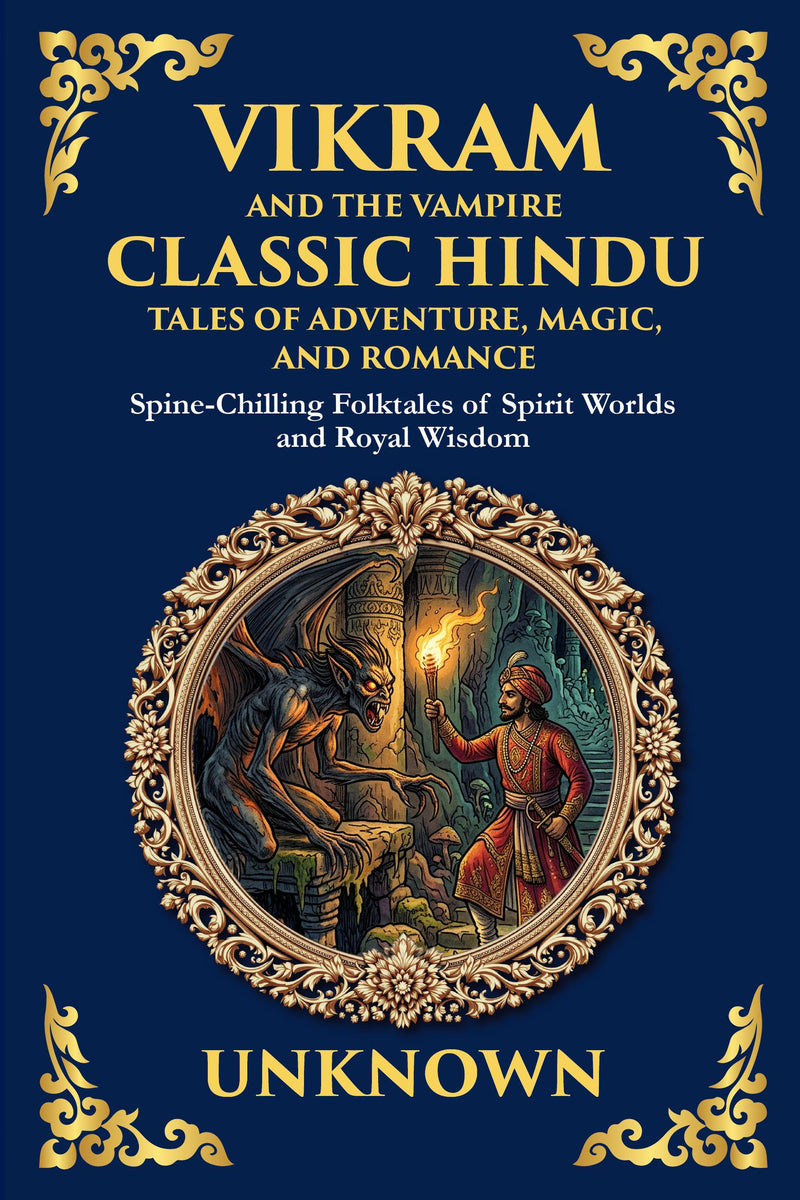
Vikram and the Vampire: Classic Hindu Tales of Adventure, Magic, and Romance — Large Print
Vikram and the Vampire From the heart of ancient India comes a cycle of thrilling tales where kings battle spirits, riddles reveal truths, and demons dance between worlds.
or free app
10,000+ hrs library
30-day guarantee
The complete Vikram and the Vampire: Classic appears in modern English through Library of Alexandria Press, available online with audiobook narration included for members.
Have you ever wondered why the most powerful wisdom hides in the strangest stories? Vikram and the Vampire: Classic Hindu Tales of Adventure, Magic, and Romance is one of the great treasures of Eastern storytelling. This compelling cycle of folktales—framed by the eerie yet clever dialogue between the noble King Vikramaditya and a ghostly vampire spirit—blends the supernatural with the moral, the romantic with the grotesque, and the divine with the absurd.
Adapted from the ancient Sanskrit text Baital Pachisi, this edition captures the rich mythological depth and dazzling imagination of India’s classical folklore tradition. Through a series of suspenseful tales, each wrapped around a moral dilemma or spiritual truth, readers explore the essence of karma, loyalty, justice, and love—all set against a backdrop of haunted forests, talking corpses, and magical kingdoms. These stories are more than parables—they are riddles of the soul, designed to awaken the intellect and conscience of both kings and commoners alike.
What you’ll discover in this modern edition
- The Legendary Journey of King Vikram – A fearless monarch faces spectral tests of wit and virtue
- Thirteen Enigmatic Tales – Each one a haunting tale with a riddle that questions morality and judgment
- Spiritual Teachings Beneath the Supernatural – Lessons on dharma, fate, and the human condition
- A Portal into Classical Indian Folklore – One of the oldest surviving collections of Hindu storytelling
| Formats | eBook (EPUB + PDF) · Audiobook · Paperback · Hardcover · Large Print |
| Language | English |
| Trim size (print) | 6 × 9 in |
| Binding | Paperback — perfect-bound · Hardcover — casewrap |
| Large Print edition | Same text in a larger, easy-read type — a larger font, not a larger trim |
| Print pricing | Every physical book at our true cost — at-cost, no profit (members) |
| Library | 873 restored titles, always growing |
| Length | 72,274 words · ~4 hr 49 min reading |
| Reading level | Grade 4 · an easy, flowing read (this modern-English edition) |
| Edition | Modern English translation · 2026 |
Member reviews for this edition are collected as readers finish it — be the first. Across the library: 12,000+ books shipped, every plan covered by a 365-day print guarantee.
About this edition
A faithful, unabridged modern-English edition by The Library of Alexandria — carefully rendered for today's reader and verified paragraph-by-paragraph against the public-domain source. Available as eBook, audiobook, paperback, hardcover, and large print.
- Complete & unabridgedVerified paragraph by paragraph against the source — never a scan, never abridged.
- Modern English, faithfulReadable today, with the author’s meaning kept intact. Readable — not simplified.
- Every format, one membershipRead in your browser or the free app, or listen to the full audiobook.
Included free with your membership
Cancel anytime, one click · 30-day money-back guarantee
Edition last updated July 2026
What’s inside
Vikram and the Vampire: Classic Hindu Tales of Adventure, Magic, and Romance — Large Print — complete and unabridged: all 14 sections included with membership, plus the full audiobook.
Begin reading Vikram and the Vampire: Classic Hindu Tales of Adventure, Magic, and Romance — Large Print
In clear modern English — the complete text is included with membership.
Introduction
There are stories that entertain, and there are stories that have outlived empires. The tales gathered in this volume belong firmly to the second kind. They have traveled across more than two thousand years, leaping from one language to another, surviving the rise and fall of dynasties, the spread of religions, and the endless reshuffling of human civilization. They began as oral performances whispered in royal courts and village squares, were committed to Sanskrit verse by poets whose names have largely faded, and have since been rendered into dozens of tongues across continents. That they reach you now, in a fresh and accessible form, is a small miracle of cultural persistence—a testament to the simple fact that a truly great story refuses to die.
What you hold is a cycle of interlinked adventures organized around one of the most ingenious narrative devices ever invented. A king is given a deceptively simple task: carry a corpse from a tree to a holy man waiting in a distant cremation ground. But the corpse is inhabited by a sly and talkative spirit—a being who knows everything about everyone, who has watched human folly unfold across countless lifetimes, and who is bored enough to make a game of his captivity. As the king trudges through the darkness, the spirit tells him a story. And at the end of each story, the spirit poses a riddle, a moral puzzle, a question of justice or love or duty so finely balanced that any thoughtful person would be compelled to weigh in. The king, bound by his own wisdom and his sense of honor, cannot help but answer. And the moment he speaks, the spirit slips away, flying back to the tree, forcing the weary monarch to begin his task all over again.
This frame—the riddle that costs you everything, the answer you cannot withhold—is the beating heart of the collection. It transforms what could have been a loose anthology into a single, suspenseful journey. The reader is drawn into a double game: we want to hear the next tale, and we also want to see whether the king can outwit the spirit, whether he can finally hold his tongue and complete his grim errand. The genius of the structure is that the king’s wisdom is also his trap. He is too intelligent, too principled, too engaged with the moral universe to stay silent. His virtue is the very thing the spirit exploits. There is something profoundly human in this predicament, and it is one of the reasons these tales have never lost their grip on the imagination.
To understand the depth of what you are about to read, it helps to know a little about where these tales came from and the extraordinary road they traveled to arrive here. The cycle has its roots in ancient India, where it formed part of a vast ocean of storytelling literature that flourished in the Sanskrit-speaking world. Storytelling in that tradition was never merely idle amusement. It was a sophisticated art form, deeply woven into philosophy, ethics, religion, and statecraft. Stories were how a culture transmitted its values, debated its dilemmas, and entertained its kings. They were nested within one another like a series of beautifully carved boxes—a tale containing a tale containing a tale—so that the act of listening became a kind of journey deeper and deeper into meaning.
The particular collection you are reading descends from a tradition of tales associated with a legendary monarch, a figure who appears in countless Indian stories as the very embodiment of just and courageous kingship. Around him gathered a whole literature of adventure: tales of magic, of clever ministers, of beautiful and dangerous women, of merchants and thieves and ascetics, of demons and gods and the strange beings that occupy the border between the living and the dead. These were not children’s bedtime stories, though children certainly heard them. They were complex meditations on how human beings ought to live, dressed in the irresistible clothing of suspense and wonder.
When these stories were first brought to Western readers in the nineteenth century, they arrived through the hands of a remarkable adventurer, soldier, linguist, and explorer who had spent years immersed in the languages and customs of India. He did not produce a dry, scholarly transcription. Instead, he reshaped the material with the flair of a born storyteller, sharpening its humor, heightening its drama, and adding his own observations about the human comedy. The result was a version that became enormously popular, a bridge between two worlds. It introduced generations of English-speaking readers to a treasury of imagination they could scarcely have encountered otherwise.
This present edition stands in that long line of transmission. It is an adaptation made for the contemporary reader—a careful effort to preserve the wit, the wonder, and the moral weight of the original while smoothing away the obstacles that time inevitably places between an ancient text and a modern audience. Older translations, however charming, can feel dense and roundabout to readers today. Their sentences wind and double back; their vocabulary belongs to another century; their cultural references assume knowledge that has slipped out of common circulation. The aim here has been to clear those obstacles without sacrificing the soul of the work. The voice you will hear is meant to feel alive and immediate, the way these tales would have felt to the first audiences who heard them spoken aloud by a master performer.
It is worth pausing to appreciate just how rare it is for any work of literature to survive this kind of journey. Most stories die with the generation that first told them. They are too local, too tied to a particular moment, too dependent on shared assumptions that fade. The tales in this book belong to that tiny fraction of human storytelling that has proven itself endlessly translatable—not just from one language to another, but from one era to another, one civilization to another. The dilemmas they explore are not Indian dilemmas or ancient dilemmas. They are human dilemmas. A father must choose between two claimants to his daughter’s hand. A wife must decide where her loyalty truly lies. A king must determine who, among several people involved in a single tragic event, bears the greatest guilt. These questions were as urgent two thousand years ago as they are today, and they will be just as urgent two thousand years from now. That is why the stories endure.
There is also something to be said about the figure of the spirit himself, the vampire of the title. He is not the bloodsucking monster of Western horror, though he shares some of that creature’s eerie associations with corpses and the unquiet dead. He is something subtler and more interesting: a trickster, a philosopher, a teacher in disguise. He occupies the corpse the way a puppeteer occupies a marionette, and he uses his strange vantage point—suspended between life and death, having witnessed the full sweep of human behavior—to hold up a mirror to the living. His tales are barbed. Each one is constructed to lead the listener toward a moral cliff edge and then ask him to jump. The spirit is testing the king, yes, but in a deeper sense he is testing the reader. Every time he poses his closing riddle, he is asking us the same thing he asks the monarch: What do you think? Where does justice lie here? Who is right and who is wrong, and how do you know?
This interactive quality is part of what makes the collection feel so modern despite its great age. These are not stories that hand you their conclusions on a platter. They invite argument. They are designed to provoke disagreement, to send readers into spirited debate about who deserves blame and who deserves sympathy. You will find yourself, more than once, taking a side—and then encountering the king’s answer and wondering whether he got it right. Sometimes you will agree with him completely. Sometimes you will be certain he is wrong. That friction is the point. The tales are a kind of moral gymnasium, a place to exercise your sense of right and wrong against problems specifically constructed to resist easy solutions.
When you step into these pages, you are entering a world governed by its own logic, and a few words of orientation will deepen your pleasure. This is a universe in which the membrane between the natural and the supernatural is thin and permeable. Gods walk among mortals. Ascetics who have meditated for years acquire fearsome magical powers. The dead do not always stay dead, and the boundary between the cremation ground and the living city is one that can be crossed by the bold or the desperate. None of this is presented as horror in the way we usually understand the term. It is simply the texture of reality in this world—a reality enchanted, dangerous, and morally charged at every turn.
You will meet a vivid cast of characters drawn from across the social spectrum. Kings and queens, of course, but also merchants and their cunning daughters, gamblers and thieves, washermen and farmers, holy men both genuine and fraudulent, and women of extraordinary intelligence and will. The tales are democratic in their scope; wisdom and folly are distributed across all stations of life, and a clever servant may well outwit a foolish prince. There is a particular fascination, throughout the collection, with the question of cleverness—who has it, how it is used, and whether it is the same thing as goodness. Many of the stories turn on a moment of brilliant ingenuity, a trick or a deduction or a perfectly timed deception. The tales delight in intelligence the way an adventure story delights in physical courage.
Love, too, runs through these pages in all its forms—noble and base, tender and treacherous, life-giving and destructive. The stories take romantic passion seriously as one of the great engines of human action, capable of inspiring extraordinary devotion and equally capable of driving people to ruin. You will encounter lovers who cross impossible distances to reunite, and lovers who betray one another for gain. The collection holds no naive view of the heart. It knows that desire can ennoble and that it can corrupt, and it examines both possibilities with unflinching honesty.
A word should be said about the moral universe these tales inhabit, because it differs in instructive ways from what many modern readers might expect. The questions the spirit poses often hinge on concepts like duty, honor, loyalty, and the proper order of relationships—ideas that carried immense weight in the world that produced these stories. A character’s obligations to family, to ruler, to caste, to the gods, and to guests are all part of the calculus by which actions are judged. Sometimes these obligations conflict, and it is precisely in those conflicts that the most fascinating dilemmas arise. When a person’s duty to one party clashes with their duty to another, which should prevail? The tales do not always answer the way we would, and part of the richness of reading them lies in noticing where ancient values align with our own and where they diverge.
This is one of the quiet gifts of reading literature from a distant time and culture. It loosens the grip of our own assumptions. We come to see that the moral frameworks we take for granted are not the only ones humans have ever lived by, that intelligent and serious people have weighed these eternal questions and arrived at conclusions different from ours. This is not relativism—the tales are passionately committed to the idea that some actions are right and others wrong—but it is a kind of expansion. We finish the book with a larger sense of the human possibilities, a deeper appreciation for the many ways people have tried to make sense of love, justice, loyalty, and death.
And death is never far away in these pages. The frame story itself unfolds in a cremation ground at night, amid the smoke and ash and bones of the dead. The spirit speaks from within a corpse. The whole apparatus of the collection is steeped in mortality. Yet the tone is rarely grim. There is a brightness, even a playfulness, that runs alongside the darkness. The spirit is a witty companion, full of dry observations and sly amusement at human weakness. The stories themselves are often funny, sometimes bawdy, frequently astonishing in their twists and turns. This mingling of the macabre and the comic, the profound and the entertaining, is one of the most distinctive flavors of the collection. It reflects a worldview in which death is not a horror to be avoided in conversation but simply part of the great cycle of existence, a fact to be faced with courage and even with humor.
Cancel anytime, one click · 30-day money-back guarantee
Founding annual rate available now — your price locks for life when you join.
Not ready? Get this free chapter by email — read it anytime.
✓ Sent — check your inbox for Vikram and the Vampire: Classic Hindu Tales of Adventure, Magic, and Romance — Large Print.
Questions about Vikram and the Vampire: Classic Hindu Tales of Adventure, Magic, and Romance — Large Print
What is Vikram and the Vampire: Classic about?
Vikram and the Vampire From the heart of ancient India comes a cycle of thrilling tales where kings battle spirits, riddles reveal truths, and demons dance between worlds. Vikram and the Vampire tells the legendary story of King Vikramaditya—a wise and fearless ruler—tasked with capturing a cunning and elusive spirit. But the spirit will not go easily.
Is Vikram and the Vampire: Classic free to read?
The opening chapter is free to read on this page. Members read and listen to the complete work — and the entire library — free, and can order any physical book at our true print cost.
How long is Vikram and the Vampire: Classic?
14 chapters (~72,274 words) — about 4 hr 49 min of reading in this modern-English edition.
Is this an abridged version of Vikram and the Vampire: Classic?
No. This is the complete, unabridged Vikram and the Vampire: Classic, carefully rendered into clear modern English and verified paragraph-by-paragraph against the public-domain source — nothing is cut or summarised.
What formats does Vikram and the Vampire: Classic come in?
Vikram and the Vampire: Classic is available as eBook, paperback, hardcover and large print. eBook and audiobook are included with membership; printed editions ship at our true print cost.
Shipping & returns
Billing & membership
More from the library


Explore Adventure
- Tarzan of the Apes · Edgar Rice Burroughs
- The Wonderful Wizard of Oz · L. Frank Baum
- Peter Pan · J. M. Barrie
- Moby Dick; Or, The Whale · Herman Melville
- The Riddle of the Sands · Erskine Childers
- The Loss of the Swansea: A Story of the Florida Coast · W. L. Alden
- Sky Island · L. Frank Baum
- Vikram and the Vampire: Classic Hindu Tales of Adventure, Magic, and Romance · Unknown
- Tales of Unrest · Joseph Conrad
- The Tomb of Ts’in · Edgar Wallace
- Skinny McCord · Percy Keese Fitzhugh
- The Men of the Moss-Hags · S. R. Crockett
- The Hunniwell Boys and the Platinum Mystery · L. P. Wyman
- Allan Quatermain · H. Rider Haggard
- She · H. Rider Haggard
- Medical Life in the Navy · Gordon Stables
- The Thirty-Nine Steps · John Buchan
- The Story of Doctor Dolittle · Hugh Lofting
- The Princess and the Goblin · George MacDonald
- The Man Who Would Be King · Rudyard Kipling
- Lucian’s True History · Lucian of Samosata
- The Secret Adversary · Agatha Christie
- Lord Jim · Joseph Conrad
- The Marvelous Land of Oz · L. Frank Baum
- The Virginian: A Horseman of the Plains · Owen Wister
- Mars is My Destination · Frank Belknap Long
- Anabasis · Xenophon
- The Mississippi Saucer · Frank Belknap Long
- Sabotage in Space · Carey Rockwell
- Brood of the Dark Moon · Charles Willard Diffin
Vikram and the Vampire: Classic Hindu Tales of Adventure, Magic, and Romance — Large Print
Vikram and the Vampire: Classic Hindu Tales of Adventure, Magic, and Romance — Large Print
Terrifying Folktales of Spirit Realms and Royal Wisdom
Unknown
Contents
- Introduction
- Preface by the Author
- Chapter 1
- Chapter 2
- Chapter 3
- Chapter 4
- Chapter 5
- Chapter 6
- Chapter 7
- Chapter 8
- Chapter 9
- Chapter 10
- Chapter 11
- Conclusion.
Introduction
There are stories that entertain, and there are stories that have outlived empires. The tales gathered in this volume belong firmly to the second kind. They have traveled across more than two thousand years, leaping from one language to another, surviving the rise and fall of dynasties, the spread of religions, and the endless reshuffling of human civilization. They began as oral performances whispered in royal courts and village squares, were committed to Sanskrit verse by poets whose names have largely faded, and have since been rendered into dozens of tongues across continents. That they reach you now, in a fresh and accessible form, is a small miracle of cultural persistence—a testament to the simple fact that a truly great story refuses to die.
What you hold is a cycle of interlinked adventures organized around one of the most ingenious narrative devices ever invented. A king is given a deceptively simple task: carry a corpse from a tree to a holy man waiting in a distant cremation ground. But the corpse is inhabited by a sly and talkative spirit—a being who knows everything about everyone, who has watched human folly unfold across countless lifetimes, and who is bored enough to make a game of his captivity. As the king trudges through the darkness, the spirit tells him a story. And at the end of each story, the spirit poses a riddle, a moral puzzle, a question of justice or love or duty so finely balanced that any thoughtful person would be compelled to weigh in. The king, bound by his own wisdom and his sense of honor, cannot help but answer. And the moment he speaks, the spirit slips away, flying back to the tree, forcing the weary monarch to begin his task all over again.
This frame—the riddle that costs you everything, the answer you cannot withhold—is the beating heart of the collection. It transforms what could have been a loose anthology into a single, suspenseful journey. The reader is drawn into a double game: we want to hear the next tale, and we also want to see whether the king can outwit the spirit, whether he can finally hold his tongue and complete his grim errand. The genius of the structure is that the king’s wisdom is also his trap. He is too intelligent, too principled, too engaged with the moral universe to stay silent. His virtue is the very thing the spirit exploits. There is something profoundly human in this predicament, and it is one of the reasons these tales have never lost their grip on the imagination.
To understand the depth of what you are about to read, it helps to know a little about where these tales came from and the extraordinary road they traveled to arrive here. The cycle has its roots in ancient India, where it formed part of a vast ocean of storytelling literature that flourished in the Sanskrit-speaking world. Storytelling in that tradition was never merely idle amusement. It was a sophisticated art form, deeply woven into philosophy, ethics, religion, and statecraft. Stories were how a culture transmitted its values, debated its dilemmas, and entertained its kings. They were nested within one another like a series of beautifully carved boxes—a tale containing a tale containing a tale—so that the act of listening became a kind of journey deeper and deeper into meaning.
The particular collection you are reading descends from a tradition of tales associated with a legendary monarch, a figure who appears in countless Indian stories as the very embodiment of just and courageous kingship. Around him gathered a whole literature of adventure: tales of magic, of clever ministers, of beautiful and dangerous women, of merchants and thieves and ascetics, of demons and gods and the strange beings that occupy the border between the living and the dead. These were not children’s bedtime stories, though children certainly heard them. They were complex meditations on how human beings ought to live, dressed in the irresistible clothing of suspense and wonder.
When these stories were first brought to Western readers in the nineteenth century, they arrived through the hands of a remarkable adventurer, soldier, linguist, and explorer who had spent years immersed in the languages and customs of India. He did not produce a dry, scholarly transcription. Instead, he reshaped the material with the flair of a born storyteller, sharpening its humor, heightening its drama, and adding his own observations about the human comedy. The result was a version that became enormously popular, a bridge between two worlds. It introduced generations of English-speaking readers to a treasury of imagination they could scarcely have encountered otherwise.
This present edition stands in that long line of transmission. It is an adaptation made for the contemporary reader—a careful effort to preserve the wit, the wonder, and the moral weight of the original while smoothing away the obstacles that time inevitably places between an ancient text and a modern audience. Older translations, however charming, can feel dense and roundabout to readers today. Their sentences wind and double back; their vocabulary belongs to another century; their cultural references assume knowledge that has slipped out of common circulation. The aim here has been to clear those obstacles without sacrificing the soul of the work. The voice you will hear is meant to feel alive and immediate, the way these tales would have felt to the first audiences who heard them spoken aloud by a master performer.
It is worth pausing to appreciate just how rare it is for any work of literature to survive this kind of journey. Most stories die with the generation that first told them. They are too local, too tied to a particular moment, too dependent on shared assumptions that fade. The tales in this book belong to that tiny fraction of human storytelling that has proven itself endlessly translatable—not just from one language to another, but from one era to another, one civilization to another. The dilemmas they explore are not Indian dilemmas or ancient dilemmas. They are human dilemmas. A father must choose between two claimants to his daughter’s hand. A wife must decide where her loyalty truly lies. A king must determine who, among several people involved in a single tragic event, bears the greatest guilt. These questions were as urgent two thousand years ago as they are today, and they will be just as urgent two thousand years from now. That is why the stories endure.
There is also something to be said about the figure of the spirit himself, the vampire of the title. He is not the bloodsucking monster of Western horror, though he shares some of that creature’s eerie associations with corpses and the unquiet dead. He is something subtler and more interesting: a trickster, a philosopher, a teacher in disguise. He occupies the corpse the way a puppeteer occupies a marionette, and he uses his strange vantage point—suspended between life and death, having witnessed the full sweep of human behavior—to hold up a mirror to the living. His tales are barbed. Each one is constructed to lead the listener toward a moral cliff edge and then ask him to jump. The spirit is testing the king, yes, but in a deeper sense he is testing the reader. Every time he poses his closing riddle, he is asking us the same thing he asks the monarch: What do you think? Where does justice lie here? Who is right and who is wrong, and how do you know?
This interactive quality is part of what makes the collection feel so modern despite its great age. These are not stories that hand you their conclusions on a platter. They invite argument. They are designed to provoke disagreement, to send readers into spirited debate about who deserves blame and who deserves sympathy. You will find yourself, more than once, taking a side—and then encountering the king’s answer and wondering whether he got it right. Sometimes you will agree with him completely. Sometimes you will be certain he is wrong. That friction is the point. The tales are a kind of moral gymnasium, a place to exercise your sense of right and wrong against problems specifically constructed to resist easy solutions.
When you step into these pages, you are entering a world governed by its own logic, and a few words of orientation will deepen your pleasure. This is a universe in which the membrane between the natural and the supernatural is thin and permeable. Gods walk among mortals. Ascetics who have meditated for years acquire fearsome magical powers. The dead do not always stay dead, and the boundary between the cremation ground and the living city is one that can be crossed by the bold or the desperate. None of this is presented as horror in the way we usually understand the term. It is simply the texture of reality in this world—a reality enchanted, dangerous, and morally charged at every turn.
You will meet a vivid cast of characters drawn from across the social spectrum. Kings and queens, of course, but also merchants and their cunning daughters, gamblers and thieves, washermen and farmers, holy men both genuine and fraudulent, and women of extraordinary intelligence and will. The tales are democratic in their scope; wisdom and folly are distributed across all stations of life, and a clever servant may well outwit a foolish prince. There is a particular fascination, throughout the collection, with the question of cleverness—who has it, how it is used, and whether it is the same thing as goodness. Many of the stories turn on a moment of brilliant ingenuity, a trick or a deduction or a perfectly timed deception. The tales delight in intelligence the way an adventure story delights in physical courage.
Love, too, runs through these pages in all its forms—noble and base, tender and treacherous, life-giving and destructive. The stories take romantic passion seriously as one of the great engines of human action, capable of inspiring extraordinary devotion and equally capable of driving people to ruin. You will encounter lovers who cross impossible distances to reunite, and lovers who betray one another for gain. The collection holds no naive view of the heart. It knows that desire can ennoble and that it can corrupt, and it examines both possibilities with unflinching honesty.
A word should be said about the moral universe these tales inhabit, because it differs in instructive ways from what many modern readers might expect. The questions the spirit poses often hinge on concepts like duty, honor, loyalty, and the proper order of relationships—ideas that carried immense weight in the world that produced these stories. A character’s obligations to family, to ruler, to caste, to the gods, and to guests are all part of the calculus by which actions are judged. Sometimes these obligations conflict, and it is precisely in those conflicts that the most fascinating dilemmas arise. When a person’s duty to one party clashes with their duty to another, which should prevail? The tales do not always answer the way we would, and part of the richness of reading them lies in noticing where ancient values align with our own and where they diverge.
This is one of the quiet gifts of reading literature from a distant time and culture. It loosens the grip of our own assumptions. We come to see that the moral frameworks we take for granted are not the only ones humans have ever lived by, that intelligent and serious people have weighed these eternal questions and arrived at conclusions different from ours. This is not relativism—the tales are passionately committed to the idea that some actions are right and others wrong—but it is a kind of expansion. We finish the book with a larger sense of the human possibilities, a deeper appreciation for the many ways people have tried to make sense of love, justice, loyalty, and death.
And death is never far away in these pages. The frame story itself unfolds in a cremation ground at night, amid the smoke and ash and bones of the dead. The spirit speaks from within a corpse. The whole apparatus of the collection is steeped in mortality. Yet the tone is rarely grim. There is a brightness, even a playfulness, that runs alongside the darkness. The spirit is a witty companion, full of dry observations and sly amusement at human weakness. The stories themselves are often funny, sometimes bawdy, frequently astonishing in their twists and turns. This mingling of the macabre and the comic, the profound and the entertaining, is one of the most distinctive flavors of the collection. It reflects a worldview in which death is not a horror to be avoided in conversation but simply part of the great cycle of existence, a fact to be faced with courage and even with humor.
The sage Bhavabhuti, the Eastern narrator of these stories, begins by offering a prayer of respect to Ganesha, the Lord of Beginnings. He tells the reader that this book is like a string of beautiful pearls worn by human intelligence, or a fragrant flower tucked into the turban of mental wisdom. He describes it as a piece of pure gold adorning the forehead of every great mind, and as a handful of crushed rubies that will clearly improve the mental clarity of anyone who reads it. Finally, he suggests that by following the lessons in these pages, a person can move happily through this life toward a state of total enlightenment, where stories are no longer necessary.
He then explains how the brave Vikramaditya became the King of Ujjayani.
About nineteen hundred years ago, the famous city of Ujjayani saw the birth of a prince given the grand name Vikramaditya. Even the Sanskrit speakers, who usually aren’t in a rush, shortened it to “Vikram,” and if he had been born a bit further West, it almost certainly would have been cut down to “Vik.”
Vikram was the second son of an old king named Gandharba-Sena. Not much positive has been passed down about this king, other than the fact that he was a fool, married four queens, and fathered six sons, each of whom was more educated and powerful than the last. Eventually, the father passed away. His oldest son, known as Shank, took over the throne, but he was immediately killed by Vikram—his “scorpion”—who is the hero of this story.
Through this display of strength and bold leadership—which every younger prince should strive to follow—Vikram earned the title of Bir, or the Brave, and became King. He ruled wisely, and the gods blessed him so much that his kingdom grew every day. Eventually, he became the ruler of all India. After securing his government, he established a new calendar era, which is a rare achievement for a king, especially one who inherited the throne.
End of the free sample
Keep reading, free
Members read and listen to the complete book — and the entire library. Cancel anytime, one click · 30-day money-back guarantee.