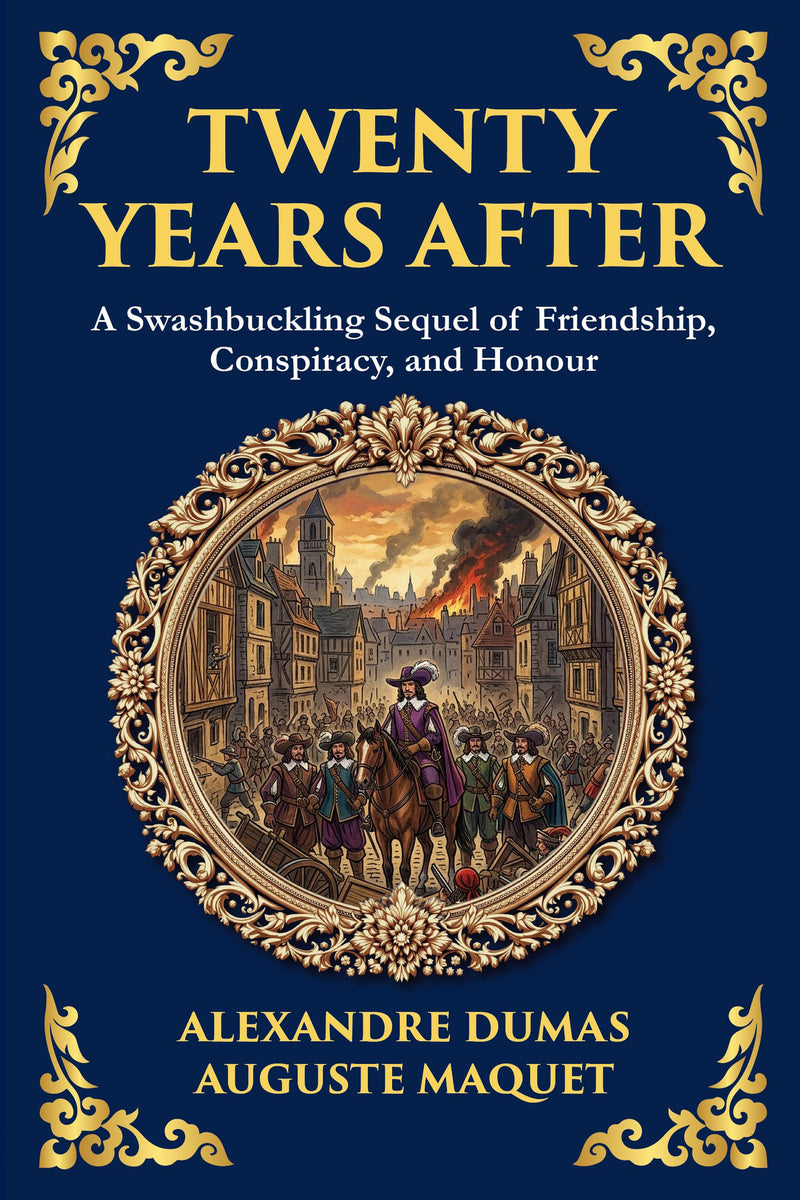
Twenty Years After
Alexandre Dumas What happens when heroes grow older, loyalties are tested, and the world they knew has changed forever? In Twenty Years After, Alexandre Dumas reunites us with the legendary swordsmen—Athos, Porthos, Aramis, and d’Artagnan—two decades after their first adventures.
or free app
10,000+ hrs library
30-day guarantee
The complete Twenty Years After appears in modern English through Library of Alexandria Press, available online with audiobook narration included for members.
Have you ever wondered why the strongest friendships are those forged by time, trials, and swords? Twenty Years After is the thrilling sequel to The Three Musketeers, a tale that dives into the complexities of friendship, duty, and redemption in a world on the edge of revolution. Written by Alexandre Dumas and Auguste Maquet, this swashbuckling epic reunites the legendary quartet —Athos, Porthos, Aramis, and d’Artagnan—now older, wiser, and pulled into a Europe where allegiances shift like sand beneath their boots.
Two decades have passed since their youthful exploits. D’Artagnan is a lieutenant in the Musketeers, navigating court politics under Cardinal Mazarin. France teeters on the brink of civil war as the Fronde rises against the monarchy.
Meanwhile, England is unraveling under the reign of Charles I. Into this turmoil, the four friends are drawn together once more, not for glory, but for a cause far more dangerous—loyalty to each other, no matter the cost. With breathtaking action, complex moral dilemmas, and razor-sharp wit, Dumas crafts a tale where the past haunts the present, and where the code of “All for one, and one for all” is tested like never before.
What you’ll discover in this modern edition
- The Return of the Musketeers – Follow Athos, Porthos, Aramis, and d’Artagnan as they reunite and face new foes in a divided world.
- A Time of Civil War and Conspiracy – Explore a France fractured by the Fronde rebellion and an England torn by revolution.
- Deeper Character Development – Watch as your favorite heroes confront aging, regret, loyalty, and legacy.
- Epic Duels, Escapes, and Intrigue – Experience masterful plots filled with narrow escapes, secret tunnels, royal betrayals, and sword-clashing action.
- A Masterclass in Historical Adventure – Dumas and Maquet blend real history with fiction in a way that feels both grand and intimate.
| Formats | eBook (EPUB + PDF) · Audiobook · Paperback · Hardcover · Large Print |
| Language | English |
| Trim size (print) | 6 × 9 in |
| Binding | Paperback — perfect-bound · Hardcover — casewrap |
| Large Print edition | Same text in a larger, easy-read type — a larger font, not a larger trim |
| Print pricing | Every physical book at our true cost — at-cost, no profit (members) |
| Library | 873 restored titles, always growing |
| Length | 218,641 words · ~14 hr 35 min reading |
| Reading level | Grade 7 · an easy, flowing read (this modern-English edition) |
| Edition | Modern English translation · 2026 |
Member reviews for this edition are collected as readers finish it — be the first. Across the library: 12,000+ books shipped, every plan covered by a 365-day print guarantee.
About this edition
A faithful, unabridged modern-English edition by The Library of Alexandria — carefully rendered for today's reader and verified paragraph-by-paragraph against the public-domain source. Available as eBook, audiobook, paperback, hardcover, and large print.
- Complete & unabridgedVerified paragraph by paragraph against the source — never a scan, never abridged.
- Modern English, faithfulReadable today, with the author’s meaning kept intact. Readable — not simplified.
- Every format, one membershipRead in your browser or the free app, or listen to the full audiobook.
Included free with your membership
Cancel anytime, one click · 30-day money-back guarantee
Edition last updated July 2026
What’s inside
Twenty Years After — complete and unabridged: all 60 sections included with membership, plus the full audiobook.
Begin reading Twenty Years After
In clear modern English — the complete text is included with membership.
Introduction
There is a particular kind of magic that occurs when a beloved story refuses to end. We close the final page of a great adventure, we say farewell to companions who have become as familiar as old friends, and we assume that the curtain has fallen for good. And then, against all expectation, the lights rise again. The faces we remember reappear, changed by the years yet unmistakably themselves, and we discover that the tale we thought complete was only the first movement of a far grander symphony. This is precisely the gift offered by the book you now hold. It is the continuation of one of the most cherished adventures ever committed to paper, and it carries forward a quartet of heroes whose names have echoed through nearly two centuries of popular imagination.
The work before you was first published in serial form in the late 1840s, the product of a remarkable creative partnership between Alexandre Dumas and his frequent collaborator Auguste Maquet. Together they produced some of the most enduring entertainment of their age, weaving historical fact and dazzling invention into narratives that readers devoured installment by installment, gathering in cafés and parlors to debate what might happen next. The story collected here is the second chapter in a saga that would eventually stretch across three monumental novels. It picks up the threads left dangling by its celebrated predecessor and follows them into territory both familiar and entirely new, demonstrating that the authors had lost none of their genius for spectacle, suspense, and the irresistible pull of camaraderie.
What makes this particular volume so special is not merely that it returns us to characters we adore. It is that the authors had the wisdom and courage to let time pass. Rather than freezing their heroes in perpetual youth, as so many lesser storytellers might have done, Dumas and Maquet allowed the years to do their work. The men we meet here are no longer the impulsive young blades of the earlier tale. They have aged, scattered, settled into different lives, and in some cases drifted apart entirely. The bonds that once seemed unbreakable have been tested by ambition, circumstance, and the slow erosion of distance. To bring these men back together, to ask whether the fire of their old friendship still burns or has been reduced to cold ash, is a far more interesting and emotionally resonant project than simply replaying past glories. It gives the entire adventure a depth and a poignancy that elevate it well above ordinary entertainment.
A Story of Time, Loyalty, and the Weight of the Years
The title itself announces the central conceit with disarming simplicity. A great span of time has elapsed since we last saw our heroes, and the world has not stood still. Thrones that once seemed secure have begun to tremble. Loyalties that once defined a generation have been complicated by the unforgiving arithmetic of survival. Men who once served the same masters now find themselves separated by circumstance, by allegiance, and sometimes by opposing sides of the very conflicts that threaten to engulf their nations. The author who returns to a successful story always faces a temptation to simply repeat the formula that pleased readers before. Dumas and Maquet refused that temptation. Instead, they confronted the difficult and rewarding question of what becomes of heroes when the heroic moment has passed and ordinary life has resumed.
This is, at its heart, a meditation on the nature of friendship across time. Anyone who has reconnected with a friend after a long separation will recognize the delicate emotional dance that unfolds in these pages. There is the joy of reunion, yes, but there is also uncertainty. Are we still the same people who once swore eternal loyalty to one another? Have the choices we made in the intervening years built invisible walls between us? Can the affection of youth survive the compromises of maturity? The narrative explores these questions with a sensitivity that may surprise readers who expect nothing more than swordplay and intrigue. The action is here in abundance, to be sure, but it is anchored to genuine human feeling, and that combination is what has kept the story alive for generations.
The historical backdrop against which all of this unfolds is one of genuine turbulence, a period in which the established order across Europe was being questioned and, in some places, violently overturned. The authors had a remarkable talent for placing fictional characters at the very center of real historical upheaval, allowing imagined heroes to brush shoulders with figures who actually walked the earth. This technique creates a thrilling sense that we are watching history happen from the inside, that the great events recorded in dusty chronicles were shaped, in part, by the loyalties and betrayals of individuals whose hearts we have come to understand. It is a flattering illusion, and the authors maintain it with such confidence that we willingly suspend our disbelief and accept that perhaps, just perhaps, the destinies of nations did indeed hinge upon a handful of swordsmen and their unshakable code of honor.
There is a particular pleasure in watching how the political machinery of the era is rendered through the lens of personal drama. Conspiracies are not abstract maneuvers in this telling. They are personal, intimate affairs, conducted in candlelit rooms and whispered in the corridors of power, driven by figures whose ambitions and fears we come to know intimately. The reader is never asked to follow dry diplomatic negotiations from a distance. Instead, we are placed in the room, behind the curtain, privy to the secret motivations that drive men to gamble everything on a single throw of the dice. This intimacy is one of the great strengths of the work, and it transforms what might have been a mere history lesson into a pulse-quickening tale of human stakes.
It is worth pausing to appreciate the central figures who carry this story, though I will be careful not to reveal anything of what befalls them. Each of the principal companions has been drawn with such distinct personality that they have become archetypes in their own right, instantly recognizable across cultures and languages. There is the natural leader, possessed of an almost melancholy nobility, a man haunted by his past yet unfailingly upright in his conduct. There is the giant of appetite and good humor, whose love of comfort and fine living conceals a deep and steadfast heart. There is the elegant, contemplative one, drawn between worldly ambition and a quieter calling, forever a mystery even to those who know him best. And there is the youngest in spirit, the irrepressible Gascon whose quick wit and quicker blade have carried him through countless scrapes, a man whose loyalty to his friends is the very engine of the entire saga.
What is fascinating about encountering these men again after the passage of years is observing how the qualities that defined them in youth have matured, hardened, or softened. The leader’s nobility has deepened into something almost spiritual. The pleasure-seeker has found new arenas in which to indulge his expansive nature. The contemplative one has pursued his ambitions further down a path that grows ever more shadowed and intriguing. And the Gascon, now older and wiser but no less brave, has learned the bitter lessons that life teaches those who serve long and are rewarded little. To watch these familiar souls navigate a changed world is to witness a masterclass in characterization, the kind that few writers in any age have managed to achieve.
The authors also introduce new figures to stand alongside the old, and these additions are not mere decoration. They represent the next generation, the inheritors of the world that the older characters helped to shape. The interplay between the seasoned veterans and the younger souls who follow in their footsteps adds yet another layer of emotional resonance to the narrative. It raises questions about legacy, about what we pass on to those who come after us, about whether the codes and values we hold dear can survive the transition from one generation to the next. These themes give the adventure a dimension that lingers in the mind long after the final page has been turned.
The Art of the Adventure and the Pleasures of the Page
Let us not pretend that the appeal of this work is purely cerebral or emotional, however. This is, first and foremost, a rollicking adventure, and it delivers on that promise with a generosity that has rarely been matched. There are duels and ambushes, daring escapes and desperate rescues, secret missions and midnight rides across moonlit countryside. The pace, particularly once the central plot gathers momentum, is relentless. Just when one crisis appears to be resolved, another erupts, and our heroes are flung into fresh peril before they have had a chance to catch their breath. The authors understood, perhaps better than any writers of their era, the precise rhythm of suspense and release that keeps a reader turning pages deep into the night.
Part of what makes the action so satisfying is that it is never gratuitous. Every clash of swords, every narrow escape, every cunning stratagem is rooted in character and consequence. The heroes do not fight for the sake of fighting. They fight because they are committed to causes and to people, because their honor demands it, because the alternative is a betrayal they could not live with. This grounding of action in moral stakes is what separates timeless adventure from forgettable spectacle. We care about the outcome of every confrontation because we understand what each combatant stands to lose, and that understanding transforms mere excitement into genuine drama.
The dialogue, too, deserves special mention. The conversations between the characters crackle with wit, warmth, and the unmistakable rhythm of men who know one another well enough to insult, tease, and challenge each other without ever doubting the underlying bond. There is a particular joy in the verbal sparring between old friends, the affectionate barbs and the unspoken understandings that pass between them. The authors had a gift for capturing the texture of these relationships, the way that true intimacy expresses itself as much through banter as through declarations of devotion. Reading these exchanges, one feels almost as though one has been admitted into the circle, granted the privilege of sitting at the table while these remarkable men plot, argue, and laugh together.
A word should be said here about the nature of this particular edition, which has been prepared as a modern translation adapted for the contemporary reader. The original text was written in a language and an idiom that, however magnificent, can present obstacles to readers approaching it across the gulf of nearly two centuries. Sentence structures that were natural to the original audience can feel labyrinthine to modern eyes. References that were instantly understood in the author’s day may require explanation now. The purpose of this adaptation is to remove those barriers without sacrificing the essential spirit of the work, to render the prose in language that flows naturally for today’s reader while preserving the energy, the humor, and the emotional power that made the original a masterpiece.
This is a delicate undertaking, and it is worth understanding what it does and does not mean. To adapt a classic for the contemporary reader is not to dumb it down or to strip away its richness. It is, rather, to act as a faithful interpreter, conveying the author’s intentions in a voice that the modern ear can readily appreciate. The aim is to allow you to experience the story as its first readers did, with the same immediacy and delight, unencumbered by the linguistic distance that time has imposed. The great events, the unforgettable characters, the breathtaking set pieces, the moral dilemmas, and the soaring themes all remain intact. What has changed is simply the ease with which you can enter into them. Think of it as cleaning the varnish from an old master painting, revealing the brilliant colors that were always there beneath the accumulated grime of centuries.
Cancel anytime, one click · 30-day money-back guarantee
Founding annual rate available now — your price locks for life when you join.
Not ready? Get this free chapter by email — read it anytime.
✓ Sent — check your inbox for Twenty Years After.
Questions about Twenty Years After
What is Twenty Years After about?
Alexandre Dumas What happens when heroes grow older, loyalties are tested, and the world they knew has changed forever? In Twenty Years After, Alexandre Dumas reunites us with the legendary swordsmen—Athos, Porthos, Aramis, and d’Artagnan—two decades after their first adventures. France is now a battleground of political unrest, civil war brews in England, and the bonds of brotherhood are strained by the winds of time and ambition.
Who wrote Twenty Years After?
Twenty Years After was written by Alexandre Dumas and Auguste Maquet. This edition presents the complete work in clear modern English, faithfully rendered from the public-domain original by Library of Alexandria Press.
Is Twenty Years After free to read?
The opening chapter is free to read on this page. Members read and listen to the complete work — and the entire library — free, and can order any physical book at our true print cost.
How long is Twenty Years After?
60 chapters (~218,641 words) — about 14 hr 35 min of reading in this modern-English edition.
Is this an abridged version of Twenty Years After?
No. This is the complete, unabridged Twenty Years After, carefully rendered into clear modern English and verified paragraph-by-paragraph against the public-domain source — nothing is cut or summarised.
What formats does Twenty Years After come in?
Twenty Years After is available as eBook, paperback and hardcover. eBook and audiobook are included with membership; printed editions ship at our true print cost.
Shipping & returns
Billing & membership
More from the library


Explore Adventure
- Tarzan of the Apes · Edgar Rice Burroughs
- The Wonderful Wizard of Oz · L. Frank Baum
- Peter Pan · J. M. Barrie
- Moby Dick; Or, The Whale · Herman Melville
- The Riddle of the Sands · Erskine Childers
- The Loss of the Swansea: A Story of the Florida Coast · W. L. Alden
- Sky Island · L. Frank Baum
- Vikram and the Vampire: Classic Hindu Tales of Adventure, Magic, and Romance · Unknown
- Tales of Unrest · Joseph Conrad
- The Tomb of Ts’in · Edgar Wallace
- Skinny McCord · Percy Keese Fitzhugh
- The Men of the Moss-Hags · S. R. Crockett
- The Hunniwell Boys and the Platinum Mystery · L. P. Wyman
- Allan Quatermain · H. Rider Haggard
- She · H. Rider Haggard
- Medical Life in the Navy · Gordon Stables
- The Thirty-Nine Steps · John Buchan
- The Story of Doctor Dolittle · Hugh Lofting
- The Princess and the Goblin · George MacDonald
- The Man Who Would Be King · Rudyard Kipling
- Lucian’s True History · Lucian of Samosata
- The Secret Adversary · Agatha Christie
- Lord Jim · Joseph Conrad
- The Marvelous Land of Oz · L. Frank Baum
- The Virginian: A Horseman of the Plains · Owen Wister
- Mars is My Destination · Frank Belknap Long
- Anabasis · Xenophon
- The Mississippi Saucer · Frank Belknap Long
- Sabotage in Space · Carey Rockwell
- Brood of the Dark Moon · Charles Willard Diffin
Twenty Years After
Twenty Years After
A Swashbuckling Sequel of Friendship, Conspiracy, and Honor
Alexandre Dumas and Auguste Maquet
Contents
- Introduction
- Chapter 1
- Chapter 2
- Chapter 3
- Chapter 4
- Chapter 5
- Chapter 6
- Chapter 7
- Chapter 8
- Chapter 9
- Chapter 10
- Chapter 11
- Chapter 12
- Chapter 13
- Chapter 14
- Chapter 15
- Chapter 16
- Chapter 17
- Chapter 18
- Chapter 19
- Chapter 20
- Chapter 21
- Chapter 22
- Chapter 23
- Chapter 24
- Chapter 25
- Chapter 26
- Chapter 27
- Chapter 28
- Chapter 29
- Chapter 30
- Chapter 31
- Chapter 32
- Chapter 33
- Chapter 34
- Chapter 35
- Chapter 36
- Chapter 37
- Chapter 38
- Chapter 39
- … and 20 more chapters
Introduction
There is a particular kind of magic that occurs when a beloved story refuses to end. We close the final page of a great adventure, we say farewell to companions who have become as familiar as old friends, and we assume that the curtain has fallen for good. And then, against all expectation, the lights rise again. The faces we remember reappear, changed by the years yet unmistakably themselves, and we discover that the tale we thought complete was only the first movement of a far grander symphony. This is precisely the gift offered by the book you now hold. It is the continuation of one of the most cherished adventures ever committed to paper, and it carries forward a quartet of heroes whose names have echoed through nearly two centuries of popular imagination.
The work before you was first published in serial form in the late 1840s, the product of a remarkable creative partnership between Alexandre Dumas and his frequent collaborator Auguste Maquet. Together they produced some of the most enduring entertainment of their age, weaving historical fact and dazzling invention into narratives that readers devoured installment by installment, gathering in cafés and parlors to debate what might happen next. The story collected here is the second chapter in a saga that would eventually stretch across three monumental novels. It picks up the threads left dangling by its celebrated predecessor and follows them into territory both familiar and entirely new, demonstrating that the authors had lost none of their genius for spectacle, suspense, and the irresistible pull of camaraderie.
What makes this particular volume so special is not merely that it returns us to characters we adore. It is that the authors had the wisdom and courage to let time pass. Rather than freezing their heroes in perpetual youth, as so many lesser storytellers might have done, Dumas and Maquet allowed the years to do their work. The men we meet here are no longer the impulsive young blades of the earlier tale. They have aged, scattered, settled into different lives, and in some cases drifted apart entirely. The bonds that once seemed unbreakable have been tested by ambition, circumstance, and the slow erosion of distance. To bring these men back together, to ask whether the fire of their old friendship still burns or has been reduced to cold ash, is a far more interesting and emotionally resonant project than simply replaying past glories. It gives the entire adventure a depth and a poignancy that elevate it well above ordinary entertainment.
A Story of Time, Loyalty, and the Weight of the Years
The title itself announces the central conceit with disarming simplicity. A great span of time has elapsed since we last saw our heroes, and the world has not stood still. Thrones that once seemed secure have begun to tremble. Loyalties that once defined a generation have been complicated by the unforgiving arithmetic of survival. Men who once served the same masters now find themselves separated by circumstance, by allegiance, and sometimes by opposing sides of the very conflicts that threaten to engulf their nations. The author who returns to a successful story always faces a temptation to simply repeat the formula that pleased readers before. Dumas and Maquet refused that temptation. Instead, they confronted the difficult and rewarding question of what becomes of heroes when the heroic moment has passed and ordinary life has resumed.
This is, at its heart, a meditation on the nature of friendship across time. Anyone who has reconnected with a friend after a long separation will recognize the delicate emotional dance that unfolds in these pages. There is the joy of reunion, yes, but there is also uncertainty. Are we still the same people who once swore eternal loyalty to one another? Have the choices we made in the intervening years built invisible walls between us? Can the affection of youth survive the compromises of maturity? The narrative explores these questions with a sensitivity that may surprise readers who expect nothing more than swordplay and intrigue. The action is here in abundance, to be sure, but it is anchored to genuine human feeling, and that combination is what has kept the story alive for generations.
The historical backdrop against which all of this unfolds is one of genuine turbulence, a period in which the established order across Europe was being questioned and, in some places, violently overturned. The authors had a remarkable talent for placing fictional characters at the very center of real historical upheaval, allowing imagined heroes to brush shoulders with figures who actually walked the earth. This technique creates a thrilling sense that we are watching history happen from the inside, that the great events recorded in dusty chronicles were shaped, in part, by the loyalties and betrayals of individuals whose hearts we have come to understand. It is a flattering illusion, and the authors maintain it with such confidence that we willingly suspend our disbelief and accept that perhaps, just perhaps, the destinies of nations did indeed hinge upon a handful of swordsmen and their unshakable code of honor.
There is a particular pleasure in watching how the political machinery of the era is rendered through the lens of personal drama. Conspiracies are not abstract maneuvers in this telling. They are personal, intimate affairs, conducted in candlelit rooms and whispered in the corridors of power, driven by figures whose ambitions and fears we come to know intimately. The reader is never asked to follow dry diplomatic negotiations from a distance. Instead, we are placed in the room, behind the curtain, privy to the secret motivations that drive men to gamble everything on a single throw of the dice. This intimacy is one of the great strengths of the work, and it transforms what might have been a mere history lesson into a pulse-quickening tale of human stakes.
It is worth pausing to appreciate the central figures who carry this story, though I will be careful not to reveal anything of what befalls them. Each of the principal companions has been drawn with such distinct personality that they have become archetypes in their own right, instantly recognizable across cultures and languages. There is the natural leader, possessed of an almost melancholy nobility, a man haunted by his past yet unfailingly upright in his conduct. There is the giant of appetite and good humor, whose love of comfort and fine living conceals a deep and steadfast heart. There is the elegant, contemplative one, drawn between worldly ambition and a quieter calling, forever a mystery even to those who know him best. And there is the youngest in spirit, the irrepressible Gascon whose quick wit and quicker blade have carried him through countless scrapes, a man whose loyalty to his friends is the very engine of the entire saga.
What is fascinating about encountering these men again after the passage of years is observing how the qualities that defined them in youth have matured, hardened, or softened. The leader’s nobility has deepened into something almost spiritual. The pleasure-seeker has found new arenas in which to indulge his expansive nature. The contemplative one has pursued his ambitions further down a path that grows ever more shadowed and intriguing. And the Gascon, now older and wiser but no less brave, has learned the bitter lessons that life teaches those who serve long and are rewarded little. To watch these familiar souls navigate a changed world is to witness a masterclass in characterization, the kind that few writers in any age have managed to achieve.
The authors also introduce new figures to stand alongside the old, and these additions are not mere decoration. They represent the next generation, the inheritors of the world that the older characters helped to shape. The interplay between the seasoned veterans and the younger souls who follow in their footsteps adds yet another layer of emotional resonance to the narrative. It raises questions about legacy, about what we pass on to those who come after us, about whether the codes and values we hold dear can survive the transition from one generation to the next. These themes give the adventure a dimension that lingers in the mind long after the final page has been turned.
The Art of the Adventure and the Pleasures of the Page
Let us not pretend that the appeal of this work is purely cerebral or emotional, however. This is, first and foremost, a rollicking adventure, and it delivers on that promise with a generosity that has rarely been matched. There are duels and ambushes, daring escapes and desperate rescues, secret missions and midnight rides across moonlit countryside. The pace, particularly once the central plot gathers momentum, is relentless. Just when one crisis appears to be resolved, another erupts, and our heroes are flung into fresh peril before they have had a chance to catch their breath. The authors understood, perhaps better than any writers of their era, the precise rhythm of suspense and release that keeps a reader turning pages deep into the night.
Part of what makes the action so satisfying is that it is never gratuitous. Every clash of swords, every narrow escape, every cunning stratagem is rooted in character and consequence. The heroes do not fight for the sake of fighting. They fight because they are committed to causes and to people, because their honor demands it, because the alternative is a betrayal they could not live with. This grounding of action in moral stakes is what separates timeless adventure from forgettable spectacle. We care about the outcome of every confrontation because we understand what each combatant stands to lose, and that understanding transforms mere excitement into genuine drama.
The dialogue, too, deserves special mention. The conversations between the characters crackle with wit, warmth, and the unmistakable rhythm of men who know one another well enough to insult, tease, and challenge each other without ever doubting the underlying bond. There is a particular joy in the verbal sparring between old friends, the affectionate barbs and the unspoken understandings that pass between them. The authors had a gift for capturing the texture of these relationships, the way that true intimacy expresses itself as much through banter as through declarations of devotion. Reading these exchanges, one feels almost as though one has been admitted into the circle, granted the privilege of sitting at the table while these remarkable men plot, argue, and laugh together.
A word should be said here about the nature of this particular edition, which has been prepared as a modern translation adapted for the contemporary reader. The original text was written in a language and an idiom that, however magnificent, can present obstacles to readers approaching it across the gulf of nearly two centuries. Sentence structures that were natural to the original audience can feel labyrinthine to modern eyes. References that were instantly understood in the author’s day may require explanation now. The purpose of this adaptation is to remove those barriers without sacrificing the essential spirit of the work, to render the prose in language that flows naturally for today’s reader while preserving the energy, the humor, and the emotional power that made the original a masterpiece.
This is a delicate undertaking, and it is worth understanding what it does and does not mean. To adapt a classic for the contemporary reader is not to dumb it down or to strip away its richness. It is, rather, to act as a faithful interpreter, conveying the author’s intentions in a voice that the modern ear can readily appreciate. The aim is to allow you to experience the story as its first readers did, with the same immediacy and delight, unencumbered by the linguistic distance that time has imposed. The great events, the unforgettable characters, the breathtaking set pieces, the moral dilemmas, and the soaring themes all remain intact. What has changed is simply the ease with which you can enter into them. Think of it as cleaning the varnish from an old master painting, revealing the brilliant colors that were always there beneath the accumulated grime of centuries.
In a magnificent room of the Palais Royal—once known as the Palais Cardinal—a man sat lost in thought. He leaned over a gilded, inlaid table covered in letters and documents, resting his head in his hands. Behind him, a massive fireplace roared with leaping flames; large oak logs crackled on polished brass andirons. The flickering light illuminated the luxurious clothing of the room’s lone occupant, while twin candelabras filled with wax candles cast a grand glow over the scene.
Anyone who happened to see that red simar—the ornate official robe—and the rich lace, or who saw that pale brow furrowed in anxious thought, might have imagined that the ghost of Cardinal Richelieu still haunted his old home. This impression was heightened by the solitude of the room, the silence of the waiting areas, and the rhythmic footsteps of the guards on the landing.
But this was merely a ghost of former greatness. France had grown weak, the king’s authority was ignored, the nobles had returned to their old habits of rebellion and arrogance, and enemies were gathered at the borders. All of this proved that the great Richelieu was truly gone.
In truth, it was even more obvious that the red robe in that familiar spot no longer belonged to him. The man’s isolation felt more suited to a phantom than a living person; the corridors were empty of courtiers, and the courtyards were crowded only with guards. A spirit of bitter mockery rose from the streets below, drifting through the windows. The city was humming with the sounds of a population united against the minister, punctuated by the distant, constant sound of gunfire. These shots were fired, fortunately, without any specific target—simply to show the guards, the Swiss troops, and the military surrounding the Palais Royal that the people were armed.
End of the free sample
Keep reading, free
Members read and listen to the complete book — and the entire library. Cancel anytime, one click · 30-day money-back guarantee.