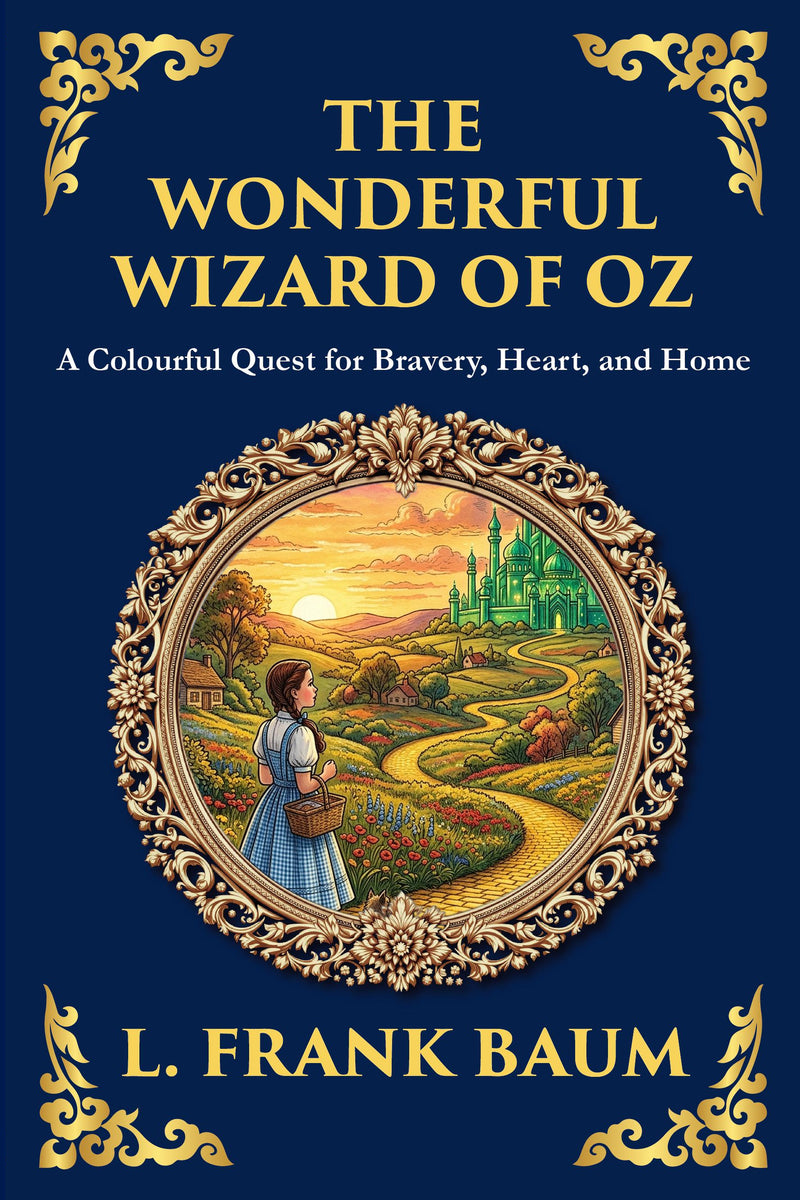
The Wonderful Wizard of Oz — Large Print
Swept away by a cyclone, young Dorothy finds herself in the magical Land of Oz—a place filled with talking animals, enchanted forests, and dangerous witches.
or free app
10,000+ hrs library
30-day guarantee
The complete The Wonderful Wizard of Oz appears in modern English through Library of Alexandria Press, available online with audiobook narration included for members.
Have you ever wondered why the things we seek most are often already within us? Follow the sparkling Yellow Brick Road in The Wonderful Wizard of Oz: A Colourful Quest for Bravery, Heart, and Home—a joyful, imaginative journey that has inspired generations. First published in 1900, L. Frank Baum’s fantastical story follows Dorothy Gale, a brave Kansas farm girl swept away into a land of wonder, whimsy, and peril.
Alongside her unforgettable companions—the Scarecrow, who desires a brain; the Tin Woodman, who longs for a heart; and the Cowardly Lion, who wishes for courage—Dorothy embarks on an epic quest to reach the Emerald City and find her way home. But as trials unfold and illusions are unmasked, each character discovers that their true strengths were within them all along.
What you’ll discover in this modern edition
- A Vivid and Enchanting World From Munchkinland to the poppy fields to the Emerald City, immerse yourself in a magical landscape full of unforgettable creatures and places.
- Iconic Characters and Life Lessons Experience the growth of Dorothy, the Scarecrow, the Tin Woodman, and the Cowardly Lion as they face fears and forge their destinies.
- Themes of Courage, Empathy, and Self-Belief Reflect on what it means to be brave, kind, and wise—and how those virtues are already within us.
- A Celebration of Home and Hope Witness Dorothy’s realization that even in the most magical of lands, there’s nothing more precious than home.
- A Modern-Formatted Classic for All Ages This edition presents Baum’s original tale in a beautifully accessible layout for today’s readers while preserving the charm and brilliance of the original.
| Formats | eBook (EPUB + PDF) · Audiobook · Paperback · Hardcover · Large Print |
| Language | English |
| Trim size (print) | 6 × 9 in |
| Binding | Paperback — perfect-bound · Hardcover — casewrap |
| Large Print edition | Same text in a larger, easy-read type — a larger font, not a larger trim |
| Print pricing | Every physical book at our true cost — at-cost, no profit (members) |
| Library | 873 restored titles, always growing |
| Length | 38,932 words · ~2 hr 36 min reading |
| Reading level | Grade 7 · an easy, flowing read (this modern-English edition) |
| Edition | Modern English translation · 2026 |
Member reviews for this edition are collected as readers finish it — be the first. Across the library: 12,000+ books shipped, every plan covered by a 365-day print guarantee.
About this edition
A faithful, unabridged modern-English edition by The Library of Alexandria — carefully rendered for today's reader and verified paragraph-by-paragraph against the public-domain source. Available as eBook, audiobook, paperback, hardcover, and large print.
- Complete & unabridgedVerified paragraph by paragraph against the source — never a scan, never abridged.
- Modern English, faithfulReadable today, with the author’s meaning kept intact. Readable — not simplified.
- Every format, one membershipRead in your browser or the free app, or listen to the full audiobook.
Included free with your membership
Cancel anytime, one click · 30-day money-back guarantee
Edition last updated July 2026
What’s inside
The Wonderful Wizard of Oz — Large Print — complete and unabridged: all 26 sections included with membership, plus the full audiobook.
Begin reading The Wonderful Wizard of Oz — Large Print
In clear modern English — the complete text is included with membership.
Introduction
There are stories that belong to a single generation, and then there are stories that seem to belong to everyone, passed hand to hand across decades like a treasured family heirloom. The tale you are about to enter sits firmly in that second category. Since it first appeared at the turn of the twentieth century, it has been read aloud at bedsides, performed on grand stages, reimagined on screens of every size, and folded so completely into the cultural imagination that even people who have never opened the book somehow feel they already know it. Yet knowing of a story and actually reading it are two very different experiences, and the pages ahead offer the genuine article: the original journey, the original wonder, the original heart, presented here in a fresh translation crafted to feel immediate and alive to the contemporary reader.
L. Frank Baum set out, by his own admission, to write something new. In the brief note he attached to his book when it first appeared in 1900, he explained that he wanted to create a “modernized fairy tale” for American children—one that retained the marvel and delight of the old European folktales while leaving behind their darker, more frightening machinery. The grim morals, the punishing lessons, the genuinely terrifying figures meant to keep children obedient through fear: all of these he wished to set aside. What he wanted instead was a tale in which “the wonderment and joy are retained and the heartaches and nightmares are left out.” Whether he fully succeeded is a question every reader gets to answer for themselves, but the ambition itself was revolutionary. He was attempting to build a homegrown American mythology, a fairyland that did not require castles in distant kingdoms or enchanted forests in foreign lands. He planted his magic squarely in the soil of the American heartland, and from that simple, daring choice grew one of the most beloved imaginative worlds ever invented.
To understand why this book feels so different from the fairy tales that came before it, it helps to know a little about the man who wrote it. Lyman Frank Baum—he disliked his first name and went by Frank his entire life—was not a writer who arrived at success early or easily. Born in 1856 in upstate New York, he tried his hand at a remarkable range of careers before finding his footing as an author. He raised fancy poultry and published a treatise on the subject. He acted in and managed theatrical productions, even writing plays and composing songs. He ran a variety store on the American frontier in Aberdeen, in what was then Dakota Territory, where he watched the dreams of pioneer families collide with the harsh realities of drought and hardship. He edited a newspaper. He sold china and glassware as a traveling salesman, journeying across the wide and often desolate prairies. He even pioneered ideas about the art of window display in retail shops. In short, he was a man of many trades and boundless imagination, a dreamer who never quite stopped dreaming even when his ventures faltered.
It was only in his forties that Baum turned seriously to writing for children, encouraged in part by his mother-in-law, the formidable suffragist and activist Matilda Joslyn Gage, who recognized that the elaborate tales he spun for his own four sons were something special. His first major children’s book, a collection called Father Goose, His Book, became a surprise bestseller in 1899. But it was the following year, when he collaborated with the illustrator W. W. Denslow on the story of a Kansas farm girl swept away into a strange and dazzling land, that Baum produced the work that would define him forever. The book was an immediate sensation. Children adored it, and they wrote to Baum by the thousands begging for more. He would eventually return to this magical country again and again, producing a long series of sequels that kept readers enchanted for years, and even after his death in 1919, other authors continued the saga, so beloved had it become.
What set Baum apart was his understanding that children deserved stories built for joy rather than for instruction alone. He did not write down to his young readers, nor did he treat them as vessels to be filled with warnings and lessons. He trusted them to delight in nonsense, to marvel at the impossible, and to follow a winding road wherever it might lead. His America was a country still young and still inventing itself, fascinated by machines and progress and the promise of the new century, and his fairyland reflects that spirit. Here you will find magic that hums with a peculiar inventiveness—creatures stitched together and brought to life, contraptions that move and think, a place where the ordinary rules of nature bend cheerfully out of shape. Baum loved gadgets and spectacle; he had a showman’s instinct for wonder, honed by all those years in theaters and shop windows. That instinct pulses through every chapter, giving the world a texture that feels at once fantastical and oddly modern.
It is worth pausing, too, on the partnership between Baum and his illustrator. When the book first appeared, it was unusually lavish for a children’s book of its time, printed in vivid color throughout, with pictures woven directly into the text rather than tucked away on separate plates. The visual richness was part of the experience from the very beginning, and Baum was deliberate about color in his storytelling. Different regions of his magical land are associated with different hues, and these colors are not mere decoration—they carry meaning, mark boundaries, and signal to the traveler exactly where they stand. The subtitle of this edition, with its promise of a “colorful quest,” nods to that deep and intentional palette. As you read, you may find yourself noticing how often color guides the journey, how a green light or a yellow path or a field of scarlet shapes both the landscape and the mood. This was a story conceived to be seen as much as read, and that visual imagination remains one of its enduring pleasures.
At its center, this is a story about a journey, and like all the greatest journeys in literature, it is as much an inner voyage as an outward one. A young girl finds herself far from everything she has ever known, in a place where nothing is familiar and the way home is uncertain. She is not a princess or a chosen one or a child of prophecy. She is simply a girl from a gray and weather-beaten farm, accompanied by a small dog she loves, and her great wish—the wish that drives the entire adventure—is one of the most universal longings a human being can feel: she wants to go home. There is something profoundly moving in this simplicity. In a land of enchantment so dazzling that it might tempt anyone to stay forever, the heroine’s deepest desire is for the plain, dull, ordinary place she came from, because it is hers, and because the people she loves are there. Baum understood something true about the human heart, which is that the most wondrous spectacle in the world cannot replace the comfort of belonging.
Along the way, she gathers companions, and these companions are the soul of the book. Each of them carries a longing of their own, a sense that something essential is missing from within. One yearns for the capacity to think and reason. One aches for the ability to feel love and tenderness. One desires the courage to face the world without trembling. They join the girl’s journey not out of obligation but because they hope that the same power who might send her home could also grant them the things they crave. And here the story performs its quiet, beautiful magic—a magic far subtler than any spell. For as the travelers make their way through danger and difficulty, the reader begins to notice something that the characters themselves cannot yet see: that the very qualities they believe they lack are already, abundantly, present within them. The one who longs for brains keeps devising clever solutions. The one who longs for a heart keeps weeping at the suffering of others and showing the gentlest compassion. The one who longs for courage keeps stepping forward to protect his friends even as his knees knock together with fear.
This is the great theme that has kept the story alive across more than a century, and it loses none of its power for being gently delivered. We so often go searching outside ourselves for permission to be what we already are. We look for an authority, a wizard, a certificate, a magic token, some external proof that will finally make us adequate. And the wisdom buried in this children’s tale is that no such external grant is necessary, because the wisdom and the kindness and the bravery were never absent in the first place. They simply needed to be tested, exercised, and recognized. The journey itself is the proof. By the time the travelers reach the end of the road they have been walking, they have already become—through the doing, the trying, the failing and rising again—exactly the people they hoped someone else would make them. It is a lesson worth carrying into adulthood, and one reason so many grown readers find that the book deepens rather than diminishes when they return to it.
There is also an undercurrent here that rewards thoughtful attention, a gentle skepticism toward grand promises and impressive facades. Without spoiling the discoveries that await you, it is fair to say that the story has a great deal to teach about the gap between appearance and reality, between what is claimed and what is true. Baum, who had spent years selling goods and staging illusions and dressing shop windows to make merchandise look more enticing than it was, knew a thing or two about the difference between the show and the substance. That worldly wisdom seeps into the narrative in ways that feel remarkably sophisticated for a book aimed at children. The tale invites its readers to look closely, to question the dazzle, and to trust their own judgment and their own goodness rather than surrendering it to anyone who claims superior power. For a story written at the dawn of the twentieth century, in a society increasingly enchanted by advertisement, spectacle, and the promises of the powerful, there is something almost prophetic in its insistence that we are wiser and stronger than we have been told.
Yet for all these riches of meaning, it would be a mistake to approach the book as though it were a lecture in disguise. The genius of Baum’s writing is that the themes never weigh down the adventure. The story moves. It is full of sudden perils and narrow escapes, of strange new lands and stranger inhabitants, of moments that make you laugh and moments that catch unexpectedly at your throat. There are fearsome enemies and unlikely rescues, peculiar customs and astonishing sights, and a sense throughout of an imagination running joyfully free. Baum never forgot that his first duty was to delight, and delight he does, page after page. The deeper meanings are there for those who care to find them, but they are woven so naturally into the fabric of the tale that a child reading purely for the excitement will feel them without ever needing to name them. That is the mark of a true storyteller: the lesson is never separate from the pleasure.
This edition presents the story in a modern translation, adapted for the contemporary reader, and a few words about what that means and why it matters will help set your expectations as you begin. The original text, for all its charm, was written more than a hundred and twenty years ago, in the cadences and conventions of its era. Certain turns of phrase that flowed naturally to readers in 1900 can feel stiff or distant to us now; certain rhythms of sentence and dialogue belong to a vanished age of prose. The aim of this adaptation is not to rewrite Baum or to second-guess his choices, but to clear away the small obstacles of time so that the immediacy and warmth of the storytelling can reach you as directly as it reached its first readers. Where an old-fashioned construction might cause a modern reader to stumble, the language has been smoothed; where a word has shifted in meaning or fallen out of use, it has been gently updated. The goal throughout has been faithfulness to the spirit, the wonder, and the meaning of the original, presented in language that feels natural to read today.
Cancel anytime, one click · 30-day money-back guarantee
Founding annual rate available now — your price locks for life when you join.
Not ready? Get this free chapter by email — read it anytime.
✓ Sent — check your inbox for The Wonderful Wizard of Oz — Large Print.
Questions about The Wonderful Wizard of Oz — Large Print
What is The Wonderful Wizard of Oz about?
Swept away by a cyclone, young Dorothy finds herself in the magical Land of Oz—a place filled with talking animals, enchanted forests, and dangerous witches. Joined by a brainless Scarecrow, a heartless Tin Woodman, and a cowardly Lion, she follows the Yellow Brick Road to seek help from the mysterious Wizard of Oz. But along the way, Dorothy learns that the answers we seek may lie within us all along.
Who wrote The Wonderful Wizard of Oz?
The Wonderful Wizard of Oz was written by L. Frank Baum. This edition presents the complete work in clear modern English, faithfully rendered from the public-domain original by Library of Alexandria Press.
Is The Wonderful Wizard of Oz free to read?
The opening chapter is free to read on this page. Members read and listen to the complete work — and the entire library — free, and can order any physical book at our true print cost.
How long is The Wonderful Wizard of Oz?
26 chapters (~38,932 words) — about 2 hr 36 min of reading in this modern-English edition.
Is this an abridged version of The Wonderful Wizard of Oz?
No. This is the complete, unabridged The Wonderful Wizard of Oz, carefully rendered into clear modern English and verified paragraph-by-paragraph against the public-domain source — nothing is cut or summarised.
What formats does The Wonderful Wizard of Oz come in?
The Wonderful Wizard of Oz is available as eBook, paperback, hardcover and large print. eBook and audiobook are included with membership; printed editions ship at our true print cost.
Shipping & returns
Billing & membership
More from the library


Explore Adventure
- Tarzan of the Apes · Edgar Rice Burroughs
- The Wonderful Wizard of Oz · L. Frank Baum
- Peter Pan · J. M. Barrie
- Moby Dick; Or, The Whale · Herman Melville
- The Riddle of the Sands · Erskine Childers
- The Loss of the Swansea: A Story of the Florida Coast · W. L. Alden
- Sky Island · L. Frank Baum
- Vikram and the Vampire: Classic Hindu Tales of Adventure, Magic, and Romance · Unknown
- Tales of Unrest · Joseph Conrad
- The Tomb of Ts’in · Edgar Wallace
- Skinny McCord · Percy Keese Fitzhugh
- The Men of the Moss-Hags · S. R. Crockett
- The Hunniwell Boys and the Platinum Mystery · L. P. Wyman
- Allan Quatermain · H. Rider Haggard
- She · H. Rider Haggard
- Medical Life in the Navy · Gordon Stables
- The Thirty-Nine Steps · John Buchan
- The Story of Doctor Dolittle · Hugh Lofting
- The Princess and the Goblin · George MacDonald
- The Man Who Would Be King · Rudyard Kipling
- Lucian’s True History · Lucian of Samosata
- The Secret Adversary · Agatha Christie
- Lord Jim · Joseph Conrad
- The Marvelous Land of Oz · L. Frank Baum
- The Virginian: A Horseman of the Plains · Owen Wister
- Mars is My Destination · Frank Belknap Long
- Anabasis · Xenophon
- The Mississippi Saucer · Frank Belknap Long
- Sabotage in Space · Carey Rockwell
- Brood of the Dark Moon · Charles Willard Diffin
The Wonderful Wizard of Oz — Large Print
The Wonderful Wizard of Oz — Large Print
A Colorful Quest for Bravery, Heart, and Home
L. Frank Baum
Contents
- Introduction
- Preface by the Author
- Chapter 1
- Chapter 2
- Chapter 3
- Chapter 4
- Chapter 5
- Chapter 6
- Chapter 7
- Chapter 8
- Chapter 9
- Chapter 10
- Chapter 11
- Chapter 12
- Chapter 13
- Chapter 14
- Chapter 15
- Chapter 16
- Chapter 17
- Chapter 18
- Chapter 19
- Chapter 20
- Chapter 21
- Chapter 22
- Chapter 23
- Chapter 24
Introduction
There are stories that belong to a single generation, and then there are stories that seem to belong to everyone, passed hand to hand across decades like a treasured family heirloom. The tale you are about to enter sits firmly in that second category. Since it first appeared at the turn of the twentieth century, it has been read aloud at bedsides, performed on grand stages, reimagined on screens of every size, and folded so completely into the cultural imagination that even people who have never opened the book somehow feel they already know it. Yet knowing of a story and actually reading it are two very different experiences, and the pages ahead offer the genuine article: the original journey, the original wonder, the original heart, presented here in a fresh translation crafted to feel immediate and alive to the contemporary reader.
L. Frank Baum set out, by his own admission, to write something new. In the brief note he attached to his book when it first appeared in 1900, he explained that he wanted to create a “modernized fairy tale” for American children—one that retained the marvel and delight of the old European folktales while leaving behind their darker, more frightening machinery. The grim morals, the punishing lessons, the genuinely terrifying figures meant to keep children obedient through fear: all of these he wished to set aside. What he wanted instead was a tale in which “the wonderment and joy are retained and the heartaches and nightmares are left out.” Whether he fully succeeded is a question every reader gets to answer for themselves, but the ambition itself was revolutionary. He was attempting to build a homegrown American mythology, a fairyland that did not require castles in distant kingdoms or enchanted forests in foreign lands. He planted his magic squarely in the soil of the American heartland, and from that simple, daring choice grew one of the most beloved imaginative worlds ever invented.
To understand why this book feels so different from the fairy tales that came before it, it helps to know a little about the man who wrote it. Lyman Frank Baum—he disliked his first name and went by Frank his entire life—was not a writer who arrived at success early or easily. Born in 1856 in upstate New York, he tried his hand at a remarkable range of careers before finding his footing as an author. He raised fancy poultry and published a treatise on the subject. He acted in and managed theatrical productions, even writing plays and composing songs. He ran a variety store on the American frontier in Aberdeen, in what was then Dakota Territory, where he watched the dreams of pioneer families collide with the harsh realities of drought and hardship. He edited a newspaper. He sold china and glassware as a traveling salesman, journeying across the wide and often desolate prairies. He even pioneered ideas about the art of window display in retail shops. In short, he was a man of many trades and boundless imagination, a dreamer who never quite stopped dreaming even when his ventures faltered.
It was only in his forties that Baum turned seriously to writing for children, encouraged in part by his mother-in-law, the formidable suffragist and activist Matilda Joslyn Gage, who recognized that the elaborate tales he spun for his own four sons were something special. His first major children’s book, a collection called Father Goose, His Book, became a surprise bestseller in 1899. But it was the following year, when he collaborated with the illustrator W. W. Denslow on the story of a Kansas farm girl swept away into a strange and dazzling land, that Baum produced the work that would define him forever. The book was an immediate sensation. Children adored it, and they wrote to Baum by the thousands begging for more. He would eventually return to this magical country again and again, producing a long series of sequels that kept readers enchanted for years, and even after his death in 1919, other authors continued the saga, so beloved had it become.
What set Baum apart was his understanding that children deserved stories built for joy rather than for instruction alone. He did not write down to his young readers, nor did he treat them as vessels to be filled with warnings and lessons. He trusted them to delight in nonsense, to marvel at the impossible, and to follow a winding road wherever it might lead. His America was a country still young and still inventing itself, fascinated by machines and progress and the promise of the new century, and his fairyland reflects that spirit. Here you will find magic that hums with a peculiar inventiveness—creatures stitched together and brought to life, contraptions that move and think, a place where the ordinary rules of nature bend cheerfully out of shape. Baum loved gadgets and spectacle; he had a showman’s instinct for wonder, honed by all those years in theaters and shop windows. That instinct pulses through every chapter, giving the world a texture that feels at once fantastical and oddly modern.
It is worth pausing, too, on the partnership between Baum and his illustrator. When the book first appeared, it was unusually lavish for a children’s book of its time, printed in vivid color throughout, with pictures woven directly into the text rather than tucked away on separate plates. The visual richness was part of the experience from the very beginning, and Baum was deliberate about color in his storytelling. Different regions of his magical land are associated with different hues, and these colors are not mere decoration—they carry meaning, mark boundaries, and signal to the traveler exactly where they stand. The subtitle of this edition, with its promise of a “colorful quest,” nods to that deep and intentional palette. As you read, you may find yourself noticing how often color guides the journey, how a green light or a yellow path or a field of scarlet shapes both the landscape and the mood. This was a story conceived to be seen as much as read, and that visual imagination remains one of its enduring pleasures.
At its center, this is a story about a journey, and like all the greatest journeys in literature, it is as much an inner voyage as an outward one. A young girl finds herself far from everything she has ever known, in a place where nothing is familiar and the way home is uncertain. She is not a princess or a chosen one or a child of prophecy. She is simply a girl from a gray and weather-beaten farm, accompanied by a small dog she loves, and her great wish—the wish that drives the entire adventure—is one of the most universal longings a human being can feel: she wants to go home. There is something profoundly moving in this simplicity. In a land of enchantment so dazzling that it might tempt anyone to stay forever, the heroine’s deepest desire is for the plain, dull, ordinary place she came from, because it is hers, and because the people she loves are there. Baum understood something true about the human heart, which is that the most wondrous spectacle in the world cannot replace the comfort of belonging.
Along the way, she gathers companions, and these companions are the soul of the book. Each of them carries a longing of their own, a sense that something essential is missing from within. One yearns for the capacity to think and reason. One aches for the ability to feel love and tenderness. One desires the courage to face the world without trembling. They join the girl’s journey not out of obligation but because they hope that the same power who might send her home could also grant them the things they crave. And here the story performs its quiet, beautiful magic—a magic far subtler than any spell. For as the travelers make their way through danger and difficulty, the reader begins to notice something that the characters themselves cannot yet see: that the very qualities they believe they lack are already, abundantly, present within them. The one who longs for brains keeps devising clever solutions. The one who longs for a heart keeps weeping at the suffering of others and showing the gentlest compassion. The one who longs for courage keeps stepping forward to protect his friends even as his knees knock together with fear.
This is the great theme that has kept the story alive across more than a century, and it loses none of its power for being gently delivered. We so often go searching outside ourselves for permission to be what we already are. We look for an authority, a wizard, a certificate, a magic token, some external proof that will finally make us adequate. And the wisdom buried in this children’s tale is that no such external grant is necessary, because the wisdom and the kindness and the bravery were never absent in the first place. They simply needed to be tested, exercised, and recognized. The journey itself is the proof. By the time the travelers reach the end of the road they have been walking, they have already become—through the doing, the trying, the failing and rising again—exactly the people they hoped someone else would make them. It is a lesson worth carrying into adulthood, and one reason so many grown readers find that the book deepens rather than diminishes when they return to it.
There is also an undercurrent here that rewards thoughtful attention, a gentle skepticism toward grand promises and impressive facades. Without spoiling the discoveries that await you, it is fair to say that the story has a great deal to teach about the gap between appearance and reality, between what is claimed and what is true. Baum, who had spent years selling goods and staging illusions and dressing shop windows to make merchandise look more enticing than it was, knew a thing or two about the difference between the show and the substance. That worldly wisdom seeps into the narrative in ways that feel remarkably sophisticated for a book aimed at children. The tale invites its readers to look closely, to question the dazzle, and to trust their own judgment and their own goodness rather than surrendering it to anyone who claims superior power. For a story written at the dawn of the twentieth century, in a society increasingly enchanted by advertisement, spectacle, and the promises of the powerful, there is something almost prophetic in its insistence that we are wiser and stronger than we have been told.
Yet for all these riches of meaning, it would be a mistake to approach the book as though it were a lecture in disguise. The genius of Baum’s writing is that the themes never weigh down the adventure. The story moves. It is full of sudden perils and narrow escapes, of strange new lands and stranger inhabitants, of moments that make you laugh and moments that catch unexpectedly at your throat. There are fearsome enemies and unlikely rescues, peculiar customs and astonishing sights, and a sense throughout of an imagination running joyfully free. Baum never forgot that his first duty was to delight, and delight he does, page after page. The deeper meanings are there for those who care to find them, but they are woven so naturally into the fabric of the tale that a child reading purely for the excitement will feel them without ever needing to name them. That is the mark of a true storyteller: the lesson is never separate from the pleasure.
This edition presents the story in a modern translation, adapted for the contemporary reader, and a few words about what that means and why it matters will help set your expectations as you begin. The original text, for all its charm, was written more than a hundred and twenty years ago, in the cadences and conventions of its era. Certain turns of phrase that flowed naturally to readers in 1900 can feel stiff or distant to us now; certain rhythms of sentence and dialogue belong to a vanished age of prose. The aim of this adaptation is not to rewrite Baum or to second-guess his choices, but to clear away the small obstacles of time so that the immediacy and warmth of the storytelling can reach you as directly as it reached its first readers. Where an old-fashioned construction might cause a modern reader to stumble, the language has been smoothed; where a word has shifted in meaning or fallen out of use, it has been gently updated. The goal throughout has been faithfulness to the spirit, the wonder, and the meaning of the original, presented in language that feels natural to read today.
Dorothy lived in the middle of the vast Kansas prairies with her Uncle Henry, a farmer, and Aunt Em, the farmer’s wife. Their house was small because the lumber used to build it had to be hauled by wagon for many miles. The house consisted of just one room with four walls, a floor, and a roof. Inside, there was a rusty-looking cooking stove, a cupboard for dishes, a table, a few chairs, and the beds. Uncle Henry and Aunt Em had a large bed in one corner, and Dorothy had a small bed in another. There was no attic and no cellar—except for a small hole dug into the ground called a cyclone cellar. The family could hide there if one of those massive whirlwinds appeared, the kind powerful enough to crush any building in its path. They reached it through a trapdoor in the middle of the floor, with a ladder leading down into the small, dark hole.
When Dorothy stood in the doorway and looked around, all she could see was the vast, gray prairie in every direction. Not a single tree or house broke the wide stretch of flat land that reached the horizon. The sun had baked the plowed earth into a gray mass crisscrossed with small cracks. Even the grass wasn’t green; the sun had scorched the tops of the long blades until they were the same gray color as everything else. The house had been painted once, but the sun blistered the paint and the rain washed it away. Now, the house was just as dull and gray as the rest of the landscape.
When Aunt Em first came to live there, she was a young, beautiful wife. But the sun and wind had changed her, too. They had taken the sparkle from her eyes, leaving them a somber gray, and drained the red from her cheeks and lips until they were gray as well. She was now thin and gaunt, and she never smiled. Dorothy was an orphan, and when she first arrived, Aunt Em had been so shocked by the child’s laughter that she would scream and clutch her heart whenever she heard Dorothy’s cheerful voice. Even now, she looked at the little girl with wonder, amazed that she could find anything to laugh about.
End of the free sample
Keep reading, free
Members read and listen to the complete book — and the entire library. Cancel anytime, one click · 30-day money-back guarantee.