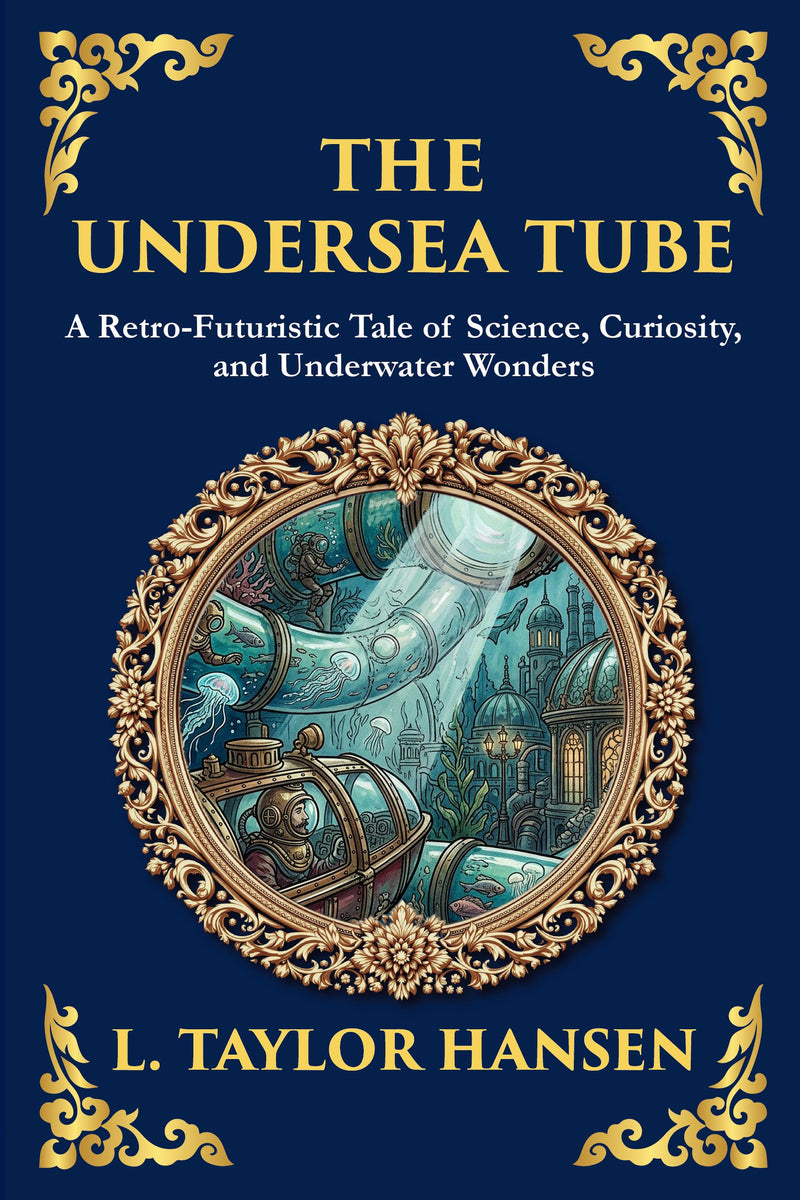
The Undersea Tube
Beneath the waves lies a vision of the future: a glittering underwater highway, stretching across the ocean floor, carrying humankind into the next age of exploration.
or free app
10,000+ hrs library
30-day guarantee
The complete The Undersea Tube appears in modern English through Library of Alexandria Press, available online with audiobook narration included for members.
Have you ever wondered why humanity’s greatest frontiers lie not above—but below the surface of the sea? The Undersea Tube by L. Taylor Hansen is a visionary exploration of science, ambition, and the power of the human imagination. Written in a time when transoceanic bridges and space colonies were still only dreams, this thrilling novella dares to imagine an underwater world transformed by human ingenuity.
The story centers on a revolutionary project: a massive tube connecting two continents beneath the ocean’s surface—a feat of engineering meant to unite the world and redefine travel forever. As scientists and builders navigate technological challenges and public skepticism, strange phenomena begin to surface. Whispers of seismic tremors, shadowy creatures in the deep, and forces that defy scientific explanation threaten to unravel the dream before it’s realized.
In the tradition of Jules Verne and H.G. Wells, Hansen weaves a tale that celebrates the brilliance of scientific thought while reminding us that nature often holds the final say. Part speculative fiction, part scientific romance, The Undersea Tube is a journey into the unknown— one lined with risk, revelation, and the unyielding pulse of human curiosity.
What you’ll discover in this modern edition
- A Bold Retrofuturistic Premise – Explore the technical and human drama of constructing a tube beneath the sea.
- Thrills Beneath the Surface – From deep-sea mysteries to unexpected dangers, the ocean becomes both setting and character.
- Themes of Progress, Hubris, and Wonder – Question the balance between technology and nature in a world chasing innovation.
- A Forgotten Treasure of Early Science Fiction – Brought back to life for modern readers fascinated by vintage sci-fi dreams.
| Formats | eBook (EPUB + PDF) · Audiobook · Paperback · Hardcover · Large Print |
| Language | English |
| Trim size (print) | 6 × 9 in |
| Binding | Paperback — perfect-bound · Hardcover — casewrap |
| Large Print edition | Same text in a larger, easy-read type — a larger font, not a larger trim |
| Print pricing | Every physical book at our true cost — at-cost, no profit (members) |
| Library | 873 restored titles, always growing |
| Length | 7,308 words · ~29 min reading |
| Reading level | Grade 11 · a confident, adult read (this modern-English edition) |
| Edition | Modern English translation · 2026 |
Member reviews for this edition are collected as readers finish it — be the first. Across the library: 12,000+ books shipped, every plan covered by a 365-day print guarantee.
About this edition
A faithful, unabridged modern-English edition by The Library of Alexandria — carefully rendered for today's reader and verified paragraph-by-paragraph against the public-domain source. Available as eBook, audiobook, paperback, hardcover, and large print.
- Complete & unabridgedVerified paragraph by paragraph against the source — never a scan, never abridged.
- Modern English, faithfulReadable today, with the author’s meaning kept intact. Readable — not simplified.
- Every format, one membershipRead in your browser or the free app, or listen to the full audiobook.
Included free with your membership
Cancel anytime, one click · 30-day money-back guarantee
Edition last updated July 2026
What’s inside
The Undersea Tube — complete and unabridged, included in full with membership, plus the full audiobook.
Begin reading The Undersea Tube
In clear modern English — the complete text is included with membership.
Introduction
There is a particular kind of magic that happens when we encounter a vision of the future imagined by someone living in the past. It is a magic compounded of wonder, of nostalgia, and of a strange and tender recognition. We see our own dreams reflected back at us, distorted as if through the curved glass of a deep-sea porthole, and we discover that the human longing to reach beyond the boundaries of the possible is something that connects us across the decades. The Undersea Tube is precisely such a vision—a relic of an age when the world still felt vast and unconquered, when the ocean depths remained as mysterious as the surface of distant planets, and when a writer with a fertile imagination could dare to dream of a marvel so audacious that it would knit two continents together beneath the crushing weight of the Atlantic.
This is a story that belongs to a tradition of speculative fiction that flourished in the early decades of the twentieth century, a period when science and imagination danced together in the pages of pulp magazines and adventure stories, each feeding the other. It was a time when the marvels of engineering—the transcontinental railroads, the towering skyscrapers, the great steamships, the first tentative flights of heavier-than-air machines—had taught the public that the impossible was merely a problem awaiting a sufficiently bold solution. Writers of the era took those achievements and extrapolated them outward, building castles of speculation upon foundations of genuine scientific curiosity. The result was a literature that crackled with optimism, that believed fervently in the capacity of human ingenuity to overcome any obstacle nature might place in its path. The Undersea Tube is a shining example of this spirit, and to read it is to step into a world where the future was something to be welcomed rather than feared, where the next great adventure lay just beyond the horizon, waiting for the brave to claim it.
To fully appreciate what you hold in your hands, it helps to understand the cultural moment from which this tale emerged. The early twentieth century was a period of breathtaking transformation. Within the span of a single human lifetime, the world had been reshaped by inventions that would have seemed like sorcery to previous generations. The telegraph had collapsed distances, allowing messages to travel across oceans in moments rather than weeks. The telephone had brought human voices into homes across the land. Electric light had banished the darkness, and the automobile had begun to remake the very geography of daily life. Above all, the great engineering projects of the age had demonstrated that humanity could bend the physical world to its will on a scale never before imagined.
Consider the achievements that would have been fresh in the minds of readers when this story first appeared. The Panama Canal, completed in 1914, had cleaved a continent in two, joining the Atlantic and Pacific oceans through one of the most ambitious construction projects ever attempted. Engineers had tamed jungles, moved mountains, and conquered diseases that had defeated earlier attempts. The great suspension bridges were beginning to span waters that had once seemed impossibly wide. Tunnels were being bored through mountain ranges and beneath rivers, connecting cities and nations that geography had kept apart. Each of these triumphs reinforced a powerful idea: that there was no natural barrier so formidable that the combined force of human intelligence and determination could not overcome it.
It was in this atmosphere of boundless confidence that writers began to ask the most exciting question of all: what comes next? If we can dig a canal across an isthmus, why not a tunnel beneath the sea? If we can build a railroad across a continent, why not a transport system that links continents directly, plunging beneath the waves to emerge thousands of miles away? These were not idle fantasies but logical extensions of the engineering marvels that surrounded them. The dream of an undersea tube connecting distant lands was, in its way, no more outlandish than the dream of flying machines had been a few decades earlier—and those machines were now a reality.
This is the imaginative wellspring from which the present tale draws its power. The vision at its heart is the dream of a vast subaqueous passage—a tube laid across the floor of the ocean, through which travelers might be conveyed at tremendous speed from one side of the world to the other. It is a concept that even today, in our age of supersonic flight and space tourism, retains an undeniable romance. There is something deeply compelling about the notion of journeying through the silent, alien world of the deep sea, sealed within a marvel of human construction, surrounded on all sides by the immense and mysterious darkness of the abyss. The story invites us to imagine what such a journey might feel like, what dangers might lurk in the lightless depths, and what wonders might reward the intrepid souls who dare to make the passage.
What makes this kind of speculation so enduring is that it operates on two levels simultaneously. On the surface, it is pure entertainment—a thrilling adventure that propels the reader forward with the momentum of a runaway train. But beneath that surface lies something more profound: a meditation on the relationship between humanity and the natural world, on the price and the promise of progress, and on the eternal human impulse to explore the unknown. The ocean depths, in particular, have always held a special place in the human imagination. They represent the last great frontier on our own planet, a realm more alien and less explored than many regions of outer space. Even today, vast stretches of the sea floor remain uncharted, and creatures of extraordinary strangeness continue to be discovered in the crushing blackness of the deep. For the writers of an earlier age, the ocean was a canvas upon which they could paint their wildest imaginings, populating it with marvels and menaces drawn equally from scientific speculation and from the deep wells of myth and legend.
The author of this work understood the dramatic potential of this setting completely. The deep sea is a place of perpetual darkness, of pressures that would crush an unprotected human in an instant, of strange luminous creatures that have evolved to thrive where no sunlight ever penetrates. It is a world that demands respect, that punishes carelessness with swift and total destruction, and that holds secrets no human eye has ever witnessed. To set an adventure in such a place is to charge every page with an undercurrent of tension and awe. The reader feels the weight of the water overhead, senses the fragility of the human creations that hold back the implacable force of the sea, and shares in the characters’ mingled exhilaration and dread as they venture into a domain that was never meant for human beings.
It is worth pausing to reflect on the author who brought this vision to life. L. Taylor Hansen occupies a fascinating and somewhat enigmatic place in the history of speculative fiction. Writing during the golden age of the science fiction and adventure pulps, Hansen contributed to a body of literature that combined genuine scientific curiosity with the boundless freedom of imaginative storytelling. The pulp writers of this era were, in many ways, the popular educators of their day, smuggling real ideas about geology, biology, physics, and engineering into stories designed first and foremost to entertain. A reader picking up a tale like this one would be thrilled by the adventure, but might also come away with a heightened sense of wonder about the natural world and a deeper appreciation for the principles of science that governed it. There was an earnestness to this approach, a sincere belief that the marvels of the universe were worth understanding and that fiction could serve as a gateway to that understanding.
This blending of education and entertainment is one of the great pleasures of reading early speculative fiction. The authors were not content merely to spin yarns; they wanted their readers to think, to wonder, to look at the world around them with fresh eyes. When they described an undersea tube or a strange deep-sea creature, they did so with an attention to plausible detail that lent their fantasies an air of credibility. They asked themselves how such things might actually work, what challenges would have to be overcome, what the consequences might be. This rigor, even when it strayed into the fanciful, gave their work a satisfying solidity. The reader was never asked simply to accept a marvel on faith; instead, the marvel was presented as the logical outcome of identifiable causes, a triumph of reason as much as of imagination.
There is a term that has come to describe the particular pleasure of encountering old visions of the future: retro-futurism. It refers to the curious and delightful experience of seeing how the past imagined the world that was to come—a world that, in many cases, never quite arrived in the form that was predicted, or arrived in forms wildly different from anything the original dreamers had foreseen. Retro-futurism has become a beloved aesthetic and cultural sensibility in our own time, appearing in films, video games, design, and literature. There is something irresistibly charming about the brass-and-rivets technology, the bold geometric optimism, and the sweeping grandeur of these earlier visions. They speak to us of a time when the future was a destination to be eagerly anticipated rather than a source of anxiety.
Reading a work of retro-futurism today offers a doubled pleasure. We enjoy the story on its own terms, allowing ourselves to be swept up in the adventure and the wonder. But we also enjoy it as a kind of time capsule, a window into the hopes and assumptions of a vanished age. We notice the things the author got right with uncanny prescience, and we smile at the things they got charmingly wrong. We see how the concerns of their day—the faith in unlimited progress, the romance of grand engineering, the thrill of exploration—shaped their vision of what was to come. And in doing so, we gain a deeper understanding not only of the past but of our own moment, for our visions of the future are no less shaped by our present concerns than theirs were by theirs.
The undersea tube at the center of this story is a perfect emblem of retro-futurist imagination. It represents a future that, in some sense, we have chosen not to build—though the dream has never entirely died. Engineers and visionaries have continued to propose grand schemes for transcontinental tunnels and undersea transport systems right up to the present day, and some of the boldest of these proposals would not look out of place alongside the marvels described in these pages. There is a direct line of descent from the dreams of the early pulp era to the speculative megaprojects of our own time. To read this story, then, is to participate in a conversation about the future that has been ongoing for more than a century, and that shows no signs of concluding.
What strikes the modern reader most forcefully, perhaps, is the sheer optimism of the vision. In our own age, we have grown accustomed to imagining the future in darker tones. So much of our contemporary speculative fiction is concerned with dystopia, with collapse, with the unintended consequences of technological hubris. We have learned, through hard experience, to be wary of the promises of progress, to ask not only what we can build but whether we should. This skepticism is hard-won and valuable, but it can also be exhausting. There is a genuine refreshment to be found in returning to an era when the future was bright, when the next great marvel was something to be celebrated rather than feared, and when the human capacity for invention was seen as an unalloyed good.
This is not to say that the optimism of the early speculative writers was naive or unexamined. The best of them understood that great achievements come with great risks, and that the forces of nature do not yield without a struggle. The drama of a story like this one arises precisely from the tension between human ambition and the indifferent power of the natural world. The deep sea does not care about our plans or our pride. It will swallow our greatest creations as readily as it swallows a pebble, and any human venture into its depths must reckon with the possibility of catastrophe. This awareness of danger gives the optimism its weight and meaning. It is not a foolish confidence that ignores the perils, but a brave determination to face them and overcome them. The heroes of such stories are not invulnerable; they triumph through courage, ingenuity, and sometimes sacrifice. Their victories are earned, and they are all the more satisfying for it.
Cancel anytime, one click · 30-day money-back guarantee
Founding annual rate available now — your price locks for life when you join.
Not ready? Get this free chapter by email — read it anytime.
✓ Sent — check your inbox for The Undersea Tube.
Questions about The Undersea Tube
What is The Undersea Tube about?
Beneath the waves lies a vision of the future: a glittering underwater highway, stretching across the ocean floor, carrying humankind into the next age of exploration. In The Undersea Tube, L. Taylor Hansen invites readers into a dazzling world where scientific wonder, technological ambition, and a spirit of curiosity combine in a thrilling tale of innovation and adventure. Blending early 20th-century optimism with timeless sci-fi speculation, this retro-futuristic gem envisions a world shaped by daring engineers,
Who wrote The Undersea Tube?
The Undersea Tube was written by L. Taylor Hansen. This edition presents the complete work in clear modern English, faithfully rendered from the public-domain original by Library of Alexandria Press.
Is The Undersea Tube free to read?
The opening chapter is free to read on this page. Members read and listen to the complete work — and the entire library — free, and can order any physical book at our true print cost.
How long is The Undersea Tube?
2 chapters (~7,308 words) — about 29 min of reading in this modern-English edition.
Is this an abridged version of The Undersea Tube?
No. This is the complete, unabridged The Undersea Tube, carefully rendered into clear modern English and verified paragraph-by-paragraph against the public-domain source — nothing is cut or summarised.
What formats does The Undersea Tube come in?
The Undersea Tube is available as eBook, paperback, hardcover and large print. eBook and audiobook are included with membership; printed editions ship at our true print cost.
Shipping & returns
Billing & membership
More from the library


Explore Adventure
- Tarzan of the Apes · Edgar Rice Burroughs
- The Wonderful Wizard of Oz · L. Frank Baum
- Peter Pan · J. M. Barrie
- Moby Dick; Or, The Whale · Herman Melville
- The Riddle of the Sands · Erskine Childers
- The Loss of the Swansea: A Story of the Florida Coast · W. L. Alden
- Sky Island · L. Frank Baum
- Vikram and the Vampire: Classic Hindu Tales of Adventure, Magic, and Romance · Unknown
- Tales of Unrest · Joseph Conrad
- The Tomb of Ts’in · Edgar Wallace
- Skinny McCord · Percy Keese Fitzhugh
- The Men of the Moss-Hags · S. R. Crockett
- The Hunniwell Boys and the Platinum Mystery · L. P. Wyman
- Allan Quatermain · H. Rider Haggard
- She · H. Rider Haggard
- Medical Life in the Navy · Gordon Stables
- The Thirty-Nine Steps · John Buchan
- The Story of Doctor Dolittle · Hugh Lofting
- The Princess and the Goblin · George MacDonald
- The Man Who Would Be King · Rudyard Kipling
- Lucian’s True History · Lucian of Samosata
- The Secret Adversary · Agatha Christie
- Lord Jim · Joseph Conrad
- The Marvelous Land of Oz · L. Frank Baum
- The Virginian: A Horseman of the Plains · Owen Wister
- Mars is My Destination · Frank Belknap Long
- Anabasis · Xenophon
- The Mississippi Saucer · Frank Belknap Long
- Sabotage in Space · Carey Rockwell
- Brood of the Dark Moon · Charles Willard Diffin
The Undersea Tube
The Undersea Tube
A Retro-Futuristic Tale of Science, Curiosity, and Underwater Wonders
L. Taylor Hansen
Contents
- Introduction
- The Undersea Tube
Introduction
There is a particular kind of magic that happens when we encounter a vision of the future imagined by someone living in the past. It is a magic compounded of wonder, of nostalgia, and of a strange and tender recognition. We see our own dreams reflected back at us, distorted as if through the curved glass of a deep-sea porthole, and we discover that the human longing to reach beyond the boundaries of the possible is something that connects us across the decades. The Undersea Tube is precisely such a vision—a relic of an age when the world still felt vast and unconquered, when the ocean depths remained as mysterious as the surface of distant planets, and when a writer with a fertile imagination could dare to dream of a marvel so audacious that it would knit two continents together beneath the crushing weight of the Atlantic.
This is a story that belongs to a tradition of speculative fiction that flourished in the early decades of the twentieth century, a period when science and imagination danced together in the pages of pulp magazines and adventure stories, each feeding the other. It was a time when the marvels of engineering—the transcontinental railroads, the towering skyscrapers, the great steamships, the first tentative flights of heavier-than-air machines—had taught the public that the impossible was merely a problem awaiting a sufficiently bold solution. Writers of the era took those achievements and extrapolated them outward, building castles of speculation upon foundations of genuine scientific curiosity. The result was a literature that crackled with optimism, that believed fervently in the capacity of human ingenuity to overcome any obstacle nature might place in its path. The Undersea Tube is a shining example of this spirit, and to read it is to step into a world where the future was something to be welcomed rather than feared, where the next great adventure lay just beyond the horizon, waiting for the brave to claim it.
To fully appreciate what you hold in your hands, it helps to understand the cultural moment from which this tale emerged. The early twentieth century was a period of breathtaking transformation. Within the span of a single human lifetime, the world had been reshaped by inventions that would have seemed like sorcery to previous generations. The telegraph had collapsed distances, allowing messages to travel across oceans in moments rather than weeks. The telephone had brought human voices into homes across the land. Electric light had banished the darkness, and the automobile had begun to remake the very geography of daily life. Above all, the great engineering projects of the age had demonstrated that humanity could bend the physical world to its will on a scale never before imagined.
Consider the achievements that would have been fresh in the minds of readers when this story first appeared. The Panama Canal, completed in 1914, had cleaved a continent in two, joining the Atlantic and Pacific oceans through one of the most ambitious construction projects ever attempted. Engineers had tamed jungles, moved mountains, and conquered diseases that had defeated earlier attempts. The great suspension bridges were beginning to span waters that had once seemed impossibly wide. Tunnels were being bored through mountain ranges and beneath rivers, connecting cities and nations that geography had kept apart. Each of these triumphs reinforced a powerful idea: that there was no natural barrier so formidable that the combined force of human intelligence and determination could not overcome it.
It was in this atmosphere of boundless confidence that writers began to ask the most exciting question of all: what comes next? If we can dig a canal across an isthmus, why not a tunnel beneath the sea? If we can build a railroad across a continent, why not a transport system that links continents directly, plunging beneath the waves to emerge thousands of miles away? These were not idle fantasies but logical extensions of the engineering marvels that surrounded them. The dream of an undersea tube connecting distant lands was, in its way, no more outlandish than the dream of flying machines had been a few decades earlier—and those machines were now a reality.
This is the imaginative wellspring from which the present tale draws its power. The vision at its heart is the dream of a vast subaqueous passage—a tube laid across the floor of the ocean, through which travelers might be conveyed at tremendous speed from one side of the world to the other. It is a concept that even today, in our age of supersonic flight and space tourism, retains an undeniable romance. There is something deeply compelling about the notion of journeying through the silent, alien world of the deep sea, sealed within a marvel of human construction, surrounded on all sides by the immense and mysterious darkness of the abyss. The story invites us to imagine what such a journey might feel like, what dangers might lurk in the lightless depths, and what wonders might reward the intrepid souls who dare to make the passage.
What makes this kind of speculation so enduring is that it operates on two levels simultaneously. On the surface, it is pure entertainment—a thrilling adventure that propels the reader forward with the momentum of a runaway train. But beneath that surface lies something more profound: a meditation on the relationship between humanity and the natural world, on the price and the promise of progress, and on the eternal human impulse to explore the unknown. The ocean depths, in particular, have always held a special place in the human imagination. They represent the last great frontier on our own planet, a realm more alien and less explored than many regions of outer space. Even today, vast stretches of the sea floor remain uncharted, and creatures of extraordinary strangeness continue to be discovered in the crushing blackness of the deep. For the writers of an earlier age, the ocean was a canvas upon which they could paint their wildest imaginings, populating it with marvels and menaces drawn equally from scientific speculation and from the deep wells of myth and legend.
The author of this work understood the dramatic potential of this setting completely. The deep sea is a place of perpetual darkness, of pressures that would crush an unprotected human in an instant, of strange luminous creatures that have evolved to thrive where no sunlight ever penetrates. It is a world that demands respect, that punishes carelessness with swift and total destruction, and that holds secrets no human eye has ever witnessed. To set an adventure in such a place is to charge every page with an undercurrent of tension and awe. The reader feels the weight of the water overhead, senses the fragility of the human creations that hold back the implacable force of the sea, and shares in the characters’ mingled exhilaration and dread as they venture into a domain that was never meant for human beings.
It is worth pausing to reflect on the author who brought this vision to life. L. Taylor Hansen occupies a fascinating and somewhat enigmatic place in the history of speculative fiction. Writing during the golden age of the science fiction and adventure pulps, Hansen contributed to a body of literature that combined genuine scientific curiosity with the boundless freedom of imaginative storytelling. The pulp writers of this era were, in many ways, the popular educators of their day, smuggling real ideas about geology, biology, physics, and engineering into stories designed first and foremost to entertain. A reader picking up a tale like this one would be thrilled by the adventure, but might also come away with a heightened sense of wonder about the natural world and a deeper appreciation for the principles of science that governed it. There was an earnestness to this approach, a sincere belief that the marvels of the universe were worth understanding and that fiction could serve as a gateway to that understanding.
This blending of education and entertainment is one of the great pleasures of reading early speculative fiction. The authors were not content merely to spin yarns; they wanted their readers to think, to wonder, to look at the world around them with fresh eyes. When they described an undersea tube or a strange deep-sea creature, they did so with an attention to plausible detail that lent their fantasies an air of credibility. They asked themselves how such things might actually work, what challenges would have to be overcome, what the consequences might be. This rigor, even when it strayed into the fanciful, gave their work a satisfying solidity. The reader was never asked simply to accept a marvel on faith; instead, the marvel was presented as the logical outcome of identifiable causes, a triumph of reason as much as of imagination.
There is a term that has come to describe the particular pleasure of encountering old visions of the future: retro-futurism. It refers to the curious and delightful experience of seeing how the past imagined the world that was to come—a world that, in many cases, never quite arrived in the form that was predicted, or arrived in forms wildly different from anything the original dreamers had foreseen. Retro-futurism has become a beloved aesthetic and cultural sensibility in our own time, appearing in films, video games, design, and literature. There is something irresistibly charming about the brass-and-rivets technology, the bold geometric optimism, and the sweeping grandeur of these earlier visions. They speak to us of a time when the future was a destination to be eagerly anticipated rather than a source of anxiety.
Reading a work of retro-futurism today offers a doubled pleasure. We enjoy the story on its own terms, allowing ourselves to be swept up in the adventure and the wonder. But we also enjoy it as a kind of time capsule, a window into the hopes and assumptions of a vanished age. We notice the things the author got right with uncanny prescience, and we smile at the things they got charmingly wrong. We see how the concerns of their day—the faith in unlimited progress, the romance of grand engineering, the thrill of exploration—shaped their vision of what was to come. And in doing so, we gain a deeper understanding not only of the past but of our own moment, for our visions of the future are no less shaped by our present concerns than theirs were by theirs.
The undersea tube at the center of this story is a perfect emblem of retro-futurist imagination. It represents a future that, in some sense, we have chosen not to build—though the dream has never entirely died. Engineers and visionaries have continued to propose grand schemes for transcontinental tunnels and undersea transport systems right up to the present day, and some of the boldest of these proposals would not look out of place alongside the marvels described in these pages. There is a direct line of descent from the dreams of the early pulp era to the speculative megaprojects of our own time. To read this story, then, is to participate in a conversation about the future that has been ongoing for more than a century, and that shows no signs of concluding.
What strikes the modern reader most forcefully, perhaps, is the sheer optimism of the vision. In our own age, we have grown accustomed to imagining the future in darker tones. So much of our contemporary speculative fiction is concerned with dystopia, with collapse, with the unintended consequences of technological hubris. We have learned, through hard experience, to be wary of the promises of progress, to ask not only what we can build but whether we should. This skepticism is hard-won and valuable, but it can also be exhausting. There is a genuine refreshment to be found in returning to an era when the future was bright, when the next great marvel was something to be celebrated rather than feared, and when the human capacity for invention was seen as an unalloyed good.
This is not to say that the optimism of the early speculative writers was naive or unexamined. The best of them understood that great achievements come with great risks, and that the forces of nature do not yield without a struggle. The drama of a story like this one arises precisely from the tension between human ambition and the indifferent power of the natural world. The deep sea does not care about our plans or our pride. It will swallow our greatest creations as readily as it swallows a pebble, and any human venture into its depths must reckon with the possibility of catastrophe. This awareness of danger gives the optimism its weight and meaning. It is not a foolish confidence that ignores the perils, but a brave determination to face them and overcome them. The heroes of such stories are not invulnerable; they triumph through courage, ingenuity, and sometimes sacrifice. Their victories are earned, and they are all the more satisfying for it.
If my engineer friend hadn’t warned me that the Tube was dangerous, I wouldn’t have bought a ticket on that fatal night, and the world would never have heard the story of the Golden Cavern and the City of the Dead. As is standard practice, I first gave my report as the sole survivor of the widely publicized Undersea Tube disaster to the International Committee for the Investigation of Disasters. Now, I am ready to share that story with the world. I know there have been many wild rumors and tales since the accident, but I ask my readers to be patient while I briefly explain the massive engineering challenges the team faced and the wind-propulsion theory they used. You have to understand these two technical aspects to make sense of the accident and what was discovered afterward.
Anyone who remembers modern history clearly will recall that at the end of the twentieth century, a long-held dream of the engineering world finally came true: the completion of the long-awaited undersea railroad. The engineers leading this massive project were inspired by the huge success of the first tube under the English Channel, which connected England and France by rail. However, they got their most radical ideas about using wind power for propulsion from the second Channel tube and the tubes connecting Montreal to New York and New York to Chicago. Consequently, before the Undersea Tube was finished, the engineers decided to use this new method for the world’s longest tunnel. They immediately began designing the massive air pumps that would be built at both ends—Liverpool and New York. I will explain the theory of wind propulsion later, based on how it was described to me.
End of the free sample
Keep reading, free
Members read and listen to the complete book — and the entire library. Cancel anytime, one click · 30-day money-back guarantee.