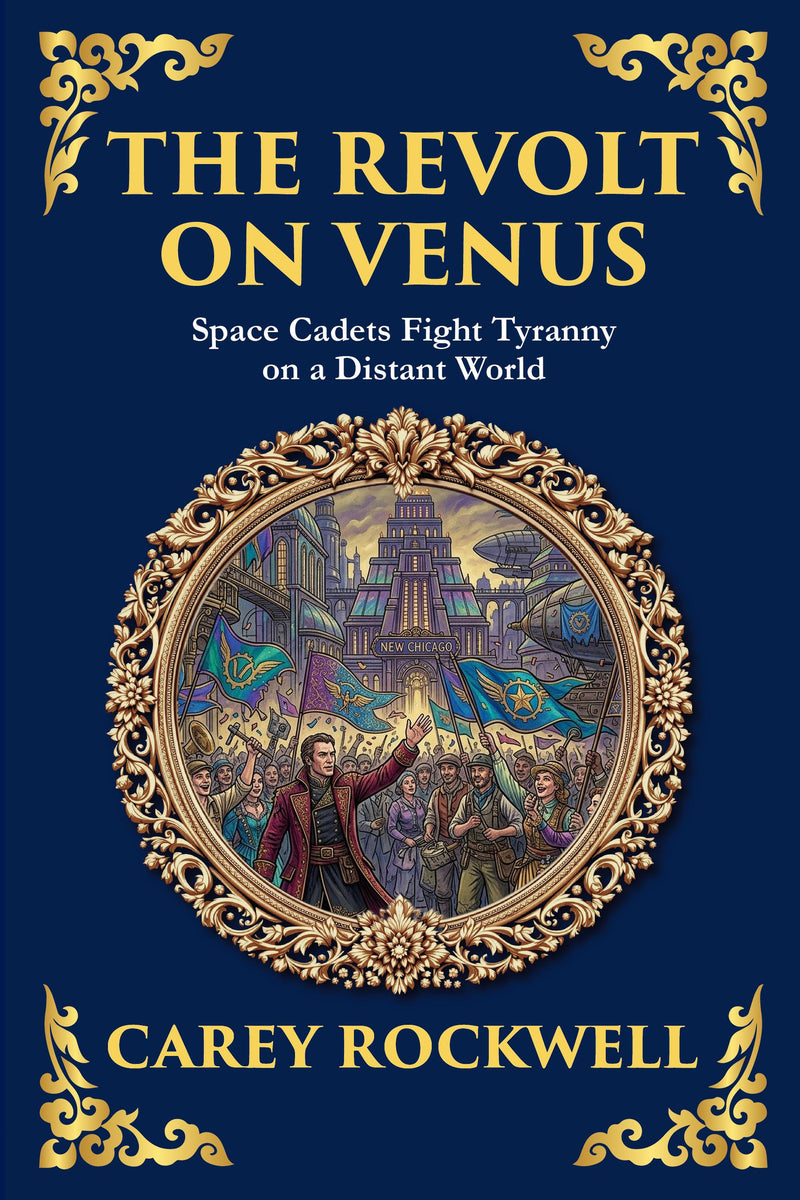
The Revolt on Venus
Venus is no paradise. Beneath its stormy skies and deadly jungles, rebellion brews. When Space Cadets Tom Corbett, Astro, and Roger Manning are assigned to a routine planetary patrol, they are thrust into a full-scale insurrection that will test their courage, loyalty, and resolve.
or free app
10,000+ hrs library
30-day guarantee
The complete The Revolt on Venus appears in modern English through Library of Alexandria Press, available online with audiobook narration included for members.
Have you ever wondered why true leadership is born in the heart of rebellion? Strap in for a rocket-fueled journey to the hostile surface of Venus, where betrayal simmers and freedom hangs by a thread. The Revolt on Venus is a classic space adventure in the Tom Corbett, Space Cadet series by Carey Rockwell—a thrilling blend of sci-fi action, camaraderie, and moral resolve.
When Tom Corbett and his fellow cadets arrive on Venus, they expect peacekeeping duty. What they find is an oppressed population, a sinister plot, and an uprising ready to explode. As loyalties are tested and ideals challenged, the cadets must decide where they stand: with the corrupt establishment or with the voice of freedom.
This isn’t just another training mission—this is a battle for the soul of a planet.
What you’ll discover in this modern edition
- A High-Stakes Sci-Fi Rebellion – Follow the cadets into a rebellion where diplomacy fails and action is the only answer.
| Formats | eBook (EPUB + PDF) · Audiobook · Paperback · Hardcover · Large Print |
| Language | English |
| Trim size (print) | 6 × 9 in |
| Binding | Paperback — perfect-bound · Hardcover — casewrap |
| Large Print edition | Same text in a larger, easy-read type — a larger font, not a larger trim |
| Print pricing | Every physical book at our true cost — at-cost, no profit (members) |
| Library | 873 restored titles, always growing |
| Length | 53,397 words · ~3 hr 34 min reading |
| Reading level | Grade 7 · an easy, flowing read (this modern-English edition) |
| Edition | Modern English translation · 2026 |
Member reviews for this edition are collected as readers finish it — be the first. Across the library: 12,000+ books shipped, every plan covered by a 365-day print guarantee.
About this edition
A faithful, unabridged modern-English edition by The Library of Alexandria — carefully rendered for today's reader and verified paragraph-by-paragraph against the public-domain source. Available as eBook, audiobook, paperback, hardcover, and large print.
- Complete & unabridgedVerified paragraph by paragraph against the source — never a scan, never abridged.
- Modern English, faithfulReadable today, with the author’s meaning kept intact. Readable — not simplified.
- Every format, one membershipRead in your browser or the free app, or listen to the full audiobook.
Included free with your membership
Cancel anytime, one click · 30-day money-back guarantee
Edition last updated July 2026
What’s inside
The Revolt on Venus — complete and unabridged: all 21 sections included with membership, plus the full audiobook.
Begin reading The Revolt on Venus
In clear modern English — the complete text is included with membership.
Introduction
There is a particular kind of magic that belongs to the dawn of an era—a freshness of imagination that comes when humankind first dares to dream seriously about reaching the stars. The Revolt on Venus arrives to us from precisely such a moment, a time when the rockets that would one day carry men beyond the sky were still drawing-board fantasies, when the planets of our solar system shimmered in the popular imagination as undiscovered countries waiting to be explored, conquered, and understood. To open this book is to step backward into that golden hour of speculative optimism, and at the same time to discover that many of its themes feel startlingly contemporary. This is a story of young people in training, of duty and courage tested under extraordinary pressure, and of the eternal struggle between freedom and tyranny carried out against the dramatic backdrop of a distant, hostile world.
The volume you now hold is part of the long-running and much-loved Tom Corbett, Space Cadet series, written under the house name Carey Rockwell. These adventures first captured the hearts of readers during the early 1950s, an age when the very phrase “space cadet” still carried the gleam of heroism rather than the wink of irony it sometimes acquired in later decades. In those years the idea of an academy that trained young men and women to pilot ships through the void was thrilling and new, a vision of the future that promised both wonder and responsibility. The books were aimed at young readers but were never condescending toward them; instead they treated their audience as capable of grappling with questions of loyalty, leadership, sacrifice, and justice. That is one of the qualities that has allowed these stories to endure, and it is one of the reasons this modern translation has been prepared with such care.
What you will find in these pages is a fast-moving, vividly imagined tale of three cadets and their officer instructor, bound together by friendship and discipline, who find themselves drawn into events far larger and more dangerous than a routine training exercise. The “revolt” promised by the title is not merely a backdrop but the engine of the drama, and the planet Venus—reimagined here as a place of swamps, jungles, frontier settlements, and untamed wilderness—becomes a stage on which questions of governance and rebellion play out with genuine tension. Without revealing the turns the plot will take, it is enough to say that the cadets are forced to rely on their training, their wits, and above all on one another, and that the consequences of failure are made to feel real and pressing throughout.
To appreciate fully what this book offers, it helps to understand the historical and cultural soil from which it grew. When these adventures were first written, no human being had yet left the surface of the Earth. The first artificial satellite would not orbit the planet until the close of the 1950s, and the first human spaceflight lay even further in the future. Everything we now know about Venus—its crushing atmospheric pressure, its searing surface temperatures, its clouds of sulfuric acid—was unknown or only dimly guessed at. To the writers and readers of this era, Venus was a blank and inviting canvas. Shrouded perpetually in thick cloud, it could be imagined as nearly anything: a steaming primeval jungle, a watery ocean world, a misty land of mystery teeming with strange life. The science of the day permitted such dreams, and the fiction of the day seized upon them eagerly.
This is why a modern reader should approach the Venus depicted here not as a scientific prediction but as a work of imaginative landscape painting. The swamps and forests, the frontier outposts and pioneer communities, are part of a long and honorable tradition in adventure literature: the untamed border country where civilization meets wilderness, where law is thin and courage must fill the gaps. In transposing that classic frontier setting onto another planet, the author tapped into something deeply resonant in the storytelling imagination. Readers who grew up on tales of pioneers, explorers, and frontier justice would have recognized the rhythms immediately, even as the rocket ships and ray guns gave everything a thrilling futuristic sheen.
There is a particular pleasure to be had in reading this kind of “retro-future.” The technology imagined in these pages was the cutting edge of what mid-century minds could conceive, and there is real charm in seeing how the future was dreamed before it actually arrived. The communications devices, the propulsion systems, the methods of navigation—all of these reflect the assumptions and aspirations of their time. Rather than dating the story in a way that diminishes it, this gives it a doubled appeal: we enjoy the adventure on its own terms, and we also enjoy the gentle archaeology of seeing how an earlier generation pictured the world to come. It is a window into the hopes of an age that believed, perhaps more wholeheartedly than we do now, that the future would be a place of progress, exploration, and human achievement.
The Tom Corbett stories were closely tied to a broader cultural phenomenon. The character and his world appeared not only in books but across radio, television, comics, and a wide range of merchandise that captured the popular imagination of children across an entire nation. This was an early example of what we would now call a multimedia franchise, and its reach was considerable. For a generation of young people, the Space Cadet was as familiar and beloved a figure as any hero of the screen. To read one of these adventures today is therefore to connect with a piece of genuine cultural history, a touchstone that shaped how an entire generation imagined the possibilities of space travel. Many of the scientists, engineers, and dreamers who would later contribute to the real space program grew up on exactly this kind of fiction, and it is no exaggeration to say that stories like these helped to plant the seeds of ambitions that would one day be fulfilled in fact.
It is worth dwelling, too, on the institution at the heart of the series. The academy that trains these cadets is not merely a setting but a kind of moral framework. It embodies an ideal of cooperation among the worlds, a vision of a future in which the planets are united under a shared system of law and exploration rather than divided by endless conflict. The cadets are taught not only the practical skills of spaceflight but a code of conduct: honor, loyalty, courage, fairness, and respect for legitimate authority balanced against the duty to resist injustice. These values run quietly through the whole series, and they give the adventures a backbone of seriousness that elevates them above mere thrill-seeking. When the cadets are confronted with a revolt, with the breakdown of order on a distant world, the story is implicitly asking what it means to uphold those values when they are tested—when the easy path and the right path diverge, when loyalty to friends and loyalty to principle pull in different directions.
The Craft of Adventure and the Art of This Translation
One of the great strengths of these stories is their narrative economy. They are built for momentum. From the early pages, the reader is propelled forward by a sequence of challenges, complications, and reversals that rarely allow the pace to slacken. This is storytelling in the classic adventure mode, where the plot is king and where every scene exists to advance the tension or deepen the stakes. There is danger that feels genuine, there are obstacles that must be overcome through ingenuity and grit, and there are moments of genuine peril in which the outcome is far from certain. The author understood, as the best writers of adventure always have, that a story lives or dies by its forward motion, and these pages move.
Yet the appeal is not merely mechanical. What gives the Space Cadet adventures their lasting warmth is the bond among the central characters. The relationship between the cadets—their banter, their disagreements, their fierce loyalty to one another in moments of crisis—gives the action a human anchor. We care what happens because we care about these young people. Their friendship is tested but never broken; their differences in temperament become strengths when combined. One brings boldness, another brings steady technical skill, another brings a gruff but good-hearted reliability. Together they form a unit that is greater than the sum of its parts, and watching that unit function under pressure is one of the chief joys of the reading experience. The officer who guides them provides a model of mature leadership, demanding but fair, and the dynamic between mentor and students adds another layer of richness to the proceedings.
There is also, running beneath the surface excitement, a genuine engagement with ideas that gives the story its weight. The theme of revolt against tyranny is not treated lightly. The narrative invites us to think about what causes a society to rise up, what distinguishes a just cause from an unjust one, and what role outsiders should play when they find themselves caught in another community’s struggle. These are not abstract questions for the cadets; they are matters of immediate, life-and-death importance, and the way the characters reason through their choices models a kind of ethical seriousness that young readers can absorb almost without noticing. The book never lectures, but it never trivializes either. It respects its audience enough to let hard situations remain genuinely hard.
Now a word about this particular edition, which has been prepared as a modern translation, adapted for the contemporary reader. It is important to be clear and honest about what that means, so that you can approach the text with the right expectations and enjoy it fully. The original stories were written for an audience of the early 1950s, and the language, idioms, and references of that period can sometimes create small barriers for readers today. Certain turns of phrase that were once common have faded from use; certain assumptions about technology, about how people speak, about the rhythms of everyday conversation, have shifted over the intervening decades. The goal of this adaptation has been to smooth those barriers gently, to clarify what might otherwise be obscure, and to allow the inherent energy and excitement of the story to come through to a new generation without the friction that aging prose can sometimes introduce.
This kind of careful modernization is a delicate art. The aim is never to strip away the charm and character of the original, nor to erase the period flavor that is so much a part of the appeal. Rather, the aim is to act as a sympathetic intermediary, ensuring that the heart of the story beats clearly for readers who did not grow up in the world that produced it. Think of it as the difference between a faded photograph and one that has been gently restored: the image is the same, the subject is the same, but the details that time had begun to obscure are made visible again. The adventure, the characters, the moral seriousness, the imaginative grandeur of the setting—all of these remain fully intact. What has changed is simply the ease with which a modern reader can step into the world and feel at home there.
Readers who come to this book with some knowledge of the original series may notice these adaptations and should understand the spirit in which they were made. Readers who come to it fresh, with no prior acquaintance, need not think about them at all; they should simply enjoy a rousing tale told in clear, accessible language. Either way, the essential experience is preserved: the thrill of the launch, the tension of the mission, the camaraderie of the crew, the satisfaction of obstacles overcome through courage and cleverness, and the deeper satisfaction of seeing characters behave honorably in difficult circumstances. This is, above all, a story meant to be enjoyed, and the modernization exists in service of that enjoyment.
Cancel anytime, one click · 30-day money-back guarantee
Founding annual rate available now — your price locks for life when you join.
Not ready? Get this free chapter by email — read it anytime.
✓ Sent — check your inbox for The Revolt on Venus.
Questions about The Revolt on Venus
What is The Revolt on Venus about?
Venus is no paradise. Beneath its stormy skies and deadly jungles, rebellion brews. When Space Cadets Tom Corbett, Astro, and Roger Manning are assigned to a routine planetary patrol, they are thrust into a full-scale insurrection that will test their courage, loyalty, and resolve.
Who wrote The Revolt on Venus?
The Revolt on Venus was written by Carey Rockwell. This edition presents the complete work in clear modern English, faithfully rendered from the public-domain original by Library of Alexandria Press.
Is The Revolt on Venus free to read?
The opening chapter is free to read on this page. Members read and listen to the complete work — and the entire library — free, and can order any physical book at our true print cost.
How long is The Revolt on Venus?
21 chapters (~53,397 words) — about 3 hr 34 min of reading in this modern-English edition.
Is this an abridged version of The Revolt on Venus?
No. This is the complete, unabridged The Revolt on Venus, carefully rendered into clear modern English and verified paragraph-by-paragraph against the public-domain source — nothing is cut or summarised.
What formats does The Revolt on Venus come in?
The Revolt on Venus is available as eBook, paperback, hardcover and large print. eBook and audiobook are included with membership; printed editions ship at our true print cost.
Shipping & returns
Billing & membership
More from the library


Explore Adventure
- Tarzan of the Apes · Edgar Rice Burroughs
- The Wonderful Wizard of Oz · L. Frank Baum
- Peter Pan · J. M. Barrie
- Moby Dick; Or, The Whale · Herman Melville
- The Riddle of the Sands · Erskine Childers
- The Loss of the Swansea: A Story of the Florida Coast · W. L. Alden
- Sky Island · L. Frank Baum
- Vikram and the Vampire: Classic Hindu Tales of Adventure, Magic, and Romance · Unknown
- Tales of Unrest · Joseph Conrad
- The Tomb of Ts’in · Edgar Wallace
- Skinny McCord · Percy Keese Fitzhugh
- The Men of the Moss-Hags · S. R. Crockett
- The Hunniwell Boys and the Platinum Mystery · L. P. Wyman
- Allan Quatermain · H. Rider Haggard
- She · H. Rider Haggard
- Medical Life in the Navy · Gordon Stables
- The Thirty-Nine Steps · John Buchan
- The Story of Doctor Dolittle · Hugh Lofting
- The Princess and the Goblin · George MacDonald
- The Man Who Would Be King · Rudyard Kipling
- Lucian’s True History · Lucian of Samosata
- The Secret Adversary · Agatha Christie
- Lord Jim · Joseph Conrad
- The Marvelous Land of Oz · L. Frank Baum
- The Virginian: A Horseman of the Plains · Owen Wister
- Mars is My Destination · Frank Belknap Long
- Anabasis · Xenophon
- The Mississippi Saucer · Frank Belknap Long
- Sabotage in Space · Carey Rockwell
- Brood of the Dark Moon · Charles Willard Diffin
The Revolt on Venus
The Revolt on Venus
Space Cadets Fight Tyranny on a Distant World
Carey Rockwell
Contents
- Introduction
- Chapter 1
- Chapter 2
- Chapter 3
- Chapter 4
- Chapter 5
- Chapter 6
- Chapter 7
- Chapter 8
- Chapter 9
- Chapter 10
- Chapter 11
- Chapter 12
- Chapter 13
- Chapter 14
- Chapter 15
- Chapter 16
- Chapter 17
- Chapter 18
- Chapter 19
- Chapter 20
Introduction
There is a particular kind of magic that belongs to the dawn of an era—a freshness of imagination that comes when humankind first dares to dream seriously about reaching the stars. The Revolt on Venus arrives to us from precisely such a moment, a time when the rockets that would one day carry men beyond the sky were still drawing-board fantasies, when the planets of our solar system shimmered in the popular imagination as undiscovered countries waiting to be explored, conquered, and understood. To open this book is to step backward into that golden hour of speculative optimism, and at the same time to discover that many of its themes feel startlingly contemporary. This is a story of young people in training, of duty and courage tested under extraordinary pressure, and of the eternal struggle between freedom and tyranny carried out against the dramatic backdrop of a distant, hostile world.
The volume you now hold is part of the long-running and much-loved Tom Corbett, Space Cadet series, written under the house name Carey Rockwell. These adventures first captured the hearts of readers during the early 1950s, an age when the very phrase “space cadet” still carried the gleam of heroism rather than the wink of irony it sometimes acquired in later decades. In those years the idea of an academy that trained young men and women to pilot ships through the void was thrilling and new, a vision of the future that promised both wonder and responsibility. The books were aimed at young readers but were never condescending toward them; instead they treated their audience as capable of grappling with questions of loyalty, leadership, sacrifice, and justice. That is one of the qualities that has allowed these stories to endure, and it is one of the reasons this modern translation has been prepared with such care.
What you will find in these pages is a fast-moving, vividly imagined tale of three cadets and their officer instructor, bound together by friendship and discipline, who find themselves drawn into events far larger and more dangerous than a routine training exercise. The “revolt” promised by the title is not merely a backdrop but the engine of the drama, and the planet Venus—reimagined here as a place of swamps, jungles, frontier settlements, and untamed wilderness—becomes a stage on which questions of governance and rebellion play out with genuine tension. Without revealing the turns the plot will take, it is enough to say that the cadets are forced to rely on their training, their wits, and above all on one another, and that the consequences of failure are made to feel real and pressing throughout.
To appreciate fully what this book offers, it helps to understand the historical and cultural soil from which it grew. When these adventures were first written, no human being had yet left the surface of the Earth. The first artificial satellite would not orbit the planet until the close of the 1950s, and the first human spaceflight lay even further in the future. Everything we now know about Venus—its crushing atmospheric pressure, its searing surface temperatures, its clouds of sulfuric acid—was unknown or only dimly guessed at. To the writers and readers of this era, Venus was a blank and inviting canvas. Shrouded perpetually in thick cloud, it could be imagined as nearly anything: a steaming primeval jungle, a watery ocean world, a misty land of mystery teeming with strange life. The science of the day permitted such dreams, and the fiction of the day seized upon them eagerly.
This is why a modern reader should approach the Venus depicted here not as a scientific prediction but as a work of imaginative landscape painting. The swamps and forests, the frontier outposts and pioneer communities, are part of a long and honorable tradition in adventure literature: the untamed border country where civilization meets wilderness, where law is thin and courage must fill the gaps. In transposing that classic frontier setting onto another planet, the author tapped into something deeply resonant in the storytelling imagination. Readers who grew up on tales of pioneers, explorers, and frontier justice would have recognized the rhythms immediately, even as the rocket ships and ray guns gave everything a thrilling futuristic sheen.
There is a particular pleasure to be had in reading this kind of “retro-future.” The technology imagined in these pages was the cutting edge of what mid-century minds could conceive, and there is real charm in seeing how the future was dreamed before it actually arrived. The communications devices, the propulsion systems, the methods of navigation—all of these reflect the assumptions and aspirations of their time. Rather than dating the story in a way that diminishes it, this gives it a doubled appeal: we enjoy the adventure on its own terms, and we also enjoy the gentle archaeology of seeing how an earlier generation pictured the world to come. It is a window into the hopes of an age that believed, perhaps more wholeheartedly than we do now, that the future would be a place of progress, exploration, and human achievement.
The Tom Corbett stories were closely tied to a broader cultural phenomenon. The character and his world appeared not only in books but across radio, television, comics, and a wide range of merchandise that captured the popular imagination of children across an entire nation. This was an early example of what we would now call a multimedia franchise, and its reach was considerable. For a generation of young people, the Space Cadet was as familiar and beloved a figure as any hero of the screen. To read one of these adventures today is therefore to connect with a piece of genuine cultural history, a touchstone that shaped how an entire generation imagined the possibilities of space travel. Many of the scientists, engineers, and dreamers who would later contribute to the real space program grew up on exactly this kind of fiction, and it is no exaggeration to say that stories like these helped to plant the seeds of ambitions that would one day be fulfilled in fact.
It is worth dwelling, too, on the institution at the heart of the series. The academy that trains these cadets is not merely a setting but a kind of moral framework. It embodies an ideal of cooperation among the worlds, a vision of a future in which the planets are united under a shared system of law and exploration rather than divided by endless conflict. The cadets are taught not only the practical skills of spaceflight but a code of conduct: honor, loyalty, courage, fairness, and respect for legitimate authority balanced against the duty to resist injustice. These values run quietly through the whole series, and they give the adventures a backbone of seriousness that elevates them above mere thrill-seeking. When the cadets are confronted with a revolt, with the breakdown of order on a distant world, the story is implicitly asking what it means to uphold those values when they are tested—when the easy path and the right path diverge, when loyalty to friends and loyalty to principle pull in different directions.
The Craft of Adventure and the Art of This Translation
One of the great strengths of these stories is their narrative economy. They are built for momentum. From the early pages, the reader is propelled forward by a sequence of challenges, complications, and reversals that rarely allow the pace to slacken. This is storytelling in the classic adventure mode, where the plot is king and where every scene exists to advance the tension or deepen the stakes. There is danger that feels genuine, there are obstacles that must be overcome through ingenuity and grit, and there are moments of genuine peril in which the outcome is far from certain. The author understood, as the best writers of adventure always have, that a story lives or dies by its forward motion, and these pages move.
Yet the appeal is not merely mechanical. What gives the Space Cadet adventures their lasting warmth is the bond among the central characters. The relationship between the cadets—their banter, their disagreements, their fierce loyalty to one another in moments of crisis—gives the action a human anchor. We care what happens because we care about these young people. Their friendship is tested but never broken; their differences in temperament become strengths when combined. One brings boldness, another brings steady technical skill, another brings a gruff but good-hearted reliability. Together they form a unit that is greater than the sum of its parts, and watching that unit function under pressure is one of the chief joys of the reading experience. The officer who guides them provides a model of mature leadership, demanding but fair, and the dynamic between mentor and students adds another layer of richness to the proceedings.
There is also, running beneath the surface excitement, a genuine engagement with ideas that gives the story its weight. The theme of revolt against tyranny is not treated lightly. The narrative invites us to think about what causes a society to rise up, what distinguishes a just cause from an unjust one, and what role outsiders should play when they find themselves caught in another community’s struggle. These are not abstract questions for the cadets; they are matters of immediate, life-and-death importance, and the way the characters reason through their choices models a kind of ethical seriousness that young readers can absorb almost without noticing. The book never lectures, but it never trivializes either. It respects its audience enough to let hard situations remain genuinely hard.
Now a word about this particular edition, which has been prepared as a modern translation, adapted for the contemporary reader. It is important to be clear and honest about what that means, so that you can approach the text with the right expectations and enjoy it fully. The original stories were written for an audience of the early 1950s, and the language, idioms, and references of that period can sometimes create small barriers for readers today. Certain turns of phrase that were once common have faded from use; certain assumptions about technology, about how people speak, about the rhythms of everyday conversation, have shifted over the intervening decades. The goal of this adaptation has been to smooth those barriers gently, to clarify what might otherwise be obscure, and to allow the inherent energy and excitement of the story to come through to a new generation without the friction that aging prose can sometimes introduce.
This kind of careful modernization is a delicate art. The aim is never to strip away the charm and character of the original, nor to erase the period flavor that is so much a part of the appeal. Rather, the aim is to act as a sympathetic intermediary, ensuring that the heart of the story beats clearly for readers who did not grow up in the world that produced it. Think of it as the difference between a faded photograph and one that has been gently restored: the image is the same, the subject is the same, but the details that time had begun to obscure are made visible again. The adventure, the characters, the moral seriousness, the imaginative grandeur of the setting—all of these remain fully intact. What has changed is simply the ease with which a modern reader can step into the world and feel at home there.
Readers who come to this book with some knowledge of the original series may notice these adaptations and should understand the spirit in which they were made. Readers who come to it fresh, with no prior acquaintance, need not think about them at all; they should simply enjoy a rousing tale told in clear, accessible language. Either way, the essential experience is preserved: the thrill of the launch, the tension of the mission, the camaraderie of the crew, the satisfaction of obstacles overcome through courage and cleverness, and the deeper satisfaction of seeing characters behave honorably in difficult circumstances. This is, above all, a story meant to be enjoyed, and the modernization exists in service of that enjoyment.
The tall, broad-shouldered officer wore the impressive black-and-gold uniform of the Solar Guard. He spoke into a small microphone and waited for a response, which came almost immediately.
“Cadet Corbett is ready for testing,” a thin voice crackled over the loudspeaker.
Captain Steve Strong sat in front of the scanner screen on the control deck of the rocket cruiser Polaris. He put the microphone back in its slot and watched a bulky figure in a spacesuit step out of the air lock and drift away from the ship. Behind him, five boys in bright blue Space Cadet Corps uniforms leaned forward to watch the lone figure adjust the jet nozzles on the back of his suit.
“Come on, Tom!” the biggest of the five boys called out, his voice a low, powerful rumble as he cheered for his teammate.
“If Tom passes this one,” bragged the cadet next to him—a slender boy with a thick crop of blond hair—“the Polaris unit wins it all!”
“This is the final test, Manning,” replied one of the other three cadets, who wore the Arcturus unit insignia on his sleeve. “If Corbett makes it, you guys deserve the win.”
Aboard the rocket cruiser Polaris, flying through the black void of space two hundred miles above Earth, six Space Cadets and a Solar Guard officer were conducting the final test for the term’s unit honors. All other Academy units had already been eliminated. Now, the results of the individual space orientation test would determine whether the Arcturus unit or the Polaris unit would take the top honor.
Roger Manning and Astro kept their eyes glued to the scanner screen, watching their teammate, Tom Corbett, drift slowly through space toward the starting point. The task was simple: with his helmet blacked out so he couldn’t see, Tom had to find his way back to the ship from a mile away, guided only by audio instructions from the officer on board. His score depended on his time and how many corrections the officer had to give him. The exercise was designed to test a cadet’s composure during a space emergency.
End of the free sample
Keep reading, free
Members read and listen to the complete book — and the entire library. Cancel anytime, one click · 30-day money-back guarantee.