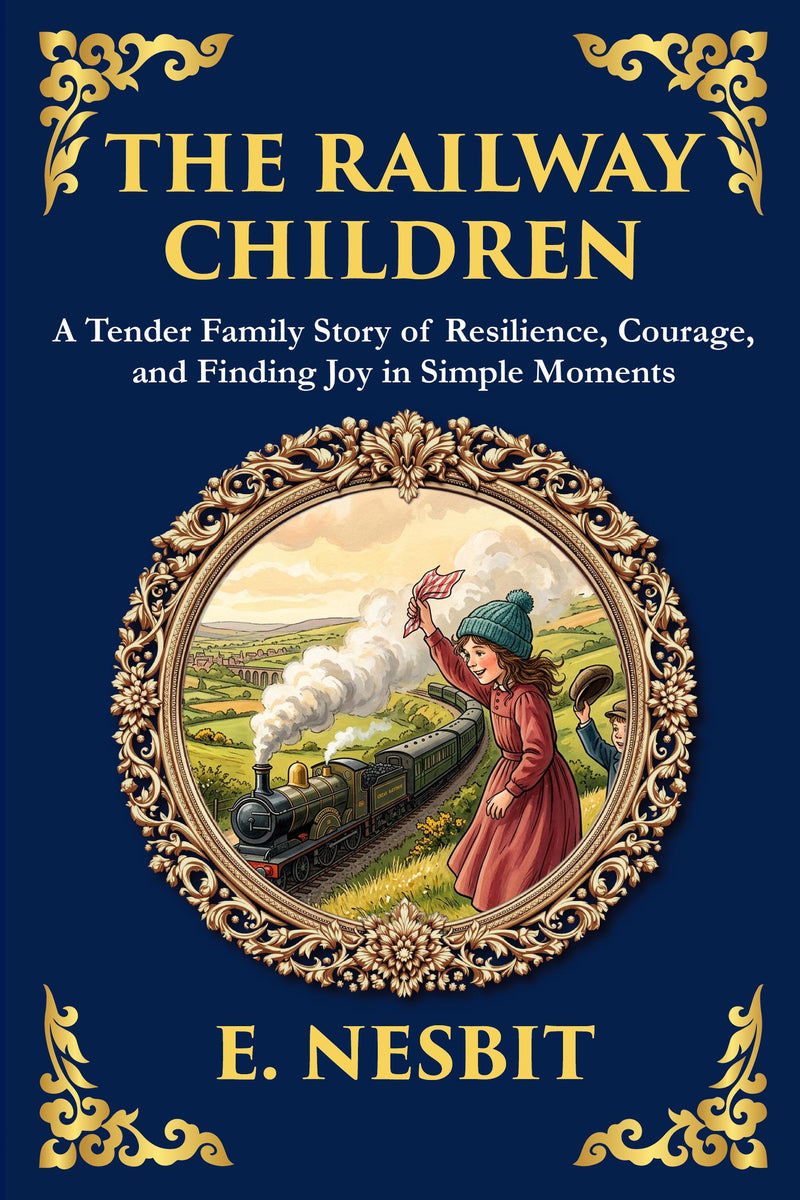
The Railway Children
When their beloved father mysteriously disappears, three children and their mother are forced to leave behind their comfortable London life and move to a quiet country cottage.
or free app
10,000+ hrs library
30-day guarantee
The complete The Railway Children appears in modern English through Library of Alexandria Press, available online with audiobook narration included for members.
Have you ever wondered why the simplest acts of kindness can carry the greatest weight? The Railway Children by E. Nesbit is a timeless coming-of-age story that beautifully explores themes of love, resilience, and the powerful bond of family. When their father is suddenly taken away under mysterious circumstances, siblings Roberta, Peter, and Phyllis must leave their city life behind and adapt to a modest rural home near a railway line.
What begins as a tale of hardship quickly unfolds into a story of discovery and hope. As the children befriend railway workers, rescue injured passengers, and help strangers in distress, they find strength they never knew they had—and slowly uncover the truth about their father’s disappearance. E. Nesbit’s tender storytelling and vivid characters offer a celebration of compassion, perseverance, and childlike wonder.
With its blend of adventure, humor, and heart, this classic novel continues to charm generations of readers and listeners around the world.
What you’ll discover in this modern edition
- A Story of Love and Loyalty – Watch as three children draw closer through adversity, proving that family is built on more than comfort.
- Moments of Courage and Compassion – From rescuing victims to helping the poor, every act of kindness creates ripples.
- Adventures Set Beside the Rails – The railway becomes a magical backdrop for discovery, imagination, and new friendships.
- Timeless Values with Modern Resonance – Honesty, empathy, and bravery remain as relevant now as ever.
- An Inspirational Portrait of Motherhood and Selflessness – The children’s mother exemplifies quiet strength in the face of hardship.
| Formats | eBook (EPUB + PDF) · Audiobook · Paperback · Hardcover · Large Print |
| Language | English |
| Trim size (print) | 6 × 9 in |
| Binding | Paperback — perfect-bound · Hardcover — casewrap |
| Large Print edition | Same text in a larger, easy-read type — a larger font, not a larger trim |
| Print pricing | Every physical book at our true cost — at-cost, no profit (members) |
| Library | 873 restored titles, always growing |
| Length | 58,791 words · ~3 hr 55 min reading |
| Reading level | Grade 5 · an easy, flowing read (this modern-English edition) |
| Edition | Modern English translation · 2026 |
Member reviews for this edition are collected as readers finish it — be the first. Across the library: 12,000+ books shipped, every plan covered by a 365-day print guarantee.
About this edition
A faithful, unabridged modern-English edition by The Library of Alexandria — carefully rendered for today's reader and verified paragraph-by-paragraph against the public-domain source. Available as eBook, audiobook, paperback, hardcover, and large print.
- Complete & unabridgedVerified paragraph by paragraph against the source — never a scan, never abridged.
- Modern English, faithfulReadable today, with the author’s meaning kept intact. Readable — not simplified.
- Every format, one membershipRead in your browser or the free app, or listen to the full audiobook.
Included free with your membership
Cancel anytime, one click · 30-day money-back guarantee
Edition last updated July 2026
What’s inside
The Railway Children — complete and unabridged: all 15 sections included with membership, plus the full audiobook.
Begin reading The Railway Children
In clear modern English — the complete text is included with membership.
Introduction
There are certain books that seem to belong to no single age. They are written in one era, yet they speak with such warmth and immediacy that readers a century later feel as though the author is sitting beside them, telling the story aloud. The Railway Children is one of those rare and luminous works. First published in 1906, it has never gone out of print, never lost its hold on the imaginations of children and the hearts of adults, and never stopped offering something that feels precious and increasingly scarce: the simple, abiding pleasure of a story told with affection, humor, and a deep, unsentimental understanding of what it means to be a family.
This edition presents E. Nesbit’s beloved classic in a modern translation adapted for the contemporary reader. That phrase deserves a moment of explanation, because it shapes the experience you are about to have. The original text, for all its charm, is rooted in the idioms, social references, and rhythms of Edwardian England. Some of its phrases have faded from common use; some of its assumptions about household life, servants, and railway travel belong firmly to a world that no longer exists. What this adaptation seeks to do is to clear away the small obstacles that can stand between a present-day reader and the living heart of the story, while preserving everything that makes Nesbit’s voice so distinctive: her wit, her gentle irony, her tenderness toward her characters, and her uncanny ability to see the world exactly as a child sees it. The goal has never been to “improve” upon a masterpiece, but to make sure that nothing dims its glow for a reader meeting it today.
What follows in these pages is, at its surface, a deceptively quiet tale. There are no wizards, no dragons, no impossible magic. The events are small in scale: a walk along a railway line, a paper chase across the hills, a garden planted, a birthday celebrated with whatever the family can afford. And yet within these modest happenings lies something that has moved generations of readers to tears and laughter alike. For The Railway Children is, above all, a book about resilience — about how an ordinary family meets an extraordinary disruption to their lives, and how, through courage, kindness, and an unshakeable bond with one another, they not only endure but find genuine joy. It is a story that understands that the most important dramas of our lives are rarely loud. They unfold in kitchens and on station platforms, in the small choices we make to be brave when we are frightened, and to be generous when we have little to give.
The Woman Who Refused to Talk Down to Children
To understand why this book feels so alive, it helps to know a little about the remarkable woman who wrote it. Edith Nesbit — who published under the deliberately ambiguous name “E. Nesbit” so that readers would not dismiss her as merely a “lady author” — was one of the most original and influential writers of her time. Born in 1858, she lived a life that was, by the standards of any era, wildly unconventional. She was a founding member of the Fabian Society, a socialist organization that counted among its members George Bernard Shaw and H.G. Wells, and she moved in circles of intellectuals, artists, and political reformers. She smoked in public when respectable women did not, cut her hair short, and ran a household of bohemian complexity. She knew financial hardship intimately; for much of her early life, it was her writing that kept the family afloat when her husband’s business ventures collapsed and his personal conduct brought turmoil into their home.
This biographical detail matters because it seeps, quietly and without preaching, into the very fabric of The Railway Children. Nesbit knew what it was to face sudden reversals of fortune. She knew the particular anxiety of a household where money is suddenly tight, where appearances must be kept up for the sake of the children, where a mother must summon cheerfulness she does not always feel. The story’s tender attention to the dignity of making do, to the quiet heroism of a parent shielding her children from worry, was not invented from nothing. It came from a woman who had lived it.
But Nesbit’s true revolution was in how she wrote for children. Before her, the dominant tradition in English children’s literature was heavily moralistic. Stories existed largely to instruct, to warn, to improve. Children in those tales were either insufferably good little angels or cautionary examples of what happened to the disobedient. They spoke in stilted, adult phrases and behaved with a propriety no real child ever managed. Nesbit swept all that aside. Her children squabble and make mistakes. They are impulsive, occasionally selfish, frequently funny, and always — gloriously, unmistakably — real. They get things wrong. They mean well and cause trouble anyway. They have favorites and rivalries and private griefs. In short, they are children as children actually are, and in writing them this way, Nesbit did nothing less than invent the modern children’s novel.
Writers from C.S. Lewis to E. Nesbit’s devoted admirer P.L. Travers, and on through to J.K. Rowling, have acknowledged their debt to her. The DNA of nearly every great twentieth-century children’s book — the ordinary family thrust into adventure, the magic that erupts into mundane suburban life, the child protagonists who are taken seriously as full human beings — can be traced back to her. When you read The Railway Children, you are reading the work of a founding mother of the form, an author whose innovations have become so universal that we no longer recognize them as innovations at all. That is, perhaps, the truest measure of her genius: she changed what was possible, and the change felt so natural that it became invisible.
What is striking is that The Railway Children contains none of the fantasy that fills many of Nesbit’s other famous works, such as Five Children and It or The Phoenix and the Carpet. There is no enchanted creature granting wishes, no carpet that flies to distant lands. And yet the book never feels lesser for its realism. If anything, the absence of magic throws Nesbit’s other gifts into sharper relief. She did not need supernatural wonders to hold her readers spellbound. She needed only a railway line, a hillside cottage, three lively children, and her own extraordinary understanding of the human heart. The “magic,” it turns out, was in her seeing — in her ability to find in the everyday world a depth of feeling and meaning that no enchantment could surpass.
This is part of what makes the book such a rewarding read for adults as well as children. Nesbit writes with a knowing wink to the grown-ups in the audience. There is a layer of gentle irony in her narration, an awareness of the gap between how the children perceive events and how an adult would understand them. She lets us smile at her young heroes even as we love them, and she trusts us to read between the lines, to grasp the worries and tensions that the children themselves only dimly perceive. This double vision — the child’s experience held within the adult’s comprehension — is one of the great pleasures of the text, and it rewards readers of every age in different but equally satisfying ways.
A Story of Heart, Home, and Quiet Courage
Without revealing the particulars of the plot — for part of the joy of this book lies in discovering its turns for yourself — it is worth setting the stage for what you are about to encounter, so that you might savor it fully. At the center of the story is a family: a mother and her three children, accustomed to a comfortable life in the city, who find that life upended by an event they do not fully understand. They must leave the home they have always known and begin again in a small cottage in the countryside, where their circumstances are vastly reduced and where everything is strange and new. Near their new home runs a railway, and it is this railway — with its great rushing trains, its busy station, its kindly porter, its mysterious passengers — that becomes the gateway to a whole new world of friendship, adventure, and discovery.
The railway itself is one of the book’s most memorable presences. To the children, the trains are a source of endless fascination, a daily spectacle that connects their small rural existence to the vast world beyond. The line becomes their playground, their highway to friendship, and, at moments, the stage for genuine drama and danger. Nesbit captures perfectly the romance that railways held for people of her era — the sense of power and possibility embodied in those thundering engines, the way a passing train could carry one’s imagination to far-off places. For the modern reader, this evokes a vanished age of travel, a time when the railway was the very symbol of progress and connection. But the trains are more than nostalgic scenery. They become, in Nesbit’s hands, a means by which the children reach out beyond themselves — toward strangers who become friends, toward acts of courage and compassion that ripple outward in ways they could never have predicted.
The three children at the heart of the story are drawn with such individuality and warmth that they feel like people we have known all our lives. There is the eldest, thoughtful and responsible, keenly aware of her duties and her changing role; the middle child, a boy bursting with curiosity and ambition, full of grand schemes and tender pride; and the youngest, whose innocence and bursts of feeling give the story some of its most touching moments. Each is distinct, each is fallible, and each grows over the course of the book in ways that feel earned and true. Nesbit never idealizes them. They bicker, they sulk, they act rashly. But she loves them, and she invites us to love them too — not in spite of their flaws but, in a sense, because of them. Their imperfections are what make their kindnesses so moving, their bravery so genuine.
Above all, the book is about the family as a refuge and a source of strength. The mother in this story is one of literature’s quietly great parents. Faced with sudden hardship, she does not collapse or grow bitter. Instead, she finds a way forward, working to support her children while teaching them — by example more than by lecture — the values of honesty, compassion, courage, and grace under pressure. There is a moment, repeated throughout the book in various forms, in which the children must decide how to behave when no one is watching, when doing the right thing is harder than doing nothing. The way they rise to these moments, fumbling and imperfect but always reaching toward goodness, is the emotional engine of the whole narrative.
It would be easy for a story so concerned with virtue to become preachy, but Nesbit’s lightness of touch saves it entirely. She never lectures. She simply shows us people behaving well — or sometimes badly, and then making amends — and lets us draw our own conclusions. The morality of the book is woven so deeply into its events that it never feels imposed. We come to admire the children not because we are told to, but because we have watched them earn our admiration through their actions. This is a far more powerful and durable kind of moral education than any sermon could provide, and it is one reason the book has endured: it treats its readers, young and old, as intelligent beings capable of recognizing goodness when they see it.
There is, too, a thread of genuine suspense and emotion running through the story that may take new readers by surprise. This is not a placid book in which nothing happens. There are moments of real danger, real heartbreak, and real joy. There is a mystery at the family’s heart — a question that hangs over the children, half-understood, casting a shadow even over their happiest days. And there is, as the story builds toward its close, an emotional payoff so beautifully rendered that it has reduced generations of readers — including many a hardened adult who picked up the book expecting mere children’s entertainment — to grateful tears. I will say no more about it here, except to assure you that the patience and tenderness Nesbit asks of you in the early chapters are repaid many times over by the book’s end. The final pages contain one of the most cherished scenes in all of children’s literature, a moment of such pure feeling that it has become iconic, embedded in the cultural memory of all who have encountered it.
Cancel anytime, one click · 30-day money-back guarantee
Founding annual rate available now — your price locks for life when you join.
Not ready? Get this free chapter by email — read it anytime.
✓ Sent — check your inbox for The Railway Children.
Questions about The Railway Children
What is The Railway Children about?
When their beloved father mysteriously disappears, three children and their mother are forced to leave behind their comfortable London life and move to a quiet country cottage. With courage in their hearts and curiosity in their souls, the children—Roberta, Peter, and Phyllis—find adventure and purpose beside the nearby railway. Through kindness, bravery, and unshakable optimism, they touch the lives of everyone they meet—station masters, railway workers, and even strangers in need.
Who wrote The Railway Children?
The Railway Children was written by E. Nesbit. This edition presents the complete work in clear modern English, faithfully rendered from the public-domain original by Library of Alexandria Press.
Is The Railway Children free to read?
The opening chapter is free to read on this page. Members read and listen to the complete work — and the entire library — free, and can order any physical book at our true print cost.
How long is The Railway Children?
15 chapters (~58,791 words) — about 3 hr 55 min of reading in this modern-English edition.
Is this an abridged version of The Railway Children?
No. This is the complete, unabridged The Railway Children, carefully rendered into clear modern English and verified paragraph-by-paragraph against the public-domain source — nothing is cut or summarised.
What formats does The Railway Children come in?
The Railway Children is available as eBook, paperback, hardcover and large print. eBook and audiobook are included with membership; printed editions ship at our true print cost.
Shipping & returns
Billing & membership
More from the library


Explore Adventure
- Tarzan of the Apes · Edgar Rice Burroughs
- The Wonderful Wizard of Oz · L. Frank Baum
- Peter Pan · J. M. Barrie
- Moby Dick; Or, The Whale · Herman Melville
- The Riddle of the Sands · Erskine Childers
- The Loss of the Swansea: A Story of the Florida Coast · W. L. Alden
- Sky Island · L. Frank Baum
- Vikram and the Vampire: Classic Hindu Tales of Adventure, Magic, and Romance · Unknown
- Tales of Unrest · Joseph Conrad
- The Tomb of Ts’in · Edgar Wallace
- Skinny McCord · Percy Keese Fitzhugh
- The Men of the Moss-Hags · S. R. Crockett
- The Hunniwell Boys and the Platinum Mystery · L. P. Wyman
- Allan Quatermain · H. Rider Haggard
- She · H. Rider Haggard
- Medical Life in the Navy · Gordon Stables
- The Thirty-Nine Steps · John Buchan
- The Story of Doctor Dolittle · Hugh Lofting
- The Princess and the Goblin · George MacDonald
- The Man Who Would Be King · Rudyard Kipling
- Lucian’s True History · Lucian of Samosata
- The Secret Adversary · Agatha Christie
- Lord Jim · Joseph Conrad
- The Marvelous Land of Oz · L. Frank Baum
- The Virginian: A Horseman of the Plains · Owen Wister
- Mars is My Destination · Frank Belknap Long
- Anabasis · Xenophon
- The Mississippi Saucer · Frank Belknap Long
- Sabotage in Space · Carey Rockwell
- Brood of the Dark Moon · Charles Willard Diffin
The Railway Children
The Railway Children
A Tender Family Story of Resilience, Courage, and Finding Joy in Simple Moments
E. Nesbit
Contents
- Introduction
- Chapter 1
- Chapter 2
- Chapter 3
- Chapter 4
- Chapter 5
- Chapter 6
- Chapter 7
- Chapter 8
- Chapter 9
- Chapter 10
- Chapter 11
- Chapter 12
- Chapter 13
- Chapter 14
Introduction
There are certain books that seem to belong to no single age. They are written in one era, yet they speak with such warmth and immediacy that readers a century later feel as though the author is sitting beside them, telling the story aloud. The Railway Children is one of those rare and luminous works. First published in 1906, it has never gone out of print, never lost its hold on the imaginations of children and the hearts of adults, and never stopped offering something that feels precious and increasingly scarce: the simple, abiding pleasure of a story told with affection, humor, and a deep, unsentimental understanding of what it means to be a family.
This edition presents E. Nesbit’s beloved classic in a modern translation adapted for the contemporary reader. That phrase deserves a moment of explanation, because it shapes the experience you are about to have. The original text, for all its charm, is rooted in the idioms, social references, and rhythms of Edwardian England. Some of its phrases have faded from common use; some of its assumptions about household life, servants, and railway travel belong firmly to a world that no longer exists. What this adaptation seeks to do is to clear away the small obstacles that can stand between a present-day reader and the living heart of the story, while preserving everything that makes Nesbit’s voice so distinctive: her wit, her gentle irony, her tenderness toward her characters, and her uncanny ability to see the world exactly as a child sees it. The goal has never been to “improve” upon a masterpiece, but to make sure that nothing dims its glow for a reader meeting it today.
What follows in these pages is, at its surface, a deceptively quiet tale. There are no wizards, no dragons, no impossible magic. The events are small in scale: a walk along a railway line, a paper chase across the hills, a garden planted, a birthday celebrated with whatever the family can afford. And yet within these modest happenings lies something that has moved generations of readers to tears and laughter alike. For The Railway Children is, above all, a book about resilience — about how an ordinary family meets an extraordinary disruption to their lives, and how, through courage, kindness, and an unshakeable bond with one another, they not only endure but find genuine joy. It is a story that understands that the most important dramas of our lives are rarely loud. They unfold in kitchens and on station platforms, in the small choices we make to be brave when we are frightened, and to be generous when we have little to give.
The Woman Who Refused to Talk Down to Children
To understand why this book feels so alive, it helps to know a little about the remarkable woman who wrote it. Edith Nesbit — who published under the deliberately ambiguous name “E. Nesbit” so that readers would not dismiss her as merely a “lady author” — was one of the most original and influential writers of her time. Born in 1858, she lived a life that was, by the standards of any era, wildly unconventional. She was a founding member of the Fabian Society, a socialist organization that counted among its members George Bernard Shaw and H.G. Wells, and she moved in circles of intellectuals, artists, and political reformers. She smoked in public when respectable women did not, cut her hair short, and ran a household of bohemian complexity. She knew financial hardship intimately; for much of her early life, it was her writing that kept the family afloat when her husband’s business ventures collapsed and his personal conduct brought turmoil into their home.
This biographical detail matters because it seeps, quietly and without preaching, into the very fabric of The Railway Children. Nesbit knew what it was to face sudden reversals of fortune. She knew the particular anxiety of a household where money is suddenly tight, where appearances must be kept up for the sake of the children, where a mother must summon cheerfulness she does not always feel. The story’s tender attention to the dignity of making do, to the quiet heroism of a parent shielding her children from worry, was not invented from nothing. It came from a woman who had lived it.
But Nesbit’s true revolution was in how she wrote for children. Before her, the dominant tradition in English children’s literature was heavily moralistic. Stories existed largely to instruct, to warn, to improve. Children in those tales were either insufferably good little angels or cautionary examples of what happened to the disobedient. They spoke in stilted, adult phrases and behaved with a propriety no real child ever managed. Nesbit swept all that aside. Her children squabble and make mistakes. They are impulsive, occasionally selfish, frequently funny, and always — gloriously, unmistakably — real. They get things wrong. They mean well and cause trouble anyway. They have favorites and rivalries and private griefs. In short, they are children as children actually are, and in writing them this way, Nesbit did nothing less than invent the modern children’s novel.
Writers from C.S. Lewis to E. Nesbit’s devoted admirer P.L. Travers, and on through to J.K. Rowling, have acknowledged their debt to her. The DNA of nearly every great twentieth-century children’s book — the ordinary family thrust into adventure, the magic that erupts into mundane suburban life, the child protagonists who are taken seriously as full human beings — can be traced back to her. When you read The Railway Children, you are reading the work of a founding mother of the form, an author whose innovations have become so universal that we no longer recognize them as innovations at all. That is, perhaps, the truest measure of her genius: she changed what was possible, and the change felt so natural that it became invisible.
What is striking is that The Railway Children contains none of the fantasy that fills many of Nesbit’s other famous works, such as Five Children and It or The Phoenix and the Carpet. There is no enchanted creature granting wishes, no carpet that flies to distant lands. And yet the book never feels lesser for its realism. If anything, the absence of magic throws Nesbit’s other gifts into sharper relief. She did not need supernatural wonders to hold her readers spellbound. She needed only a railway line, a hillside cottage, three lively children, and her own extraordinary understanding of the human heart. The “magic,” it turns out, was in her seeing — in her ability to find in the everyday world a depth of feeling and meaning that no enchantment could surpass.
This is part of what makes the book such a rewarding read for adults as well as children. Nesbit writes with a knowing wink to the grown-ups in the audience. There is a layer of gentle irony in her narration, an awareness of the gap between how the children perceive events and how an adult would understand them. She lets us smile at her young heroes even as we love them, and she trusts us to read between the lines, to grasp the worries and tensions that the children themselves only dimly perceive. This double vision — the child’s experience held within the adult’s comprehension — is one of the great pleasures of the text, and it rewards readers of every age in different but equally satisfying ways.
A Story of Heart, Home, and Quiet Courage
Without revealing the particulars of the plot — for part of the joy of this book lies in discovering its turns for yourself — it is worth setting the stage for what you are about to encounter, so that you might savor it fully. At the center of the story is a family: a mother and her three children, accustomed to a comfortable life in the city, who find that life upended by an event they do not fully understand. They must leave the home they have always known and begin again in a small cottage in the countryside, where their circumstances are vastly reduced and where everything is strange and new. Near their new home runs a railway, and it is this railway — with its great rushing trains, its busy station, its kindly porter, its mysterious passengers — that becomes the gateway to a whole new world of friendship, adventure, and discovery.
The railway itself is one of the book’s most memorable presences. To the children, the trains are a source of endless fascination, a daily spectacle that connects their small rural existence to the vast world beyond. The line becomes their playground, their highway to friendship, and, at moments, the stage for genuine drama and danger. Nesbit captures perfectly the romance that railways held for people of her era — the sense of power and possibility embodied in those thundering engines, the way a passing train could carry one’s imagination to far-off places. For the modern reader, this evokes a vanished age of travel, a time when the railway was the very symbol of progress and connection. But the trains are more than nostalgic scenery. They become, in Nesbit’s hands, a means by which the children reach out beyond themselves — toward strangers who become friends, toward acts of courage and compassion that ripple outward in ways they could never have predicted.
The three children at the heart of the story are drawn with such individuality and warmth that they feel like people we have known all our lives. There is the eldest, thoughtful and responsible, keenly aware of her duties and her changing role; the middle child, a boy bursting with curiosity and ambition, full of grand schemes and tender pride; and the youngest, whose innocence and bursts of feeling give the story some of its most touching moments. Each is distinct, each is fallible, and each grows over the course of the book in ways that feel earned and true. Nesbit never idealizes them. They bicker, they sulk, they act rashly. But she loves them, and she invites us to love them too — not in spite of their flaws but, in a sense, because of them. Their imperfections are what make their kindnesses so moving, their bravery so genuine.
Above all, the book is about the family as a refuge and a source of strength. The mother in this story is one of literature’s quietly great parents. Faced with sudden hardship, she does not collapse or grow bitter. Instead, she finds a way forward, working to support her children while teaching them — by example more than by lecture — the values of honesty, compassion, courage, and grace under pressure. There is a moment, repeated throughout the book in various forms, in which the children must decide how to behave when no one is watching, when doing the right thing is harder than doing nothing. The way they rise to these moments, fumbling and imperfect but always reaching toward goodness, is the emotional engine of the whole narrative.
It would be easy for a story so concerned with virtue to become preachy, but Nesbit’s lightness of touch saves it entirely. She never lectures. She simply shows us people behaving well — or sometimes badly, and then making amends — and lets us draw our own conclusions. The morality of the book is woven so deeply into its events that it never feels imposed. We come to admire the children not because we are told to, but because we have watched them earn our admiration through their actions. This is a far more powerful and durable kind of moral education than any sermon could provide, and it is one reason the book has endured: it treats its readers, young and old, as intelligent beings capable of recognizing goodness when they see it.
There is, too, a thread of genuine suspense and emotion running through the story that may take new readers by surprise. This is not a placid book in which nothing happens. There are moments of real danger, real heartbreak, and real joy. There is a mystery at the family’s heart — a question that hangs over the children, half-understood, casting a shadow even over their happiest days. And there is, as the story builds toward its close, an emotional payoff so beautifully rendered that it has reduced generations of readers — including many a hardened adult who picked up the book expecting mere children’s entertainment — to grateful tears. I will say no more about it here, except to assure you that the patience and tenderness Nesbit asks of you in the early chapters are repaid many times over by the book’s end. The final pages contain one of the most cherished scenes in all of children’s literature, a moment of such pure feeling that it has become iconic, embedded in the cultural memory of all who have encountered it.
They weren’t “railway children” at first. I doubt they ever thought about trains except as a way to get to the magic shows, the zoo, or Madame Tussauds. They were just ordinary kids living in the suburbs with their parents in a typical red-brick house. It had stained glass in the front door, a tiled entryway, a bathroom with hot and cold water, electric doorbells, French windows, and plenty of white paint—basically “every modern convenience,” as real estate agents put it.
There were three of them. Roberta was the oldest. Now, mothers aren’t supposed to have favorites, but if their mother did, it was probably Roberta. Then there was Peter, who wanted to be an engineer when he grew up, and the youngest was Phyllis, who always had the best intentions.
Their mother didn’t spend her days making boring social calls to boring women or sitting around waiting for those same women to visit her. She was almost always there for the children, ready to play, read to them, or help with their homework. She even wrote stories for them while they were at school and read them aloud after dinner. She also wrote funny poems for their birthdays and other big events, like when the new kittens were named, when the dollhouse got new furniture, or when they were recovering from the mumps.
These three lucky children had everything they could want: cute clothes, warm fires, a wonderful nursery filled with toys and Mother Goose wallpaper. They had a kind, cheerful nanny and a dog named James who belonged just to them. Their father was perfect, too—he was never grumpy or unfair and always wanted to play. If he ever couldn’t, he always had a great excuse, and he explained it so interestingly and funny that the children were sure he couldn’t help it.
End of the free sample
Keep reading, free
Members read and listen to the complete book — and the entire library. Cancel anytime, one click · 30-day money-back guarantee.