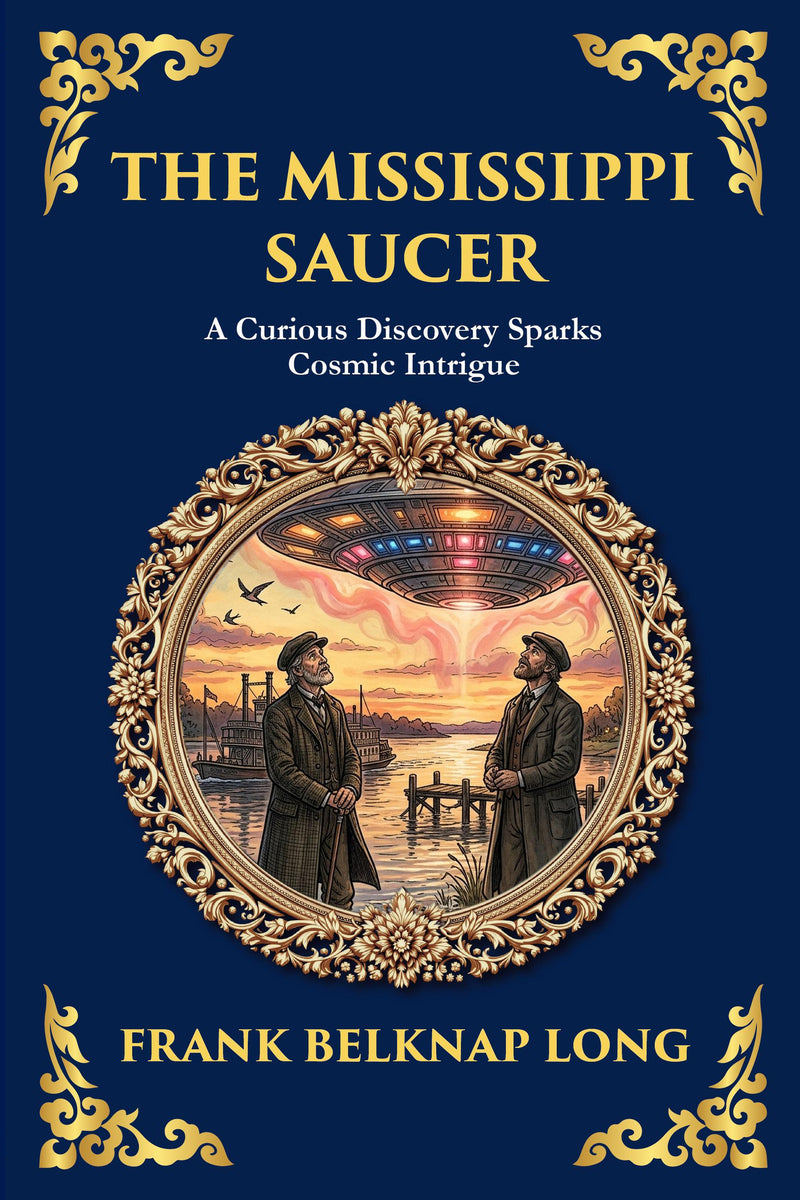
The Mississippi Saucer — Large Print
When a mysterious object crash-lands in a sleepy Mississippi town, it ignites more than just curiosity—it awakens suspicion, wonder, and fear.
or free app
10,000+ hrs library
30-day guarantee
The complete The Mississippi Saucer appears in modern English through Library of Alexandria Press, available online with audiobook narration included for members.
Have you ever wondered why the greatest mysteries don’t arrive with answers—but with questions that shake the world? The Mississippi Saucer by Frank Belknap Long is a gripping, imaginative tale that begins with a bang—literally. A saucer-shaped object crashes in the swamplands outside a modest Southern town, drawing the attention of locals, reporters, and military men alike.
But as the dust settles, the real mystery begins. Tom Travers, a principled newspaper editor, wants to investigate the truth, while the townspeople whisper theories of aliens, government coverups, and divine omens. As conflicting interests stir tension and chaos brews beneath the surface, Travers must confront not only the unknown origin of the saucer—but also the deeper question of what people do when faced with something that defies explanation.
With its rich blend of science fiction, social commentary, and small-town drama, Long’s story captures the paranoia and wonder of a world on the brink of the space age.
What you’ll discover in this modern edition
- A suspenseful mystery grounded in classic 1950s small-town America
- A nuanced exploration of fear, curiosity, and the need to explain the unexplainable
| Formats | eBook (EPUB + PDF) · Audiobook · Paperback · Hardcover · Large Print |
| Language | English |
| Trim size (print) | 6 × 9 in |
| Binding | Paperback — perfect-bound · Hardcover — casewrap |
| Large Print edition | Same text in a larger, easy-read type — a larger font, not a larger trim |
| Print pricing | Every physical book at our true cost — at-cost, no profit (members) |
| Library | 873 restored titles, always growing |
| Length | 9,161 words · ~37 min reading |
| Reading level | Grade 6 · an easy, flowing read (this modern-English edition) |
| Edition | Modern English translation · 2026 |
Member reviews for this edition are collected as readers finish it — be the first. Across the library: 12,000+ books shipped, every plan covered by a 365-day print guarantee.
About this edition
A faithful, unabridged modern-English edition by The Library of Alexandria — carefully rendered for today's reader and verified paragraph-by-paragraph against the public-domain source. Available as eBook, audiobook, paperback, hardcover, and large print.
- Complete & unabridgedVerified paragraph by paragraph against the source — never a scan, never abridged.
- Modern English, faithfulReadable today, with the author’s meaning kept intact. Readable — not simplified.
- Every format, one membershipRead in your browser or the free app, or listen to the full audiobook.
Included free with your membership
Cancel anytime, one click · 30-day money-back guarantee
Edition last updated July 2026
What’s inside
The Mississippi Saucer — Large Print — complete and unabridged, included in full with membership, plus the full audiobook.
Begin reading The Mississippi Saucer — Large Print
In clear modern English — the complete text is included with membership.
Introduction
Subtitle: A Strange Find Ignites a Cosmic Mystery – A Modern Translation – Adapted for the Contemporary Reader
There are certain stories that arrive at exactly the right moment in cultural history, capturing a feeling that millions of people share but cannot quite articulate. They tap into a wellspring of wonder, anxiety, and longing that defines an era. The tale you are about to read is one of these rare convergences—a brief but resonant work of imaginative fiction born during one of the most peculiar and electrifying periods in modern history, when the skies over America suddenly seemed full of unexplained shapes, and the human heart trembled between fear and fascination at the thought that we might not be alone.
To open this book is to step back into a particular kind of dreaming. It is a dreaming that belonged to a postwar world still reeling from the enormity of what humanity had unleashed upon itself, a world where the atom had been split, where rockets had begun their tentative climb toward the heavens, and where the night sky—once a comfortable canopy of familiar stars—had become a screen onto which an entire civilization projected its hopes and terrors. The author understood this perfectly. He had spent a lifetime watching the genre of fantastic literature evolve, contributing to it, shaping it, and refining the art of the short tale until it could deliver, in a handful of pages, the kind of emotional and intellectual jolt that lesser writers required entire novels to achieve.
What makes this particular work so worthy of your time and attention is not merely its place in literary history, though that place is secure and significant. It is the way the story manages to be simultaneously intimate and vast. It takes the smallest of human stages—a riverbank, a humble life lived along the muddy currents of America’s greatest waterway—and against that homely backdrop it sets a question of truly cosmic dimensions. The contrast is deliberate and masterful. There is something profoundly moving about the collision of the ordinary and the extraordinary, about the way a discovery that might shake the foundations of human knowledge can arrive not in a gleaming laboratory or a government war room, but in the hands of someone simple, weathered, and entirely unprepared for the weight of what fate has dropped into his path.
To fully appreciate what unfolds in these pages, it helps to understand the man whose imagination produced it and the world that shaped him. The author belongs to a remarkable generation of writers who came of age in the early decades of the twentieth century, when the pulp magazines were the engine rooms of popular imagination. These were inexpensive periodicals, printed on rough paper, sold for pennies, and devoured by readers hungry for adventure, mystery, horror, and speculation about the unknown. Far from being disposable trash, as some snobbish critics of the day insisted, these magazines became the proving grounds for an entirely new mode of storytelling. They nurtured talents who would go on to define modern science fiction, fantasy, and weird fiction, and they cultivated an audience whose appetite for the strange and the speculative laid the groundwork for the genre’s eventual cultural dominance.
Our author was a central figure in this world. He was a writer who moved fluidly between the eerie atmospheres of supernatural horror and the more rationalized wonders of scientific speculation, and he counted among his closest associates some of the most celebrated names in the history of imaginative literature. He belonged to a circle of correspondents and collaborators whose letters, exchanged across great distances, formed an informal academy of the fantastic—a community of minds dedicated to exploring, in fiction, the outer boundaries of human comprehension. From these exchanges emerged a particular sensibility: a deep awareness of cosmic scale, a fascination with the idea that humanity occupies a small and possibly precarious position in a universe far older, stranger, and more indifferent than our comforting myths would have us believe.
This sensibility runs like a current beneath everything in the present work. The author had spent decades thinking carefully about how to make the unknown feel real, about how to evoke dread and wonder without overstating his hand, about the delicate craft of suggestion. He understood that the most powerful effects in fantastic fiction often come not from exhaustive description but from restraint—from the thing half-glimpsed, the implication left hanging, the question that lingers long after the final page is turned. A lesser writer, confronted with a premise like the one at the heart of this story, might have rushed to explain everything, to catalog the mysteries and resolve them with mechanical precision. This author knew better. He understood that mystery, properly handled, is a gift to the reader—an invitation to participate in the act of imagining, to fill the silences with one’s own fears and speculations.
By the time he wrote this tale, the author was a seasoned professional with an enormous body of work behind him. He had survived the lean years of the Great Depression, when writers scraped by on the modest rates the pulps could afford, churning out stories at a furious pace simply to keep the wolf from the door. He had watched the genre mature, watched it gain respectability, watched it begin its long march from the dime-store racks toward the bookshelves of serious literature. And he had developed, through sheer accumulated experience, a craftsman’s instinct for what worked and what did not. You will feel this instinct on every page of the story before you. There is an economy to the prose, a confidence in the pacing, a sureness of touch that comes only from a writer who has done this thousands of times and knows precisely which notes to strike.
It is worth pausing here to reflect on what it means to encounter a master of the short form. In our current era of sprawling series and doorstop novels, the art of the compact, self-contained tale can feel almost lost—a relic of an earlier age. But the short story, when it is done well, possesses a unique power. It can deliver a single, concentrated experience, an undiluted emotional and intellectual impact that a longer work, for all its richness, must inevitably spread thin. A great short story is like a struck bell: it sounds a clear note that resonates and fades, but the resonance stays with you. The work you are about to read is precisely this kind of struck bell. It does not waste a word. It moves with purpose toward its conclusion, and when it arrives, it leaves you sitting with your thoughts, turning the implications over in your mind.
A Modern Translation for the Contemporary Reader
A word now about the particular edition you hold in your hands, because it represents a thoughtful and necessary act of literary stewardship. This is described as a modern translation, adapted for the contemporary reader, and that description deserves some explanation, because it speaks to one of the genuine challenges of bringing older works of fiction to new audiences.
When a story was written in the middle of the twentieth century, it was written for readers of that time. Those readers shared a set of cultural assumptions, a vocabulary, a rhythm of speech, and a frame of reference that we no longer fully share. They knew the slang of their day. They understood references that have since faded from common memory. They were accustomed to certain conventions of prose—a particular cadence, a certain density of phrasing, occasional turns of expression that can feel, to a modern eye, archaic or stilted. None of these things are flaws in the original work; they are simply the natural patina that any text acquires as the years pass and the world moves on. But they can, for a contemporary reader, create small friction points, moments where the smooth flow of the story stutters and the spell is briefly broken.
The purpose of a careful modern adaptation is to remove that friction without violating the integrity of the original vision. This is a delicate balancing act, and it must be approached with respect and restraint. The goal is never to “improve” upon the author—an arrogance no honest editor should entertain—but rather to clear away the small obstacles that time has placed between the writer’s intentions and the reader’s experience. It is a matter of ensuring that the wonder, the suspense, the emotional resonance that the author so carefully constructed can reach you as directly and powerfully as it reached the original audience, undimmed by the accumulated dust of decades.
What this means in practice is that you can settle into this story with confidence. You will not find yourself stumbling over outdated phrasing or pausing to puzzle out forgotten idioms. The narrative will carry you along at the pace the author intended, with its tension building and its atmosphere thickening exactly as it should. At the same time, the essential character of the work—its voice, its tone, its particular flavor of mid-century American imagination—remains intact. The riverbank still smells of mud and fish. The light still falls the way it fell in the original. The strangeness still feels strange. This is the paradox of good adaptation: it works best when you do not notice it at all, when it simply allows the story to be itself, fully and freely, in your present moment.
There is a deeper philosophical point embedded in this work of preservation, and it is worth dwelling on. Literature is not a static thing. It lives only in the act of reading, in the meeting of a text and a mind. A story that sits unread on a shelf, however brilliant, is dormant—a seed waiting for water. The great works of the past survive not because they are preserved under glass like museum specimens, but because each new generation finds a way to engage with them, to make them speak to present concerns and present sensibilities. Every translation, every adaptation, every thoughtful new edition is an act of resurrection, a way of carrying the living essence of a work forward across the gulf of time so that it can do its work again, on new readers, in new circumstances. By making this tale accessible and inviting to the contemporary reader, this edition participates in that ancient and honorable tradition of keeping stories alive.
And this story, in particular, deserves to live on. Its central concern—the question of what lies beyond our world, and how we might react if the answer suddenly arrived—has lost none of its urgency. If anything, the passage of time has made it more relevant, not less. We live now in an age of renewed and serious scientific interest in the possibility of life beyond Earth. Telescopes peer at distant worlds, searching for the chemical signatures of life. Probes voyage to the edges of our solar system and beyond. Governments and researchers openly discuss the investigation of unexplained aerial phenomena. The questions that this story raised in its own time are questions we are still asking, with greater sophistication but no greater certainty. What would it mean to discover that we are not alone? How would we cope with knowledge that exceeds our understanding? What does the cosmos owe us, and what, if anything, do we owe it? These are not idle speculations. They are among the great open questions of our species, and this modest, beautifully crafted tale engages with them in a way that is both entertaining and quietly profound.
To read this story well, it helps to imagine the precise emotional climate from which it sprang. There was a moment in the middle of the twentieth century when something extraordinary happened to the collective imagination of the public. Reports began to circulate—first as scattered curiosities, then as a wave, then as a genuine cultural phenomenon—of strange objects seen moving through the sky. They were described as discs, as plates, as saucers; they moved in ways that defied conventional explanation; they appeared and vanished, and they captured headlines across the world. Whether these reports represented genuine encounters with the unknown, misidentified natural phenomena, the fevered products of mass anxiety, or some combination of all three, has never been definitively settled. But what is beyond dispute is the effect these reports had on the popular mind.
Cancel anytime, one click · 30-day money-back guarantee
Founding annual rate available now — your price locks for life when you join.
Not ready? Get this free chapter by email — read it anytime.
✓ Sent — check your inbox for The Mississippi Saucer — Large Print.
Questions about The Mississippi Saucer — Large Print
What is The Mississippi Saucer about?
When a mysterious object crash-lands in a sleepy Mississippi town, it ignites more than just curiosity—it awakens suspicion, wonder, and fear. Is it a harmless oddity or the harbinger of something far greater than Earth has ever known? In The Mississippi Saucer, acclaimed pulp and weird fiction author Frank Belknap Long delivers a sharply written, thought-provoking tale that explores how ordinary people respond to extraordinary mysteries.
Who wrote The Mississippi Saucer?
The Mississippi Saucer was written by Frank Belknap Long. This edition presents the complete work in clear modern English, faithfully rendered from the public-domain original by Library of Alexandria Press.
Is The Mississippi Saucer free to read?
The opening chapter is free to read on this page. Members read and listen to the complete work — and the entire library — free, and can order any physical book at our true print cost.
How long is The Mississippi Saucer?
2 chapters (~9,161 words) — about 37 min of reading in this modern-English edition.
Is this an abridged version of The Mississippi Saucer?
No. This is the complete, unabridged The Mississippi Saucer, carefully rendered into clear modern English and verified paragraph-by-paragraph against the public-domain source — nothing is cut or summarised.
What formats does The Mississippi Saucer come in?
The Mississippi Saucer is available as eBook, paperback, hardcover and large print. eBook and audiobook are included with membership; printed editions ship at our true print cost.
Shipping & returns
Billing & membership
More from the library


Explore Adventure
- Tarzan of the Apes · Edgar Rice Burroughs
- The Wonderful Wizard of Oz · L. Frank Baum
- Peter Pan · J. M. Barrie
- Moby Dick; Or, The Whale · Herman Melville
- The Riddle of the Sands · Erskine Childers
- The Loss of the Swansea: A Story of the Florida Coast · W. L. Alden
- Sky Island · L. Frank Baum
- Vikram and the Vampire: Classic Hindu Tales of Adventure, Magic, and Romance · Unknown
- Tales of Unrest · Joseph Conrad
- The Tomb of Ts’in · Edgar Wallace
- Skinny McCord · Percy Keese Fitzhugh
- The Men of the Moss-Hags · S. R. Crockett
- The Hunniwell Boys and the Platinum Mystery · L. P. Wyman
- Allan Quatermain · H. Rider Haggard
- She · H. Rider Haggard
- Medical Life in the Navy · Gordon Stables
- The Thirty-Nine Steps · John Buchan
- The Story of Doctor Dolittle · Hugh Lofting
- The Princess and the Goblin · George MacDonald
- The Man Who Would Be King · Rudyard Kipling
- Lucian’s True History · Lucian of Samosata
- The Secret Adversary · Agatha Christie
- Lord Jim · Joseph Conrad
- The Marvelous Land of Oz · L. Frank Baum
- The Virginian: A Horseman of the Plains · Owen Wister
- Mars is My Destination · Frank Belknap Long
- Anabasis · Xenophon
- The Mississippi Saucer · Frank Belknap Long
- Sabotage in Space · Carey Rockwell
- Brood of the Dark Moon · Charles Willard Diffin
The Mississippi Saucer — Large Print
The Mississippi Saucer — Large Print
A Strange Find Ignites a Cosmic Mystery
Frank Belknap Long
Contents
- Introduction
- The Mississippi Saucer
Introduction
Subtitle: A Strange Find Ignites a Cosmic Mystery – A Modern Translation – Adapted for the Contemporary Reader
There are certain stories that arrive at exactly the right moment in cultural history, capturing a feeling that millions of people share but cannot quite articulate. They tap into a wellspring of wonder, anxiety, and longing that defines an era. The tale you are about to read is one of these rare convergences—a brief but resonant work of imaginative fiction born during one of the most peculiar and electrifying periods in modern history, when the skies over America suddenly seemed full of unexplained shapes, and the human heart trembled between fear and fascination at the thought that we might not be alone.
To open this book is to step back into a particular kind of dreaming. It is a dreaming that belonged to a postwar world still reeling from the enormity of what humanity had unleashed upon itself, a world where the atom had been split, where rockets had begun their tentative climb toward the heavens, and where the night sky—once a comfortable canopy of familiar stars—had become a screen onto which an entire civilization projected its hopes and terrors. The author understood this perfectly. He had spent a lifetime watching the genre of fantastic literature evolve, contributing to it, shaping it, and refining the art of the short tale until it could deliver, in a handful of pages, the kind of emotional and intellectual jolt that lesser writers required entire novels to achieve.
What makes this particular work so worthy of your time and attention is not merely its place in literary history, though that place is secure and significant. It is the way the story manages to be simultaneously intimate and vast. It takes the smallest of human stages—a riverbank, a humble life lived along the muddy currents of America’s greatest waterway—and against that homely backdrop it sets a question of truly cosmic dimensions. The contrast is deliberate and masterful. There is something profoundly moving about the collision of the ordinary and the extraordinary, about the way a discovery that might shake the foundations of human knowledge can arrive not in a gleaming laboratory or a government war room, but in the hands of someone simple, weathered, and entirely unprepared for the weight of what fate has dropped into his path.
To fully appreciate what unfolds in these pages, it helps to understand the man whose imagination produced it and the world that shaped him. The author belongs to a remarkable generation of writers who came of age in the early decades of the twentieth century, when the pulp magazines were the engine rooms of popular imagination. These were inexpensive periodicals, printed on rough paper, sold for pennies, and devoured by readers hungry for adventure, mystery, horror, and speculation about the unknown. Far from being disposable trash, as some snobbish critics of the day insisted, these magazines became the proving grounds for an entirely new mode of storytelling. They nurtured talents who would go on to define modern science fiction, fantasy, and weird fiction, and they cultivated an audience whose appetite for the strange and the speculative laid the groundwork for the genre’s eventual cultural dominance.
Our author was a central figure in this world. He was a writer who moved fluidly between the eerie atmospheres of supernatural horror and the more rationalized wonders of scientific speculation, and he counted among his closest associates some of the most celebrated names in the history of imaginative literature. He belonged to a circle of correspondents and collaborators whose letters, exchanged across great distances, formed an informal academy of the fantastic—a community of minds dedicated to exploring, in fiction, the outer boundaries of human comprehension. From these exchanges emerged a particular sensibility: a deep awareness of cosmic scale, a fascination with the idea that humanity occupies a small and possibly precarious position in a universe far older, stranger, and more indifferent than our comforting myths would have us believe.
This sensibility runs like a current beneath everything in the present work. The author had spent decades thinking carefully about how to make the unknown feel real, about how to evoke dread and wonder without overstating his hand, about the delicate craft of suggestion. He understood that the most powerful effects in fantastic fiction often come not from exhaustive description but from restraint—from the thing half-glimpsed, the implication left hanging, the question that lingers long after the final page is turned. A lesser writer, confronted with a premise like the one at the heart of this story, might have rushed to explain everything, to catalog the mysteries and resolve them with mechanical precision. This author knew better. He understood that mystery, properly handled, is a gift to the reader—an invitation to participate in the act of imagining, to fill the silences with one’s own fears and speculations.
By the time he wrote this tale, the author was a seasoned professional with an enormous body of work behind him. He had survived the lean years of the Great Depression, when writers scraped by on the modest rates the pulps could afford, churning out stories at a furious pace simply to keep the wolf from the door. He had watched the genre mature, watched it gain respectability, watched it begin its long march from the dime-store racks toward the bookshelves of serious literature. And he had developed, through sheer accumulated experience, a craftsman’s instinct for what worked and what did not. You will feel this instinct on every page of the story before you. There is an economy to the prose, a confidence in the pacing, a sureness of touch that comes only from a writer who has done this thousands of times and knows precisely which notes to strike.
It is worth pausing here to reflect on what it means to encounter a master of the short form. In our current era of sprawling series and doorstop novels, the art of the compact, self-contained tale can feel almost lost—a relic of an earlier age. But the short story, when it is done well, possesses a unique power. It can deliver a single, concentrated experience, an undiluted emotional and intellectual impact that a longer work, for all its richness, must inevitably spread thin. A great short story is like a struck bell: it sounds a clear note that resonates and fades, but the resonance stays with you. The work you are about to read is precisely this kind of struck bell. It does not waste a word. It moves with purpose toward its conclusion, and when it arrives, it leaves you sitting with your thoughts, turning the implications over in your mind.
A Modern Translation for the Contemporary Reader
A word now about the particular edition you hold in your hands, because it represents a thoughtful and necessary act of literary stewardship. This is described as a modern translation, adapted for the contemporary reader, and that description deserves some explanation, because it speaks to one of the genuine challenges of bringing older works of fiction to new audiences.
When a story was written in the middle of the twentieth century, it was written for readers of that time. Those readers shared a set of cultural assumptions, a vocabulary, a rhythm of speech, and a frame of reference that we no longer fully share. They knew the slang of their day. They understood references that have since faded from common memory. They were accustomed to certain conventions of prose—a particular cadence, a certain density of phrasing, occasional turns of expression that can feel, to a modern eye, archaic or stilted. None of these things are flaws in the original work; they are simply the natural patina that any text acquires as the years pass and the world moves on. But they can, for a contemporary reader, create small friction points, moments where the smooth flow of the story stutters and the spell is briefly broken.
The purpose of a careful modern adaptation is to remove that friction without violating the integrity of the original vision. This is a delicate balancing act, and it must be approached with respect and restraint. The goal is never to “improve” upon the author—an arrogance no honest editor should entertain—but rather to clear away the small obstacles that time has placed between the writer’s intentions and the reader’s experience. It is a matter of ensuring that the wonder, the suspense, the emotional resonance that the author so carefully constructed can reach you as directly and powerfully as it reached the original audience, undimmed by the accumulated dust of decades.
What this means in practice is that you can settle into this story with confidence. You will not find yourself stumbling over outdated phrasing or pausing to puzzle out forgotten idioms. The narrative will carry you along at the pace the author intended, with its tension building and its atmosphere thickening exactly as it should. At the same time, the essential character of the work—its voice, its tone, its particular flavor of mid-century American imagination—remains intact. The riverbank still smells of mud and fish. The light still falls the way it fell in the original. The strangeness still feels strange. This is the paradox of good adaptation: it works best when you do not notice it at all, when it simply allows the story to be itself, fully and freely, in your present moment.
There is a deeper philosophical point embedded in this work of preservation, and it is worth dwelling on. Literature is not a static thing. It lives only in the act of reading, in the meeting of a text and a mind. A story that sits unread on a shelf, however brilliant, is dormant—a seed waiting for water. The great works of the past survive not because they are preserved under glass like museum specimens, but because each new generation finds a way to engage with them, to make them speak to present concerns and present sensibilities. Every translation, every adaptation, every thoughtful new edition is an act of resurrection, a way of carrying the living essence of a work forward across the gulf of time so that it can do its work again, on new readers, in new circumstances. By making this tale accessible and inviting to the contemporary reader, this edition participates in that ancient and honorable tradition of keeping stories alive.
And this story, in particular, deserves to live on. Its central concern—the question of what lies beyond our world, and how we might react if the answer suddenly arrived—has lost none of its urgency. If anything, the passage of time has made it more relevant, not less. We live now in an age of renewed and serious scientific interest in the possibility of life beyond Earth. Telescopes peer at distant worlds, searching for the chemical signatures of life. Probes voyage to the edges of our solar system and beyond. Governments and researchers openly discuss the investigation of unexplained aerial phenomena. The questions that this story raised in its own time are questions we are still asking, with greater sophistication but no greater certainty. What would it mean to discover that we are not alone? How would we cope with knowledge that exceeds our understanding? What does the cosmos owe us, and what, if anything, do we owe it? These are not idle speculations. They are among the great open questions of our species, and this modest, beautifully crafted tale engages with them in a way that is both entertaining and quietly profound.
To read this story well, it helps to imagine the precise emotional climate from which it sprang. There was a moment in the middle of the twentieth century when something extraordinary happened to the collective imagination of the public. Reports began to circulate—first as scattered curiosities, then as a wave, then as a genuine cultural phenomenon—of strange objects seen moving through the sky. They were described as discs, as plates, as saucers; they moved in ways that defied conventional explanation; they appeared and vanished, and they captured headlines across the world. Whether these reports represented genuine encounters with the unknown, misidentified natural phenomena, the fevered products of mass anxiety, or some combination of all three, has never been definitively settled. But what is beyond dispute is the effect these reports had on the popular mind.
Jimmy watched the Natchez Belle approach, his eyes shining with excitement. He stood on the deck of the shantyboat, his toes poking through his socks and his heart racing in his chest. The massive packet boat steamed straight down the river, casting a purple shadow on the water and belching soot from its smokestacks.
Jimmy had a natural knack for collecting things. He knew exactly how to annoy the captains without getting himself into real trouble. All along the Mississippi River, from the Louisiana bayous to the Great Sandy, other shantyboat boys envied Jimmy and tried their best to copy him.
However, Jimmy possessed a very specific talent: he was a master of pantomime. He would wait for that moment when the river glowed with a hint of red light and small objects became strikingly clear. That was when he started his performance.
Nothing bothered the captains more than Jimmy’s habit of holding up a large, croaking bullfrog by its legs as the steamboats passed by. It was a guaranteed way to remind the captains that humans and frogs were essentially the same under the skin. The frog’s puffed-out throat told the captains exactly what Jimmy thought of their arrogance.
Jimmy didn’t make faces or stick out his tongue at the laughing deckhands. He let the frog do all the work.
In the quiet of the dawn, the captains would toss things toward Jimmy. They did so with a glimmer of hidden amusement in their eyes—eyes that were far kinder and more forgiving than Jimmy ever imagined.
Even though shantyboat dwellers weren’t supposed to insult the riverboats, Jimmy had managed to collect forty empty tobacco tins, a worn-out shoe, a Sears Roebuck catalog, and more rolled-up newspapers than he could ever possibly read.
End of the free sample
Keep reading, free
Members read and listen to the complete book — and the entire library. Cancel anytime, one click · 30-day money-back guarantee.