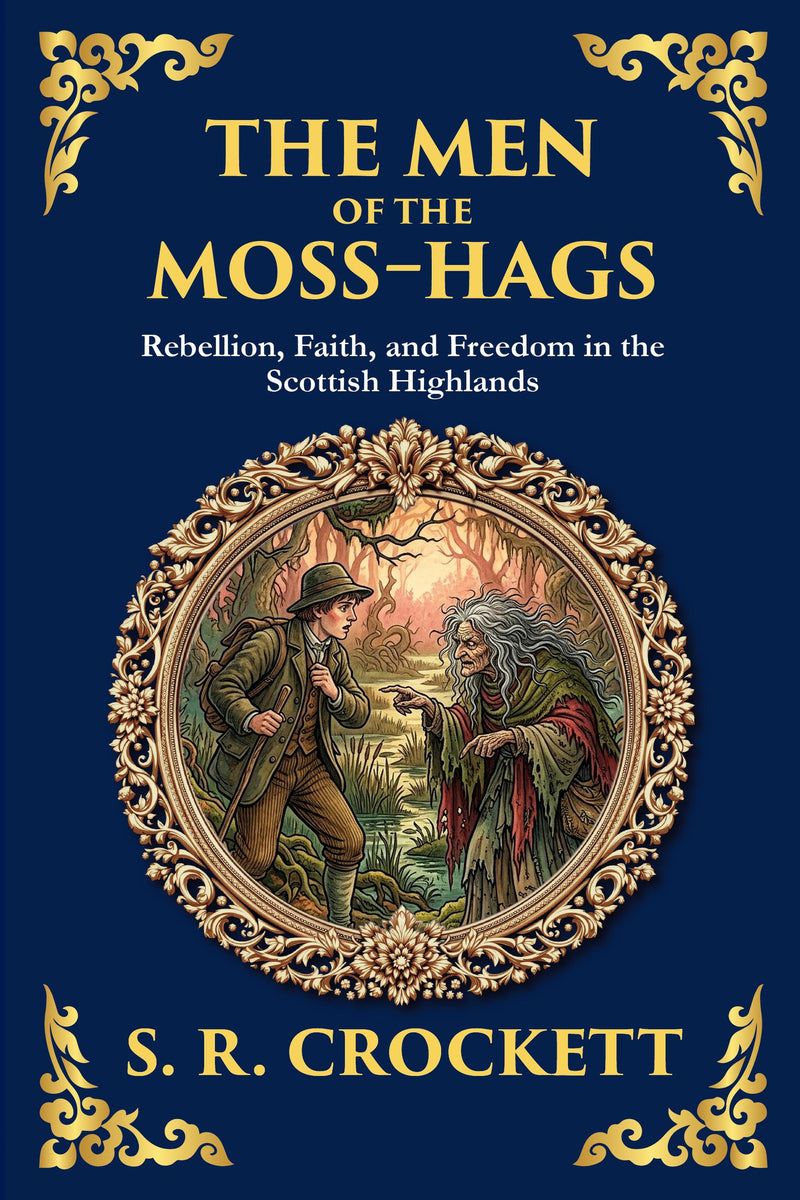
The Men of the Moss-Hags — Large Print
In The Men of the Moss-Hags, S. R. Crockett resurrects the spirit of Scotland’s covenanting past with raw power and lyrical passion.
or free app
10,000+ hrs library
30-day guarantee
The complete The Men of the Moss-Hags appears in modern English through Library of Alexandria Press, available online with audiobook narration included for members.
Have you ever wondered why the fires of freedom burn brightest in the darkest valleys? The Men of the Moss-Hags is an epic tale of faith, rebellion, and identity in a land soaked with history and defiance. S. R. Crockett’s riveting novel transports readers into the heart of the Scottish Covenanter resistance, where honor is forged in heather, and freedom is paid for in blood.
Set during the tumultuous reign of Charles II, this classic work follows young William Gordon of Earlstoun, whose journey from boyhood to warrior is shaped by the fires of persecution and the call of conscience. As he joins the “Moss-Hags”—those devout Scottish Presbyterians who worship in secret and fight in shadows—Gordon discovers the true cost of standing for truth against tyranny. Blending rich historical detail with action-packed storytelling, Crockett paints a vivid picture of Scotland’s highland terrain and the indomitable souls who defended their faith and land.
This edition revives the voice of one of Scotland’s great storytellers and brings his tale of bravery and sacrifice to a new generation.
What you’ll discover in this modern edition
- A Hero’s Journey Amidst Uprising – Follow William Gordon as he is thrust into the epicenter of a resistance born in faith and fire.
- Immersive Highland Landscapes – Discover the haunting beauty of Scotland’s glens, lochs, and mossy battlefields.
- A Tale of Religious Liberty and Defiance – Witness how a nation’s conscience refused to bow to royal decree.
- Historical Authenticity – A gripping portrait of the Covenanters’ plight, anchored in real events and cultural legacy.
- An Enduring Scottish Classic – A cornerstone in the tradition of Walter Scott, Robert Louis Stevenson, and literary nationalism.
| Formats | eBook (EPUB + PDF) · Audiobook · Paperback · Hardcover · Large Print |
| Language | English |
| Trim size (print) | 6 × 9 in |
| Binding | Paperback — perfect-bound · Hardcover — casewrap |
| Large Print edition | Same text in a larger, easy-read type — a larger font, not a larger trim |
| Print pricing | Every physical book at our true cost — at-cost, no profit (members) |
| Library | 873 restored titles, always growing |
| Length | 110,453 words · ~7 hr 22 min reading |
| Reading level | Grade 9 · a comfortable read (this modern-English edition) |
| Edition | Modern English translation · 2026 |
Member reviews for this edition are collected as readers finish it — be the first. Across the library: 12,000+ books shipped, every plan covered by a 365-day print guarantee.
About this edition
A faithful, unabridged modern-English edition by The Library of Alexandria — carefully rendered for today's reader and verified paragraph-by-paragraph against the public-domain source. Available as eBook, audiobook, paperback, hardcover, and large print.
- Complete & unabridgedVerified paragraph by paragraph against the source — never a scan, never abridged.
- Modern English, faithfulReadable today, with the author’s meaning kept intact. Readable — not simplified.
- Every format, one membershipRead in your browser or the free app, or listen to the full audiobook.
Included free with your membership
Cancel anytime, one click · 30-day money-back guarantee
Edition last updated July 2026
What’s inside
The Men of the Moss-Hags — Large Print — complete and unabridged: all 58 sections included with membership, plus the full audiobook.
Begin reading The Men of the Moss-Hags — Large Print
In clear modern English — the complete text is included with membership.
Introduction
There are landscapes that exist twice: once on the map and once in the imagination. The moorlands of southwestern Scotland — the rolling, peat-soaked uplands of Galloway and the wild stretches of Ayrshire and Dumfriesshire — belong to both worlds. On the map they are a patchwork of hills and hollows, of granite and gorse, of streams that thread silver through brown heather. In the imagination, thanks in no small part to the book you now hold, they are something more: a theatre of conscience, a refuge for the hunted, and a proving ground for the human spirit. The “moss-hags” of the title are the broken, treacherous edges of the peat bogs — sudden trenches and pits where the turf has been cut away or has collapsed, leaving hidden hazards in the open moor. To the casual traveler they were a nuisance and a danger. To the men and women who feature in this story, they were salvation: places to hide, to crouch unseen, to slip away from pursuing dragoons across ground no horse could safely cross. The title is therefore not merely scenic. It announces a theme. This is a book about people forced to the margins, who found in the most desolate and forbidding country a freedom they could not find in the comfortable towns and ordered farms below.
To read this novel well, it helps to understand the historical soil from which it grows. The events take place during one of the most turbulent and morally charged periods in Scottish history, a stretch of years that later generations would call “the Killing Time.” After the restoration of the monarchy in the mid-seventeenth century, the Crown sought to impose its authority over the religious life of Scotland, insisting on bishops and royal control of the church. A large portion of the Scottish people — particularly in the southwest — refused. They were the Covenanters, so named because they held to solemn national covenants binding them to a particular vision of Presbyterian worship and church government, free from the interference of kings and prelates. To them, the matter was not a quibble over ceremony. It was a question of who ruled the conscience: God or the king. When the government outlawed their gatherings, the Covenanters did not submit. They met in secret, in glens and on hillsides, holding open-air services called conventicles, sometimes with armed men posted as sentries on the heights. The authorities responded with escalating violence: fines, imprisonment, torture, transportation to the colonies, and finally summary execution. Soldiers rode the moors hunting fugitives. Men were shot at their own doors or on the open hill for refusing to swear loyalty oaths. Women were drowned. It is no exaggeration to call it a persecution, and the memory of it burned in the Scottish Lowlands for centuries afterward.
This is the world S. R. Crockett recreates with such loving, granular intensity. He did not invent it; he inherited it. He grew up steeped in the lore of the Covenanters, surrounded by the very landscape in which they fought and hid and died, hearing the stories that had been passed down through families for generations. When he came to write this book, he was not approaching the material as a tourist or an antiquarian dabbling in a colorful past. He was writing about his own people, his own ground, his own deepest inheritance. That is why the novel carries a peculiar authority. The reader senses that the author knows the smell of the peat smoke, the bite of the east wind off the hills, the particular quality of light on a Galloway afternoon when the clouds break. He knows how the people spoke, how they prayed, how they courted and quarreled and grieved. The historical fiction here is not a costume draped over invented characters; it is a resurrection.
It is worth pausing on the question of religion, because modern readers sometimes approach a book of this kind with hesitation, expecting either dry theological lecturing or pious sentimentality. They will find neither. The faith of the Covenanters in these pages is fierce, stubborn, sometimes harsh, occasionally even comic in its rigidity — and always intensely human. Crockett does not turn his characters into plaster saints. They argue about doctrine while hiding for their lives. They are capable of pride, of self-righteousness, of the particular vanities that attach to people who are certain they are right. But they are also capable of breathtaking courage, of loyalty that does not flinch in the face of death, and of a kind of moral seriousness that our own age, for all its advantages, often lacks. You do not need to share their theology — or any theology at all — to be moved by them. What matters is the spectacle of human beings who believe something so completely that they will die rather than betray it. That is a drama that transcends any particular creed, and it is the beating heart of this book.
The subtitle of this edition speaks of “Rebellion, Faith, and Freedom,” and those three words map the territory neatly. Rebellion, because the Covenanters were, in the eyes of the state, traitors and rebels — and the question of when defiance of authority becomes legitimate, when obedience becomes complicity, is one the novel never lets us forget. Faith, because everything in this world is colored and conditioned by belief, by the conviction that there is a higher law than the king’s, that the soul answers to God before it answers to any earthly power. And freedom, because that, finally, is what the whole bloody business was about — not freedom in the modern, individualistic sense of doing as one pleases, but the older and harder freedom of worshipping according to conscience, of not bowing the knee to a power one believes to be unjust. The mention of “the Scottish Highlands” in the subtitle should be read with a touch of poetic latitude; the events of the story unfold chiefly in the wild uplands and moors of the Lowland southwest rather than the Highlands proper, but the spirit of the phrase — remote, rugged, defiant country sheltering hunted men — captures the mood precisely.
A Storyteller at the Height of His Powers
Samuel Rutherford Crockett — he generally published as S. R. Crockett — was one of the most popular and prolific Scottish novelists of his era. His very name carries a flag: he was christened after a famous Covenanting divine, which tells you something about the household and the tradition that formed him. Trained for the ministry and for a time a clergyman himself, he eventually gave up the pulpit for the pen, and the pen rewarded him handsomely. In his heyday he was a bestseller, mentioned in the same breath as Robert Louis Stevenson, with whom he corresponded and who admired his work. The two men shared a love of Scotland, a gift for adventure, and a romantic temperament that found in their native land an inexhaustible store of story.
It is the comparison with Stevenson that perhaps best prepares a new reader for what to expect. Like Stevenson, Crockett writes adventure with a moral spine. There is action here — pursuit, escape, ambush, the constant tension of the hunted — but it is action that means something, because the stakes are not merely physical survival but the survival of the soul and of a way of life. Like Stevenson, too, Crockett has a magnificent ear for the Scots tongue. His characters speak in a language flavored with the rhythms and vocabulary of the southwest, and this is one of the great pleasures of the book, though it can also be one of its initial challenges. Crockett does not flatten his people into bland modern speech; he lets them talk as they would have talked, with all the salt and color and biblical cadence of their world.
This brings us to the nature of the present edition, and to a few words about how to read it. This is described as a modern translation, adapted for the contemporary reader. What does that mean, and what does it not mean? It means that the most formidable barriers to enjoyment have been gently lowered. The dense thickets of antiquated spelling, the more obscure dialect terms that would send a modern reader repeatedly to a glossary, the archaic constructions that slow the eye and break the spell — these have been thoughtfully smoothed and clarified so that the story can move at the pace its drama deserves. What it does not mean is that the book has been gutted of its character. The aim of a good adaptation is not to erase the author’s voice but to clear away the dust that time has settled on it, so that voice can be heard again as freshly as it was first heard. The flavor of the Scots, the dignity of the period, the particular music of Crockett’s prose — these remain. A reader coming to this story for the first time should find it accessible without finding it bland, modernized without being modern.
A note on that prose is in order, because Crockett’s style is one of his glories and deserves to be approached with the right expectations. He writes with a richness and a fullness that belong to his age rather than ours. Where a contemporary thriller might give you a clipped sentence and a quick cut, Crockett gives you the long, rolling description, the loving accumulation of detail, the digression into character and memory. He lingers. He savors. He will pause in the middle of a chase to describe the way the mist sits in a hollow or the look on an old woman’s face. To a reader trained on the brisk efficiency of modern storytelling, this can feel unhurried at first. The advice is simple: slow down to meet it. Let the rhythm of the prose set the rhythm of your reading. Once you surrender to its pace, you will find that the descriptions are not delays but immersions, that the digressions deepen rather than dilute, and that the world Crockett builds is one you can walk into and inhabit. This is a book to be read in the firelight, so to speak — not skimmed on a screen between appointments, but settled into, the way one settles into a long winter evening with no need to hurry.
The narrative voice itself rewards attention. Crockett frequently writes in the first person, in the voice of a participant looking back on the events of his youth from the vantage of age. This is a deliberate and powerful choice. It gives the story the warmth and intimacy of memory, the sense of a man telling you, by his own fireside, the things he saw and did and suffered in the great days of his youth. It allows for irony — the older narrator can smile gently at the follies of his younger self — and for poignancy, the awareness that the bright figures who move through the tale are now mostly gone, that the teller has outlived his companions. It is a technique that lends the historical material an emotional immediacy that pure third-person chronicle could never achieve. You are not reading a history; you are being confided in.
For all its seriousness, this is not a grim book. That is one of the things readers most often fail to anticipate and most delight to discover. There is humor here — sly, dry, often deflating, the humor of a people who have learned to laugh in the teeth of hardship. There is romance, handled with a tenderness and a sense of fun that lighten the darker matter without trivializing it. There is the warmth of friendship and family, the comedy of household life, the eternal entertainment of strong personalities knocking against one another. Crockett understood that no people, however persecuted, lives in unrelieved gloom; that even in the worst of times there are weddings and jokes and meals and the small daily pleasures that make life worth defending. He gives us the whole texture of existence, the comic and the tragic woven together as they are in any real life. The result is a book that is full of feeling without being heavy, serious without being solemn, and morally weighty without ever forgetting to be, first and last, a tremendously good story.
A fair question hangs over any old novel newly presented to modern readers: why should we bother? The events are centuries past. The theological disputes that drove them have long since cooled into history. The Scots dialect can seem remote. The romantic conventions of the period — the noble heroes, the steadfast heroines, the clear lines between the persecutors and the persecuted — can feel, to a cynical age, almost naive. Why read this now?
Cancel anytime, one click · 30-day money-back guarantee
Founding annual rate available now — your price locks for life when you join.
Not ready? Get this free chapter by email — read it anytime.
✓ Sent — check your inbox for The Men of the Moss-Hags — Large Print.
Questions about The Men of the Moss-Hags — Large Print
What is The Men of the Moss-Hags about?
In The Men of the Moss-Hags, S. R. Crockett resurrects the spirit of Scotland’s covenanting past with raw power and lyrical passion. Set amidst the rugged moors and shadowed glens of 17th-century Scotland, this stirring tale follows the struggle of ordinary men and women who rise against religious persecution and political oppression. With blades drawn and faith unshaken, they become the legendary “Moss-Hags”—rebels hidden in the wilderness, bound by conscience and country.
Who wrote The Men of the Moss-Hags?
The Men of the Moss-Hags was written by S. R. Crockett. This edition presents the complete work in clear modern English, faithfully rendered from the public-domain original by Library of Alexandria Press.
Is The Men of the Moss-Hags free to read?
The opening chapter is free to read on this page. Members read and listen to the complete work — and the entire library — free, and can order any physical book at our true print cost.
How long is The Men of the Moss-Hags?
58 chapters (~110,453 words) — about 7 hr 22 min of reading in this modern-English edition.
Is this an abridged version of The Men of the Moss-Hags?
No. This is the complete, unabridged The Men of the Moss-Hags, carefully rendered into clear modern English and verified paragraph-by-paragraph against the public-domain source — nothing is cut or summarised.
What formats does The Men of the Moss-Hags come in?
The Men of the Moss-Hags is available as eBook, paperback, hardcover and large print. eBook and audiobook are included with membership; printed editions ship at our true print cost.
Shipping & returns
Billing & membership
More from the library


Explore Adventure
- Tarzan of the Apes · Edgar Rice Burroughs
- The Wonderful Wizard of Oz · L. Frank Baum
- Peter Pan · J. M. Barrie
- Moby Dick; Or, The Whale · Herman Melville
- The Riddle of the Sands · Erskine Childers
- The Loss of the Swansea: A Story of the Florida Coast · W. L. Alden
- Sky Island · L. Frank Baum
- Vikram and the Vampire: Classic Hindu Tales of Adventure, Magic, and Romance · Unknown
- Tales of Unrest · Joseph Conrad
- The Tomb of Ts’in · Edgar Wallace
- Skinny McCord · Percy Keese Fitzhugh
- The Men of the Moss-Hags · S. R. Crockett
- The Hunniwell Boys and the Platinum Mystery · L. P. Wyman
- Allan Quatermain · H. Rider Haggard
- She · H. Rider Haggard
- Medical Life in the Navy · Gordon Stables
- The Thirty-Nine Steps · John Buchan
- The Story of Doctor Dolittle · Hugh Lofting
- The Princess and the Goblin · George MacDonald
- The Man Who Would Be King · Rudyard Kipling
- Lucian’s True History · Lucian of Samosata
- The Secret Adversary · Agatha Christie
- Lord Jim · Joseph Conrad
- The Marvelous Land of Oz · L. Frank Baum
- The Virginian: A Horseman of the Plains · Owen Wister
- Mars is My Destination · Frank Belknap Long
- Anabasis · Xenophon
- The Mississippi Saucer · Frank Belknap Long
- Sabotage in Space · Carey Rockwell
- Brood of the Dark Moon · Charles Willard Diffin
The Men of the Moss-Hags — Large Print
The Men of the Moss-Hags — Large Print
Rebellion, Faith, and Freedom in the Scottish Highlands
S. R. Crockett
Contents
- Introduction
- Preface by the Author
- Chapter 1
- Chapter 2
- Chapter 3
- Chapter 4
- Chapter 5
- Chapter 6
- Chapter 7
- Chapter 8
- Chapter 9
- Chapter 10
- Chapter 11
- Chapter 12
- Chapter 13
- Chapter 14
- Chapter 15
- Chapter 16
- Chapter 17
- Chapter 18
- Chapter 19
- Chapter 20
- Chapter 21
- Chapter 22
- Chapter 23
- Chapter 24
- Chapter 25
- Chapter 26
- Chapter 27
- Chapter 28
- Chapter 29
- Chapter 30
- Chapter 31
- Chapter 32
- Chapter 33
- Chapter 34
- Chapter 35
- Chapter 36
- Chapter 37
- Chapter 38
- … and 18 more chapters
Introduction
There are landscapes that exist twice: once on the map and once in the imagination. The moorlands of southwestern Scotland — the rolling, peat-soaked uplands of Galloway and the wild stretches of Ayrshire and Dumfriesshire — belong to both worlds. On the map they are a patchwork of hills and hollows, of granite and gorse, of streams that thread silver through brown heather. In the imagination, thanks in no small part to the book you now hold, they are something more: a theatre of conscience, a refuge for the hunted, and a proving ground for the human spirit. The “moss-hags” of the title are the broken, treacherous edges of the peat bogs — sudden trenches and pits where the turf has been cut away or has collapsed, leaving hidden hazards in the open moor. To the casual traveler they were a nuisance and a danger. To the men and women who feature in this story, they were salvation: places to hide, to crouch unseen, to slip away from pursuing dragoons across ground no horse could safely cross. The title is therefore not merely scenic. It announces a theme. This is a book about people forced to the margins, who found in the most desolate and forbidding country a freedom they could not find in the comfortable towns and ordered farms below.
To read this novel well, it helps to understand the historical soil from which it grows. The events take place during one of the most turbulent and morally charged periods in Scottish history, a stretch of years that later generations would call “the Killing Time.” After the restoration of the monarchy in the mid-seventeenth century, the Crown sought to impose its authority over the religious life of Scotland, insisting on bishops and royal control of the church. A large portion of the Scottish people — particularly in the southwest — refused. They were the Covenanters, so named because they held to solemn national covenants binding them to a particular vision of Presbyterian worship and church government, free from the interference of kings and prelates. To them, the matter was not a quibble over ceremony. It was a question of who ruled the conscience: God or the king. When the government outlawed their gatherings, the Covenanters did not submit. They met in secret, in glens and on hillsides, holding open-air services called conventicles, sometimes with armed men posted as sentries on the heights. The authorities responded with escalating violence: fines, imprisonment, torture, transportation to the colonies, and finally summary execution. Soldiers rode the moors hunting fugitives. Men were shot at their own doors or on the open hill for refusing to swear loyalty oaths. Women were drowned. It is no exaggeration to call it a persecution, and the memory of it burned in the Scottish Lowlands for centuries afterward.
This is the world S. R. Crockett recreates with such loving, granular intensity. He did not invent it; he inherited it. He grew up steeped in the lore of the Covenanters, surrounded by the very landscape in which they fought and hid and died, hearing the stories that had been passed down through families for generations. When he came to write this book, he was not approaching the material as a tourist or an antiquarian dabbling in a colorful past. He was writing about his own people, his own ground, his own deepest inheritance. That is why the novel carries a peculiar authority. The reader senses that the author knows the smell of the peat smoke, the bite of the east wind off the hills, the particular quality of light on a Galloway afternoon when the clouds break. He knows how the people spoke, how they prayed, how they courted and quarreled and grieved. The historical fiction here is not a costume draped over invented characters; it is a resurrection.
It is worth pausing on the question of religion, because modern readers sometimes approach a book of this kind with hesitation, expecting either dry theological lecturing or pious sentimentality. They will find neither. The faith of the Covenanters in these pages is fierce, stubborn, sometimes harsh, occasionally even comic in its rigidity — and always intensely human. Crockett does not turn his characters into plaster saints. They argue about doctrine while hiding for their lives. They are capable of pride, of self-righteousness, of the particular vanities that attach to people who are certain they are right. But they are also capable of breathtaking courage, of loyalty that does not flinch in the face of death, and of a kind of moral seriousness that our own age, for all its advantages, often lacks. You do not need to share their theology — or any theology at all — to be moved by them. What matters is the spectacle of human beings who believe something so completely that they will die rather than betray it. That is a drama that transcends any particular creed, and it is the beating heart of this book.
The subtitle of this edition speaks of “Rebellion, Faith, and Freedom,” and those three words map the territory neatly. Rebellion, because the Covenanters were, in the eyes of the state, traitors and rebels — and the question of when defiance of authority becomes legitimate, when obedience becomes complicity, is one the novel never lets us forget. Faith, because everything in this world is colored and conditioned by belief, by the conviction that there is a higher law than the king’s, that the soul answers to God before it answers to any earthly power. And freedom, because that, finally, is what the whole bloody business was about — not freedom in the modern, individualistic sense of doing as one pleases, but the older and harder freedom of worshipping according to conscience, of not bowing the knee to a power one believes to be unjust. The mention of “the Scottish Highlands” in the subtitle should be read with a touch of poetic latitude; the events of the story unfold chiefly in the wild uplands and moors of the Lowland southwest rather than the Highlands proper, but the spirit of the phrase — remote, rugged, defiant country sheltering hunted men — captures the mood precisely.
A Storyteller at the Height of His Powers
Samuel Rutherford Crockett — he generally published as S. R. Crockett — was one of the most popular and prolific Scottish novelists of his era. His very name carries a flag: he was christened after a famous Covenanting divine, which tells you something about the household and the tradition that formed him. Trained for the ministry and for a time a clergyman himself, he eventually gave up the pulpit for the pen, and the pen rewarded him handsomely. In his heyday he was a bestseller, mentioned in the same breath as Robert Louis Stevenson, with whom he corresponded and who admired his work. The two men shared a love of Scotland, a gift for adventure, and a romantic temperament that found in their native land an inexhaustible store of story.
It is the comparison with Stevenson that perhaps best prepares a new reader for what to expect. Like Stevenson, Crockett writes adventure with a moral spine. There is action here — pursuit, escape, ambush, the constant tension of the hunted — but it is action that means something, because the stakes are not merely physical survival but the survival of the soul and of a way of life. Like Stevenson, too, Crockett has a magnificent ear for the Scots tongue. His characters speak in a language flavored with the rhythms and vocabulary of the southwest, and this is one of the great pleasures of the book, though it can also be one of its initial challenges. Crockett does not flatten his people into bland modern speech; he lets them talk as they would have talked, with all the salt and color and biblical cadence of their world.
This brings us to the nature of the present edition, and to a few words about how to read it. This is described as a modern translation, adapted for the contemporary reader. What does that mean, and what does it not mean? It means that the most formidable barriers to enjoyment have been gently lowered. The dense thickets of antiquated spelling, the more obscure dialect terms that would send a modern reader repeatedly to a glossary, the archaic constructions that slow the eye and break the spell — these have been thoughtfully smoothed and clarified so that the story can move at the pace its drama deserves. What it does not mean is that the book has been gutted of its character. The aim of a good adaptation is not to erase the author’s voice but to clear away the dust that time has settled on it, so that voice can be heard again as freshly as it was first heard. The flavor of the Scots, the dignity of the period, the particular music of Crockett’s prose — these remain. A reader coming to this story for the first time should find it accessible without finding it bland, modernized without being modern.
A note on that prose is in order, because Crockett’s style is one of his glories and deserves to be approached with the right expectations. He writes with a richness and a fullness that belong to his age rather than ours. Where a contemporary thriller might give you a clipped sentence and a quick cut, Crockett gives you the long, rolling description, the loving accumulation of detail, the digression into character and memory. He lingers. He savors. He will pause in the middle of a chase to describe the way the mist sits in a hollow or the look on an old woman’s face. To a reader trained on the brisk efficiency of modern storytelling, this can feel unhurried at first. The advice is simple: slow down to meet it. Let the rhythm of the prose set the rhythm of your reading. Once you surrender to its pace, you will find that the descriptions are not delays but immersions, that the digressions deepen rather than dilute, and that the world Crockett builds is one you can walk into and inhabit. This is a book to be read in the firelight, so to speak — not skimmed on a screen between appointments, but settled into, the way one settles into a long winter evening with no need to hurry.
The narrative voice itself rewards attention. Crockett frequently writes in the first person, in the voice of a participant looking back on the events of his youth from the vantage of age. This is a deliberate and powerful choice. It gives the story the warmth and intimacy of memory, the sense of a man telling you, by his own fireside, the things he saw and did and suffered in the great days of his youth. It allows for irony — the older narrator can smile gently at the follies of his younger self — and for poignancy, the awareness that the bright figures who move through the tale are now mostly gone, that the teller has outlived his companions. It is a technique that lends the historical material an emotional immediacy that pure third-person chronicle could never achieve. You are not reading a history; you are being confided in.
For all its seriousness, this is not a grim book. That is one of the things readers most often fail to anticipate and most delight to discover. There is humor here — sly, dry, often deflating, the humor of a people who have learned to laugh in the teeth of hardship. There is romance, handled with a tenderness and a sense of fun that lighten the darker matter without trivializing it. There is the warmth of friendship and family, the comedy of household life, the eternal entertainment of strong personalities knocking against one another. Crockett understood that no people, however persecuted, lives in unrelieved gloom; that even in the worst of times there are weddings and jokes and meals and the small daily pleasures that make life worth defending. He gives us the whole texture of existence, the comic and the tragic woven together as they are in any real life. The result is a book that is full of feeling without being heavy, serious without being solemn, and morally weighty without ever forgetting to be, first and last, a tremendously good story.
A fair question hangs over any old novel newly presented to modern readers: why should we bother? The events are centuries past. The theological disputes that drove them have long since cooled into history. The Scots dialect can seem remote. The romantic conventions of the period — the noble heroes, the steadfast heroines, the clear lines between the persecutors and the persecuted — can feel, to a cynical age, almost naive. Why read this now?
Maisie May and I spent many mornings playing “Wanderers and King’s Men” on the beautiful green hills overlooking the Black Water of Dee, near where it joins the clear Ken river. I remember it as if it happened yesterday; the valleys and riverbanks were decorated with white hawthorn and wide daisies. Small, delicate wildflowers grew near our hiding spots in the woods, nodding at us while we lay there holding our breath.
Maisie Lennox—which was her full name—was my cousin and had been my closest friend since we were five years old. My older brother, Sandy, ignored me because I was so much younger and he was always focused on his own wants. To be honest, I never liked him very much either. Whenever we fought, which happened often, he would chase me and hit me; however, I usually got the upper hand by pelting him with pebbles, since I had a sharp eye and a steady aim. Sandy, on the other hand, was clumsy and threw stones like a girl, despite how strong his arms were.
However, that wasn’t the case for Maisie Lennox. She was Anthony Lennox’s daughter and could keep up with anyone in a stone-throwing contest. She lived at the Lesser Duchrae, located above the Black Water. I lived at Earlstoun on the hillside overlooking the Ken, which is quite a distance from the Duchrae. But our fathers shared the same beliefs, and since we were cousins through an old family connection and lifelong friends, Maisie and I spent a lot of time playing together. Additionally, my mother felt a deep sympathy for the little girl who had no mother and a father who spent as much time hunting wildfowl on the moors as he did at home with his only daughter.
End of the free sample
Keep reading, free
Members read and listen to the complete book — and the entire library. Cancel anytime, one click · 30-day money-back guarantee.