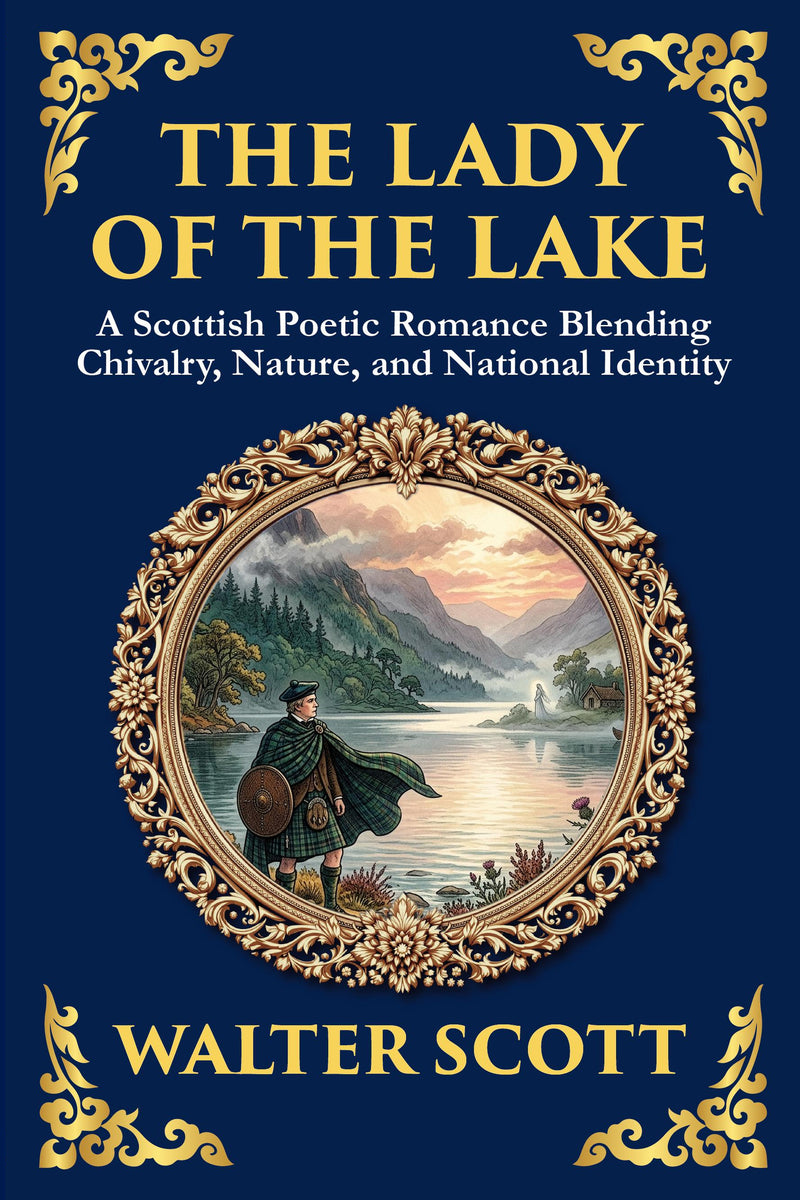
The Lady of the Lake
In the mist-veiled Highlands of Scotland, where chivalry and clan loyalty clash with romance and royal intrigue, The Lady of the Lake unfolds.
or free app
10,000+ hrs library
30-day guarantee
The complete The Lady of the Lake appears in modern English through Library of Alexandria Press, available online with audiobook narration included for members.
Have you ever wondered why the most enduring romances are born in the shadows of conflict and legend? Walter Scott’s The Lady of the Lake is one of the most celebrated narrative poems in literary history—an enchanting tale that seamlessly blends romance, patriotism, nature, and chivalric ideals. First published in 1810, this verse epic transformed how the world viewed the Scottish Highlands, inspiring artists, composers, and national identity movements alike.
Set during a time of political unrest between King James V and the Highland clans, the story revolves around the noble and elusive Ellen Douglas. Living in exile on the tranquil shores of Loch Katrine, she becomes the object of desire for three suitors: the valiant but outlawed James Fitz-James, the loyal Highland warrior Roderick Dhu, and the chivalrous Malcolm Graeme. But Ellen’s fate is bound to more than love—her choices hold the key to peace or war.
What you’ll discover in this modern edition
- A Sweeping Highland Romance – Experience the emotional depth and intrigue of a love story intertwined with clan loyalty and personal honor.
- Epic Scottish History and Legend – Immerse yourself in the cultural landscape that helped shape modern Scottish identity.
- Lyrical Language and Natural Imagery – Revel in Scott’s vivid depictions of lochs, mountains, forests, and the majesty of untouched nature.
- Themes of Valor, Loyalty, and Justice – Encounter characters who embody courage, compassion, and the complexity of moral choice.
- A Classic Modernized for Today’s Reader – With updated formatting and clear presentation, this edition allows readers to savor Scott’s poetic mastery with ease and clarity.
| Formats | eBook (EPUB + PDF) · Audiobook · Paperback · Hardcover · Large Print |
| Language | English |
| Trim size (print) | 6 × 9 in |
| Binding | Paperback — perfect-bound · Hardcover — casewrap |
| Large Print edition | Same text in a larger, easy-read type — a larger font, not a larger trim |
| Print pricing | Every physical book at our true cost — at-cost, no profit (members) |
| Library | 873 restored titles, always growing |
| Length | 17,830 words · ~1 hr 11 min reading |
| Reading level | Grade 12 · a confident, adult read (this modern-English edition) |
| Edition | Modern English translation · 2026 |
Member reviews for this edition are collected as readers finish it — be the first. Across the library: 12,000+ books shipped, every plan covered by a 365-day print guarantee.
About this edition
A faithful, unabridged modern-English edition by The Library of Alexandria — carefully rendered for today's reader and verified paragraph-by-paragraph against the public-domain source. Available as eBook, audiobook, paperback, hardcover, and large print.
- Complete & unabridgedVerified paragraph by paragraph against the source — never a scan, never abridged.
- Modern English, faithfulReadable today, with the author’s meaning kept intact. Readable — not simplified.
- Every format, one membershipRead in your browser or the free app, or listen to the full audiobook.
Included free with your membership
Cancel anytime, one click · 30-day money-back guarantee
Edition last updated July 2026
What’s inside
The Lady of the Lake — complete and unabridged: all 7 sections included with membership, plus the full audiobook.
Begin reading The Lady of the Lake
In clear modern English — the complete text is included with membership.
Introduction
There are poems that simply tell a story, and there are poems that capture an entire world—its landscape, its people, its tensions, and its dreams—and then offer that world to the reader as a gift. The Lady of the Lake belongs firmly to the second category. When Walter Scott published this sweeping narrative poem in 1810, he did far more than craft an entertaining tale of knights, kings, and Highland chieftains. He summoned into existence a Scotland that millions of readers would come to love, visit, and remember. He gave the Trossachs and the shores of Loch Katrine a literary immortality so powerful that, within months of publication, tourists were flooding into a region that had previously been considered remote, wild, and largely impassable. Few works of literature have so directly reshaped the cultural geography of an entire nation.
This modern translation has been prepared with a single purpose in mind: to allow you, the contemporary reader, to step into Scott’s enchanted Highlands without the obstacles that two centuries of changing language can place in the way. The original poem is a marvel of musicality and craftsmanship, but its archaic diction, its dense allusions, and its sometimes intricate verse forms can prove daunting to those encountering it for the first time. What follows in these pages preserves the spirit, the energy, the romance, and the grandeur of Scott’s vision while making its meaning clear and its pleasures accessible. The aim is not to replace the original but to open a door to it—to ensure that the thrill of the chase, the hush of the loch at dawn, the clash of loyalties, and the ache of forbidden feeling all reach you as vividly as they reached Scott’s first delighted audience.
Before you begin, it is worth understanding a little about the man who wrote this poem, the time in which he wrote it, and the remarkable cultural moment that The Lady of the Lake both reflected and helped to create. Doing so will deepen your appreciation of every canto, every song, and every sudden turn of fortune that awaits you.
The Bard of the North and His Borderland Imagination
Walter Scott was born in Edinburgh in 1771, into a Scotland that was being pulled in two directions at once. On one side stood the Enlightenment city of his birth, a center of rational philosophy, scientific inquiry, and refined manners, where thinkers like David Hume and Adam Smith had made Edinburgh one of the intellectual capitals of Europe. On the other side lay the older Scotland of clans and ballads, of feuds and folk memory, of a Gaelic-speaking Highland culture that had only recently been broken by the catastrophic defeat at Culloden in 1746 and the brutal suppression that followed. Scott, with one foot in each world, would spend his life as a kind of bridge between them—translating the passions and traditions of the ancient past into a form that the modern, literate, increasingly urban reader could embrace.
A childhood illness left him with a permanent limp, and during his recovery he was sent to his grandfather’s farm in the Border country, the rugged region between Scotland and England that had for centuries been a contested no-man’s-land of raids and reivers. There, surrounded by relatives and neighbors who carried in their memories an enormous store of songs, legends, and family histories, the young Scott developed the consuming passion that would define his career. He grew up steeped in the oral tradition of the Borders, learning to feel the romance of the past not as something distant and academic but as something living, vivid, and emotionally immediate.
Trained as a lawyer and eventually appointed to comfortable legal positions that gave him both income and leisure, Scott began his literary life as a collector and editor of traditional ballads, publishing the Minstrelsy of the Scottish Border in the early 1800s. From there it was a natural step to writing original narrative poems in the ballad spirit. His The Lay of the Last Minstrel (1805) and Marmion (1808) were enormous successes, establishing him as the most popular poet in the English-speaking world—a reputation that The Lady of the Lake would only enhance. Indeed, the poem you are about to read sold an astonishing number of copies in its first year, a publishing phenomenon that turned Scott into a literary celebrity on a scale rarely seen before.
It is one of the great ironies of literary history that Scott, the supreme poet of his moment, would later abandon verse for prose—launching, with Waverley in 1814, the historical novel as a major literary form and producing a string of masterpieces that influenced novelists across Europe and America for generations. Some of this shift was strategic: the young Lord Byron had begun publishing poems whose smoldering intensity captured the public imagination, and Scott, ever the shrewd professional, recognized that the literary winds were changing. But to read The Lady of the Lake is to understand exactly why Scott was, in his poetic heyday, so universally beloved. The poem displays every gift that made him great: his instinct for pacing and suspense, his painter’s eye for landscape, his deep sympathy for human character across social divides, and above all his genius for making the past feel urgently alive.
It is important, too, to appreciate what Scott was doing for Scotland itself. In the decades after Culloden, Highland culture had been actively suppressed; the wearing of tartan, the carrying of weapons, and many of the old clan customs had been outlawed. The Highlands were widely regarded by the genteel southern public as a backward, even barbaric wilderness. Scott, through this poem and his other works, performed an extraordinary act of cultural rehabilitation. He took the very qualities that had been despised—the fierce loyalties, the wild scenery, the ancient codes of honor—and reframed them as noble, romantic, and worthy of admiration. He helped to transform the Highlander from a feared rebel into a figure of dignity and pathos. In doing so, he laid much of the groundwork for the romantic image of Scotland that endures to this day, an image of misty glens, brave chieftains, and stirring loyalty that draws visitors from around the globe. When you read of clans gathering, of the fiery cross summoning warriors to battle, of the haunting beauty of the lochs, you are reading the very passages that fashioned a national identity.
A World of Lochs, Loyalties, and Hidden Identities
The Lady of the Lake unfolds across six cantos, each one a distinct movement in a larger symphony. The setting is the Scottish Highlands during the reign of James V in the sixteenth century—a period of tension between the Scottish crown, seeking to consolidate its authority, and the proud, semi-independent clans of the mountains, who guarded their freedom fiercely. Into this charged landscape Scott introduces a small cast of unforgettable characters whose fates become entangled in ways that drive the narrative forward with mounting urgency. Without revealing the turns and surprises that give the poem its power, it is enough to say that the story turns on questions of identity, honor, love, and loyalty, and that several of its central figures are not at all what they first appear to be.
The poem opens, famously, with a stag hunt—one of the most exhilarating passages in all of English narrative poetry. The chase sweeps across the landscape at breathless speed, the hounds in full cry, the hunter pressing his exhausted horse onward through wild and increasingly unfamiliar country until both the prey and the pursuer are carried into the heart of a region of stunning beauty and mystery. From this opening, Scott establishes the tone that will govern the entire work: a constant interplay between the natural world and human drama, between motion and stillness, between the public sphere of politics and warfare and the private sphere of feeling and desire.
What follows draws the reader into a network of relationships and rivalries that span the social spectrum, from the courtly and the royal to the rugged world of the Highland clans. Scott was deeply interested in the points where different worlds collide—where the values of one culture rub against those of another, where personal affection runs counter to political duty, where the demands of honor pull characters in opposite directions. This is the emotional engine of the poem. The central female figure, who gives the work its title, is one of the most beloved heroines of Romantic literature: graceful, intelligent, spirited, and caught at the intersection of forces far larger than herself. Around her revolve men of contrasting temperaments and allegiances, each embodying a different vision of how one ought to live and what one owes to others.
One of the great pleasures of the poem lies in its structure of concealment and revelation. Scott was a master of the withheld secret, the gradually disclosed truth, the figure whose real nature emerges only at the perfect dramatic moment. Identities are veiled and unveiled; assumptions are overturned; the reader, like the characters, must continually revise their understanding of who is friend and who is foe, who holds power and who is at the mercy of events. This is part of what makes the poem so compulsively readable. It moves with the momentum of a thriller, even as it pauses, again and again, to dwell on moments of lyrical beauty.
And those moments are essential, for The Lady of the Lake is not merely a story of action—it is a poem profoundly attuned to song and music. Scattered throughout the narrative are lyrics and ballads that the characters themselves sing, each one a small masterpiece in its own right. Several of these embedded songs became famous independently of the poem. The “Coronach,” a lament for the dead, and “Hail to the Chief,” a song of clan loyalty that would later inspire the ceremonial music associated with heads of state, both originate here. The most celebrated of all is the exquisite “Ave Maria,” whose words Scott composed as a hymn sung by his heroine and which the composer Franz Schubert would later set to music in a version that remains one of the most cherished pieces in the entire classical repertoire. In this modern translation, the lyrical quality of these songs has been carefully preserved, so that you can feel the shift in register when the narrative pauses and a character lifts their voice in melody. These moments give the poem its emotional depth, its tenderness, and its haunting beauty.
Equally central is Scott’s treatment of the landscape itself. He does not merely use scenery as a backdrop; he makes it a living presence, almost a character in its own right. The waters of the loch, the mist-wreathed mountains, the dark passes and hidden islands, the changing light of dawn and dusk—all of these are rendered with a vividness that transports the reader directly into the Highlands. Scott had walked this country, had absorbed its moods and its grandeur, and he poured that intimate knowledge into every description. It is no exaggeration to say that The Lady of the Lake invented Highland tourism. After its publication, the area around Loch Katrine became a place of pilgrimage, with travelers arriving in their thousands to see for themselves the scenes the poem had immortalized. The region’s economy was transformed; new roads and inns were built; the very names of the places Scott described became household words. To read the poem today is to walk in the footsteps of those first enchanted readers, and to discover the landscape that launched a thousand journeys.
Beneath the romance and the scenery, however, runs a current of serious reflection. Scott was writing at a time when the old clan system had been irrevocably destroyed, and he was acutely aware that the world he was depicting was a vanished one. There is an elegiac quality to the poem, a sense of mourning for a way of life that could be admired precisely because it was gone. At the same time, Scott was no simple sentimentalist. He understood the violence and the dangers of the old order as well as its nobility, and the poem holds these things in a delicate balance. It asks searching questions about the costs of loyalty, the limits of vengeance, the possibility of mercy and reconciliation between enemies, and the proper relationship between a ruler and the people over whom he rules. The figure of the king, who moves through the poem in ways the reader will come to understand, embodies Scott’s interest in the ideal of a just and merciful authority—an authority that could heal the wounds of a divided land. In this sense, the poem is also a meditation on nationhood itself, on what it might mean for the warring elements of Scotland—Highland and Lowland, clan and crown, Gaelic and English—to be reconciled into a single, harmonious whole.
Cancel anytime, one click · 30-day money-back guarantee
Founding annual rate available now — your price locks for life when you join.
Not ready? Get this free chapter by email — read it anytime.
✓ Sent — check your inbox for The Lady of the Lake.
Questions about The Lady of the Lake
What is The Lady of the Lake about?
In the mist-veiled Highlands of Scotland, where chivalry and clan loyalty clash with romance and royal intrigue, The Lady of the Lake unfolds. Through lyrical verse, Walter Scott conjures a powerful epic of love, honor, betrayal, and the haunting beauty of the natural world. Set against a backdrop of political tension and Highland legend, this poetic romance tells the story of Ellen Douglas—the mysterious Lady of the Lake—and the three men whose lives are forever changed by her.
Who wrote The Lady of the Lake?
The Lady of the Lake was written by Walter Scott. This edition presents the complete work in clear modern English, faithfully rendered from the public-domain original by Library of Alexandria Press.
Is The Lady of the Lake free to read?
The opening chapter is free to read on this page. Members read and listen to the complete work — and the entire library — free, and can order any physical book at our true print cost.
How long is The Lady of the Lake?
7 chapters (~17,830 words) — about 1 hr 11 min of reading in this modern-English edition.
Is this an abridged version of The Lady of the Lake?
No. This is the complete, unabridged The Lady of the Lake, carefully rendered into clear modern English and verified paragraph-by-paragraph against the public-domain source — nothing is cut or summarised.
What formats does The Lady of the Lake come in?
The Lady of the Lake is available as eBook, paperback, hardcover and large print. eBook and audiobook are included with membership; printed editions ship at our true print cost.
Shipping & returns
Billing & membership
More from the library


Explore Adventure
- Tarzan of the Apes · Edgar Rice Burroughs
- The Wonderful Wizard of Oz · L. Frank Baum
- Peter Pan · J. M. Barrie
- Moby Dick; Or, The Whale · Herman Melville
- The Riddle of the Sands · Erskine Childers
- The Loss of the Swansea: A Story of the Florida Coast · W. L. Alden
- Sky Island · L. Frank Baum
- Vikram and the Vampire: Classic Hindu Tales of Adventure, Magic, and Romance · Unknown
- Tales of Unrest · Joseph Conrad
- The Tomb of Ts’in · Edgar Wallace
- Skinny McCord · Percy Keese Fitzhugh
- The Men of the Moss-Hags · S. R. Crockett
- The Hunniwell Boys and the Platinum Mystery · L. P. Wyman
- Allan Quatermain · H. Rider Haggard
- She · H. Rider Haggard
- Medical Life in the Navy · Gordon Stables
- The Thirty-Nine Steps · John Buchan
- The Story of Doctor Dolittle · Hugh Lofting
- The Princess and the Goblin · George MacDonald
- The Man Who Would Be King · Rudyard Kipling
- Lucian’s True History · Lucian of Samosata
- The Secret Adversary · Agatha Christie
- Lord Jim · Joseph Conrad
- The Marvelous Land of Oz · L. Frank Baum
- The Virginian: A Horseman of the Plains · Owen Wister
- Mars is My Destination · Frank Belknap Long
- Anabasis · Xenophon
- The Mississippi Saucer · Frank Belknap Long
- Sabotage in Space · Carey Rockwell
- Brood of the Dark Moon · Charles Willard Diffin
The Lady of the Lake
The Lady of the Lake
A Scottish Poetic Romance Blending Chivalry, Nature, and National Identity
Walter Scott
Contents
- Introduction
- Canto 1
- Canto 2
- Canto 3
- Canto 4
- Canto 5
- Canto 6
Introduction
There are poems that simply tell a story, and there are poems that capture an entire world—its landscape, its people, its tensions, and its dreams—and then offer that world to the reader as a gift. The Lady of the Lake belongs firmly to the second category. When Walter Scott published this sweeping narrative poem in 1810, he did far more than craft an entertaining tale of knights, kings, and Highland chieftains. He summoned into existence a Scotland that millions of readers would come to love, visit, and remember. He gave the Trossachs and the shores of Loch Katrine a literary immortality so powerful that, within months of publication, tourists were flooding into a region that had previously been considered remote, wild, and largely impassable. Few works of literature have so directly reshaped the cultural geography of an entire nation.
This modern translation has been prepared with a single purpose in mind: to allow you, the contemporary reader, to step into Scott’s enchanted Highlands without the obstacles that two centuries of changing language can place in the way. The original poem is a marvel of musicality and craftsmanship, but its archaic diction, its dense allusions, and its sometimes intricate verse forms can prove daunting to those encountering it for the first time. What follows in these pages preserves the spirit, the energy, the romance, and the grandeur of Scott’s vision while making its meaning clear and its pleasures accessible. The aim is not to replace the original but to open a door to it—to ensure that the thrill of the chase, the hush of the loch at dawn, the clash of loyalties, and the ache of forbidden feeling all reach you as vividly as they reached Scott’s first delighted audience.
Before you begin, it is worth understanding a little about the man who wrote this poem, the time in which he wrote it, and the remarkable cultural moment that The Lady of the Lake both reflected and helped to create. Doing so will deepen your appreciation of every canto, every song, and every sudden turn of fortune that awaits you.
The Bard of the North and His Borderland Imagination
Walter Scott was born in Edinburgh in 1771, into a Scotland that was being pulled in two directions at once. On one side stood the Enlightenment city of his birth, a center of rational philosophy, scientific inquiry, and refined manners, where thinkers like David Hume and Adam Smith had made Edinburgh one of the intellectual capitals of Europe. On the other side lay the older Scotland of clans and ballads, of feuds and folk memory, of a Gaelic-speaking Highland culture that had only recently been broken by the catastrophic defeat at Culloden in 1746 and the brutal suppression that followed. Scott, with one foot in each world, would spend his life as a kind of bridge between them—translating the passions and traditions of the ancient past into a form that the modern, literate, increasingly urban reader could embrace.
A childhood illness left him with a permanent limp, and during his recovery he was sent to his grandfather’s farm in the Border country, the rugged region between Scotland and England that had for centuries been a contested no-man’s-land of raids and reivers. There, surrounded by relatives and neighbors who carried in their memories an enormous store of songs, legends, and family histories, the young Scott developed the consuming passion that would define his career. He grew up steeped in the oral tradition of the Borders, learning to feel the romance of the past not as something distant and academic but as something living, vivid, and emotionally immediate.
Trained as a lawyer and eventually appointed to comfortable legal positions that gave him both income and leisure, Scott began his literary life as a collector and editor of traditional ballads, publishing the Minstrelsy of the Scottish Border in the early 1800s. From there it was a natural step to writing original narrative poems in the ballad spirit. His The Lay of the Last Minstrel (1805) and Marmion (1808) were enormous successes, establishing him as the most popular poet in the English-speaking world—a reputation that The Lady of the Lake would only enhance. Indeed, the poem you are about to read sold an astonishing number of copies in its first year, a publishing phenomenon that turned Scott into a literary celebrity on a scale rarely seen before.
It is one of the great ironies of literary history that Scott, the supreme poet of his moment, would later abandon verse for prose—launching, with Waverley in 1814, the historical novel as a major literary form and producing a string of masterpieces that influenced novelists across Europe and America for generations. Some of this shift was strategic: the young Lord Byron had begun publishing poems whose smoldering intensity captured the public imagination, and Scott, ever the shrewd professional, recognized that the literary winds were changing. But to read The Lady of the Lake is to understand exactly why Scott was, in his poetic heyday, so universally beloved. The poem displays every gift that made him great: his instinct for pacing and suspense, his painter’s eye for landscape, his deep sympathy for human character across social divides, and above all his genius for making the past feel urgently alive.
It is important, too, to appreciate what Scott was doing for Scotland itself. In the decades after Culloden, Highland culture had been actively suppressed; the wearing of tartan, the carrying of weapons, and many of the old clan customs had been outlawed. The Highlands were widely regarded by the genteel southern public as a backward, even barbaric wilderness. Scott, through this poem and his other works, performed an extraordinary act of cultural rehabilitation. He took the very qualities that had been despised—the fierce loyalties, the wild scenery, the ancient codes of honor—and reframed them as noble, romantic, and worthy of admiration. He helped to transform the Highlander from a feared rebel into a figure of dignity and pathos. In doing so, he laid much of the groundwork for the romantic image of Scotland that endures to this day, an image of misty glens, brave chieftains, and stirring loyalty that draws visitors from around the globe. When you read of clans gathering, of the fiery cross summoning warriors to battle, of the haunting beauty of the lochs, you are reading the very passages that fashioned a national identity.
A World of Lochs, Loyalties, and Hidden Identities
The Lady of the Lake unfolds across six cantos, each one a distinct movement in a larger symphony. The setting is the Scottish Highlands during the reign of James V in the sixteenth century—a period of tension between the Scottish crown, seeking to consolidate its authority, and the proud, semi-independent clans of the mountains, who guarded their freedom fiercely. Into this charged landscape Scott introduces a small cast of unforgettable characters whose fates become entangled in ways that drive the narrative forward with mounting urgency. Without revealing the turns and surprises that give the poem its power, it is enough to say that the story turns on questions of identity, honor, love, and loyalty, and that several of its central figures are not at all what they first appear to be.
The poem opens, famously, with a stag hunt—one of the most exhilarating passages in all of English narrative poetry. The chase sweeps across the landscape at breathless speed, the hounds in full cry, the hunter pressing his exhausted horse onward through wild and increasingly unfamiliar country until both the prey and the pursuer are carried into the heart of a region of stunning beauty and mystery. From this opening, Scott establishes the tone that will govern the entire work: a constant interplay between the natural world and human drama, between motion and stillness, between the public sphere of politics and warfare and the private sphere of feeling and desire.
What follows draws the reader into a network of relationships and rivalries that span the social spectrum, from the courtly and the royal to the rugged world of the Highland clans. Scott was deeply interested in the points where different worlds collide—where the values of one culture rub against those of another, where personal affection runs counter to political duty, where the demands of honor pull characters in opposite directions. This is the emotional engine of the poem. The central female figure, who gives the work its title, is one of the most beloved heroines of Romantic literature: graceful, intelligent, spirited, and caught at the intersection of forces far larger than herself. Around her revolve men of contrasting temperaments and allegiances, each embodying a different vision of how one ought to live and what one owes to others.
One of the great pleasures of the poem lies in its structure of concealment and revelation. Scott was a master of the withheld secret, the gradually disclosed truth, the figure whose real nature emerges only at the perfect dramatic moment. Identities are veiled and unveiled; assumptions are overturned; the reader, like the characters, must continually revise their understanding of who is friend and who is foe, who holds power and who is at the mercy of events. This is part of what makes the poem so compulsively readable. It moves with the momentum of a thriller, even as it pauses, again and again, to dwell on moments of lyrical beauty.
And those moments are essential, for The Lady of the Lake is not merely a story of action—it is a poem profoundly attuned to song and music. Scattered throughout the narrative are lyrics and ballads that the characters themselves sing, each one a small masterpiece in its own right. Several of these embedded songs became famous independently of the poem. The “Coronach,” a lament for the dead, and “Hail to the Chief,” a song of clan loyalty that would later inspire the ceremonial music associated with heads of state, both originate here. The most celebrated of all is the exquisite “Ave Maria,” whose words Scott composed as a hymn sung by his heroine and which the composer Franz Schubert would later set to music in a version that remains one of the most cherished pieces in the entire classical repertoire. In this modern translation, the lyrical quality of these songs has been carefully preserved, so that you can feel the shift in register when the narrative pauses and a character lifts their voice in melody. These moments give the poem its emotional depth, its tenderness, and its haunting beauty.
Equally central is Scott’s treatment of the landscape itself. He does not merely use scenery as a backdrop; he makes it a living presence, almost a character in its own right. The waters of the loch, the mist-wreathed mountains, the dark passes and hidden islands, the changing light of dawn and dusk—all of these are rendered with a vividness that transports the reader directly into the Highlands. Scott had walked this country, had absorbed its moods and its grandeur, and he poured that intimate knowledge into every description. It is no exaggeration to say that The Lady of the Lake invented Highland tourism. After its publication, the area around Loch Katrine became a place of pilgrimage, with travelers arriving in their thousands to see for themselves the scenes the poem had immortalized. The region’s economy was transformed; new roads and inns were built; the very names of the places Scott described became household words. To read the poem today is to walk in the footsteps of those first enchanted readers, and to discover the landscape that launched a thousand journeys.
Beneath the romance and the scenery, however, runs a current of serious reflection. Scott was writing at a time when the old clan system had been irrevocably destroyed, and he was acutely aware that the world he was depicting was a vanished one. There is an elegiac quality to the poem, a sense of mourning for a way of life that could be admired precisely because it was gone. At the same time, Scott was no simple sentimentalist. He understood the violence and the dangers of the old order as well as its nobility, and the poem holds these things in a delicate balance. It asks searching questions about the costs of loyalty, the limits of vengeance, the possibility of mercy and reconciliation between enemies, and the proper relationship between a ruler and the people over whom he rules. The figure of the king, who moves through the poem in ways the reader will come to understand, embodies Scott’s interest in the ideal of a just and merciful authority—an authority that could heal the wounds of a divided land. In this sense, the poem is also a meditation on nationhood itself, on what it might mean for the warring elements of Scotland—Highland and Lowland, clan and crown, Gaelic and English—to be reconciled into a single, harmonious whole.
Harp of the North! you have hung for so long
on the witch-elm shading Saint Fillan’s spring,
scattering your songs on the erratic breeze,
O Minstrel Harp, must your voice sleep forever?
Among the rustling leaves and murmuring springs,
never making a warrior smile or a girl weep?
It wasn’t like this in the ancient days of Scotland;
your voice was never silent in the festive crowds,
when songs of hopeless love or hard-won glory
stirred the fearful or humbled the proud.
Beautiful ladies and great chiefs listened intently,
was always the bravery of knights and the beauty of women.
O, wake once more! No matter how clumsy the hand
that dares to wander through your magic strings;
O, wake once more! Even if my skill is barely enough
to create a faint echo of your original songs:
Though the sound is harsh, weak, and quickly fades,
But if one heart beats faster because of it,
Then these magical notes were not played in vain.
Then don’t be silent anymore! Wake up, Enchantress!
The stag had finished drinking at evening,
Deep in the hazel shade of lonely Glenartney;
The sound of galloping hooves and horns could be heard.
‘To arms! The enemy is storming the wall!’
Which grew louder as the hunters drew near;
He cleared the thicket with one brave leap,
They searched the wild heaths of Uam-Var.
They shouted as they saw the pack break away;
The rocks, valleys, and caves echoed back;
A hundred dogs bayed loudly and strongly,
Until the commotion moved beyond her sight,
Sweeping through the valley like a hurricane.
The fading noise grew fainter and fainter,
Echoing back from caves, cliffs, and waterfalls,
Over the lonely woods and the massive hill.
End of the free sample
Keep reading, free
Members read and listen to the complete book — and the entire library. Cancel anytime, one click · 30-day money-back guarantee.