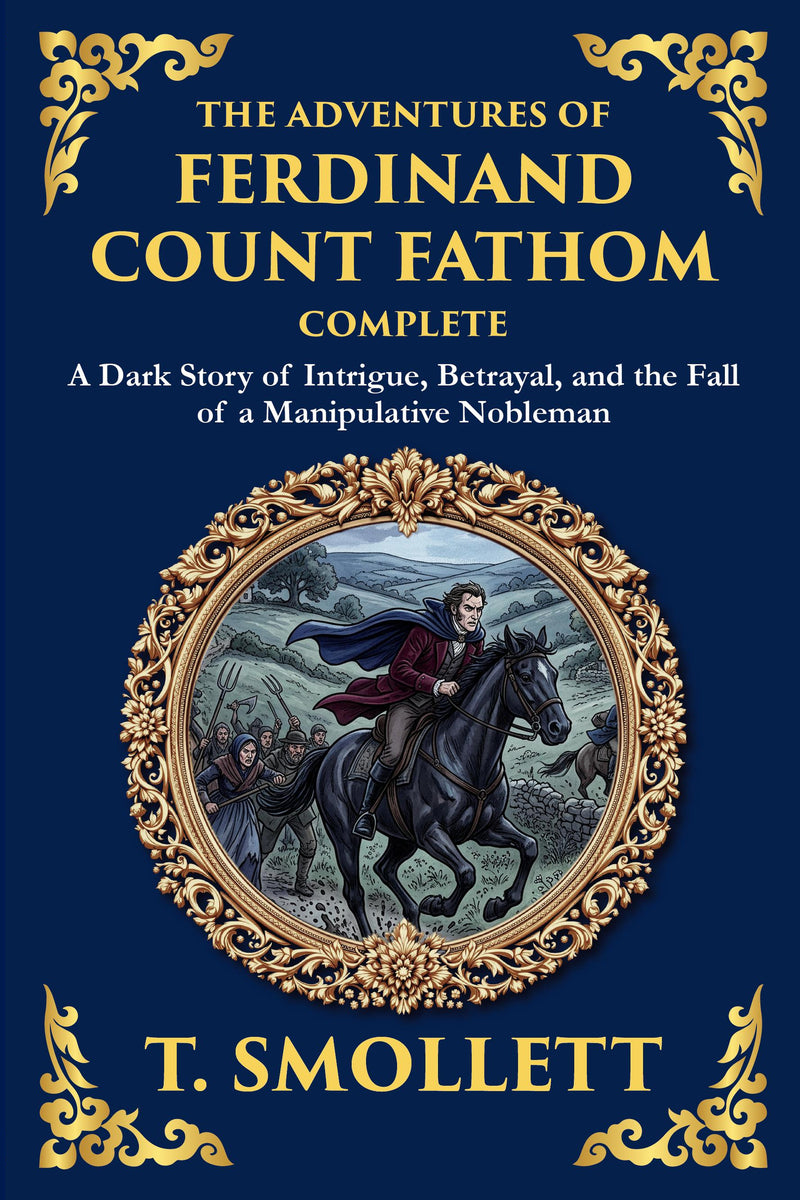
The Adventures of Ferdinand Count Fathom — Complete
Step into the mind of one of literature’s most cunning antiheroes. In The Adventures of Ferdinand Count Fathom, T. Smollett crafts a bold, satirical, and unflinching portrait of a master manipulator whose rise through European society is built on deceit, seduction, and calculated charm.
or free app
10,000+ hrs library
30-day guarantee
The complete The Adventures of Ferdinand Count appears in modern English through Library of Alexandria Press, available online with audiobook narration included for members.
Have you ever wondered why the most dangerous people are often the ones who charm us first? In The Adventures of Ferdinand Count Fathom, T. Smollett presents a gripping and morally provocative story about a man who lives by manipulation—and ultimately perishes by it. A dark mirror to society’s obsession with reputation and success, this novel follows Ferdinand, a nobleman by birth but a scoundrel by nature, as he cons his way across Europe.
From fraudulent schemes to scandalous seductions, Ferdinand’s intellect and charisma allow him to outwit nearly everyone he encounters. Yet beneath his polished surface lies a cold, calculating heart—one incapable of love or loyalty. And as his ambition grows, so does his cruelty.
Smollett, one of the great satirists of the 18th century, pulls no punches in his depiction of a man consumed by self-interest. This complete edition takes you through every twist of Ferdinand’s rise and ruin, from his early manipulations to his final, dramatic collapse. With its richly drawn characters, international intrigue, and relentless pacing, this novel is a masterclass in psychological fiction and moral dissection.
What you’ll discover in this modern edition
- A Master Manipulator Unveiled – Explore the chilling psychology of Ferdinand, one of literature’s earliest antiheroes.
- A Cautionary Tale of Ambition and Vanity – Witness the dangers of a life built on lies, charm, and ruthless exploitation.
- A Sweeping Tale of European Intrigue – Travel from the battlefields of war to the boudoirs of the elite.
- A Landmark in 18th-Century Satire – Smollett's razor-sharp social commentary still resonates with modern readers.
- The Complete, Unabridged Edition – Experience the full arc of Ferdinand’s life, in its darkest and most revealing detail.
| Formats | eBook (EPUB + PDF) · Audiobook · Paperback · Hardcover · Large Print |
| Language | English |
| Trim size (print) | 6 × 9 in |
| Binding | Paperback — perfect-bound · Hardcover — casewrap |
| Large Print edition | Same text in a larger, easy-read type — a larger font, not a larger trim |
| Print pricing | Every physical book at our true cost — at-cost, no profit (members) |
| Library | 873 restored titles, always growing |
| Length | 136,286 words · ~9 hr 5 min reading |
| Reading level | Grade 11 · a confident, adult read (this modern-English edition) |
| Edition | Modern English translation · 2026 |
Member reviews for this edition are collected as readers finish it — be the first. Across the library: 12,000+ books shipped, every plan covered by a 365-day print guarantee.
About this edition
A faithful, unabridged modern-English edition by The Library of Alexandria — carefully rendered for today's reader and verified paragraph-by-paragraph against the public-domain source. Available as eBook, audiobook, paperback, hardcover, and large print.
- Complete & unabridgedVerified paragraph by paragraph against the source — never a scan, never abridged.
- Modern English, faithfulReadable today, with the author’s meaning kept intact. Readable — not simplified.
- Every format, one membershipRead in your browser or the free app, or listen to the full audiobook.
Included free with your membership
Cancel anytime, one click · 30-day money-back guarantee
Edition last updated July 2026
What’s inside
The Adventures of Ferdinand Count Fathom — Complete — complete and unabridged: all 60 sections included with membership, plus the full audiobook.
Begin reading The Adventures of Ferdinand Count Fathom — Complete
In clear modern English — the complete text is included with membership.
Introduction
There are villains, and then there is Ferdinand Count Fathom. When Tobias Smollett set out to write the life of this charming, calculating rogue in 1753, he was attempting something that few novelists of his age dared: to make the reader spend hundreds of pages in the company of a man designed to be despicable. Most writers of the period gave us heroes to admire, sentimental innocents to weep over, or comic blunderers to laugh at. Smollett gave us a predator. And in doing so, he produced one of the most fascinating and unsettling experiments in the entire history of the English novel — a book that asks us to look directly into the workings of a manipulative mind and to consider what such a mind reveals about the world that allows it to flourish.
This modern adaptation has been prepared with a single ambition: to let a contemporary reader experience the full force of that experiment without being held at arm’s length by the dense, latinate, eighteenth-century prose in which it was originally cast. Smollett wrote in long, winding periods, studded with classical allusion, legal and medical jargon, and the elaborate courtesies of Georgian society. To his first readers, this was the ordinary texture of literate English. To us, it can be a thicket. What follows in these pages preserves the architecture of his storytelling — the sequence of schemes and betrayals, the wild swings of fortune, the moral reckoning that gathers slowly and then descends with terrible weight — while clearing away the obstacles that might otherwise keep a twenty-first-century reader from feeling the story’s grip. The aim is not to simplify Smollett but to make him vivid again, to restore the immediacy and the dark pleasure that his contemporaries felt when they first turned these pages.
To understand what Smollett was attempting, it helps to know a little about the man and the moment. Tobias Smollett was a Scotsman, trained as a surgeon, who came to London with literary ambitions and a temperament both combative and acutely observant. He had served as a ship’s surgeon’s mate, witnessed the brutality of naval warfare firsthand, and carried throughout his life a deep skepticism about human pretension — about the gap between how people present themselves and what they actually are. That skepticism is the engine of everything he wrote. His earlier novels had already established him as a master of the picaresque, the loose, episodic form in which a roguish protagonist wanders through society, exposing its absurdities and cruelties along the way. But with the work you are about to read, he sharpened that form into something far more pointed and morally provocative.
The picaresque tradition gave novelists a flexible vehicle. Its hero — or anti-hero — could move through every layer of society, from the gutter to the drawing rooms of the great, precisely because he belonged to none of them. He was an outsider, an opportunist, a survivor. Earlier rogues in this tradition tended to be lovable scamps, men whose mischief we forgave because they were charming and because their victims usually deserved it. Smollett took that figure and pressed on it until something darker emerged. What if the rogue were not merely an opportunist but a genuine manipulator? What if his charm were not the byproduct of high spirits but a deliberate weapon, cultivated and deployed against the trusting, the generous, and the innocent? What if his cunning were turned not against the deserving but against precisely those people who showed him kindness?
This is the question that animates the book. Its central figure is presented to us almost as a case study — a man whose character is traced from his origins, through his education in deceit, to the full flowering of his villainy. Smollett does not ask us to like him. He asks us to understand him, and in understanding him, to understand something about the mechanisms by which a clever and ruthless person can move through the world, leaving wreckage behind while maintaining an unblemished surface. There is a coldness to the portrait that can be genuinely chilling, and a brilliance in the way Smollett anatomizes the techniques of manipulation: the false confidences, the manufactured sympathy, the careful study of a victim’s weaknesses, the patient cultivation of trust that is meant to be betrayed.
In this respect, the book feels startlingly modern. Long before psychology had a vocabulary for such things, Smollett was describing a personality type that we would now recognize instantly — the charming predator, the social chameleon who feels no remorse, the person who treats other human beings purely as means to an end. The reader who comes to this book expecting a quaint historical curiosity will be surprised by how contemporary its central figure feels. He could walk out of these pages and into a modern courtroom, a corporate boardroom, or a confidence scheme run over the telephone, and we would know him at once. Smollett understood that this kind of person is not a creature of any particular century. He is a permanent possibility of human nature, and the recognition of that possibility is part of what makes the book so durable and so disturbing.
Yet Smollett’s purpose was never merely to fascinate us with evil. In his own preface to the work, he explained his moral reasoning with characteristic directness. He believed that vice, when shown in its full ugliness and traced to its inevitable consequences, could teach as powerfully as virtue held up for admiration. By making us follow a villain through the long arc of his schemes, Smollett wanted us to feel, viscerally, the damage that such a man does — and to feel, equally, the satisfaction of seeing the moral universe eventually assert itself. This is not a book that lets its villain triumph forever. The shape of the story is the shape of a fall, and the reader who stays the course will find that the moral accounting, when it comes, is all the more powerful for having been so long delayed. Smollett trusted his readers to hold both responses at once: to be appalled and absorbed, repelled and unable to look away.
It is worth saying a word here about the structure of the experience Smollett designed. Because his protagonist is a wanderer and a schemer, the narrative moves through a remarkable variety of settings and social worlds. We travel across Europe and through the strata of eighteenth-century society, encountering soldiers and gamblers, aristocrats and servants, doctors and swindlers, the genuinely good and the thoroughly corrupt. Each new setting becomes a stage on which the central figure can practice his arts, and each encounter reveals something new about the people he targets and about the society that produces and tolerates such predators. This episodic richness is one of the book’s great pleasures. There is always something new around the corner — a fresh scheme, a new victim, a sudden reversal — and the reader’s curiosity is constantly renewed.
Running alongside the story of cunning and betrayal, however, is another thread entirely, and it is one that gives the book its emotional depth and its claim on our hearts. For against the cold calculation of the central figure, Smollett sets examples of genuine virtue, loyalty, and love. There are characters in these pages whose goodness is as real as the villain’s wickedness, and the contrast between them is the moral spine of the whole work. Some of the most affecting passages in the book concern not the schemer but those whose trust he abuses, those whose patience and constancy endure through suffering, those who represent everything he is incapable of feeling. Smollett was, beneath his combative surface, a writer capable of real tenderness, and the reader will find moments here of surprising warmth and beauty amid the intrigue. These passages matter enormously, because they remind us what is at stake. Without them, the villainy would be merely sensational. With them, it becomes tragic.
It is also in this book that Smollett produced what literary historians regard as a landmark in the development of suspense and atmosphere in English fiction. One celebrated sequence — set at night, in a place of menace, with danger pressing in from every side — was admired and imitated by later writers and is often credited as a forerunner of the Gothic mode that would dominate fiction in the decades to come. Smollett demonstrated that the novel could do more than expose social folly or trace a comic career; it could grip the reader by the nerves, could make the heart pound and the breath catch. Readers who associate the eighteenth-century novel with leisurely social comedy will find, to their surprise, that this book contains passages of genuine terror, rendered with a control and a power that anticipate much later masters of the form. To preserve the force of these scenes in modern English has been one of the chief concerns of this adaptation, for they represent some of Smollett’s finest and most influential writing.
A word now about the nature of the text in your hands, and about how best to approach it. This is a modern adaptation, which means that the language has been carefully rendered into clear, contemporary English while the substance of Smollett’s novel — its events, its characters, its moral design, its distinctive voice — has been faithfully preserved. The goal throughout has been to honor the original rather than to replace it, to act as a kind of skilled interpreter who lets you hear what Smollett is saying without the constant labor of translation that the original prose would otherwise demand.
It is important to be honest about what this involves and why it is worth doing. Smollett’s original sentences are magnificent constructions, but they are also long, heavily subordinated, and rich in vocabulary and reference that have faded from common use. A single sentence might run to a hundred words or more, looping through several qualifications before arriving at its main point. His characters speak in the formal registers of their day, and his narrator addresses the reader with the elaborate rhetorical flourishes that eighteenth-century taste admired. For Smollett’s first audience, all of this was a source of pleasure — the prose itself was part of the entertainment, a display of wit and learning to be savored. But for many modern readers, that same prose can become a barrier, and a high one. The pleasure of the story, the suspense of the schemes, the emotional pull of the virtuous characters, the chill of the villainy — all of these can be lost when the reader is forced to stop every few lines to parse a tangled clause or puzzle out an obsolete term.
This adaptation removes that barrier. The sentences have been opened up and clarified; the vocabulary has been brought into the present without being flattened or dumbed down; the references that would have been instantly familiar to a Georgian reader but baffling to us have been handled so that their meaning comes through. What remains is the story Smollett told, with its full force and its full intelligence intact. You will still encounter his sharp observation, his moral seriousness, his flashes of dark humor, and his command of incident. You will still feel the shape of his design. What you will not encounter is the friction that might otherwise have stood between you and the experience he intended you to have.
Some readers may wonder whether something is lost in such an undertaking, and the honest answer is that any adaptation involves choices, and that the original prose has its own incomparable music that no modern rendering can entirely reproduce. The reader who falls in love with this story — and many will — is warmly encouraged to seek out the original eighteenth-century text afterward, to hear Smollett in his own voice and to appreciate the full splendor of his style. But the relationship between the two need not be a competition. Think of this adaptation as a door. For many readers, the original would remain closed, its riches locked behind a wall of unfamiliar language. This version opens the door and invites you in. Once you are inside, once you have come to know these characters and to care about their fates, the original will be all the more rewarding should you choose to pursue it. Adaptation, at its best, does not diminish the classic; it widens the circle of those who can encounter it.
Cancel anytime, one click · 30-day money-back guarantee
Founding annual rate available now — your price locks for life when you join.
Not ready? Get this free chapter by email — read it anytime.
✓ Sent — check your inbox for The Adventures of Ferdinand Count Fathom — Complete.
Questions about The Adventures of Ferdinand Count Fathom — Complete
What is The Adventures of Ferdinand Count about?
Step into the mind of one of literature’s most cunning antiheroes. In The Adventures of Ferdinand Count Fathom, T. Smollett crafts a bold, satirical, and unflinching portrait of a master manipulator whose rise through European society is built on deceit, seduction, and calculated charm. But every deception comes at a price.
Who wrote The Adventures of Ferdinand Count?
The Adventures of Ferdinand Count was written by T. Smollett. This edition presents the complete work in clear modern English, faithfully rendered from the public-domain original by Library of Alexandria Press.
Is The Adventures of Ferdinand Count free to read?
The opening chapter is free to read on this page. Members read and listen to the complete work — and the entire library — free, and can order any physical book at our true print cost.
How long is The Adventures of Ferdinand Count?
60 chapters (~136,286 words) — about 9 hr 5 min of reading in this modern-English edition.
Is this an abridged version of The Adventures of Ferdinand Count?
No. This is the complete, unabridged The Adventures of Ferdinand Count, carefully rendered into clear modern English and verified paragraph-by-paragraph against the public-domain source — nothing is cut or summarised.
What formats does The Adventures of Ferdinand Count come in?
The Adventures of Ferdinand Count is available as eBook, paperback, hardcover and large print. eBook and audiobook are included with membership; printed editions ship at our true print cost.
Shipping & returns
Billing & membership
More from the library


Explore Adventure
- Tarzan of the Apes · Edgar Rice Burroughs
- The Wonderful Wizard of Oz · L. Frank Baum
- Peter Pan · J. M. Barrie
- Moby Dick; Or, The Whale · Herman Melville
- The Riddle of the Sands · Erskine Childers
- The Loss of the Swansea: A Story of the Florida Coast · W. L. Alden
- Sky Island · L. Frank Baum
- Vikram and the Vampire: Classic Hindu Tales of Adventure, Magic, and Romance · Unknown
- Tales of Unrest · Joseph Conrad
- The Tomb of Ts’in · Edgar Wallace
- Skinny McCord · Percy Keese Fitzhugh
- The Men of the Moss-Hags · S. R. Crockett
- The Hunniwell Boys and the Platinum Mystery · L. P. Wyman
- Allan Quatermain · H. Rider Haggard
- She · H. Rider Haggard
- Medical Life in the Navy · Gordon Stables
- The Thirty-Nine Steps · John Buchan
- The Story of Doctor Dolittle · Hugh Lofting
- The Princess and the Goblin · George MacDonald
- The Man Who Would Be King · Rudyard Kipling
- Lucian’s True History · Lucian of Samosata
- The Secret Adversary · Agatha Christie
- Lord Jim · Joseph Conrad
- The Marvelous Land of Oz · L. Frank Baum
- The Virginian: A Horseman of the Plains · Owen Wister
- Mars is My Destination · Frank Belknap Long
- Anabasis · Xenophon
- The Mississippi Saucer · Frank Belknap Long
- Sabotage in Space · Carey Rockwell
- Brood of the Dark Moon · Charles Willard Diffin
The Adventures of Ferdinand Count Fathom — Complete
The Adventures of Ferdinand Count Fathom — Complete
A Dark Story of Intrigue, Betrayal, and the Fall of a Manipulative Nobleman
T. Smollett
Contents
- Introduction
- Chapter 1
- Chapter 2
- Chapter 3
- Chapter 4
- Chapter 5
- Chapter 6
- Chapter 7
- Chapter 8
- Chapter 9
- Chapter 10
- Chapter 11
- Chapter 12
- Chapter 13
- Chapter 14
- Chapter 15
- Chapter 16
- Chapter 17
- Chapter 18
- Chapter 19
- Chapter 20
- Chapter 21
- Chapter 22
- Chapter 23
- Chapter 24
- Chapter 25
- Chapter 26
- Chapter 27
- Chapter 28
- Chapter 29
- Chapter 30
- Chapter 31
- Chapter 32
- Chapter 33
- Chapter 34
- Chapter 35
- Chapter 36
- Chapter 37
- Chapter 38
- Chapter 39
- … and 20 more chapters
Introduction
There are villains, and then there is Ferdinand Count Fathom. When Tobias Smollett set out to write the life of this charming, calculating rogue in 1753, he was attempting something that few novelists of his age dared: to make the reader spend hundreds of pages in the company of a man designed to be despicable. Most writers of the period gave us heroes to admire, sentimental innocents to weep over, or comic blunderers to laugh at. Smollett gave us a predator. And in doing so, he produced one of the most fascinating and unsettling experiments in the entire history of the English novel — a book that asks us to look directly into the workings of a manipulative mind and to consider what such a mind reveals about the world that allows it to flourish.
This modern adaptation has been prepared with a single ambition: to let a contemporary reader experience the full force of that experiment without being held at arm’s length by the dense, latinate, eighteenth-century prose in which it was originally cast. Smollett wrote in long, winding periods, studded with classical allusion, legal and medical jargon, and the elaborate courtesies of Georgian society. To his first readers, this was the ordinary texture of literate English. To us, it can be a thicket. What follows in these pages preserves the architecture of his storytelling — the sequence of schemes and betrayals, the wild swings of fortune, the moral reckoning that gathers slowly and then descends with terrible weight — while clearing away the obstacles that might otherwise keep a twenty-first-century reader from feeling the story’s grip. The aim is not to simplify Smollett but to make him vivid again, to restore the immediacy and the dark pleasure that his contemporaries felt when they first turned these pages.
To understand what Smollett was attempting, it helps to know a little about the man and the moment. Tobias Smollett was a Scotsman, trained as a surgeon, who came to London with literary ambitions and a temperament both combative and acutely observant. He had served as a ship’s surgeon’s mate, witnessed the brutality of naval warfare firsthand, and carried throughout his life a deep skepticism about human pretension — about the gap between how people present themselves and what they actually are. That skepticism is the engine of everything he wrote. His earlier novels had already established him as a master of the picaresque, the loose, episodic form in which a roguish protagonist wanders through society, exposing its absurdities and cruelties along the way. But with the work you are about to read, he sharpened that form into something far more pointed and morally provocative.
The picaresque tradition gave novelists a flexible vehicle. Its hero — or anti-hero — could move through every layer of society, from the gutter to the drawing rooms of the great, precisely because he belonged to none of them. He was an outsider, an opportunist, a survivor. Earlier rogues in this tradition tended to be lovable scamps, men whose mischief we forgave because they were charming and because their victims usually deserved it. Smollett took that figure and pressed on it until something darker emerged. What if the rogue were not merely an opportunist but a genuine manipulator? What if his charm were not the byproduct of high spirits but a deliberate weapon, cultivated and deployed against the trusting, the generous, and the innocent? What if his cunning were turned not against the deserving but against precisely those people who showed him kindness?
This is the question that animates the book. Its central figure is presented to us almost as a case study — a man whose character is traced from his origins, through his education in deceit, to the full flowering of his villainy. Smollett does not ask us to like him. He asks us to understand him, and in understanding him, to understand something about the mechanisms by which a clever and ruthless person can move through the world, leaving wreckage behind while maintaining an unblemished surface. There is a coldness to the portrait that can be genuinely chilling, and a brilliance in the way Smollett anatomizes the techniques of manipulation: the false confidences, the manufactured sympathy, the careful study of a victim’s weaknesses, the patient cultivation of trust that is meant to be betrayed.
In this respect, the book feels startlingly modern. Long before psychology had a vocabulary for such things, Smollett was describing a personality type that we would now recognize instantly — the charming predator, the social chameleon who feels no remorse, the person who treats other human beings purely as means to an end. The reader who comes to this book expecting a quaint historical curiosity will be surprised by how contemporary its central figure feels. He could walk out of these pages and into a modern courtroom, a corporate boardroom, or a confidence scheme run over the telephone, and we would know him at once. Smollett understood that this kind of person is not a creature of any particular century. He is a permanent possibility of human nature, and the recognition of that possibility is part of what makes the book so durable and so disturbing.
Yet Smollett’s purpose was never merely to fascinate us with evil. In his own preface to the work, he explained his moral reasoning with characteristic directness. He believed that vice, when shown in its full ugliness and traced to its inevitable consequences, could teach as powerfully as virtue held up for admiration. By making us follow a villain through the long arc of his schemes, Smollett wanted us to feel, viscerally, the damage that such a man does — and to feel, equally, the satisfaction of seeing the moral universe eventually assert itself. This is not a book that lets its villain triumph forever. The shape of the story is the shape of a fall, and the reader who stays the course will find that the moral accounting, when it comes, is all the more powerful for having been so long delayed. Smollett trusted his readers to hold both responses at once: to be appalled and absorbed, repelled and unable to look away.
It is worth saying a word here about the structure of the experience Smollett designed. Because his protagonist is a wanderer and a schemer, the narrative moves through a remarkable variety of settings and social worlds. We travel across Europe and through the strata of eighteenth-century society, encountering soldiers and gamblers, aristocrats and servants, doctors and swindlers, the genuinely good and the thoroughly corrupt. Each new setting becomes a stage on which the central figure can practice his arts, and each encounter reveals something new about the people he targets and about the society that produces and tolerates such predators. This episodic richness is one of the book’s great pleasures. There is always something new around the corner — a fresh scheme, a new victim, a sudden reversal — and the reader’s curiosity is constantly renewed.
Running alongside the story of cunning and betrayal, however, is another thread entirely, and it is one that gives the book its emotional depth and its claim on our hearts. For against the cold calculation of the central figure, Smollett sets examples of genuine virtue, loyalty, and love. There are characters in these pages whose goodness is as real as the villain’s wickedness, and the contrast between them is the moral spine of the whole work. Some of the most affecting passages in the book concern not the schemer but those whose trust he abuses, those whose patience and constancy endure through suffering, those who represent everything he is incapable of feeling. Smollett was, beneath his combative surface, a writer capable of real tenderness, and the reader will find moments here of surprising warmth and beauty amid the intrigue. These passages matter enormously, because they remind us what is at stake. Without them, the villainy would be merely sensational. With them, it becomes tragic.
It is also in this book that Smollett produced what literary historians regard as a landmark in the development of suspense and atmosphere in English fiction. One celebrated sequence — set at night, in a place of menace, with danger pressing in from every side — was admired and imitated by later writers and is often credited as a forerunner of the Gothic mode that would dominate fiction in the decades to come. Smollett demonstrated that the novel could do more than expose social folly or trace a comic career; it could grip the reader by the nerves, could make the heart pound and the breath catch. Readers who associate the eighteenth-century novel with leisurely social comedy will find, to their surprise, that this book contains passages of genuine terror, rendered with a control and a power that anticipate much later masters of the form. To preserve the force of these scenes in modern English has been one of the chief concerns of this adaptation, for they represent some of Smollett’s finest and most influential writing.
A word now about the nature of the text in your hands, and about how best to approach it. This is a modern adaptation, which means that the language has been carefully rendered into clear, contemporary English while the substance of Smollett’s novel — its events, its characters, its moral design, its distinctive voice — has been faithfully preserved. The goal throughout has been to honor the original rather than to replace it, to act as a kind of skilled interpreter who lets you hear what Smollett is saying without the constant labor of translation that the original prose would otherwise demand.
It is important to be honest about what this involves and why it is worth doing. Smollett’s original sentences are magnificent constructions, but they are also long, heavily subordinated, and rich in vocabulary and reference that have faded from common use. A single sentence might run to a hundred words or more, looping through several qualifications before arriving at its main point. His characters speak in the formal registers of their day, and his narrator addresses the reader with the elaborate rhetorical flourishes that eighteenth-century taste admired. For Smollett’s first audience, all of this was a source of pleasure — the prose itself was part of the entertainment, a display of wit and learning to be savored. But for many modern readers, that same prose can become a barrier, and a high one. The pleasure of the story, the suspense of the schemes, the emotional pull of the virtuous characters, the chill of the villainy — all of these can be lost when the reader is forced to stop every few lines to parse a tangled clause or puzzle out an obsolete term.
This adaptation removes that barrier. The sentences have been opened up and clarified; the vocabulary has been brought into the present without being flattened or dumbed down; the references that would have been instantly familiar to a Georgian reader but baffling to us have been handled so that their meaning comes through. What remains is the story Smollett told, with its full force and its full intelligence intact. You will still encounter his sharp observation, his moral seriousness, his flashes of dark humor, and his command of incident. You will still feel the shape of his design. What you will not encounter is the friction that might otherwise have stood between you and the experience he intended you to have.
Some readers may wonder whether something is lost in such an undertaking, and the honest answer is that any adaptation involves choices, and that the original prose has its own incomparable music that no modern rendering can entirely reproduce. The reader who falls in love with this story — and many will — is warmly encouraged to seek out the original eighteenth-century text afterward, to hear Smollett in his own voice and to appreciate the full splendor of his style. But the relationship between the two need not be a competition. Think of this adaptation as a door. For many readers, the original would remain closed, its riches locked behind a wall of unfamiliar language. This version opens the door and invites you in. Once you are inside, once you have come to know these characters and to care about their fates, the original will be all the more rewarding should you choose to pursue it. Adaptation, at its best, does not diminish the classic; it widens the circle of those who can encounter it.
Cardinal de Retz wisely noted that all historians inevitably make mistakes when explaining the motives behind the actions they record, unless they get their information from the honest confession of the person they are writing about. Consequently, every important person should write their own memoirs—provided they are honest enough to tell the truth without hiding details that might inform the reader. However, I’m afraid this requirement is rarely met by those who share their lives with the public. In fact, I’d venture to say that no matter how honest a man’s intentions are, he will sometimes be misled by his own imagination and describe things as they seemed to him through the lens of his own prejudices and passions.
When a casual reader reads about two rivals from two thousand years ago—or perhaps people who only existed in an author’s imagination—they can’t help but get invested in the dispute and passionately take a side. So, it’s no surprise that we feel the same way about our own lives. We look back on our actions with the same approval we felt at the time and present them to the world with the kind of enthusiasm a parent has for their child.
If that’s the case, it was lucky for the sake of historical truth that so many accounts were written by people who weren’t biased. It was also fortunate that many great figures, both ancient and modern, either refused to or were unable to write their own memoirs. Because our hero lacked the desire or the ability to write, the task of passing down the remarkable adventures of FERDINAND COUNT FATHOM to future generations has fallen to me. Once the reader has skimmed through the following pages, I’m sure they will be grateful that the adventurer didn’t write his own history.
End of the free sample
Keep reading, free
Members read and listen to the complete book — and the entire library. Cancel anytime, one click · 30-day money-back guarantee.