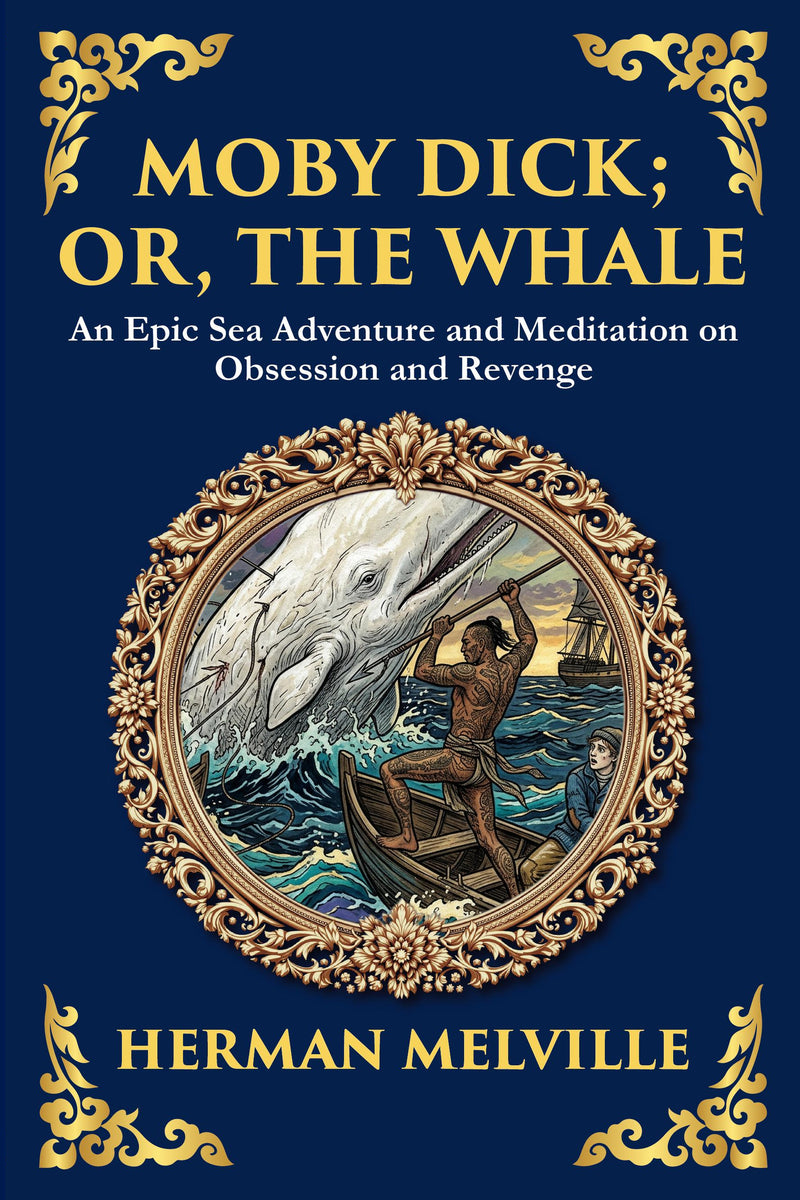
Moby Dick; Or, The Whale — Large Print
Thus begins one of the greatest literary journeys ever written—Moby Dick, Herman Melville’s epic tale of the sea, obsession, and the eternal struggle between man and nature.
or free app
10,000+ hrs library
30-day guarantee
The complete Moby Dick; Or, The Whale appears in modern English through Library of Alexandria Press, available online with audiobook narration included for members.
Have you ever wondered why the pursuit of vengeance can consume a man’s soul? Moby Dick; Or, The Whale is a monumental exploration of the human condition—of obsession, free will, fate, and the deep, unfathomable forces that govern the universe. The story follows Ishmael, a restless wanderer, who signs aboard the whaling ship Pequod in search of meaning and adventure.
But under the relentless command of Captain Ahab, the ship’s mission becomes far more than the hunt for whale oil—it becomes a perilous quest for Ahab’s personal nemesis: Moby Dick, a vast, spectral white whale that embodies all the fear, defiance, and mystery of existence itself. Through rich symbolism, unforgettable characters, and sweeping philosophical insight, Herman Melville crafts a tale that navigates the turbulent waters of revenge, obsession, and spiritual inquiry. This modern edition delivers his towering work with accessibility and precision— capturing both its physical dangers and its psychological storms.
What you’ll discover in this modern edition
- An Immortal Tale of Obsession and Madness – Witness Ahab’s descent into fury and the haunting impact it has on his crew.
- An Introspective Narrative of Humanity and Nature – Reflect on the eternal conflict between man’s will and the natural world.
- A Masterpiece of Symbolism and Allegory – Dive into one of literature’s richest texts, where every scene carries deeper meaning.
- A Cast of Legendary Characters – Meet the diverse souls aboard the Pequod, including Starbuck, Queequeg, Stubb, and Tashtego.
- A Sea Epic Like No Other – Embark on a voyage that is as philosophical as it is perilous. Whether you come for the adventure or the existential questions, Moby Dick offers a vast ocean of meaning, power, and literary brilliance.
| Formats | eBook (EPUB + PDF) · Audiobook · Paperback · Hardcover · Large Print |
| Language | English |
| Trim size (print) | 6 × 9 in |
| Binding | Paperback — perfect-bound · Hardcover — casewrap |
| Large Print edition | Same text in a larger, easy-read type — a larger font, not a larger trim |
| Print pricing | Every physical book at our true cost — at-cost, no profit (members) |
| Library | 873 restored titles, always growing |
| Length | 195,158 words · ~13 hr 1 min reading |
| Reading level | Grade 8 · an easy, flowing read (this modern-English edition) |
| Edition | Modern English translation · 2026 |
Member reviews for this edition are collected as readers finish it — be the first. Across the library: 12,000+ books shipped, every plan covered by a 365-day print guarantee.
About this edition
A faithful, unabridged modern-English edition by The Library of Alexandria — carefully rendered for today's reader and verified paragraph-by-paragraph against the public-domain source. Available as eBook, audiobook, paperback, hardcover, and large print.
- Complete & unabridgedVerified paragraph by paragraph against the source — never a scan, never abridged.
- Modern English, faithfulReadable today, with the author’s meaning kept intact. Readable — not simplified.
- Every format, one membershipRead in your browser or the free app, or listen to the full audiobook.
Included free with your membership
Cancel anytime, one click · 30-day money-back guarantee
Edition last updated July 2026
What’s inside
Moby Dick; Or, The Whale — Large Print — complete and unabridged: all 60 sections included with membership, plus the full audiobook.
Begin reading Moby Dick; Or, The Whale — Large Print
In clear modern English — the complete text is included with membership.
Introduction
There are books that you read, and there are books that read you. Herman Melville’s masterpiece belongs firmly to the second category. To open its pages is to embark on a voyage that is at once thrilling and contemplative, terrifying and tender, deceptively simple in its outward shape yet bottomless in its meaning. On the surface, it is the story of a sea captain consumed by his hunt for a single, monstrous white whale. But beneath that surface—and this is a book endlessly concerned with surfaces and the depths that lie below them—it is a meditation on everything: on God and nature, on madness and reason, on friendship and solitude, on the human will pitted against forces it can neither understand nor master. Few works of literature have dared so much. Fewer still have succeeded so completely.
This edition presents the novel in a modern translation, carefully adapted for the contemporary reader. That phrase deserves a moment of explanation, because it speaks to the very heart of why this book has so often intimidated readers, and why it need not intimidate you. When Melville wrote his great whale story in the middle of the nineteenth century, he wrote in the dense, allusive, sometimes archaic prose of his age—a prose studded with biblical cadences, Shakespearean flourishes, technical jargon drawn from the whaling trade, and digressions that could stretch for pages. For some readers, this richness is precisely the appeal. For many others, it has been a wall too high to climb, and countless people have abandoned the journey in its early chapters, never reaching the astonishing rewards that lie ahead. This adaptation has been prepared with a single purpose: to clear away the obstacles of unfamiliar idiom and tangled syntax while preserving the soul of the work—its grandeur, its humor, its philosophical daring, and above all its overwhelming power. What you hold is not a watered-down version but a welcoming one, a hand extended across more than a century and a half to bring you aboard.
And what a journey awaits. Before we set sail, let us spend a little time understanding the strange and wonderful vessel we are about to board, and the remarkable man who built it.
It is difficult to convey, to someone who has never read it, just how unusual this novel is. We are accustomed to thinking of great literature as a polished, unified thing—a story that moves cleanly from beginning to middle to end, with every part subordinate to the whole. This book is not like that. It is sprawling, untidy, magnificently excessive. It contains a gripping adventure narrative, yes, but it also contains chapters that read like scientific lectures, passages composed as if they were scenes in a play, soliloquies of operatic intensity, comic interludes, philosophical essays, and meditations so strange and beautiful that they seem to belong to no recognizable genre at all. Melville threw everything he had into this book—everything he knew, everything he felt, everything he feared and wondered about. The result is less a novel in the conventional sense than a kind of literary cathedral, vast and irregular, built of countless different stones, in which the reader is invited to wander and look up in awe.
Some readers, encountering this for the first time, may feel impatient with the digressions. Why, they ask, does the author stop the action to explain the anatomy of the whale, or to catalog the various tools used in the hunt, or to ruminate at length on the color white? The answer is essential to understanding what kind of book this is. Melville was not interested merely in telling a story. He was interested in using the story as a vehicle for capturing the totality of an experience and, through it, the totality of existence. The whaling ship becomes a small world, a floating microcosm of humanity, and the ocean upon which it sails becomes nothing less than the universe itself, indifferent and unfathomable. Every detail of the whaling life—however technical, however seemingly mundane—is pressed into service of this larger vision. When the author describes the rendering of whale oil or the structure of a whale’s enormous head, he is also, always, talking about something else: about knowledge and its limits, about humanity’s place in nature, about the impossibility of ever fully grasping the things we most desperately wish to understand.
This is why the book rewards patience so generously. The reader who allows themselves to settle into its rhythms—who accepts that this is a voyage with no fixed schedule, that there will be stretches of calm contemplation between the storms of action—will find that the so-called digressions are not interruptions at all. They are the very substance of the experience. They slow us down, deepen our immersion, and prepare us, almost without our noticing, for the moments of overwhelming drama that come crashing through. By the time the final chapters arrive, the accumulated weight of all that came before gives them a force that no straightforward adventure tale could ever achieve. The book has been training us, all along, to feel the full magnitude of what unfolds.
Consider, too, the voice that carries us through it all. The narrator—who introduces himself in one of the most famous opening lines in all of literature, an invitation so direct and intimate that it feels like a hand on your shoulder—is one of the great companions in fiction. He is curious, self-deprecating, philosophical, and warm. He is a young man of no particular distinction who goes to sea, as he tells us, partly out of restlessness and partly out of a vague melancholy, and through his eyes we come to know the strange company of men aboard the ship. His voice ranges effortlessly from the comic to the cosmic, from earthy humor about the realities of life among sailors to soaring meditations on mortality and the divine. It is a voice you will come to trust and love, and it is the thread that holds together the book’s wild abundance.
And then there is the matter of friendship, which forms the emotional foundation of the book’s early chapters. Before we ever reach the open ocean, before the great hunt begins, we are given the story of an unlikely bond between two men from utterly different worlds—a bond that develops with surprising tenderness and that quietly establishes one of the novel’s deepest themes: the possibility of human connection across the gulfs of culture, belief, and circumstance. This relationship is rendered with a humor and humanity that may surprise readers who expect only grim severity from a “classic” of this stature. The book is, in places, genuinely funny, genuinely moving, genuinely warm. It contains darkness, yes—great oceanic depths of it—but it also contains light, and the two are forever playing against each other.
At the center of it all stands the captain, one of the most unforgettable figures ever created by a writer. He is a man of towering will and terrible purpose, scarred in body and soul, who has bent his entire being—and the lives of every man under his command—toward a single, all-consuming goal. To say more would be to spoil the slow, dreadful unfolding of his character, but it can be said that he ranks among the great tragic figures of world literature, a man whose grandeur is inseparable from his ruin. Through him, the book poses its most haunting questions. What does it mean to devote a life entirely to one purpose? When does determination curdle into madness? Is there nobility in defiance, even when defiance leads to destruction? And against what, exactly, are we truly struggling when we struggle against the things that have wounded us?
The white whale itself—the great creature whose pursuit drives the entire narrative—is among the most resonant symbols in literature, precisely because it refuses to be pinned to any single meaning. To one character, it represents one thing; to another, something else entirely; to the reader, it can seem to shimmer and shift, meaning everything and nothing, an emblem of the unknowable mystery at the heart of existence. The author is fully aware of this ambiguity and embraces it. He does not tell us what the whale “means.” He invites us to confront it, as his characters do, and to wrestle with our own answers. This is part of what makes the book feel so endlessly alive, so available to each new generation of readers. It does not deliver a tidy moral. It opens a door into mystery and asks us to step through.
The Man Who Wrote It and the World That Made It
To appreciate this extraordinary book, it helps to know something of the man who wrote it and the experiences that shaped it. Herman Melville was born in 1819 into a once-prosperous New York family that fell on hard times during his childhood, particularly after the death of his father left the family in financial difficulty. Young Herman’s formal education was cut short, and he was forced to work from an early age—as a clerk, a teacher, a farmhand. But the experience that would shape his imagination above all others came when, in his early twenties, he went to sea.
In 1841 he signed aboard a whaling ship bound for the Pacific. This was no romantic adventure but grueling, dangerous, often brutal labor. The whaling industry in that era was one of the most important and perilous in the world, sending ships on voyages that could last for years, into waters barely charted, in pursuit of creatures whose capture required men to row tiny boats directly toward animals many times the size of their vessel and to drive harpoons into them by hand. The mortality rate was high; the conditions were harsh; the rewards were uncertain. Melville endured the discomfort and danger of this life, and he eventually deserted his ship in the South Pacific, living for a time among the islanders, before making his way home by various other vessels.
These years at sea were the great furnace in which his imagination was forged. He had seen things that few of his readers could imagine: the immensity of the open ocean, the savage drama of the hunt, the diverse company of men—drawn from every corner of the globe and every walk of life—who crewed the whaling fleets. He had witnessed the casual cruelty and the unexpected nobility of life among sailors. He had felt, firsthand, the smallness of the human being against the vastness of the sea. All of this would pour into his great whale book, lending it a texture of authenticity that no amount of research could provide. When he describes the rigging of a ship, the rendering of oil, the terror and exhilaration of the chase, he is writing from the inside, from lived experience. This is one of the secrets of the book’s overwhelming power: it is grounded in the real, even as it reaches toward the metaphysical.
When Melville returned to America, he turned his experiences into a series of sea narratives that won him considerable popularity. His early books, drawing on his Pacific adventures, were received as exotic travel tales, and he enjoyed a brief period as a successful and admired young author. But Melville was restless and ambitious in a way that went far beyond the writing of popular entertainments. He was reading deeply—Shakespeare, the Bible, the great philosophers, the metaphysical poets—and his mind was reaching toward something larger and stranger than the adventure stories that had made his name. He had also, around this time, formed a profound friendship with the writer Nathaniel Hawthorne, whose dark, probing fiction encouraged Melville to follow his own imagination into its deepest and most dangerous recesses. He dedicated his whale book to Hawthorne, in admiration of his genius.
And so, around 1850 and 1851, Melville set himself the task of writing the book that would consume him. He worked at it with feverish intensity, and what began, by his own account, as a relatively straightforward whaling adventure transformed, under the pressure of his expanding ambitions, into something vastly more profound. He was no longer content to entertain. He wanted to write a book that would grapple with the ultimate questions, that would say everything he had to say about the universe and humanity’s place in it. He poured his whole self into it. “I have written a wicked book,” he told Hawthorne, “and feel spotless as the lamb.”
Cancel anytime, one click · 30-day money-back guarantee
Founding annual rate available now — your price locks for life when you join.
Not ready? Get this free chapter by email — read it anytime.
✓ Sent — check your inbox for Moby Dick; Or, The Whale — Large Print.
Questions about Moby Dick; Or, The Whale — Large Print
What is Moby Dick; Or, The Whale about?
Thus begins one of the greatest literary journeys ever written—Moby Dick, Herman Melville’s epic tale of the sea, obsession, and the eternal struggle between man and nature. When Ishmael joins the whaling ship Pequod, he finds himself under the command of the enigmatic Captain Ahab—a man consumed by a single, terrifying purpose: to hunt and destroy the monstrous white whale that once maimed him. As the voyage unfolds, the crew descends into a storm of madness, mystery, and metaphysical reflection.
Who wrote Moby Dick; Or, The Whale?
Moby Dick; Or, The Whale was written by Herman Melville. This edition presents the complete work in clear modern English, faithfully rendered from the public-domain original by Library of Alexandria Press.
Is Moby Dick; Or, The Whale free to read?
The opening chapter is free to read on this page. Members read and listen to the complete work — and the entire library — free, and can order any physical book at our true print cost.
How long is Moby Dick; Or, The Whale?
60 chapters (~195,158 words) — about 13 hr 1 min of reading in this modern-English edition.
Is this an abridged version of Moby Dick; Or, The Whale?
No. This is the complete, unabridged Moby Dick; Or, The Whale, carefully rendered into clear modern English and verified paragraph-by-paragraph against the public-domain source — nothing is cut or summarised.
What formats does Moby Dick; Or, The Whale come in?
Moby Dick; Or, The Whale is available as eBook, paperback and hardcover. eBook and audiobook are included with membership; printed editions ship at our true print cost.
Shipping & returns
Billing & membership
More from the library


Explore Adventure
- Tarzan of the Apes · Edgar Rice Burroughs
- The Wonderful Wizard of Oz · L. Frank Baum
- Peter Pan · J. M. Barrie
- Moby Dick; Or, The Whale · Herman Melville
- The Riddle of the Sands · Erskine Childers
- The Loss of the Swansea: A Story of the Florida Coast · W. L. Alden
- Sky Island · L. Frank Baum
- Vikram and the Vampire: Classic Hindu Tales of Adventure, Magic, and Romance · Unknown
- Tales of Unrest · Joseph Conrad
- The Tomb of Ts’in · Edgar Wallace
- Skinny McCord · Percy Keese Fitzhugh
- The Men of the Moss-Hags · S. R. Crockett
- The Hunniwell Boys and the Platinum Mystery · L. P. Wyman
- Allan Quatermain · H. Rider Haggard
- She · H. Rider Haggard
- Medical Life in the Navy · Gordon Stables
- The Thirty-Nine Steps · John Buchan
- The Story of Doctor Dolittle · Hugh Lofting
- The Princess and the Goblin · George MacDonald
- The Man Who Would Be King · Rudyard Kipling
- Lucian’s True History · Lucian of Samosata
- The Secret Adversary · Agatha Christie
- Lord Jim · Joseph Conrad
- The Marvelous Land of Oz · L. Frank Baum
- The Virginian: A Horseman of the Plains · Owen Wister
- Mars is My Destination · Frank Belknap Long
- Anabasis · Xenophon
- The Mississippi Saucer · Frank Belknap Long
- Sabotage in Space · Carey Rockwell
- Brood of the Dark Moon · Charles Willard Diffin
Moby Dick; Or, The Whale — Large Print
Moby Dick; Or, The Whale — Large Print
An Epic Sea Adventure and Meditation on Obsession and Revenge
Herman Melville
Contents
- Introduction
- Chapter 1
- Chapter 2
- Chapter 3
- Chapter 4
- Chapter 5
- Chapter 6
- Chapter 7
- Chapter 8
- Chapter 9
- Chapter 10
- Chapter 11
- Chapter 12
- Chapter 13
- Chapter 14
- Chapter 15
- Chapter 16
- Chapter 17
- Chapter 18
- Chapter 19
- Chapter 20
- Chapter 21
- Chapter 22
- Chapter 23
- Chapter 24
- Chapter 25
- Chapter 26
- Chapter 27
- Chapter 28
- Chapter 29
- Chapter 30
- Chapter 31
- Chapter 32
- Chapter 33
- Chapter 34
- Chapter 35
- Chapter 36
- Chapter 37
- Chapter 38
- Chapter 39
- … and 20 more chapters
Introduction
There are books that you read, and there are books that read you. Herman Melville’s masterpiece belongs firmly to the second category. To open its pages is to embark on a voyage that is at once thrilling and contemplative, terrifying and tender, deceptively simple in its outward shape yet bottomless in its meaning. On the surface, it is the story of a sea captain consumed by his hunt for a single, monstrous white whale. But beneath that surface—and this is a book endlessly concerned with surfaces and the depths that lie below them—it is a meditation on everything: on God and nature, on madness and reason, on friendship and solitude, on the human will pitted against forces it can neither understand nor master. Few works of literature have dared so much. Fewer still have succeeded so completely.
This edition presents the novel in a modern translation, carefully adapted for the contemporary reader. That phrase deserves a moment of explanation, because it speaks to the very heart of why this book has so often intimidated readers, and why it need not intimidate you. When Melville wrote his great whale story in the middle of the nineteenth century, he wrote in the dense, allusive, sometimes archaic prose of his age—a prose studded with biblical cadences, Shakespearean flourishes, technical jargon drawn from the whaling trade, and digressions that could stretch for pages. For some readers, this richness is precisely the appeal. For many others, it has been a wall too high to climb, and countless people have abandoned the journey in its early chapters, never reaching the astonishing rewards that lie ahead. This adaptation has been prepared with a single purpose: to clear away the obstacles of unfamiliar idiom and tangled syntax while preserving the soul of the work—its grandeur, its humor, its philosophical daring, and above all its overwhelming power. What you hold is not a watered-down version but a welcoming one, a hand extended across more than a century and a half to bring you aboard.
And what a journey awaits. Before we set sail, let us spend a little time understanding the strange and wonderful vessel we are about to board, and the remarkable man who built it.
It is difficult to convey, to someone who has never read it, just how unusual this novel is. We are accustomed to thinking of great literature as a polished, unified thing—a story that moves cleanly from beginning to middle to end, with every part subordinate to the whole. This book is not like that. It is sprawling, untidy, magnificently excessive. It contains a gripping adventure narrative, yes, but it also contains chapters that read like scientific lectures, passages composed as if they were scenes in a play, soliloquies of operatic intensity, comic interludes, philosophical essays, and meditations so strange and beautiful that they seem to belong to no recognizable genre at all. Melville threw everything he had into this book—everything he knew, everything he felt, everything he feared and wondered about. The result is less a novel in the conventional sense than a kind of literary cathedral, vast and irregular, built of countless different stones, in which the reader is invited to wander and look up in awe.
Some readers, encountering this for the first time, may feel impatient with the digressions. Why, they ask, does the author stop the action to explain the anatomy of the whale, or to catalog the various tools used in the hunt, or to ruminate at length on the color white? The answer is essential to understanding what kind of book this is. Melville was not interested merely in telling a story. He was interested in using the story as a vehicle for capturing the totality of an experience and, through it, the totality of existence. The whaling ship becomes a small world, a floating microcosm of humanity, and the ocean upon which it sails becomes nothing less than the universe itself, indifferent and unfathomable. Every detail of the whaling life—however technical, however seemingly mundane—is pressed into service of this larger vision. When the author describes the rendering of whale oil or the structure of a whale’s enormous head, he is also, always, talking about something else: about knowledge and its limits, about humanity’s place in nature, about the impossibility of ever fully grasping the things we most desperately wish to understand.
This is why the book rewards patience so generously. The reader who allows themselves to settle into its rhythms—who accepts that this is a voyage with no fixed schedule, that there will be stretches of calm contemplation between the storms of action—will find that the so-called digressions are not interruptions at all. They are the very substance of the experience. They slow us down, deepen our immersion, and prepare us, almost without our noticing, for the moments of overwhelming drama that come crashing through. By the time the final chapters arrive, the accumulated weight of all that came before gives them a force that no straightforward adventure tale could ever achieve. The book has been training us, all along, to feel the full magnitude of what unfolds.
Consider, too, the voice that carries us through it all. The narrator—who introduces himself in one of the most famous opening lines in all of literature, an invitation so direct and intimate that it feels like a hand on your shoulder—is one of the great companions in fiction. He is curious, self-deprecating, philosophical, and warm. He is a young man of no particular distinction who goes to sea, as he tells us, partly out of restlessness and partly out of a vague melancholy, and through his eyes we come to know the strange company of men aboard the ship. His voice ranges effortlessly from the comic to the cosmic, from earthy humor about the realities of life among sailors to soaring meditations on mortality and the divine. It is a voice you will come to trust and love, and it is the thread that holds together the book’s wild abundance.
And then there is the matter of friendship, which forms the emotional foundation of the book’s early chapters. Before we ever reach the open ocean, before the great hunt begins, we are given the story of an unlikely bond between two men from utterly different worlds—a bond that develops with surprising tenderness and that quietly establishes one of the novel’s deepest themes: the possibility of human connection across the gulfs of culture, belief, and circumstance. This relationship is rendered with a humor and humanity that may surprise readers who expect only grim severity from a “classic” of this stature. The book is, in places, genuinely funny, genuinely moving, genuinely warm. It contains darkness, yes—great oceanic depths of it—but it also contains light, and the two are forever playing against each other.
At the center of it all stands the captain, one of the most unforgettable figures ever created by a writer. He is a man of towering will and terrible purpose, scarred in body and soul, who has bent his entire being—and the lives of every man under his command—toward a single, all-consuming goal. To say more would be to spoil the slow, dreadful unfolding of his character, but it can be said that he ranks among the great tragic figures of world literature, a man whose grandeur is inseparable from his ruin. Through him, the book poses its most haunting questions. What does it mean to devote a life entirely to one purpose? When does determination curdle into madness? Is there nobility in defiance, even when defiance leads to destruction? And against what, exactly, are we truly struggling when we struggle against the things that have wounded us?
The white whale itself—the great creature whose pursuit drives the entire narrative—is among the most resonant symbols in literature, precisely because it refuses to be pinned to any single meaning. To one character, it represents one thing; to another, something else entirely; to the reader, it can seem to shimmer and shift, meaning everything and nothing, an emblem of the unknowable mystery at the heart of existence. The author is fully aware of this ambiguity and embraces it. He does not tell us what the whale “means.” He invites us to confront it, as his characters do, and to wrestle with our own answers. This is part of what makes the book feel so endlessly alive, so available to each new generation of readers. It does not deliver a tidy moral. It opens a door into mystery and asks us to step through.
The Man Who Wrote It and the World That Made It
To appreciate this extraordinary book, it helps to know something of the man who wrote it and the experiences that shaped it. Herman Melville was born in 1819 into a once-prosperous New York family that fell on hard times during his childhood, particularly after the death of his father left the family in financial difficulty. Young Herman’s formal education was cut short, and he was forced to work from an early age—as a clerk, a teacher, a farmhand. But the experience that would shape his imagination above all others came when, in his early twenties, he went to sea.
In 1841 he signed aboard a whaling ship bound for the Pacific. This was no romantic adventure but grueling, dangerous, often brutal labor. The whaling industry in that era was one of the most important and perilous in the world, sending ships on voyages that could last for years, into waters barely charted, in pursuit of creatures whose capture required men to row tiny boats directly toward animals many times the size of their vessel and to drive harpoons into them by hand. The mortality rate was high; the conditions were harsh; the rewards were uncertain. Melville endured the discomfort and danger of this life, and he eventually deserted his ship in the South Pacific, living for a time among the islanders, before making his way home by various other vessels.
These years at sea were the great furnace in which his imagination was forged. He had seen things that few of his readers could imagine: the immensity of the open ocean, the savage drama of the hunt, the diverse company of men—drawn from every corner of the globe and every walk of life—who crewed the whaling fleets. He had witnessed the casual cruelty and the unexpected nobility of life among sailors. He had felt, firsthand, the smallness of the human being against the vastness of the sea. All of this would pour into his great whale book, lending it a texture of authenticity that no amount of research could provide. When he describes the rigging of a ship, the rendering of oil, the terror and exhilaration of the chase, he is writing from the inside, from lived experience. This is one of the secrets of the book’s overwhelming power: it is grounded in the real, even as it reaches toward the metaphysical.
When Melville returned to America, he turned his experiences into a series of sea narratives that won him considerable popularity. His early books, drawing on his Pacific adventures, were received as exotic travel tales, and he enjoyed a brief period as a successful and admired young author. But Melville was restless and ambitious in a way that went far beyond the writing of popular entertainments. He was reading deeply—Shakespeare, the Bible, the great philosophers, the metaphysical poets—and his mind was reaching toward something larger and stranger than the adventure stories that had made his name. He had also, around this time, formed a profound friendship with the writer Nathaniel Hawthorne, whose dark, probing fiction encouraged Melville to follow his own imagination into its deepest and most dangerous recesses. He dedicated his whale book to Hawthorne, in admiration of his genius.
And so, around 1850 and 1851, Melville set himself the task of writing the book that would consume him. He worked at it with feverish intensity, and what began, by his own account, as a relatively straightforward whaling adventure transformed, under the pressure of his expanding ambitions, into something vastly more profound. He was no longer content to entertain. He wanted to write a book that would grapple with the ultimate questions, that would say everything he had to say about the universe and humanity’s place in it. He poured his whole self into it. “I have written a wicked book,” he told Hawthorne, “and feel spotless as the lamb.”
Call me Ishmael. Some years ago—it doesn’t matter exactly how long—I had very little money in my pocket and nothing on land that interested me, so I decided to sail for a while and explore the oceans. It’s my way of curing my depression and getting my life back in balance. Whenever I start feeling bitter; whenever my soul feels like a damp, drizzly November day; whenever I find myself unconsciously stopping in front of coffin shops or trailing behind every funeral I pass; and especially whenever my mood swings get so bad that it takes a huge effort to keep me from walking into the street and knocking people’s hats off—that’s when I know it’s time to get to sea as soon as possible. This is my alternative to a gun and a bullet. While a philosopher like Cato might dramatically fall on his sword, I simply board a ship. There’s nothing strange about this. If they admitted it, almost every man feels the same pull toward the ocean that I do.
Take your island city of Manhattan, surrounded by piers like Indian islands are surrounded by coral reefs—commerce washes over it like surf. Every street leads you toward the water. At the southern tip is the Battery, where the great seawall is washed by waves and cooled by breezes that, just a few hours earlier, were far out at sea. Look at the crowds of people there, staring at the water.
Walk around the city on a dreamy Sunday afternoon. Go from Corlears Hook to Coenties Slip, and from there, head north past Whitehall. What do you see? Thousands upon thousands of people are standing all around town like silent sentinels, lost in thoughts of the ocean. Some lean against the pilings; some sit on the edge of the piers; some look over the rails of ships from China; some climb high into the rigging, as if trying to get an even better view of the horizon. But these are all city dwellers; during the week, they are trapped in walls of plaster—tied to counters, nailed to benches, or chained to desks. Why is this? Have the green fields disappeared? What are they doing here?
End of the free sample
Keep reading, free
Members read and listen to the complete book — and the entire library. Cancel anytime, one click · 30-day money-back guarantee.